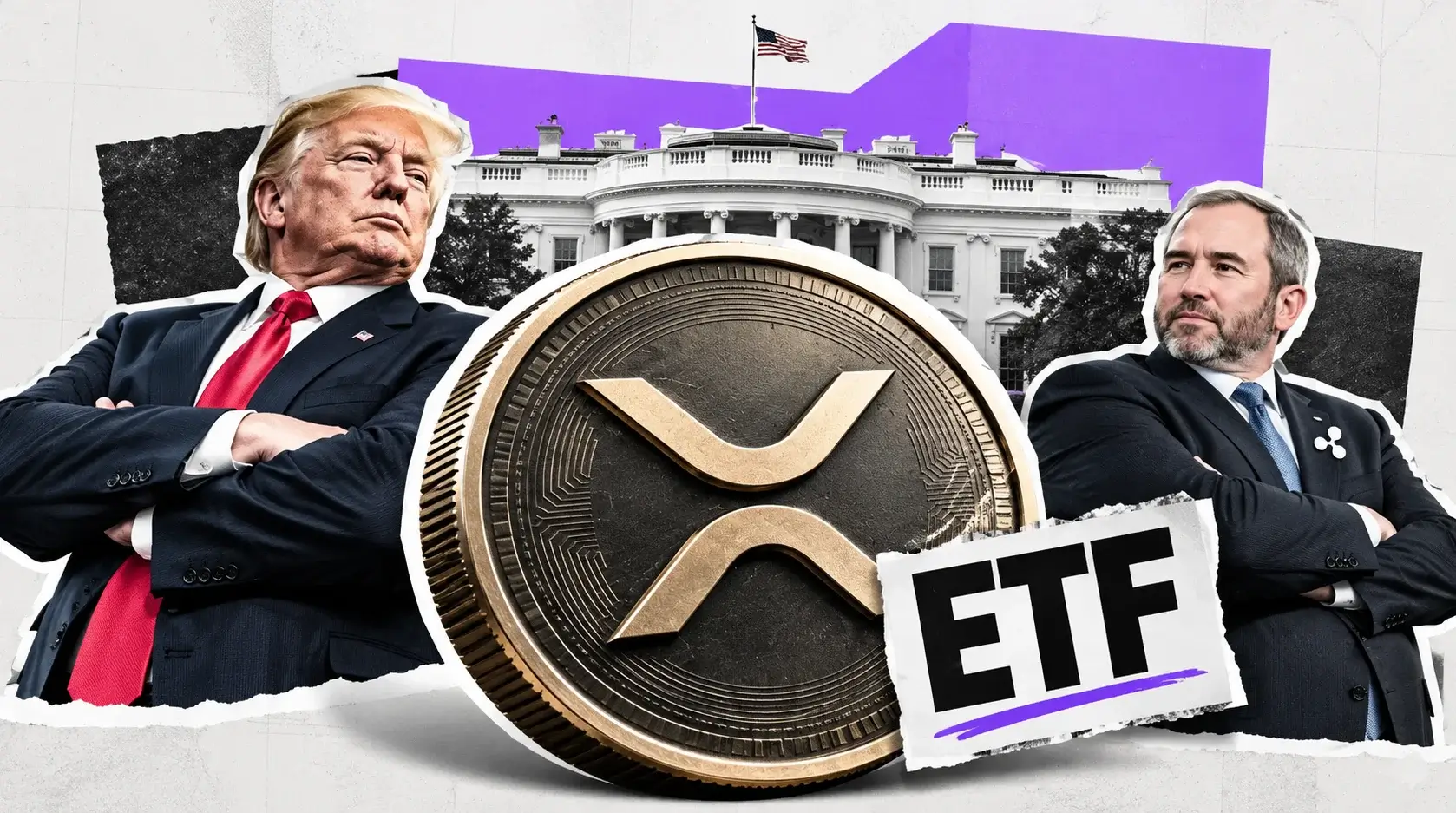
XRPI Sinks to $6.04 With a 4.4-Point Tracking Gap Against the Token — a $4-$8 Billion Wave Waits on Seven Senators
XRPI holds 63.79% of its book in a single CME futures contract against a -65.69% cash offset through a Cayman subsidiary
Key Points
- XRPI closed at $6.04, down 74.3% from its $23.53 high against XRP's 69.9% decline from $3.6556.
- Seven US spot XRP ETFs hold 964.7 million tokens worth $1.062 billion against nearly $1.5 billion of inflows.
- May's $100 million monthly inflow pace collapsed to zero, with July 8 posting a $7.29 million outflow.
The Volatility Shares Trust XRP ETF closed at $6.04, down 1.15% or $0.070 against a previous close of $6.11. The session ran roughly $5.95 to $6.20. After hours printed $6.04, unchanged.
The REX-Osprey XRP ETF closed at $8.96 on BATS, down 1.37% or $0.12 from a $9.08 previous close, with the session tracking $8.90 to $9.10.
Both funds finished at the bottom of their day ranges on a session when XRP itself gained ground.
The underlying is the tell. XRP trades at $1.1013 against a previous close of $1.0723 — up 2.7% — with a session range of $1.0610 to $1.1033. Market capitalization sits at $69.69 billion on 62.47 billion tokens of a 100 billion maximum. Twenty-four-hour volume ran $1.14 billion.
The token rose 2.7%. XRPI fell 1.15%. XRPR fell 1.37%.
That divergence on a single session is the entire thesis. These are not one product. XRPI is a futures wrapper that does not own XRP, charges 0.94% after a waiver, holds 63.79% of its book in a single expiring CME contract against a negative 65.69% cash offset, and has decayed 4.4 percentage points worse than the token it tracks. XRPR is a different structure with a different result. The spot complex behind both has gone from $50 million a day to zero in six weeks, and the whole thing is now a binary option on a Senate floor vote that has already slipped once.
The 52-week ranges frame the damage. XRPI has run $5.60 to $23.53 — meaning $6.04 sits 74.3% below the high and 7.9% above the low. XRPR has run $8.29 to $25.99, putting $8.96 at 65.5% below its high and 8.1% above its low.
Both funds are within 8% of their floors.
XRP itself has changed by -62.27% over twelve months across a 52-week range of $0.3865 to $3.6556. At $1.1013 the token is 69.9% below its high.
Three instruments, three different drawdowns, one asset.
XRPI Has Fallen 74.3% Against XRP's 69.9%
Here is the number that should decide whether anyone owns this fund.
XRPI at $6.04 sits 74.3% below its $23.53 52-week high. XRP at $1.1013 sits 69.9% below its $3.6556 52-week high.
That is a 4.4 percentage point gap, and it is pure wrapper cost.
The fund seeks to track 1x the daily price performance of XRP. Over a single day, it does. Over twelve months, it has delivered 440 basis points of underperformance against the thing it exists to replicate.
Run where it goes. The net expense ratio is 0.94% — one year of that is 94 basis points. The fund has distributed $0.23 per share on a trailing basis, a 2.83% yield that reduces net asset value dollar for dollar. Those two together account for roughly 380 basis points. The remainder is roll decay: the cost of selling an expiring futures contract and buying the next one at a higher price.
Fee, distribution and roll. Four and a half points a year, compounding, against an asset already down 62.27%.
The price history shows the compounding in real time. XRPI traded $15.33 on January 1, 2025. It printed $18.28 on October 3, 2025 with $214.82 million in assets. By October 24 it was $14.93 with assets down to $184.00 million. By March 20, 2026 it closed $8.13. By April 1 it was $7.63. On May 11 it ripped 4.41% to $8.29 on 322,035 shares. On May 19 it closed $7.58.
Today: $6.04.
From $18.28 to $6.04 in nine months. That is a 67.0% decline. XRP over roughly the same window went from about $2.60 toward $1.10 — a 57.7% decline.
Nine points of gap in nine months.
XRPR tells the opposite story and it is worth registering. The fund traded $13.36 earlier in the cycle, $11.07 on May 19, and $8.91 to $9.37 on July 3 against a $8.70 previous close. At $8.96 today it is 65.5% below its $25.99 high — better than XRP's 69.9%.
Same token. Two wrappers. A four-point spread in XRP's favour against one and a four-point spread against the token in the other.
The structure is the difference and almost nobody reads the holdings page.
XRPI Does Not Own XRP
The single most important fact about this fund is stated plainly in its own documentation and almost universally ignored.
The Volatility Shares Trust XRP ETF is an actively managed fund offering price participation in XRP using near-term futures and XRP-linked instruments. The fund does not directly invest in XRP.
It does not own the token. Not one.
The mechanism is a multi-asset structure investing in currency and fixed income instruments. For the fixed income portion it primarily holds cash, cash-like instruments or high-quality securities. For the currency portion it invests through derivatives in XRP, using futures and swaps to construct the portfolio, and it accesses XRP futures through a wholly-owned Cayman Islands subsidiary.
A Cayman subsidiary holding CME futures, wrapped in a US-listed ETF, tracking 1x daily performance.
Compare that to what the market assumes it is buying. The seven US spot XRP ETFs hold 964.7 million actual XRP tokens in custody, worth roughly $1.062 billion at today's price. Those funds create and redeem against real coins. When money flows in, tokens get bought and removed from the float.
XRPI's flows do none of that. A dollar into XRPI buys a futures contract from a counterparty. It does not remove a single token from Binance's 2.61 billion reserve. It does not tighten the float. It does not do the thing the entire ETF bull case is built on.
The fund was launched May 22, 2025 and is issued by Volatility Shares. It carries five holdings.
Five.
That distinction matters enormously for anyone reading the flow data. When headlines report XRP ETF inflows, they are counting the spot complex — the 964.7 million tokens locked across seven funds. XRPI sits outside that count. Its assets are a bet on price, not a claim on supply.
The asset class is listed as Currency. The category is Digital Assets. The exchange is NASDAQ.
Anyone buying XRPI for the supply-shock thesis is buying the wrong instrument.
63.79% CME Futures and a -65.69% Cash Offset
The holdings table is the most revealing document in this entire complex and it does not look like an ETF.
Other Assets and Liabilities: 68.78%. CME XRP Futures May26: 63.79%. US Bank Money Market Deposit Account: 33.14%. US Dollars: -0.02%. Cash Offset: -65.69%.
Those five lines sum to 100%. They also do not describe an XRP position in any intuitive sense.
Read what the structure does. Roughly 63.79% of the book sits in a single CME XRP futures contract with a stated May 2026 expiry. Another third sits in a bank money market account earning short rates. The negative 65.69% cash offset is the notional accounting entry that reconciles the futures exposure against the collateral.
That is a margined futures position with a cash sleeve, presented as a fund.
The roll is where the decay lives. A single-contract futures book must sell the expiring contract and buy the next one before expiry. When the forward curve is in contango — later contracts priced above nearer ones — that roll crystallizes a loss on every cycle. Over twelve months, on a monthly roll, contango compounds mercilessly.
That is where the 4.4-point gap against XRP comes from, and it is structural. It does not go away in a bull market. It gets larger, because contango steepens when spot rallies.
The money market sleeve is the offset nobody mentions. At 33.14% of the book earning short rates near 3.50%-3.75%, the collateral generates roughly 120 basis points of income annually against the portfolio. That funds the monthly distribution.
Which brings the structure into focus. XRPI holds futures, earns interest on collateral, pays that interest out monthly as a distribution, and charges 0.94% for the service — while the futures roll bleeds the position against the underlying.
The distributions are not a yield. They are the money market sleeve being handed back.
The concentration risk is worth stating. One contract, one exchange, one Cayman subsidiary, five holdings, $117.57 million of assets. If CME XRP futures liquidity thins, the fund's tracking is the first casualty.
The 2.83% Yield That Is Not a Yield
The distribution history reads like an income product and it is nothing of the sort.
XRPI carries a trailing dividend of $0.23 per share for a 2.83% yield, paid monthly, with the most recent ex-dividend date on April 22, 2026.
The record: April 22 at $0.0152. March 18 at $0.0135. February 18 at $0.0163. January 21 at $0.0263. December 15 at $0.0147. November 25 at $0.024.
Six months. $0.11 per share. Roughly 1.8% of today's $6.04.
Here is why it is not income. The fund holds no dividend-paying assets. XRP does not distribute. Futures contracts do not distribute. The only cash generation in the entire structure is the money market sleeve at 33.14% of the book earning short rates.
Every dollar distributed reduces net asset value by a dollar. The share price falls by the distribution on the ex-date. The holder receives cash and owns less fund.
That is a return of capital wearing a yield label.
The yield reading itself tells the story. In October 2025, XRPI's dividend yield read 0.49% at a $18.28 share price. By October 24 it read 0.60% at $14.93. Today it reads 2.83% at $6.04.
The distribution did not grow. The denominator collapsed.
A yield that quintuples because the price falls 67% is not a yield improving. It is a fraction with a broken bottom.
Compare the mechanics to what an income allocator would actually want. A covered-call Bitcoin product like BlackRock's BITA generates premium by selling optionality — real cash from a real counterparty. A dividend ETF collects distributions from operating companies. XRPI hands back Treasury bill interest earned on collateral it must post to hold futures.
The tax treatment compounds it. Monthly distributions from a Cayman-subsidiary futures structure are not qualified dividends. A holder in a taxable account pays ordinary rates on a payment that reduced their own principal.
The 2.83% is the most misleading number on the fund's page, and it appears above the fold on every quote screen in the market.
0.94% After a 0.21% Waiver on $117.57 Million
The fee stack is aggressive and the waiver is the tell.
XRPI's management fee is 1.15% with 0.00% of other expenses, for a 1.15% total expense — reduced by a 0.21% fee waiver to a 0.94% net.
The cryptocurrency ETF category averages 0.84% management, 0.43% other expenses and 0.88% total, waived down to 0.86% net.
XRPI charges more than its category on a gross basis and roughly the same net. That is not a cheap product.
Set it against the alternatives an allocator actually faces. IBIT charges 0.25% with no waiver on $60 billion of assets. VOO charges 0.03% on $979 billion. The seven spot XRP funds hold $1 billion of real tokens.
XRPI charges 0.94% to hold futures on an asset down 62.27%.
The waiver is the structural signal. A fund waiving 21 basis points is running a promotional price it can withdraw. At $117.57 million of assets, 0.94% generates roughly $1.1 million of annual revenue — before the waiver, $1.35 million. That is not a business at scale. It is a product being subsidized until it finds one.
The asset trajectory explains why. XRPI held $214.82 million on October 3, 2025 with a $210.22 million market cap. By October 24 assets were $184.00 million against a $191.70 million cap. By May 11 assets had fallen to $117.57 million across 14.19 million shares outstanding.
From $214.82 million to $117.57 million in seven months. That is a 45.3% decline in assets on a fund whose share price fell 67% across the same window — meaning shares outstanding actually rose as holders bought the drawdown.
Volume tells the liquidity story. XRPI traded 563,000 shares on October 3 against a 526,883 average. By March 20 it traded 103,000 shares — roughly $836,390 of value. On May 11 it managed 322,035 shares. The average daily volume by May had fallen to 201,700.
At $6.04 and 200,000 shares, this fund turns over roughly $1.2 million a day.
That is a thinly traded futures wrapper. Spreads matter more than the expense ratio at that depth.
The Complex: Seven Funds, $1 Billion, 964.7 Million Tokens
The spot side is where the real story lives and it is a separate market from XRPI entirely.
As of July 16, seven XRP spot ETFs trade in the United States with combined AUM of $1 billion and 964.7 million XRP tokens locked. AUM has slipped below $1 billion.
Nine hundred sixty-four point seven million tokens. That is 1.54% of XRP's 62.47 billion circulating supply.
Run the math nobody runs. 964.7 million tokens at $1.1013 equals $1.062 billion. Cumulative net inflows since launch approach $1.5 billion.
The complex took in $1.5 billion and is worth $1.06 billion. Every allocator who bought a spot XRP ETF is, in aggregate, down 29%.
That is the number explaining why the flows stopped.
The token growth tells a different story than the dollars. Holdings ran 769 million tokens across five funds in early March. They now stand at 964.7 million across seven. That is an increase of 195.7 million XRP — 25.4% — in four and a half months, alongside two new fund launches.
Institutions kept buying tokens the whole way down. The dollar AUM fell anyway because price fell faster.
The scale comparison is brutal. Bitcoin's ETF complex holds 1,210,144 BTC worth $78.5 billion — 5.8% of supply. Ethereum's crossed $10 billion. Solana's holds roughly $1 billion against a $45.42 billion market cap. XRP's holds $1.062 billion against $69.69 billion.
XRP's regulated bid is one-seventy-fourth the size of Bitcoin's, against a market cap one-eighteenth as large. Proportionally, the XRP ETF bid is roughly a quarter as deep as Bitcoin's.
The issuer roster spans the wrappers: Bitwise's spot fund on NYSE Arca, Franklin's XRPZ, REX-Osprey's XRPR, plus the leveraged and futures sleeves — XXRP, XRPT, UXRP, XRPC, XRPM, TOXR and XRPI.
The leveraged products are where the volatility concentrates. On July 3, XXRP printed $24.75 up 11.34%, XRPT $26.23 up 11.78%, and UXRP $11.96 up 11.57% — against XRPR at $9.37 up 5.16%.
Eleven percent moves on a token that moved five. That is 2x leverage doing exactly what it says, and decaying exactly as fast.
From $50 Million a Day to Zero in Six Weeks
The flow collapse is the most consequential development in this complex and it happened fast.
May 2026 saw the product complex take in well over $100 million for the month, with money flowing week after week. July has inverted that picture entirely. Several days this month have recorded flat zero inflows. July 8 logged $7.29 million in net outflows — one of the largest single-day losses since March 2026.
Across the July 6-10 week, XRP ETFs recorded $7.18 million in net outflows, driven mainly by that Wednesday exit.
From $100 million a month to zero, in six weeks.
The pace of accumulation has decelerated from a structural bid to a near-standstill.
That phrase is the whole story: not a panic, not a crash — a stop. And a stop is worse than a crash for an asset whose entire thesis rests on institutional adoption.
The mitigating detail deserves airing. The concentration of July's outflows in a single issuer suggests fund-specific redemption pressure rather than a coordinated institutional exit across the board.
One fund's redemptions are not a verdict on the asset class. But several days of flat zero are not fund-specific. Zero is everyone.
The comparison to the launch period makes the deceleration stark. XRP's spot ETFs were pulling in roughly $50 million a day in fresh capital, hitting nearly $1 billion in inflows in under four weeks — the fastest adoption pace since Ethereum ETFs launched.
$50 million a day, to zero, in eight months.
The May run showed what a working bid looked like: a nine-consecutive-day inflow streak totaling $95.5 million, with cumulative net inflows since the November 2025 launch crossing $1.4 billion and aggregate AUM running $1.14 billion to $1.25 billion across the issuer roster.
That AUM is now $1 billion and falling.
The bear scenario is not a sudden collapse. It is a prolonged grind in which cold-storage support gradually erodes if outflows persist long enough to signal a real shift in institutional conviction rather than a temporary pause.
Whether institutional patience survives another month of sub-$1.10 prices is the question July's remaining flow data answers.
The Fastest to $1 Billion Since Ethereum
The launch was genuinely extraordinary and the fade makes it more instructive, not less.
US spot XRP ETFs did not record a single net outflow day in their first month. By December 16, 2025, cumulative inflows had crossed $1 billion — making XRP the fastest digital asset to reach that milestone since Ethereum's ETF launch. By early March 2026, cumulative inflows had grown to over $1.50 billion with five spot funds trading and over 769 million tokens locked.
Four US spot XRP ETFs plus a wave of new approvals pulled in roughly $939 to $954 million in less than a month, with not a single outflow day.
Zero outflow days in a month. On a token that was already falling.
That flow persistence — inflows holding steady even as price experienced volatility — was read as institutions making considered allocation decisions rather than chasing momentum.
The reading was correct at the time and it has aged into a warning. The same persistence that looked like conviction in December looks like a trapped cohort in July, sitting on a 29% aggregate loss with no exit that does not crystallize it.
Bitwise's CIO captured the surprise: the XRP ETF launch surprised a lot of people, and demand at that level in a weak market environment would likely be substantially larger in a strong one.
That conditional is doing enormous work. The market never got strong. It got weaker — XRP fell from $1.42 in early March to $1.04 by end-June to $1.1013 today.
The institutional validation is real and it is small. Goldman Sachs allocated nearly $154 million to XRP ETFs at precisely the moment the network was processing record transaction volumes.
$154 million. On a complex now worth $1.06 billion. Goldman is roughly 15% of the entire regulated XRP bid.
The reasoning was that institutional inflows are not disconnected from underlying utility — the XRP Ledger has processed over 4 billion transactions, daily transactions hit 3 million on March 15, 2026 in a threefold increase from mid-2025, and RWA tokenization on XRPL grew past $474 million with total represented value approaching $1.5 billion.
The volumes are still there. The inflows stopped.
CLARITY Slipped and the Complex Is a Binary
Everything reduces to one Senate vote and the vote keeps moving.
The CLARITY Act would permanently classify XRP as a commodity under US law instead of leaving its status to regulators. The White House pointed to July 4 as a target. That did not happen. The Senate returned July 13 and leadership wants the first week back for the defense bill, pushing the floor vote to late July or the first week of August at the earliest.
The bill needs 60 votes, meaning roughly seven Democrats must cross. Talks broke down over an ethics provision aimed at the President's own crypto holdings.
The XRP ETF complex is functioning as a binary option on CLARITY Act passage.
That framing is exact. If the legislation clears the Senate floor in the current window, the institutional allocation channel opens substantially and a projected $4 to $8 billion inflow wave produces structural price discovery toward higher levels. If it stalls into the second half of 2026, the existing institutional flow pace is the realistic continuation case — meaningful but not transformational.
Run the scale. A $4 to $8 billion inflow wave against a complex currently holding $1 billion is a four- to eight-fold expansion. Against 964.7 million tokens locked, it would remove another 3.6 to 7.3 billion XRP from a 62.47 billion float.
That is the entire bull case and it requires seven senators.
The precedent for what passage is worth exists and it is measurable. On May 14, the token jumped about 4.5% to $1.49 on nothing more than a committee vote to advance the bill.
A procedural step in one chamber moved XRP 4.5%. A floor vote clearing 60 is worth multiples of it.
The asymmetry argument is the honest one. Capital deployed into XRPI, XRPR, Bitwise XRP, Franklin XRPZ or any spot-tracking wrapper at current depressed levels offers genuinely meaningful upside optionality if the CLARITY Act passes, with downside contained by the persistent institutional flow architecture and the existing cumulative capital base.
The counterweight: even if CLARITY surprises everyone and passes late in the month, it would likely buy XRP a relief rally rather than a genuine trend change — at least until the broader market steadies.
A binary catalyst producing a relief rally is a catalyst already half-priced.
An SEC crypto regulation carrying a $75 million exemption arrives with or without CLARITY.
Read More
-
Yen Stalls at 160 Despite a 3% JGB and Tokyo Core CPI at 2.0% — Intervention Sits at 164, Friday's Payrolls Decide
02.09.2026 · TradingNEWS ArchiveEnergy
-
QQQ ETF ($706.22) Slides 7.4% Below Its High as the Market Reprices the AI Capex Bill — $686.57 Target if $700 Breaks
22.10.2026 · TradingNEWS ArchiveStocks
-
XRPI ($7.00) and XRPR ($10.74) Slide Toward 52-Week Lows as Spot XRP ETF Flows Stall at $708,510
22.10.2026 · TradingNEWS ArchiveCrypto
-
NG ($2.775) Decoupled From Europe’s €88 Gas Crisis as LNG Feedgas Hits 18.9 Bcf/d — $3.30 Upside on Cold Weather
22.10.2026 · TradingNEWS ArchiveCommodities
-
Dollar-Yen (157.35) Loses 157.65 as the Yen Rallies on Haven Demand — 155 Target if 156 Breaks
22.10.2026 · TradingNEWS ArchiveForex
XRP at $1.1013 on an 830-Million-Token Shelf
The underlying is what these funds track and it is sitting on the last support that exists.
XRP trades at $1.1013 against a previous close of $1.0723, having ranged $1.0610 to $1.1033. The token is up 1.20% over seven days against a global crypto market up 1.60% — underperforming a market that is barely moving.
The floor is specific. XRP is held up by a thick band between $1.00 and $1.06 where roughly 830 million tokens last changed hands. If XRP closes a day below $1.00, there is not much to catch the price — the next support sits around $0.80.
That is a 27% gap with nothing in it.
Run what that does to the funds. XRPI tracks 1x daily. A move from $1.1013 to $0.80 is a 27.4% decline in the token — and XRPI would deliver worse, because roll decay and the 0.94% fee compound on top. From $6.04, a token move to $0.80 puts the fund near $4.30 before wrapper costs.
The upside is symmetric and smaller. Buyers have not reclaimed the recovery zone near $1.15 to $1.20. RSI reads 49.61 — neutral. Prediction markets put the probability XRP clears $1.20 in July at 47% and the probability it prints below $1.00 at 31%.
For the year: 28% odds above $2.75 against 78% odds of a sub-$1.00 print.
The one structurally bullish reading is exchange supply. Binance's XRP reserves have dropped to about 2.61 billion — the lowest since February, down from above 3 billion last year — with no meaningful inflows to replenish them. Exchange selling pressure is drying up.
It has not helped. XRP fell to around $1.06 while reserves were emptying, meaning liquidity, trading activity and sentiment outweighed the declining exchange supply.
The forecast dispersion frames the range. 21Shares set a $2.45 base target for XRP in 2026 in its "XRP Outlook for 2026" while warning of significant risks. 21Shares and CoinCodex jointly assign roughly a 30% chance of a bullish outcome with a maximum near $2.60, keeping the bear case close to current levels. Higher projections place XRP near $5 by the fourth quarter.
Forecasts cluster $2.45 to $3.50. Bullish scenarios above $5 rely entirely on sustained ETF inflows. Targets of $8 to $14 carry low probability.
Every one of those requires the flow that stopped.
What Has to Break
Map the bull case. The CLARITY Act clears the Senate floor in late July or early August with seven Democrats crossing, and the $4 to $8 billion projected inflow wave hits a complex currently holding $1 billion against 964.7 million tokens. The $1.00-$1.06 shelf holds as it has since late June. Binance reserves stay pinned at 2.61 billion and the thin order book does what thin order books do. Spot flows return from zero toward May's $100 million monthly pace. XRP reclaims $1.15-$1.20 and runs at 21Shares' $2.45.
On that path, XRPI at $6.04 and XRPR at $8.96 — both within 8% of 52-week lows — deliver the leveraged optionality the asymmetry argument describes.
Map the bear case. CLARITY misses again over the ethics provision, as it already missed July 4. The single-issuer redemptions broaden. Zero-inflow days keep printing. The 830-million-token shelf at $1.00 gives way and $0.80 opens with nothing between. XRPI's roll decay keeps compounding the 4.4-point annual gap against a token already down 62.27%.
On that path, the wrapper costs more than the position.
The base case is the shelf. XRP chops between $1.00 and $1.15 into a Senate calendar that has no scheduled vote, with XRPI grinding toward $5.60 and XRPR toward $8.29.
What separates these two funds is the thing nobody checks before buying. XRPR at $8.96 has tracked XRP within four points over twelve months. XRPI at $6.04 has lost 74.3% against the token's 69.9% — because it holds CME futures through a Cayman subsidiary, charges 0.94%, and pays back its own collateral interest as a 2.83% "yield" that reduces the NAV it came from.
Same ticker family. Same underlying. Same headline. Four and a half points a year apart.
If the CLARITY Act passes, both go up. Only one of them keeps what it earns.