Alphabet (GOOGL) Slides to $341 as AI Talent Losses and Capex Anxiety Spark Worst Selloff in a Year
Google's biggest-ever one-day market-cap loss ($225B) deepened after two top AI minds defected and Microsoft's Nadella called AI "commoditized." | That's TradingNEWS
Key Points
- Alphabet fell to ~$341, extending Monday's 5% drop to $349.56 — a record $225B one-day market-cap loss — as John Jumper left for Anthropic and Noam Shazeer for OpenAI.
- The real fear is capex: a $180-190B 2026 AI spend and an $84.75B raise as Q1 free cash flow fell 47% to $10B, raising the "commoditized" moat question.
- Wall Street stays Strong Buy (28 Buy/5 Hold, $427 target, ~25% upside) on $422B revenue and 38% margins; $350 is resistance, $340 support, July earnings the catalyst.
Alphabet (GOOGL) is trading around $341.50, down roughly 2% on Tuesday and pressing the session low, extending a brutal slide that began Monday when the stock cratered to a $349.56 close — its steepest single-day drop in more than a year. That Monday plunge erased around $225 billion in market value, the largest single-session market-cap loss in Alphabet's history. Add Tuesday's continuation and the two-day decline runs into the high single digits, dragging the stock to its lowest level since late April and off roughly 16% from the all-time high near $404 set on May 18. Over the past four weeks, Alphabet has shed better than 10%.
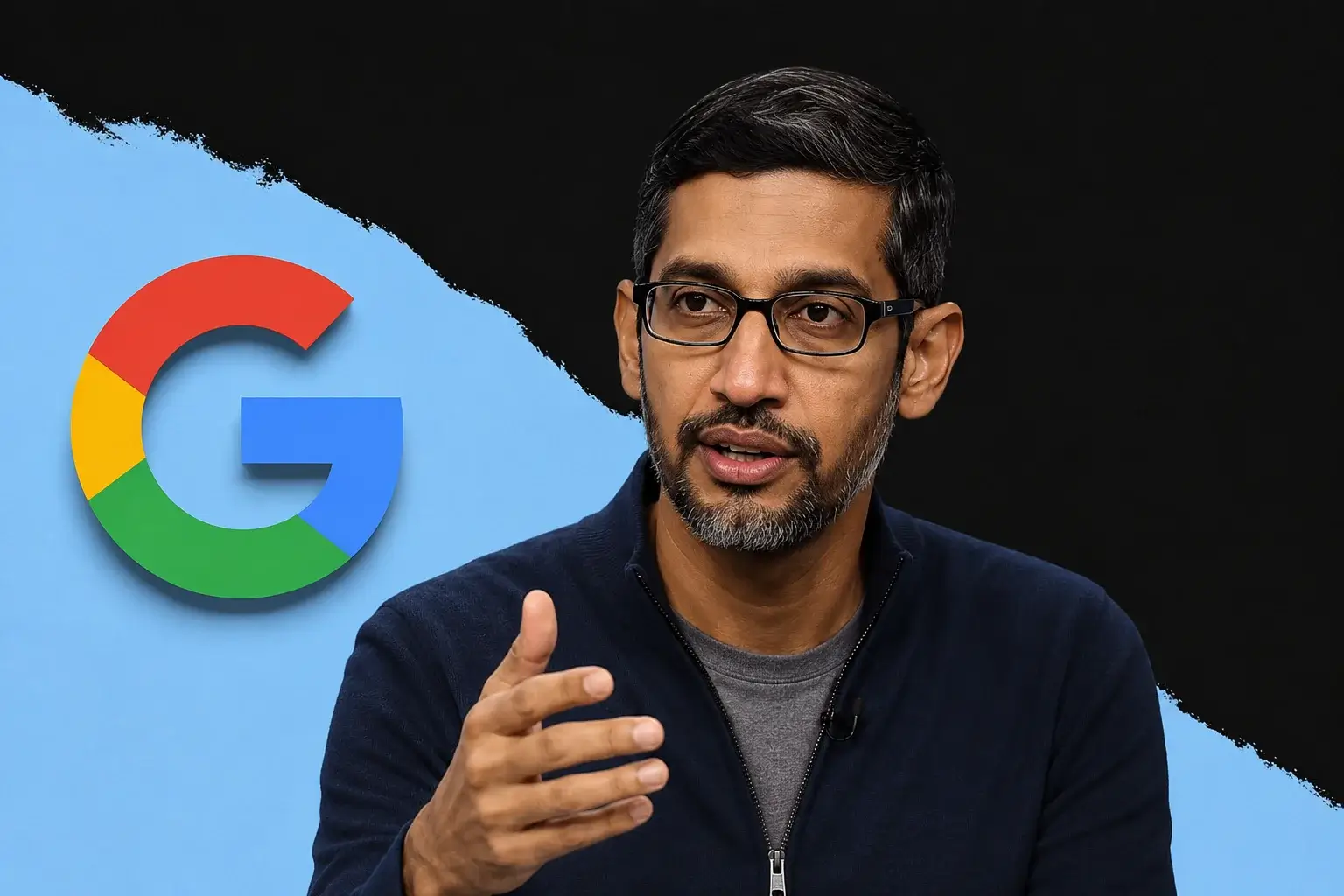
The trigger was specific and it landed hard: two of Google's most senior AI researchers announced exits to direct competitors within days of each other. Nobel laureate John Jumper, the AlphaFold creator, is leaving Google DeepMind for Anthropic. Days earlier, Noam Shazeer — VP of engineering and co-lead of Google's Gemini models — announced his departure for OpenAI. Two frontier-level minds, gone in a week, taking their reputations and their playbooks across the table to the companies Google is racing against. The market read it as Google losing the war for AI talent, and it dumped the stock.
The thesis here is that this is a narrative break, not a fundamentals break — and that distinction is the whole story. Alphabet's underlying business is a cash machine running at full tilt, and Wall Street still rates it a Strong Buy with a price target implying roughly 25% upside. What broke was the story the market tells itself about Google's place in the AI race. The talent exodus was the spark, but the fuel was a question that's been smoldering for months: with Alphabet spending $180–190 billion on AI capex this year and free cash flow collapsing, is that money buying a durable moat, or is it being lit on fire in a war Google might be losing? Until that question gets answered, the stock doesn't stabilize.
The Scoreboard
Here's where Alphabet stands. GOOGL is around $341.50, down about 2% on Tuesday after Monday's roughly 5% drop to $349.56, with the two-day move carving the stock down to its lowest since late April. The market cap sits near $4.24 trillion, still one of the largest in the world, but down meaningfully from the peak. The 52-week range tells the story of the run and the unwind: from a low near $162 a year ago to an all-time high near $408 in May, and now back to the low $340s. Volume has spiked to roughly 53 million shares against a 32-million average, confirming this is real distribution, not a quiet drift.
The valuation hasn't gotten expensive — if anything, the selloff has made it cheaper. Alphabet trades at a trailing P/E around 27–28 and a forward P/E near 28, on trailing-twelve-month revenue of about $422 billion, EBITDA of roughly $168 billion, a net margin near 38%, and a return on equity around 39%. Those are elite numbers for a company this size, and the multiple is far from a bubble valuation. The stock isn't falling because it's overpriced on the fundamentals; it's falling because the market is repricing the risk around the story.
The relative performance is the tell. Alphabet has been lagging the rest of the Magnificent Seven as the desk questions its AI edge specifically, rather than selling Big Tech uniformly. On a day when the whole tech complex is red from the global chip rout, Alphabet is red for its own reasons on top of the macro — the talent losses, the capex anxiety, the legal overhang. It's the name the market has singled out, and the underperformance versus its mega-cap peers is the clearest signal that this is a company-specific narrative problem layered onto a sector-wide risk-off move.
The Trigger: Two AI Minds Walked Out in a Week
The catalyst that broke the stock was a one-two punch of departures that would rattle any AI company. On Friday, John Jumper announced he was leaving Google DeepMind after nearly nine years to join Anthropic. Jumper isn't a replaceable engineer — he won the 2024 Nobel Prize in Chemistry for the AlphaFold breakthrough that cracked protein structure prediction, and he led that team inside DeepMind. Losing a Nobel laureate who built one of the lab's signature achievements is the kind of headline that forces the market to reassess.
Days earlier, Noam Shazeer announced his own exit, leaving Google for OpenAI. Shazeer is arguably even more central to the modern AI story — he co-authored the foundational academic paper that underpins the entire large-language-model boom, and inside Google he served as VP of engineering and co-lead of the Gemini models that are Alphabet's answer to GPT and Claude. Google had paid roughly $2.7 billion to bring Shazeer back less than two years ago through a deal with Character.AI. Watching him walk out the door so soon after that investment, to a direct competitor, stung doubly.
Two departures of this caliber in a single week is what flipped the switch. Wedbush's Dan Ives put it bluntly, telling Barron's that losing Jumper is a big loss for Google with no way to sugarcoat it, and that Anthropic got a special one. D.A. Davidson's Gil Luria framed the deeper worry — that the back-to-back exits raise the concern Google is losing the war for talent at the frontier of AI, and that having briefly held the state-of-the-art model crown last year, Google has slipped since. The individual losses matter, but the signal they send about Google's competitive trajectory matters more, and that signal is what the market sold.
Why the Talent Loss Cut So Deep
The reason two departures could wipe $225 billion off a company's value in a day is that AI talent has become the single most important asset in the most important race in technology, and the market treats the movement of top researchers as a direct read on competitive position. In a war where compensation packages have ballooned into nine-figure sums and acquisitions of talent have become routine, where the best minds go is where the frontier moves. When two of Google's best choose Anthropic and OpenAI over staying, the market infers that the frontier is moving away from Google.
The timing sharpened the wound. Both Anthropic and OpenAI have recently disclosed plans to pursue public listings, which opens a new front in the competition — not just for talent but for the capital that funds it. As those rivals prepare to tap public markets, every senior researcher they poach from Google strengthens their pitch and weakens Alphabet's. The talent flow and the capital flow are reinforcing each other, and Google is on the losing side of both narratives right now, fairly or not.
There's a substantive concern underneath the sentiment, too. Feedback from inside DeepMind suggests Google has not yet established a clear strategic path in the enterprise AI programming-tools space — an area where OpenAI and Anthropic have made significant commercial progress, with those businesses growing into core revenue engines for both. If the talent is leaving partly because they see clearer commercial momentum elsewhere, that's not just a morale story; it's a signal about where the durable AI businesses are being built. Some analysts have warned the quality gap between Gemini and the frontier models from OpenAI and Anthropic may be widening, and the departures are read as evidence of that drift.
Nadella Lit the Fuse: The "Commoditized" Comment
The talent exits would have been damaging on their own, but a single comment from a rival CEO turned the fire into an inferno. In a Sunday Wall Street Journal interview, Microsoft CEO Satya Nadella described the AI market as "commoditized" and called for less dependence on "AI Giants." That framing, landing the same weekend as the Jumper departure, crystallized the deepest fear hanging over Alphabet — and over every company pouring tens of billions into AI infrastructure.
Here's why "commoditized" is the most dangerous word in the market right now. If AI models become cheap and interchangeable — if the difference between Gemini, GPT, and Claude shrinks to the point where customers pick on price rather than capability — then the enormous sums Google is spending to build frontier models don't buy a moat. They buy a seat at a table where everyone sells roughly the same product and margins get competed away. The entire bull case for Alphabet's AI spend rests on the assumption that being at the frontier confers durable advantage. Nadella, from a position of authority as the CEO of OpenAI's biggest backer, just publicly questioned that assumption.
The comment landed especially hard for Alphabet because of how much it has staked on the opposite bet. Google has raised roughly $141 billion in debt and equity since October to fund its AI push, on the premise that scale and capability translate into a defensible lead. If models are commoditizing, that capital may be building parity rather than advantage, and shareholders are right to ask what they're getting for it. Nadella didn't create the fear — it's been building for months as the capex numbers climbed — but he gave it a word and a megaphone at the worst possible moment for Google, and the market reacted accordingly.
The Capex Problem: $180 Billion Spend, Free Cash Flow Collapsing
Strip away the talent headlines and the structural concern underneath is the spending. Alphabet's 2026 capital-expenditure plan sits at $180–190 billion, an staggering sum aimed at building the data centers and compute the AI race demands. The problem is what that spending is doing to the cash flow that's supposed to justify it. Alphabet's first-quarter 2026 free cash flow fell 47% year over year to about $10 billion, as the capex tide swamped the operating cash the business generates. Core operating cash flow reached roughly $174 billion through March, but the spending is consuming it faster than it accumulates.
This is the real wound, and it's shared across the hyperscalers. Combined 2026 capex across the major cloud-and-AI players tops $452 billion, and the bears worry that monetization is lagging the buildout — that the companies are spending enormous sums today on the promise of returns that haven't shown up yet. The pattern shows up across the group: the AI-capex payers are seeing their free cash flow compressed while the AI-check-receivers, the chipmakers and infrastructure suppliers, collect the spending. Alphabet sits squarely in the payer camp, and its collapsing free cash flow is the financial expression of the commoditization fear — it's spending like the moat is real, and the market is no longer sure it is.
The capex question feeds directly back into the talent and commoditization narratives, which is what makes this selloff so self-reinforcing. If the models are commoditizing and the talent is leaving, then the $180–190 billion looks less like an investment in a durable lead and more like the cost of staying in a brutal, low-return race. If the models retain their edge and the talent loss proves manageable, the spending looks like the price of dominance in the defining technology of the era. The stock is trading on which of those two stories the market believes, and right now the believers are losing ground to the skeptics.
The $84.75 Billion Raise and the Buyback Question
Alphabet's recent financing adds another layer to the capex anxiety. The company completed a historic $84.75 billion equity raise in June, with demand strong enough to push the deal above its original $80 billion target. On its face, raising capital to fund growth is normal. But the size and the structure raised eyebrows, because a company that generates the cash Alphabet does tapping the equity market for nearly $85 billion signals just how enormous the AI buildout's capital appetite has become.
The equity raise carries a specific concern for shareholders: the threat to buybacks. Alphabet has historically returned substantial cash through share repurchases, which support the stock by shrinking the share count and signaling management confidence. An $84.75 billion equity raise points the other way — it adds shares rather than retiring them, and it raises the question of whether the company will pause or scale back buybacks to preserve capital for the capex program. A buyback pause would remove a meaningful source of support for the stock precisely when sentiment has turned, which is part of why the raise weighed on the shares.
The financing also sharpens the return-on-investment question. Having raised roughly $141 billion in debt and equity since October to fund AI, Alphabet has committed to the buildout in a way that's hard to reverse. That capital has to earn a return, and the longer monetization lags the spending, the more pressure builds on the stock. The market gave Alphabet the benefit of the doubt on the capex while the AI narrative was bullish; now that the narrative has soured, the same spending that looked visionary looks risky, and the equity raise that funded it looks like a warning rather than a vote of confidence.
The Rotation: Out of Capex-Payers, Into Check-Receivers
There's a structural shift underway in how money is positioning around the AI trade, and Alphabet is on the wrong side of it. The market is increasingly rotating out of the firms paying for AI compute and into the companies receiving the checks — out of the hyperscalers building data centers and into the chipmakers and infrastructure suppliers selling them the hardware. That rotation is bigger than any single talent departure, and it's a key reason Alphabet has been lagging its mega-cap peers even before this week's headlines.
The logic is straightforward and, for the payers, uncomfortable. When the AI narrative was about who would dominate, money flowed to the giants building the models. As the narrative shifted to questioning whether that dominance pays off, money started flowing to the suppliers whose revenue is guaranteed regardless of which model wins — the picks-and-shovels of the AI gold rush. Alphabet, as one of the biggest spenders, is a primary funder of that supplier revenue, which makes it a natural source of funds for the rotation rather than a destination.
The irony is that this same rotation is why the chip names had been ripping right up until today's rout, and why a name like Nvidia held up relatively better than the broader market even amid the chip selloff. The check-receivers were the beloved trade; the check-writers were the funding source. Alphabet's underperformance reflects its position as a payer in a market that has fallen out of love with payers. Breaking that dynamic requires Alphabet to prove its spending generates returns the suppliers can't capture — that the moat is real — which loops back to the central question the whole selloff is built around.
The Legal and Regulatory Pile-On
As if the AI concerns weren't enough, a cluster of legal and regulatory problems hit at the same time, compounding the pressure. A California court denied Google and YouTube a retrial in a case where a jury found their platforms were designed to be addictive for minors. That ruling leaves Alphabet exposed to damages and, more dangerously, opens the door to copycat lawsuits that could multiply the liability. Product-liability exposure tied to platform design is a new and open-ended risk for a company whose business depends on engagement.
The regulatory front added more. The UK government's planned ban on social media for users under 16, combined with stricter chatbot rules, threatens YouTube's youth audience and the advertising revenue tied to it. YouTube is one of Alphabet's most important growth engines, and rules that shrink its addressable audience or constrain how it operates strike at the heart of the ad business. Layered on top of the existing antitrust scrutiny Google faces across multiple jurisdictions, the regulatory environment is tightening around several of the company's core franchises at once.
The legal and regulatory issues wouldn't move the stock much on their own — they're chronic risks the market has long discounted. But arriving simultaneously with the talent exodus and the commoditization fear, they fed the sense that everything was going wrong for Alphabet at once. Even minor operational stumbles got swept into the narrative; Google users reported Gmail and YouTube outages on the same Monday the stock cratered, a coincidence that added to the impression of a company under siege from every direction. When sentiment turns, every negative headline gets amplified, and Alphabet got the full treatment.
Read More
-
Yen Stalls at 160 Despite a 3% JGB and Tokyo Core CPI at 2.0% — Intervention Sits at 164, Friday's Payrolls Decide
02.09.2026 · TradingNEWS ArchiveEnergy
-
QQQ ETF ($739) Fades From an Early Tech Rally as a 77.9 ISM Prices Index Meets Micron's $61.5B Guide — $760 Record Test Ahead
01.10.2026 · TradingNEWS ArchiveStocks
-
XRPR and XRPI Follow XRP's $1.49 Test as Spot Funds Hold 1.16B XRP and a 1 Billion Token Escrow Release Lands — $1.70 in Play
01.10.2026 · TradingNEWS ArchiveCrypto
-
November NG Slips Below $3 as Decade-High Storage Meets Capped LNG Exports — $2.75 in Sight
01.10.2026 · TradingNEWS ArchiveCommodities
-
Dollar-Yen at 158 Presses Toward 160 as a 363 bp Carry Gap Meets Katayama-Bessent Intervention Risk — 159 in Sight
01.10.2026 · TradingNEWS ArchiveForex
The Technical Picture: The Late-April Low Is the Line
The chart has broken down, and the levels now matter. Alphabet's two-day plunge dragged the stock to its lowest since late April, slicing through the $350 area that had acted as support — a level that was former multi-month resistance from February before becoming a floor. With $350 broken, that level flips to resistance, and the stock now has to prove it can reclaim it to repair the technical damage. The break of $350 on heavy volume is a bearish signal that the prior support has given way.
Below current levels, the late-April lows become the next reference, with the stock probing the $340 area where it's currently trading. A clean hold here would suggest the selling is finding a floor; a break lower opens the path toward the next support zones from earlier in the spring. The stock spent the past few sessions in a downtrend that thwarted its last two rally attempts and produced a new local low, which is the signature of a market under sustained distribution rather than a quick washout that's ready to bounce.
The volume and the speed of the move cut both ways for what comes next. The spike to roughly 53 million shares against a 32-million average confirms real selling, but capitulation-style volume can also mark the kind of flush that precedes a bottom once the forced selling exhausts. With the stock down 16% from its May high and roughly 10% on the month, a lot of bad news is now in the price. The technical picture says the trend is down and $350 is the line to reclaim, but it also says the stock is getting stretched to the downside, and the next catalyst — earnings, a talent retention, a capex update — could spark a sharp reversal off oversold levels.
The Core Business Is Still a Machine
Lost in the narrative panic is the fact that Alphabet's actual business remains one of the most formidable cash generators on earth. The company runs on trailing-twelve-month revenue of roughly $422 billion, a net margin near 38%, gross margins above 60%, and a return on equity around 39% — numbers that describe a business operating at extraordinary scale and profitability. Google Search, the advertising engine, YouTube, and Google Cloud continue to produce the cash that funds everything else, including the AI spend that's currently spooking the market. None of that broke this week.
The growth initiatives outside the headline panic are advancing, too. Alphabet announced a multi-year partnership with HSBC to apply AI across more than 200 use cases in the bank's global operations, alongside deals involving MediaTek and a Waymo safety push — concrete commercial AI traction that cuts against the "losing the race" narrative. Waymo, Alphabet's autonomous-driving unit, is widely seen as leading the self-driving race, with some observers arguing it's well ahead of Tesla in deployed autonomy. And Google made a $75 million investment in studio A24, pushing its AI ambitions into Hollywood. These aren't the moves of a company in retreat; they're the moves of a company aggressively deploying AI across industries.
The bull's anchor is precisely this gap between the narrative and the numbers. The stock is being repriced on fear about Google's AI future, but the present-day business is intact and the AI deployment is broadening, not collapsing. Two researchers leaving, however talented, doesn't change the revenue, the margins, or the partnerships closing every week. If the market is wrong that Google is losing the AI race — if Gemini holds its ground and the commercial traction continues — then the current selloff is handing patient money a discounted entry into one of the best businesses in the world. That's the case the bulls are making, and the fundamentals support it even as the sentiment doesn't.
Wall Street Hasn't Blinked
For all the panic in the tape, the analyst community has barely flinched, and that disconnect is one of the most important data points in the whole story. The consensus rating on Alphabet remains Strong Buy, built on 28 Buy ratings against just five Holds over the past three months, with an average price target around $427 — implying roughly 25% upside from current levels near $341. The professionals who cover the stock for a living are looking at the same talent departures and capex concerns the market is selling on, and they're staying bullish.
The bullish case from the Street rests on the same fundamentals the panic is ignoring. Jefferies argued that the bigger picture still favors Alphabet, looking past the talent headlines to the durable franchises and the AI deployment. The argument is that the market is overreacting to sentiment-driven news — two departures and a rival CEO's soundbite — while underweighting the $422 billion revenue base, the elite margins, the cloud growth, the Waymo leadership, and a valuation that's now cheaper than it's been in months at a forward P/E around 28. From that vantage, the selloff is a buying opportunity, not a warning.
The tension between the Strong Buy consensus and the cratering stock is the defining feature of this moment. Either the market is right that something has fundamentally shifted in Google's competitive position — in which case the analyst targets will come down — or the analysts are right that this is a sentiment overshoot that the fundamentals will eventually correct. The 25% gap between the current price and the average target is the size of that disagreement. It won't be resolved by another headline; it'll be resolved by whether Google's next earnings report and its ability to retain talent validate the bull case or confirm the bear's fears.
The Competitor Scorecard
Alphabet doesn't trade in isolation, and the competitive landscape is central to the thesis. Among the public mega-caps, Microsoft (MSFT), Meta Platforms (META), and Amazon (AMZN) are all fellow hyperscalers facing the same AI-capex scrutiny — Meta fell more than 2% and Amazon dropped around 4% in the same selloff, with all three caught in the rotation out of the capex payers. But the more pointed competition is from the private frontier labs: OpenAI, now home to Shazeer, and Anthropic, now home to Jumper. Those two are the destinations for the talent leaving Google and the rivals whose models the market fears are pulling ahead of Gemini.
The dynamic with the private labs is what makes Alphabet's position uniquely awkward. Microsoft is OpenAI's largest backer, so it benefits from OpenAI's success even as it competes; Amazon has a major stake in Anthropic, giving it similar optionality. Alphabet, by contrast, is going it largely alone with Gemini and DeepMind, which means the talent flowing to OpenAI and Anthropic flows to companies its biggest peers are invested in. When the frontier labs win talent, Microsoft and Amazon capture some upside through their stakes; Google just loses. That structural difference is part of why Alphabet has been singled out by the market.
Nvidia sits on the other side of the ledger as the prime check-receiver, the supplier collecting the hyperscaler capex regardless of which model wins. The competitor scorecard, then, isn't just Google versus its mega-cap peers — it's Google as a capex payer competing against private labs backed by its own peers, while the suppliers collect from everyone. That's a tough position in a market that has soured on payers and the impending OpenAI and Anthropic IPOs only intensify the competition for both talent and capital. Alphabet has to win on its own, and the market is currently betting it won't.
The Forecast: What It Takes to Stabilize
Strip it down and Alphabet's situation is a narrative crisis sitting on top of an intact business. The stock had its worst day in a year and its biggest market-cap loss ever, it's extending lower toward the low $340s, and it's lagging its peers — all because the market suddenly fears Google is losing the AI race and burning $180–190 billion in capex without building a moat. The talent exodus was the trigger, Nadella's commoditization comment was the fuel, and the collapsing free cash flow is the underlying wound. None of it changed the $422 billion revenue base or the elite margins, but all of it changed the story.
The levels frame the near-term path. The broken $350 support is now resistance — reclaiming it would be the first sign the technical damage is repairing. Below, the late-April lows around $340 are the floor the stock is testing now; a clean hold suggests the selling is exhausting, while a break opens the door to deeper spring support. With the stock down 16% from its May high and a Strong Buy consensus pointing to $427, the risk-reward has shifted toward the bulls on valuation even as the momentum stays with the bears on sentiment.
What it takes to stabilize is specific. Alphabet needs to either retain its remaining AI stars and stem the talent narrative, or demonstrate through its July earnings report that the capex is generating real returns — that Gemini is holding its edge, that Cloud is accelerating, that the spending is building a moat rather than parity. Whether Google can retain its remaining talent or reverse the narrative will define how the stock trades across the rest of 2026. The bull case is that this is a sentiment overshoot in one of the world's best businesses, now on sale at a forward P/E near 28. The bear case is that the talent flight and commoditization mark a genuine erosion of Google's AI position. The fundamentals favor the bulls; the tape favors the bears; and the next earnings report is where the two finally collide. Until then, $340 is the line, $350 is the wall, and the stock stays hostage to a story it has to rewrite.