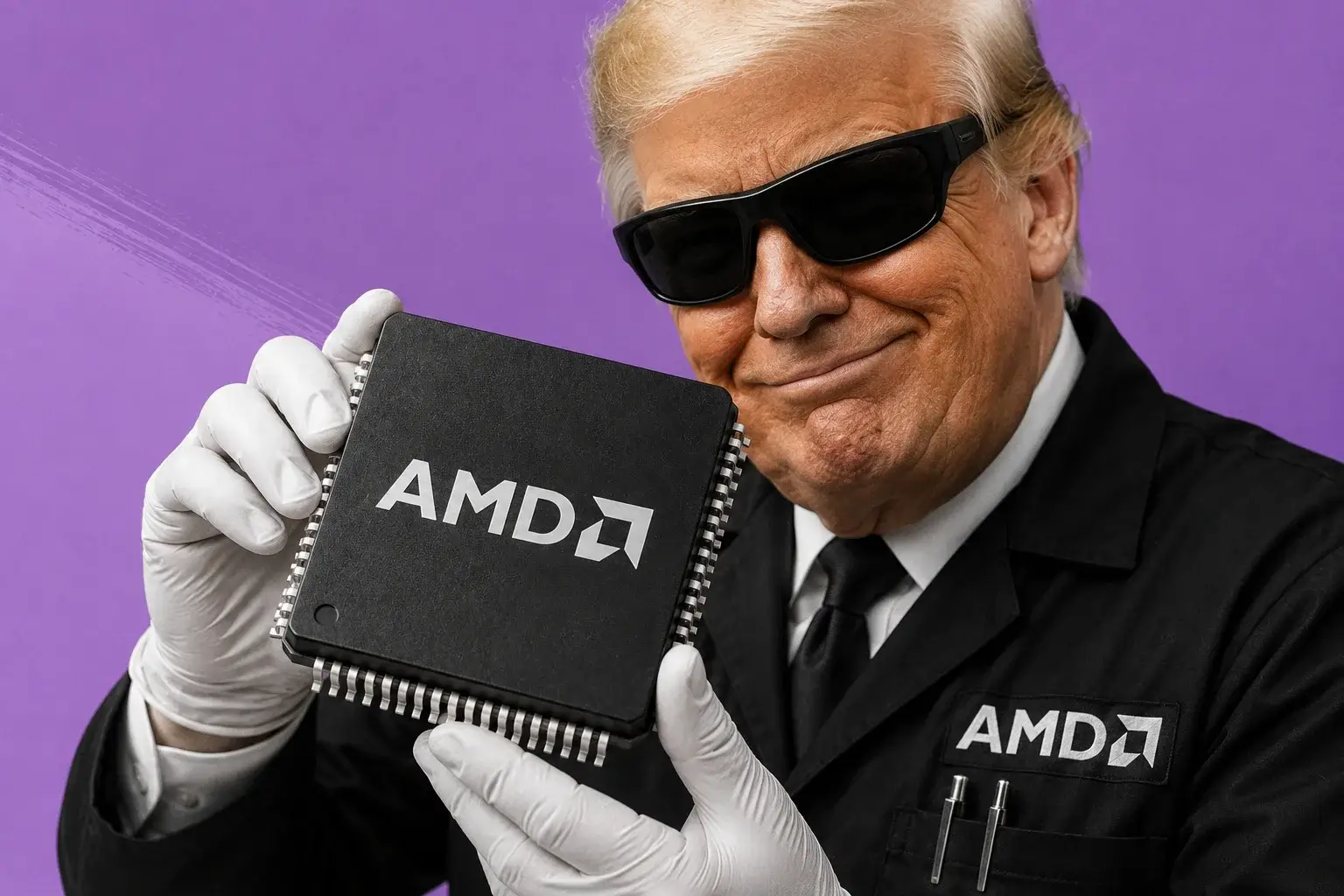
AMD Rips 7.75% to $558 as a Morgan Stanley MI400 Packaging Report Fires the Rebound — $529 Is the Breakout to the $584 Record
AMD bounced hard off the Samsung-driven chip selloff after Morgan Stanley flagged rising advanced-packaging allocation for the MI400 through 2027 | That's TradingNEWS
Key Points
- AMD rose ~7.75% to around $558 on a Morgan Stanley MI400 packaging report and a sector rebound; $529.30 breakout targets $557.70 then the $584.73 record.
- Q1 revenue hit $10.25B (+38%) with Data Center up 57%; Q2 guided to $11.2B and server CPU up 70%, with Goldman at $640 and UBS at $670.
- Bear risks: 170x+ trailing P/E, William Blair's Arm CPU and Nvidia GPU share warnings, an $800M China MI308 charge, and $163.7M in insider selling.
AMD is ripping on Thursday, up roughly 7.75% to around $558 as it reverses a multi-day slide and charges back toward its 52-week high of $584.73. The rebound erases the damage from a brutal start to the week, when the stock fell 8% Tuesday from Monday's $552.05 close to $516.55 on a chip-sector selloff, then clawed back through Wednesday's $518.47 close before exploding higher Thursday. The move puts AMD's market cap near $892 billion, within about 11% of the $1 trillion club, and cements its status as one of 2026's biggest winners, up roughly 141% year-to-date and trouncing Nvidia's 10% gain over the same stretch.
Two forces powered Thursday's surge. A Morgan Stanley supply-chain report showed AMD's global advanced-packaging allocation projected to rise significantly through 2027 to meet demand for its high-performance infrastructure, including the next-generation MI400 accelerators, a concrete read-through that the company is securing the manufacturing capacity to scale its AI ambitions. William Blair initiated coverage with a Market Perform rating that, despite its neutral stance, forecast AMD's revenue doubling from $52 billion in 2026 to over $104 billion by 2028. Layered on top, a prominent market call that the tech and memory selloff had bottomed cleared the way for dip-buyers, with Asian memory peers SK Hynix and Kioxia jumping 8% overnight and dragging the whole chip complex higher.
That sets up the only question that matters for AMD: can it execute the MI400 and Helios ramp fast enough to justify a valuation built for perfection? The bull case is enormous, revenue guided to double by 2028, Data Center up 57%, EPYC server CPUs growing more than 70% year-over-year, the Helios rack-scale system launching in the second half of 2026, and targets from Goldman at $640, UBS at $670, and Cantor at $700. The bear case is equally sharp, a stock trading above 170 times trailing earnings with William Blair flagging the end of easy CPU share gains and severe GPU share constraints. The $529.30 level is the breakout pivot toward $557.70 and the $584 record. The $457 moving average is the floor. Everything hangs on whether AMD's second-source AI franchise can outrun a multiple that leaves no room for a single misstep.
The One Question: Can Execution Justify the Multiple?
Every argument about AMD reduces to a single tension: the company is executing a genuine transformation into an AI powerhouse, but it trades at a valuation that assumes flawless execution of that transformation. The bull case and the bear case do not disagree about the facts, they disagree about whether the facts justify the price. AMD is the credible second source to Nvidia in AI accelerators, the second turbine every hyperscaler wants to avoid single-vendor pricing and supply risk, and its data-center business is compounding at extraordinary rates. The question is whether that reality supports a multiple north of 170 times trailing earnings.
The bull framing is that AMD is early in a structural share-gain story with a doubling revenue trajectory. Revenue is guided from $52 billion in 2026 to over $104 billion by 2028, with non-GAAP EPS approaching $20, driven by the MI400 accelerator ramp, the Helios rack-scale system challenging Nvidia's DGX architecture, and the EPYC server CPU franchise growing 70% year-over-year. If AMD captures even a quarter of the merchant accelerator market while protecting margins, the current price looks cheap against 2028 earnings, which is why Cantor's $700 and UBS's $670 targets are credible. Execution converts the premium multiple into a bargain.
The bear framing is that any multiple built for perfection breaks the first time execution slips. AMD trades at over 170 times trailing earnings and 33 times its 2027 estimates, a clear premium to the roughly 23 times carried by the peer group, which leaves the stock highly vulnerable to multiple compression if the MI400 ramp slips, Nvidia starts a price war, or China export rules reshuffle. The bear case to roughly $400 assumes any combination of a slipped ramp, a price war, or AI-capex digestion forces the multiple to compress toward peers. For the forecast, this is the fault line: the AMD trade is less a price prediction than a probability weighting on execution. The July 9 rip says the market is betting execution holds. The valuation says there is no margin for error. Whether the second-source franchise outruns the perfection premium is the entire debate, and it is decided by the MI400 ramp and the Advancing AI event on July 22-23.
The Catalysts Behind Thursday's 7.75% Surge
The specific drivers of Thursday's rebound reveal what the market cares about, and the standout was the Morgan Stanley supply-chain report. The report highlighted that AMD's global advanced-packaging allocation is projected to rise significantly through 2027 to meet the massive demand for its high-performance infrastructure, including the MI400. That matters because advanced packaging at TSMC is the physical bottleneck for AI accelerators, and rising allocation is a concrete, supply-chain-level confirmation that AMD is securing the capacity to ship the volumes its bull case requires. Packaging allocation is a leading indicator of shipments, so a projected increase through 2027 signals real demand being locked in.
The second driver was fresh analyst coverage. William Blair initiated on AMD with a Market Perform rating, and while the neutral stance is not a ringing endorsement, the underlying numbers are strongly bullish: revenue growing from $52 billion in 2026 to over $104 billion by 2028, with non-GAAP EPS approaching $20 by 2028, fueled by demand across GPUs, CPUs, and AI-optimized silicon. Even a cautious initiation forecasting a doubling of revenue reinforces the growth story. Goldman's earlier target hike to $640 from $450, on the agentic-AI thesis that AMD's EPYC chips are uniquely suited to data-center orchestration, added to the bullish backdrop entering Thursday.
The third driver was the broad sector rebound. A prominent market call suggested the recent tech and memory selloff had reached its bottom, presenting a buying opportunity, and the stabilization of global semiconductor sentiment cleared the way for dip-buyers to step back into the high-growth chip sector. SK Hynix and Kioxia jumping 8% overnight validated the sector-wide demand thesis and lifted U.S. chip listings broadly. For the forecast, the July 9 catalysts matter because they combine a fundamental supply-chain signal (packaging allocation), an analyst growth endorsement (William Blair's $104 billion 2028 revenue), and a sentiment reversal (the selloff-bottomed call). That trifecta drove the 7.75% pop off the Samsung-induced lows. The rebound is not just a technical bounce, it is the market re-embracing the AI infrastructure thesis after a valuation-driven scare, with the MI400 packaging news providing the concrete anchor.
The Record Fundamentals Anchor the Bull Case
The foundation under AMD's premium valuation is a data-center business compounding at rates that justify serious attention. First-quarter fiscal 2026 revenue reached $10.25 billion, up 37.8% year-over-year and beating the $9.90 billion consensus, with EPS of $1.37 surpassing the $1.29 estimate. The engine was the Data Center segment, which hit $5.8 billion in revenue, up 57% year-over-year, as AI accelerator adoption and server CPU share gains drove the business that CEO Lisa Su called the primary driver of both revenue and earnings. That 57% data-center growth is the number the bull case is built on.
The forward guidance extends the trajectory. AMD guided second-quarter revenue to approximately $11.2 billion with a gross margin around 56%, another sequential step up, and management expects server CPU revenue to grow more than 70% year-over-year. The full-year fiscal 2026 EPS estimate stands at $6.15, and the longer-term model, per William Blair, sees revenue doubling to over $104 billion by 2028 with EPS approaching $20. Those are the numbers of a company scaling rapidly into the AI infrastructure buildout, not a mature chipmaker.
The margin profile supports the growth story. A 56% gross margin guide, up from the low-50s, reflects the richer mix as high-value data-center products grow faster than the legacy business, and management targets long-term gross margins of 55% to 58% as the MI400 and EPYC ramps mature. Lisa Su has been explicit that the mix has shifted decisively toward data center, telling analysts server growth would accelerate meaningfully as AMD scales supply to meet demand. For the forecast, the record fundamentals are the bulls' strongest card: revenue up 38%, data center up 57%, server CPU guided up 70%, and a clear path to doubling revenue by 2028. These are genuine, reported numbers, not projections, and they explain why 41 of 51 analysts are bullish. The bear rebuttal is that all of this is already priced into a 170x multiple, which is the crux of the valuation debate. But on operational execution, AMD is delivering, and the August 4 earnings report is the next test of whether the trajectory holds.
Helios and the MI400 Are the Second Turbine
The single most important product story for AMD is Helios, the rack-scale system launching in the second half of 2026, which represents the company's most direct assault yet on Nvidia's dominance. Helios integrates EPYC Venice server CPUs with MI400-series GPUs and networking into AMD's first-ever rack-scale system, directly challenging Nvidia's DGX and Vera Rubin architectures. This is a strategic leap: rather than selling individual chips, AMD is now offering a complete rack-scale solution, the same integrated approach that made Nvidia's systems the industry standard. Competing at the rack level is how AMD moves from component supplier to platform provider.
The technical specifications give AMD a genuine edge in the metric that matters most. The Helios system, powered by AMD's MI455X GPU, offers 432 gigabytes of high-bandwidth memory, well above the 288 gigabytes in Nvidia's Vera Rubin NVL72 system. With memory emerging as one of the biggest bottlenecks in AI infrastructure, that 50% memory advantage is a real selling point for customers running large AI models that require substantial parameter storage. AMD does not need to beat Nvidia on every metric, it needs to be close enough that buyers can credibly threaten to switch, and the memory advantage gives it that credibility.
The second-turbine dynamic is the heart of the bull case. Nvidia has sold most of the AI accelerators so far, but every hyperscaler wants a credible second supplier to avoid single-vendor pricing and supply risk, and AMD is positioning the MI400 and Helios as that second turbine. That means AMD can win substantial volume simply by staying competitive, without matching Nvidia chip-for-chip. The risk is the mirror image: the second-source premium evaporates the moment AMD's parts fall far enough behind that the switching threat stops being credible, which is why the MI400's competitiveness, not just its ship date, is the number that matters. For the forecast, Helios and the MI400 are the catalyst that could re-rate the stock, and the Advancing AI 2026 event on July 22-23 is where AMD is expected to announce new Helios customer wins and update the roadmap. A strong showing validates the second-turbine thesis and drives the stock toward its record; a disappointment or a competitiveness gap versus Nvidia's roadmap undercuts it.
EPYC Is the Cash Engine Funding the AI Push
Beneath the AI accelerator story sits AMD's steady, profitable CPU franchise, and EPYC is the cash engine that funds the entire accelerator assault. AMD guided server CPU revenue to grow more than 70% year-over-year in the second quarter, an extraordinary rate for a CPU business, driven by continued share gains against Intel and strong data-center demand. Lisa Su now expects the server CPU total addressable market to grow more than 35% annually, reaching over $120 billion by 2030, and AMD's EPYC processors have consistently taken share in that expanding market. The CPU franchise is not a legacy drag, it is a growth business in its own right.
The strategic value is that EPYC provides the stable cash flow that lets AMD absorb a price war Nvidia might start in accelerators. A company fighting for GPU market share needs a profitable base to fund the fight, and EPYC is that base, generating the earnings that support the R&D and capacity investments behind the MI400 ramp. The agentic-AI thesis that drove Goldman's $640 target rests partly on EPYC: multi-step AI workflows increase demand for data-center orchestration, and EPYC chips are uniquely suited to that role, giving the CPU franchise an AI-driven tailwind of its own. The next-generation EPYC Venice, built on TSMC's 2nm process, extends the roadmap.
The bear case targets exactly this franchise. William Blair flagged the end of easy CPU share gains, pointing to unprecedented, aggressive competition in server sockets from the Arm ecosystem, including hyperscalers, Nvidia, Qualcomm, and Arm itself, with Arm now holding roughly 20% of global server share. AI has accelerated Arm adoption across new sockets, threatening the market-share expansion that has powered EPYC's growth. For the forecast, EPYC is a double-edged story: it is a genuine growth engine guided up 70% with a $120 billion TAM by 2030, and it funds the accelerator push, but the Arm threat means the easy share gains that drove the last few years may be ending. The bulls see a durable cash engine with an agentic-AI tailwind; the bears see a franchise facing its first serious competitive pressure in years. The Q2 earnings on August 4 will show whether the 70% server CPU growth guide holds against the rising Arm competition, a key data point for the durability of AMD's cash engine.
The Hyperscaler Wins Validate the Demand
The proof that AMD's AI strategy is working shows up in its hyperscaler relationships, and the marquee win is Meta. AMD's Helios platform has been adopted by Meta, which will begin deploying Helios servers in the second half of 2026, and the broader Meta partnership spans a 6-gigawatt commitment across several product generations. A 6-gigawatt deal is enormous, representing a multi-year, multi-generation commitment from one of the world's largest AI infrastructure builders, and it validates that AMD's rack-scale systems are competitive enough for a hyperscaler to build around. Meta choosing Helios over an all-Nvidia stack is the strongest evidence that the second-turbine thesis is real.
The OpenAI relationship adds another anchor. Lisa Su has described AMD as a core partner to the world's largest AI infrastructure builders, and the OpenAI connection positions AMD in the accounts that define the frontier of AI demand. Management has noted strong customer interest in the MI450 series and Helios, with lead customer forecasts now exceeding initial plans, a signal that demand is running ahead of AMD's own expectations. When a company's own forecasts get revised up by customers, it points to a demand environment stronger than the base case assumes.
The hyperscaler wins matter because they de-risk the revenue trajectory. The doubling of revenue to $104 billion by 2028 requires AMD to keep winning large customers, and the Meta 6-gigawatt deal plus the OpenAI relationship provide concrete anchors for that growth. There is good reason to expect more wins, given Helios's memory advantage over Nvidia's Vera Rubin and the industry-wide desire for a second supplier. For the forecast, the hyperscaler wins are the evidence that converts the bull thesis from hope to reality: Meta deploying Helios in H2 2026 and OpenAI's partnership show AMD is winning real volume in the accounts that matter. The Advancing AI event on July 22-23 is where investors expect additional customer announcements, potentially expanding the roster beyond Meta and OpenAI. More hyperscaler wins would firm the revenue trajectory and support the premium multiple; a lack of new wins would raise questions about whether the second-source demand is as broad as the bulls assume. The customer momentum is the bull case's real-world validation.
Read More
-
Yen Stalls at 160 Despite a 3% JGB and Tokyo Core CPI at 2.0% — Intervention Sits at 164, Friday's Payrolls Decide
02.09.2026 · TradingNEWS ArchiveEnergy
-
QQQ ETF ($706.22) Slides 7.4% Below Its High as the Market Reprices the AI Capex Bill — $686.57 Target if $700 Breaks
22.10.2026 · TradingNEWS ArchiveStocks
-
XRPI ($7.00) and XRPR ($10.74) Slide Toward 52-Week Lows as Spot XRP ETF Flows Stall at $708,510
22.10.2026 · TradingNEWS ArchiveCrypto
-
NG ($2.775) Decoupled From Europe’s €88 Gas Crisis as LNG Feedgas Hits 18.9 Bcf/d — $3.30 Upside on Cold Weather
22.10.2026 · TradingNEWS ArchiveCommodities
-
Dollar-Yen (157.35) Loses 157.65 as the Yen Rallies on Haven Demand — 155 Target if 156 Breaks
22.10.2026 · TradingNEWS ArchiveForex
The Samsung Selloff Showed the Valuation Vulnerability
The sharp drop that preceded Thursday's rebound is instructive, because it revealed exactly how vulnerable AMD's valuation is to sentiment shifts. On Tuesday, AMD fell 8% from Monday's $552.05 close to $516.55, part of a chip-sector selloff triggered by Samsung's preliminary second-quarter earnings. Samsung reported operating profit of $58 billion, up 19-fold year-over-year on higher HBM earnings and rising DRAM prices, a blockbuster result, but it beat consensus by only about 6%, and that modest beat prompted investors to take profits across the chip sector. Intel fell 10%, AMD dropped 8%, and Applied Materials shed 10%, all on a day the Dow hit a record.
The lesson is that at these valuations, even great news that merely meets rather than crushes expectations triggers selling. Samsung's 19-fold profit surge was extraordinary, but because the market had priced in even more, the 6% beat was treated as a disappointment, and the selloff reflected how much optimism is already embedded in chip-stock prices. When a stock trades at 170 times earnings, the bar for a positive surprise is extreme, and results that would be spectacular for a normally-valued company become a reason to sell. The DeepSeek news the same week, that the Chinese AI company is building its own inference chip, added to the pressure by raising questions about long-term accelerator demand.
The rebound Thursday shows the flip side: the same valuation sensitivity that amplified the drop also amplifies the recovery when sentiment turns. The Morgan Stanley packaging report and the selloff-bottomed call were enough to spark a 7.75% pop, because the underlying demand story remained intact and the drop was sentiment-driven rather than fundamental. For the forecast, the Samsung episode is a warning embedded in the bull case: AMD's premium valuation means the stock will be volatile, swinging hard on sentiment shifts even when the fundamentals do not change. The 8% drop and 7.75% rebound within days, on no change to AMD's own business, illustrate the multiple compression risk the bears emphasize. The stock can rip toward its record on good sentiment and crater on a merely-good earnings beat, which is why the August 4 report carries outsized risk. The valuation cuts both ways, and the Samsung selloff showed how fast it can turn.
The Bear Case Rests on Two Structural Cracks
The most credible bear case comes from William Blair's fresh Market Perform initiation, which identified two structural cracks beneath AMD's growth story. The first is the end of easy CPU share gains. William Blair flagged unprecedented, aggressive competition in server sockets from the Arm ecosystem, including offerings from hyperscalers, Nvidia, Qualcomm, and Arm itself, with Arm holding roughly 20% of global server share today and AI accelerating Arm adoption across new sockets. AMD's EPYC growth has been powered by taking share from Intel, but the threat is now shifting to the Arm architecture, which the x86 franchise cannot easily counter. If Arm keeps gaining server share, the 70% EPYC growth guide becomes harder to sustain over time.
The second crack is severe GPU market share constraints. Despite AMD accelerating its hardware roadmap, William Blair projects that intense competition from Nvidia and expanding proprietary hyperscaler ASIC programs will limit meaningful GPU market share gains. Nvidia maintains 80% to 95% of the AI GPU market, protected by its CUDA software ecosystem and established customer relationships, and the switching costs and ecosystem advantages favor the incumbent. Even worse, the hyperscalers building their own custom ASICs are competing with AMD for the same second-source volume, squeezing AMD from both above (Nvidia) and below (in-house chips). The competition, per William Blair, is likely to constrain share gains even with increased packaging allocation.
Together these cracks challenge the core assumption of the bull case, that AMD keeps gaining share in both CPUs and GPUs. If Arm erodes the CPU franchise and Nvidia plus hyperscaler ASICs cap the GPU business, the doubling-revenue trajectory that justifies the multiple comes into question. For the forecast, William Blair's two cracks are the bear case's strongest argument, and the neutral Market Perform rating despite a $104 billion 2028 revenue forecast reflects the tension: the growth is real, but the competitive pressures and the valuation make the risk-reward balanced rather than compelling. The bulls counter that the second-source demand is structural and the memory advantage keeps AMD credible, but the Arm and ASIC threats are genuine and growing. Whether AMD can gain share fast enough against intensifying competition on both fronts is the question the bears keep asking, and it is the reason the stock is not a clean buy at 170 times earnings.
The China Overhang Is the Wild Card Wall Street Can't Model
The variable that Wall Street models least well is Washington, and AMD has already been caught in the U.S.-China crossfire in ways that threaten its long-term revenue ceiling. The company took a charge of roughly $800 million, some sources put the net inventory hit at $440 million, tied to U.S. export restrictions on its China-market MI308 accelerator, a concrete cost of the geopolitical conflict. That charge shows the tangible financial damage export controls can inflict, and it is a preview of a larger risk if the rules tighten further.
The regulatory risk is escalating. The bipartisan SAFE Chips Act, if enacted in its tougher form, could reimpose a multi-month freeze on advanced-chip exports, and analysts estimate that permanently losing the China market would compress AMD's long-term revenue ceiling by 10% to 15%, given China represents a $5 billion to $10 billion potential annual market for AI accelerators. That is a material hit to the growth trajectory, and it is entirely dependent on political decisions that no financial model can reliably predict. The China overhang is the definition of an unmodelable risk: it could be resolved favorably or tightened dramatically, and the outcome swings AMD's addressable market by billions.
The competitive threats from China compound the regulatory risk. DeepSeek building its own inference-specialized chip and the broader push by Chinese firms toward domestic AI silicon threaten to erode AMD's China demand even if export rules loosen, since Chinese customers are being pushed toward homegrown alternatives. For the forecast, the China overhang is the wild card that caps the upside and adds tail risk. The $800 million MI308 charge is the realized cost, and the potential 10% to 15% revenue-ceiling compression from losing China entirely is the unrealized risk. Combined with the TSMC dependence, AMD relies entirely on Taiwan for leading-edge silicon, a single point of failure, the geopolitical exposure is a genuine overhang on the stock. The bulls note that the China market is a relatively small part of the total AI opportunity and that AMD is diversifying, but the export-control risk is real, escalating, and unpredictable. It is the reason even bullish analysts build a wide door on the downside, and it is a factor the market tends to underprice until a specific policy action forces a repricing.
The Valuation Is the Perfection Premium
AMD's valuation is where the bull and bear cases become mathematically irreconcilable, because the stock is priced for flawless execution. On traditional metrics, AMD is plainly expensive: it trades at a trailing price-to-earnings multiple well above 170 times, with some measures near 192 times, and a forward multiple in the 33 to 77 times range depending on which year's estimates are used, a clear premium to the roughly 23 times carried by the peer group. Even on 2027 estimates, the stock trades at 33 times, which assumes continued rapid growth just to sustain the current price. This is the bear's strongest card: by any conventional measure, AMD is richly valued.
The bull rebuttal is that traditional metrics understate a company doubling its revenue. If AMD grows revenue from $52 billion in 2026 to $104 billion by 2028 with EPS approaching $20, then the forward multiple on 2028 earnings is far more reasonable, and the stock is cheap relative to its growth. The bull case to $670, and the more aggressive $650 to $750 range some desks float, assumes the MI400 ramps on schedule and AMD captures a quarter or more of the merchant accelerator market while protecting margins. On those assumptions, the premium multiple is justified by the growth trajectory, and the stock re-rates higher as the earnings materialize.
The resolution depends entirely on execution, which is why the valuation is a probability weighting rather than a fixed judgment. If AMD executes the MI400 ramp, wins hyperscaler share, and delivers the doubling revenue, the multiple compresses naturally as earnings catch up and the stock rises. If the ramp slips, Nvidia starts a price war, or China rules tighten, the multiple compresses violently toward the peer group and the stock falls toward $400. For the forecast, the valuation is the crux: at 170 times trailing earnings, AMD prices in near-flawless execution, leaving no margin for a single misstep. The Samsung selloff showed how fast the multiple can compress on even minor disappointments. The bulls are betting execution justifies the premium; the bears are betting the premium breaks on the first stumble. At $558, the market is pricing closer to the bull case, betting the second-turbine thesis and the doubling revenue hold. The margin of safety exists only if the growth trajectory delivers, which the August 4 earnings and the MI400 ramp will reveal.
Wall Street Is Bullish, With Targets From $320 to $700
The analyst community leans decisively bullish, and the spread of targets captures the execution debate. Of 51 analysts, 41 are bullish with a Strong Buy consensus, and zero rate the stock a sell, a striking level of conviction. The average 12-month target sits around $506 to $512, roughly in line with the current price after the rebound, but the range is enormous, from a low of $320 to a high of $700. That spread, more than double from bottom to top, reflects the same peak-execution-versus-competitive-pressure disagreement embedded in the valuation.
The specific bullish calls are aggressive and rising. Goldman Sachs raised its target to $640 from $450 on the agentic-AI CPU thesis, UBS lifted its target to $670 from $455, Wells Fargo set $615 with an Overweight rating, and Cantor carries a $700 target as a credible bull case anchored on the MI450 and Helios ramp. These targets, clustering in the $615 to $700 range, imply meaningful upside from $558 and reflect conviction that AMD executes its growth plan. The unifying thread is the AI infrastructure buildout, the Helios rack-scale opportunity, and the EPYC franchise.
The cautious voices provide the counterweight. William Blair's Market Perform initiation, despite forecasting $104 billion in 2028 revenue, reflects concern about competition and valuation, and MarketBeat's average sits lower around $454, closer to the bear scenario. The bear case to roughly $400 assumes a slipped ramp, a price war, or capex digestion. For the forecast, the analyst spread frames AMD as a stock with strong bullish conviction, 41 of 51 bullish and targets up to $700, but genuine dissent on valuation and competition. The rising targets from Goldman, UBS, and Wells Fargo provide a magnet toward the $615 to $700 zone if execution holds, while the wide range acknowledges the execution risk. At $558, the stock sits near the average target but well below the bull targets, suggesting analysts collectively see upside if AMD delivers. The August 4 earnings and the Advancing AI event are the catalysts that will drive target revisions, up if Helios wins accumulate, down if competition bites.
The Technical Map Centers on $529 and $457
The chart frames the execution debate in specific levels, with $529.30 as the breakout pivot and $457 as the structural floor. After the Samsung-driven pullback and Thursday's 7.75% rebound, AMD is pushing back toward its breakout zone, and a sustained rally above $529.30 would open targets at $557.70 and beyond toward the $584.73 record high. The stock recorded its second higher-low in a row above the $457.04 EMA200 during the pullback, and that long-term moving average, sitting above AMD's long-term average at $457, has held as support through the volatility, a constructive sign that the uptrend remains intact.
The momentum indicators lean neutral-to-constructive. The RSI around 46 during the pullback showed the stock neither oversold nor overbought, with room to grow further and no bearish divergence, and Thursday's surge will have lifted it toward more bullish territory. The stock trading above its EMA200 with a pattern of higher lows reflects an intact uptrend that survived the Samsung scare, and the trendline above the long-term average at $457 remains unbroken. The technical structure is that of a stock consolidating after a massive run, holding key support, and attempting to resume its uptrend.
The levels that matter are clear. On the upside, $529.30 is the immediate breakout pivot, with $552.05, the Monday high, and $557.70 as intermediate targets, then the $584.73 record. On the downside, immediate support sits at $497, then $478, and the critical $457 EMA200 that has anchored the uptrend. A break below $457 would signal the uptrend is failing and open a deeper correction toward the bear-case levels. For the forecast, the technical map is binary around these levels: reclaiming and holding above $529.30 confirms the rebound has legs and targets the record, validating the bulls; losing $457 would confirm the valuation-driven selling has broken the trend, favoring the bears. Thursday's 7.75% rip put AMD back in the breakout zone, and the technicals lean constructive with the EMA200 holding and higher lows forming. The Advancing AI event on July 22-23 and the August 4 earnings are the catalysts most likely to drive the next sustained move out of the $497-to-$529 range that decides the trend.
The Verdict: A Second-Source Franchise Racing Its Own Multiple
AMD at $558 is a genuine second-source AI franchise racing against a valuation built for perfection, and the July 9 rip of 7.75% off the Samsung selloff is the market re-embracing the growth story after a valuation scare. The entire stock reduces to whether AMD can execute the MI400 and Helios ramp fast enough to justify a multiple above 170 times trailing earnings. The Morgan Stanley packaging report showing rising MI400 allocation through 2027, the record fundamentals, and the Meta 6-gigawatt deal say the second-turbine thesis is real. William Blair's two cracks and the 170x multiple say there is no room for error. The $529.30 level is the breakout pivot; the $457 EMA200 is the floor.
The bull case is formidable and winning the session. Revenue guided to double from $52 billion to $104 billion by 2028, Data Center up 57%, EPYC up 70%, Helios launching in H2 2026 with a 432GB HBM advantage over Nvidia's 288GB, Meta and OpenAI as anchor customers, and targets from Goldman at $640, UBS at $670, and Cantor at $700. Reclaim $529.30 and the path opens to $557.70 and the $584.73 record, with the Advancing AI event on July 22-23 the catalyst for new Helios wins.
The bear case is structural and patient. A multiple above 170 times trailing earnings prices flawless execution, William Blair flags the end of easy CPU share gains as Arm takes 20% of server sockets and severe GPU share constraints from Nvidia's CUDA moat and hyperscaler ASICs, the China overhang threatens a 10-15% revenue-ceiling hit after an $800 million MI308 charge, and insider selling of $163.7 million including Lisa Su's $57.6 million adds caution. The verdict: AMD is a binary bet on execution, and the trade hinges on $529.30 above and $457 below. Deliver the MI400 ramp, win more hyperscalers at Advancing AI, and beat on August 4, and the second-turbine franchise drives AMD past $529 toward the $584 record and the bull targets. Slip the ramp, cede share to Arm and Nvidia, or stumble on earnings, and the perfection premium compresses toward $400. The fundamentals are real, the growth is genuine, and the competition is intensifying. This session, the second-source franchise won. The MI400 ramp and the August 4 earnings decide whether it keeps outrunning its multiple.