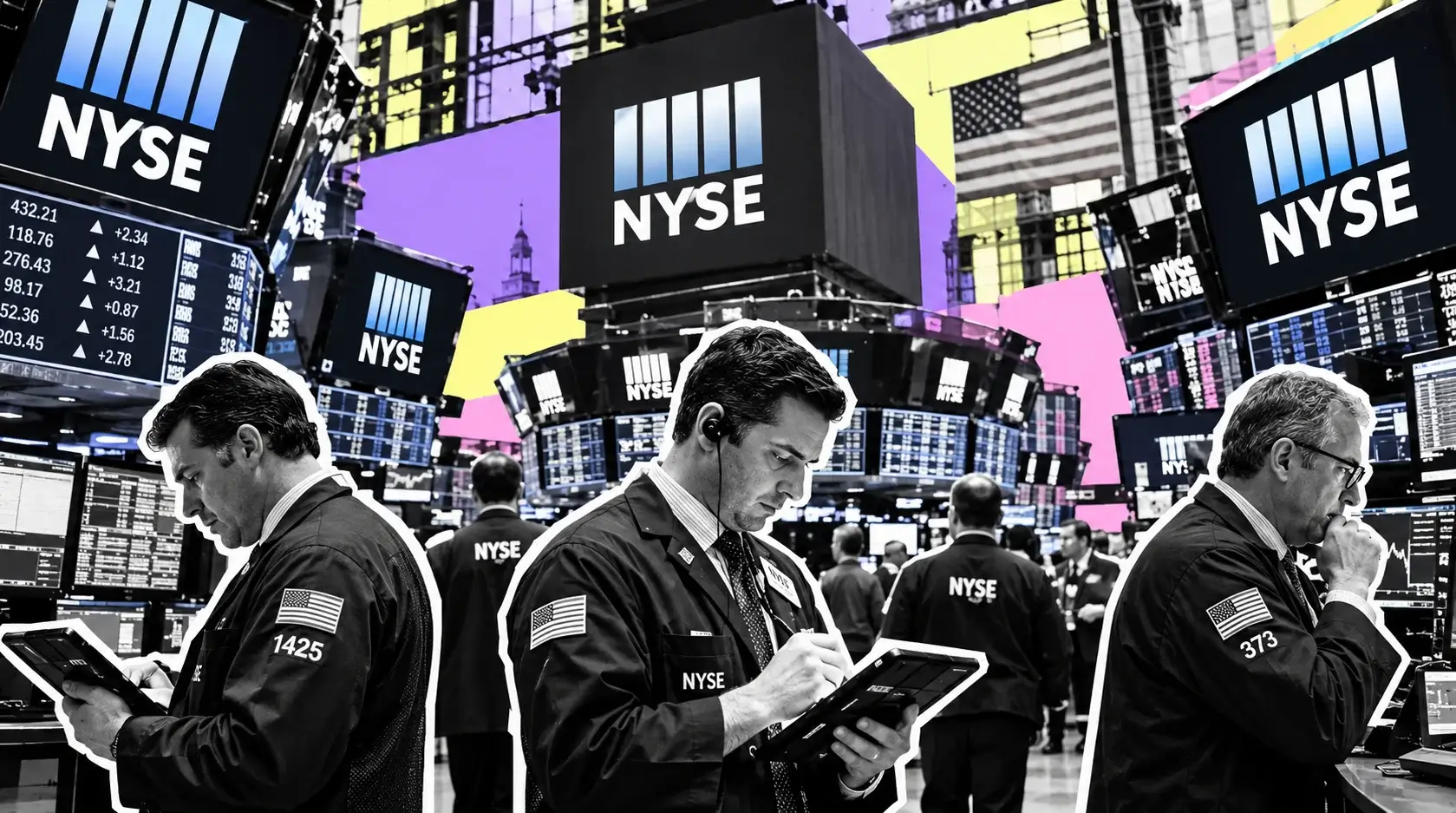
Micron Rips 6% and Nasdaq Leads at 25,960 While Ionis Craters 21% and the Dow Fights Back From a 577-Point Iran Rout
A second night of U.S. strikes on Iran pushed Brent to $78 and the 10-year yield to 4.58% | That's TradingNEWS
Key Points
- Micron ripped ~6% leading SMH up nearly 3%; SanDisk added 5% ahead of SK Hynix's $28B Nasdaq debut priced Thursday, trading Friday under SKHY.
- Ionis cratered 21.1% and AstraZeneca fell ~8% after their Wainua heart drug missed its primary endpoint in a Phase 3 trial.
- 10-year yield hit 4.58% and Brent held near $78 after a second night of U.S.-Iran strikes; September Fed hike odds jumped to 70%.
Wall Street opened Thursday leaning into a rebound it wasn't fully sure it believed. The S&P 500 changed hands near 7,499, up about 0.2% after the 9:30 bell, the Nasdaq Composite pushed to 25,960 for a 0.35% gain, and the Dow Jones Industrial Average hovered around 52,312, essentially flat at -0.04% after briefly turning green by 63 points. That flatness is the entire story compressed into one number: the blue-chip index is trying to stand back up after Wednesday's beating, when it got smoked for 576.76 points, a 1.09% drop that closed it at 52,348.39 and marked its worst session in weeks. Twenty-four of the thirty Dow names finished Wednesday in the red, and at the intraday low the index was down more than 855 points before dip-buyers dragged it off the mat.
The catalyst hasn't changed, it's just escalated. U.S. forces ran a second straight night of strikes on Iran, hitting 90 targets after President Trump declared the ceasefire finished, and Iran fired back at U.S.-allied positions in Kuwait and Bahrain. Traffic through the Strait of Hormuz slowed to a near standstill. On paper that's a risk-off script. The tape refused to follow it. The VIX actually eased to 16.74, down 0.95%, and money rotated straight back into semiconductors instead of Treasuries or gold.
What's holding the bid together is the AI trade, and specifically the memory-chip complex ahead of SK Hynix's Nasdaq debut. Micron ripped roughly 6% out of the gate and dragged the VanEck Semiconductor ETF (SMH) up nearly 3%, with SanDisk tacking on 5%. That single sector move is doing the heavy lifting on the Nasdaq while the Dow gets pinned by AstraZeneca's collapse and a batch of consumer names rolling over. The S&P 500 sits about 10% higher on the year and roughly 1% below its June 2 record close of near 7,570. The whole session is a tug-of-war between an oil shock that wants to reprice inflation higher and a chip bid that refuses to sell the AI story on a geopolitical headline.
The Old War Playbook Is Running In Reverse
For decades the geopolitical shock trade ran one direction: missiles fly, equities sell, Treasuries rally as capital sprints to safety, the Federal Reserve turns patient, and dip-buyers collect the rebound a few sessions later. Wednesday inverted every step of that sequence, and Thursday is trading in the wreckage of the old assumption. The 10-year Treasury yield climbed to 4.58% from 4.55%, against 3.97% before this conflict began, and gold slid below $4,100 into a firmer dollar even as the shooting intensified. When bonds sell off and gold fades on the exact day the U.S. bombs Iran twice, the safe-haven cushion that used to soften these shocks isn't there anymore.
The mechanism behind the flip is oil. Crude's near-8% two-session surge didn't just hit energy prices, it dragged Treasury yields and Fed rate-hike odds higher together. A war that pushes oil up now reads as an inflation event first and a growth scare second, which is the opposite of how markets priced the 2020 or 2022 shocks. That's why the 10-year hit its highest level since mid-May instead of catching a flight-to-quality bid. Higher yields discount future corporate earnings more aggressively and hand investors a better return on safer paper, which is a direct brake on equity multiples.
Chris Weston at Pepperstone framed the standoff plainly: the tape still expects Iran to cool off, but that's not real conviction, and the timing is impossible to call. That describes Thursday's price action exactly. Buyers are stepping in, but they're doing it while watching crude and the 10-year, ready to fold the moment either one breaks the wrong way. The bond market is the governor on this rally. As long as the 10-year presses toward its June high near 4.60%, every equity bounce is a rally that can be sold rather than a durable turn. The safe-haven trade didn't just fail to show up on Wednesday, it reversed, and until oil rolls over that reversal keeps the ceiling low on any rebound the indices try to stage.
Crude Is The Transmission Line The Whole Market Is Watching
Everything routes through the oil price right now. West Texas Intermediate futures rose 0.5% to $73.85 a barrel Thursday morning, extending Wednesday's move, while Brent advanced to $78.53, up roughly 10% for the week and holding near its biggest advance since May. The catalyst stack is dense: the U.S. revoked the waiver that had allowed Iranian barrels back onto the world market, both sides traded strikes around Hormuz, and Trump promised to hit Iran hard again. Brent spiked toward $80.07 intraday during the worst of Wednesday's panic before easing back, and WTI popped as high as $75.77 before settling.
The Strait of Hormuz is the pressure point. Roughly a fifth of global seaborne crude moves through that chokepoint, and traffic slowing to a near standstill is exactly the scenario that turns a headline into a supply shock. That's what dragged Asian markets lower overnight and why energy names were among the only groups spared in the Wednesday selloff. Baker Hughes and Valero Energy both ran up around 2% as the energy sector became the day's safe haven in place of bonds. On the ASX, the energy sector jumped almost 2% by midday while materials sank more than 1%.
The reason this matters beyond the pump is the inflation channel it reopens. Oil up 10% in a week feeds straight into headline inflation expectations, which feeds into Fed hike odds, which feeds into the 10-year, which feeds back into equity valuations. That's the full loop the market is pricing in real time. Thursday brought a small counter-move, with oil edging up only modestly and some traders betting the conflict resolves before flows are seriously disrupted. Brent actually slipped 0.5% to $77.60 in one read as the market weighed the bumpy path to Middle East peace against the escalation. That tug decides the session. If crude breaks back below $73 on WTI, the inflation scare deflates and the chip bid runs free. If it clears $80 on Brent with Hormuz still choked, the 10-year pushes past 4.60% and the equity ceiling drops.
Micron And The Memory Complex Are Carrying The Index
The single cleanest trade on Thursday is semiconductors, and Micron is the engine. The stock ripped roughly 6% out of the open, leading the VanEck Semiconductor ETF (SMH) to a near-3% gain and pulling the entire memory complex with it. SanDisk added 5%, and the broader chip group in Asia, Europe and the U.S. rallied together as SK Hynix drew ferocious demand for its American depositary receipts. This is a straight repricing higher of the AI memory trade after a brutal stretch, and it's what's keeping the Nasdaq green while the Dow bleeds.
The setup makes the bounce sharper. Micron and Broadcom had both pulled back roughly 25% from recent record highs heading into this week, which UBS flagged as a more attractive entry across the sector rather than a warning. The firm's argument is that forward price-to-earnings multiples on the Philadelphia Semiconductor Index sit around 26x today, a fraction of the 150x peak of the dot-com cycle, so the group is nowhere near bubble math even after this year's run. Chip earnings growth has kept pace with the price, which is the piece that separates 2026 from 2000.
That doesn't erase the whipsaw that got the group here. Micron closed down 4.7% earlier in the week alongside declines in KLA, Marvell, Broadcom and AMD as the SMH shed more than 3% on fears expectations had outrun fundamentals. The PHLX Semiconductor Index (SOX) is down 16% from its June 22 peak and sitting below its 50-day moving average for the first time since early April, with its relative strength reading below 45, under the 50 line that typically signals bullish momentum. So the 6% Micron pop is a rebound inside a downtrend, not a fresh breakout. The tell for whether it holds is breadth: if the rally stays concentrated in memory names tied to the SK Hynix catalyst, it fades once the debut passes. If it broadens back into equipment names like Applied Materials and Lam Research, the chip trade has real legs into earnings season, where tech-sector profits are projected to jump around 65% year-over-year.
The SK Hynix Debut Is The Session's Gravity Well
Every chip bid on the tape is oriented around one event: SK Hynix prices its U.S. offering Thursday and starts trading Friday on the Nasdaq under the ticker SKHY. The scale is historic. The South Korean memory giant is raising roughly $28 to $29 billion by issuing 17.79 million common shares as American depositary receipts, with 10 ADRs representing one common share, and demand is running at seven times the shares available. That would rank as the largest foreign listing in history and the second-biggest share sale ever behind SpaceX's $85.7 billion IPO last month, edging past Saudi Aramco's $29.4 billion 2019 debut.
The fundamentals underneath the hype are real. SK Hynix controls roughly 56% to 57% of the global high-bandwidth memory market, supplying the HBM chips that sit alongside Nvidia's accelerators and inside Google's AI systems. Its Korea-listed stock has shot up more than 250% this year and over 770% in twelve months, pushing market value past $1 trillion. First-quarter operating profit hit a record 37.61 trillion won on a 72% operating margin, with sales nearly tripling to 52.58 trillion won. The proceeds fund two new South Korean fabs and ASML lithography gear to chase HBM capacity that's already sold out well into 2027.
The caution sits right next to the euphoria. Memory is deeply cyclical, and after a 770% run a lot of good news is already in the price, the same peak-cycle worry pressing on Micron and Samsung. SK Hynix's own comments last month about slowing its AI memory business triggered one of the Kospi's worst plunges ever, a move Capital Economics called evidence of excessive froth. Bank of America reaffirmed a year-end S&P 500 target of 7,100, roughly 5% below current levels, warning that speculation is hitting extremes. So the debut is a barometer as much as a listing. A blowout first print validates the AI trade and pours fuel on the memory rally. A soft one, with seven-times oversubscription already baked in, hands the bears the froth signal they've been waiting for.
Treasury Yields Are The Governor On Every Bounce
The bond market is where this rally lives or dies, and right now it's leaning against equities. The 10-year U.S. Treasury yield sat around 4.56% to 4.59% Thursday, its highest since mid-May, after climbing 8 basis points in the prior session on the oil surge. Against the 3.97% level that prevailed before this conflict started, that's a massive move in the discount rate the entire equity complex is valued off. Treasuries were steady Thursday after Wednesday's spike as traders looked past the Middle East for a beat, but the direction of travel is unmistakably higher.
The supply side is adding to the pressure. Wednesday brought a $58 billion 3-year note auction that saw solid demand, but 10-year notes went to market the same day and 30-year bonds followed, testing appetite at exactly the moment inflation fears are climbing. The May trade deficit blew out to $77.6 billion from a revised $54.6 billion, and rising imports feed more Treasury supply into a market already digesting an oil-driven inflation scare. New Fed Chair Kevin Warsh's earlier calls for a smaller balance sheet, achieved by trimming longer-dated holdings, add another layer of upward pressure on the long end.
This is the brake the whole equity rebound is fighting. When the 10-year presses toward 4.60% and beyond, the math on high-multiple growth stocks gets harder, and the chip names leading Thursday's tape are precisely the high-multiple cohort most exposed to a rising discount rate. That's the internal contradiction in the session: the same oil shock powering the inflation trade that lifts yields is the thing that should cap the valuations of the AI winners doing the lifting. For now the chip bid is winning, but it's winning on a leash. A clean break above the June yield high would pull the rug from under the growth trade fast, which is why every desk on the Street has the 10-year quote pinned to the top of the screen next to crude.
The Fed Minutes Handed The Hawks Fresh Ammunition
Wednesday's release of the June FOMC minutes reset the rate conversation, and Thursday is trading the fallout. The minutes showed a central bank split, with some policymakers making the case for an actual rate hike in June and officials broadly expressing growing concern over inflation, even as the committee left rates at 3.50% to 3.75%. On a day already primed by an oil shock, minutes that lean hawkish were rocket fuel for yields and hike expectations. The implied probability of a September increase jumped to around 70% from 58% the day before, and rate futures show a loose consensus for one hike this year, with nearly half the market positioned for more than one.
That's a stunning repricing for a market that spent early 2026 debating cuts. The July 29 meeting now carries roughly a 25% chance of a 25-basis-point hike per CME's FedWatch tool, and the energy-driven inflation risk from Iran is the swing factor. Jeffrey Roach at LPL Financial noted the minutes carried some ambiguity and tied policy directly to the Middle East, which is exactly the linkage traders are pricing: the more oil climbs, the more the Fed's inflation worry hardens into action. The read on the minutes was that a few officials had wanted to raise rates in June, reinforcing tighter-policy bets and lifting Treasury yields into the close.
The data slate this week either confirms or complicates that hawkish drift. The Atlanta Fed's GDPNow indicator for the second quarter has cratered from above 4% earlier this year to just above 1.4% in the latest reading, a sharp deceleration that argues against hiking into a slowing economy. That's the tension the July 14 CPI print and Warsh's congressional testimony the same day will have to resolve. A hot CPI on top of an oil spike locks in the hawkish case and pushes the 10-year higher. A soft one gives the equity dip-buyers cover to keep chasing the chip trade. Until then, the market is caught between minutes that scream hike and a growth indicator quietly flashing slowdown.
AstraZeneca And Ionis Get Blown Up By A Failed Heart Trial
The single ugliest move on the tape belongs to the pharma pair caught in a failed drug trial. AstraZeneca cratered, down around 8% in U.S. premarket and NYSE trading and as much as 9.4% in London, on track for its worst session since March 2020 at the start of the Covid outbreak. The trigger: the late-stage trial for its heart disease drug Wainua, generic name eplontersen, failed to hit its primary goal of reducing deaths and recurrent heart-related emergencies over 140 weeks versus a placebo. For a drug the market had built real expectations around, a clean miss on the main endpoint is a valuation reset, not a wobble.
The wreckage hit the co-developer harder in percentage terms. Ionis Pharmaceuticals, which is co-developing Wainua in the U.S., tumbled 21.1% after opening down 12.5% in premarket, a far more violent move because the drug represents a bigger slice of Ionis's pipeline value than AstraZeneca's sprawling portfolio. When a mid-cap biotech's flagship late-stage asset misses, the stock reprices the entire probability-weighted revenue stream in a single session, and a 21% haircut is the market doing that arithmetic in real time.
The knock-on damage rippled through the defensive corners of the market that would normally catch a bid on a risk-off day. CACI International dropped 7.7% in the same session, and the pharma weakness undercut the healthcare sector's usual role as a shock absorber. That matters for the Dow, where AstraZeneca's NYSE-listed collapse is one of the anchors dragging the blue-chip index while the Nasdaq's chip names climb. The split screen is stark: memory chips ripping 6% on one side of the tape, a marquee pharma name printing its worst day in six years on the other. It's a reminder that even in a session dominated by macro headlines about Iran and oil, single-stock catalysts can carve out double-digit moves that have nothing to do with the war and everything to do with a trial readout. Healthcare, the sector that's supposed to be boring when the world gets scary, delivered the day's biggest blowup instead.
Salesforce Gets Downgraded As The Software Bid Wobbles
Software took its own hit Thursday, with Salesforce dropping 4.5% after KeyBanc cut the stock to sector weight from overweight. The analyst logic was blunt: the firm said it's struggling to find evidence of future upside based on its channel checks, customer conversations, and the numbers Salesforce itself has disclosed. Specifically, KeyBanc flagged a lack of evidence that the Agentforce AI platform will drive the upside the bull case requires. For a stock whose entire premium rests on monetizing AI agents, an analyst saying the monetization isn't showing up in the data is a direct shot at the thesis.
The timing sharpens the pain. Software has been the market's designated AI winner outside of semiconductors, and a downgrade landing on a day when chips are ripping 6% draws an uncomfortable contrast. Money is rewarding the hardware layer of the AI stack, the memory and compute names with visible, sold-out demand, while questioning whether the application layer can actually convert AI hype into revenue. Salesforce sliding 4.5% while Micron rips higher is that rotation playing out inside the AI trade itself, not a rejection of it.
The move fits a broader pattern of the market getting pickier about where AI dollars land. Cerebras Systems announced a major European data-center expansion, bringing its first capacity online by the end of 2026 and targeting 200 megawatts by the end of 2027, and Starbucks disclosed it's leaning on AI to cut its reliance on Microsoft and IBM software. The infrastructure spend is accelerating, but the enterprise-software names that were supposed to ride that wave are getting interrogated on whether the spending translates to their income statements. That's a maturing AI trade, one that no longer lifts every boat equally. Hyperscalers dropped more than 1% earlier in the week on worries about heavy data-center capex, with Alphabet, Amazon and Microsoft all lower on the exact spending that names like Cerebras are celebrating. The capex is real. The question the tape keeps asking is who actually captures the return on it, and Thursday's answer was memory chips, not enterprise software.
PepsiCo Delivers A Mixed Quarter The Market Can't Love
The consumer staples read came in soft, and PepsiCo paid for it. Shares slipped around 1.8% to $140 after the food and beverage giant posted a mixed second quarter. Adjusted earnings landed at $2.20 per share, a penny light of the $2.21 consensus, while revenue rose 6.4% year-over-year to $24.18 billion, topping the $23.95 billion analysts expected on strong international demand for snacks and beverages. A one-cent EPS miss paired with a revenue beat is the kind of split result that leaves a defensive stock nowhere to hide when the macro backdrop is already hostile.
The guidance commentary is what kept a lid on the stock. CFO Steve Schmitt acknowledged the North America business was softer than the company anticipated in the quarter, and management now expects a more gradual improvement in performance trends across the balance of the year. That admission, softer domestic demand plus a slower recovery path, is exactly what staples investors don't want to hear when rising oil is squeezing consumer wallets and input costs at the same time. PepsiCo did reiterate its full-year outlook, backing adjusted earnings growth of 4% to 6% and organic revenue growth of 2% to 4%, which put a floor under the reaction and kept the drop contained to under 2%.
The stock walked into the print carrying baggage. It had been trading around $142.50 and sitting 17% below its 52-week high, with some analysts pegging it as 22.5% overvalued against a fair value near $116.35, even as a discounted-cash-flow model argued the opposite case for meaningful undervaluation. That valuation split explains the muted reaction: bulls and bears both had ammunition, so a mixed quarter simply confirmed each camp's priors without forcing a violent repricing. For the broader tape, PepsiCo's soft North America read is a small warning flare on the U.S. consumer, one that lands as airlines and homebuilders are already rolling over on higher energy and borrowing costs. The staples group is supposed to be the ballast when growth wobbles. A penny miss and a guidance hedge from Pepsi isn't reassuring ballast.
Read More
-
Yen Stalls at 160 Despite a 3% JGB and Tokyo Core CPI at 2.0% — Intervention Sits at 164, Friday's Payrolls Decide
02.09.2026 · TradingNEWS ArchiveEnergy
-
QQQ ETF ($706.22) Slides 7.4% Below Its High as the Market Reprices the AI Capex Bill — $686.57 Target if $700 Breaks
22.10.2026 · TradingNEWS ArchiveStocks
-
XRPI ($7.00) and XRPR ($10.74) Slide Toward 52-Week Lows as Spot XRP ETF Flows Stall at $708,510
22.10.2026 · TradingNEWS ArchiveCrypto
-
NG ($2.775) Decoupled From Europe’s €88 Gas Crisis as LNG Feedgas Hits 18.9 Bcf/d — $3.30 Upside on Cold Weather
22.10.2026 · TradingNEWS ArchiveCommodities
-
Dollar-Yen (157.35) Loses 157.65 as the Yen Rallies on Haven Demand — 155 Target if 156 Breaks
22.10.2026 · TradingNEWS ArchiveForex
Levi Strauss And The Consumer Names Roll Over
The consumer discretionary picture turned uglier, and Levi Strauss was the headline example of a beat getting sold. The stock dropped more than 4% despite topping estimates on both the top and bottom line, with adjusted earnings of 28 cents per share crushing the 24-cent consensus. The problem was forward guidance: full-year and current-quarter forecasts came in below Street expectations. CEO Michelle Gass insisted demand remained solid across the company's key consumer segments, but a guide-down after a beat tells traders the good quarter is already behind and the outlook is what matters. In a tape this jumpy, that's an automatic sell.
The Levi move fits a broader consumer breakdown that's been building all week. Consumer-oriented stocks including homebuilders, airlines, and clothing and home-goods retailers backtracked on the double threat of rising borrowing costs and higher energy prices. Airlines were among the worst performers, with Delta and United both down more than 3% in the Wednesday session, and Delta reports earnings Friday, putting the group directly in the crosshairs of the oil spike. Homebuilders like Toll Brothers and Lennar kept sliding as the 10-year yield climbing toward 4.60% jacked up mortgage math at the worst possible moment for housing.
The read-through is a consumer getting squeezed from two directions at once. Oil at $78 Brent lifts gasoline and shipping costs, while a 10-year yield at multi-month highs raises the cost of every financed purchase from a house to a car. That's a direct hit to discretionary spending power, and the market is front-running it by selling the names most exposed. There were pockets of strength that cut against the gloom: Costco reported June net sales of $29.24 billion, up 10.6% for the five weeks ended July 5, with U.S. comparable sales up 10.6%, and Dollar Tree gained almost 2% earlier after a Goldman Sachs upgrade to neutral. But the tape's message on the consumer is cautious, and the discretionary weakness is another anchor on the Dow even as the Nasdaq's chip trade tries to pull the broad market higher.
The Data Slate Becomes The Session's Second Catalyst
With Iran and oil dominating the headlines, Thursday's economic data quietly became the day's other swing factor. Initial jobless claims for the week ended July 4 came in at 215,000, undercutting the 218,000 economists expected and printing below the prior week, a labor-market read that argues the economy is still holding together. Continuing claims were forecast at 1.82 million against 1.814 million prior. For a Fed already split on hikes, a labor market refusing to crack removes one of the arguments against tightening, which nudges the hawkish case forward and keeps upward pressure on yields.
The housing print landed alongside it. June existing home sales were forecast at 4.19 million, a slight uptick from May's 4.17 million, with the month-over-month figure following a prior 3.2% reading. A modest rise would signal the housing market is stabilizing at low levels, but with the 10-year pushing toward 4.60% and mortgage rates tracking higher, any strength in the data cuts against affordability and reinforces the homebuilder weakness already showing up in Toll Brothers and Lennar. The data cuts both ways: a firmer housing number is good for the economy but bad for the rate-cut case that housing stocks need.
The Fed-speak calendar piles on. New York Fed President John Williams spoke early, and Dallas Fed President Lorie Logan follows at 1:30 PM ET, both positioned to add color on how the committee weighs energy-driven inflation against a decelerating GDPNow reading. A 30-year bond auction at 1:01 PM ET tests long-end demand at a fragile moment, and any weakness there feeds straight back into the 10-year. Layer in China's June CPI slowing to 1.0% from 1.2%, its lowest in three months, and Germany's trade surplus widening to €19.1 billion, and the global backdrop is one of cooling price pressure abroad colliding with a fresh oil-driven inflation impulse at home. The data won't resolve the Iran question, but it decides whether the Fed's hawkish minutes get validated or undercut, and that's what the bond market trades off next.
Rotation And The Breadth Problem Under The Surface
Strip away the index prints and the internals tell a rotation story that's been running for weeks. Money has been cycling out of the crowded semiconductor names and into healthcare, financials and Big Tech, then reversing when a catalyst like SK Hynix pulls it back into chips. That churn is why the SOX can be down 16% from its June 22 peak while Micron rips 6% on the same tape, and why the S&P 500 Equal Weight Index has been outpacing the cap-weighted semiconductor group since late June. The average stock and the megacap-driven index are telling slightly different stories, and that gap is the breadth problem lurking under a market near record highs.
Wednesday's session showed the credit-sensitive corners cracking first. JPMorgan lost 2.5% and Visa fell 1.3% as financials took the brunt of the yield spike, while Home Depot and GE Vernova sank around 3% on the borrowing-cost and energy squeeze. Broadcom was the standout exception, gaining nearly 5% after expanding its agreement with Apple on U.S.-made components, which is the kind of single-name strength that keeps the Nasdaq afloat while the broader tape wobbles. Six of eleven S&P sectors managed to close green Wednesday despite the index falling, a split that captures how uneven the damage was.
The concentration cuts both ways. When memory and storage names comprise the top four stocks in the S&P 500 this year, the index's fate is chained to a single cyclical trade, and the AI memory story carrying the tape is precisely the one most exposed to the peak-cycle worry weighing on SK Hynix, Micron and Samsung. Apple and Microsoft hiking prices on Macs, iPads and Xbox consoles over a memory-chip shortage shows the AI boom bleeding into consumer costs, another inflation vector the Fed has to weigh. The rotation keeps the averages resilient by rolling the bid from one group to the next, but a market that needs constant rotation to stay elevated is a market where breadth is thinning, and thinning breadth near highs is the setup bulls least want to see heading into an earnings season where S&P 500 profits are expected to climb 24% year-over-year.
The Levels And The Verdict
This session is one trade wearing two faces: an oil-driven inflation shock that wants to push yields higher and cap valuations, fighting a chip bid that refuses to sell the AI story on a war headline. The tape's near-term direction lives at specific levels. The S&P 500 at 7,499 has technical support between 7,390 and 7,415, with a deeper shelf at 7,335 to 7,350; a close under that lower band opens the door to a real correction. On the Dow at 52,348, the 52,500 rebound cap is the first obstacle, then 52,850 and the 53,000 round handle guard the approach to last week's 53,333 record, while support sits at Wednesday's 52,056 low and the late-June congestion near 51,600. The 10-year at 4.58% and Brent near $78 are the two quotes that override every chart.
The bull case is clean and it's winning the morning: Iran gets priced as noise, oil rolls back under $73 WTI, the SK Hynix debut Friday validates the AI trade with a blowout print, and the memory rally led by Micron's 6% pop broadens into a durable chip bid that carries the Nasdaq to new highs into an earnings season projecting 65% tech-sector profit growth. Jobless claims at 215,000 say the economy isn't breaking, and the VIX at 16.74 says nobody's panicking.
The bear case is the bond market and the froth signals. The Fed minutes handed the hawks a June hike argument, September odds jumped to 70%, and the 10-year pressing toward 4.60% is a direct brake on the exact high-multiple names doing the lifting. Bank of America's 7,100 S&P target sits 5% below here, AstraZeneca's 8% collapse and Ionis's 21% crater show single-stock risk is live, and a market this dependent on rotation and one memory-chip IPO is a market running on thin breadth. The verdict: this is a rally trading on borrowed time and a leash held by crude and the 10-year, and until oil rolls over and yields back off, every bounce, including Thursday's, is a rally to be sold rather than a bottom to be bought. The chip trade can win the day. The bond market still owns the tape.