Apple ($333.38) Loses $103B in Value as Memory Costs Squeeze Margins to 47–48%
Apple’s June quarter delivered $109.4B in revenue and $2.02 in EPS | That's TradingNEWS
Key Points
- AAPL trades at $333.38, down 2.07%, after a session low of $331.22 on 13.86M shares.
- October iPhone 18 Pro component orders were cut 15%–20% after a $100 price rise to $1,199.
- At 38.62x trailing EPS versus a 30.98 median, 35x earnings implies $302 a share.
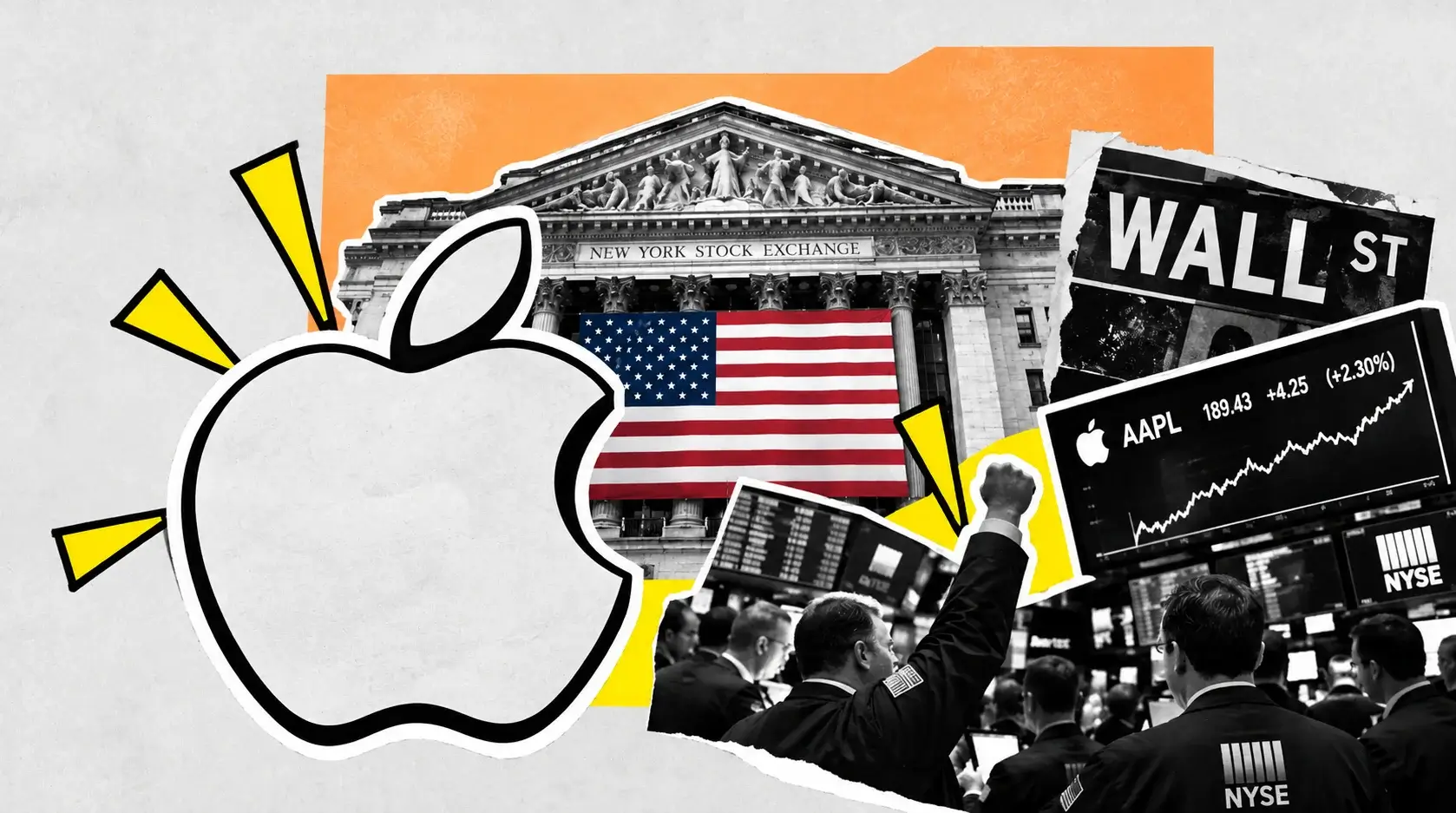
Apple (AAPL) trades at $333.38 late Friday morning, down $7.05 or 2.07% from Thursday’s $340.42 close. The stock opened weak, hit $331.22 in the first minutes of trading for a 3% loss, and has recovered a third of that. Volume is 13.86 million shares against a three-month daily average of 45.21 million. Market value is $4.865 trillion, which puts today’s decline at $103 billion.
The trigger was a supply-chain report that Apple has told suppliers to reduce component production for the iPhone 18 Pro and iPhone 18 Pro Max. October orders have been cut by at least 15% from what was originally requested, and by as much as 20% for some parts. The company is said to have turned more conservative on shipments since early September, the month the phones launched.
Context matters for a move like this. Apple closed Thursday up 1.11% on a day the Nasdaq fell 1.3%. Its 52-week high of $345.34 was set within the past few sessions. At $333.38 the stock is $11.96, or 3.5%, below that record, up 38.79% over twelve months and still ahead by a fifth year to date. It trades at 38.62 times trailing earnings.
That multiple is the real subject. A stock at 38.6 times earnings, against a five-year median of 30.98, is priced on the assumption that the product cycle is working. The iPhone was 49.6% of revenue last quarter. The Pro models are the most profitable phones Apple sells. A report that their production is being cut four weeks after launch goes directly to the assumption holding up the valuation.
There are two readings of the cut and both have evidence. One is that a $100 price increase on the Pro line, forced by soaring memory-chip costs, has run into the limit of what buyers will pay. The other is that Apple changed its launch schedule this year, releasing only premium models in September and holding the base iPhone 18 until early 2027, which shifts component volume later and makes October look soft by comparison with past cycles.
The September-quarter results due at the end of this month will not settle it, because the cut concerns October orders and the December quarter. Management’s holiday guidance will. Until then the stock is carrying a premium multiple into a period of doubt about its largest product, and the forecast that follows treats $331.22 as near-term support, with the valuation leaving room for a deeper test if guidance disappoints.
The Report: October Orders Down at Least 15%
The details of the report are narrow and specific, and they should be read that way.
Apple instructed some suppliers to scale back production of components for the iPhone 18 Pro and iPhone 18 Pro Max. Component orders for October were reduced by 15% to 20% against original plans. Multiple people in the supply chain described the change. Apple has been more cautious on shipments since early September. Demand for devices has been softer from late August into October. The company could fall short of its internal production target for the cycle if output does not accelerate.
What the report does not say is equally important. It does not say Apple has cut its full-cycle build plan. It does not give unit numbers. It covers one month of component orders for two models. Apple has not commented.
Supply-chain reports of this kind have a mixed record. Some have marked the start of a weak cycle. Others have reflected inventory adjustments, yield improvements or shifts between suppliers that had nothing to do with end demand. A component order is several steps removed from a sale at a retail counter. Apple holds weeks of parts inventory and adjusts orders constantly as its forecasts update.
The timing gives this one more weight than usual. A cut in the first full month after launch is early. In a strong cycle the pattern runs the other way: orders are raised in October as initial demand exceeds supply and lead times stretch. Shipping estimates for new Pro models have historically lengthened through the first weeks. An order cut suggests supply is catching up with demand faster than planned.
There is also a contrast with what management said in July. On the June-quarter call, the outgoing chief executive described supply constraints as a demand-forecasting issue, with the iPhone and the Mac doing far better than the company had expected. Apple guided for supply constraints to increase in the September quarter across iPhone, Mac and iPad. A company short of product in July that is cutting orders in October has seen something change in between.
What changed is the price. The iPhone 18 Pro starts at $1,199 and the Pro Max at $1,299, each $100 above last year’s equivalents. That is the first increase to Pro entry prices in several cycles, applied globally.
The market’s reaction was measured. A 2% to 3% decline on a fifth of normal volume is a repricing of risk. It is not capitulation. Had investors concluded the cycle was failing, a company with half its revenue from the iPhone would be down far more than $7.
Memory Costs: The Squeeze Behind the $100 Price Increase
The order cut is the downstream effect of a cost problem Apple has been describing for two quarters. Memory-chip prices have surged as artificial-intelligence data centers absorb supply. DRAM costs rose in every quarter of fiscal 2026 and were expected to rise again in the September quarter. A leading memory manufacturer has said the tightness is likely to persist well into 2027.
Apple’s numbers show how much it matters. In the June quarter, gross margin excluding one-time tariff refunds was 48.1%. Guidance for the September quarter is 47% to 48%, including one point of refund benefit. The chief financial officer said memory costs explain more than 100% of the 160-basis-point step down to the midpoint. Every other input moved in Apple’s favor, and memory alone more than wiped that out.
The former chief executive put it plainly on the July call: market pricing for memory was continuing to increase and could drive an increasing impact on the business.
Apple had three ways to respond. It could absorb the cost and accept lower margins. It could cut memory configurations. Or it could raise prices. It raised prices on some iPads and MacBooks in June, saying it could no longer shield customers. In September it added $100 to the Pro iPhones.
Today’s report is the first data point on how buyers reacted. If a 9% increase on a $1,099 phone produces a 15% to 20% cut in component orders, the implied elasticity is high. That would be a new condition for Apple. For most of the past decade the Pro line has shown very little price sensitivity, helped by carrier subsidies and trade-in programs that hide the sticker price inside a monthly payment.
The carrier channel deserves a closer look today of all days. AT&T, Verizon and T-Mobile sell most iPhones in the United States and fund the promotions that drive upgrades. All three are down 6% to 9.5% this morning after SpaceX agreed to buy nationwide wireless spectrum for $8 billion, a move that threatens them with a new competitor. Carriers under margin pressure tend to spend less on device subsidies. That is a second-order risk to iPhone volumes that arrived in the same session.
Macro conditions add to it. U.S. consumer sentiment fell to 46.3 in October. Gasoline is up more than a dollar a gallon in a year. A $1,199 phone is a discretionary purchase, and the households that buy Pro models, while better off than average, are not immune.
The uncomfortable implication is that Apple faces a trade-off it has avoided for years. It can protect margin with price and lose units, or protect units and lose margin. The memory market is making it choose, and the supply chain is reporting on the result.
The Staggered Launch: Why October May Look Worse Than It Is
The strongest counter to the bearish reading is a calendar change. For the first time, Apple did not launch its full iPhone range in September. It introduced the iPhone 18 Pro, the iPhone 18 Pro Max and the iPhone Duo, its first foldable, which carries the highest price of any iPhone to date. The standard iPhone 18 and an updated iPhone Air are scheduled for early 2027.
That changes the shape of the cycle. In prior years, September and October component orders covered four or five models, including the standard version that makes up a large share of unit volume. This year those months cover premium models only. Buyers who want a new iPhone at a lower price have nothing new to buy until the spring.
Some share of them will wait. A customer who would have bought a base model in October and has been considering stretching to a Pro now has a reason to hold off and see what the standard phone offers. The report itself acknowledged that softer demand since late August could be related to the change in launch schedule.
The staggered release also redistributes volume across fiscal quarters. Apple’s December quarter has always been its largest because it captured the full launch. A split launch moves part of that demand into the March and June quarters. Total units over twelve months could be unchanged while the December quarter comes in lighter than history would suggest.
For the supply chain, a plan built on the old cadence would have been too high for October. If Apple’s original orders assumed some customers would trade up from the missing base model to a Pro, and fewer did than expected, a correction of 15% to 20% in one month’s orders is plausible without the cycle being weak overall.
There is evidence on the other side too. The Duo launched on September 11 and the stock rose 3% that day. A foldable at a record price is aimed at the highest-spending customers, some of whom would otherwise have bought a Pro Max. Cannibalization within the premium tier would reduce Pro component orders while leaving Apple’s revenue per customer higher.
None of this can be confirmed from outside the company. It does mean the simple reading, that orders are down so demand is weak, skips several steps. The mix between Pro, Pro Max and Duo, the deferral of base-model buyers, and the shift of volume into 2027 all sit between the component order and the conclusion.
What investors need from management is a clear statement on how the split launch is expected to affect the December quarter against last year’s, and whether Pro demand at the new prices is tracking to plan. Apple does not usually give unit commentary. Under a new chief executive in his first earnings call, with the stock at a premium multiple, the incentive to address it is stronger than usual.
The June Quarter: Revenue of $109.4 Billion and iPhone Up 22%
The business that produced the 38.6 multiple was firing on every cylinder three months ago. Apple’s fiscal third-quarter results, for the period ended June 27, set records across the board.
Revenue was $109.4 billion, up 16% from a year earlier and above the top of the company’s own 14% to 17% growth guidance when it was given. Diluted earnings per share were $2.02, up 29% from $1.57, though that included an $0.11 benefit from tariff refunds. Net income was $29.8 billion.
iPhone revenue was $54.25 billion, up 22%. That is a striking figure for a June quarter, traditionally the weakest of the cycle because it falls nine months after launch. It reflected strength in the iPhone 17 line and the premium tier in particular. Mac revenue rose 29% to $10.35 billion on demand for the MacBook Pro and the lower-priced MacBook Neo. Services grew 12% to $30.74 billion. Wearables, Home and Accessories rose 6% to $7.9 billion. iPad was the one decliner, down 6% to $6.2 billion against a tough comparison.
Every geographic segment set a June-quarter record. Greater China contributed $18.8 billion, a record for the period though below what the market had hoped for.
Gross margin was 50.1%, the first time Apple has printed above 50%. Two points of that came from tariff refunds. The underlying 48.1% was at the midpoint of prior guidance.
Management said the installed base of active devices reached an all-time high in every product category and every region. Paid subscriptions exceeded 1.5 billion.
Two points from that quarter bear on today. The first is that Apple was supply-constrained. It sold everything it could make of several products and said it would have sold more. A company in that position has pent-up demand, which makes an October order cut harder to square with a healthy pipeline unless something changed with the new models.
The second is the comparison base. iPhone revenue growing 22% in an off-season quarter sets a high bar for the cycle that follows. The iPhone 17 pulled forward a large number of upgrades. Customers who bought a 17 Pro in the past twelve months are not in the market for an 18 Pro. A strong prior cycle is, by arithmetic, a headwind for the next.
That is the pattern Apple has shown before: a big upgrade year followed by a digestion year. If fiscal 2026 was the big year, the question for fiscal 2027 is how much growth is left once the easy upgrades are done and prices have gone up.
September-Quarter Guidance: 9% to 11% Growth and a 47% to 48% Margin
The outlook Apple gave in July already pointed to slower growth. For the fiscal fourth quarter ending in late September, the company guided to revenue growth of 9% to 11% year over year. That implies $111.7 billion to $113.7 billion, with a midpoint of $112.7 billion. The Street had been looking for $114.95 billion.
The step down from 16% growth to 10% had identifiable causes. Foreign exchange was expected to be a sequential headwind of 2.5 percentage points as the dollar strengthened. Supply constraints on advanced chips were expected to increase and to limit iPhone, Mac and iPad sales. Management was clear that demand exceeded what it could build.
Within that, iPhone revenue was guided to grow in the mid-teens, and Services at a rate similar to the June quarter after adjusting for currency. Gross margin was guided to 47% to 48%, including one point of tariff refund. Operating expenses were guided to $19.1 billion to $19.4 billion, and the tax rate to 16.5%.
Those numbers will be reported at the end of October. Because the new phones went on sale in mid-September, the quarter captures only the first two weeks of the iPhone 18 Pro and Duo. The reported order cut concerns October production and therefore December-quarter sales. A beat on the September quarter would say little about the question the market is now asking.
What matters is the December-quarter guide. Three things in it will move the stock.
First, the revenue growth range. After 16% and a guided 10%, a holiday-quarter outlook in the mid-single digits would confirm deceleration. Anything at or above 8% would suggest the Pro cut is a timing issue.
Second, gross margin. Memory costs are still rising. If the guide holds at 47% to 48% without tariff help, the price increases are doing their job. A guide below 47% would mean Apple is absorbing cost and losing units at once.
Third, the commentary on supply and demand. In July the message was that Apple could not make enough. If that has shifted to language about aligning supply with demand, the report is confirmed.
The Street’s reaction function is asymmetric at this valuation. Consensus was above guidance for September, which means estimates for December were also set optimistically. A guide that merely meets a lowered bar may not be enough for a stock at 38.6 times earnings.
This will also be the first earnings call for John Ternus, who became chief executive on September 1. New leaders often set conservative expectations early. That tendency raises the odds of a cautious outlook irrespective of the underlying trend, and the stock would have to digest it.
Services: 28% of Revenue and 42% of Gross Profit
The part of Apple that does not depend on this year’s phone is the reason the multiple is not lower. Services revenue was $30.74 billion in the June quarter, up 12%. It was 28.1% of total revenue.
Its share of profit is much larger. Services carried a gross margin of 75.6% against 40.1% for products. As a result it generated 42.4% of Apple’s gross profit from 28.1% of its sales. Each dollar of Services revenue is worth nearly two dollars of product revenue at the gross line.
That mix is the foundation of the bull case. Services revenue is tied to the installed base, which is at a record in every category, and not to unit sales in any single quarter. A customer who keeps an iPhone 16 for another year instead of buying an 18 Pro still pays for iCloud storage, still buys apps, still generates search revenue through Safari, and may still subscribe to Apple Music or TV+. More than 1.5 billion paid subscriptions sit on top of the base.
If the iPhone cycle softens, Services growth of 12% cushions the blow. A back-of-envelope case shows how. Suppose iPhone revenue were flat for a year while Services grew 12%. Total gross profit would still rise by 5%, because the high-margin line keeps compounding. That is why a 15% to 20% cut in one month’s Pro components does not threaten earnings in the way it would have a decade ago.
There are limits to the comfort. Services growth has been slowing gradually, from the mid-teens to 12%. The segment missed consensus in the June quarter, $30.74 billion against $31.22 billion expected. A portion of it rests on payments from a search partner under an arrangement that has faced legal scrutiny. And regulatory pressure on app-store commissions in Europe and elsewhere is a persistent drag.
There is also a link between hardware and Services that takes time to show. New devices drive new subscriptions, AppleCare purchases and accessory sales. A weak hardware cycle does not hurt Services this quarter. It reduces the growth rate two or three quarters later.
Artificial intelligence is the possible new leg. Apple introduced a rebuilt Siri at its developer conference in June. One line of bullish thinking holds that Apple will act as the toll collector for consumer AI, taking a share of spending that flows through its devices in the way it does with apps. If AI services are sold through the App Store or bundled into iCloud tiers, the Services line has a new source of growth that requires little capital.
That is an argument about 2027 and beyond. For the coming quarter, the relevant fact is that 42% of Apple’s gross profit is insulated from a soft October for Pro components. It is why the stock is down 2% and not 6%.
Capital Return: $25.8 Billion of Buybacks in a Quarter
Apple’s use of cash provides a second layer of support. In the June quarter the company repurchased $25.8 billion of its own stock and returned $33 billion in total including dividends. Over the first nine months of the fiscal year, buybacks came to $61.8 billion. The quarterly dividend is $0.27 a share.
Annualized, the June-quarter pace is $103 billion of repurchases. Against a market value of $4.865 trillion, that is 2.1% of the shares each year. The dividend adds 0.3%. The total cash return to shareholders runs at 2.4% of market value.
That figure is modest as a yield and significant as a flow. Apple is the largest single buyer of its own stock on any given day. A $7 decline brings that buyer more shares per dollar. The program is not price-sensitive in the short run, but it creates steady demand that most megacaps cannot match.
It also drives per-share growth independent of the business. In the June quarter, net income rose 27% and earnings per share rose 29%. The two-point gap is the buyback. Over a year, a 2% reduction in share count turns 8% profit growth into 10% earnings-per-share growth.
The comparison with other megacaps is instructive, and it has been part of Apple’s appeal in 2026. The companies building AI infrastructure are spending hundreds of billions on data centers. Apple is not. Its capital intensity is low, its free cash flow is returned and not reinvested in chips and power, and it has been rewarded for that restraint. Earlier this year it overtook Nvidia as the most valuable company for a time, with the market citing its avoidance of the capital-spending arms race.
Thursday’s AI-driven selloff showed the benefit. A report that OpenAI’s revenue run rate was $20 billion short of earlier figures sent semiconductor stocks down 3.4%. Apple rose 1.11%. It was the defensive megacap on a day investors questioned the returns on AI spending.
That status cuts both ways today. The same AI buildout Apple has avoided is the reason memory prices have surged and squeezed its margins. Apple escaped the capital cost of AI and is paying for it in components.
The balance sheet gives management room to respond. If the order cut reflects a real demand shortfall at $1,199, Apple can afford to fund more aggressive trade-in values or carrier promotions to stimulate upgrades. It can also accelerate repurchases into weakness.
For holders, the capital return programme means the downside in a soft cycle is cushioned by a company retiring 2% of its shares a year. It does not justify the multiple. It does make a derating slower and shallower than it would be for a company that needed its cash.
Read More
-
Yen Stalls at 160 Despite a 3% JGB and Tokyo Core CPI at 2.0% — Intervention Sits at 164, Friday's Payrolls Decide
02.09.2026 · TradingNEWS ArchiveEnergy
-
Robolox Recovers 18% From $41.18 as Bookings Bar Sits at $1.65B — Upside to $65 if Q3 Beats
09.10.2026 · TradingNEWS ArchiveStocks
-
XRP ($1.38) Slips Below Its 50-Day Average at $1.42 While Fund Buyers Keep Adding — 200-Day at $1.28 Is the Floor
09.10.2026 · TradingNEWS ArchiveCrypto
-
WTI ($91.63) Erases a 1.1% Loss on Gulf Shut-Ins, Brent Holds $100 After Iran Pledge — $104.26 in View Above $95.06
09.10.2026 · TradingNEWS ArchiveCommodities
-
S&P 500 +26 Points, Nasdaq +0.40%, Dow +0.34% as HUM Hits $433.77 and T Drops 6.81%
09.10.2026 · TradingNEWS ArchiveMarkets
-
Sterling Steady at 1.3240 After 5 Tests of 1.3182 as BoE Hike Bets Hit 85% — Budget on October 28 Decides the Break
09.10.2026 · TradingNEWS ArchiveForex
Valuation: 38.6 Times Earnings Against a 31 Median
The numbers that matter for the forecast are these. At $333.38 and 38.62 times trailing earnings, Apple has earned $8.63 a share over the past twelve months. Its five-year median multiple is 30.98.
Apply the median to current earnings and the stock would trade at $267. That is 20% below today’s price. One valuation model built on historical multiples, growth and estimates puts fair value at $288.10, which is 13.6% lower. At 35 times earnings, a midpoint between the median and today’s multiple, the price would be $302.
Those are not predictions. They show how much of the current price rests on the market’s willingness to pay more for Apple’s earnings than it has on average, and what happens if that willingness fades.
Why has the multiple expanded? Three reasons account for most of it. Earnings growth accelerated to 29% in the June quarter, well above the long-run trend. The Services mix keeps rising, and Services deserve a higher multiple than hardware. And Apple became the favored megacap for investors who wanted technology exposure without AI capital-spending risk.
Each of those is now in question to some degree. Earnings growth is guided to slow, with revenue growth dropping from 16% to 10% and margins compressing 160 basis points. Services growth is 12% and decelerating. And the capital-light premium depends on Apple’s hardware cycle holding up, which is what today’s report challenges.
Run the earnings arithmetic forward. If fiscal 2027 earnings grow 10%, to $9.50 a share, and the multiple holds at 38.6, the stock is worth $367 in a year, a 10% gain. If earnings grow 10% and the multiple slips to 34, the stock is worth $323, a 3% loss. If earnings grow 5% and the multiple falls to 31, the stock is worth $281, a 16% loss.
The asymmetry is visible. Upside requires both growth and a stable premium multiple. Downside requires only one of them to disappoint.
Compare with the nearest megacap. Nvidia trades at 30.03 times trailing earnings with a market value of $5.569 trillion. Apple, at 38.62 times, is the more expensive stock on trailing earnings despite slower growth. The gap between the two companies’ market values is $704 billion.
Interest rates add pressure. The 10-year Treasury yields 5.27%. Apple’s earnings yield at this price is 2.6%. An investor accepts half the Treasury yield in exchange for growth and buybacks. That trade has worked. It leaves little cushion.
Year to date the stock had gained 22% through Thursday. Strong runs into a product cycle reduce the buffer for disappointment, and Apple had no buffer in its multiple to begin with.
Suppliers and Read-Through: Skyworks Down 6%, Qualcomm Down 1%
The supply chain took the news harder than Apple did, which is how these episodes usually go.
Skyworks Solutions (SWKS) fell 5.89% to $75.99, having been down as much as 6.41%. The company supplies radio-frequency front-end components for the iPhone, and Apple is its largest customer. Its revenue tracks handset unit volumes and dollar content per device. On its July call, management had guided for a seasonal mobile ramp tied to new launches at that customer. Skyworks was up 27% year to date before today, so it too had little margin for bad news.
Qualcomm (QCOM) slipped 1.14% to $174.01 after starting the session higher. It sells modems and processors to a broader customer base and said in July that its share in new iPhone launches was materially lower, as Apple moves to in-house modems. Its exposure to any single iPhone program is shrinking. The stock is up 5% this year.
The broader chip sector did not follow. The iShares Semiconductor ETF (SOXX) was down 0.72% at $559.20 after rising in early trading, and the Invesco QQQ Trust (QQQ) was up 0.35% at $750.18 even with Apple among its largest holdings. The market is treating the news as specific to the handset chain.
A separate disclosure today points the same direction for consumer hardware generally. HP (HPQ) fell 6.04% after a regulatory filing showed its preliminary planning assumes a mid-single-digit percentage decline in global PC unit volumes in 2027. Memory and storage costs are the common factor. Two device makers signaling weaker units on the same morning suggests component inflation is now reducing demand across consumer electronics.
That matters for Apple’s Mac business, which grew 29% last quarter. If the PC market contracts in 2027, the Mac has been gaining share and could continue to. It is still selling into a shrinking pool.
The confirmation to watch for is from other suppliers. Assemblers, display makers, camera-module vendors and chip foundries report monthly sales in Asia. If October revenue at several of them shows a drop consistent with a 15% to 20% cut in Pro components, the report is verified. If their numbers hold, the cut may be narrower than described or limited to specific parts.
The largest contract chipmaker reported quarterly revenue of $46.7 billion this week, driven by AI demand. That company makes Apple’s processors as well. Its commentary on smartphone-related demand, when it comes, will be a useful cross-check.
For investors who want exposure to the iPhone cycle, the supplier reaction is a reminder of leverage. Apple has Services and buybacks to dampen a hardware miss. Skyworks does not. A 2% move in Apple became a 6% move in its radio-frequency supplier.
Competitive Position: A New CEO, a New Siri and the $704 Billion Gap to Nvidia
Apple enters this period with a leadership change and an AI strategy that is still being proven. John Ternus took over as chief executive on September 1 after running hardware engineering. The June quarter was the last presented by his predecessor. The September-quarter call will be his first.
A hardware executive at the top is a statement about priorities. The iPhone Duo, the staggered launch and the pricing decisions all reflect a willingness to change a formula that had been stable for years. Those are larger product bets than Apple has made in some time. Today’s report is the first piece of evidence on how one of them is landing.
On AI, Apple has taken a different path from its peers. It has not built frontier models or spent at the scale of the hyperscalers. It introduced a rebuilt assistant at its June developer conference and has leaned on partnerships. After several years in which its AI efforts were seen as behind, the company now has a product in market and a strategy the bulls can describe: own the device, own the distribution, and collect a share of what consumers spend on AI through it.
That view depends on the installed base. Apple’s is at a record. If AI features are what drive the next wave of upgrades, older devices that cannot run them create a replacement cycle. That was part of the thesis for the iPhone 17’s strong year. Whether the 18 Pro offers enough beyond the 17 Pro to justify $1,199 is what the order data is beginning to answer.
Against Android competitors, Apple’s position in the premium segment is as strong as it has been. Samsung and the Chinese manufacturers face the same memory costs and have less pricing power. If Apple is seeing elasticity at the high end, its rivals are seeing more. The risk is not share loss. It is that the whole premium smartphone market shrinks as prices rise, which industry forecasts for 2026 already assume.
In China, Apple’s $18.8 billion June quarter was a record for the period and below expectations. Domestic brands have recovered ground. A $100 increase lands differently in a market where local alternatives at half the price have closed much of the feature gap.
The scoreboard against Nvidia captures the market’s current preference. Nvidia is worth $5.569 trillion and Apple $4.865 trillion, a gap of $704 billion. Apple held the top spot earlier this year when investors rotated toward companies not exposed to AI capital spending. It lost it as chip demand kept surprising to the upside.
Regaining it would require either a setback for AI infrastructure or proof that Apple can grow earnings at a mid-teens rate through a soft hardware cycle. Thursday showed the first is possible. Today’s news makes the second harder to argue.
The Tape: Light Volume, a 3% Low and a Record Just Above
Price action offers a few useful markers, though the day’s volume counsels against reading too much into them.
The session low of $331.22 came at 9:31 a.m., one minute after the open. That was the 3% decline. From there the stock recovered to $334.99, a 1.60% loss, before settling at $333.38. Premarket trading had ranged between $332 and $335, with a print of $334.89 early on. The stock found buyers where the first wave of sellers was done.
Volume of 13.86 million shares by late morning is on pace for a session below the 45.21 million average. A decline on light volume, in a stock that hit a record within the week, is consistent with holders marking the price down and not with institutions exiting.
Resistance is plain. Thursday’s close of $340.42 is the first level, and the gap between it and today’s open is unfilled. The 52-week high of $345.34 is the second. The stock approached $345 before this report and was turned back. A close above $345.34 would be a new record and would require the order-cut story to be discredited.
Support starts at $331.22. Below that, the round number of $330 and then $320 are the next references. The valuation-derived levels of $302, at 35 times earnings, and $288, the model fair value, are where longer-term buyers would have a stronger case. The 52-week low of $243.42 is not in play.
The pattern over the past year has been a steady advance: up 38.79% in twelve months. Pullbacks have been shallow and bought. That history is why a 2% dip did not turn into a 5% one.
Relative strength tells the more interesting story this week. On Thursday, Apple gained 1.11% while the Nasdaq lost 1.3%, a 2.4-point outperformance. Today it is down 2.07% while the Nasdaq is up 0.40%, a 2.5-point underperformance. The stock has moved opposite to the index on consecutive days. Money left AI hardware for Apple on Thursday and went back on Friday.
That rotation is a feature of Apple’s current role in portfolios. It is the megacap investors own when they are worried about AI. When that worry eases, as it did overnight after OpenAI’s revenue outlook was clarified, Apple loses relative demand even without bad news of its own. Today it had both.
The market backdrop is mixed. The S&P 500 is up 0.34% at 7,791.71. The VIX is 15.02. The 10-year yield is rising. Wednesday’s inflation report could move growth stocks across the board in either direction.
The earnings date at the end of the month is the event that defines the next leg. Until then, the range to respect is $331 to $345.
Forecast and Verdict: Hold, With $331 Support and a Better Entry Near $302
The bull case is built on durability. Services produce 42% of gross profit at a 75.6% margin and are growing 12%. The installed base is at a record. Buybacks retire 2% of the shares a year. The June quarter delivered 16% revenue growth and 29% earnings growth. The staggered launch offers a plausible explanation for soft October orders. And Apple is the megacap that benefits when investors doubt AI spending.
The bear case is built on price, in both senses. Apple raised Pro iPhone prices by $100 and its suppliers are reporting a 15% to 20% cut in October components. Memory costs are compressing gross margin by 160 basis points and are expected to stay high into 2027. Revenue growth is guided to slow from 16% to 10%. Carriers that fund upgrades are under pressure. Consumer sentiment is at 46.3. And the stock trades at 38.6 times earnings against a 31 median, with a Treasury yield at 5.27%.
On balance, the company is in better shape than the stock price implies it needs to be, and the stock price implies a lot. The business can absorb a soft Pro cycle. The multiple may not.
The base case into earnings is a range of $325 to $345. The stock holds above $331 if no further supply-chain reports confirm the cut, and drifts toward $325 if they do.
The bullish path needs management to attribute the order change to launch timing, guide December-quarter revenue growth at 8% or better, and hold gross margin at 47% or above. That would send the stock through $345.34 to a new record, with $367 a reasonable twelve-month objective on 10% earnings growth at the current multiple.
The bearish path is a December guide in the mid-single digits with margin below 47% and language about aligning supply with demand. That would begin a derating toward 35 times earnings, or $302, and could extend to $288.
On rating, Apple at $333.38 is a hold. Existing positions are supported by cash returns and the Services base, and there is no reason to sell a company of this quality on one month of component data. New money has a poor entry here: $12 of upside to the record against $31 of downside to 35 times earnings. The better price to add is $300 to $305, where the multiple has corrected and the capital return yield is higher.
For those who must own it now, position size should reflect an earnings report in three weeks under a new chief executive with the first real question about pricing power in years.
The stance is neutral. Apple has earned its premium over a long period, and one supply-chain report does not take it away. The stock is priced as though that premium cannot shrink, and October’s orders suggest it can.