
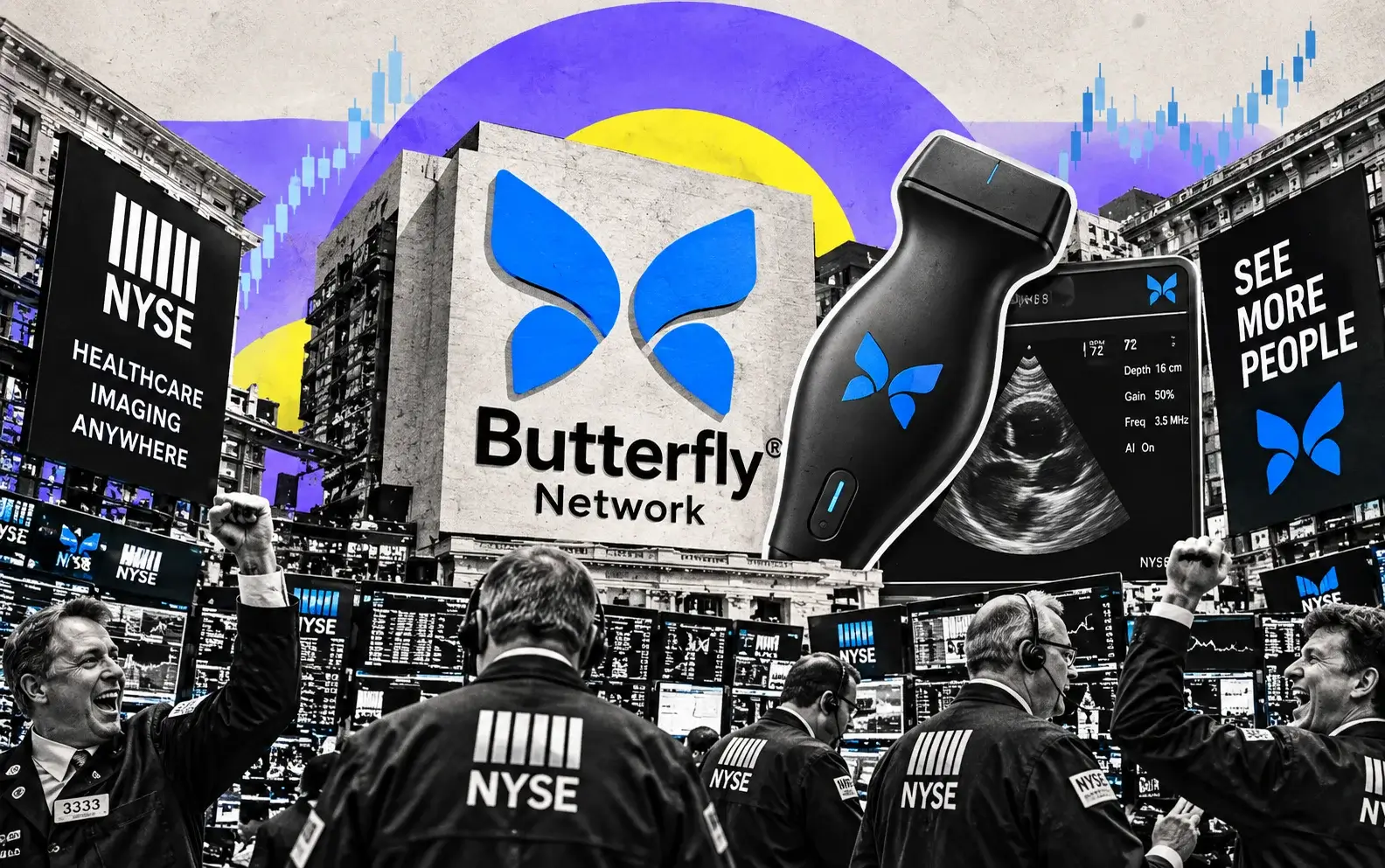
BFLY ($9.58) Reprices as Chip Platform as Embedded Revenue Jumps 150% — $11.00 on a Breakout
Butterfly's software and licensing revenue surged to $16.89M as 11 Embedded partners build on its Ultrasound-on-Chip platform | That's TradingNEWS
Key Points
- BFLY rose 17.81% to $9.58, trading 4.9% below its $10.05 52-week high after new buy-rated coverage.
- Q2 revenue hit a record $32.6M, up 39%, as software and licensing revenue jumped 150% to $16.89M.
- A close above $10.05 targets $11.00, while a close below $8.20 fills the gap and flips the bias.
Butterfly Network (NYSE: BFLY) traded at $9.58 on Tuesday, September 22, up 17.81% on the session, and held at $9.555 at 12:24 p.m. ET. The move added $1.45 per share to Monday's close of $8.13 and lifted the stock to within $0.47 of its 52-week high of $10.05. On Monday, the shares traded in a tight $7.83–$8.20 band on 4.19 million shares, below the 4.52 million daily average. Tuesday's surge broke that range decisively.
The catalyst was fresh sell-side coverage initiated with a buy rating and a 12-month price target of $10. The valuation model behind it uses a sum-of-the-parts approach worth 16 times estimated 2027 enterprise value to sales. The bull case rests on Butterfly's proprietary chip-based ultrasound technology, which the new coverage argues can open markets well beyond ultrasound's traditional footprint.
The thesis for this forecast is direct. Butterfly is no longer trading as a handheld ultrasound device company. It is trading as a semiconductor platform with licensing economics. The second-quarter numbers prove the shift: software and other services revenue jumped 150% to $16.89 million, driven by Butterfly Embedded partnerships, while product revenue fell 5.4% to $15.72 million. Gross margin hit 71.4%, up 770 basis points, because licensing revenue carries much higher margins than probe sales. The market is paying for that platform story, and the price now assumes it keeps working.
The scale of the rerating is extreme. The 52-week low is $1.81. At $9.58, the stock is up 429% from that level. At Tuesday's price, with 264.4 million Class A and Class B shares outstanding, Butterfly carries a market value of $2.53 billion. Net of $124.7 million in cash, enterprise value is $2.41 billion. Against the midpoint of 2026 revenue guidance, $121 million, that is 19.9 times current-year sales.
The momentum is real and backed by fundamentals. Second-quarter revenue of $32.6 million grew 39%, beat the top of guidance and set a record. Management raised full-year guidance to $119 million to $123 million. Adjusted EBITDA loss narrowed 78% to $1.4 million.
The risk is equally clear. At nearly 20 times sales, the stock prices in years of successful Embedded licensing. Third-quarter guidance of $26 million to $30 million sits below the $32.6 million second quarter. The company burned $30.2 million in operating cash in the first half.
The forecast bias is bullish with tight risk control. A daily close above $10.05 opens $11.00. A close below $8.20 fills the gap and invalidates the breakout.
Tuesday's Tape: From an $8.13 Close to $9.58 on a Coverage Initiation
The session's structure shows how quickly buyers responded, and it sets the levels traders need to watch.
Butterfly closed Monday at $8.13 after trading between $7.83 and $8.20. Volume came in at 4.19 million shares, below the 4.52 million average, a sign of consolidation rather than conviction. The stock had spent September trading between $7.02 and $9.69, with an earlier September range of $7.06 to $8.50. On September 11, it traded at $7.33, up 2.95% on the day.
Tuesday's coverage initiation broke that range. By 12:10 p.m. ET, the stock was up 17.81% at $9.58. By 12:24 p.m. ET, it held at $9.555. That puts BFLY above the $9.69 one-month high intraday reference and within 4.9% of the $10.05 52-week high.
The size of the move reflects the stock's volatility. Butterfly carries a beta of 2.31, meaning it tends to move more than twice as much as the broader market. Its daily volatility runs near 4.5%. A 17.81% gain is a four-standard-deviation day. It also has elevated short interest compared with other stocks, which means a sharp rally forces short sellers to cover, adding buying pressure.
The broader market offered no help. The S&P 500 was flat on Tuesday, the Dow was down more than 200 points and financials were selling off after the Federal Reserve's first rate hike since 2023. Healthcare equipment stocks showed no sector-wide rally. BFLY's move is entirely company-specific.
The context matters for traders. The $10 price target set by the new coverage sits just 4.4% above Tuesday's price. That means the stock has already priced in most of the stated upside on the day of initiation. When a stock moves this close to a new target in a single session, the next leg depends on whether other investors see more upside than the initiating firm does.
The first test is whether BFLY holds above $9.00. The second is the $10.05 52-week high. A close above that level would put the stock at a new 52-week high and open room above, since there is no overhead resistance from the past year. A failure near $10.05 would create a double top against the prior high.
On the downside, Monday's $8.20 high is the gap level. If the stock closes back below $8.20, the Tuesday gap is filled and the move becomes a one-day spike.
Q2 Results: Record $32.6 Million in Revenue and a 71.4% Gross Margin
The second-quarter report is the fundamental base for the rerating, and the details show both the strength and the shift in the business.
Butterfly reported total revenue of $32.6 million for the quarter ended June 30, 2026, up 39% from $23.4 million a year earlier. It was record revenue and came in above the top of the company's $27 million to $31 million guidance range. U.S. revenue rose 57% to $27.6 million. International revenue fell 14% to $5.0 million because of lower probe sales to distribution partners, partly offset by the company's new entry into Brazil.
The revenue mix is the key detail. Product revenue, mainly probe sales, fell to $15.72 million from $16.62 million, a 5.4% decline. Software and other services revenue surged to $16.89 million from $6.76 million, a 150% gain. For the first time, services and licensing revenue made up more than half of total revenue. The driver was Butterfly Embedded, including its co-development partnership with Midjourney.
That mix shift explains the margin jump. Gross profit rose to $23.3 million from $14.9 million, and gross margin climbed to 71.4% from 63.7%. The company attributed the gain to the higher margin on Embedded licensing revenue and to lower software amortization costs. Depreciation and amortization fell to 2.1% of revenue from 4.9%.
Profitability improved sharply. Adjusted EBITDA loss narrowed to $1.4 million from $6.2 million, a 78% improvement. Net loss narrowed to $12.9 million from $13.8 million. GAAP earnings per share were a loss of $0.05, compared with a loss of $0.06. Adjusted EPS was a loss of $0.01, compared with a loss of $0.03.
Operating expenses rose 19% to $37.0 million. Excluding stock-based compensation and other items, they rose to $26.3 million from $23.1 million, reflecting headcount growth in product and software development. Stock-based compensation was $7.0 million in the quarter.
For the first half, revenue reached $59.1 million, up from $44.6 million. Gross margin was 70.3%. Adjusted EBITDA loss was $7.5 million, compared with $15.2 million a year earlier.
The full second-quarter release shows a company moving from a hardware model toward a licensing model. That is the core of the investment case, and it is also the core of the risk.
Butterfly Embedded: 11 Partners, Midjourney and the Ultrasound-on-Chip Licensing Model
Butterfly Embedded is the engine behind the rerating, and it deserves a detailed look because it now drives most of the company's growth.
Embedded is Butterfly's licensing and co-development business. It lets third-party companies build ultrasound-enabled products on Butterfly's proprietary Ultrasound-on-Chip semiconductor and software platform. Partners pay through co-development fees, revenue shares, chip purchases or chip licensing. Butterfly's core advantage is its semiconductor design: instead of the piezoelectric crystals used in traditional ultrasound, it puts the ultrasound transducer on a silicon chip. That makes the technology cheaper to produce, smaller and easier to integrate into new devices.
The partner count is growing. Butterfly added two new partners in the second quarter, bringing the total to 11. Two partners publicly unveiled products built on the platform during the quarter. Midjourney, known for AI image generation, announced a full-body ultrasound scanner. Aleph Neuro unveiled brain images captured with the technology. Those announcements drew global attention, according to CEO Joseph DeVivo, and validated the idea that Butterfly's chip can enable applications far outside traditional point-of-care ultrasound.
The Midjourney relationship is the largest near-term contributor. U.S. revenue growth of 57% was primarily driven by Embedded revenue, including the Midjourney co-development partnership. The balance sheet shows the effect: current deferred revenue fell to $15.5 million at June 30 from $26.9 million at the end of 2025, as the company recognized revenue it had been paid in advance.
That creates the key question for the stock. Co-development revenue can be lumpy. It depends on milestones and contract timing, not recurring sales. If Embedded revenue in the second quarter included one-time recognition of deferred amounts, it may not repeat at the same level. Third-quarter guidance of $26 million to $30 million, below the second quarter's $32.6 million, suggests some of that revenue was front-loaded.
The long-term opportunity is what the market is buying. The new coverage argues that Butterfly's chip opens markets well beyond ultrasound's traditional footprint. If Embedded partners move from development to commercial products, Butterfly would earn ongoing chip sales and revenue shares. That would turn one-time co-development fees into recurring, high-margin revenue.
The company's roadmap supports that path. Butterfly is developing its P5 chip, the Apollo chip and fourth-generation technology. The P5.1 probe, with improved cardiac imaging, is on track for a first-quarter 2027 launch.
For the forecast, Embedded is both the reason to own the stock and the main source of volatility. Each partner announcement can move the shares sharply.
Raised Guidance: $119 Million to $123 Million in 2026 Revenue
The company's outlook frames what the market expects over the next two quarters.
After the second quarter, Butterfly raised its full-year 2026 revenue guidance to $119 million to $123 million, representing growth of 22% to 26%. The prior guidance, issued with first-quarter results, was $117 million to $121 million, or 20% to 24% growth. The raise lifted the midpoint by $2 million to $121 million.
The company also improved its adjusted EBITDA guidance to a loss of $19 million to $23 million for the year. Through the first half, adjusted EBITDA loss was $7.5 million. That implies a second-half loss of $11.5 million to $15.5 million, which means losses will widen from the second quarter's $1.4 million.
The third-quarter outlook is the near-term test. Butterfly guided third-quarter revenue of $26 million to $30 million, about 30% growth year over year at the midpoint. It guided an adjusted EBITDA loss of $6 million to $9 million. Both figures are weaker than the second quarter's $32.6 million in revenue and $1.4 million EBITDA loss. The sequential decline reflects the lumpy timing of Embedded revenue.
The fourth quarter carries the rest of the year. To hit the $121 million midpoint, with $59.1 million in the first half and $28 million at the third-quarter midpoint, the fourth quarter needs $33.9 million. That would be a new record. The company expects its Home and Community Care business to start generating revenue in the fourth quarter, after its first commercial implementation in the second half.
The track record supports the guidance. In the first quarter, Butterfly delivered $26.5 million in revenue, up 25%, above consensus, with a 69% gross margin. In the second quarter, it beat the top of its range. The company has beaten guidance two quarters in a row and raised its outlook once.
The next report comes on October 29. It will show whether third-quarter revenue lands at or above the $30 million top of the range, whether Embedded revenue holds up without large deferred revenue recognition, and whether the fourth-quarter ramp is on track. A beat and raise would support the stock's move toward and above $10.05. A miss or a cut would test the $8.20 gap level quickly.
For the forecast, the guidance is credible but back-end loaded. The stock has priced in success. The October 29 report is the next major checkpoint.
The Other Growth Engines: Compass AI, FedRAMP, Education and Home Care
Butterfly describes itself as a multi-engine growth company, and the non-Embedded businesses matter because they provide the recurring revenue base.
The point-of-care ultrasound business, known as POCUS, is the core. It sells the Butterfly iQ3, the company's best-selling, third-generation handheld probe, which covers the whole body with a single device. Probe sales to health systems, medical schools and e-commerce customers rose in the second quarter, even as international distribution sales fell.
Enterprise software is the second engine. Butterfly signed six new enterprise software agreements in the quarter and expanded its Compass AI software pipeline year over year. Compass AI is the company's enterprise workflow solution, which helps hospitals manage and document ultrasound exams. Software revenue is recurring and high-margin, which supports the gross margin gains.
Government is the third engine. Butterfly received provisional authorization to sell across the U.S. Department of Veterans Affairs and is on track to achieve FedRAMP certification in the third quarter of 2026. FedRAMP is the federal security standard for cloud services. Certification would open sales to a broader range of federal agencies.
Medical education is the fourth. Butterfly closed four new medical education partners in the quarter, including a long-term partnership with VCOM, a medical school. The strategy is to put Butterfly probes in the hands of medical students and follow them into residency and practice. That builds brand loyalty early in a physician's career.
The Butterfly Garden marketplace is the fifth. It lets third-party developers build imaging AI apps on Butterfly's platform. The company added a partner focused on precision needle-guidance AI and expects three existing partner tools to become commercially available by year-end.
Home and Community Care is the sixth. Butterfly prepared its first commercial implementation for the second half of 2026 and expects revenue in the fourth quarter. It is the company's first move beyond hospitals and clinics into home-based and community care settings.
International expansion rounds it out. Butterfly received regulatory authorization in Brazil, one of the world's largest and fastest-growing ultrasound markets.
For the forecast, these engines matter because they diversify revenue away from lumpy Embedded contracts. If FedRAMP certification arrives in the third quarter and Home Care revenue starts in the fourth, the company would have more predictable growth drivers heading into 2027.
Balance Sheet and Cash Burn: $124.7 Million in Cash, $30.2 Million Burned in H1
The balance sheet is the constraint on Butterfly's growth story, and it matters for anyone valuing the stock.
Butterfly ended the second quarter with $124.7 million in cash and cash equivalents, down from $150.5 million at the end of 2025. Including restricted cash, the total was $128.7 million. The company carries no traditional debt on its balance sheet. Total liabilities were $93.6 million, mostly accrued expenses, deferred revenue and lease obligations.
Cash burn accelerated in the first half. Net cash used in operating activities was $30.2 million in the first six months of 2026, up from $18.8 million a year earlier. The increase came from working capital. Accounts receivable rose by $8.6 million as revenue grew. Prepaid expenses rose by $9.6 million. Deferred revenue fell by $10.6 million as the company recognized advance payments from Embedded partners. That last item is important. Butterfly received cash for co-development work before it recognized the revenue, so part of the second quarter's reported revenue did not bring in new cash.
Capital expenditure was modest at $1.9 million in the first half. The company raised $6.3 million from stock option exercises and its employee stock purchase plan.
At the first-half pace of $32.1 million in combined operating and investing cash use, Butterfly's $124.7 million in cash would last roughly two years. The full-year adjusted EBITDA loss guidance of $19 million to $23 million points to a slower burn in operating terms, but working capital swings can change that.
The share count is the other side of the balance sheet. Class A shares outstanding rose to 237,995,479 at June 30 from 227,318,426 at the end of 2025, a 4.7% increase in six months. Class B shares stayed at 26,426,937. Weighted average shares rose to 262.1 million from 248.4 million a year earlier. In the first half of 2025, the company raised $81.0 million in a share offering. Dilution through stock compensation and potential future raises is a structural cost to shareholders.
The stock's rally changes the financing picture. At $9.58, Butterfly could raise capital at a much higher price than a year ago, reducing dilution per dollar raised. Companies that have run from under $2 to near $10 often use strength to raise cash. That is a risk for current shareholders in the near term, and a support for the business long term.
Insider activity offers a counterweight. Director Phanstiel bought $1.0 million of stock, a signal of insider confidence.
Read More
-
Yen Stalls at 160 Despite a 3% JGB and Tokyo Core CPI at 2.0% — Intervention Sits at 164, Friday's Payrolls Decide
02.09.2026 · TradingNEWS ArchiveEnergy
-
Nasdaq Extends Record at 27,222, S&P 500 Holds 7,767, Dow Slides 0.40% as SCHW Drops 5.70%
22.09.2026 · TradingNEWS ArchiveStocks
-
XRP-USD ($1.5176) Tests Multi-Month Ceiling as ETF Inflows Reach $1.68B With Zero Outflow Days — $1.60 Next
22.09.2026 · TradingNEWS ArchiveCrypto
-
Brent ($97) Extends 4-Day Slide From $108 Peak as Saudi Hormuz Exports Hit 2.9M bpd — $91 Next on a Deal
22.09.2026 · TradingNEWS ArchiveCommodities
-
GBPUSD Capped Below 1.3440 EMA Cluster as Record £8.8B Debt Interest Hits Sterling — 1.3250 in View
22.09.2026 · TradingNEWS ArchiveForex
Valuation: 19.9 Times 2026 Sales After a 429% Run From the Low
The valuation is the biggest question for the stock at $9.58, and the numbers show how much optimism is priced in.
At Tuesday's price, Butterfly's 264.4 million shares give it a market value of $2.53 billion. Subtracting $124.7 million in cash leaves an enterprise value of $2.41 billion. Against the $121 million midpoint of 2026 revenue guidance, that is 19.9 times current-year sales. Against the trailing first-half revenue of $59.1 million annualized to $118.3 million, it is 20.4 times.
For comparison, the new coverage values the stock at 16 times estimated 2027 enterprise value to sales. At that multiple, a $2.41 billion enterprise value implies 2027 revenue of $150.6 million, 24.5% growth over the 2026 midpoint. That growth rate is consistent with the company's recent pace. But it means the stock already trades near the target multiple on next year's numbers.
The multiple reflects the platform story. Traditional medical device companies trade at a few times sales. Semiconductor and software platforms with high gross margins and licensing revenue can trade at much higher multiples. Butterfly's 71.4% gross margin and 150% growth in services and licensing revenue support a platform valuation. The question is whether that licensing revenue is recurring or one-time.
The stock has already priced in a lot. It has risen 429% from its 52-week low of $1.81. At the time of an earlier review, the company scored poorly on valuation and very strongly on momentum. That combination is typical of stocks in a narrative-driven rerating. Momentum can carry prices well above fundamental value for extended periods. When momentum breaks, the correction is sharp.
The price-to-earnings ratio is negative at -27.70, because the company is not profitable. That makes traditional earnings-based valuation irrelevant for now.
The comparison with the company's own history is instructive. At the start of 2025, the stock traded near $3.12, and it traded as low as $1.94 in April 2025 with a market value of $478.5 million. Since then, revenue has grown and margins have expanded, but the market value has grown more than fivefold. Most of the gain reflects a change in how investors value the company, not a change in its size.
The valuation rule for the forecast: at 19.9 times sales, the stock needs continued Embedded wins and a clean October 29 report to hold its level. A disappointment could compress the multiple quickly.
Sector and Competition: Handheld Ultrasound Versus the Chip Opportunity
Butterfly competes in two different markets, and its valuation depends on which one investors focus on.
In handheld point-of-care ultrasound, Butterfly faces established medical device giants and smaller specialists. GE HealthCare and Philips both sell handheld ultrasound devices, backed by large sales forces and hospital relationships. Several private companies also compete with portable probes. In that market, Butterfly's advantage is its single-probe, whole-body design and its low price, which comes from its chip-based technology. Its disadvantage is scale. Its second-quarter product revenue of $15.72 million fell 5.4% year over year, and international probe sales dropped 14%. The core device business is not growing.
In semiconductor-based ultrasound licensing, Butterfly has a much more unusual position. Few companies have a commercialized ultrasound-on-a-chip platform that third parties can build on. That is the market the new coverage focuses on, arguing the chip opens doors well beyond traditional ultrasound. The 11 Embedded partners, including Midjourney and Aleph Neuro, show demand from companies outside the traditional medical device industry.
The macro backdrop for medical technology is mixed. Hospital budgets are under pressure from inflation and higher interest rates. The Federal Reserve raised rates to 3.75%–4.00% on September 16, and the 10-year Treasury yield sits at 4.96%. Higher rates raise the cost of capital for unprofitable growth companies like Butterfly, which rely on future cash flows for their valuations. Growth stocks broadly have held up, with the Nasdaq Composite at a record 27,122.09 on Monday, but high-multiple small caps are vulnerable to rate shocks.
The reimbursement environment also matters. On Tuesday, Quest Diagnostics fell 6.08% after the Centers for Medicare & Medicaid Services proposed cuts of up to 15% to laboratory fee payments starting January 1, 2027. That does not affect Butterfly directly, but it shows that federal healthcare payment policy can move quickly. Butterfly's government sales push, including its Veterans Affairs authorization and FedRAMP certification, ties part of its growth to federal budgets.
The AI connection is a tailwind. Butterfly positions itself as a leader in semiconductor-based ultrasound, programmable cloud software and AI. Its Garden marketplace hosts AI imaging apps, and Midjourney's involvement links it to the AI trade that drove the Nasdaq to records this week. That association can attract momentum capital.
For the forecast, Butterfly's valuation depends on investors viewing it as a chip platform. If the market refocuses on flat probe sales, the multiple would compress.
Technical Picture and Key Levels: $10.05 Resistance, $8.20 Gap Support
The chart structure is clear, and Tuesday's move set up a decisive test.
Before Tuesday, BFLY traded in a September range between $7.02 and $9.69. It consolidated in the $7.33–$8.50 area through most of the month, with earlier technical support at $7.33 and resistance near $7.97. On Monday, it closed at $8.13 after trading between $7.83 and $8.20.
Tuesday's gap broke the consolidation. The stock jumped to $9.58, clearing Monday's $8.20 high and moving above most of the September range. The move was a breakaway gap on a fundamental catalyst.
The upside map has one major level. The 52-week high of $10.05 is the key resistance. It sits 4.9% above Tuesday's price. A daily close above $10.05 would put the stock at a new 52-week high with no overhead supply from the past year. That is a clean technical breakout. The measured move from the September range, which spanned $2.67 from $7.02 to $9.69, projects a target near $12.72 on a full breakout, but that is an extended projection. A more conservative first target is $11.00, which is 14.8% above Tuesday's price.
The $10.00 round number sits just below the high and also matches the new price target. Many holders who follow that target may take profits there, creating supply. That makes the $10.00–$10.05 zone a strong ceiling in the near term.
The downside map has three levels. The first is $9.00, a round number and the first support after Tuesday's move. The second is $8.20, Monday's high and the top of the gap. A daily close below $8.20 would fill the gap and signal that the breakout failed. The third is $7.33–$7.83, the support zone that held through September. Below that, $7.02, the September low, is the last line before the uptrend from the summer is in question.
Momentum and volatility shape the trading plan. With a beta of 2.31 and daily volatility near 4.5%, the stock can move $0.40–$0.50 in a normal session. Traders need wider stops than they would use for a large-cap stock. Elevated short interest adds the potential for continued squeezes on good news, but it also means sellers are positioned against the stock.
The level rule: above $8.20, the breakout holds. Above $10.05 on a daily close, the next leg opens toward $11.00. Below $8.20, the gap fails and $7.33–$7.83 comes back into play.
Risks: Lumpy Embedded Revenue, a Sequential Q3 Dip and Dilution
The bullish case depends on the Embedded platform working at scale, and the risks are specific.
The first risk is revenue quality. Second-quarter U.S. revenue growth was driven mainly by Embedded revenue, including the Midjourney co-development partnership. Current deferred revenue fell from $26.9 million to $15.5 million in six months as the company recognized advance payments. Co-development revenue is milestone-based and lumpy. If a large share of second-quarter revenue was one-time recognition, the $32.6 million record will not repeat soon. The third-quarter guidance of $26 million to $30 million confirms a sequential decline.
The second risk is the core device business. Product revenue fell 5.4% to $15.72 million. International revenue fell 14% to $5.0 million. The handheld ultrasound business, which built the company's brand, is not growing. If Embedded revenue slows, there is no fast-growing core business to support the valuation.
The third risk is dilution. Class A shares rose 4.7% in the first half of 2026. The company raised $81.0 million in a share offering in the first half of 2025. With $124.7 million in cash and a first-half burn of $30.2 million from operations, Butterfly has runway. But companies that rally from under $2 to near $10 often raise capital. A secondary offering near current prices would dilute shareholders and pressure the stock.
The fourth risk is valuation. At 19.9 times 2026 sales, the stock prices in years of successful execution. High-multiple stocks are vulnerable to any disappointment. A weak October 29 report, a delay in FedRAMP certification or a slower Home Care ramp could compress the multiple sharply. The stock's history, including a drop to $1.94 in April 2025, shows how quickly sentiment can reverse.
The fifth risk is rates. The Federal Reserve has signaled more hikes, and markets price a 90% chance of a December increase. Higher rates reduce the present value of future cash flows, which hurts unprofitable growth companies most.
The sixth risk is execution on new products. The P5.1 probe is due in the first quarter of 2027. The P5 chip, Apollo chip and fourth-generation technology are in development. Delays would slow both the core device business and the Embedded roadmap.
The seventh risk is concentration. With 11 Embedded partners and Midjourney driving much of the recent growth, the loss or delay of one large partner would hit revenue hard.
The risk rule for the forecast: the October 29 report is the key checkpoint. A clean beat of the $30 million top of third-quarter guidance would reduce most of these risks. A miss would amplify them.
Price Targets: $10.05 Near Term, $11.00 on a Breakout, $8.20 as the Line
The forecast breaks into three scenarios, each tied to the technical levels and the October 29 report.
The near-term base case, over the next one to three weeks, is a test of $10.05. The stock is 4.9% below that level after Tuesday's surge. Momentum from the coverage initiation and elevated short interest support a push toward the 52-week high. The most likely outcome is a test of the $10.00–$10.05 zone, where profit-taking from the new target and the prior high creates supply. The stock is likely to consolidate between $8.80 and $10.05 as it digests the move.
The bull case is a breakout above $10.05 toward $11.00. It requires a daily close above $10.05 on strong volume, confirming a new 52-week high with no overhead resistance. The catalysts would be additional Embedded partner announcements, FedRAMP certification in the third quarter as guided, or a strong October 29 report showing revenue at or above $30 million. At $11.00, the stock would trade at 22.8 times 2026 sales on an enterprise value basis. An extended move toward $12.72, the measured target from the September range, would require a beat and raise in October and a clear path to recurring Embedded revenue.
The bear case is a failure at $10.05 that fills the gap. It would be triggered by profit-taking, a secondary offering, weak Embedded news or a broader selloff in high-multiple growth stocks. A daily close below $8.20 would fill Tuesday's gap and target the $7.33–$7.83 support zone. A break below $7.02 would put the summer uptrend in question.
The probability weighting favors the base case, with a moderate chance of a breakout. The coverage initiation and momentum support near-term strength. The valuation and the close proximity of the $10 target to the current price limit the upside before October 29.
The risk-reward supports a cautious long bias. From $9.58, the upside to $10.05 is $0.47, and to $11.00 is $1.42. The downside to the $8.20 gap level is $1.38. At current prices, the ratio to the $11.00 target is roughly 1 to 1. A pullback to $8.80–$9.00 would improve it. From $8.90, the upside to $11.00 is $2.10 against $0.70 of risk to $8.20, a ratio of 3 to 1.
Position sizing should stay small. The stock's beta of 2.31 and daily volatility near 4.5% mean it can move against a position quickly.
Verdict: Bullish With Tight Risk, Buy Pullbacks to $8.80–$9.00, Stop Below $8.20
The verdict on BFLY at $9.58 is bullish, with disciplined risk management required because of valuation and volatility.
The bullish case rests on the platform shift. Butterfly has evolved from a handheld ultrasound device maker into a semiconductor platform with licensing economics. Software and other services revenue rose 150% to $16.89 million in the second quarter, driven by Butterfly Embedded. Total revenue hit a record $32.6 million, up 39% and above the top of guidance. Gross margin rose 770 basis points to 71.4%. Adjusted EBITDA loss narrowed 78% to $1.4 million. The company raised full-year revenue guidance to $119 million to $123 million. It has 11 Embedded partners, including Midjourney and Aleph Neuro, both of which unveiled products built on its Ultrasound-on-Chip technology.
The momentum is strong. The stock jumped 17.81% on fresh buy-rated coverage with a $10 target, and it is 4.9% below its $10.05 52-week high. It has risen 429% from its $1.81 low. A director bought $1.0 million of stock.
The cautions are significant. At a $2.41 billion enterprise value, the stock trades at 19.9 times 2026 sales. Third-quarter guidance of $26 million to $30 million sits below the second quarter's record. Product revenue fell 5.4%, and international revenue fell 14%. The company burned $30.2 million in operating cash in the first half, and its share count rose 4.7%. Embedded revenue is lumpy and depends on partner milestones.
The trading plan follows. Buy pullbacks toward $8.80–$9.00 with a stop on a daily close below $8.20. Target $10.05 first. Treat a daily close above $10.05 on strong volume as a breakout, with $11.00 as the next target. A close below $8.20 fills the Tuesday gap and invalidates the bullish view, with $7.33–$7.83 as the next support. Keep position sizes small given the 2.31 beta.
The next major catalyst is the October 29 third-quarter report. Revenue at or above $30 million, confirmation of FedRAMP certification and a clear fourth-quarter Home Care revenue start would support a sustained move above $10.05.
Verdict: bullish with tight risk. Near-term target $10.05. Breakout target $11.00. Stop below $8.20.