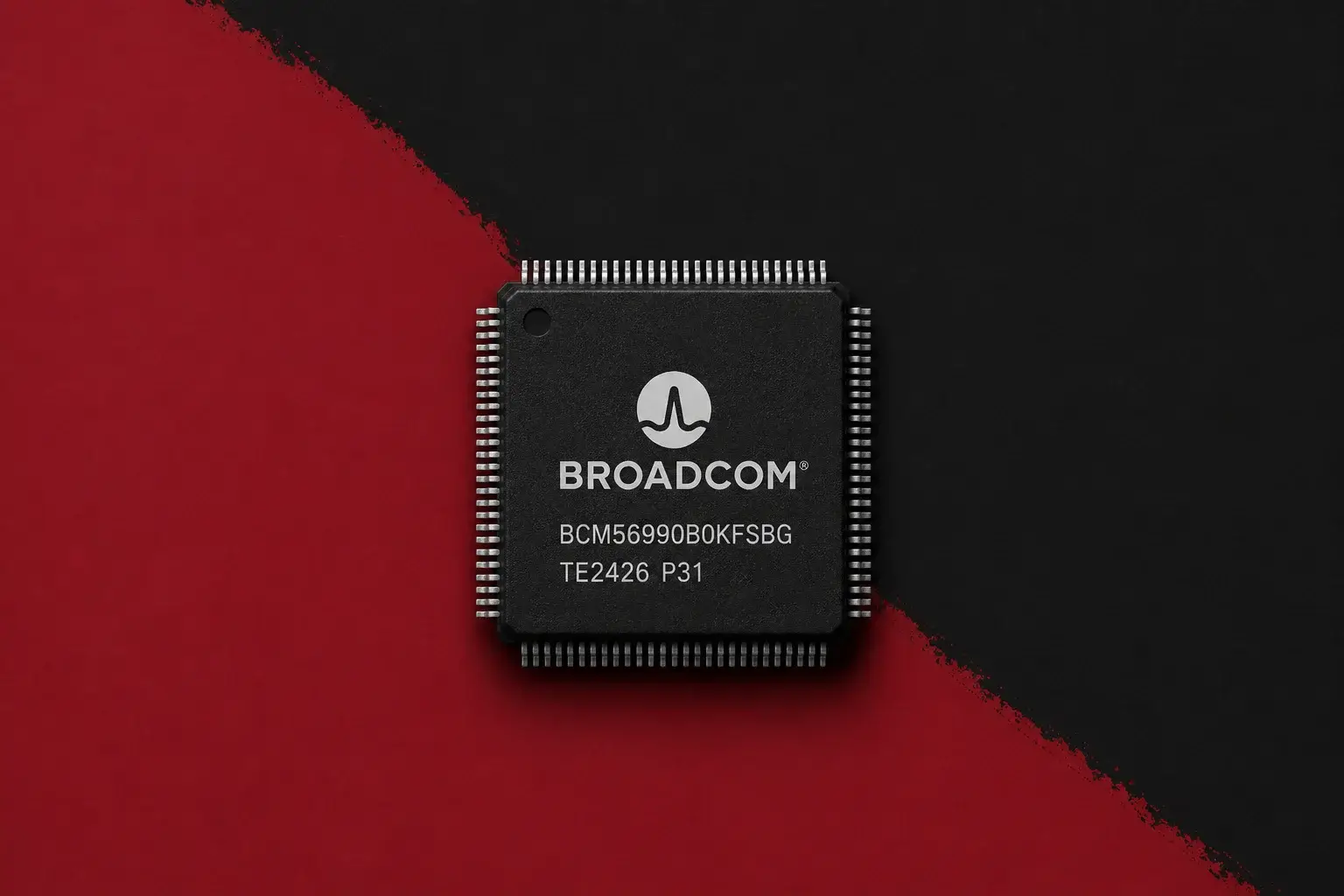
Broadcom Drops to $382, Down 25% From Its High as the Chip Rout and Google's MediaTek Move Mask a Record AI Quarter
AVGO's June 3 quarter was elite — revenue +48%, $10.8B in AI silicon, $10B+ free cash flow — but the stock fell 17% | That's TradingNEWS
Key Points
- Broadcom fell ~2.7% to $382 in the chip rout, down 25% from its $495 high, holding up better than peers like Micron and Qualcomm in the AI-semiconductor selloff.
- The June 3 quarter was a record — revenue +48% to $22.19B, $10.8B AI revenue, $10B+ free cash flow — but fell 17% on a reaffirmed $100B+ target and Google adding MediaTek to its TPU supply chain.
- Wall Street is overwhelmingly bullish (Strong Buy, ~$520 avg target, ~37% upside, JPM "aggressive buyer"); $380 is support, $400+ to reclaim, Sept 3 earnings the catalyst.
Broadcom (AVGO) is trading around $381.57, down roughly 2.7% on the session as the global chip rout pulls the entire semiconductor complex lower, though the stock is holding up better than the hardest-hit names like Micron and Qualcomm. The decline extends a brutal stretch — AVGO sits down roughly 25% from its 52-week high near $495, having tumbled after its June 3 earnings report and continued to slide as the AI trade unwinds. The stock is caught in a double bind: the macro chip selloff on one side, and a company-specific overhang on the other.
The thesis here is that Broadcom is a fundamentally elite AI-infrastructure business being repriced on two fears at once, neither of which reflects a collapse in the underlying business. The first fear is the broad one hitting every chip name today — the rotation out of high-multiple AI semiconductors as the market questions whether AI spending is outrunning returns. The second is specific to Broadcom: Google, its largest AI-chip customer, is bringing MediaTek into its custom-silicon supply chain as a secondary vendor, threatening the dominant share Broadcom has held in Google's TPU program. Together, those fears have knocked a quarter off the stock's value despite a business that's still growing AI revenue at a blistering pace.
That sets up the tension that defines AVGO. The bull case is the underlying business — custom AI silicon for the hyperscalers, enormous free cash flow, a software engine in VMware, and a new mega-deal to power Anthropic's compute. The bear case is the overhang — Google's diversification to MediaTek, a premium valuation, and the chip-rout beta that makes AVGO a casualty on risk-off days. The thesis: Broadcom is a beaten-down quality AI name where the elite fundamentals are being overwhelmed by the Google-concentration fear and the macro de-risking, but the AI revenue is still tripling, the cash flow is enormous, and Wall Street sees roughly 37% upside. The line is whether the September 3 earnings confirm the growth trajectory remains intact — and in the meantime, the stock trades the gap between what Broadcom is and what the market fears it's becoming.
The Scoreboard
Here's where Broadcom stands. AVGO is around $381.57, down about 2.7% on the day in the chip rout, with the prior close near $392 and the stock having traded in a $392–$414 range the prior session. The 52-week range runs from $244.17 at the low to $495.00 at the high, and the stock now sits roughly 23% below that peak — a sharp drawdown for a name that had run up roughly 40% through the first five months of 2026 before the June 3 earnings reset the trajectory. The market cap remains enormous, placing AVGO firmly in the mega-cap tier of the AI complex.
The valuation reflects the premium the market has paid for Broadcom's AI growth. The stock trades at a price-to-earnings ratio in the mid-to-high 60s — roughly 65 to 68 times — a rich multiple that prices in continued rapid expansion of the AI business. That premium is the source of the stock's vulnerability in a risk-off environment, since high-multiple names get compressed hardest when the appetite for growth fades. But the multiple also reflects the genuine quality of the business — the AI revenue growth, the massive margins, and the free-cash-flow generation that few companies in any sector can match.
The defining event on the scoreboard is the June 3 earnings drop. Broadcom reported a record quarter — revenue of $22.19 billion, up 48% year over year, with AI semiconductor revenue of $10.8 billion, adjusted EBITDA of $15.24 billion at a 69% margin, and free cash flow crossing $10 billion in a single quarter for the first time — and the stock fell 17%. A company that had closed near record levels was treated like it had disappointed, because the market had priced perfection and the quarter, however strong, didn't raise the bar. That drop, compounded by the subsequent chip rout, is why AVGO sits 25% off its highs. The scoreboard says Broadcom is a high-quality, high-multiple AI name that's been punished for not exceeding sky-high expectations, now trading at a level Wall Street views as a significant discount to fair value.
The Chip Rout Drags It Down
The immediate pressure on Broadcom today is the broad semiconductor selloff. The global chip rout — sparked by the crash in South Korean chipmakers and the rotation out of AI-exposed technology — is hitting the entire sector, and AVGO, as a major AI-chip name, is caught in the downdraft. The selloff reflects a market recalibrating its exposure to high-multiple AI semiconductors amid fears that the AI capital-spending boom is outrunning the returns it's generating, and that recalibration is indiscriminate, pulling down quality names and speculative ones alike.
Broadcom is holding up better than the hardest-hit names, though, which is telling. While Micron is down double digits ahead of its earnings, Qualcomm and Arm are down high single digits, and Nvidia is sliding, AVGO's roughly 2.7% decline is comparatively mild. That relative resilience reflects Broadcom's quality — its diversified business spanning custom AI silicon, networking, and infrastructure software, plus its enormous free cash flow, makes it a higher-conviction holding that the market is less eager to dump than the more speculative or commodity-exposed chip names. Nvidia was sliding amid the sector selloff but holding up better than some peers, and Broadcom belongs in that more-resilient cohort.
Still, the chip rout is a real headwind that AVGO can't escape. As a high-multiple AI name, Broadcom moves with the sector sentiment, and when money rotates out of AI semiconductors broadly, the stock falls regardless of its individual merits. The macro de-risking is the force pulling AVGO lower today, layered on top of the company-specific Google overhang that's been weighing since June 3. The chip rout is the market-wide pressure; the Google story is the Broadcom-specific one. Together they explain why a stock with such strong fundamentals is trading 25% off its highs, and why the near-term direction depends as much on the AI-trade sentiment as on anything Broadcom does itself.
The June 3 Earnings: A Record Quarter That Fell 17%
The pivotal event for Broadcom was the June 3 earnings report, and understanding why a record quarter produced a 17% selloff is essential to understanding the stock. The numbers were exceptional by any measure: revenue of $22.19 billion, up 48% year over year; AI semiconductor revenue of $10.8 billion; adjusted EBITDA of $15.24 billion at a 69% margin; and free cash flow of $10.26 billion, 46% of revenue and the first time the company ever crossed $10 billion in a single quarter. EPS of $2.44 beat the $2.40 consensus, and Q3 revenue guidance of around $29.4 billion came in well above the $28.53 billion Wall Street estimate.
So why the selloff? Two things rattled the market. First, management did not raise the company's full-year AI semiconductor sales target of $100 billion-plus for fiscal 2027 — CEO Hock Tan reaffirmed it rather than raising it. Second, Broadcom acknowledged that Google, its largest AI-chip customer, is beginning to bring MediaTek into its TPU supply chain as a secondary vendor. The company also signaled a shift from an integrated AI-systems model to a chips-only approach mid-cycle. Neither of these is a fundamental collapse, but when a stock has run up 40% in five months, anything short of a raised forecast reads as a disappointment.
The dynamic was an expectation reset, not a deterioration in the business. The market had priced a raised guidance and a confirmation that Broadcom would keep its dominant grip on Google's silicon; it got a reaffirmed target and an admission of customer diversification. A company that posted a strong score was being treated like it fell short, because the entire market had expected more. That's the recurring pattern with Broadcom — large post-earnings drops have typically been driven by expectation resets rather than fundamental problems, and the stock has historically recovered once subsequent quarters confirm the growth trajectory is intact. The June 3 selloff was almost entirely about what management didn't say, not what they reported. The numbers were elite; the guidance just wasn't elite enough for a stock priced for perfection.
The Google/MediaTek Overhang
The company-specific fear weighing on Broadcom is the Google diversification story, and it connects directly to the broader unwinding of the Google AI narrative. Google has been Broadcom's largest AI-chip customer, relying on Broadcom to design and supply the custom TPU accelerators that power Google's AI infrastructure. The overhang is that Google is now bringing MediaTek into that supply chain as a secondary vendor, diversifying away from its near-total dependence on Broadcom for its custom silicon. For a stock that had priced Broadcom's grip on Google's TPU program as a durable moat, the diversification is a direct threat to that assumption.
The fear is the mirror image of the Google story playing out across the AI complex. Google itself is under pressure as the market questions its AI capital spending and its talent retention, and part of Google's response is to diversify its silicon suppliers — which is good for Google's bargaining power and bad for Broadcom's revenue concentration. The same forces reshaping the hyperscaler side of the AI trade are reshaping the supplier side, and Broadcom sits on the supplier side of Google's TPU story. When Google diversifies, Broadcom loses share, and that's the overhang the market is pricing.
There's an important nuance, though, and it's why the bulls argue the fear is overdone. Reports of delays or cancellations in Broadcom's chip-development program with Google have circulated, and the company has signaled those concerns are overstated — the relationship remains substantial even with MediaTek entering as a secondary vendor. Diversification to a second supplier is normal for a customer of Google's scale and doesn't mean Broadcom loses the business; it means Broadcom shares a growing pie rather than owning all of it. The AI silicon market is expanding so fast that even a smaller share of a much larger market can still mean growing absolute revenue. The Google/MediaTek overhang is real and it's the proximate cause of the June 3 selloff, but whether it's a genuine threat to Broadcom's growth or an overblown fear about a normal diversification is the central debate around the stock.
The Customer-Concentration Risk
The Google overhang crystallizes a broader concern about Broadcom: customer concentration in its AI business. The most specific articulation came from Macquarie, which downgraded the stock to Neutral and projected Broadcom's share of Google's TPU-related revenue falling from approximately 95% in 2026 to around 80% in 2027 and 65% in 2028 as MediaTek gains a larger role. That trajectory — from near-total dominance to a declining majority share — is the bear case quantified, and it's why the diversification news hit the stock so hard.
The concentration risk cuts to the heart of the bull-bear debate. Broadcom's AI semiconductor business is heavily dependent on a small number of large hyperscaler customers, with Google the most important. When a single customer accounts for such a large share of a key revenue stream, any move by that customer to diversify, reduce orders, or bring development in-house represents a material risk. The custom-silicon business is built on deep, multi-year relationships, which provides stickiness, but it also concentrates the risk — losing or diluting a relationship like Google's has an outsized impact compared to a more diversified revenue base.
The bull's rebuttal is that the concentration reflects Broadcom's dominance, not a vulnerability, and that the customer base is broadening. Broadcom has multiple major AI clients beyond Google, and the company has been adding new ones — including the recently announced platform to support Anthropic's compute. As the AI buildout expands and more hyperscalers and AI labs design custom silicon, Broadcom's addressable market grows, diluting the dependence on any single customer over time. The Macquarie trajectory assumes MediaTek takes meaningful share without accounting for the absolute growth in Google's TPU spending or Broadcom's new customers. The concentration risk is genuine and it's the bear's strongest argument, but the bulls argue the expanding market and broadening customer base offset the declining share of any one account. The September 3 earnings will be the first real test of which view is right.
The Fundamentals Are Elite: AI Silicon Plus Cash Flow
Strip away the stock-price drama and Broadcom's business is among the strongest in technology. The June 3 quarter showcased it: revenue up 48% year over year to $22.19 billion, AI semiconductor revenue of $10.8 billion, and a 69% adjusted-EBITDA margin that few companies of any size achieve. The AI revenue is on pace to triple toward $16 billion in a single quarter, reflecting the explosive demand for the custom silicon that powers the hyperscalers' AI infrastructure. For fiscal year 2025, Broadcom's revenue was $63.89 billion, up nearly 24% from the prior year, with earnings rising sharply.
The free cash flow is the crown jewel. Broadcom generated $10.26 billion in free cash flow in the June quarter alone — 46% of revenue and the first time the company crossed $10 billion in a single quarter. That cash-generation capacity is what separates Broadcom from speculative AI names: it's not promising future profits, it's producing enormous cash now, which funds dividends, debt reduction, and reinvestment. The company has been actively managing its balance sheet, announcing debt tender offers including a $2.5 billion repurchase, using its cash flow to optimize its capital structure. The dividend yield of around 0.6%, while modest, reflects a capital-return program backed by real cash.
The earnings trajectory underscores the growth. Next quarter's EPS estimate sits at $3.21, up from $2.44 in the prior quarter, with revenue guidance around $29.22 billion versus $22.19 billion the prior quarter — sequential acceleration driven by the AI ramp. The company has consistently beaten estimates, and the AI semiconductor business is scaling faster than almost anything in the sector. These are the fundamentals of a business firing on all cylinders, and they're the foundation of the bull case: a company growing revenue at 48%, generating $10 billion in quarterly free cash flow, and tripling its AI revenue, trading 25% off its highs because the market is worried about a customer's diversification. The fundamentals say Broadcom is elite; the stock says the market is scared.
The Custom-ASIC Moat
What makes Broadcom uniquely positioned in the AI buildout is its custom-silicon business — the design of application-specific integrated circuits and custom AI accelerators for the hyperscalers. While Nvidia dominates the market for general-purpose AI GPUs, Broadcom is the leader in helping companies like Google design their own custom chips — the XPUs and TPUs tailored to specific workloads. As the hyperscalers seek to reduce their dependence on Nvidia and optimize their AI infrastructure for cost and performance, they turn to Broadcom to co-design custom silicon, and that's a business with deep moats.
The moat rests on engineering expertise and relationships that are hard to replicate. Designing custom AI accelerators requires specialized intellectual property, advanced packaging capabilities, networking technology to connect the chips, and the engineering scale to execute at the leading edge — capabilities Broadcom has built over years and that competitors struggle to match. The custom-silicon relationships are sticky because they involve multi-year co-design partnerships where Broadcom becomes deeply embedded in the customer's hardware roadmap. Once a hyperscaler builds its AI infrastructure around Broadcom's custom chips, switching is expensive and slow, which is what made the Google relationship so valuable and the diversification news so impactful.
Broadcom is, in a sense, the picks-and-shovels supplier to the AI gold rush. Rather than betting on which AI applications win, Broadcom sells the essential infrastructure — the custom silicon and networking — that every hyperscaler needs regardless of how the AI applications shake out. That positioning is why the bulls see Broadcom as one of the best ways to play the AI buildout: it captures the spending on AI infrastructure broadly, with the custom-ASIC business growing as more companies design their own chips. The shift Broadcom signaled toward a chips-only approach, away from integrated AI systems, sharpens that focus on the custom-silicon core. The moat is real, the demand is exploding, and the custom-ASIC business is the heart of the bull case — even with the Google concentration risk attached to it.
The VMware Software Engine
Broadcom isn't just a chip company — it operates in two segments, Semiconductor Solutions and Infrastructure Software, and the software side provides diversification and recurring revenue that pure-play chipmakers lack. The Infrastructure Software segment, anchored by the VMware acquisition, generates high-margin, sticky, subscription-based revenue from enterprise customers running their data-center and cloud infrastructure on VMware's virtualization platform. That software engine smooths the cyclicality of the semiconductor business and adds a layer of predictable, recurring cash flow.
The VMware integration has been a major driver of Broadcom's profitability. By shifting VMware to a subscription model and focusing on its largest enterprise customers, Broadcom has expanded the software segment's margins and locked in recurring revenue from companies that depend on VMware to run their operations. The software business is less exposed to the AI-trade sentiment and the chip-cycle volatility that's hitting the semiconductor side, providing a ballast that makes Broadcom more diversified and resilient than a pure semiconductor name. That diversification is part of why AVGO holds up better than commodity chipmakers in a selloff.
The software segment also extends Broadcom's reach into the enterprise AI transition. Broadcom has been expanding VMware's capabilities around private-cloud AI infrastructure, positioning the software business to benefit as enterprises shift AI inference workloads to private clouds — what the company has framed as an AI tipping point. The combination of leading AI custom silicon on the hardware side and enterprise infrastructure software on the software side gives Broadcom exposure to the AI buildout from multiple angles. The VMware engine is the underappreciated half of the Broadcom story — a high-margin, recurring-revenue business that diversifies the company beyond the chip cycle and adds a layer of stability that the market often overlooks when it treats AVGO purely as a semiconductor stock.
The Anthropic/Apollo $35 Billion AI Platform Deal
A major new growth vector for Broadcom is its expansion into financing and building large-scale AI infrastructure, exemplified by a landmark transaction. Apollo Global Management led a $35 billion financing for Broadcom's AI platform to support Anthropic's compute needs, in partnership with Blackstone, covering more than one gigawatt of capacity. The deal positions Broadcom at the center of one of the largest AI-infrastructure buildouts, supplying the silicon and platform for Anthropic — one of the fastest-growing AI companies, whose demand has accelerated sharply in 2026.
The Anthropic deal matters for two reasons. First, it diversifies Broadcom's AI customer base beyond Google and the other established hyperscalers, adding a major new AI lab as a customer at exactly the moment the market is worried about Google concentration. A $35 billion platform deal to power Anthropic's compute is precisely the kind of new business that offsets the MediaTek-driven share loss at Google, demonstrating that Broadcom's addressable market is expanding faster than any single customer's diversification can erode. Second, it signals Broadcom's evolution from a chip supplier to a provider of complete AI-infrastructure platforms, capturing more of the value chain in the AI buildout.
The scale of the deal underscores the magnitude of the AI-infrastructure opportunity Broadcom is addressing. More than one gigawatt of AI compute capacity, financed at $35 billion with backing from Apollo and Blackstone, reflects the enormous capital flowing into AI infrastructure and Broadcom's central role in building it. As AI labs and hyperscalers race to expand their compute, deals like this represent the demand that drives Broadcom's custom-silicon and platform business. The Anthropic/Apollo transaction is the bull case in action — proof that the AI buildout is generating new mega-customers for Broadcom even as existing ones diversify, and that the company's addressable market is growing fast enough to absorb the Google concentration risk. It's the kind of deal that argues the market's fear about customer concentration misses the expanding opportunity.
The Valuation Question
The central debate around Broadcom is whether the premium valuation is justified, and it's the battleground between the bulls and the bears. AVGO trades at roughly 65 to 68 times trailing earnings, a multiple that looks expensive at first glance and that prices in continued rapid growth of the AI business. In a risk-off environment where high-multiple tech is being compressed, that premium is the stock's biggest vulnerability — it's why AVGO fell 17% on a record quarter that didn't beat sky-high expectations, and why it's down in the chip rout today.
The bull's argument is that the multiple is reasonable relative to the growth. A company growing revenue at 48%, tripling its AI revenue toward $16 billion a quarter, generating $10 billion in quarterly free cash flow, and carrying a 69% EBITDA margin can support a premium multiple, because the earnings are growing fast enough to bring the forward multiple down quickly. On forward estimates, with EPS climbing from $2.44 to $3.21 sequentially, the valuation looks far more reasonable than the trailing 65x suggests. The bulls argue that paying a premium for the highest-quality AI-infrastructure business with the best cash generation is justified, especially after the 25% drawdown has already compressed the multiple from its peak.
The bear's argument is that the premium leaves no margin for error. At 65-plus times earnings, the stock is priced for flawless execution and continued hypergrowth, which means any disappointment — a customer loss, a guidance miss, a slowdown in AI spending — gets punished severely, as the June 3 drop demonstrated. The Google diversification, the customer concentration, and the broader question of whether AI capital spending is sustainable all represent risks that a premium-valued stock can't easily absorb. The valuation question doesn't have a clean answer — it depends entirely on whether Broadcom's AI growth continues at the pace the bulls expect or decelerates as the bears fear. The 25% drawdown has made the risk-reward more attractive than it was at the highs, but the premium multiple means AVGO remains a high-expectations stock where the September 3 earnings carry enormous weight.
Wall Street Says "Aggressive Buyer"
Despite the selloff, the analyst community is overwhelmingly bullish on Broadcom, and the conviction is striking. The consensus rating sits at Strong Buy across the roughly 45 to 51 analysts covering the stock, with zero Sell ratings and an average price target ranging from approximately $516 to $524 — implying upside of roughly 37% from current levels near $382. The high targets reach $630 to $650, while the low end sits around $390. The professionals who model Broadcom's business are looking at the same selloff the market is pricing and seeing a buying opportunity.
J.P. Morgan has been the most vocal bull. The bank told clients to be "aggressive buyers" of the beaten-down chip stock, arguing that the market continues to underestimate the semiconductor and software company and urging investors to "ignore the noise" around the Google fears. The thesis is that the June 3 selloff and the subsequent decline reflect an overreaction to the MediaTek diversification and the failure to raise guidance, both of which are minor relative to the underlying growth trajectory. Major institutional analysts raised their price targets within 24 hours of the June 3 drop, treating the selloff as an opportunity rather than an exit signal — a vote of confidence that the fundamentals remain intact.
The bullish consensus rests on the AI growth and the cash flow. Analysts point to the tripling AI revenue, the enormous free cash flow, the expanding customer base including the Anthropic deal, and the VMware software engine as justification for targets well above the current price. The lone notable exception is Macquarie's downgrade to Neutral on the Google-concentration concern, which captures the bear case but stands against an overwhelmingly bullish Street. The gap between the $382 price and the $520-plus average target is the size of the market's disagreement with the analysts — either the chip-rout and Google fears are right that the stock deserves to be lower, or the analysts are right that the AI franchise and cash generation will drive it substantially higher. The Street is firmly in the latter camp.
Read More
-
Yen Stalls at 160 Despite a 3% JGB and Tokyo Core CPI at 2.0% — Intervention Sits at 164, Friday's Payrolls Decide
02.09.2026 · TradingNEWS ArchiveEnergy
-
QQQ ETF ($739) Fades From an Early Tech Rally as a 77.9 ISM Prices Index Meets Micron's $61.5B Guide — $760 Record Test Ahead
01.10.2026 · TradingNEWS ArchiveStocks
-
XRPR and XRPI Follow XRP's $1.49 Test as Spot Funds Hold 1.16B XRP and a 1 Billion Token Escrow Release Lands — $1.70 in Play
01.10.2026 · TradingNEWS ArchiveCrypto
-
November NG Slips Below $3 as Decade-High Storage Meets Capped LNG Exports — $2.75 in Sight
01.10.2026 · TradingNEWS ArchiveCommodities
-
Dollar-Yen at 158 Presses Toward 160 as a 363 bp Carry Gap Meets Katayama-Bessent Intervention Risk — 159 in Sight
01.10.2026 · TradingNEWS ArchiveForex
The Competitor Scorecard
Broadcom sits in a competitive AI-semiconductor landscape, and understanding its peers sharpens the picture. The most direct comparison is Marvell Technology (MRVL), the other major player in custom AI silicon, which has been up roughly 240% as the AI-spending boom lifted both names. Yet analysts prefer Broadcom over Marvell despite Marvell's bigger stock gains, citing Broadcom's larger scale, deeper hyperscaler relationships, superior cash generation, and the VMware software diversification. Marvell is the higher-beta, faster-moving stock; Broadcom is the larger, more diversified, higher-quality franchise.
Nvidia (NVDA) is the dominant force in AI chips, but it competes with Broadcom in a different lane. Nvidia owns the market for general-purpose AI GPUs, while Broadcom leads in custom silicon — the chips hyperscalers design to reduce their Nvidia dependence and optimize specific workloads. In that sense, Broadcom benefits from the same trend that pressures Nvidia: as hyperscalers seek alternatives to Nvidia's expensive GPUs, they turn to Broadcom for custom accelerators. The two are both winners of the AI buildout, but Broadcom's custom-silicon niche is somewhat counter-cyclical to Nvidia's GPU dominance, capturing the hyperscalers' desire for in-house alternatives.
The broader competitive context includes AMD in the GPU race and the customer-side dynamics with Google and MediaTek. MediaTek's entry into Google's TPU supply chain is the competitive threat at the center of Broadcom's overhang — a new rival for the custom-silicon business that Broadcom has dominated. The sector ETFs — the semiconductor funds tracking the group — have been hit hard in the chip rout, down sharply as the whole complex de-risks. Broadcom's position in that landscape is as the diversified quality leader: larger and more cash-generative than Marvell, complementary to Nvidia, and facing a new competitive threat from MediaTek at its largest customer. The competitor scorecard says Broadcom is the premium name in custom AI silicon, with the franchise and the cash flow to defend its position even as MediaTek enters the picture.
The Forecast: The Levels and September 3 Earnings
Strip it down and Broadcom is an elite AI-infrastructure business caught in a double bind that's masked its quality. The stock is down 25% from its $495 high, trading around $382 in the chip rout, weighed by the broad AI-trade unwind and the company-specific fear that Google is diversifying its custom-silicon suppliers to MediaTek. The June 3 earnings were a record quarter — revenue up 48%, AI revenue of $10.8 billion, $10 billion in free cash flow — that fell 17% because management reaffirmed rather than raised guidance and acknowledged the Google diversification. The selloff was an expectation reset, not a fundamental deterioration.
The levels frame the path. Support sits around the recent lows near $380–390, the zone the stock is testing in the chip rout, with the 52-week low at $244 the distant floor if the AI-trade unwind deepens dramatically. On the upside, the stock needs to stabilize and reclaim the $400-plus area, with the $495 high the eventual target the analysts are pointing toward — their $520-plus average target implies a new high. The 25% drawdown has compressed the premium multiple and improved the risk-reward, which is why Wall Street is calling AVGO an aggressive buy. The near-term direction depends on the chip-rout sentiment and whether the Google overhang stabilizes; the medium-term path depends on the AI revenue trajectory.
The catalyst is the September 3 earnings report, which will be the first real test of whether the Q3 $16 billion AI revenue guidance is achieved and whether the growth trajectory remains intact. A strong quarter that confirms the AI ramp and shows the customer base broadening — with the Anthropic deal and new clients offsetting the Google diversification — would validate the bull case and likely drive the stock back toward its highs. A miss or weak guidance would confirm the bears' concerns about concentration and decelerating growth. The honest read is that Broadcom is a high-quality AI franchise being repriced on fears that the bulls argue are overblown — the Google diversification is a normal evolution, the AI market is expanding faster than any customer's share loss, and the cash flow is enormous. The fundamentals favor the bulls; the chip-rout tape and the Google overhang favor the bears in the near term; and September 3 is where the two collide. Until then, $380 is the line being defended, $400-plus is the level to reclaim, and the stock trades the gap between an elite business and a frightened market.