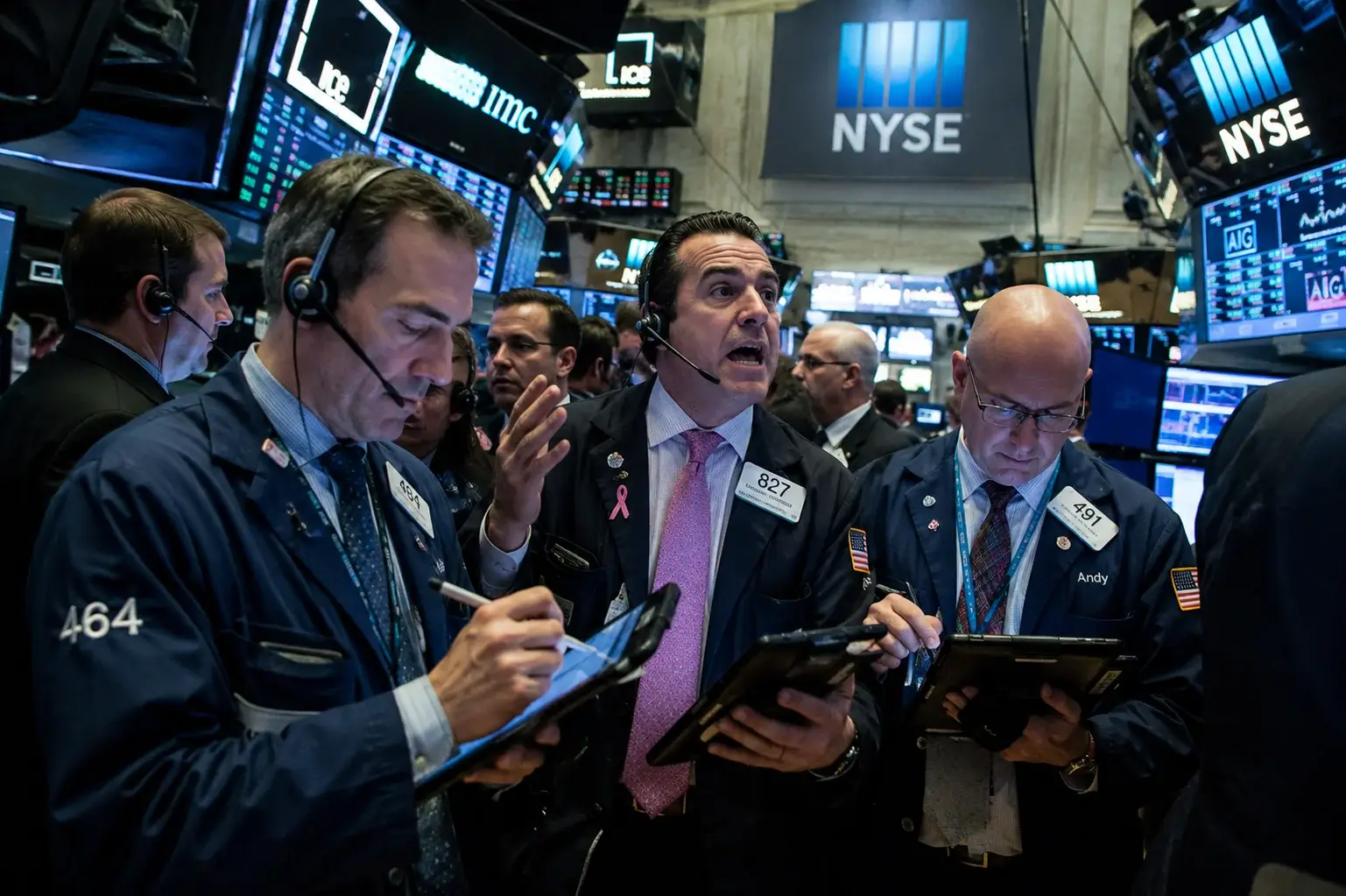
Dow (DJI) Rips 460 Points Toward 51,250 While AVGO Stock Loses $69 — Rotation Out of AI Chips Guts the Nasdaq
Capital fled crowded AI semiconductors into blue-chip and defensive names after Broadcom's soft $16B AI guidance cracked the chip trade | That's TradingNEWS
Key Points
- Dow (DJI) jumped ~1.06%, about 460 points, near 51,250; S&P 500 (SPX) flat at 7,545; Nasdaq (IXIC) down ~0.6%.
- Broadcom (AVGO) sank 14% to ~$410 after Q3 AI chip guidance of $16B missed the $17.2B estimate, despite a revenue and EPS beat.
- AMD fell 4% to ~$521 and Intel dropped 3% to ~$109 in a sympathy selloff with no company-specific news.
The split that's been building under the surface for two weeks ripped open at the opening bell. The Dow is up roughly 1.06%, about 460 points, pushing toward 51,250, while the Nasdaq rolled over and the S&P 500 (SPX) sits dead flat near 7,545. One index is printing fresh gains; another is bleeding. That's not noise — that's money physically moving out of crowded artificial-intelligence semiconductors and into blue-chip and defensive names, and the trigger has a ticker: Broadcom (AVGO), down 14% and dragging the entire chip complex with it. The tape isn't selling off. It's rotating, hard, and the headline index level hides how violent the move underneath actually is.
The thesis for the session is straightforward and it drives everything below: a single guidance miss from the market's most important custom-silicon name cracked the AI trade's confidence, capital sprinted into value and safety, and that rotation is happening on top of the richest valuations since the dot-com peak — with a hawkish Fed and a jobs print twelve hours away. Strip out the chips and this looks like a green day. Keep them in and it looks like the air finally coming out of the most stretched corner of the market.
Where the Tape Stands at Midmorning
The S&P 500 (SPX) is hugging the flatline near 7,545, having been down as much as 0.36% — roughly 27 points — before the bid in defensives clawed it back to even. The broad index is sitting about 0.7% below Tuesday's record finish above 7,600. The Dow Jones Industrial Average (DJI) is the day's outlier to the upside, up around 1.06% and adding close to 460 points to trade near 51,250, carried by industrials, healthcare, and the kind of old-economy names that get ignored when the Mag-style tech crowd is in charge.
The Nasdaq Composite (IXIC) is the casualty. The tech-heavy index was down 1.15% at one stage, shedding more than 350 points, before paring to a loss closer to 0.6% as buyers nibbled at the wreckage. The Russell 2000 (RUT) is chopping around the flatline near 2,888 after a soft open, small caps unable to decide whether higher yields or the rotation-friendly tape matter more. The breadth split is the entire story: advancers and decliners are roughly balanced even with the Nasdaq red, which tells you the selling is concentrated, not broad.
Oil got smoked, down more than $3 with West Texas Intermediate near $92.83 after trading above $95 in the premarket. Bitcoin slipped $527 to $63,512. The 10-year Treasury yield is parked near 4.48%, holding the prior session's climb. Volatility ticked up off the rotation but stayed orderly — this is a reshuffle, not a panic.
Broadcom Beat the Quarter and Lost the Story
Broadcom (AVGO) did almost everything right and got crushed anyway. The stock is down about 14%, sinking near $410 after closing Wednesday at $479.23 — roughly $69 erased in a morning. The fiscal Q2 print, released after Wednesday's close, beat on the lines that usually matter: revenue of $22.19 billion edged the $22.13 billion consensus, non-GAAP EPS of $2.44 cleared the $2.39 estimate, AI semiconductor revenue ripped 143% year over year to $10.80 billion, and the company threw off $10.26 billion in free cash flow. Current-quarter total revenue guidance of $29.4 billion blew past the $28.61 billion the Street was modeling.
The kill shot sat in one line. Third-quarter AI chip sales were guided to $16 billion against expectations near $17.2 billion, and the company declined to raise its full-year 2026 AI semiconductor forecast. CEO Hock Tan reiterated that AI semiconductor revenue would exceed $100 billion into fiscal 2027 and insisted the momentum continues — but after a stock that had gained 88% over the past year and printed fresh all-time highs into the report, "in line with plan" wasn't enough. The bar was set in the stratosphere, and a soft AI number was all it took. One research desk yanked its rating to neutral with a $437 target this morning. This is a textbook sell-the-news: the quarter was fine, the expectations were insane, and the gap closed in one direction.
The Chip Complex Wears the Read-Through
When the largest custom-silicon name signals even a hint of a near-term ceiling, the extended peers pay for it without a single piece of their own news. Advanced Micro Devices (AMD) is off about 4% near $521 — a stock up 153% year to date and 362% over the past year, which leaves zero cushion when AI sentiment wobbles. Intel (INTC) is down roughly 3% near $109, and that name has run even harder: up 205% year to date and 456% over twelve months on foundry and inference traction.
These are sympathy moves, pure read-through, and they expose how thin the margin for error has become across the AI silicon trade. Research commentary circulating this morning flagged sliding chip prices and a possible cooling in AI build-out pace as the live worry, and that's exactly the nerve Broadcom's guidance touched. The long-term backdrop hasn't changed — hyperscaler AI spending is still tracking toward an estimated $650 billion this year, and there's a separate report this morning of a $20 billion bet to break the incumbent CPU duopoly. But "the story is intact" and "the stock can keep going up at this pace" are two different sentences, and the tape is now testing the second one. Whether AVGO holds $410 into the close will tell you whether dip-buyers still trust the trade or whether the profit-taking has more to run.
Money Didn't Leave the Market — It Switched Seats
Here's the part the red Nasdaq obscures: the cash coming out of chips didn't go to the sidelines, it went shopping in the parts of the market that have been left for dead. The day's leaderboard reads like a defensive playbook. Texas Pacific Land (TPL) is up 9.69% to $406.76, adding nearly $36 a share. Healthcare and biotech are catching a hard bid — Moderna (MRNA) ripped 7.49% to $49.06 on heavy volume of almost 7 million shares, Incyte (INCY) climbed 6.22% to $97.98, and Medtronic (MDT) tacked on 5.69% to $77.95 with more than 20 million shares changing hands. Industrials joined: United Rentals (URI) jumped 6.21%, a $61.76 gain to $1,056.58.
That mix — land, biotech, medtech, industrial rentals — is the signature of investors rotating toward earnings stability and away from valuation-at-any-price growth. The Dow's 460-point pop isn't a vote of confidence in the economy so much as a vote against paying 40-plus times earnings for chips that just guided soft. When the bid concentrates in defensives and old-economy cyclicals while megacap tech rolls over, the market is telling you what it wants to own if the AI narrative loses a step.
The Energy Unwind and the Oil Whip
Crude reversed sharply and took the energy patch with it. WTI dropped more than $3 to around $92.83, and Brent slipped toward $96.70, the pullback driven by conflicting but hope-tinged signals on a possible U.S.-Iran ceasefire even as the underlying conflict grinds on. Cooling energy prices are part of why the Dow is flying — lower oil reads as relief on the inflation side and a tailwind for everything outside the energy complex.
For energy names themselves, it's the opposite. Coterra Energy (CTRA) got the worst of it, down 8.62% to $32.56 on enormous volume north of 73 million shares — the heaviest-traded name on the loser board by a wide margin. That's the cost of a $3 oil move landing on a sector that had been bid up on war-premium pricing. The whip cuts both ways and fast: there's even chatter this morning floating whether $150 oil is possible in a matter of weeks if the diplomacy collapses, which captures exactly how binary the energy tape has become. Own oil here and you're trading a headline, not a fundamental.
Five Below Beats and Still Gets Sold
The sell-the-news pattern wasn't confined to chips. Five Below (FIVE) snapped 10% lower — about $23 a share — despite a quarter that, on paper, was a beat across the board. EPS of $2.22 cleared estimates by 43 cents, revenue of $1.28 billion rose 31.9% year over year and topped forecasts by roughly $50 million, and operating income surged to $154.2 million from $50.8 million a year earlier. The company even raised its full-year outlook.
So why did it get hammered? The full-year raise wasn't big enough for a stock priced for perfection, with second-half estimates left unchanged and management flagging caution on the consumer spending environment. Same script as Broadcom: a good print isn't a good-enough print when the multiple already bakes in flawless execution. The recurring tell across both names is that this market has stopped paying up for "beat and reiterate" — it now demands "beat and raise hard," and anything short of that gets faded into the open.
Yields Are the Real Story Under the Surface
Strip away the equity rotation and the prime mover is the bond market. The 10-year Treasury yield is holding near 4.48% after climbing in the prior session, the 2-year is testing the 4.00% line, and the long bond sits above 5%. Yields are rising for a reason that should worry the bulls: the labor data keeps coming in hot. Wednesday's private-payrolls reading showed 122,000 jobs added in May, beating forecasts and marking the strongest pace since January 2025, and earlier in the week job openings climbed to their highest level since November 2024.
A resilient labor market plus sticky, energy-juiced inflation has flipped the rate conversation entirely. Markets now price an 85% probability of a quarter-point Fed rate hike by year-end, up from 60% just a week ago. That repricing lands right as the central bank heads into its first meeting under new leadership widely read as hawkish, with a documented preference for shrinking the balance sheet — a move that acts like a stealth rate hike by pulling liquidity even if the funds rate doesn't budge. Higher yields are precisely the kind of pressure that punishes long-duration, high-multiple tech first, which is part of why the Nasdaq is the one bleeding while value holds. The rotation and the rate story are the same trade viewed from two angles.
Friday's Jobs Print Is the Whole Ballgame
Everything happening today is a warm-up act for tomorrow. The monthly nonfarm payrolls report lands Friday, and after a private-payrolls beat and rising job openings, the setup is loaded. A hot number cements the hike-by-year-end pricing, sends yields higher, and pours more fuel on the exact rotation gutting tech right now. A soft number complicates the hawkish narrative and could snap yields lower, handing the growth names a reprieve.
That binary is why the tape feels coiled rather than committed. Traders aren't going to plant a flag the day before a print that can swing year-end rate odds by 20 points. The midmorning chop in the S&P 500 and the Russell's inability to pick a direction both read as positioning ahead of the data, not conviction about it. Whatever verdict today's session lands, it gets re-graded at 8:30 a.m. ET Friday.
The Valuation Problem Hanging Over Everything
The reason a single guidance miss can trigger a rotation this sharp is that the market has no margin for disappointment left. The S&P 500 ran up more than 16% across April and May — a two-month surge that's occurred only four other times since World War II. The last time it climbed like this outside of a recovery from recession was the few months before the 1987 crash. That's not a forecast; it's a statistical flag, and the desks that track this stuff are waving it.
The valuation gauges back it up. The cyclically-adjusted P/E ratio sits at 42.53, its second-highest reading ever, sitting just under the 43.21 peak hit in 1999 right before the dot-com unwind. When a market is priced at the second-richest level in its history, beats stop being rewarded and misses get punished violently — which is exactly the behavior on display in Broadcom and Five Below today. Stretched markets don't need a recession to wobble; they just need an excuse to take profits, and a soft AI chip guide is a perfectly good excuse.
Read More
-
Yen Stalls at 160 Despite a 3% JGB and Tokyo Core CPI at 2.0% — Intervention Sits at 164, Friday's Payrolls Decide
02.09.2026 · TradingNEWS ArchiveEnergy
-
T-Rex 2X Inverse MSTR ($4.39) Rips 10.44% as Strategy Pauses Bitcoin Buys for a 2nd Week — $4.63 Close Opens $5.27
15.09.2026 · TradingNEWS ArchiveStocks
-
XRPR ($10.59) and XRPI ($7.04) Open at Highs and Close at Lows After Senate Kills CLARITY Act
15.09.2026 · TradingNEWS ArchiveCrypto
-
NG ($2.908) Holds Above $2.80 Low as LNG Feedgas Hits 18.8 Bcf and TTF Trades 9.2x Henry Hub
15.09.2026 · TradingNEWS ArchiveCommodities
-
USD/JPY (155.09) Faces 275bp Policy Gap as BOJ Prepares 31-Year-High Rate — Close Below 154 Opens 153.40
15.09.2026 · TradingNEWS ArchiveForex
SpaceX, Bitcoin, and the Edges of the Tape
Away from the rotation, the IPO machine is gearing up for a giant. SpaceX set a fixed price of $135 per share ahead of marketing its offering, a deal that implies a roughly $75 billion raise across 555.6 million shares and values the company near $1.77 trillion. At that mark it would rank as the seventh-largest U.S. company by market cap and sit above the roughly $1.6 trillion valuation of Tesla. The stock is slated to debut on the Nasdaq on June 12, and a debut of that size will pull liquidity and attention when it lands.
Crypto leaned with risk-off, with Bitcoin down $527 to $63,512 as the same higher-yield pressure weighing on long-duration equities bled into digital assets. Across the broad tape, the participation picture stayed lopsided: defensives and industrials green, megacap tech and energy red, small caps stuck in the middle. That's a market sorting itself by factor, not by overall direction.
Broad or Narrow? Reading the Participation
This is a narrow decline wearing a mixed costume. The headline damage is concentrated almost entirely in two buckets — AI semiconductors (AVGO, AMD, INTC) and energy (CTRA and the oil-sensitive names) — while the rest of the market is flat to higher. The advance-decline split sitting near balanced even with the Nasdaq down 0.6% confirms it: this isn't broad distribution, it's a targeted unwind of the most crowded, most expensive trades.
That distinction matters for how to read the day. Broad selling, where everything goes down together, signals fear about the economy or liquidity. Targeted selling, where capital exits one theme and immediately recycles into another, signals rotation and risk management. Today is the second kind. The Dow's 460-point gain and the bid in healthcare and industrials are the receipts — the money is staying invested, just not in chips. The risk is that a narrow leadership group like AI semis is also what's been carrying the indexes to records, so weakness there can cap the whole tape even when breadth elsewhere looks fine.
The Session Verdict: Mixed, Rotational, and Coiled
Call this session what it is: mixed with a rotational core. The Dow (DJI) is up over 1% and roughly 460 points near 51,250, the S&P 500 (SPX) is flat near 7,545, the Nasdaq (IXIC) is down around 0.6% after a steeper morning loss, and the Russell 2000 (RUT) is pinned near the flatline at 2,888. Broadcom's 14% break and the sympathy hits to AMD and Intel are the dominant theme; the defensive and industrial bid is the counterweight; cratering oil and a 4.48% 10-year yield are the macro backdrop; and Friday's payrolls report is the catalyst everyone is positioned around.
The session reads as a market reluctantly admitting that valuations this stretched leave no room for guidance that merely meets the plan. Capital is rotating rather than fleeing, which keeps the indexes from breaking, but the speed of the move out of the most-loved names is the signal to respect. The tape is balanced on a knife's edge between a hot jobs number that validates the hawkish rate path and a soft one that rescues growth — and until that print clears, conviction in either direction is borrowed.