Dow Rips 617 Points to Record 54,700.74, S&P 500 Prints 7,758.74 All-Time High,Nasdaq Stuck at 26,605.44 as LLY Crosses $1T
A fifth straight advance took the S&P 500 to 7,758.74 and the Dow to 54,700.74 | That's TradingNEWS
Key Points
- Dow added 614.86 points (+1.14%) to a record 54,700.74 while the Nasdaq managed just +0.08% to 26,605.44.
- Shopify ripped 26% on $3.58B revenue (+33.6%) and GMV up 32% to $115.57B, with Q3 guided to low-thirties growth.
- Eli Lilly posted $23.0B revenue (+48%) and $8.38 adjusted EPS, raising FY26 guidance to $85–87B at a $1.035T cap.
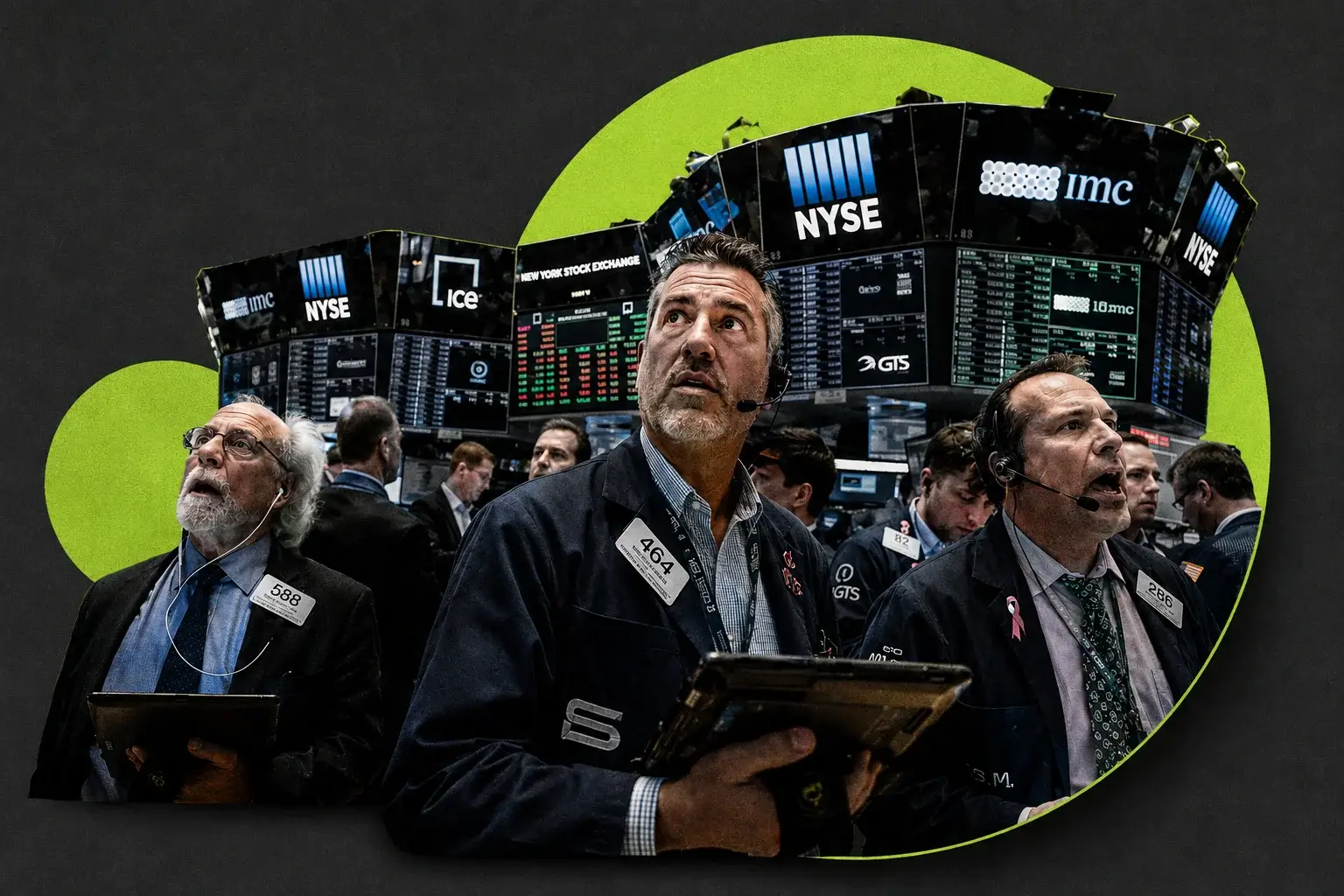
The S&P 500 punched a fresh all-time intraday high Wednesday morning at 7,758.74, up 22.22 points or 0.29%, and the number tells you almost nothing about what is actually happening underneath it. The Dow Jones Industrial Average ripped 614.86 points to 54,700.74, a 1.14% move and another record for the blue chips. The Nasdaq Composite crawled 20.44 points to 26,605.44, a gain of 0.08% that rounds to nothing. The Russell 2000 went the other way entirely, down 3.56 points to 3,033.41, off 0.12%. That spread — 114 basis points between the Dow and the small-cap index on the same tape, in the same hour — is the entire story of the session.
This is the fifth consecutive advance for the S&P 500, the longest winning streak since early June, and the three major indexes are tracking their best five-day run since April 2025. Over the past week the S&P has added more than 6%, the Dow more than 5%, and the Nasdaq more than 9%. Tuesday's closes were the launch pad: the Dow finished at 54,085.88 after a 907.47-point, 1.71% surge, with an intraday print of 54,272.60 along the way and 26 of the 30 components green. The S&P closed at a record 7,736.52, up 136.02 points or 1.79%, its first closing record since July 2. The Nasdaq Composite added 671.10 points, or 2.59%, to 26,584.99, still roughly 2% below its own early-June peak.
Volatility is not arguing. The VIX slipped 0.22 to 16.28, down 1.33%, which is a market that has decided the summer air pocket is over. Year to date the Dow is up 12.5%, the S&P 500 up 13%, and the Nasdaq up more than 14%.
What changed Wednesday is the engine. Tuesday's rally was a semiconductor and AI-software melt-up. Wednesday's is a pharmaceutical major, a media conglomerate, and an e-commerce platform, with the AI hardware complex rolling over hard beneath the surface. The Dow's 617 points are coming from earnings that converted into cash and raised guidance. The Nasdaq's flat print is what happens when a $500-billion capex story and a chipmaker trading at 54 times forward earnings both get repriced on the same morning. Records are records, but the leadership rotated overnight, and the tape is now paying for delivered free cash flow rather than promised compute.
Tuesday Set A Bar That Wednesday's Reporters Could Not Clear
The setup matters because Tuesday's session priced in a level of enthusiasm that made every Wednesday print a high-wire act. The Philadelphia Semiconductor Index shot up 6.6% Tuesday, its fourth straight gain, after getting smoked for 20.6% during July. The S&P 500 technology sector added 4.1%, the best of the 11 major sectors. Intel jumped 10.8%, Marvell 13%, Micron 7.6% — enough to push it back above a $1 trillion market cap — and Broadcom 6.6%. The Nasdaq 100 climbed 3.3%.
Palantir did the heavy lifting on the software side, soaring 29.5% for its biggest single-day percentage gain since February 2024 after posting adjusted earnings of $0.41 per share against a $0.35 consensus and revenue of $1.94 billion, a 7.2% beat, alongside a raised annual revenue forecast. Caterpillar snapped 5.97% higher on adjusted earnings of $8.17 per share versus $6.25 expected, with revenue of $20.54 billion beating by 6.4%, and lifted its annual revenue growth outlook on data center and power equipment demand. Cisco Systems added 5.11% and IBM 3.91%. That is a Dow being carried by industrial and enterprise cash flow, not by the Magnificent Seven.
The earnings scoreboard behind it is genuinely lopsided. Of the 304 S&P 500 companies that had reported second-quarter results through Friday, 85.2% beat estimates against a long-run average of 67.5%. Blended second-quarter EPS growth is tracking at 45% year over year, and even stripping out non-recurring items the figure holds at 26%, one of the fastest paces since 2021. Almost 90% of companies reporting so far have cleared the bar.
So Wednesday's reporters walked into a tape that had already rewarded the beat-and-raise trade for four straight sessions. Anything that beat and guided higher got bought again. Anything that beat and spent — or beat and guided merely in line — got sold into the strength. That is the mechanical explanation for a Dow up 1.14% and a Nasdaq up 0.08% at the same instant, and it is why the divergence is a positioning story rather than a macro one. The rotation out of concentrated AI exposure and into diversified cyclical and defensive cash generators had already been running through June and July, when healthcare and financials outperformed technology and kept the Dow pinned near records while the Nasdaq struggled. Wednesday put that rotation back on the screen in a single session.
Eli Lilly Crossed A Trillion Dollars And Dragged The Dow With It
The single largest contributor to Wednesday's blue-chip surge is a drugmaker that just became the most valuable pharmaceutical company on earth. Eli Lilly reported second-quarter revenue of $23.0 billion, up 48% from $15.56 billion, blowing past a consensus near $20.93 billion by more than $2.04 billion. Non-GAAP earnings came in at $8.38 per share against estimates that ranged from $6.06 to $6.07 depending on the tracking service, a beat of roughly $2.31. Reported diluted EPS was $7.94, up 26% from $6.29. Reported net income rose 25% to $7.1 billion from $5.66 billion, while non-GAAP net income climbed 32% to $7.49 billion.
The margin structure is what makes the number durable. Gross margin expanded to $19.7 billion, or 85.8% of revenue, up from 84.3% a year earlier, even as research and development spending rose 14% to $3.8 billion. U.S. revenue climbed 33% to $14.4 billion on a 37% increase in volume, driven by Mounjaro and Zepbound. Management raised full-year 2026 revenue guidance to a range of $85 billion to $87 billion from the prior $82 billion to $85 billion — a raise at both ends, not a nudge to the midpoint.
Shares traded at $1,142.66, up $26.98 or 2.42%, after touching roughly $1,170 in the premarket for a gain just under 5%. Market capitalization sits at about $1.035 trillion, having crossed the $1 trillion line and stayed there. The stock is up more than 50% over the trailing 12 months and carries a forward multiple above 32.
The one soft spot is the oral obesity pill Foundayo, approved in April, which posted revenue down 3% against expectations in its first full commercial quarter as patients gravitate toward a rival oral formulation. That did not matter to the print because the injectable incretin franchise covered the gap and then some. The pipeline update helped as well: retatrutide delivered weight loss topping 20% at 80 weeks across two Phase 3 trials, and the filing timeline moved up to the first quarter of 2027 from a later-2026 expectation. Medicare's new obesity drug coverage, live since early July with a $50 monthly copay for eligible seniors, gives the back half a volume tailwind that was not in the first-half base.
Novo Nordisk traded the other side of the same trade, down 5.97% to $44.28 after slipping as much as 6.51% to $44.03 intraday. The Danish drugmaker is off 7.8% on the year, and its oral Wegovy reaching more than 3,000 patients in its first week on market was not enough to close the sentiment gap.
AMD Beat On Every Line And Got Smoked Anyway
Advanced Micro Devices delivered a clean double beat and lost roughly $70 billion of market value for it. Second-quarter revenue hit $11.536 billion, up 50% year over year and 13% sequentially, against a consensus of $11.25 billion to $11.284 billion. Adjusted EPS of $1.66 topped the $1.60 to $1.62 range analysts carried, with diluted earnings per share up approximately 82% on a comparable basis. GAAP gross margin was 54%, non-GAAP 56%. GAAP operating income was $2.0 billion, net income $2.3 billion, diluted EPS $1.38. Adjusted operating income reached $3.09 billion, up 22% from the first quarter.
The data center line is the whole bull case and it printed a record. Revenue of $6.72 billion climbed 107% year over year and now accounts for 58% of the company total, up from 42% in the same quarter of 2025, driven by EPYC server processors and Instinct accelerators. Segment operating income of $2.10 billion swung from a $155 million loss a year ago to a 31.3% margin, up from 27.7% in the first quarter. Embedded contributed $977 million of revenue, up 19%, and $386 million of segment operating income for a 39.5% margin. Client and gaming was messier: $3.8 billion combined, with client up 23% and gaming down 31% to $779 million on lower semi-custom volume.
Third-quarter guidance came in at approximately $13 billion plus or minus $300 million, implying about 41% year-over-year and 13% sequential growth at the midpoint against a $12.5 billion to $12.52 billion consensus, with non-GAAP gross margin around 56%.
None of it worked. The stock had already run 7.7% to over $513 during Tuesday's regular session — closing at $518.58, near its 52-week high — on top of a 21% gain across the prior five sessions and a 140% year-to-date advance. It then fell 8.94% after hours to $472.20 and was trading around $490.65, down 6.5%, Wednesday morning. At 54 times forward earnings, the stock had priced the whisper number and the whisper number was higher.
Compounding it: word that SpaceX will stop purchasing AMD chips and commit to Nvidia's Blackwell architecture. No revenue figure was disclosed, so the financial impact is unquantifiable, but the timing was brutal for a company arguing that hyperscale buyers now treat its silicon as a genuine second source. Technically, $460.55 is the level bulls need to hold to keep a path back toward $500 intact.
SpaceX's First Public Quarter: 92% Growth, $18.37 Billion Of Capex
The most violent repricing of the session belongs to a company that beat on every metric investors had asked about. SpaceX posted second-quarter revenue of $7.81 billion, up 92% from $4.1 billion, against a consensus of $6.72 billion to $6.93 billion. The loss came in at $0.09 per share versus an expected $0.26 loss. Net loss narrowed to $541 million from roughly $1 billion. Adjusted EBITDA nearly tripled to $3.54 billion. AI segment revenue surged 247%, and the AI unit's operating loss of $1.26 billion came in far better than the $2.39 billion the Street modeled.
Then investors read the cash flow statement. Capital expenditure reached $18.37 billion in a single quarter, close to the entire 2025 outlay, with AI capex alone ballooning to $15.8 billion from $7.7 billion in the first quarter. Guidance points to the next two quarters looking similar. The balance sheet also carries 18,712 bitcoin, which took a roughly $195 million fair-value hit in the period and injected volatility into a reported number that already had plenty.
The share reaction has been chaotic. The stock closed Tuesday's regular session at $125.33, up 9.43% from Monday's $114.53, then fell to $115.98 after hours, a 7.46% decline from the close that still left it about 1.3% above the prior day. Premarket Wednesday it was down 11%, and it slid nearly 10% once the bell rang, trading around $118 at one point before settling near a 7.98% loss. Since opening at $150 on June 12 — after a $135 listing price and a $160.95 first trade — the stock has erased more than $500 billion in market capitalization and sits over 50% below its intraday high.
The second overhang is mechanical: 20% of shares unlock for trading Thursday. That is supply arriving into a stock already down 16% from its opening print as of Tuesday's close, in a week when the company's own numbers argue the demand side is not the problem.
Management framed the trajectory around a run-rate target of $100 billion in annualized recurring revenue by year-end, with an additional $6.7 billion of cloud services revenue contracted in the first few weeks of the current quarter over a six-month period that begins ramping in October. The market is not disputing the revenue. It is discounting the $40-billion-a-year infrastructure bill required to get there.
Shopify Ripped 26% On A $115.6 Billion GMV Quarter
The cleanest beat on the board came from a stock that had shed roughly 25% of its value since January. Shopify reported second-quarter revenue of $3.58 billion, up 33.6% year over year, beating a $3.44 billion to $3.45 billion consensus by about $140 million. Adjusted EPS of $0.42 edged the $0.40 estimate. Gross merchandise volume climbed 32% to $115.57 billion, extending a four-quarter average growth rate of 32.4%.
The composition is where the operating leverage shows up. Merchant solutions revenue, which captures payment processing and shipping, rose 37% to $2.78 billion. Subscription solutions revenue increased 22% to $802 million. Gross profit reached $1.71 billion, up 31%. Operating income surged 68% to $488 million from $291 million. Free cash flow hit $654 million against $422 million a year ago, an 18% margin. Growth above 30% across GMV, revenue, gross profit, and free cash flow simultaneously is a rare print, and no single merchant accounts for more than 5% of total revenue.
Guidance is what turned a good quarter into a 26% gap higher. Third-quarter revenue is guided to grow at a low-thirties percentage rate against a 26.3% consensus. Gross profit dollars are guided to a mid-to-high twenties rate with a 27.5% midpoint, against a 24.1% Street expectation, though that midpoint sits below the 31% pace just delivered. Free cash flow margin is guided to the high teens to low twenties.
The stock traded up 21.22% by 9:18 a.m. ET after a 26% premarket gain, with intraday coverage pegging the pop as high as 25.1%. That is a stock that carried a 26.5% year-to-date loss into the print and erased a large chunk of it in one session.
The underlying drivers had been building. First-quarter payments processed $67 billion of GMV, up 41%, with penetration expanding three points to 67%. Shop Pay GMV grew 59% with international growth above 70%. Offline GMV rose 33% and business-to-business GMV surged 80%. AI-driven traffic to merchant stores increased eightfold and orders originating from AI-powered search rose nearly 13-fold. A newly added DoorDash native channel extends merchants into local delivery. The bear case — that AI-built custom tools erode the platform moat — did not survive contact with a 32% GMV quarter.
Disney Bought Its Way Back Into Favor With Parks And Streaming
Disney's fiscal third quarter, covering the period ended June 27, produced adjusted earnings of $2.06 per share against $1.86 to $1.88 expected and $1.61 a year ago. Revenue rose 7% to $25.25 billion, a shade under the $25.4 billion to $25.48 billion consensus. Total segment operating income jumped 21% to $5.6 billion, clearing the roughly $5.3 billion management had guided toward. GAAP net income was $2.64 billion, or $1.51 per share, down from $5.26 billion and $2.92 — a comparison distorted by one-time tax benefits tied to the Hulu stake purchase in the prior-year quarter.
Experiences, which houses theme parks, cruise lines, and consumer products, generated $9.97 billion of revenue, up 10% on an uptick in attendance. That is the number that mattered most given a rival Orlando operator flagged softer attendance last month on weak consumer sentiment and higher travel costs, both aggravated by the Iran conflict and the oil price spike that came with it. Entertainment streaming revenue, primarily Disney+ and Hulu, rose 11% to $5.53 billion, with streaming profits more than doubling after the segment posted its first double-digit SVOD operating margin last quarter and management reiterated at least 10% for the full year. Sports, built around ESPN, grew 4% to $4.5 billion on subscription, affiliate, and advertising gains, against prior guidance for a roughly 14% operating income decline on programming costs.
Capital return got upgraded. The fiscal 2026 buyback target moved to a minimum of $9 billion from at least $8 billion, funded in part by the $1.2 billion cash sale of the company's 50% stake in A+E Global Media to its co-owner. The quarter also collected approximately $100 million from reversed tariff payments. Full-year adjusted earnings growth guidance of roughly 12% was backed, and the fiscal 2027 outlook held.
Shares traded at $100.39, up $2.21 or 2.25%, after a roughly 4% premarket gain and a 3% early-session move. The studio slate did real work: a theatrical release that crossed $1 billion globally drove studio revenue and consumer products, while a late-June streaming debut supported engagement and content sales. A newly unveiled global short-form content partnership with TikTok landed the same morning. The consumer products business is also moving under Studios from its longtime home in Experiences — a structural change that will complicate segment comparisons from here.
Uber Delivered The Quarter And Missed The Guide
Uber posted the most instructive miss of the morning, because almost nothing about the quarter was weak. Revenue of $14.19 billion rose 12% from $12.65 billion but landed just under the $14.22 billion to $14.24 billion consensus. Non-GAAP EPS of $0.81 matched estimates exactly and rose 35% year over year. GAAP net income climbed to $2.39 billion, or $1.17 per diluted share, from $1.36 billion and $0.63, though the figure includes a $1.6 billion pre-tax benefit from equity investment revaluations.
Volumes ran far ahead of revenue. Gross bookings totaled $58 billion, up 24% — 22% on a constant-currency basis, the fourth straight quarter above 20% — against a $57.23 billion consensus. Mobility bookings rose 22% to $28.99 billion and delivery bookings jumped 26% to $27.46 billion. Mobility revenue was $7.36 billion and delivery revenue $5.25 billion. Trips grew 18% to 3.87 billion. Monthly active platform consumers reached 208 million, up 16%, with monthly trips per consumer up 2%, meaning user acquisition drove the volume rather than deeper engagement. Trailing twelve-month free cash flow crossed $10 billion for the first time. Business model changes clipped eight percentage points off reported and constant-currency revenue growth, which explains the gap between a 24% bookings number and a 12% revenue number.
The guide did the damage. Third-quarter gross bookings of $58.25 billion to $60.25 billion put the midpoint at $59.25 billion against a $59.33 billion consensus. Non-GAAP EPS guidance of $0.84 to $0.88 sits below the $0.89 average estimate. Missing consensus by $80 million on a $59 billion bookings line is a rounding error in absolute terms and a signal in narrative terms, and the options market had priced a 7% move in either direction against a 4.73% average post-earnings reaction over the prior four quarters.
Shares fell 2.68% to $70.06 in the premarket and sank about 4% once trading opened. The stock entered the print down 12% for the year against a Nasdaq up 14% over the same stretch, weighed by robotaxi competition concerns.
The strategic layer keeps expanding. The pending $14.8 billion Delivery Hero acquisition widens the food and grocery footprint across new markets. Autonomous deployment is targeted at 15 cities by year-end 2026, and a robotaxi launch with a U.K. autonomy startup was announced the same morning. The World Cup provided a ride-hail tailwind during the quarter that will not repeat.
Read More
-
Yen Stalls at 160 Despite a 3% JGB and Tokyo Core CPI at 2.0% — Intervention Sits at 164, Friday's Payrolls Decide
02.09.2026 · TradingNEWS ArchiveEnergy
-
CHAT Fund Holds $96.37 as Korean Memory and Chip Exposure Drive a 109.73% Year — Break of $98.02 Opens $105.20
18.09.2026 · TradingNEWS ArchiveStocks
-
First-Generation XRPR and XRPI Ride XRP's Rebound to $1.386 as Spot Funds Post First Outflow — Break of $1.40 Opens $1.54
18.09.2026 · TradingNEWS ArchiveCrypto
-
NG Holds $2.9255 as Storage Surplus Narrows From 5.5% to 3.7% in 3 Weeks — Break of $3.00 Opens $3.15
18.09.2026 · TradingNEWS ArchiveCommodities
-
Dollar Surges to 157.90 as BoJ's Divided Hike Fails to Lift the Yen — Break of 158.87 Opens 159
18.09.2026 · TradingNEWS ArchiveForex
ADP At 44,000 Hands Friday's Payroll Print The Whole Week
The labor data landed soft and the market barely blinked, which is its own signal about what equities are focused on. Private payrolls increased 44,000 in July, against a Dow Jones consensus of 75,000 and a Reuters forecast of 70,000, with June revised down to 95,000 from 98,000. Services added 47,000 while goods-producing industries shed 3,000. Education and health services contributed 36,000 of the total, continuing a multi-year pattern in which one sector carries the aggregate. For the four weeks ending July 11, private employers added an average of 15,000 jobs per week.
The pay detail cuts the other direction. Annual pay for workers staying in their jobs held at 4.4%. Pay for job changers accelerated to 7%, the largest year-over-year increase since August 2025 and the strongest pace in nearly a year. Weak hiring alongside accelerating switcher pay points to constrained labor supply rather than collapsing labor demand — which is the more uncomfortable read for a central bank with three officials already pushing to tighten.
The dollar took the print in stride, with the Dollar Index off 0.22% at 99.66, weakest against sterling. Treasury yields eased on the release after Tuesday's sharp drop.
Friday is the event. Nonfarm payrolls for July are forecast at 80,000 after a 57,000 June increase, with private payrolls expected at 78,000 after 49,000 and the unemployment rate holding at 4.2%. Tuesday's JOLTS data showed 1.04 open jobs for every unemployed person in June, essentially unchanged from May, and a Conference Board survey last week showed the share of consumers describing jobs as plentiful fell in July to the lowest reading since February 2021 — a setup that leaves room for the jobless rate to tick up.
The June trade deficit, released Tuesday, came in at $73.3 billion against a $72.8 billion consensus, narrowing from $77.6 billion in May.
The gap between this labor data and equity behavior is the point. A 44,000 private payroll print in a normal cycle pulls forward rate cut expectations and lifts long-duration growth stocks. Instead the Nasdaq is flat and the Dow is up 617 points, because the policy question in front of this market is not when cuts arrive. It is whether a hike arrives in September.
The September Hike Nobody Wants To Underwrite
The rate structure heading into Wednesday is the constraint on every multiple in the market. The July meeting left rates unchanged with three dissents, all arguing that additional tightening is warranted and that waiting too long would eventually require more aggressive action. No forward guidance came out of the press conference. Market-implied odds of a 25 basis point September hike sat near 80% before the decision, fell to roughly 63% immediately after, ran back to about 65% Tuesday, and got trimmed to around 57% Wednesday as the Hormuz reopening headlines took some of the inflation risk out of the front end.
The curve reflects a market that has stopped pricing an easing cycle entirely. As of Tuesday's close, the one-year yielded 4.00%, the two-year 4.21%, the five-year 4.34%, the ten-year 4.63%, and the thirty-year 5.20%. That puts 10s2s at 42 basis points of positive slope and leaves the long bond hovering near its highest level since 2007. The ten-year retreated from an 18-month high on Monday and held around 4.69% during Tuesday's session before Tuesday's oil collapse dragged government bond yields sharply lower.
Long-term Treasury yields set fresh 2026 highs last week, which is the mechanical reason a 54-times-forward semiconductor multiple gets sold on a beat while an 85.8% gross margin pharmaceutical with a raised guide gets bought. Discount rates that are not falling force the market to pay for near-term cash rather than terminal-year optionality. Every rotation this session traces back to that arithmetic.
The commentary layer offered no resolution. Policy is described as well positioned, with inflation expected to ease during the second half, on a gradual path lower — paired with an explicit warning that rates would rise if price pressures persist. Reports also circulated that the number of policy meetings per year could be cut from the current eight, which would reduce the frequency of scheduled repricing events and concentrate more risk into each one.
Data dependence with de-emphasized forward guidance loads every release. That is why a 44,000 ADP print, a Friday payroll number, and a Hormuz headline all carry more weight than they would in a cycle with a visible policy path. The equity market is choosing to trade earnings and let the September question sit unresolved, which works until Friday morning.
Hormuz Is The Entire Oil Trade And It Cut Both Ways
The geopolitical layer has done more for equities over five sessions than any earnings report. Qatar disclosed Tuesday that an interim proposal had been drafted between the U.S. and Iran to reopen the Strait of Hormuz, the chokepoint carrying a fifth of the world's oil. Washington signaled a deal allowing commercial transit could be struck this week, and comments Wednesday put agreement as close as the same day. Iran is weighing whether to allow European countries to clear mines from the strait, and U.S. Central Command declared the southern route free and open.
That sequence knocked crude down almost 6% during Tuesday's session and dragged Treasury yields with it, which is precisely the combination that produced a 908-point Dow and a record S&P close. Oil has fallen for three straight sessions.
Wednesday delivered the counterpunch. Crude turned higher after Iran-backed Houthi militants claimed a strike on a Saudi Arabian tanker in the Red Sea. Brent rose 1% to $80.22 per barrel. West Texas Intermediate for September delivery traded around $76.29 in the premarket, up roughly 0.3%, after falling below $75 earlier in the session on the reopening headlines. The two-way risk in a single morning — a diplomatic breakthrough and a tanker attack — is why the energy complex refuses to price the all-clear.
Energy is the best-performing S&P 500 sector year to date, up more than 30%, almost entirely on the Iran-driven crude surge. That gain is the swing factor on the index if Hormuz actually reopens and the geopolitical premium bleeds out. Industrials are up 20% year to date, a gain built on the data center buildout rather than on oil, which gives that group a different sensitivity to the same headline.
The macro read matters as much as the price. A reopened strait pulls down imported energy costs, eases the inflation impulse, and lowers the probability of near-term tightening — the mechanism by which September hike odds fell from 67% to 57%. A collapsed negotiation reverses all of it and puts crude back in charge of the front end of the curve. Asian markets voted on the optimistic version overnight, with South Korea's KOSPI leading global gains at 3.76%, SK Hynix up 7%, Samsung Electronics up over 4%, SoftBank up 9%, and Kioxia up 7%.
Gold, The Dollar, And Bitcoin Are Not Buying The Resolution
The hedge complex disagrees with the equity tape, and that disagreement is worth reading. Gold futures caught a serious bid Wednesday, printing $4,295.70, up $143.10 or 3.45% on the session, after trading near $4,216 to $4,217 in the premarket. Spot gold held around $4,095 to $4,100, up 0.44%, keeping it inside the $4,000 to $4,100 band that has framed trading for several weeks. Over the past month spot has drifted down 1.66%; over the past year it is up 21.57%. July delivered a gain of approximately 0.5%, the first monthly advance since February.
A metal bid this aggressively into a session where equities are printing records and a Middle East de-escalation is being negotiated is not a risk-on signal. The mechanism is the rate path: reduced probability of near-term tightening lowers the opportunity cost of holding a non-yielding asset, and the same Hormuz headline that trims hike odds supports gold even as it caps crude. Conflicting signals out of both capitals over the negotiations have kept safe-haven demand intact regardless.
The dollar is soft. The Dollar Index traded at 99.66, down 0.22% on the session, weakest against sterling, after the ADP miss took the immediate reaction lower. A slipping dollar with the ten-year at 4.63% and the thirty-year at 5.20% is an awkward combination — high yields that are not attracting the currency.
Bitcoin traded at $64,522.99, up $452.07 or 0.71%, after printing $64,102.52 for a 0.89% gain earlier in the morning. That is a market grinding rather than participating. The crypto backdrop is not supportive: U.S. bitcoin ETFs logged $265.37 million of net outflows on Friday, offsetting the prior session's inflows and bringing the week's total to $61.5 million of net redemptions. A corporate treasury holder sold 1,638 BTC for $104.7 million between July 27 and August 2 at an average price of $63,957, using roughly half to fund preferred dividends and the rest for share repurchases, alongside $290.6 million raised through an at-the-market program.
Twenty-one percent annual gains in gold, a soft dollar, and bitcoin flat at $64,500 while the Dow sets records is a market hedging the record, not endorsing it.
The Rest Of The Board And What Comes After The Bell
Beneath the headline names, the session's dispersion is wide. Charles River Laboratories climbed nearly 12% in early trading after its pharmaceutical and biotechnology services print. CVS Health lifted its full-year 2026 outlook after second-quarter growth and traded higher. Kennametal gained 5.3% on a fiscal 2027 growth outlook. Arista Networks added 3.04% to $190.51. Wayfair had ripped 30.35% Tuesday to $116.42 on its best revenue since 2020, Snap jumped 14% on 186,000 call contracts — ten times its average daily pace — and CoreWeave gained 19.49% to $85.76. Vistra went the other way, down 6.36% to $146.02. Overseas, Infineon posted higher fiscal third-quarter profit and guided to fourth-quarter revenue growth on AI demand but traded lower, while Toyota lifted its fiscal 2027 view and announced a buyback of up to ¥1 trillion, also trading down.
The after-close docket is dense and the implied moves are large. Western Digital's August 7 weekly 547.50 straddle is priced for a 15% move with a one-to-one call-put ratio. SanDisk's August 7 weekly 1430 straddle is also priced for 15%, one-to-one — on a stock up 423.2% in 2026, the largest year-to-date gain in the memory complex. Block's 85 straddle carries a 10% implied move with 2.4 puts for every call. eBay's 110 straddle prices 9%. DoorDash reports after the bell against a $4.33 billion revenue and $0.45 EPS consensus, with total orders, gross order value, and new-vertical pace the swing metrics. AppLovin, Circle, Riot Platforms, Phillips 66, GlobalFoundries, Kraft Heinz, and CDW round out the day, and Lyft and Instacart follow Thursday.
Two memory names priced for 15% moves in the same session, on the same night the AI hardware complex just got repriced 6.5% lower on a beat, is the setup that decides whether Wednesday's rotation was a one-day event or the start of a leadership change. The S&P 500 at 7,758.74 sits at an all-time high with 85.2% of reporters beating and blended EPS growth at 45%. The Dow at 54,700.74 is being carried by pharma, industrials, and media. The Nasdaq at 26,605.44 is going nowhere and remains roughly 2% below its June record. Friday's 80,000 payroll forecast and a 57% September hike probability are what stand between this tape and the next repricing.