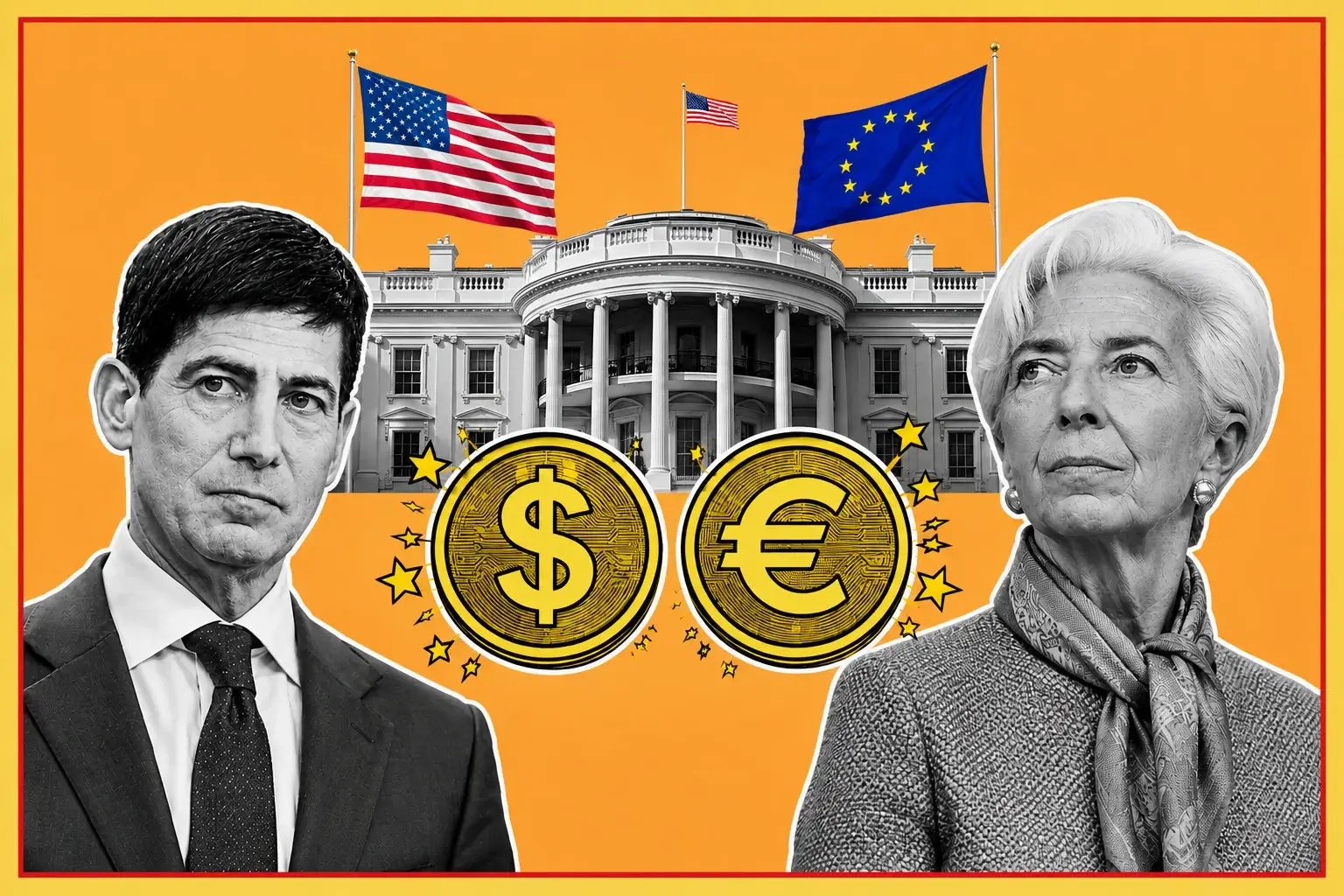

EUR/USD Price Forecast - EURUSD: Tariff Chaos And Fed Cut Pricing Keep 1.18 In Play, 1.20 On The Radar
EUR/USD defends the 1.1800–1.1820 zone while a weaker Dollar Index, 15% US tariffs and improving German data tilt the bias toward a break toward 1.1925 | That's TradingNEWS
EUR/USD Price Forecast – Tariffs, Fed Path And Euro Fundamentals Around $1.18
EUR/USD Holds Above $1.1800 As US And European Narratives Clash
EUR/USD is orbiting $1.1820, locked just above the $1.1800 pivot where short-term buyers and sellers are testing each other. Price is sitting on a cluster of averages and trendlines that effectively define the line between a grind higher toward $1.1925–$1.2000 and a deeper slide back toward $1.1740. The backdrop is not calm: US growth has cooled, US policy looks erratic after the tariff reversal-and-reimposition saga, while euro data has quietly shifted from survival to early-stage stabilization. That combination leaves the dollar struggling to build momentum and gives EUR-denominated assets a relative advantage as long as $1.1800 holds on closing basis.
US Growth Down To 1.4% As Core PCE Sits Near 3.0%
On the US side, the macro mix is hostile for sustained dollar strength. Real GDP expanded only 1.4% at an annualized pace in Q4 2025, clearly softer than earlier expectations for a stronger finish to the year. At the same time, core PCE inflation is still running around 3.0% year-on-year in December, above the Federal Reserve’s formal target corridor. Slower growth with sticky inflation is the classic stagflation-flavored mix that undermines the credibility of a prolonged “higher for longer” stance. Rate futures now price a very high probability that cuts begin in the second half of 2026, with at least two 25-basis-point moves implied by year-end. That repricing caps US front-end yields and removes one of the dollar’s key structural supports against EUR/USD.
Supreme Court Shock And New 15% Global Tariff Undermine USD
The tariff story has amplified pressure on the greenback rather than supporting it. The Supreme Court has struck down the original emergency tariff framework, only for the White House to pivot to a new 15% global levy using Section 122 authority, with a 150-day blanket tariff announced across all imports. This is a direct squeeze on US real incomes and corporate margins, with significant potential to distort supply chains. Instead of the dollar benefiting from a generic flight-to-safety impulse, markets are leaning into a Sell America narrative as investors reassess the policy risk premium on US assets. That is why the US Dollar Index is grinding around the mid-97s instead of reclaiming the 100+ levels seen in prior macro stress episodes, and why EUR/USD is finding dip demand every time price tests the low $1.18 area.
Dollar Index Trapped Below 98.00 As 97.20 And 96.30 Become Focus
Technically, the broader dollar structure has already weakened. The Dollar Index has broken a previous bearish channel only to stall underneath the 98.00–98.10 resistance band, with repeated intraday spikes into that zone being sold aggressively. Price is hovering near the 0.5 Fibonacci area around 97.20, with additional support zones flagged near 96.80 and 96.30. The 50-period moving average is essentially flat, while the 200-period average sits above it, reinforcing the message that upside momentum has faded. As long as DXY cannot hold above 98.00 on a closing basis, rallies look more like distribution than the start of a new uptrend, which favors a constructive tone for EUR/USD on pullbacks rather than chasing fresh dollar longs at current levels.
Read More
-
Yen Stalls at 160 Despite a 3% JGB and Tokyo Core CPI at 2.0% — Intervention Sits at 164, Friday's Payrolls Decide
02.09.2026 · TradingNEWS ArchiveEnergy
-
SPY Stalls Below Its Record As A 4.63% Earnings Yield Loses To A 4.74% Treasury
03.09.2026 · TradingNEWS ArchiveStocks
-
Bitwise Holds 286.8M XRP At A $480M Cost And $393M Of Value — The Category Bought Every Dip And Is Still Underwater
03.09.2026 · TradingNEWS ArchiveCrypto
-
Natural Gas Stalls Under $3 As Record 111.5 Bcf/d Production Absorbs Every Bullish Signal
03.09.2026 · TradingNEWS ArchiveCommodities
-
Dow 53,461, S&P 500 7,702 And Nasdaq 26,392 Climb On Waller's Dovish Turn — HOOD Explodes 14.9%
03.09.2026 · TradingNEWS ArchiveMarkets
-
Yen Rips Four Yen In A Session As Japan Takes Control Of The Dollar — Brent At $97.62 Could Not Stop It
03.09.2026 · TradingNEWS ArchiveForex
Euro Macro Tone Improves As German IFO Climbs To 88.6
The euro side of the equation is no longer defined by crisis language. Germany’s IFO Business Climate Index has risen to 88.6 in February from 87.6 in January, beating expectations and signaling that confidence has stopped deteriorating. The current assessment component has climbed to 86.7 from 85.7, indicating that firms see conditions as less strained than they did at the start of the year. Within the details, manufacturing sentiment has improved to around -11.3 and the services reading has edged into positive territory around 0.1. None of this points to a booming eurozone, but it decisively contradicts the “permanent sick man” narrative that previously justified EUR/USD trading closer to $1.05–$1.07. With the real economy stabilizing and external balances solid, the euro has a fundamental anchor closer to the mid-$1.10s and above, making levels just above $1.18 defensible as long as the news flow does not reverse sharply.
Fed Cut Pricing Versus ECB Hawkish Pause Lifts EUR/USD Carry Profile
Rate differentials increasingly lean in favor of the single currency. Markets assign roughly a 97% probability that the Fed begins cutting rates in the second half of 2026, with at least two quarter-point reductions priced into the curve as growth slows and tariff uncertainty weighs on sentiment. By contrast, the European Central Bank is operating a de facto hawkish pause. Inflation in the euro area is closer to target, ECB officials continue to demand clear evidence before easing further, and there is no aggressive cut cycle priced into European rates. That leaves short-term euro yields relatively stable while US short-end yields are capped by easing expectations. For EUR/USD, that revises the carry profile away from automatic dollar dominance and supports a grind higher whenever dips reset the pair toward the $1.1760–$1.1805 demand band.
Institutional Targets Cluster Between $1.21 And $1.25 Over 12 Months
Medium-term projections from large institutions reflect the same structural picture. One major Nordic bank sees EUR/USD moving toward $1.25 on a 12-month horizon as capital rotates gradually out of US assets and the gap in policy stances narrows. A large euro-area lender flags $1.21 as a reasonable trading area if the ECB has effectively ended its rate-cut cycle and the eurozone avoids a fresh internal shock. Several North American houses expect broad-based dollar underperformance against major developed currencies through 2026 and into 2027, grounded in a path that combines near-term Fed easing with more stable policy elsewhere. In that environment, sustained trades below $1.18 would require either a sudden negative euro shock or a sharp positive surprise out of the US, neither of which is the base case implied by current data and pricing.
Short-Term Technical Map: $1.1800, $1.1860, $1.1925 And $1.1740
Technically, EUR/USD is coiling inside a tightening triangle structure. Price is caught between a descending trendline from the February high near $1.1970 and a rising support line from the January lows. The nine-day exponential moving average sits around $1.1820 and is starting to flatten, while the 50-day EMA around $1.1775 underpins the broader constructive bias. The 200-day EMA near $1.1800 acts as a medium-term “line in the sand” for buyers. On the upside, the $1.1860 cluster remains the immediate breakout trigger; a daily close above this zone opens space toward $1.1925 and then roughly $1.1985. On the downside, a clean break under $1.1800 and then $1.1775 would expose the $1.1760 and $1.1740 supports. A decisive daily close below $1.1740 would signal that the bullish short-to-medium-term structure has failed and that a deeper correction is underway.
Bias: Constructive On Dips With Preference To Accumulate Above $1.1760
Given the combination of softer US growth at 1.4%, core PCE stuck near 3.0%, a messy 15% global tariff plan, stabilizing euro data, and a policy path that favors Fed cuts against an ECB pause, EUR/USD still looks better accumulated on weakness than sold aggressively at current levels. As long as DXY cannot sustain levels above 98.00 and spot holds above the $1.1760–$1.1800 support belt on closing basis, the path of least resistance leans toward retesting $1.1860 and then the $1.1925–$1.2000 region. A break and close below $1.1740 would invalidate that constructive bias and reopen downside risk, but until that level is taken out, the structure argues for staying aligned with euro strength against the dollar rather than fighting it.