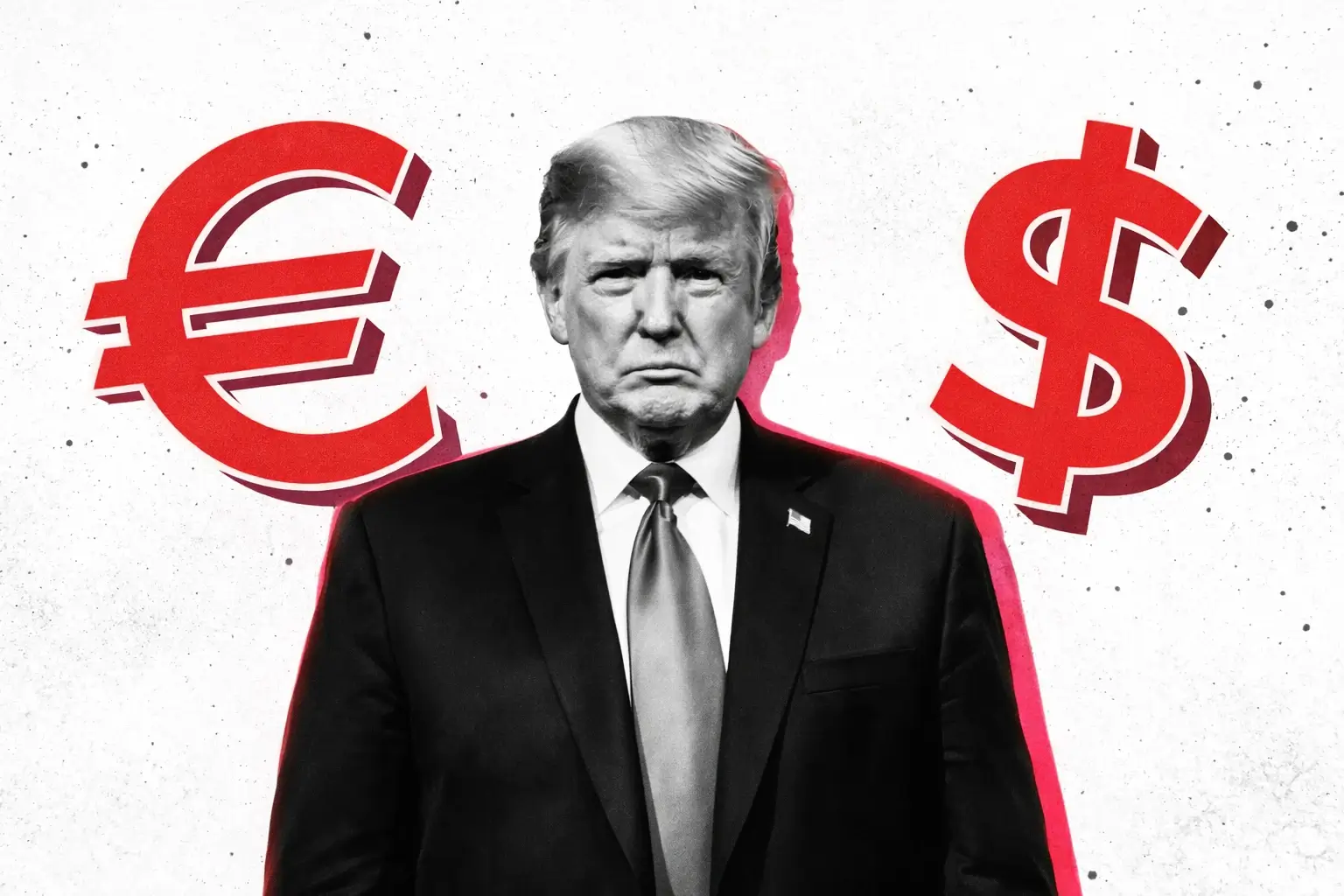
EUR/USD Price Forecast: Five-Day Losing Streak Snaps at 1.1450 as Dollar Hits Ten-Month Highs
Eurozone HICP Jumps to 2.7%, ECB Frozen, and the Hormuz Closure Puts Europe's Energy Bill on a Collision Course With the Euro — Next Target 1.1400, Then 1.1100 | that's TradingNEWS
Key Points
- EUR/USD bounced to 1.1450 on Iran hopes, but DXY near $100.63 and U.S. 10-year yields at 4.334% keep every rally a selling opportunity.
- Eurozone HICP jumped to 2.7% from 1.9%, locking the ECB in policy paralysis while the Fed holds rates at 3.5%-3.75% with no cuts before H2 2026.
- Short rallies toward 1.1490-1.1530 — a break below 1.1409 opens the path directly to 1.1100.
EUR/USD entered Tuesday having shed ground for five consecutive sessions — one of the most sustained directional moves in the pair since the Iran war reshaped global capital flows on February 28. The recovery that printed Tuesday, bouncing from the 1.1445-1.1480 zone toward 1.1500 and eventually pushing toward 1.1550, is real in the sense that it exists on the chart. What it is not is a trend reversal. Every single macro driver that built the dollar's five-session winning streak — rate differentials, energy dependency, inflation repricing, and geopolitical safe-haven demand — remains structurally intact. Tuesday's bounce is a relief move triggered by one specific catalyst: a Wall Street Journal report that President Trump told aides he was willing to end the Iran war without forcing a full reopening of the Strait of Hormuz. That is a diplomatic nuance, not a resolution. And the history of the past five weeks shows that Washington's messaging on Iran reverses within hours.
The U.S. Dollar Index (DXY) hit a multi-month ceiling at $100.637-$100.65 during Monday's session, closing at $100.44. That resistance level is psychologically and technically significant — it represents the convergence of a rising trendline established in February and the $101.00 handle that bulls have repeatedly failed to crack. A 4-hour close above $100.70 opens the door to $101.125-$101.50. A failure to clear $100.637 sends the DXY back toward $99.59 support. Tuesday's dollar softness came from the Iran ceasefire headline, not from any shift in the fundamental framework. As long as the 10-year U.S. Treasury yield holds above 4.3% — which it did, closing near 4.334% — the dollar's structural advantage over the euro remains fully operational.
The Rate Differential Is the Entire Story — And It Hasn't Changed
The interest rate differential between the United States and the Eurozone is the most powerful force operating on EUR/USD right now. The Federal Reserve is frozen at 3.5%-3.75% with markets pricing no cuts before H2 2026 at the earliest. Fed Chair Jerome Powell stated explicitly on Monday that long-term U.S. inflation expectations remain anchored despite the Middle East conflict, and that the Fed's policy stance "allows officials to evaluate the economic impact" of the war — which is central bank language for: we are not moving. New York Fed President John Williams reinforced that posture, telling Reuters that monetary policy is "well-positioned for any unusual circumstances" and that the labor market is still sending mixed signals. Neither statement contains even a hint of dovish pivot.
The ECB, meanwhile, is navigating a different kind of crisis. Bank of France Governor François Villeroy de Galhau warned Monday that policymakers stand ready to act if energy-driven inflation broadens — while simultaneously acknowledging that the ECB cannot prevent the initial surge in prices. That is a central bank caught between its inflation mandate and the economic reality of an energy-importing bloc facing oil prices up 50% in a month. Eurozone headline HICP for March came in at 2.7% year-on-year, up sharply from 1.9% in February — breaking above the ECB's 2% target for the first time since November. Germany's CPI was also ticking higher toward 2.7%. The ECB cannot cut into accelerating inflation. It cannot hike aggressively into an energy shock that is already compressing consumption. The policy paralysis in Frankfurt is a structural negative for the euro that doesn't resolve regardless of what happens on Tuesday's battlefield headlines.
Capital flows into the dollar when U.S. rates are elevated, the dollar offers yield, and uncertainty pushes risk-averse positioning into the world's reserve currency. All three conditions are simultaneously present right now at a level not seen since 2022. The euro is on the wrong side of every one of those flows.
The Hormuz Closure Is an Asymmetric Shock for EUR/USD
The Strait of Hormuz handled roughly 20% of global oil and LNG shipments before the U.S.-Iran conflict began. The Eurozone is a net energy importer. The United States is energy independent and an active exporter. The closure of the Hormuz is therefore not a symmetric shock — it hits European energy costs directly and structurally in a way that has no equivalent impact on U.S. production economics. Brent crude near $115-$117 per barrel and WTI above $103 means European industrial input costs are surging, consumer purchasing power is being compressed, and energy import bills are widening the Eurozone's current account in the wrong direction.
Qatar, which had been a significant natural gas supplier to Europe, has seen its LNG infrastructure damaged in the conflict. That supply disruption compounds the energy picture for a bloc that is already warning about potentially needing to ration fuel through the coming months. The EU's energy chief explicitly described the disruption as "potentially prolonged" and urged member states to conserve fuel. This is not background noise — it is a direct negative for euro-denominated assets and a direct positive for dollar-denominated ones. As long as the strait remains functionally closed to safe passage, Europe's energy vulnerability keeps the structural pressure on EUR/USD pointed south.
The U.S. energy independence advantage is not merely an abstraction. It means American manufacturers face lower input cost increases than European competitors, American consumers — while stressed at $4.018 per gallon — are not experiencing the severity of European fuel shortages, and American exporters of LNG and crude are generating extraordinary revenues that recirculate into dollar-denominated assets. Europe is importing the inflation and exporting the capital. That dynamic plays out directly in EUR/USD.
The DXY Technical Map: $100.637 Resistance, $99.59 Support, $101.50 Target
The U.S. Dollar Index (DXY) has been riding a well-defined rising trendline since February, consistently finding buyers on every pullback. Monday's session saw DXY jump roughly 0.2% as Strait of Hormuz tensions intensified, with the index reaching its daily high of $100.65 before settling at $100.44. The 4-hour chart shows a series of highs barely failing to sustain above the $100.637 ceiling — a pattern of strong buying interest combined with resistance selling that creates the compression typical of a breakout setup rather than a trend exhaustion.
If the DXY achieves a sustained 4-hour close above $100.70, the $101.125 level comes into view, and above that $101.50 — a level that would represent a fresh multi-month high for the dollar and a corresponding collapse in EUR/USD toward the 1.1300-1.1400 zone. The mean-reversion scenario on a failure to break $100.637 targets $99.59 support — which would give EUR/USD a temporary bid, but not a trend change. The structural trendline from February remains intact regardless of Tuesday's single-session move.
The 10-year U.S. Treasury yield at 4.334% is the gravitational anchor beneath the DXY. Christopher Lewis's analysis is direct and accurate: as long as the 10-year yield stays above 4.3%, the dollar is structurally difficult to break down. Bond yields above 4.3% reflect a market that is not pricing Fed cuts, is pricing persistent inflation, and is treating dollar assets as the combination of safety and yield that no other major currency can currently match.
EUR/USD at 1.1450-1.1500: Everything Below 1.1549 Is a Short
EUR/USD broke below its long-term ascending trendline on the 4-hour chart — a structural development that changes the technical bias regardless of day-to-day oscillations. The break below $1.15016 support-turned-resistance is the critical event. Having violated that level, the pair now faces overhead supply at every attempt to reclaim it. The RSI on the 4-hour chart was hovering around the 40 mark entering Tuesday's session — bearish momentum present, but not extreme enough to signal immediate capitulation. That is actually the most dangerous setup for EUR/USD longs: enough RSI room to attract buyers into a recovery that runs directly into supply.
The sequence of bearish engulfing patterns followed by inside bars on the 4-hour chart is a textbook continuation signal — a pause before the next leg lower rather than a genuine reversal. The 1.1445-1.1450 zone, which held as support Tuesday morning after the five-day losing streak, was identified by Economies.com analysts as a pre-set price target that triggered the technical bounce. That bounce has now pushed toward 1.1500-1.1550 on the dollar's intraday weakness. The optimal positioning strategy is to treat that recovery as a short entry, not a long signal.
The key resistance levels on EUR/USD are: 1.1490-1.1500 (immediate supply zone where sellers reemerged repeatedly through March), 1.1530 (the stop-loss level above which the short thesis is invalidated in the near term), and 1.1549 (the swing high that must be cleared on a daily close for any genuine trend reversal argument). Below 1.1409 — the critical swing low — the path opens toward 1.1100, a level that represents a full unwinding of the euro's 2025 strength and a return to pre-conflict range boundaries. The 1.1400 round number is the next logical downside target once 1.1409 fails, and below that the structure offers minimal support until 1.1100.
The optimal trade setup: short on a retest of 1.1490 targeting 1.1410 with a stop above 1.1530. On a confirmed break below 1.1400, that target extends toward 1.1100.
GBP/USD at the 0.236 Fibonacci Level — Sterling Is Holding by a Thread
GBP/USD is clinging to the 0.236 Fibonacci retracement level at $1.3233, which has become the defining battleground for the pair. The sharp rejection from the descending trendline and the blue moving average sent sterling into self-preservation mode, with price pressing against $1.3233 as the last meaningful technical defense before $1.3158-$1.3150. Tuesday saw GBP/USD rebound sharply toward 1.3260 on the dollar's intraday weakness, but the structural picture hasn't changed — the RSI bounced from oversold territory but remained below 40 at the time of the technical assessment, confirming that bears maintain control of the intermediate trend.
The hammer formation at the $1.3159 low is constructive from a short-term tactical perspective — it signals that immediate selling exhaustion has occurred at that level. But exhaustion at a low is not the same as reversal. Sterling faces the same interest rate differential headwind as the euro, compounded by UK-specific concerns about economic vulnerability to energy cost spikes. The UK is less energy-exposed than the eurozone but more exposed than the United States, placing GBP/USD in the same structural decline pattern as EUR/USD while potentially being slightly more resilient during individual risk-on sessions. Above $1.3278, the pair can challenge $1.3350. A break below $1.3150 opens $1.3085 directly. The pair is a hold near current levels with a short bias on any failure to sustain above $1.3278 on a daily close.
Eurozone HICP at 2.7% — Why Higher Inflation Is Bearish for the Euro Right Now
Under normal circumstances, a jump in Eurozone HICP to 2.7% year-on-year from 1.9% would be modestly euro-positive, as it would push ECB rate expectations higher. These are not normal circumstances. The 2.7% March HICP print — which exceeded the consensus forecast and came entirely from energy price pass-through — puts the ECB in the worst possible position: inflation above target in an environment where the underlying economy is being squeezed by the same energy shock causing the inflation. Hiking into this would accelerate the economic contraction. Holding makes the ECB appear reactive and passive. Neither outcome is euro-positive.
The flash HICP data confirms that higher oil prices are transmitting rapidly and aggressively into European consumer prices. Germany's headline CPI was trending toward 2.7% for March as well. The ECB's credibility in managing an externally-driven inflation shock without the policy tools to actually address the supply side is a structural drag on confidence in the currency. Compare that to the Fed's position — facing similar inflationary pressure from oil, but from a position of energy independence, with a labor market still showing 6.88 million job openings and a currency benefiting from every flight to safety and yield. The ECB is in a structurally inferior position, and EUR/USD is pricing exactly that.
German Retail Sales and Unemployment data for February were also in focus Tuesday, adding to the picture of an economy navigating the war's secondary effects on consumer behavior and labor market dynamics. Any miss on retail sales in particular would reinforce the stagflation narrative that is the most bearish scenario for the euro — rising prices combined with falling consumption, with an ECB unable to cut because CPI is above 2% and unable to hike because the economy can't absorb it.
Read More
-
Yen Stalls at 160 Despite a 3% JGB and Tokyo Core CPI at 2.0% — Intervention Sits at 164, Friday's Payrolls Decide
02.09.2026 · TradingNEWS ArchiveEnergy
-
Dow Jones Hits 3-Week High at 51,913 as S&P 500 Stalls at 7,814, Nasdaq Falls on MU -3.1%
12.10.2026 · TradingNEWS ArchiveStocks
-
Bitcoin Fades From $84,243 as 5.24% Yields Bite — $87,000 Breakout Needs a Soft CPI
12.10.2026 · TradingNEWS ArchiveCrypto
-
Gold Fails at $4,218 as Fed Hike Odds Hit 85% for December — $4,109.90 Low Now in Focus
12.10.2026 · TradingNEWS ArchiveCommodities
-
EUR/USD (1.1180) Slides as 175bp U.S.-Bund Yield Gap Widens — 1.1160 Support Faces CPI Test
12.10.2026 · TradingNEWS ArchiveForex
The Powell Factor: Why "Anchored Expectations" Locked EUR/USD Lower
Powell's Monday comments — that long-term U.S. inflation expectations remain "well anchored" despite the Iran conflict — had a paradoxical effect on EUR/USD. The natural reading of anchored expectations is that the Fed can afford patience rather than aggressive rate hikes, which should be slightly dollar-negative. But the market's actual interpretation was more sophisticated: anchored long-term expectations mean the Fed can hold at 3.5%-3.75% for longer without panic-hiking, which means the current rate structure — highly favorable to the dollar — persists. There is no urgency to cut, no need to hike, and therefore no directional change in the rate differential that would give the euro sustained lift.
New York Fed President Williams reinforced this picture by describing the job market as "sending mixed signals" — exactly the kind of data ambiguity that keeps the Fed on hold indefinitely. A Fed on hold at 3.5%-3.75% against an ECB caught between 2.7% inflation and an energy-shocked economy is precisely the configuration that keeps capital flowing into dollar assets and out of euro assets. The February JOLTS data — showing only 6.88 million job openings against a prior 7.2 million and a hiring rate that collapsed to its lowest since April 2020 at 3.1% — added a data point of economic softening that could theoretically give the Fed cover to cut. But consumer confidence surprising to the upside at 91.8 versus the 87.5 consensus undercut that narrative and left the Fed's "wait and see" posture fully intact.
The Energy Independence Asymmetry: America Drives, Europe Rides
The Iran war has created a macro environment that structurally advantages the United States relative to every major energy-importing economy. U.S. gasoline crossed $4.018 per gallon on Tuesday — painful, but manageable within an economy where consumer confidence still printed 91.8 and the labor market still shows nearly 7 million open positions. Europe's energy situation is categorically different. Qatari LNG infrastructure has been damaged. The Strait of Hormuz closure has removed roughly 20% of global energy flows. European industrial competitiveness — already under pressure before the conflict — faces input cost increases that American competitors simply do not face at the same magnitude.
This asymmetry is the structural backbone of the dollar's multi-week strengthening trend. The DXY hit ten-month highs near $100.63 during the March run. The euro broke its long-term ascending trendline. The pound tested critical Fibonacci support. These are not coincidental moves — they are the market pricing a world where the United States is an energy exporter, its currency provides yield above 4%, and its central bank can afford patience, while Europe faces an energy crisis with a frozen central bank and accelerating consumer prices.
Until either the Strait of Hormuz reopens — removing the energy price premium — or the Fed signals actual rate reductions, the structural advantage remains with the dollar. Trump's statement Tuesday that the war "won't last much longer" and that the strait will open "automatically" after a U.S. withdrawal generated the intraday dollar weakness that drove EUR/USD back toward 1.1500-1.1550. But Trump also threatened to strike Iranian electricity plants and oil facilities on Monday and sent 2,500 Marines to the region over the weekend. The messaging has been contradictory throughout the five-week conflict, and positioning around diplomatic optimism that reverses within 24 hours is the defining characteristic of how this market gets caught offside repeatedly.
The Verdict: Short EUR/USD Into Rallies, Target 1.1400 Then 1.1100
EUR/USD is a sell. The trade is to short rallies toward 1.1490-1.1530 with a stop above 1.1549, targeting 1.1410 as the immediate objective and 1.1100 as the medium-term destination if 1.1400 breaks on a daily close. Every technical signal — broken ascending trendline, RSI below 50, bearish engulfing patterns on the 4-hour chart — aligns with the fundamental picture: rate differentials favor the dollar, energy dependency weighs on Europe, ECB paralysis undercuts the euro, and the DXY's rising trendline from February remains structurally intact.
Tuesday's recovery to 1.1500-1.1550 on the Iran ceasefire headline is the exact type of relief rally that has characterized EUR/USD throughout March — sharp, sentiment-driven, and subsequently faded. The pair snapped five days of losses on a single diplomatic report from an administration that has reversed course multiple times. That is not a trend reversal. That is a short entry.
GBP/USD is a hold with a short bias below 1.3278 — less aggressive than the EUR/USD short given sterling's slightly better energy positioning, but fundamentally on the same trajectory. DXY is a buy on any pullback toward $99.59, with the breakout target at $101.50 if $100.70 clears on a sustained 4-hour close. The interest rate differential, the energy asymmetry, and the technical structure all point the same direction. Fade every euro rally until the Strait of Hormuz reopens or the Fed blinks. Neither is happening this week.