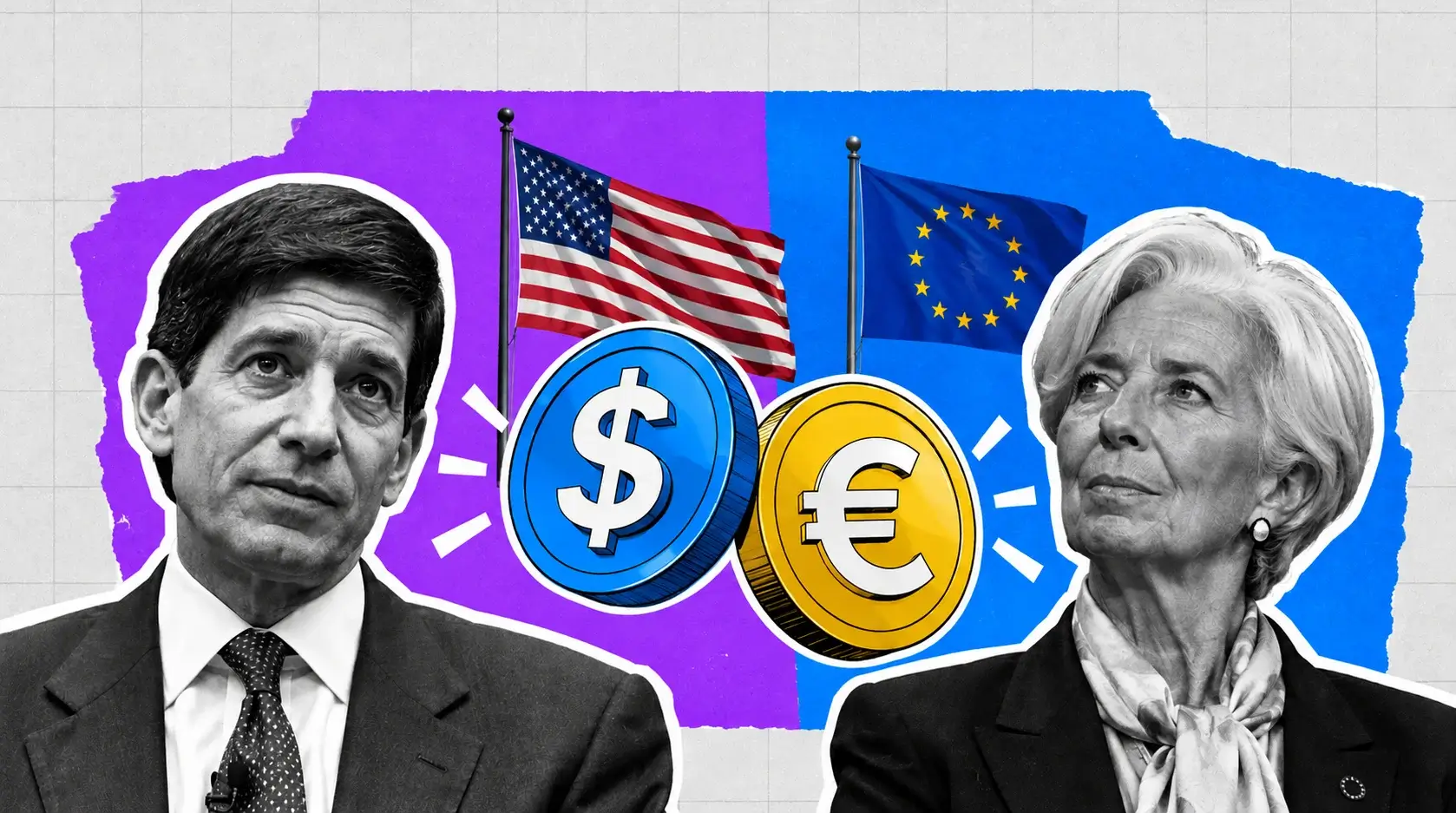
EUR/USD Price Forecast: Euro Slides to 1.1500 Support as Dollar Dominance Builds and Iran Peace Talks Collapse
With the ascending channel broken, the 200-day EMA flipped to resistance at 1.1540, and Fed rate hike odds crossing 50% | That's TradingNEWS
Key Points
- Dollar at 100, Rate Hike Odds at 52% — Euro Has No Ammunition The DXY is pressing 100.142 resistance with bullish momentum building on the 2-hour chart.
- Spain's CPI at 3.3% Confirms Europe's Inflation Problem Is Getting Worse Spain's March inflation jumped to 3.3% year-over-year from 2.3% in February, blowing past the 2.4% consensus.
- Channel Broken, 200-Day EMA Flipped to Resistance — The Structure Is Bearish EUR/USD broke below its ascending channel and the 200-day EMA at 1.1540 is now acting as a ceiling, not a floor.
EUR/USD has dropped for four consecutive sessions, falling from Monday's weekly high of 1.1640 all the way down to 1.1500 as of Friday's trading — a move of 140 pips in five days that reflects something far more serious than a routine technical pullback. The pair broke below the lower boundary of its ascending channel, slipped under the 200-day EMA at 1.1540, and is now pressing against the psychologically critical 1.1500 level. The MACD line has turned negative and is trading below its signal line. The RSI is sitting in the low 40s — not oversold enough to trigger automatic buying, but weak enough to confirm that sellers are in control at every intraday bounce. The shorter-term moving average remains pointed downward, capping every attempted recovery. This is a pair that is not just correcting — it is repricing against a macro backdrop that is fundamentally hostile to the euro right now.
The DXY at 100 Is the Headwind That Won't Go Away
The US Dollar Index is hovering between 99.90 and 100.00, and every time it touches that level it reinforces the ceiling on EUR/USD recovery attempts. The DXY's 2-hour chart is compressing inside a descending triangle with resistance at 100.142. The shorter moving average has crossed above the longer one — a short-term bullish signal for the dollar — and the RSI is climbing toward 65 with its moving average also crossing higher. A clean daily close above 100.142 opens the path to 100.538 and then 100.894. For EUR/USD, that translates directly into sustained pressure below 1.1540. The dollar is drawing strength from two simultaneous forces: safe-haven demand driven by the Middle East conflict, and the collapse of Fed rate cut expectations as oil prices push inflation higher. With WTI near $97 and Brent crossing $110, the Fed is no longer in an easing posture — futures markets now assign a 52% probability to a rate hike by year-end 2026. That rate differential between the US and Europe is the dollar's primary weapon against the euro right now, and it is widening, not narrowing.
1.1500 Is the Last Meaningful Defense Before 1.1415 and Then 1.1350
The technical structure of EUR/USD below the channel is straightforward and unfriendly to bulls. The pair is currently defending 1.1500 — a large, round psychological figure that traders on both sides are watching intensely. Immediate support below it sits at the March 23 low of 1.1484, followed by the March 18-19 lows clustered around 1.1440. A decisive break below 1.1415 — the late pullback low — confirms the downswing continuation and opens the 1.1350 zone, where longer-term structural buyers are expected to re-emerge. On the upside, the pair faces a layered resistance wall: the channel base now acting as resistance at 1.1540, the 20-day EMA at 1.1590, and the weekly high of 1.1640. A daily close above 1.1590 would be the first signal that bearish pressure is easing and a move toward 1.1690 becomes viable. A stronger recovery targeting 1.1810-1.1850 — where prior highs cluster and the recent breakdown began — requires a genuine geopolitical shift, not just a temporary headline bounce. The 200-day EMA at 1.1540, which previously acted as support, has now flipped to resistance, and every attempted recovery is getting sold into at or below that level.
ECB President Lagarde Drops a Warning the Market Hasn't Fully Priced
ECB President Christine Lagarde stated in an interview with the Economist that the negative energy shock hitting the global economy from the Middle East conflict will be larger than current market projections because too much Gulf energy infrastructure has already been sustained damage. That statement is significant for EUR/USD on multiple levels. First, it signals that the ECB is operating with a higher inflation baseline than what is currently embedded in rate expectations. Second, Bundesbank President Joachim Nagel has been signaling hawkishness — arguing that rates need to move higher — while other ECB council members are sending mixed signals. That internal division creates uncertainty about ECB policy direction precisely at the moment when clarity is most needed. The eurozone cannot afford a split central bank when Spain's CPI just jumped to 3.3% year-over-year in March from 2.3% in February — its highest level in nearly two years, blowing past the 2.4% analyst consensus. Spain's inflation print is an early warning signal for the broader eurozone. The energy pass-through into consumer prices is accelerating faster than the ECB's models projected, and Lagarde's own admission that the shock will be larger than expected is effectively the central bank acknowledging it is behind the curve.
Europe's Energy Dependence Is the Structural Problem — The Strait of Hormuz Makes It Worse
Europe imports a substantial portion of its energy, and the Strait of Hormuz closure announced by Iran's IRGC on Friday — which saw two Chinese vessels turned away and a Thai-flagged cargo ship run aground after being struck — is an energy supply shock that hits the eurozone disproportionately harder than it hits the United States. The US has domestic oil production capacity. Europe does not. Higher energy costs in Germany flow directly into manufacturing input costs, which compress industrial output, which then drags on German business confidence. Germany's deteriorating confidence is already pulling the wider eurozone sentiment lower. Brent crude above $110 per barrel is not a temporary market spike — it reflects a physical supply disruption at the world's most critical oil chokepoint. Lagarde's warning that the energy shock will exceed current projections is rooted in exactly this reality: if Brent stays above $100 through Q2, European inflation will continue accelerating, forcing a stagflationary dynamic where the ECB must choose between fighting inflation with rate hikes that crush a slowing economy, or tolerating above-target inflation to protect growth. Neither option is good for the euro.
The Double Top Pattern on the Intraday Chart Is Confirming Bearish Bias
The technical formation on the intraday EUR/USD chart is a double top — a classically bearish reversal pattern that increases the probability of continued sideways-to-lower price action in the near term. The pair is holding above 1.1530 but the pattern has broken below the EMA50, which removes the near-term bullish baseline and leaves the RSI struggling to hold recovery attempts into the neutral 40-60 zone. The selling pressure at higher levels — specifically every time price approaches 1.1575-1.1590 — is consistent with institutional distribution rather than retail panic. The combination of a broken ascending channel, a confirmed double top, MACD negative and below signal, and RSI anchored in the low 40s produces a technically clean bearish case. The only counterargument is that EUR/USD remains within a broader long-term upward structure — the pair is still substantially above its 2025 lows — but near-term, the momentum is entirely in the dollar's favor.
GBP/USD at 1.3300 Tells the Same Story — Dollar Dominance Is Broad-Based
GBP/USD is trading in negative territory for the fourth consecutive day near 1.3300, reinforcing that the dollar's strength is not an EUR/USD-specific phenomenon but a broad-based repricing across all G10 currencies. The pound's 2-hour chart shows a descending triangle compressing between an upper trendline from 1.3575 and lower support from 1.3218. Price got rejected from 1.3433 — where the long-term moving average acted as a ceiling — and is now pressing against rising trendline support at 1.3292. The RSI is dropping with moving average lines crossing bearishly. A break below 1.3292 targets 1.3218 directly, and below that the descending triangle measured move accelerates. The Bank of England is offering no directional clarity, choosing to neither commit to cuts nor hikes explicitly — which in a risk-off environment where the dollar is attracting safe-haven flows simply means sterling drifts lower by default. The fact that GBP/USD and EUR/USD are trading at nearly equivalent levels against each other confirms that both European currencies are facing the same macro headwinds: energy vulnerability, inflation acceleration, and central bank uncertainty.
Read More
-
Yen Stalls at 160 Despite a 3% JGB and Tokyo Core CPI at 2.0% — Intervention Sits at 164, Friday's Payrolls Decide
02.09.2026 · TradingNEWS ArchiveEnergy
-
COCO Bounces From Oversold as Short Interest Hits 10.9% of Float — Hold Into Q3, With $59.82 the Level to Reclaim
08.10.2026 · TradingNEWS ArchiveStocks
-
XRP-USD ($1.35) Slides 18.7% From September High as 3 Supports Fail — $1.27 Demand Zone Is Next, Bulls Must Reclaim $1.45
08.10.2026 · TradingNEWS ArchiveCrypto
-
Brent ($103.63) and WTI ($90.87) Fade From 5% Spike as Nine Tanker Attacks Hit Hormuz — $108.23 Breakout
08.10.2026 · TradingNEWS ArchiveCommodities
-
S&P 500 Slips Below 7,800, Nasdaq −0.56%, Dow Under 51,000 on $105 Oil and 5.35% Yields; HAE +13.41%
08.10.2026 · TradingNEWS ArchiveMarkets
-
Sterling Stuck Between 1.3180 and 1.3287 as Gilt Selloff Tests UK Fiscal Credibility — BoE Hike in Play for Nov. 5
08.10.2026 · TradingNEWS ArchiveForex
USD/CAD and USD/CHF Confirm the Dollar's Dominance Is Structural, Not Situational
USD/CAD pulled back early Friday but reversed higher as US rates climbed, with the market targeting the 1.39 level — a mid-range cluster from January. The Canadian dollar is getting some cushion from higher oil prices given Canada's energy export position, but the US interest rate differential is overwhelming that commodity benefit. USD/CAD remains well above its 200-day EMA, meaning every pullback is a buying opportunity for the dollar. USD/CHF is approaching the psychologically critical 0.80 level — a round number with historical significance that is now also attracting the 200-day EMA. The Swiss National Bank has explicitly warned it would intervene if CHF strengthened excessively, and the interest rate differential between the US and Switzerland is enormous. The SNB's intervention threat effectively puts a floor under USD/CHF and a ceiling on CHF safe-haven flows. The pattern across USD/CAD, USD/CHF, GBP/USD, and EUR/USD is identical: the dollar is winning everywhere simultaneously because of one thing — US interest rates are rising while every other central bank is hesitating.
The Interest Rate Differential Is the Engine — And It's Accelerating
The 10-year US Treasury yield is at 4.44%, its highest level since last July. US rate hike probability for year-end 2026 just crossed 50% for the first time. German and other major European bond yields are also rising as the energy shock filters into inflation expectations, but the absolute level and the trajectory of US rates are still running ahead of European equivalents. That differential — the swap rate favoring the dollar — is the single most reliable predictor of EUR/USD direction in this environment. When US rates rise faster than European rates, the dollar attracts capital inflows and EUR/USD falls. That is exactly what is happening right now. The only scenario that breaks this dynamic is a ceasefire in Iran that collapses oil prices, which would simultaneously remove inflation pressure from the US and restore European energy cost stability. Peace mediators contradicted Trump's claim Friday, Iran has publicly rejected the U.S. 15-point plan, and the Pentagon is planning for 10,000 additional ground troops. The rate differential trade stays alive.
The Trade: Sell EUR/USD Rallies Into 1.1540-1.1590, Target 1.1415 and 1.1350
EUR/USD is a sell on rallies. Every bounce toward the former channel support now acting as resistance at 1.1540 — and especially any test of the 20-day EMA at 1.1590 — is a distribution zone where the risk-reward favors short positions. The stop on any short entry should sit above 1.1625, which represents the weekly high and the level above which the bearish channel breakdown becomes invalid. The primary downside target is the March 18-19 low cluster at 1.1440, with 1.1415 as the key confirmation level. A clean break and daily close below 1.1415 opens 1.1350 as the next meaningful support zone. The bullish case — a genuine ceasefire, oil below $80, Fed rate hike expectations collapsing — would send EUR/USD back through 1.1640 and toward 1.1690 and eventually 1.1810-1.1850. That scenario is possible but not the base case while the Strait of Hormuz remains closed, Spain's CPI is accelerating above 3%, Lagarde is warning of a larger-than-expected energy shock, and the DXY is pressing against the 100.142 breakout level. Until April 6 — Trump's new deadline — every EUR/USD rally is someone else's exit. Fade it.