
Euro Pinned at 1.1555 Into the ECB's First Hike in Years as Dollar Refuses to Roll Over
EUR/USD traded near 1.1555 on June 10 on the eve of a June 11 ECB meeting priced at 100% for a 25bp hike to 2.25% | That's TradingNEWS
Key Points
- EUR/USD slipped near 1.1555 before a June 11 ECB meeting priced 100% for a 25bp hike to 2.25%.
- A hot 4.2% US CPI and a fully priced December Fed hike keep the dollar near 100, capping the euro.
- The pair pierced 1.1611 support; 1.1492–1.1525 is next, with 1.15–1.20 the likely six-month range.
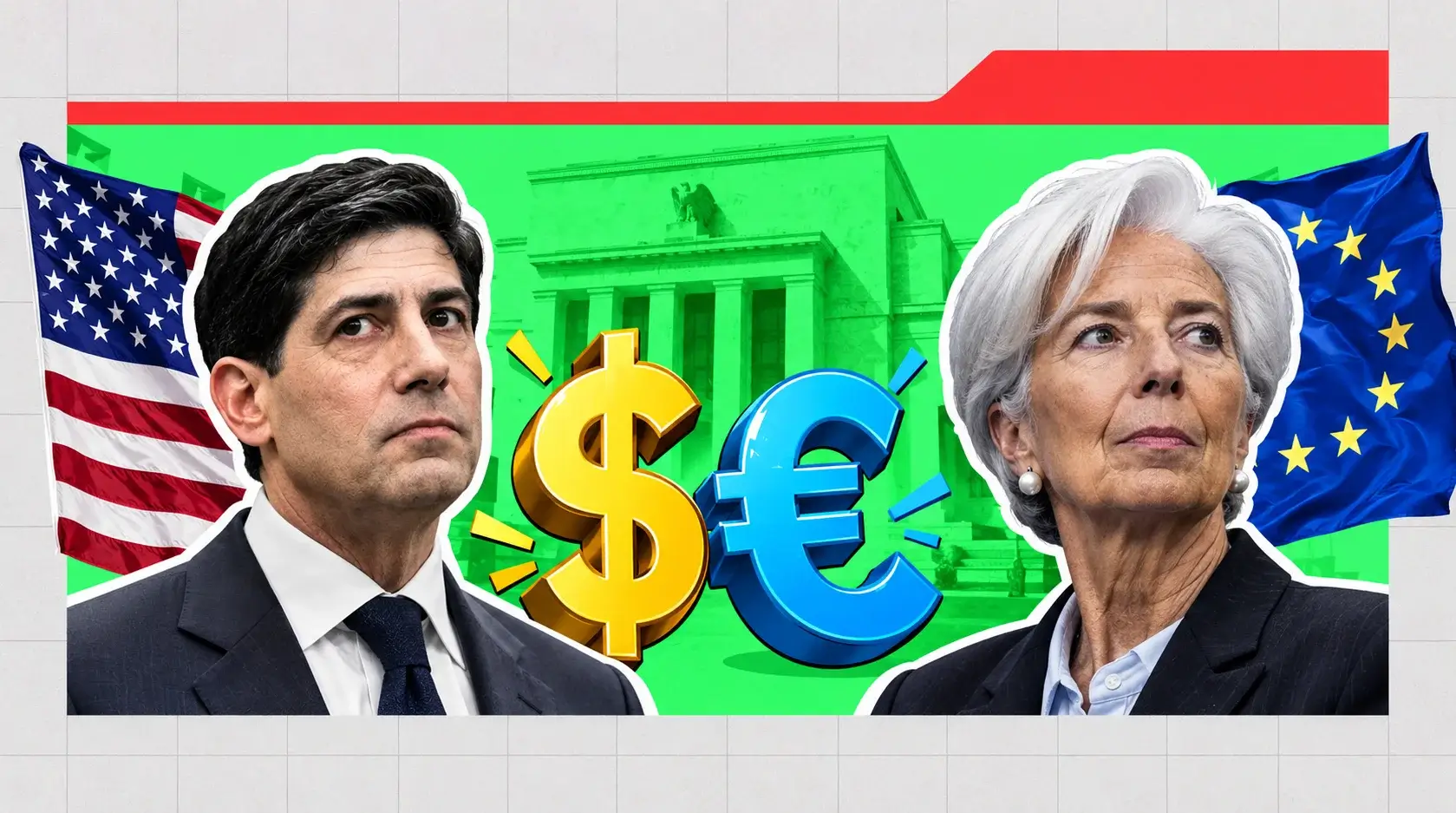
EUR/USD traded near 1.1555 by midday Wednesday, slipping toward multi-week lows on the eve of a European Central Bank decision that money markets have already settled. The June 11 meeting carries a 100% market-implied probability of a 25-basis-point increase that would lift the deposit facility rate from 2.00% to 2.25% — the bank's first rate hike in years and a decisive turn for an institution that spent the prior cycle cutting and then holding. On most days, a currency heading into a fully priced hike from its own central bank would firm. The euro is doing the opposite, and the reason sits across the Atlantic.
The pair had risen to 1.1539 on June 9, up about 0.10% on the session, before drifting to roughly 1.1555 into the US inflation release. The May Consumer Price Index printed a hot 4.2% headline, the fastest annual pace since April 2023, but a cooler 0.2% monthly core handed the euro a small reprieve by pushing back against the most hawkish read on Federal Reserve policy. That left EUR/USD suspended in a tense range, caught between an ECB about to tighten and a dollar that has refused to roll over despite every reason to weaken.
A Hike Fully Priced: The June 11 ECB Decision
The European Central Bank's June 11 meeting is the single most important event on the euro calendar, and the market has left no ambiguity about the outcome. The ECB-implied probability of a 25-basis-point hike to 2.25% sits at 100%, with at least one additional increase priced by year-end. The move would mark a genuine regime shift: after holding the deposit rate at 2.00% through its April 30 and March 19 meetings, the Governing Council is poised to begin tightening for the first time in years.
The path to this point has been shaped by the energy shock. At the April meeting, President Christine Lagarde described the decision to hold as unanimous, even as policymakers debated a hike and acknowledged the bank was "certainly moving away" from its baseline scenario. The statement flagged that upside risks to inflation and downside risks to growth had intensified, language that did not pre-commit to a June move but did nothing to rule one out. Since then, board member Isabel Schnabel signaled that "a rate hike in June will be needed," and the market took the cue, moving from roughly 90% odds toward full pricing as eurozone inflation data confirmed the pressure.
The complication for the euro is that a 25-basis-point hike is already in the price. With the outcome a foregone conclusion, the currency's reaction will hinge entirely on Lagarde's guidance about what comes after June — whether the bank signals a sustained tightening campaign or frames the move as a one-off response to an energy-driven inflation spike it expects to fade. A hawkish lean toward further hikes would give the euro fresh fuel; a dovish framing that treats June as the peak would leave the currency exposed to the dollar's strength.
The Paradox: Why the Euro Can't Rally Into a Rate Hike
The defining feature of the current setup is that the euro has slipped to multi-week lows precisely as its central bank prepares to tighten. EUR/USD traded around 1.1668 at the end of May and has since drifted toward 1.1555, a move that looks contradictory on its surface. A hiking central bank should support its currency; instead, the euro is soft.
The answer lies in relative dynamics. A currency pair is a ratio, and the euro's rate support means little when the dollar is being driven by an even more powerful set of forces. The greenback has refused to roll over despite a global backdrop that would normally weaken it, anchored by a US inflation rate running hot, a labor market that broke the rate-cut narrative, and a Federal Reserve the market now expects to hike before year-end. When both sides of the pair are firming for the same reason — sticky, energy-driven inflation forcing both central banks toward tighter policy — the net effect is a standoff rather than a trend, and the dollar's deeper liquidity and higher absolute yields tilt that standoff in its favor.
The result is a euro that is firm but capped, supported by ECB tightening yet unable to break higher against a dollar that keeps finding a bid. The base case across several desks is for EUR/USD to hold a 1.15 to 1.20 range over the next six months, firm at the bottom but blocked at the top by a currency that has not behaved as a "post-peak dollar" world would predict.
The US Side: A 4.2% CPI and a December Fed Hike
The dollar's resilience traces directly to the US data. The May CPI rose 0.5% on the month, lifting the annual rate to 4.2%, the third consecutive monthly acceleration and the highest reading since April 2023. The surge was overwhelmingly energy-driven — energy prices jumped 3.9% on the month and accounted for more than 60% of the total increase — while the core reading rose a cooler 0.2%, beneath the 0.3% consensus, holding the annual core rate at 2.9%.
That split mattered for the euro. A hotter core would have cemented the case for aggressive Fed tightening and driven the dollar higher still, pressuring EUR/USD toward the lower end of its range. The softer core instead gave the pair a modest lift, easing the most hawkish scenario without removing the underlying support for the dollar. The Federal Reserve meets on June 17, the first decision under new Chair Kevin Warsh, with the market pricing a 96.3% probability that rates hold at the current 3.5% to 3.75% target — but the curve now fully prices a 25-basis-point hike by December, with additional hikes seen as more likely than cuts.
That December hike is the anchor beneath the dollar. The blowout May payrolls report, which showed 172,000 jobs added against a consensus near 85,000 to 95,000, broke the rate-cut narrative and triggered an aggressive repricing toward tightening. With the 10-year Treasury yield holding near 4.55% and the U.S. Dollar Index (DXY) pressing against 100 after surging toward 99.73, the dollar carries the kind of yield and momentum support that caps the euro regardless of what the ECB does on June 11.
Two Hawks, One Pair: The Policy Convergence
The current EUR/USD environment is unusual because both central banks are leaning the same direction at the same time. The ECB is set to hike on June 11 with at least one further move priced for later in the year; the Fed is fully priced for a December hike with the risk skewed toward more. Two hawkish central banks pulling in the same direction tend to neutralize the rate-differential trade that normally drives a currency pair, leaving the cross to grind sideways while the absolute level of yields rises on both sides.
This convergence is itself a product of the same shock. The Iran conflict drove a global energy spike that pushed inflation higher in both economies simultaneously, forcing both the ECB and the Fed away from the easing paths they had been expected to follow at the start of the year. The eurozone and the United States are now running parallel inflation problems with parallel policy responses, and a pair priced off the difference between two converging paths has little reason to trend. The dollar's edge in the standoff comes from its higher starting yield — a 10-year near 4.55% against a German Bund just above 3.00% — and from its status as the reserve currency that attracts safe-haven flows when the geopolitical backdrop deteriorates.
Eurozone Inflation and the Energy Shock
The euro's hawkish turn rests on a genuine inflation problem. Eurozone headline inflation jumped to 3.0% in April, the highest since July 2024, driven largely by the rise in energy costs that the Iran conflict unleashed. May flash readings showed prices still accelerating in France, Italy and Spain even as Germany cooled, with the headline rate expected near 3.2% and core around 2.4%, up from 2.2%. That breadth across the largest economies is what shifted the ECB from a wait-and-see hold toward an active hike.
The ECB's judgment is that the inflation has already landed and cannot be looked through. Even as Brent crude fell toward $92 a barrel — down roughly 19% in May, its worst month since the pandemic, as the US and Iran moved toward a ceasefire framework — the price pressure embedded in the April and May data gave the bank little choice but to respond. The question Lagarde must answer on June 11 is whether the energy shock is now unwinding fast enough to make June a one-off, or whether the pass-through into core services and wages requires a sustained campaign. The renewed US-Iran hostilities on Wednesday, which sent fresh strikes flying even as oil failed to spike, add a layer of uncertainty to that calculus.
The Technical Map: 1.1611 Pierced, 1.1492 in View
The chart has turned defensive in line with the fundamentals. EUR/USD pierced the support zone at 1.1633 to 1.1611 on the recent slide, a break that opened the path toward the next support band at 1.1525 to 1.1492. The pair trading near 1.1555 sits between those two zones, with the broken 1.1611 to 1.1633 region now acting as the first overhead resistance and the pivot near 1.1563 marking the immediate inflection point.
A hold above 1.1492 keeps the broader structure intact and frames the current move as a correction within the wider 2026 range rather than a breakdown. A decisive loss of that support, particularly on a daily close, would expose lower levels and signal that the dollar's strength is winning the standoff outright. To the upside, reclaiming the 1.1611 to 1.1633 zone would be the first sign that the ECB hike is feeding through into euro strength, with the late-May level near 1.1668 the next hurdle and the year's broader resistance clustered toward 1.17 and above. The pair has spent 2026 within an expected band of roughly 1.11 to 1.24, and the current test sits in the lower-middle of that range.
Bund Yields and the Rate-Differential Story
The yield backdrop frames why the euro is firm but not surging. German Bund yields crossed 3.00% during the recent repricing, touching multi-week highs alongside the move in US Treasurys, a reflection of the market pricing the ECB's hawkish turn into the long end. That rise in Bund yields is what gives the euro its floor — higher eurozone yields make the currency more attractive and prevent a deeper slide.
The problem is the spread. Even with Bunds above 3.00%, the gap to a US 10-year near 4.55% remains wide, and that differential continues to favor the dollar on a carry basis. For the euro to break out of its range to the upside, the spread would need to compress — either through Bund yields rising faster than Treasurys as the ECB signals a sustained campaign, or through US yields falling as the Fed's December hike gets priced out. Until one of those shifts, the rate differential keeps the pair anchored, with the euro's hawkish ECB support offset by the dollar's superior yield.
Read More
-
Yen Stalls at 160 Despite a 3% JGB and Tokyo Core CPI at 2.0% — Intervention Sits at 164, Friday's Payrolls Decide
02.09.2026 · TradingNEWS ArchiveEnergy
-
GLD ETF Sheds Value With Bullion as North American Funds Stay $7.7B in the Red
10.09.2026 · TradingNEWS ArchiveStocks
-
XRP ETF Flows: 7 Funds Split $1.682B With the Complex at Just 1.68% of Market Cap
10.09.2026 · TradingNEWS ArchiveCrypto
-
NG Breaks $2.90 With Production at 113 Bcf/d and LNG Feedgas Capped at 18.3 Bcf/d
10.09.2026 · TradingNEWS ArchiveCommodities
-
USD/JPY Holds Below the 157.23 Average as 2 Central Banks Tighten in 48 Hours
10.09.2026 · TradingNEWS ArchiveForex
Forecast: Rangebound 1.15–1.20 With the ECB as Swing Factor
The configuration points to a pair that stays rangebound in the near term, with the June 11 ECB decision as the swing factor. The base case holds EUR/USD between 1.15 and 1.20 over the coming months, firm at the lower boundary thanks to ECB tightening and Bund yields above 3.00%, but capped near 1.20 by a dollar that has consistently refused to weaken. With the hike itself fully priced, the immediate reaction will be driven by Lagarde's tone rather than the decision.
A hawkish ECB that signals further hikes beyond June, combined with a Fed on June 17 that leans on the cooler core CPI to sound patient, would compress the rate spread and lift the pair back toward the broken 1.1611 to 1.1633 zone and potentially the late-May level near 1.1668. A dovish ECB that frames June as the peak, paired with a Fed that emphasizes the hot 4.2% headline and reaffirms the December hike, would push EUR/USD toward the 1.1525 to 1.1492 support and risk a deeper test of the range floor. The near-term path runs through those two central-bank communications within a week of each other, an unusually dense policy window that will set the tone into the second half of the year. Longer-horizon forecasts remain constructive on the euro, with some projections pointing above 1.20 over the cycle in a post-peak-dollar world, but those require the dollar to finally roll over — something it has stubbornly declined to do.
What Would Break the Range
For EUR/USD to break above 1.20, the dollar's resilience has to crack. The clearest catalyst would be a sustained cooling in US inflation that prices out the December Fed hike, pulling the 10-year back from 4.55% and the dollar index away from 100. A dovish pivot under new Chair Warsh, or any sign that the labor-market strength behind the 172,000-job payrolls print is fading, would do the same. On the euro side, a hawkish ECB campaign that lifts Bund yields and compresses the spread to Treasurys would supply the other half of the move.
For the range to break to the downside, the dollar's bid simply has to persist while the ECB disappoints. A hot reacceleration in the US core CPI that confirms broad-based inflation, an even more hawkish Fed than the December hike already implies, or a deterioration in the geopolitical backdrop that drives safe-haven flows into the dollar would all pressure the euro through 1.1492. A dovish ECB that treats the June hike as a one-off would remove the currency's main support at the worst moment. Until one side of that balance gives way, EUR/USD remains caught between two hawks, pinned near 1.1555 and watching 1.1611 above and 1.1492 below.