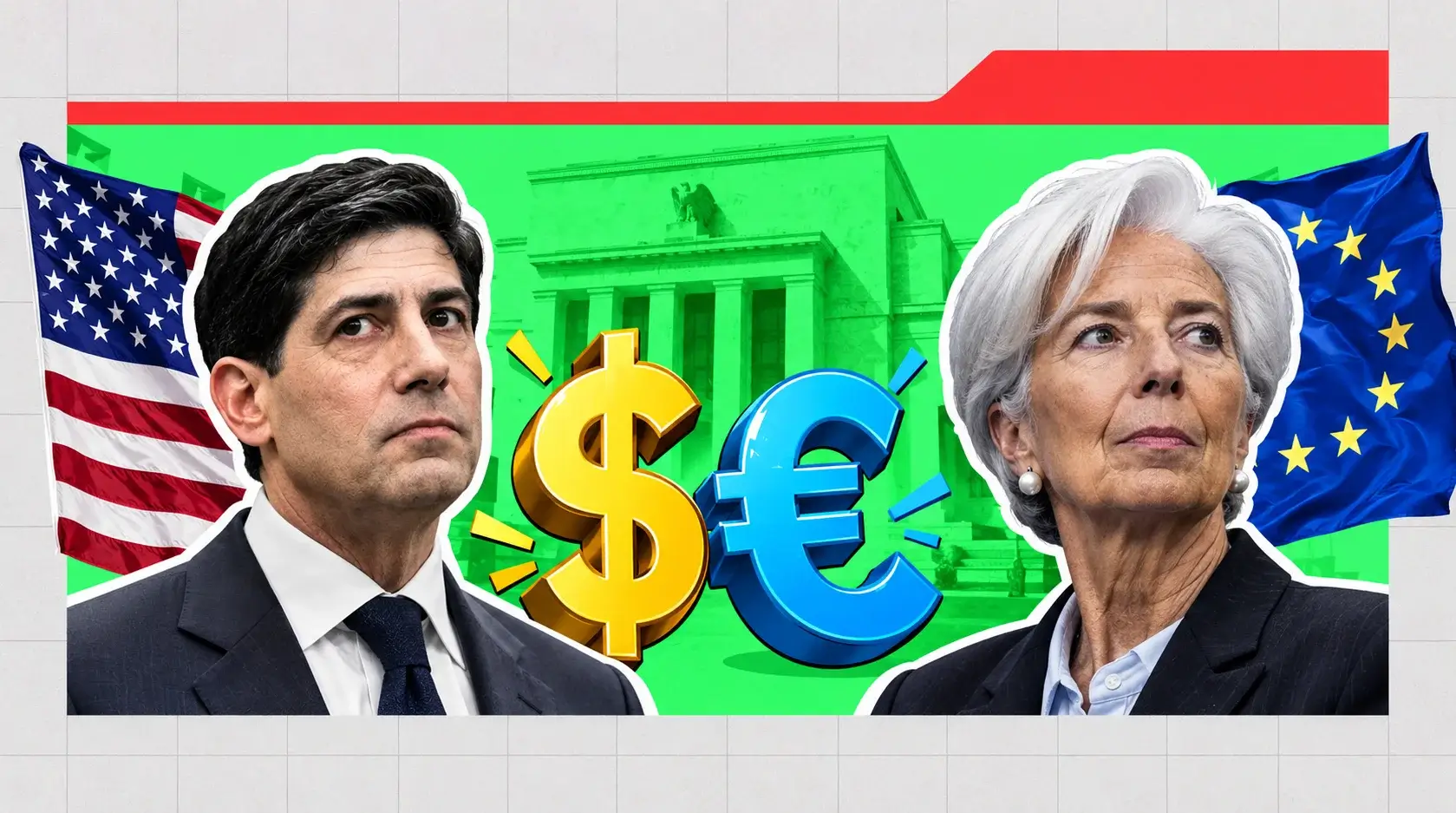
Euro Holds $1.15 Near April Lows as ECB Hike Looms and US CPI Hits 4.2%
EUR/USD trades just above $1.15 on June 9, near its weakest since early April, despite a near-certain ECB rate hike on Thursday | That's TradingNEWS
Key Points
- EUR/USD holds just above $1.15 near April lows
- with 1.1476 the key support and 1.17 the resistance cap.
- An ECB hike is near-certain Thursday after eurozone inflation hit 3.2%, but a firm dollar and a contracting eurozone economy weigh on the euro.
EUR/USD is trading just above $1.15 on Tuesday, June 9, hovering close to its weakest level since early April even as the European Central Bank prepares to raise interest rates on Thursday. The pair has shed roughly 0.7% on the week after a blowout US jobs report sent the dollar surging, dragging the euro from the $1.1668 area at the end of May down toward the $1.15 handle and erasing the modest gains it had built earlier in the spring. The setup is a genuine paradox: a central bank on the verge of tightening policy would ordinarily lift its currency, yet the euro has slipped to a multi-month low against a dollar that has refused to roll over.
The explanation lies in the interplay of three forces. The ECB's June 11 rate hike is so widely anticipated, with markets pricing it at roughly 90% or higher, that it is already baked into the price, leaving little upside surprise. The dollar, meanwhile, has been propelled higher by a hawkish repricing of Federal Reserve expectations and by safe-haven demand stemming from the conflict in the Middle East. And the eurozone economy itself has shown alarming signs of weakness, with first-quarter GDP revised to show a contraction, raising the specter of stagflation just as the ECB is forced to raise rates to combat surging inflation. With the US Consumer Price Index due Wednesday and the ECB decision Thursday, EUR/USD sits at the intersection of two major catalysts that will define its direction into the back half of June. The pair's struggle to hold above $1.17 has defined the recent range, and $1.15 now stands as the line that separates consolidation from a deeper decline.
Mapping the Slide to Multi-Month Lows
The euro's recent trajectory tells the story of dollar dominance. The pair erased early gains to trade below $1.16, hitting its lowest level since April 6 and heading for a 0.7% weekly loss as investors flocked to the dollar in the wake of stronger-than-expected US employment data. From there, continued safe-haven flows and the firm greenback pushed EUR/USD down to just above $1.15, close to its weakest level since April 3, as renewed Middle East tensions stoked fears of a prolonged Iran conflict.
The decline is notable for its timing. The euro has weakened precisely as the case for ECB tightening has strengthened, a divergence that underscores how thoroughly the dollar has dominated the cross-rate. At the end of May, the pair traded around $1.1668, already a six-week low, and the subsequent move toward $1.15 represents an extension of that weakness rather than a reversal. The euro's inability to hold above the $1.17 zone, despite the imminent rate hike, signals that the market views the ECB's tightening as fully discounted and is instead trading the relative strength of the US economy and the geopolitical risk premium that flows to the dollar in times of stress. The pair now sits near the lower end of its recent range, with the April lows representing the immediate downside reference.
The June 11 ECB Hike: The Central Event of the Week
The defining catalyst for the euro arrives Thursday, June 11, when the ECB announces its monetary policy decision at 13:15 BST, followed by a press conference at 13:45. Markets see a near-certain 25-basis-point rate increase, with pricing at roughly 90% or higher and traders now anticipating two or possibly three hikes from the ECB this year. This represents a dramatic reversal of the easing path the central bank had been on, and it reflects a fundamental shift in the eurozone's inflation picture.
The hawkish repricing has been driven by data showing euro-area inflation rising to 3.2% in May, its highest in over two and a half years and well above the ECB's 2% target. The conflict in the Middle East has triggered an acceleration in inflation that upended bets that central banks around the world would keep cutting rates through 2026, and with the effects of higher energy costs still feeding through into consumer prices, the ECB may want to raise rates now to keep inflation under control over the longer term. The key question for EUR/USD is not whether the hike happens but what guidance accompanies it. A rate hike combined with a signal that further increases may be needed could make the euro more attractive and help it gain ground, while a hike delivered with dovish or cautious language, framed as a reluctant response to energy-driven inflation rather than the start of a sustained cycle, could disappoint a market that has fully priced the move. The hawkishness of the tone matters more than the action itself.
The Eurozone Inflation Surge That Forced the ECB's Hand
The scale of the inflation acceleration is what makes the ECB's pivot so striking. Eurozone harmonized inflation leapt from 1.9% in February, comfortably near the ECB's target, to 2.6% in March, 3.0% in April, and 3.2% in May, a relentless climb that has more than doubled in the space of three months. The producer-price data is even more alarming, with the April eurozone PPI jumping to 4.9% year over year from a previous 2%, signaling that further consumer-price pressure is in the pipeline.
The driver behind this surge is largely external. The near-closure of the Strait of Hormuz amid the Iran conflict has disrupted energy supplies and pushed up oil prices, with the energy component of eurozone inflation running far above the headline figure. This creates a profound dilemma for the ECB: the inflation is supply-driven and energy-led rather than demand-driven, which is the type of inflation that monetary policy is least equipped to address. Raising rates does little to bring down oil prices, but the central bank risks allowing inflation expectations to become unanchored if it fails to respond. The 3.2% reading, the highest in over two and a half years, has effectively removed the ECB's option of patience and forced it into a tightening stance that the economy may struggle to absorb. This is the backdrop against which the euro's weakness becomes more understandable: the market sees the ECB hiking out of necessity rather than strength.
The Growth Problem: A Contracting Economy Meets Tightening Policy
The most troubling element of the eurozone picture is the growth data, which has injected a stagflationary dimension into the outlook. Eurozone GDP figures were revised to show a contraction in the first quarter of 2026, the first such contraction since late 2022 and the steepest since mid-2020. This means the ECB is poised to raise rates into an economy that is already shrinking, a combination that rarely supports a currency over the medium term.
The juxtaposition of accelerating inflation and contracting output is the textbook definition of stagflation, and it places the ECB in an extraordinarily difficult position. Tightening policy to fight energy-driven inflation risks deepening the economic contraction, while failing to tighten risks letting inflation expectations spiral. For EUR/USD, this dynamic caps the euro's upside even on a hawkish ECB outcome, because investors recognize that the eurozone economy cannot sustain an aggressive tightening cycle without significant damage. The contraction also raises the possibility that the ECB's hiking path proves shorter than the market currently prices, with the two-to-three hikes expected this year potentially scaled back if the growth picture deteriorates further. This growth fragility is a structural headwind for the euro that works against the support provided by higher rates, and it helps explain why the currency has slipped to multi-month lows despite the imminent hike.
The Dollar Side: Strong Jobs and a Hawkish Fed Repricing
On the other side of the pair, the dollar has been the dominant force, driven by a fundamental repricing of Federal Reserve expectations. May nonfarm payrolls surged by 172,000, nearly double the forecast of around 85,000, prompting markets to move toward fully pricing a Federal Reserve interest rate hike by year-end. The CME FedWatch readings on the December hike probability have ranged in recent commentary from above 60% to as high as 72%, a stark contrast to the roughly 50% odds that prevailed before the jobs data.
This hawkish repricing has lifted Treasury yields and strengthened the dollar across the board. The greenback has also benefited from safe-haven demand tied to the Middle East conflict, with investors flocking to dollar assets whenever tensions escalate. The result is a currency that has, in the words of one analyst, refused to roll over, frustrating the consensus forecasts that called for dollar weakness in 2026. The dollar's resilience is the single most important factor capping EUR/USD, and it stems from the same inflation acceleration that is forcing the ECB to hike, illustrating how the global inflation shock has pushed both major central banks toward tightening simultaneously. The critical difference is that the US economy is expanding while the eurozone is contracting, a growth divergence that tilts the balance of the rate-differential trade in the dollar's favor even as both sides raise rates.
Why the Euro Is Weak Despite the Hike
The central puzzle of EUR/USD right now is why the euro has fallen to a multi-month low when its central bank is about to tighten. The answer comes down to three factors working in concert. First, the June 11 hike is so thoroughly priced, at roughly 90% or higher, that it offers no positive surprise; markets have already adjusted, and the actual delivery of the hike may even trigger a sell-the-news reaction unless the accompanying guidance is decisively hawkish.
Second, the dollar's strength is being driven by forces independent of the ECB, namely the Fed repricing and the safe-haven bid, which means the euro is fighting a headwind that its own central bank cannot directly counter. Third, the eurozone's growth contraction undermines the durability of any rate-driven euro support, because a tightening cycle into a shrinking economy is inherently self-limiting. The combination produces a currency that is firm in the sense of being supported by relative stability and a higher rate floor, yet weak in the sense of being unable to break out against a dominant dollar. For EUR/USD to climb back toward $1.20, two things would need to align: the ECB delivering its hike with genuinely hawkish guidance, and clear signs that US inflation is cooling enough for the Fed to ease later in the year. If both materialize, the path of least resistance shifts toward a stronger euro; if the dollar stays firm, the pair holds the middle of its range.
Technical Levels: $1.15 Support and the $1.17 Ceiling
The technical structure frames a range-bound pair with a defensive near-term bias. On the downside, the immediate support is the $1.1476 March 2026 swing low, a level whose breach would confirm the extension of the recent weakness and open the path toward $1.1400, which corresponds to the 23.6% Fibonacci retracement of the 2022 to 2026 rally. Below that, the $1.1200 August 2025 pullback low represents the deeper downside objective in a sustained dollar-strength scenario. The current price just above $1.15 sits precariously close to the first of these supports, making the March low the critical level to watch.
On the topside, the pair has repeatedly struggled to hold above the $1.1680 to $1.17 zone, which now acts as the primary near-term resistance and the level that must be reclaimed to neutralize the bearish bias. Above that, $1.1837 marks the September 2025 high, followed by $1.1974, the January 2026 peak, and the psychologically significant $1.2000 round number, which also functions as an option barrier. A daily close above $1.2000 would confirm a stronger bullish breakout and likely trigger trend-following demand, but that scenario requires a meaningful shift in the dollar's trajectory. The analyst consensus places EUR/USD in a $1.15 to $1.20 range over the coming months, firm but capped, with the pair currently sitting at the lower boundary of that range. The behavior around $1.15 in the wake of Wednesday's CPI and Thursday's ECB decision will determine whether the floor holds or gives way.
Geopolitics and Oil: The Middle East Crosscurrent
The Iran conflict runs through the EUR/USD trade in complex ways. The renewed Middle East tensions have stoked fears of a prolonged conflict, with Brent crude surging over 4% after Iran and Israel exchanged missile strikes despite calls from President Trump for both sides to cease hostilities and pursue peace talks. Higher oil prices are unambiguously negative for the eurozone, a major energy importer, both because they worsen the inflation problem the ECB is fighting and because they sap growth from an already contracting economy.
The geopolitical premium also flows to the dollar through safe-haven demand, creating a double headwind for the euro: the conflict simultaneously weakens the eurozone's fundamentals and strengthens the dollar's appeal. The ceasefire dynamics add volatility, with an earlier US-Iran ceasefire having triggered a sharp unwind of safe-haven dollar flows that erased the dollar index's entire 2026 gain, before ceasefire optimism faded and the dollar firmed again. President Trump has suggested a deal could be reached within days and has demanded that Iran fully restore freedom of navigation through the Strait of Hormuz. A genuine, durable ceasefire would be a meaningful positive for the euro, easing both the energy-inflation pressure and the safe-haven dollar bid, and represents one of the few catalysts capable of driving EUR/USD back toward the upper end of its range. The lack of progress in the early days of June, by contrast, has kept the dollar bid and the euro pinned near its lows.
US CPI Wednesday: The Dollar's Decisive Test
Before the ECB takes center stage Thursday, the US Consumer Price Index on Wednesday is the pivotal catalyst for the dollar side of the pair. Economists expect headline inflation to accelerate to 4.2% year over year, which would be the hottest reading since 2023 and would reinforce the case for a Fed hike, lifting yields and the dollar and pressuring EUR/USD toward the $1.1476 support.
The asymmetry around the CPI is important for the euro's path. A hot print at or above 4.2% would harden Fed hike expectations and likely push EUR/USD lower, potentially breaking the March swing low. A softer-than-expected reading, however, would relieve the dollar, ease the yield pressure, and provide the euro with room to recover ahead of the ECB decision, setting up a potential rally if the ECB then delivers a hawkish hike. The two-day sequence of CPI followed by the ECB creates a compressed window of high volatility, and the interaction between the two events will be decisive. The most euro-bullish outcome would be a soft US CPI followed by a hawkish ECB hike, a combination that would simultaneously weaken the dollar and strengthen the euro's rate appeal. The most euro-bearish outcome would be a hot CPI followed by a dovish-sounding ECB hike framed as a one-off response to energy prices.
Read More
-
Yen Stalls at 160 Despite a 3% JGB and Tokyo Core CPI at 2.0% — Intervention Sits at 164, Friday's Payrolls Decide
02.09.2026 · TradingNEWS ArchiveEnergy
-
GLD ETF Sheds Value With Bullion as North American Funds Stay $7.7B in the Red
10.09.2026 · TradingNEWS ArchiveStocks
-
XRP ETF Flows: 7 Funds Split $1.682B With the Complex at Just 1.68% of Market Cap
10.09.2026 · TradingNEWS ArchiveCrypto
-
NG Breaks $2.90 With Production at 113 Bcf/d and LNG Feedgas Capped at 18.3 Bcf/d
10.09.2026 · TradingNEWS ArchiveCommodities
-
USD/JPY Holds Below the 157.23 Average as 2 Central Banks Tighten in 48 Hours
10.09.2026 · TradingNEWS ArchiveForex
Forecast Scenarios: Bear, Base, and Bull Paths
The forecast resolves into three paths shaped by the CPI-ECB sequence. In the bearish scenario, a hot US CPI at or above 4.2% on Wednesday strengthens the dollar, and a cautiously delivered ECB hike on Thursday fails to provide hawkish support, driving EUR/USD through the $1.1476 March low toward $1.1400 and potentially opening the path to $1.1200. This path would be reinforced by continued safe-haven dollar demand if Middle East tensions escalate and oil prices climb further, deepening the eurozone's stagflationary bind.
In the base case, EUR/USD holds the $1.15 to $1.17 range through the back half of June, with the priced-in ECB hike and the firm dollar offsetting each other and the pair oscillating around the lower-middle of its broader $1.15 to $1.20 channel. This range-bound scenario reflects the standoff between a tightening ECB and a resilient dollar, with neither side able to force a decisive break absent a clear shift in the data. In the bullish scenario, a softer US CPI relieves the dollar, the ECB delivers its hike with explicitly hawkish guidance signaling further increases, and a Middle East de-escalation eases the energy-inflation pressure, allowing EUR/USD to reclaim $1.17 and push toward $1.1837 and the $1.1974 to $1.2000 resistance zone. Given the fully priced ECB hike, the resilient dollar, and the eurozone growth contraction, the base-to-bearish path carries more near-term weight, but a dovish US inflation surprise remains the wildcard capable of flipping the bias.
What to Watch: CPI, the ECB Tone, and the $1.15 Floor
The decisive variables for EUR/USD are concentrated in a tight 48-hour window. Wednesday's US CPI is the first hurdle, with a print near or above 4.2% pressuring the euro toward $1.1476 and a softer reading offering relief. Thursday's ECB decision is the main event, where the 25-basis-point hike itself matters less than the guidance: hawkish language signaling further hikes would support the euro, while cautious framing would disappoint a fully positioned market.
On the chart, the $1.1476 March swing low is the immediate support whose breach would confirm a deeper decline, while the $1.17 zone is the resistance that caps any recovery. Traders should monitor the path of the dollar index and Treasury yields as real-time gauges of the dollar's strength, the Brent crude price as a proxy for the eurozone's energy-inflation pressure, and any developments in the Iran ceasefire negotiations, which could swing the safe-haven flows in either direction. The eurozone's growth trajectory remains a structural overhang that limits the euro's upside even on favorable rate news. With EUR/USD sitting just above $1.15 near its April lows, and with a hot US inflation print and a live ECB decision both on the calendar, the euro enters the heart of the week balanced between a tightening central bank that cannot lift it and a dollar that refuses to fall.