Ferrari Stock Price Forecast - RACE at $377 Stock Turns Sentiment Slump Into A High-Margin Buying Window
With RACE down from $519 to ~$377, buying back 39,000 shares at ~€318, locking in the Exor–Ferrari pact to 2029 and ramping EV, lifestyle and F1 2026, the market is repricing risk while the cash engine keeps compounding | That's TradingNEWS
Ferrari NYSE:RACE – Luxury Cash Machine On Sale After Sentiment Reset
*Brand Power And Scarcity Economics Behind NYSE:RACE
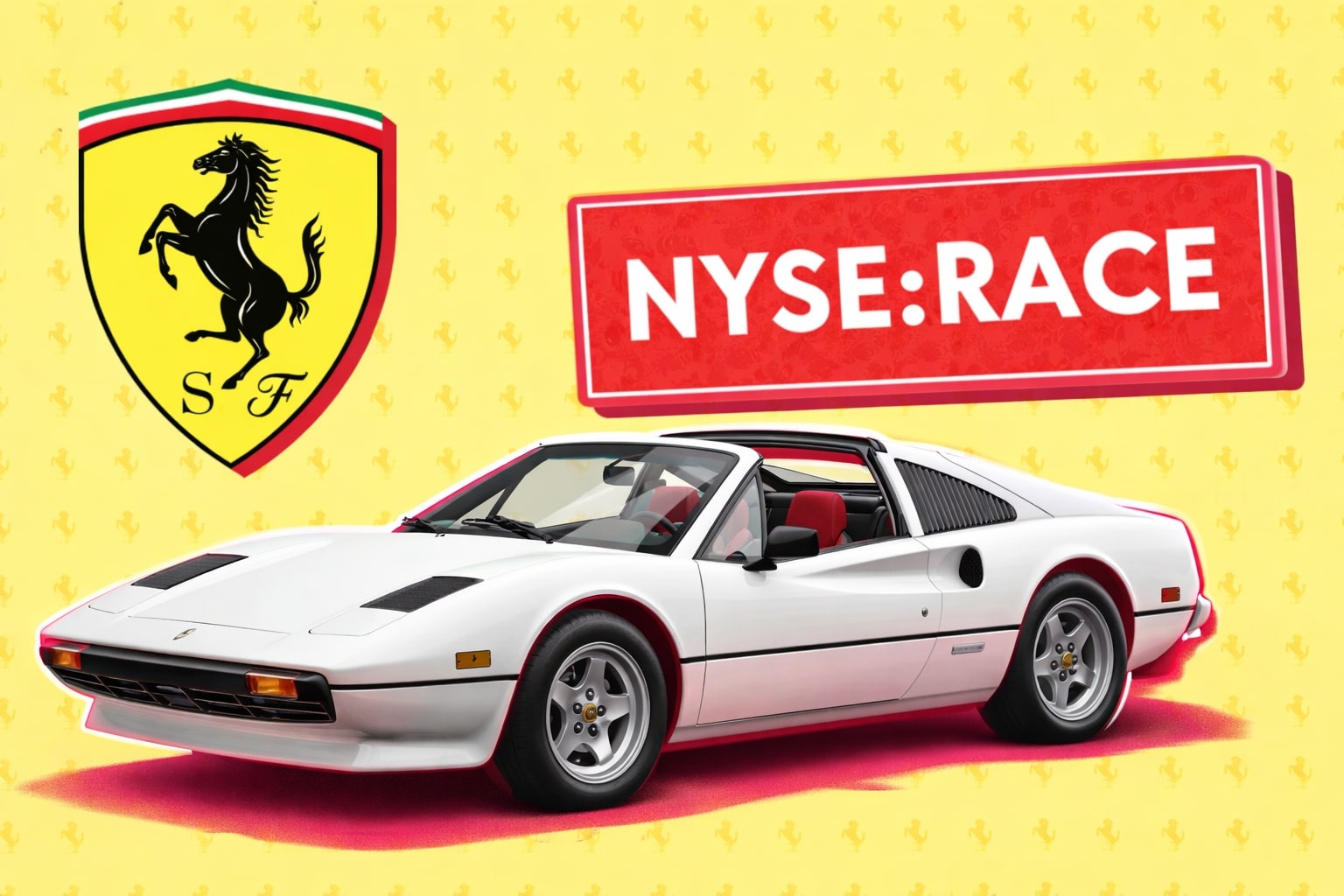
Ferrari NV is priced and run as a global luxury franchise, not as a cyclical carmaker. The product range spans around 11 models, from the Purosangue SUV and Amalfi grand tourer to the F80 hypercar with close to 1,200 hp. Pricing starts near $266,000 for the Amalfi and runs to roughly $3.7 million for the F80, with volumes intentionally capped. The economic model is simple: limited units, extreme pricing power, heavy options, and a brand that signals status everywhere from Maranello to Manhattan. On top of vehicle sales, the prancing horse logo has been monetized through sponsorships, racing and lifestyle products. Branded apparel, accessories and licensing generated roughly €607 million of revenue in the first nine months of 2025, effectively turning the logo into its own profit center. Management’s strategy is to push this further, with Tailor Made centers in Tokyo and Los Angeles and lifestyle positioned as a third core earnings pillar alongside cars and motorsport. That configuration explains why NYSE:RACE trades structurally above auto peers: the market values it more like a scarce luxury house than like Ford or GM.
Revenue, EPS And Margin Profile Of NYSE:RACE After Q3 2025
Latest reported numbers confirm how far Ferrari has pulled away from the auto pack. In Q3 2025, net revenue reached about €1.7 billion, up 7.4% year on year. EBITDA rose roughly 5%, to around €574 million. Diluted EPS printed at €2.14, up 2.9% despite a tougher macro tape for autos. Those results were strong enough for management to lift full-year 2025 guidance, adding roughly €100 million to revenue and moving EPS guidance from €8.60 to €8.80. Looking over a multi-year window, revenue has almost doubled from about €3.45 billion in 2020 to roughly €6.5 billion in 2024. Current year-on-year revenue growth sits near 9.5%, roughly three times the sector median around 3.5%. Diluted EPS growth is even more aggressive at about 13.1% versus a peer median near 1.3%. At the current share price around $377 for NYSE:RACE, you are buying a proven growth machine, not a cyclical recovery story.
Why NYSE:RACE Earns 22–23% Net Margins While Other Automakers Fight For 3–5%
Ferrari’s net income margin sits around 21.6–22.6%. That is not a marginal edge; it is a structural gap. Tesla is near 5.3%, Toyota around 9.4%, and most traditional OEMs sit between 1.5% and 3%. Ferrari is effectively earning more than twice Toyota’s margin and up to ten times what Ford, GM, Volkswagen or Honda generate. The reason is the business architecture: low units, extreme pricing, high mix, and tight cost control. EBITDA margins in the high 30s are expected to grind closer to 39% as scale and mix improve. One detailed model for 2026 assumes revenue of about €7.5 billion (up 5.2%), EBITDA margin around 39%, depreciation and amortization of roughly €700 million, minimal interest expense near €20 million and a 22% tax rate. That delivers net profit close to €1.7 billion. In other words, NYSE:RACE is not just a good car business; it is one of the most profitable hard-luxury franchises listed anywhere.
*Balance Sheet, Leverage And Returns On Capital At NYSE:RACE
The balance sheet is conservative for a company with this level of pricing power. Total assets are roughly €9.5 billion, up about 5.5% year on year. Total liabilities stand near €5.7 billion, barely 1% higher, leaving equity around €3.8 billion. Cash and short-term investments are about €1.38–1.40 billion, after a modest decline as buybacks and capex absorb cash. Gross debt of roughly €2.87 billion is down about €500 million versus the end of 2024. With EBITDA around €1.5–1.6 billion, net debt/EBITDA is roughly 0.5x – extremely comfortable. Return on assets is about 13%, and return on capital sits close to 18.7%. Combine that with net margins north of 22%, and you have an asset-light, high-ROIC luxury manufacturer using modest leverage. For a name like NYSE:RACE, that justifies a premium multiple to almost any industrial peer.
Free Cash Flow And Buybacks: How NYSE:RACE Drives Per-Share Compounding
Free cash flow tells you how far the equity story can run. In the latest quarter, Ferrari generated net income of roughly €381 million and operating cash flow around €588 million. Cash used in investing was about €230 million, primarily growth capex, while cash used in financing was about €458 million, reflecting dividends and repurchases. The net change in cash was a moderate outflow of roughly €100 million, but free cash flow over the period was close to €1 billion, up more than 40% year on year. That surplus is not sitting idle. Ferrari has an active €3.5 billion buyback program and is on pace to retire roughly €900 million of stock per year. Between January 5 and 9, 2026 alone, the company bought 39,000 shares at an average price of €318.48, spending €12.4 million. Treasury shares now total about 16.7 million, roughly 8.6% of share capital. With around 177.9 million shares outstanding, continued repurchases at these levels will lift EPS even if net profit growth moderates. Tracking buyback execution alongside insider and capital-allocation data through the RACE stock profile and insider transactions is critical, because this management team is clearly willing to exploit sentiment dips to shrink the float.
Demand, Order Book And Residual Values: Can NYSE:RACE Still Sell Every Car It Builds?
The real health check for Ferrari is not unit volume; it is order visibility and used-car pricing. Dealer feedback, particularly from North America, which accounts for about 25% of shipments, remains constructive. There are no systemic demand cracks either in new cars or pre-owned inventory. Cancellations are running in line with historical norms and are described as isolated rather than structural. Residual value worries are localized to Purosangue and some EV-linked product questions, not broad across the range. At the same time, Ferrari is deliberately broadening its customer base while maintaining tight allocation discipline. That combination – high residuals and controlled allocation – keeps pricing power intact and protects margins. Regulatory pressure on emissions has also softened at the margin for low-volume luxury makers, removing the most immediate threat of being forced into uneconomic EV volume just to hit fleet averages. Right now, the data does not show demand fatigue; the risk is macro, not brand-specific.
Read More
-
Yen Stalls at 160 Despite a 3% JGB and Tokyo Core CPI at 2.0% — Intervention Sits at 164, Friday's Payrolls Decide
02.09.2026 · TradingNEWS ArchiveEnergy
-
QQQI ($53.80) Turns Nasdaq Volatility Into a 14.2% Monthly Yield as Assets Top $15B — Big Tech Earnings Set November
27.10.2026 · TradingNEWS ArchiveStocks
-
IBIT ETF Captures 100% of $110.3M as Spot Funds Snap Outflow Streak, but October Stays $202M Negative Ahead of the Fed
27.10.2026 · TradingNEWS ArchiveCrypto
-
NG($3.002) Takes the Front Month Near a Multi-Month Low as Record Production Meets Mild Weather — Break of $2.945 Opens $2.80
27.10.2026 · TradingNEWS ArchiveCommodities
-
USD/JPY (157.86) Squeezed Between a 2.8-Point Carry Edge and Tokyo’s 160 Line — BoJ Hawkish Hold Friday Sets the Break
27.10.2026 · TradingNEWS ArchiveForex
*Governance, Exor Pact And Voting Control Around NYSE:RACE
Governance has actually strengthened as the stock has de-rated. Exor, the Agnelli family holding vehicle, and Piero Ferrari plus the Piero Ferrari Trust recently renewed their shareholders’ agreement through 2029. That pact effectively locks in roughly 32% of share capital and close to 48% of voting rights. Exor did sell 4% of its stake in 2025, but the renewed agreement signals that long-term strategic control remains aligned and stable. This matters because Ferrari is in the middle of a multi-year capex and brand expansion cycle: new platforms, EV investment, lifestyle, Tailor Made, and continued heavy commitment to Formula 1. A stable control block makes it far less likely that short-term market pressure forces value-destructive decisions. For NYSE:RACE, the renewed pact is a direct positive for equity holders who want long-duration compounding instead of quarter-to-quarter noise.
*Formula 1, Brand Heat And Optionality For NYSE:RACE
Ferrari’s F1 program is a marketing engine and an option on upside, even if 2025 results were underwhelming. Poor track performance did weigh on sentiment and contributed to the October 2025 share price reset, but the sport is about to go through a regulatory reboot. The FIA’s 2026 technical rulebook effectively resets the competitive order. Past advantages shrink; design and execution from the new baseline will dictate the next cycle of winners. Ferrari’s leadership is openly framing 2026 as a clean slate with high internal expectations. A competitive resurgence would reinforce the racing-heritage narrative, push demand for high-end models and tighten the link between track and road technology, particularly in hybrid and EV systems. Another weak season would hurt pride and narrative, but the core P&L impact remains limited. For NYSE:RACE, F1 is asymmetric: strong results can re-rate the multiple; continued disappointment primarily hits sentiment, not cash generation.
*EV Strategy And Industrial Investment Risk At NYSE:RACE
Electrification is the main strategic execution risk for Ferrari over the next decade. The company has already built a new industrial complex in Maranello designed around hybrid and EV architectures. The key difference versus mass OEMs is positioning: Ferrari does not need to chase EV volume targets; it will deploy EV and hybrid where they enhance performance, emotion and brand, not to fill every price bracket. Regulatory timelines for low-volume luxury manufacturers in the EU and US have eased, which reduces the risk of being forced into unprofitable EV launches on an aggressive schedule. The risk is qualitative and financial rather than regulatory: electric Ferraris that fail to deliver on the brand’s sensory expectations would hurt desirability, and heavy EV capex that does not translate into premium pricing would compress returns on capital. So far, none of that is visible in the numbers – margins remain above 22% and modeled ROIC is above 40% – but investors in NYSE:RACE must treat EV execution as a live risk factor, not background noise.
*Lifestyle, Tailor Made And New Profit Pillars For NYSE:RACE
Lifestyle and fashion are not side projects anymore; they are being built into a third operating profit engine. New Tailor Made centers in Tokyo and Los Angeles target ultra-high-net-worth customization demand, while apparel, accessories and broader branded goods extend Ferrari into a daily-visibility luxury brand. Done correctly, this delivers high-margin revenue on an asset-light base, deepens customer engagement and diversifies earnings away from pure vehicle cycles. The risk is overextension and dilution. A mis-positioned fashion line or over-distributed merchandise can cheapen a logo that currently stands for scarcity and performance. Early numbers are still small relative to total revenue, so execution errors are survivable, but the equity multiple for NYSE:RACE is built on purity of brand. Investors need to monitor the lifestyle push carefully: growth is attractive, but not at the expense of the core positioning that justifies a luxury valuation.
*Valuation, Multiple Compression And Relative Positioning Of NYSE:RACE
The market has already punished the stock; that is the entry point. NYSE:RACE trades around $377, versus a 52-week range of $356.93 to $519.10. On the Italian line, the stock sits near €323, with consensus target around €377, implying roughly 16% upside just to reach the sell-side average. Trailing GAAP P/E is about 35x versus an auto sector median near 20x, but Ferrari’s own historical average P/E is around 45x. The current forward P/E in the mid-30s therefore reflects about a 20–25% discount to its own history, despite higher revenue, more diversified profits and a stronger governance framework than in earlier years. One simple framework uses 2026 EPS near $11.34 and a forward multiple of about 33x to land on a fair value around $379, roughly in line with the spot price. The real upside, however, comes from two levers: Ferrari’s consistent tendency to beat EPS consensus and the possibility of partial multiple re-expansion if sentiment and F1 performance improve. At the same time, a more conservative model values 2026 EPS around €9.2 and applies a 40x P/E (below the historical 45x, but in line with ROIC above 40% and EBITDA margins near 39%), which supports a target around €368 per share, equivalent to roughly $428 per ADR. That is meaningfully above the current $370s print.
*Macro, FX And Execution Risks That Could Hit NYSE:RACE
The primary risk is macro. A Ferrari priced at $266,000–$3.7 million is the definition of discretionary. A sharp global slowdown, equity-market drawdown or liquidity squeeze among wealthy buyers would show up first in order books and used-car prices. That would not destroy the franchise, but it would cap near-term growth and could compress the multiple further. There is also FX risk: roughly 58% of revenue is generated outside the euro area, so earnings translate into euros and then into dollars for NYSE:RACE holders. Unfavorable currency shifts can erode reported growth even when unit economics are stable. Industrial and product risks remain, from potential defects and recalls to delays or missteps in the EV rollout. Lifestyle and fashion expansion add a new execution layer, where misjudging the market could bruise brand equity. Finally, F1 performance still influences sentiment more than fundamentals; another bad season during an economic downturn would be a double hit to perception. None of these risks are hidden, but they are real and must be sized against the quality of the franchise.
Verdict On NYSE:RACE – Buy, Sell Or Hold?
At around $377 per share, NYSE:RACE trades near the low end of its 12-month range after a roughly 20–23% drawdown from 2025 highs, while the underlying business continues to deliver double-digit EPS growth, net margins over 22%, ROIC north of 40% in forward models, and free cash flow close to €1 billion with an aggressive buyback program. Governance has been reinforced by the renewed Exor–Ferrari family pact, lifestyle and Tailor Made are building a third profit leg, and EV and regulatory risks have eased compared with the narrative a year ago. Against that, macro risk, FX exposure, EV execution and brand-dilution risk in lifestyle are genuine, and the stock is not “cheap” in absolute terms. Netting those factors, the combination of de-rated multiple, intact growth, superior profitability and disciplined capital returns justifies a clear stance: NYSE:RACE is a Buy for investors willing to hold a high-quality luxury compounder through macro volatility, with upside driven by earnings growth, buybacks and potential re-rating back toward its historical P/E band.