GBP/USD Price Forecast - Pound Holds 1.37 Channel as UK Political Shock Clashes with Weak Dollar
Pair trades near 1.3680, defending the 1.3650–1.3630 support zone while BoE cut pricing, Keir Starmer’s leadership crisis, DXY stabilizing around 96.90 and looming US CPI/NFP keep a 1.3810–1.3869 breakout on the table | That's TradingNEWS
GBP/USD – bullish channel faces BoE cuts, UK turmoil and a softer dollar
GBP/USD – price structure, channel and momentum
GBP/USD trades around 1.3680–1.3670 in Europe after failing to hold above 1.37. Price sits just above the nine-day EMA clustered at 1.3650–1.3655 and well above the 50-day EMA near 1.3513. The pair remains inside an ascending channel from the 1.30 November low to the late-January peak at 1.3868–1.3869. The 14-day RSI has cooled from overbought to about 56, a midline area that usually signals consolidation rather than a completed top. The structure is still a sequence of higher lows and higher highs, so the trend stays positive as long as 1.3620–1.3580 holds.
GBP/USD – intraday levels, Fibonacci pivots and key support zones
On the 2-hour chart, GBP/USD has pulled back from a descending trendline drawn off the 1.3870 high. Recent candles show small bodies and upper wicks between 1.3690 and 1.3710, confirming supply in that band. The 50% Fibonacci retracement of the recent leg sits at 1.3655, almost on top of the nine-day EMA, which turns 1.3650–1.3655 into the first decision zone. Below it, 1.3630 marks the lower edge of the current consolidation. A clean break under 1.3630 opens the door to 1.3580, where the 100-period moving average on the 2-hour chart aligns with the rising mid-January trendline. As long as price holds above 1.3620–1.3580, the pullback is a pause inside an uptrend, not a reversal.
GBP/USD – upside resistance, channel objectives and bullish triggers
On the topside, initial resistance for GBP/USD remains at 1.3699–1.3710. That area has capped intraday bounces several times and needs to give way to extend the move. Above that, 1.3730–1.3760 is the next band; a sustained break there reopens the late-January highs. If the pair clears 1.3810 and then 1.3868–1.3869, it extends the ascending channel and starts pointing at the upper boundary in the low 1.40s, with 1.4090 as a logical next target and 1.4248, the April 2018 high, as a later medium-term level. While the current momentum is slower than in January, the map still favours buying dips into the 1.3650–1.3630 zone and fading stretched spikes near 1.38 until data move the range.
GBP – domestic politics, Keir Starmer risk and sterling’s premium
The GBP side is dominated by Westminster tension. Prime Minister Keir Starmer has just survived a leadership shock after high-profile resignations and an open call for his resignation from Scottish Labour leader Anas Sarwar. The prospect of a deeper split inside Labour or a shift toward a more left-leaning replacement raised fears around fiscal direction and regulation. That stress already showed up in UK markets: gilt yields jumped as talk of a leadership change grew, then eased back as support from the cabinet stabilised Starmer’s position. For GBP/USD, this kind of political noise adds a risk premium that tends to cap the pair whenever it nears the top of its channel, even if the underlying trend stays constructive.
BoE and GBP – dovish split, inflation path and rate-cut timing
The GBP outlook is also shaped by a more dovish tone at the Bank of England. Bank Rate remains at 3.75%, but the 5–4 split on the Monetary Policy Committee was meaningfully softer than markets had expected. Signals from the BoE now point to inflation potentially dropping below the 2% target as early as April. That profile has futures markets pricing a strong chance of a 25-basis-point cut as soon as March and roughly 50 basis points of easing over 2026. Lower yields shrink the carry appeal of GBP, which explains why sterling lags the best-performing majors despite the uptrend in GBP/USD. The closer the market comes to a March cut, the harder it will be for the pair to stretch much beyond 1.39–1.40 without help from dollar weakness.
GBP – relative performance against majors and what the heat map signals
The daily performance grid underlines this mixed picture for GBP. Against the Japanese yen, GBP is down around 0.47%, and against the Swiss franc it is weaker by roughly 0.23%. At the same time, the pound is only modestly softer versus USD and the euro, by about 0.14% and 0.15%, while it is roughly flat against the New Zealand dollar and slightly firmer versus the Australian dollar and Canadian dollar. This pattern fits a currency that still benefits from an improving domestic story compared with last year, but not enough to outrun currencies backed by very strong policy or safe-haven flows. For GBP/USD, that translates into an uptrend that is intact but no longer explosive, with rallies met by measured selling rather than aggressive chasing.
DXY – structural dollar headwinds from China, Treasuries and reserve shifts
On the USD side, the structural backdrop is leaning negative. The US Dollar Index sits near 96.90 after slipping from a recent high at 97.99. The latest push lower came after reports that Chinese regulators asked local banks to limit exposure to US Treasury debt. Even if framed as diversification rather than a direct challenge to US credit, any reduction in marginal demand for Treasuries matters when the US is selling around $125 billion of new paper in upcoming auctions. A slower build-up of foreign holdings compresses support under the dollar and reinforces the idea that the strong-dollar regime of the past cycles is giving way to a more balanced reserve mix.
DXY – technical picture, Fibonacci floors and the 95.00 risk zone
Technically, DXY is trying to stabilise just above the 38.2% Fibonacci retracement at 96.83, with recent candles showing small bodies and lower wicks around 96.80, which indicates buying interest at that level rather than panic selling. A rising trendline from late January also supports the index around 96.70. However, the 50-period moving average near 97.30 and the 100-period average around 97.60 sit overhead and cap rebounds. If price decisively loses 96.70, the next natural area is 96.34, and below that the 95.00 region becomes a realistic downside objective if upcoming CPI and labour numbers come in soft. That path would support GBP/USD by pulling the dollar leg lower even if sterling itself is not particularly strong.
USD – Takaichi trade, Middle East diplomacy and fading safe-haven demand
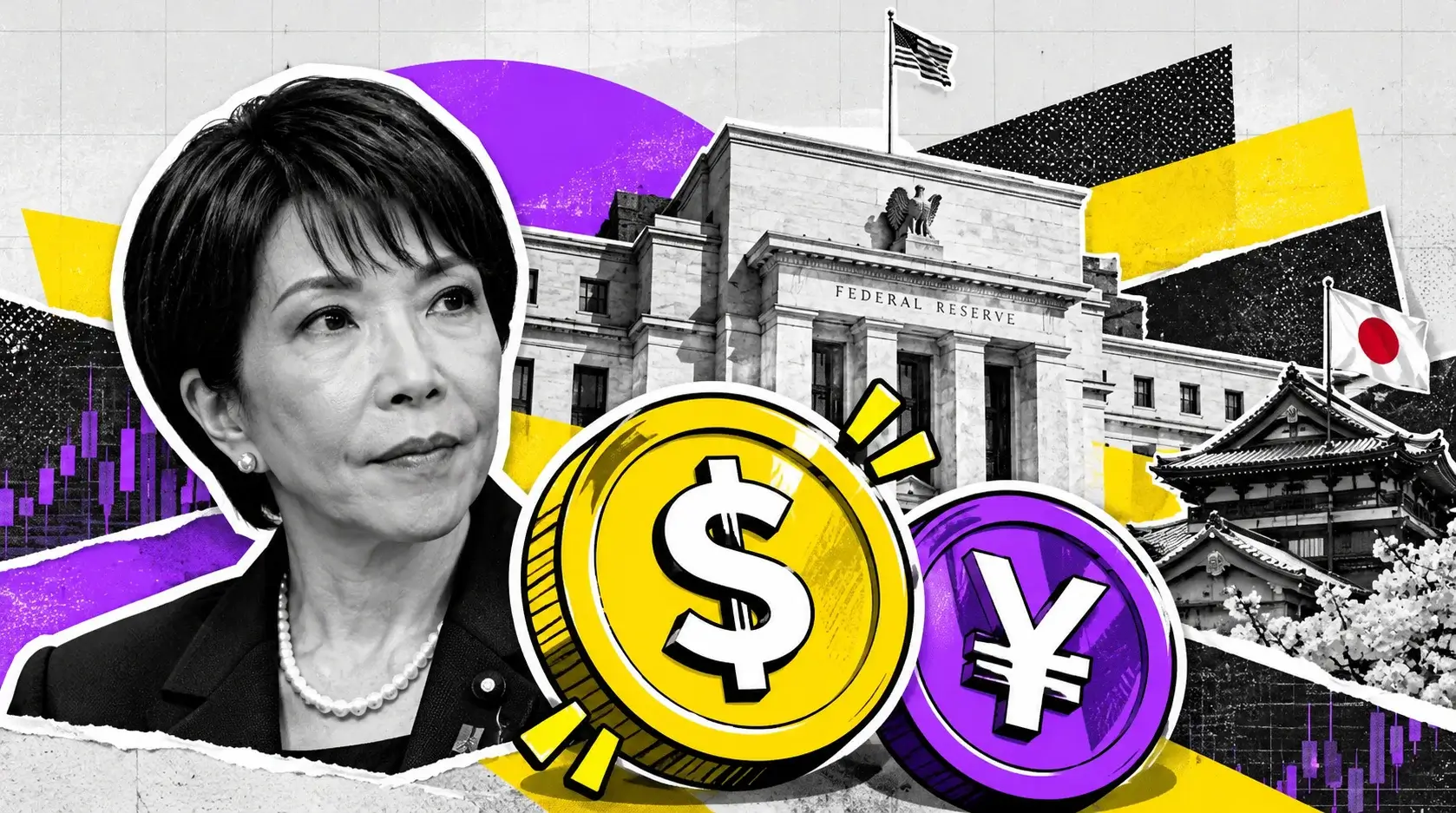
Beyond the charts, the global risk backdrop is no longer delivering a full safe-haven premium to USD. In Japan, Prime Minister Sanae Takaichi’s supermajority and expected fiscal expansion have created a “Takaichi trade” that favours the yen and Japanese equities. That draws capital toward Japan and away from dollar assets at the margin. In the Middle East, progress in US–Iran talks in Muscat has reduced some of the fear premium around the region, even though risk is far from gone. When geopolitical stress eases while alternatives such as Japanese and European assets look more attractive, the dollar’s role as the default hedge weakens. For GBP/USD, this environment helps offset the drag from BoE cuts and UK politics, because the other side of the cross is under its own pressure.
USD – Fed politics, Miran’s rate-cut push and the independence question
Internal dynamics at the Federal Reserve also lean against a stronger USD. Governor Stephen Miran has argued that current policy is “overly tight” and has floated the possibility of up to 100 basis points of rate cuts in 2026. His move from the White House Council of Economic Advisers to the Fed has revived debate about political influence over the central bank, especially after he stated that “100% pure independence” is not realistic in a crisis. Markets interpret this as a higher probability that the Fed will respond more quickly to softer data, which mechanically lowers the expected path of US yields and softens demand for dollar assets. For GBP/USD, a Fed that leans toward cuts while the BoE also prepares to ease still favours the currency that starts from a weaker positioning, and in this case that is the dollar, not the pound.
Read More
-
Yen Stalls at 160 Despite a 3% JGB and Tokyo Core CPI at 2.0% — Intervention Sits at 164, Friday's Payrolls Decide
02.09.2026 · TradingNEWS ArchiveEnergy
-
QQQ ETF ($706.22) Slides 7.4% Below Its High as the Market Reprices the AI Capex Bill — $686.57 Target if $700 Breaks
22.10.2026 · TradingNEWS ArchiveStocks
-
XRPI ($7.00) and XRPR ($10.74) Slide Toward 52-Week Lows as Spot XRP ETF Flows Stall at $708,510
22.10.2026 · TradingNEWS ArchiveCrypto
-
NG ($2.775) Decoupled From Europe’s €88 Gas Crisis as LNG Feedgas Hits 18.9 Bcf/d — $3.30 Upside on Cold Weather
22.10.2026 · TradingNEWS ArchiveCommodities
-
Dollar-Yen (157.35) Loses 157.65 as the Yen Rallies on Haven Demand — 155 Target if 156 Breaks
22.10.2026 · TradingNEWS ArchiveForex
GBP/USD – US data, CPI, delayed NFP and near-term volatility bands
In the near term, GBP/USD is hostage to a dense US data calendar. December US retail sales printed flat at 0.0% month-on-month versus a 0.4% consensus, while the year-on-year rate slowed to 2.4% from 3.3%. The Employment Cost Index for Q4 eased to 0.7% from 0.8%. These readings support the argument for a June rate cut and fit Miran’s case for easier policy. The delayed January Nonfarm Payrolls report on February 11, with expectations around a 70,000 job gain and a 4.4% unemployment rate, plus the next CPI print, are the obvious inflection points. A soft combination – weaker jobs and benign inflation – would likely drag DXY toward 95.00 and allow GBP/USD to test and potentially clear the 1.3730–1.3810 area. A surprise upside in either jobs or inflation would defend 97.00 on DXY and raise the risk of a retest of 1.3630 and then 1.3580 on the pair.
GBP/USD – UK inflation, BoE paths and how much easing is really priced
On the UK side, the key questions for GBP/USD are how fast inflation drops toward or below 2% and how quickly labour market data weaken. If headline CPI slips through target by April while wage growth cools, the market will feel justified in expecting a March cut and more easing later in the year. That scenario would make it difficult for the pound to sustain levels above 1.39–1.40 without an aggressive dollar sell-off. If, instead, inflation proves sticky and unemployment remains contained, the current pricing of roughly 50 basis points of cuts over 2026 becomes too heavy. A repricing toward fewer cuts would push gilt yields higher again, steepen the curve, and inject fresh support into GBP/USD via improved relative rate differentials.
GBP/USD – political stabilisation, FTSE dynamics and risk appetite on sterling
The broader UK risk landscape also matters for GBP/USD. Recent FTSE 100 moves highlight how individual corporate stories and sector swings interact with politics. Large-cap names such as BP dropped over 5% after suspending buybacks on weaker crude, while banks such as Barclays gained near 2% after delivering better-than-expected profits and promising £15 billion of capital returns. When political stress in London coincides with strong corporate cash returns and a relatively stable index, sterling tends to find a floor rather than collapsing. The current environment, with Starmer bruised but still in office and the equity market not in crisis, fits that profile and reinforces the case for a supported GBP/USD channel rather than a break lower.
GBP/USD – directional stance: buy, sell or hold at current levels
Taking the technical and macro pieces together, GBP/USD still trades in a constructive configuration. The pair holds an ascending channel from roughly 1.30 to 1.3868, trades above the nine-day EMA around 1.3650 and the 50-day EMA near 1.3513, and carries a mid-50s RSI that signals cooling but not reversal. DXY hovers near 96.90 with clear risk to 96.34 and perhaps 95.00 if CPI and the delayed NFP confirm a softer US backdrop. UK politics and BoE easing expectations cap the upside but have not broken the structural pattern or forced a close below the 1.3620–1.3580 floor that defines the trend. On that basis, the stance is straightforward: GBP/USD is a buy on dips, with a bullish bias, not a short or flat call. The attractive accumulation band sits at 1.3650–1.3630 with risk defined below 1.3580 and upside targets at 1.3735, 1.3810 and the 1.3868–1.3869 highs, extending toward 1.4090 if the dollar leg weakens further.