Stock Market Today - Dow Tops 50,458, S&P 500 Near 6,982 and Nasdaq Hits 23,280 as Wall Street Extends Record Run
Blue-chip and broad benchmarks push deeper into record territory while Nasdaq inches higher, December retail sales flatline at $735B, the 10-year yield drops to 4.15%, gold steadies above $5,000, bitcoin trades around $68,600, and earnings swings lift Spotify and Ferrari but hit S&P Global and BP | That's TradingNEWS
Dow and S&P 500 grind to fresh records as Nasdaq lags and volatility stays contained
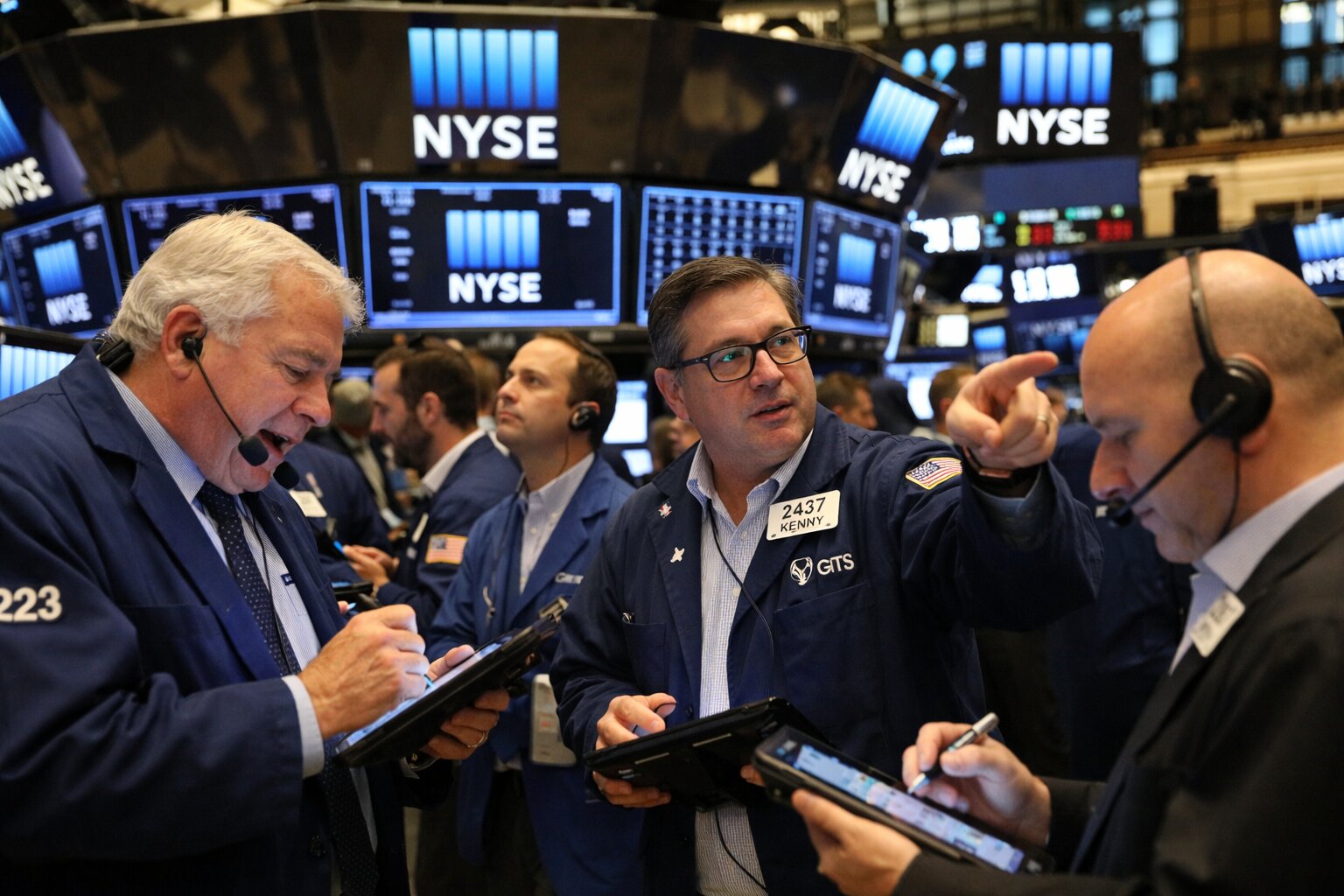
The cash market opened with a bid under blue chips and never lost it. The Dow Jones Industrial Average (^DJI) trades around 50,450–50,460, up roughly 0.6%–0.7%, and on track for a third straight record close. The S&P 500 (SPX) sits near 6,980–6,985, up about 0.2%–0.3% and back above its prior record close. The Nasdaq Composite (COMP) is positive but softer, near 23,270–23,280, up around 0.1%–0.2% as mega-cap tech cools. Small caps barely participate: the Russell 2000 hovers near 2,690, up only 0.06%, signaling that risk appetite is concentrated, not broad.
Volatility remains orderly. The VIX trades around 17.3, down a touch on the day, consistent with a market that is making new highs while still digesting big macro prints and earnings surprises. On the rates side, the U.S. 10-year Treasury yield slips to about 4.15%–4.17%, down roughly 6–7 basis points, reinforcing the equity bid and supporting financials. The KBW Nasdaq Bank Index trades near 177.7, up about 0.7%, reflecting the tailwind from lower yields and a steeper curve. Commodities stay mixed: front-month crude oil trades around $64.40–$64.45 a barrel, up only 0.1%, while the S&P GSCI Spot Index sits near 591, fractionally lower and signaling that the commodity complex as a whole is taking a breather rather than leading.
Currency moves confirm a mild risk-on tone. The WSJ Dollar Index trades around 94.25, down about 0.15%, while the broader DXY sits near 96.8, also slightly weaker. A softer dollar, lower yields and record U.S. equity benchmarks build a picture of markets that are leaning optimistic even as key data points expose cracks in the growth story.
Retail sales stall at $735 billion and rate-cut odds tick higher as bonds rally
The session’s macro hinge is December U.S. retail sales. Adjusted advance sales for retail and food services came in flat month-on-month at about $735 billion, versus a revised $735.1 billion in November and well below expectations for a 0.4% gain. November had delivered a 0.6% increase; December’s zero print marks a clear loss of momentum into the core holiday period.
Under the surface, eight of 13 spending categories declined. Auto dealers, furniture and electronics stores showed drawdowns, while spending on building materials, food and drink, and gasoline offset some of the weakness. Ex-autos and gasoline, sales were also flat against consensus for a 0.4% rise. For an economy that has relied heavily on consumption resilience, a flat December is not a disaster, but it is a warning.
Rates markets responded instantly. Two-year yields slipped toward 3.46%, down almost 4 basis points, while the 10-year yield fell to about 4.148%, down roughly 6–7 basis points. The long bond yield moved under 4.80%. Fed-funds futures now assign a probability north of 20% to a March rate cut, up from the low-teens before the release, as traders begin to price a softer consumer and a slower 2026 start.
The timing is critical. Wednesday brings the delayed January jobs report, and Friday delivers the next CPI print. A combination of weaker retail sales, softer labor data and fading inflation could force a shift in the Fed’s narrative from “higher for longer” to “earlier and smoother” easing. Equities are front-running that shift: lower yields, higher banks, record SPX and DJIA prints, and modest tech pressure rather than a wholesale de-risking.
AI rotation gets complicated: software rallies while mega-cap tech wobbles
The most crowded theme in global markets—AI infrastructure—looks less linear. The iShares Expanded Tech-Software Sector ETF (IGV) trades around $86.25, up roughly 1.4%, signaling fresh demand for software names that can monetize AI rather than just feed it with hardware. At the same time, several members of the “Magnificent Seven” trade lower. NVIDIA (NVDA) hovers near $189, down about 0.4%. Alphabet (GOOG) trades around $320, down roughly 1.4%, while Meta Platforms (META) sits near $672, off around 0.7%. The Roundhill Magnificent Seven ETF (MAGS) barely moves, near $63.9, up only about 0.1%.
The message is straightforward: the market is not rejecting AI as a long-term driver, but it is becoming more selective. A blanket bid for mega-caps has been replaced by a more nuanced rotation. Investors are asking which companies have sustainable pricing power and defensible margins once AI build-out capex stops being a one-way tailwind.
In parallel, the policy backdrop is evolving. Plans for chip tariffs now include carve-outs designed to shield U.S. hyperscalers such as Amazon (AMZN), Alphabet (GOOG) and Microsoft (MSFT), provided they commit to specific investments tied to Taiwan Semiconductor Manufacturing Company (TSM). That structure keeps pressure on global supply chains while giving Big Tech a path to secure the silicon it needs for AI-driven data centers.
Balance-sheet strategy is also shifting. Alphabet is tapping sterling and Swiss franc bond markets, diversifying funding away from U.S. dollar debt. As AI-related capex grows, megacaps are broadening their investor base and managing currency risk more aggressively. That is constructive for credit markets but also a reminder that the AI race has become capital intensive and global, not just a domestic equity story.
Chipmakers split: TSMC sets revenue records while device brands face margin squeeze
Semiconductors stay at the center of the equity narrative, but leadership is changing inside the sector. Taiwan Semiconductor Manufacturing Company (TSM) posted its highest monthly revenue on record, sending its shares up about 1.6% in U.S. trading and boosting sentiment around the durability of AI and high-performance computing demand. The print confirms that the foundry at the core of the global chip supply chain is still operating near full throttle.
The downstream picture is more mixed. Rising memory costs are hitting device manufacturers and PC brands. A broad gauge of consumer electronics makers is down roughly 12% since the end of September, while a basket of memory producers, including Samsung Electronics (005930.KS), has surged more than 160%. That divergence reflects a classic margin squeeze: input costs for memory-heavy products are rising faster than end prices can adjust.
Names tied to consoles and consumer hardware are in the crosshairs. Nintendo (NTDOY) trades near $14.5, up about 2%, but the broader pressure on device profitability remains a key risk. Suppliers into the Apple (AAPL) ecosystem share that pressure, even when unit volumes hold up. Investors are now analyzing which companies can pass through higher memory costs, lock in favorable supply contracts, or redesign products to use fewer memory components.
In U.S. auto and industrial chips, the picture is volatile rather than uniformly weak. ON Semiconductor (ON) initially sold off in pre-market trading after reporting fourth-quarter EPS of $0.45 on $1.53 billion in revenue, missing profit expectations and falling from $0.88 EPS a year ago. Guidance for first-quarter revenue in the $1.43–$1.53 billion range, with EPS expected at $0.56–$0.66, straddles consensus but doesn’t reset the growth story. As the session progressed, ON shares recovered to trade around $66.7, up about 2.5%, as investors focused on signs of stabilization in key end-markets and quarter-over-quarter improvement in Intelligent Sensing.
Taken together, the chip complex still underpins the equity bull case, but leadership is shifting: foundries and memory producers are the clear winners, while consumer devices and some analog/mixed-signal names wrestle with margin pressure.
Earnings tape: Spotify and Ferrari lead gainers as S&P Global and BP get punished
On the single-stock level, the day belongs to growth names that delivered clean beats and convincing guidance. Spotify Technology (SPOT) spikes roughly 17% to about $487 after reporting fourth-quarter EPS almost $2 above expectations and a 10% year-over-year jump in subscribers to about 290 million despite a $1 price hike. The key takeaway is simple: pricing power is real, churn is contained, and cost discipline is flowing through to profitability. After a gain of this size, the risk-reward for new money becomes less attractive, but the print validates the long-term operating leverage story.
In Europe and cross-listed in the U.S., Ferrari (RACE) rallies more than 7% after laying out a confident path into its EV era. The company expects adjusted operating profit above €2.22 billion (about $2.6 billion) in 2026, up around 5% from last year and ahead of consensus. The ramp of the $4 million F80 supercar and the pipeline leading to the fully electric Luce drive that outlook. Investors had worried that the transition to EVs could dilute brand economics; today’s guidance indicates the opposite, at least for now.
At the other end of the spectrum, S&P Global (SPGI) sinks about 7% to roughly $413 after forecasting 2026 adjusted EPS of $19.40–$19.65, below prior expectations near $19.9–$20.0. The company did deliver adjusted EPS of $4.30 in the quarter on revenue of $3.916 billion, edging top-line estimates but missing on earnings by a few cents. With the stock already under pressure and down more than 20% year-to-date, the market is signaling concern that AI-driven competition could erode the pricing power of traditional index, ratings and data franchises. Peer Moody’s (MCO) trades near $421.6, down more than 6%, pulled lower in sympathy.
Energy is another weak pocket. BP (BP) drops about 3% in U.S. trading and around 6.5% in London after suspending its $750 million quarterly share buyback and outlining plans to step up cost cuts and sell as much as $20 billion of assets by 2027. The move might be prudent from a balance-sheet perspective, especially under activist pressure from Elliott, but it directly undercuts a key pillar of the equity story: aggressive capital return. Investors who owned BP for its buyback and payout algorithm have to reassess.
Healthcare and defensive names are mixed. CVS Health (CVS) trades lower by more than 2% after posting a profit decline that still beat consensus and reiterating full-year adjusted EPS guidance. The reaction reflects concern about margin compression rather than headline beats. Coca-Cola (KO) “inches lower” after disappointing net revenue; earnings quality is not enough when top-line growth fails to impress at this stage of the cycle.
On the more speculative side, Oscar Health (OSCR) jumps about 8% despite a wider loss and a medical loss ratio of roughly 95.4%. Markets are rewarding its path to profitability and constructive full-year outlook, showing that investors will tolerate short-term pain if they see a credible route to positive earnings beyond 2025.
Banks, credit and the coming M&A wave
Financials benefit from the combination of stable credit, lower yields and a supportive CEO tone. The KBW Nasdaq Bank Index gains about 0.7%, while large-cap banks digest a new regulatory and political overhang. Concerns over a possible 10% cap on U.S. credit-card interest rates sparked earlier weakness in card lenders. Barclays has emphasized that it has “levers” to pull, including repricing, product redesign and underwriting shifts, to defend returns if the cap materializes.
In investment banking, the tone turns more optimistic. Goldman Sachs CEO David Solomon reiterates a bullish view on dealmaking, arguing that 2026 M&A volumes will be meaningfully higher than the average of the past five years. With equity markets at all-time highs, financing windows open and boards under pressure to reposition for an AI and deglobalization world, the backdrop for advisory and underwriting desks is improving. That is a direct offset to cyclical weakness in trading and some lending businesses.
Succession and talent flows remain a theme. The abrupt departure of Standard Chartered CFO Diego De Giorgi—seen as a front-runner for the CEO job—to lead Apollo in EMEA underscores a broader trend: private capital continues to lure top banking talent. That has implications for future strategy and risk appetite across both sectors.
Gold stabilizes above $5,000 as banks talk $6,000 and beyond
After one of the most violent shakeouts in years, precious metals are stabilizing. April gold futures (GC=F) trade around $5,064–$5,065 per ounce, off about 0.3% on the day but still holding above the $5,000 line reclaimed earlier in the week. Silver trades near $81.8, down about 0.5%, also pausing after extreme moves.
The positioning debate is intense. A speculative surge pushed both gold and silver to stretched levels, followed by a brutal washout that saw silver register its largest daily drop on record and gold suffer its biggest one-day fall since 2013. Despite that, the fundamental drivers remain in place: elevated geopolitical risk, persistent central-bank buying (with the PBoC extending purchases into a 15th straight month), and the prospect of lower real yields if the Fed moves from restrictive to neutral.
Large banks remain constructive. Some houses see gold at $6,000 by year-end on continued demand for hedges and portfolio insurance. The most aggressive voices talk about much higher theoretical fair values, even north of $10,000–$12,000 in extreme scenarios. Those numbers are not base cases, but they capture the asymmetry: any renewed flare-up in geopolitics or a sharper Fed pivot would likely be expressed through bullion before equities.
With the 10-year yield sliding back toward 4.15%, the opportunity cost of holding gold is falling again. For now, the metal is digesting prior gains, but the structure of the rally remains intact.
Bitcoin and ether search for a floor after a ‘crisis of confidence’ slide
Crypto assets remain fragile. Bitcoin (BTC-USD) trades between roughly $68,600 and $68,800, down around 1%–3% on the day and well below recent highs north of $69,000–$70,000. The move follows its worst single-day loss since November 2022 and a sharp snapback, leaving traders whipsawed by intraday swings. Ether (ETH-USD) trades near $2,013–$2,015, also lower, as the broader complex pauses.
The latest leg down is less about a specific blow-up and more about positioning. After a relentless climb, leverage and short-dated options activity elevated sensitivity to any wobble in macro or flows. Some analysts describe the move as a “crisis of confidence” rather than a structural break: no major protocol failure, no large custodial collapse, no systemic ETF redemption shock. That framing matters because it implies that if macro conditions stabilize and risk appetite recovers, the asset class can regain its footing.
For now, equities and gold are the preferred macro hedges. Crypto is trading more like a high-beta risk asset than a pure hedge, moving down on growth scares and up on liquidity hopes. Until volatility compresses and ETF flows re-anchor, the path remains choppy.
Read More
-
Yen Stalls at 160 Despite a 3% JGB and Tokyo Core CPI at 2.0% — Intervention Sits at 164, Friday's Payrolls Decide
02.09.2026 · TradingNEWS ArchiveEnergy
-
QQQ ETF ($739) Fades From an Early Tech Rally as a 77.9 ISM Prices Index Meets Micron's $61.5B Guide — $760 Record Test Ahead
01.10.2026 · TradingNEWS ArchiveStocks
-
XRPR and XRPI Follow XRP's $1.49 Test as Spot Funds Hold 1.16B XRP and a 1 Billion Token Escrow Release Lands — $1.70 in Play
01.10.2026 · TradingNEWS ArchiveCrypto
-
November NG Slips Below $3 as Decade-High Storage Meets Capped LNG Exports — $2.75 in Sight
01.10.2026 · TradingNEWS ArchiveCommodities
-
Dollar-Yen at 158 Presses Toward 160 as a 363 bp Carry Gap Meets Katayama-Bessent Intervention Risk — 159 in Sight
01.10.2026 · TradingNEWS ArchiveForex
Japan’s Nikkei smashes records as investors rotate toward international equities
In Asia, the story is dominated by Japan. The Nikkei 225 (^N225) closes up about 2.3% to roughly 57,650–57,820, extending Monday’s 3.9% surge and pushing year-to-date gains toward 15%. The catalyst is political as much as economic: a landslide victory for Prime Minister Sanae Takaichi’s party has reinforced expectations for pro-growth reforms, corporate governance tightening and continued shareholder-friendly policy.
Other regional indices join the move. Australia’s S&P/ASX 200 (^AXJO) adds about 0.3% to roughly 8,894. South Korea’s Kospi (^KS11) climbs around 0.6% to above 5,320. Hong Kong’s Hang Seng (^HSI) rises about 1% to near 27,300, and the Shanghai Composite adds around 0.2%. The backdrop is a gradual rotation of global capital: after years of overweight U.S. large caps, allocators are redeploying into markets where valuations are less stretched and policy momentum is improving.
The move is not without risks. A firmer yen—USDJPY trades near 154.4, down almost 1%—could compress margins for Japanese exporters if it continues. But for now, optimism on domestic reform and better corporate returns is overpowering FX concerns.
Big picture: records built on softer data, selective tech, and global rotation
The cross-asset map is coherent. Record DJIA and near-record SPX, a positive but lagging Nasdaq, stable VIX, lower Treasury yields, a softer dollar, bid Japanese equities, and firm but consolidating gold all tell the same story: markets see a slowdown, not a collapse, and are betting that central banks will lean dovish before growth cracks too deeply.
Within U.S. equities, leadership is shifting. High-quality cyclicals, banks and selected software are outperforming, while some mega-cap AI darlings tread water or slip modestly as valuation and capital-intensity questions pile up. Earnings are rewarding real beats and credible guidance—SPOT, RACE, OSCR—and punishing any sign of disappointment or structural threat—SPGI, MCO, BP, KO, CVS.
Macro risk remains. Soft retail sales raise the chance that the labor market and inflation data later this week surprise in a way that forces the Fed’s hand. Global politics—from tariff design around chips to Japanese fiscal and structural reform—continues to shape sector winners and losers.
Trading stance: bullish bias for U.S. and Japan, selective on tech, constructive on gold, cautious on crypto
Given the tape and the numbers:
-
At current levels near 6,980–6,985, the S&P 500 (SPX) merits a Hold with a bullish bias. Valuations are rich, but falling yields, resilient earnings and improving M&A prospects support the index. Dips driven by event risk (jobs and CPI) should be viewed as opportunities rather than exits unless wage and inflation data accelerate sharply.
-
The Dow Jones Industrial Average (^DJI) around 50,450–50,460 looks like a Buy on pullbacks. Its composition is less tech-heavy, more exposed to global industrial and financial recovery, and it is the clear outperformer today.
-
The Nasdaq Composite (COMP) deserves a neutral Hold. The AI story is intact, but the easy multiple expansion phase is behind, and leadership is concentrating in fewer names as some mega-caps face regulatory, funding and valuation friction.
-
Japan’s Nikkei 225 (^N225) at roughly 57,650–57,800 remains a Buy, with the caveat that FX volatility can dent returns. Political momentum, governance reform and global rotation into non-U.S. equities support a continued overweight.
-
Gold (GC=F) above $5,000 is a Buy as a strategic hedge. The combination of geopolitical risk, central-bank demand and the prospect of lower real yields argues for maintaining or building positions on dips, with upside skewed as long as central banks stay in the market.
-
Bitcoin (BTC-USD) in the $68,000–$69,000 band is a high-risk Hold, not a fresh chase. Volatility and leverage remain elevated. Until price action settles and a cleaner base forms, chasing short-term moves adds more risk than reward.
-
Among single names, Spotify (SPOT) after a 17% spike shifts to a Hold, with the result validating the long-term story but limiting near-term upside. S&P Global (SPGI) around $413 and down almost 7% today is a selective Buy for long-horizon capital: the franchise remains strong, but AI disruption risk and guidance reset justify a slower accumulation. BP (BP) is a Hold at best as long as buybacks are suspended and the market reprices its capital-return profile.
Overall, the tone stays constructive and moderately bullish on equities, with the key to the next leg up resting on whether upcoming labor and inflation data confirm the picture that today’s flat retail sales and falling yields are already sketching: slower, but not broken, growth and a Fed that can start easing before the expansion runs out of road.