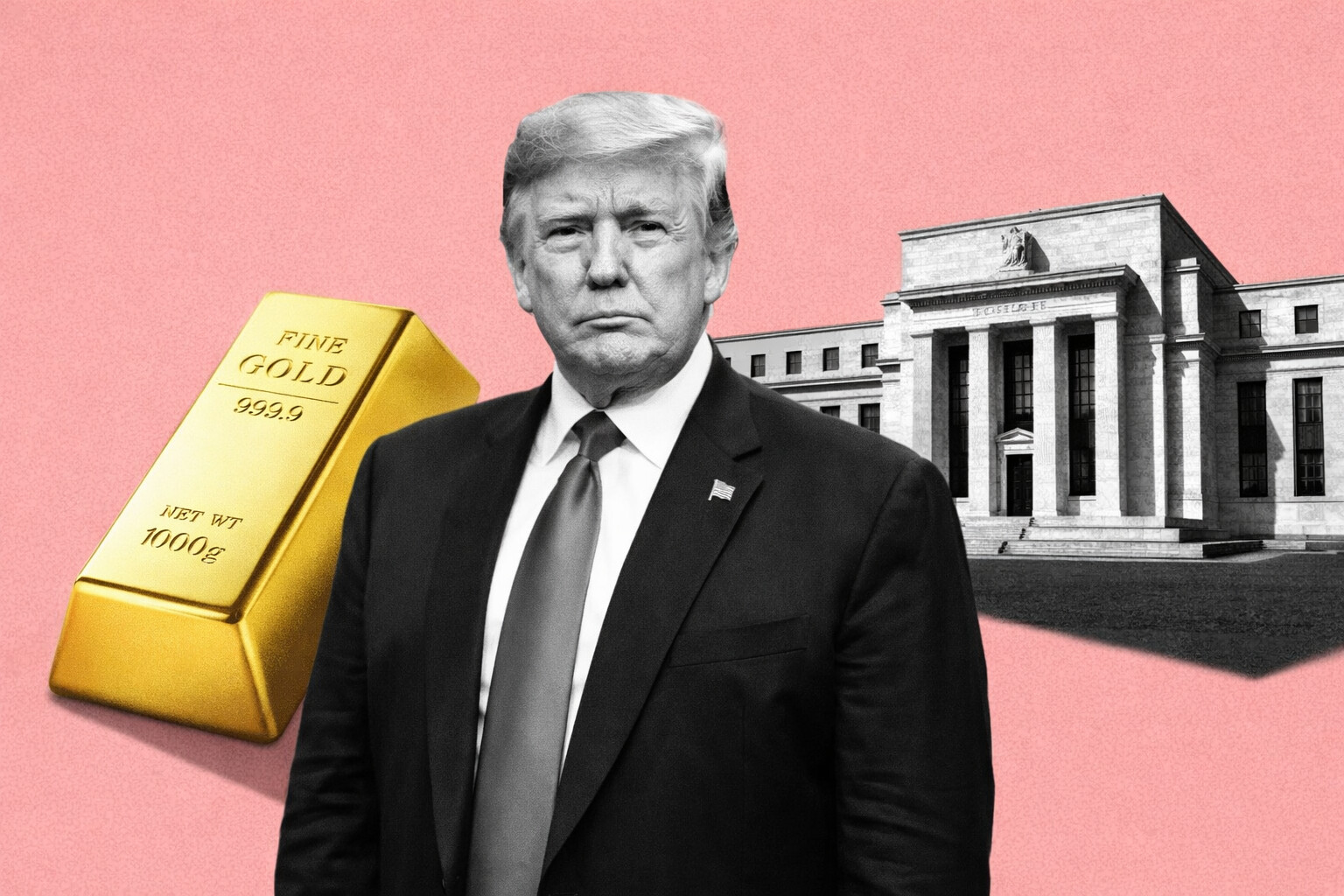
Gold Price Forecast - Gold Soars Toward $5,000 as XAU/USD Eyes $5,400–$6,000 Breakout
With spot gold holding near $4,987 and Q1 targets around $5,150, Bank of America’s $6,000 call, a sliding U.S. dollar, record Turkish prices and global “debasement trade” flows are turning XAU/USD into the key safe-haven trade of 2026 | That's TradingNEWS
Gold Price Surge Puts XAU/USD On A Path Toward $5,400–$6,000
Spot Gold Near $4,987 Confirms An Accelerated 2026 Uptrend
Spot gold (XAU/USD) is trading just under the psychological $5,000 mark, with the latest session closing around $4,987 per ounce, up more than 1% on the day and roughly 15% in 2026 alone. The structure is no longer a slow grind higher; the tape is showing an accelerated phase where every dip into the high $4,800s–low $4,900s is bought aggressively. Instead of deep corrections, the market is delivering shallow consolidations, and the zone around $4,900 has turned into the first real support band, indicating that recent highs are being absorbed rather than rejected.
Macro Drivers: Real Yields, Fiscal Strain And The Debasement Trade Behind Gold
The move in gold is being driven by a combination of lower expected real rates, persistent fiscal stress and a broad “debasement trade” rather than a single data point. Markets expect rate cuts later in 2026, inflation risks are still in play, and deficit trajectories in major economies keep moving in the wrong direction. Since late August 2025, when dovish policy signaling reignited fears that governments will lean on inflation and financial repression to manage debt, gold has jumped by about 50%, while silver and platinum have rallied even more. Historically, higher real 10-year yields would pressure XAU/USD; this time the correlation has broken. Real yields remain positive, yet gold keeps printing new highs, which only happens when debt sustainability and currency dilution start to dominate the macro narrative.
Q1 2026 Trading Range For XAU/USD And Near-Term Bias
A large-scale AI pricing model projects gold finishing Q1 2026 around $5,150 per ounce, inside a working range of roughly $4,950–$5,350. That path assumes sideways to slightly choppy trade around $5,000 through most of February, followed by a fresh push above $5,100 into March as policy expectations settle more firmly on cuts. The logic is simple: price behavior near $5,000 still looks like consolidation within a strong trend rather than a blow-off, strong demand keeps emerging below $4,900, and the quarter is not long enough to sustain an uncontrolled parabolic spike but is long enough to allow an overshoot above the round number before profit-taking.
Turkey As A Case Study For Local Gold Shock And FX Fragility
In Türkiye, the global gold rally is being magnified by FX weakness. Local prices have surged to around 7,049 TRY per gram (about $162.7), after a 0.68% one-day rise, leaving gold up roughly 18% in lira terms since the start of the year. Silver sits at a record 138 TRY per gram (~$3.20) and is up close to 39% year-to-date. At the same time, the Turkish lira has dropped about 21.4% versus the dollar, from roughly 35.72 to 43.37 per USD since early 2025. That combination is crippling the physical trade: workshops in Istanbul’s jewelry hubs report production collapsing by around 60%, with many closing or working only for a handful of private clients, while households use rallies to sell silver back into the market. Türkiye shows how a global XAU/USD bull market, when layered on top of a fragile currency, turns gold from a luxury product into a parallel balance-sheet asset and a direct hedge against domestic monetary erosion.
Bank Of America Scenarios Point To $4,538 Base And $6,000 Bull Case For Gold
One major U.S. bank frames this gold cycle against four previous bull phases, where the metal delivered about 300% average gains over roughly 43 months. Using that pattern, they outline a bull case near $6,000 per ounce by spring 2026, more than 20% above today’s records and well above mainstream street targets. Their base case assumes an average real-terms gold price around $4,538 per ounce in 2026, implying that even a normalization year keeps XAU/USD anchored dramatically higher than pre-2024 levels. Supply and earnings projections support that stance. The 13 largest North American gold miners are expected to produce roughly 19.2 million ounces in 2026, about 2% less than in 2025, while total EBITDA is projected to jump roughly 41% to around $65 billion. In other words, volumes are flat to shrinking while profitability explodes, which is exactly what you expect when price is sending a strong signal that mine supply has not yet caught up with demand.
Gold Versus Silver: Ratio Around 59 Signals Sector-Wide Precious Metals Strength
The gold-to-silver ratio hovering near 59 shows that this is not a single-asset story. When the entire precious metals complex rallies and silver outpaces gold, it usually means the sector is in the middle of a re-rating, not at the end. Historical extremes in the ratio illustrate the point. A move back toward the 2011 low near 32 would be compatible with silver around $135 per ounce at current gold levels; a retest of the 1980 low near 14 would imply silver above $300 per ounce. Those are not base-case numbers, but they explain why high-beta flows are rotating into silver while investors still use XAU/USD as the anchor hedge. The key implication is that a broad-based metals rally rarely ends with gold alone still moving; as long as silver and platinum are leading, the probability is that the precious metals cycle still has room.
Flow Structure: Retail, Funds And ETFs Now Drive XAU/USD More Than Central Banks
Official sector buying is a tailwind, not the engine. Emerging-market central banks have been adding gold reserves steadily in recent years, but reported data do not show any sudden acceleration after the 2022 sanctions wave that would explain a near-vertical price move across gold, silver, platinum and palladium. The broad surge across all those markets points instead to leveraged funds, physically backed ETFs and retail accounts as the marginal price setters. The “debasement trade” today is being expressed through bullion, futures, miners and royalty companies rather than just reserve management desks. For XAU/USD, that matters because speculative capital can push prices far above what traditional fair-value models would suggest and can keep trends extended for longer than usual once narratives like “global debt crisis” and “currency debasement” become dominant.
Technical Picture: Ascending Triangle From $4,400 Projects Toward $5,400–$6,000
On the weekly chart, gold has just cleared a clean ascending triangle whose horizontal ceiling sat near $4,400 while higher lows repeatedly squeezed price into that resistance. Similar structures in 2024 and 2025 delivered follow-through of roughly $900–$1,000 per ounce once the breakout confirmed. This time, the consolidation was shorter and the breakout sharper, which typically signals stronger underlying demand. A straightforward measured-move projection of $900–$1,000 on top of the $4,400 base gives a primary target region around $5,300–$5,400, aligning with the current push to and beyond the $5,000 psychological barrier. Weekly momentum remains supportive: RSI is overbought but not yet at historic exhaustion extremes, and MACD remains in a bullish configuration. First serious support now sits in the $4,900–$4,950 band, with a more structural floor in the $4,400–$4,500 region where the pattern broke out. Only a sustained return below $4,400 would invalidate the current breakout and open room for a deeper mean-reversion; above that, the path of least resistance for XAU/USD is still up.
Read More
-
Yen Stalls at 160 Despite a 3% JGB and Tokyo Core CPI at 2.0% — Intervention Sits at 164, Friday's Payrolls Decide
02.09.2026 · TradingNEWS ArchiveEnergy
-
SOFI ($16.71) Posts Its Best Day of the Quarter as Profit Guidance Finally Rises — Holding $15.70 Unlocks $20
27.10.2026 · TradingNEWS ArchiveStocks
-
XRP-USD ($1.30) Defends a $1.27 Double Bottom as Whales Hold 68.5% of Supply — Break of $1.31 Opens $1.35 and $1.40
27.10.2026 · TradingNEWS ArchiveCrypto
-
Brent ($113.88) Trades a $2.35 Range as Houthi Strikes Meet Saudi-Iran Diplomacy — Break of $117 Unlocks $120
27.10.2026 · TradingNEWS ArchiveCommodities
-
Nasdaq Rips 1.3%, S&P 500 Hits 7,728, Dow Stalls as BA Drops to $171
27.10.2026 · TradingNEWS ArchiveMarkets
-
GBP/USD (1.3310) Can’t Cash In on 5.43% Gilt Yields as Budget Risk Meets a Firm Dollar — Break of 1.3274 Opens 1.3200
27.10.2026 · TradingNEWS ArchiveForex
Dollar Breakdown And Easy Financial Conditions As A Tailwind For Gold
The U.S. dollar index has transitioned from range-bound to a clearly bearish structure between roughly 96 and 100, repeatedly failing near a pivot around 100.5 and printing three consecutive heavy monthly declines. A decisive break below the 96 band would expose the 90 zone last seen in early 2021. For gold, that is exactly the backdrop that usually delivers a second-leg extension. A weaker dollar mechanically lifts dollar-denominated commodities and increases non-U.S. buying power. At the same time, a key U.S. financial conditions index has retraced back to its easiest levels since 2021, meaning liquidity is plentiful. The unusual combination now is easy liquidity plus rising fear, not easy liquidity plus risk-on equity appetite. That is why XAU/USD is rallying in parallel with other safe-havens instead of being rotated out in favor of stocks and high-yield credit.
Debt, Trust And The Emerging Safe-Haven Premium Embedded In Gold
The surge in gold is tightly linked to how markets are repricing sovereign risk. High-debt issuers like Japan are seeing mounting pressure in their bond markets, even as capital is moving toward lower-debt countries and toward assets that sit outside the government liability structure. XAU/USD has effectively become a barometer for confidence in fiscal trajectories and institutional credibility. Public debates about tariffs, sanctions, currency policy and even alliance stability, amplified by episodes like the latest Davos rhetoric, are undermining trust in the post-crisis rules-based order. When investors start to price in not just inflation but also the possibility of more aggressive debt-management tools – from financial repression to selective restructuring – gold earns a structural trust premium that supports higher and stickier price levels.
Risk Scenarios That Could Derail A Move Toward $6,000 In XAU/USD
The bullish route for gold is straightforward: sustained dollar weakness, confirmation of rate-cut paths, continued central bank and institutional buying and persistent geopolitical and fiscal anxiety together build a case for $5,400 in the near term and a non-trivial probability of a test of $6,000 by mid-2026. The counter-cases are narrower but relevant. A surprise hawkish shift by major central banks, a sharp move higher in real yields, a credible risk-on rotation into equities, or an aggressive unwinding of speculative positioning could easily cut $500–$800 from the price without destroying the longer-term uptrend. Given the size of recent inflows, any positioning clear-out would likely be abrupt and violent, which is why monitoring ETF flows, futures positioning and options skew is critical for anyone trading XAU/USD at these levels.
Verdict On Gold – Bias Is Bullish, With XAU/USD Favored As A Buy-On-Dips Trade
Taking the full picture together – spot gold around $4,987, the structural macro support from fiscal stress and the debasement trade, a validated ascending triangle off $4,400 projecting toward $5,400–$6,000, tight physical supply, a weakening dollar, and speculative flows still pushing into the sector – the probability still leans toward further upside in XAU/USD. The move is already extended and volatility will remain elevated, so the execution logic is clear. The stance is bullish on gold, effectively a Buy bias, expressed as a buy-the-dip strategy into the $4,900–$4,500 bands rather than chasing vertical spikes, with the understanding that a decisive breakout toward $5,400–$6,000 will offer both exceptional upside and the real risk of a sharp reversal once this cycle finally exhausts.