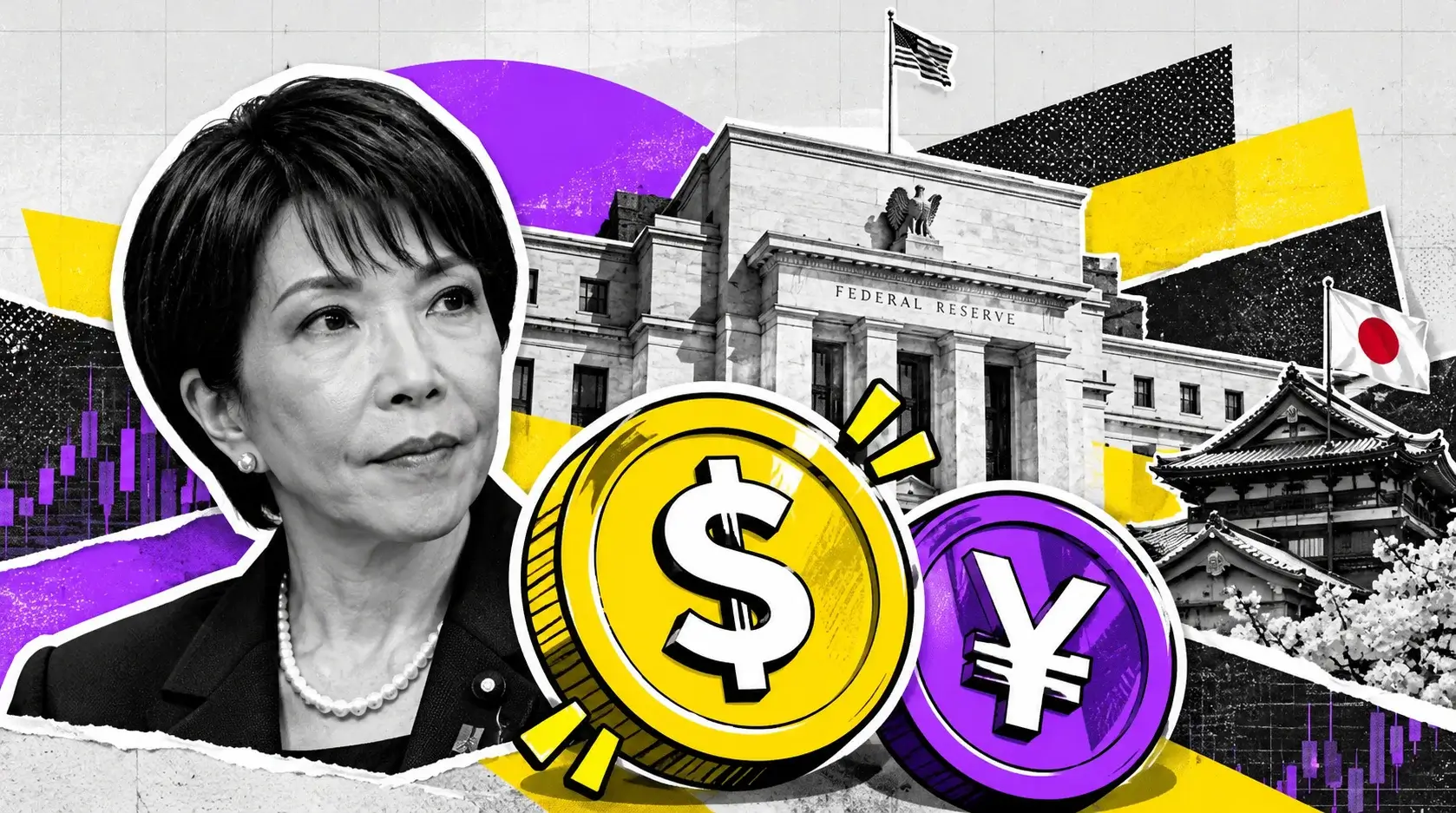
USD/JPY Price Forecast - Pairs at 159.18 Puts Japan Back on Intervention Watch — 300bps Rate Gap the BoJ Cannot Close
With Treasury yields at 4.25%, DXY pressing 100, and Iran's Hormuz closure hammering Japan's energy import bill, USD/JPY is one clean weekly close above 159.60 away from targeting 160.80 | That's TradingNEWS
USD/JPY Price Forecast — March 12, 2026: 159.18 and Climbing, Intervention Risk Building, and the Most Dangerous Resistance Zone the Yen Has Faced Since April 2024
USD/JPY at 159.18 — Three Consecutive Days of Gains, Intervention-Watch Levels Breached, and $100 Oil Doing What the Fed Never Could
USD/JPY is trading at 159.18 on March 12, 2026, extending gains for the third consecutive session and returning to levels that triggered official "rate check" warnings from Japanese authorities as recently as January 23. The pair has traveled more than 4.3% from its February low in a rally that is now testing the most consequential resistance cluster on the weekly chart — the 159.22 January high and the 159.45 mid-January peak, a zone where USD/JPY has twice been repelled and where a weekly close above 159.60 would signal a structural regime shift toward 160 and beyond. The DXY is simultaneously pressing toward key resistance at 99.50 and 100.40, levels connecting price action between January 2023 and March 2026 that represent the decisive test of whether the dollar's broader uptrend from the 2008 lows continues with conviction or stalls into consolidation.
The macro architecture driving this move is not subtle. Brent crude surged approximately 8% to $98.49 per barrel after Iranian drone strikes targeted vessels near Iraq's export terminals and in the Strait of Hormuz on Wednesday night, pushing energy prices back toward the $100 mark that has been the central obsession of every risk desk since the Iran war began on February 28. Japan imports the overwhelming majority of its energy from the Middle East — there is no meaningful domestic hydrocarbon production buffer, no significant domestic LNG output, and no strategic reserve large enough to absorb a prolonged Strait of Hormuz shutdown. Every dollar that crude gains is a direct tax on Japan's trade balance, a structural deterioration of the current account that was already being pressured by the interest rate differential between the Bank of Japan and the Federal Reserve. Higher oil prices simultaneously weaken the fundamental case for yen strength AND force the BoJ into an impossible monetary policy configuration where inflation may demand tightening while the energy-driven trade shock demands stimulus. USD/JPY at 159.18 is the market's precise and merciless read of that contradiction.
The Energy Import Vulnerability That Turns Every Crude Price Spike Directly Into Yen Weakness — Japan's Terms of Trade at the Mercy of Hormuz
Japan's dependence on Middle Eastern energy supply is the single most powerful structural force operating on USD/JPY in the current environment, and it needs to be understood with specificity rather than in passing. Japan sources a substantial share of its crude oil imports from Middle Eastern producers who route their exports through the Strait of Hormuz. When Iranian forces attacked vessels near Iraq's key export terminals on Wednesday — the same Basra terminals that handle the majority of Iraq's 1.4 million barrels per day of export capacity — and simultaneously struck Oman's largest oil storage facility, the combination created a specific and concrete deterioration in Japan's terms of trade that has no short-term offset. MUFG analysts explicitly characterized the current energy price environment as a negative terms-of-trade shock for Japan — not a temporary spike to be looked through, but a sustained deterioration of the price Japan pays for its energy relative to the prices it receives for its exports.
That terms-of-trade shock has a direct mechanical transmission to USD/JPY through the current account. Japan pays for energy imports in US dollars. When energy prices rise 8% to 10% in a single session and the Strait of Hormuz remains functionally closed with Iranian forces committed to keeping it that way, Japanese importers need more dollars to pay for the same volume of energy. Increased dollar demand from Japanese energy importers puts direct upward pressure on USD/JPY independent of the interest rate differential, the BoJ's policy stance, or any other macro variable. MUFG added a critical observation that changes the intervention calculus significantly: Japan's authorities may tolerate a weaker yen in the near term precisely because the energy shock means that a stronger yen would provide only limited import price relief — the underlying commodity disruption is not a pricing problem that yen appreciation can solve. This is fundamentally different from the 2022 intervention dynamic, when Tokyo acted aggressively to cap USD/JPY because yen weakness was amplifying import inflation in a way that threatened household purchasing power directly. In the current setup, with Iran controlling the physical supply disruption, currency intervention purchases time rather than addressing the root cause.
The Fed Rate-Cut Evaporation — From 50 Basis Points to Under 25 in Two Weeks, and What 10-Year Yields at 4.25% Mean for the Yen
Before the Iran war began on February 28, markets were pricing in more than 50 basis points of Federal Reserve rate cuts through year-end 2026. As of March 12, that figure has been slashed to under 25 basis points — a reduction of more than half in just 13 days of trading. Fed Fund Futures are now pricing a 58% probability that the next rate cut arrives in July, pushed back from earlier expectations for a May or June delivery. Markets are no longer debating whether the Fed eases in 2026 — they are debating whether it eases at all, and some participants are beginning to factor in the possibility that the ECB delivers a rate hike as early as June while the Fed stays frozen at 3.50% to 3.75%. This monetary policy divergence compression — the BoJ expected to hike in April while the Fed pauses through mid-year — is theoretically Yen-positive in isolation. But the energy shock is overwhelming the theoretical model.
US 10-year Treasury yields pushed to approximately 4.25% as oil-driven inflation fears mounted through the Wednesday session, delivering the kind of yield premium that makes dollar-denominated assets the path of least resistance for capital allocation when risk appetite deteriorates. The February CPI data released Wednesday by the Bureau of Labor Statistics showed headline inflation rising 0.3% month-over-month versus 0.2% prior, and core CPI (excluding food and energy) rising 0.2% month-over-month after a 0.3% prior reading — both matching expectations. The market largely dismissed the CPI print not because it was benign, but because it is backward-looking data from a pre-war period that Goldman Sachs projects will see PCE inflation hit 2.9% at $98 oil and 3.3% if crude sustains above $110. The real inflation data that matters is not February's number — it is the March and April readings that will embed the full cost of $100 crude into consumer price indexes across the G10. When that data arrives, the Fed's already constrained easing cycle faces further compression, Treasury yields find additional upward pressure, and USD/JPY's interest rate differential advantage deepens rather than narrows.
The PCE Price Index due Friday alongside the preliminary Q4 GDP annualized reading, Durable Goods Orders, and the University of Michigan Consumer Sentiment and Expectations Index represents the next major event risk for the pair. With crude at $96 to $101 and the market acutely sensitive to any forward inflation signal, a PCE reading that surprises to the upside — even modestly — could push USD/JPY through the 159.60 ceiling that represents the weekly trigger for Fibonacci extension targets at 160.80 and 162.00.
USD/JPY Technical Structure — The 159.22/159.45 Resistance Cluster, the DXY at 99.50, and the Ascending Channel That Defines Every Trade Level That Matters
The technical configuration for USD/JPY on March 12 is a market at maximum analytical tension — pressing against the most significant resistance zone on the weekly chart, sitting on ascending channel support on the 240-minute timeframe, with the DXY simultaneously at its own critical resistance at 99.50 that connects three years of price history. A simultaneous breakout in both USD and a breakdown in JPY would create the kind of momentum cascade that drives 200 to 300 pip moves in a single session. The setup is binary and the data that resolves it arrives within the next 48 hours.
On the daily chart, USD/JPY has been trading within an ascending channel with the Wednesday high at 159.22 pressing directly into the January 23 high-day close and the mid-January peak at 159.45. These two levels, separated by just 23 pips, define the resistance zone that has capped every meaningful rally attempt since January. A topside breach and weekly close above 159.60 — the 38.2% Fibonacci extension derived from the April 2025 low, January 2026 high, and February 2026 low — would expose 160.80 (the 44% extension) and 162.00 (the 50% extension near the 2024 highs). The 160.00 psychological level sits between those extension targets and coincides with the April 1990 to April 2024 historical highs at 160.16 to 160.21 — a zone where Japan's Ministry of Finance conducted its most aggressive FX intervention operations in recent history.
On the 240-minute chart, the ascending channel's lower boundary, where the pair is currently finding support, sits near the 2025 high-day close at 157.70. A daily close below this slope threatens a larger pullback toward 156.37 to 156.67 — a region with exceptional technical density: it represents simultaneously the 38.2% retracement of the February rally, the 61.8% retracement of the year-to-date range, and the 2026 yearly open. That three-way convergence at 156.37 to 156.67 is the level where any corrective move will face aggressive buying interest from participants who missed the initial rally off the February low. Below that, the monthly open at 156.05, the 50% retracement at 155.59, and the 61.8% retracement and February open at 154.79 to 154.80 define the full corrective sequence if the 156.37 zone fails.
Upside resistance above 159.60 runs through the April 2024 high at 160.22 — the level that converges with channel resistance into the weekly close — making this Friday's PCE release a potential catalyst for a decisive break or rejection at the most historically significant ceiling in USD/JPY's recent trading range.
The DXY at 99.50 and 100.40 — Why the Dollar's Monthly Resistance Zone Is the Master Variable for Everything USD/JPY Does From Here
DXY's position at 99.50 — pressing against the resistance zone connecting price action from January 2023 through March 2026 — is the master variable that determines whether USD/JPY completes its breakout through 159.60 or reverses into a corrective phase. The monthly DXY chart shows that this resistance zone represents the decisive test of bullish continuation from the broader uptrend originating at the 2008 lows. A sustained monthly close above 100.40 would confirm that the structural dollar bull case is reasserting through a combination of geopolitical safe-haven demand, rate-cut evaporation, and energy inflation premium — a configuration that simultaneously pressures every energy-importing currency with particular severity. The Japanese yen, as the currency of an economy that imports essentially all of its hydrocarbon energy and whose central bank is tightening the slowest among major economies, is the most exposed of the G10 currencies to a DXY breakout above 100.40.
Failure to break above the 99.50 to 100.40 zone without a sustained daily close — the scenario that triggers short-term consolidation or a corrective DXY pullback — would correspondingly provide relief to USD/JPY and create the conditions for a retreat toward the 156.37 to 156.67 support complex. DBS analysts specifically noted that a diplomatic de-escalation in the Middle East, potentially connected to upcoming discussions between the US and China, could reduce energy prices and remove the fundamental support structure holding USD/JPY at current levels. That de-escalation scenario is the primary risk to the bull case: Iran's new Supreme Leader Mojtaba Khamenei declared on March 12 that the Strait of Hormuz stays closed as a strategic commitment — but peace negotiations are dynamic, and any credible signal of military de-escalation would simultaneously cut crude prices, reduce the JPY terms-of-trade shock, and push Treasury yields lower, compressing the interest rate differential that underpins the dollar's current premium.
Read More
-
Yen Stalls at 160 Despite a 3% JGB and Tokyo Core CPI at 2.0% — Intervention Sits at 164, Friday's Payrolls Decide
02.09.2026 · TradingNEWS ArchiveEnergy
-
QQQ ETF ($706.22) Slides 7.4% Below Its High as the Market Reprices the AI Capex Bill — $686.57 Target if $700 Breaks
22.10.2026 · TradingNEWS ArchiveStocks
-
XRPI ($7.00) and XRPR ($10.74) Slide Toward 52-Week Lows as Spot XRP ETF Flows Stall at $708,510
22.10.2026 · TradingNEWS ArchiveCrypto
-
NG ($2.775) Decoupled From Europe’s €88 Gas Crisis as LNG Feedgas Hits 18.9 Bcf/d — $3.30 Upside on Cold Weather
22.10.2026 · TradingNEWS ArchiveCommodities
-
Dollar-Yen (157.35) Loses 157.65 as the Yen Rallies on Haven Demand — 155 Target if 156 Breaks
22.10.2026 · TradingNEWS ArchiveForex
The BoJ's April Rate Hike Expectations — What Governor Ueda Said on March 12 and Why 25 Basis Points From Tokyo Cannot Compete With $100 Oil
Bank of Japan Governor Kazuo Ueda addressed the yen's sustained weakness on Thursday, stating that the central bank will conduct appropriate monetary policy while carefully assessing the impact of foreign-exchange moves on its economic forecasts — language that is deliberately non-committal and confirms the BoJ has no imminent intervention trigger based on current FX levels. The market is currently pricing a BoJ rate hike in April, with the March 19 meeting expected to deliver a hawkish hold that signals the April timing. DBS analysts flagged the March 19 meeting as potentially hawkish even without immediate action, as Ueda's communication style has consistently been to prepare the market for tightening rather than surprise it.
The April BoJ hike expectation is genuinely JPY-positive in a neutral macro environment — a central bank raising rates while the Fed holds is textbook support for the currency of the hiking institution. But the environment is not neutral. A 25 basis point BoJ hike closes a fraction of the interest rate differential that USD/JPY is built upon. The Fed funds rate sits at 3.50% to 3.75% and is heading no lower in the near term given the inflation dynamics from $100 crude. The BoJ's rate, even after an April hike, would remain more than 300 basis points below the Fed's floor. Carry trade mathematics do not reverse on a 25 basis point move from the central bank with the lower rate. Rising oil prices simultaneously fuel inflation in Japan — a country that imports all of its crude — which is keeping BoJ tightening expectations alive while also weakening the yen through the terms-of-trade channel that rate hikes cannot address directly. The BoJ faces a genuine policy bind: raising rates helps the yen through interest rate differentials but increases the cost of servicing Japan's elevated public debt; not raising rates allows yen weakness to persist, which passes through to imported inflation. Neither path closes the 300-plus basis point gap to the Fed that is the structural foundation of USD/JPY's current altitude.
Asian Equity Deterioration and Safe-Haven Flows — Nikkei Down 1.5%, MSCI Asia-Pacific ex-Japan Off 1.6%, and the Capital Flow Paradox
The risk environment surrounding USD/JPY on March 12 contains a structural paradox that is worth examining closely. Japan's Nikkei 225 dropped approximately 1.5% on the session — a significant single-day deterioration driven by the energy shock's implications for Japan's corporate earnings, import costs, and economic growth trajectory. The MSCI Asia-Pacific ex-Japan fell roughly 1.6%, with Hong Kong's Hang Seng losing approximately 1.2%. US and European equity futures also signaled further declines. This broad-based equity deterioration is the kind of risk-off environment that typically generates safe-haven demand for the Japanese yen — historically, when global equities sell off and risk appetite contracts, capital flows into yen as a classic safe-haven currency, compressing USD/JPY rather than lifting it.
The reason that dynamic is not playing out conventionally in the current episode is the energy shock overlay. Japan's safe-haven status in prior risk-off events derived from its net creditor position, its current account surplus, and the historical tendency for Japanese institutional investors to repatriate overseas investments during market stress — bringing foreign currency back to yen and strengthening JPY in the process. The current oil shock is actively deteriorating Japan's current account by raising the import bill for energy faster than any repatriation dynamic can compensate. The yen is therefore caught between two opposing forces: safe-haven demand that would normally strengthen it during the equity selloff, and terms-of-trade deterioration that is weakening it through the energy import channel. The net result is a yen that is weakening rather than strengthening during global equity stress — the opposite of its traditional behavior — because the specific nature of this crisis targets Japan's structural vulnerability rather than benefiting from it.
Japan's Pro-Stimulus Prime Minister and the Public Debt Overhang — Why Sanae Takaichi's Fiscal Stance Is a Structural JPY Headwind
The structural headwinds facing the yen extend beyond the immediate oil shock and into Japan's domestic political economy in ways that are compounding the current weakness. Prime Minister Sanae Takaichi's pro-stimulus fiscal stance — her signature policy position since taking office — is generating concern in the foreign exchange market about Japan's already elevated public debt trajectory. Japan's debt-to-GDP ratio is among the highest in the developed world, and additional fiscal stimulus that increases public debt while the BoJ is simultaneously attempting to normalize policy creates a credibility problem for the central bank's tightening cycle. If the government is expanding the fiscal deficit at the same moment the BoJ is raising rates, the two institutions are working at cross-purposes in ways that limit how aggressive the BoJ can realistically be with monetary tightening. Market participants are pricing this constraint into the yen — a central bank that cannot raise rates aggressively because the government needs cheap financing for its debt is structurally limited in its ability to close the interest rate differential that makes the yen a perennial short.
USD/JPY Verdict — Bullish Bias with Disciplined Stop Below 156.37, Target 160.00–160.22 on PCE Upside, Intervention Risk the Only Structural Brake on the Move
USD/JPY at 159.18 is a hold-long with a clear trigger structure for adding exposure on confirmation and a defined risk management level below 156.37. The three-week advance of 4.3% from the February low is not overextended relative to the fundamental drivers now in place — $100 Brent, Fed rate-cut expectations compressed to under 25 basis points from 50, Treasury yields at 4.25%, and a BoJ that cannot tighten aggressively enough to close the 300-plus basis point interest rate gap with the Fed. The pair is pressing the 159.22 to 159.45 resistance cluster from below, and the weekly close above 159.60 is the trigger that opens Fibonacci extension targets at 160.80 and 162.00 derived from the April 2025 low, January 2026 high, and February 2026 low sequence.
The immediate trade structure: for existing long exposure, hold above 156.37 — the 38.2% retracement of the February rally and the level where three separate technical reference points converge. A daily close below the ascending channel's lower boundary at 157.70 is the first warning sign. Below that, 156.37 is the threshold below which the multi-week advance loses structural validity and a more significant reversal is underway, with subsequent support at 155.59 and 154.79. For the upside, a close above 158.88 — the January high-day close — fuels the next leg toward 159.45, then 159.60, then the 160.00 to 160.22 zone where Ministry of Finance intervention becomes the primary event risk. Intervention at 160 is a real and present danger but historically has produced temporary corrections of 200 to 400 pips before the underlying differential dynamics reassert. The Friday PCE print is the nearest binary event: an upside surprise pushes USD/JPY through 159.60 with momentum; a downside surprise combined with crude reversing on diplomatic signals creates the corrective phase toward 156.37 to 156.67 that buying interest has been awaiting.