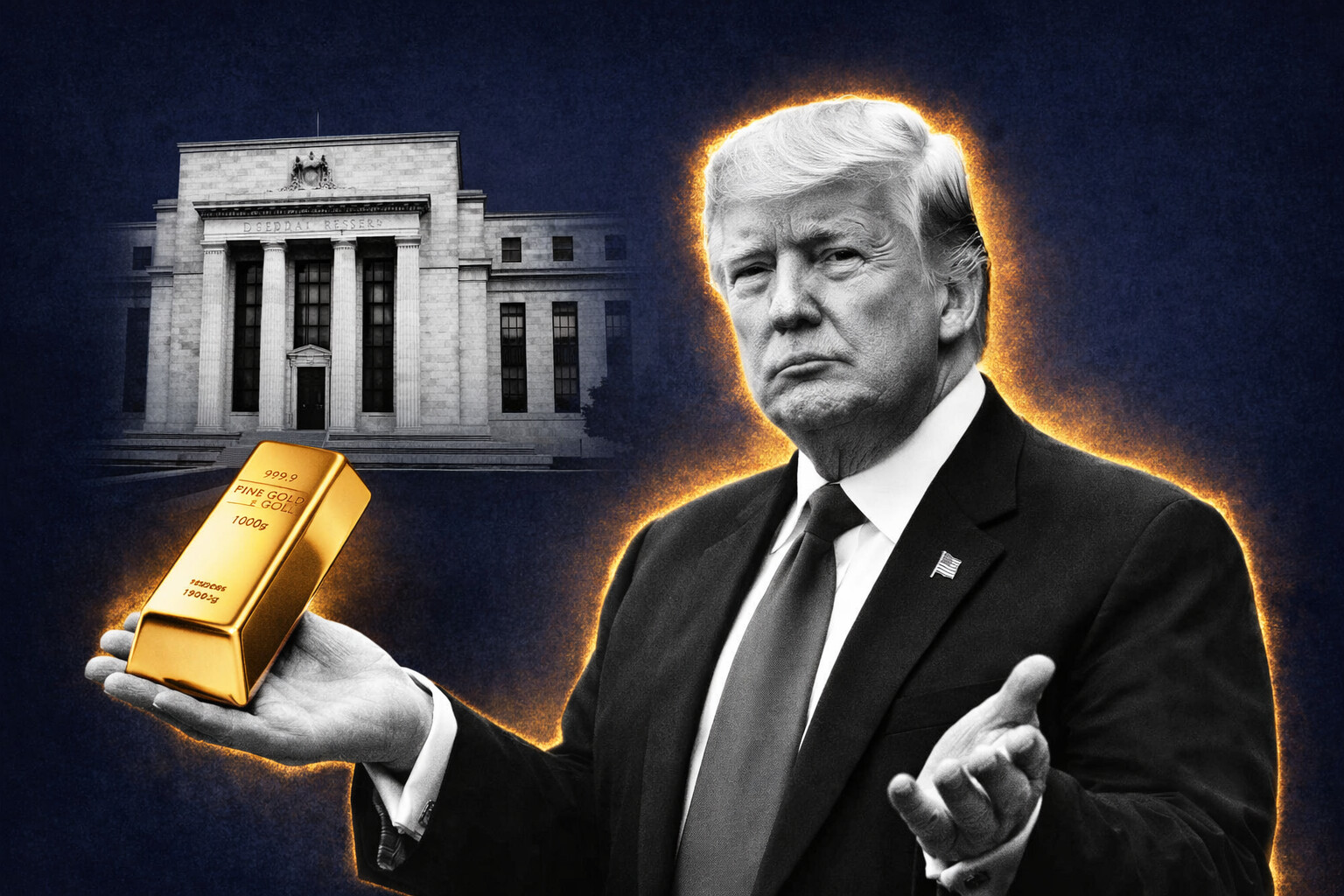
Gold Price Forecast: XAU/USD Snaps Back Above $5,100 After Fed Shock And Iran Tension
Gold bounces from a violent slide off record highs near $5,598 to lows around $4,400, reclaiming the $5,000 zone as Kevin Warsh’s Fed nomination, a U.S.–Iran drone incident, delayed jobs data and record-heavy Nasdaq and S&P 500 indexes reignite safe-haven demand | That's TradingNEWS
Gold Price (XAU/USD) Reclaims $5,000 As Volatility Turns Brutal
Gold’s Whipsaw From $5,598 To $4,403 And Back Above $5,000
Spot Gold (XAU/USD) has swung from euphoria to panic and back to cautious optimism in a matter of days. After starting 2026 near $4,313 per ounce, bullion surged to a record zone around $5,580–$5,598 last week, only to suffer its sharpest collapse in years. Prices dumped almost 9–10% in a single session, extended losses to roughly $4,403–$4,545, and then snapped back above the $5,000 handle.
In early European and US trade, spot gold has been fluctuating roughly between $5,050 and $5,083 per ounce, with US futures around $5,103.50, implying a rebound of more than 15% off the recent low near $4,403.24. The latest leg higher included a nearly 6% daily surge, the strongest one-day gain since November 2008, underlining how crowded positioning and thin liquidity now amplify every move.
Across January, gold still logged a massive 13.2% monthly rise, the best performance since September 1999, and is up roughly 17–18% year-to-date from the $4,313 opening level of 2026 despite the violent drawdown. The message: the bull run is intact on a 12-month view, but the path is now dominated by forced deleveraging and policy shocks rather than a smooth haven grind.
Geopolitics: U.S.–Iran Tension Rebuilds The Safe-Haven Premium In Gold (XAU/USD)
The first driver behind the rebound in Gold (XAU/USD) back toward $5,100 is geopolitics. Safe-haven flows re-accelerated after the U.S. military shot down an Iranian drone near a carrier group in the Arabian Sea. That single headline was enough to reverse some of the post-Warsh liquidation, sending spot prices up 2.5–2.9% on the day and lifting April futures by about 3.4%.
This sits on top of a broader geopolitical backdrop that has been bullish for bullion for months:
-
Ongoing tensions around US–China trade,
-
Frictions over the U.S. push to buy Greenland,
-
Russia’s war in Ukraine,
-
Iran’s role across regional flashpoints.
Those risks helped push gold to its $5,598 record last week and continue to anchor a structural risk premium. The recent crash did not come from an improvement in geopolitics; it came from macro and microstructure shocks. That distinction matters: if geopolitical stress remains elevated, dips toward the $4,800–$4,900 area tend to find buyers rather than trigger a full-scale regime change.
Kevin Warsh And The Dollar Shock: Why Gold Crashed Below $4,500
The catalyst that flipped the Gold (XAU/USD) narrative from melt-up to rout was political and monetary, not fundamental demand. Donald Trump’s nomination of Kevin Warsh as the next Fed chair reset rate expectations in one stroke.
Warsh is seen as a more orthodox, hawkish choice on inflation and the Fed balance sheet. Markets had been leaning toward aggressive and rapid cuts; Warsh implies slower easing and a willingness to defend the dollar. The result:
-
The US dollar spiked as traders priced out the weakest-USD scenarios.
-
Real yields pushed higher, eroding one of the core tailwinds for non-yielding gold.
-
The “easy Fed + weak dollar” story that powered the move above $5,500 was abruptly repriced.
On top of that, the Chicago Mercantile Exchange raised margin requirements on gold and silver futures. That forced over-leveraged long positions to liquidate into a fast-falling market, accelerating the slide from above $5,580 to the $4,545 region and briefly under $4,500.
The combination of a stronger dollar, hawkish Fed expectations, and margin calls explains why gold fell roughly 12–13% from the top in a matter of days despite no meaningful improvement in geopolitical risk or inflation dynamics.
Derivatives, Crowd Positioning And How Gold (XAU/USD) Overshot On The Way Up And Down
The earlier spike in Gold (XAU/USD) above $5,580 was not purely a function of macro fear. A huge build-up of call options and leveraged futures exposure created a feedback loop:
-
Traders bought upside call options in size.
-
Option dealers hedged by buying the underlying metal as spot moved higher.
-
That hedging flow squeezed prices even further, pulling in momentum-chasing longs.
Once Warsh was announced and margin requirements increased, the same structure worked in reverse. Dealers reduced hedges as calls lost value, long futures holders were forced to sell as collateral thresholds were raised, and liquidity thinned out. The result was an air pocket that took gold from just above $5,580 to near $4,545, and intraday toward $4,403.24, before two-way flows returned.
Analysts who have traded previous crises compare this to the 2008 pattern: gold briefly plunged more than 25% from around $1,000 to $700 before staging a multi-year rally as central banks cut rates and launched QE. The current episode shows similar mechanics: an overcrowded trade, a sudden policy shock, an exchange margin adjustment, and a brutal but technically driven liquidation rather than a collapse in long-term demand.
Central Banks, ETF Flows And Physical Demand Still Backstop Gold
Despite the shake-out, the underlying demand structure for Gold (XAU/USD) has not disintegrated. Several pillars remain in place:
Central banks: institutions such as China, Poland and South Korea have been steadily increasing gold reserves. For them, bullion is a strategic hedge against currency depreciation, sanctions risk and geopolitical shock. This buyer base is less sensitive to short-term volatility and more focused on multi-year allocation.
ETFs and funds: banks like Goldman Sachs still project upside toward $5,400 for year-end and see risk to the upside if central bank buying and ETF inflows remain solid. IndusInd Securities has even held a $6,000 year-end target despite the recent crash, signalling that major desks view the correction as violent but not thesis-breaking.
Retail and Asia: physical buyers, especially in Asia, continue to treat price dips as opportunities to convert weakening local currencies into portable wealth. After a 66% gain over 2025 and another 13.2% jump in January 2026, the pullback is sizeable but sits inside a powerful upward trend that many households see as protection against policy mistakes and inflation.
This is why, after the flush toward $4,400–$4,500, Gold (XAU/USD) quickly reclaimed the $5,000 handle. Structural demand is still there; what has changed is the margin for error on leverage and timing.
Tokenized Gold: On-Chain XAU Exposure Hits $6 Billion But Legal Risk Lurks
One newer element in the Gold (XAU/USD) story is the rise of tokenized gold on blockchains. Around 20 listed tokens now represent claims on vaulted bullion, with a combined market value near $6 billion as of early this week.
The latest surge in spot prices, and the subsequent crash, has filtered directly into these instruments. Flows indicate that investors looking for 24/7 access and crypto-style settlement are increasingly comfortable holding gold exposure in token form instead of traditional ETFs.
However, legal ownership of these structures is not always clear. Research heads in the physical bullion space highlight a key risk: the investor often holds a claim on a corporate issuer, not a direct, legally robust title to specific numbered bars. In the event of a dispute, bankruptcy or regulatory challenge, the path to recovery can be very different from holding allocated bars or a well-regulated ETF share.
For price action in XAU/USD, the expansion of tokenized gold broadens the investor base and may deepen liquidity, but it also adds another vector for forced liquidations if crypto markets experience stress similar to the recent BTC-USD drawdown.
Silver’s Parallel Crash Underscores How Overcrowded The Precious Metals Trade Became
The unwind in Gold (XAU/USD) did not happen in isolation. Silver staged an even sharper round-trip, underscoring how aggressively speculative money had piled into the broader precious-metals complex.
Silver ripped to a record around $121.64 per ounce, then collapsed by roughly one-third in short order and was down about 41% to near $72 by Monday before clawing back some losses.
Part of that move was justified by fundamentals – silver demand is rising in electronics, AI infrastructure and clean-energy technology – but positioning in China and on futures exchanges became so stretched that a modest shift in macro expectations and margin terms was enough to trigger a violent cascade.
For gold, this matters because cross-asset deleveraging is real: when silver longs are forced to close, they often liquidate gold to meet margin calls. The synchronized rout explains why Gold (XAU/USD) sold off harder than the macro narrative alone would imply and why the subsequent rebound in both metals has been sharp once the weakest hands were cleared.
Technical Picture For Gold (XAU/USD): Key Levels Around $4,885, $4,990, $5,100 And $5,330
From a technical standpoint, Gold (XAU/USD) is trying to rebuild a bullish structure after the crash, but the chart is now defined by very clear levels.
Price has reclaimed the 100-period simple moving average on the reference intraday timeframe, currently near $4,885. As long as XAU/USD holds above that zone, the immediate trend is considered constructive. The MACD histogram has flipped positive and is expanding, while RSI sits around 55, neutral with a slight upward lean rather than stretched.
Short-term resistance is clustered in the $5,100–$5,135 region. That band combines:
-
The former January 29 swing low near $5,100, now acting as resistance.
-
The 61.8% Fibonacci retracement of last week’s sell-off around $5,135.
If bulls can close Gold (XAU/USD) decisively above that zone, the next upside target is the 78.6% retracement area around $5,330. A break of $5,330 would open the door to a retest of the $5,580–$5,598 records, but that will likely require either renewed dollar weakness, a softer tone from Warsh and the Fed, or another step-up in geopolitical stress.
On the downside, immediate support is around the February 3 high at $4,990, followed by the $4,885 100-SMA. A confirmed daily close below $4,885 would invalidate the short-term bullish recovery and put the $4,545–$4,403 crash zone back in play.
Macro Calendar Shock: Jobs Data Delay, ADP And The Fed Path For Gold (XAU/USD)
The macro calendar has become unusually messy at precisely the wrong time for Gold (XAU/USD). The partial U.S. government shutdown means the January non-farm payrolls report has been postponed. The Bureau of Labor Statistics has said it will reschedule once funding is restored, leaving traders temporarily blind on the single most important monthly data point for Fed policy.
That vacuum shifts attention to ADP’s National Employment Report, due at 8:15 a.m. ET, as the primary near-term catalyst for both the US dollar and gold. A stronger-than-expected ADP print would reinforce the hawkish interpretation of the Warsh nomination, support the dollar and push real yields higher – a negative mix for XAU/USD. A softer-than-expected number would do the opposite, potentially easing some of the pressure on gold and re-validating the view that last week’s sell-off ran “too far, too fast.”
Beyond jobs, markets are recalibrating the entire rate-cut path. The rally to $5,598 was priced on aggressive easing; the current $5,050–$5,100 range reflects a more cautious path, with traders still expecting cuts, but fewer or later than initially assumed. Gold’s sensitivity to marginal changes in that path is now extreme given the leverage that remains in the system.
Read More
-
Yen Stalls at 160 Despite a 3% JGB and Tokyo Core CPI at 2.0% — Intervention Sits at 164, Friday's Payrolls Decide
02.09.2026 · TradingNEWS ArchiveEnergy
-
QQQ ETF ($739) Fades From an Early Tech Rally as a 77.9 ISM Prices Index Meets Micron's $61.5B Guide — $760 Record Test Ahead
01.10.2026 · TradingNEWS ArchiveStocks
-
XRPR and XRPI Follow XRP's $1.49 Test as Spot Funds Hold 1.16B XRP and a 1 Billion Token Escrow Release Lands — $1.70 in Play
01.10.2026 · TradingNEWS ArchiveCrypto
-
November NG Slips Below $3 as Decade-High Storage Meets Capped LNG Exports — $2.75 in Sight
01.10.2026 · TradingNEWS ArchiveCommodities
-
Dollar-Yen at 158 Presses Toward 160 as a 363 bp Carry Gap Meets Katayama-Bessent Intervention Risk — 159 in Sight
01.10.2026 · TradingNEWS ArchiveForex
Broader Risk Backdrop: Gold, Equities And The Safe-Haven Trade
Even after the crash, Gold (XAU/USD) sits near $5,000, while global equities – including the S&P 500 and Nasdaq 100 – are still trading near or above prior highs, heavily concentrated in mega-cap tech.
That divergence sends a clear signal. Investors have not abandoned risk assets, but they increasingly hedge tail risk with gold rather than dumping equities outright. Index funds have become more concentrated – with the “Magnificent 7” accounting for a disproportionate share of S&P 500 gains – and that concentration risk pushes allocators toward hard assets like gold as a portfolio offset.
As a result, gold now trades not only as a traditional inflation hedge and geopolitical hedge, but also as a concentration-risk hedge against over-owned U.S. equity benchmarks. This is one reason why, despite a 9–10% one-day crash and a slide to $4,403–$4,545, flows into gold-backed products and central bank purchases have not collapsed.
Scenario Analysis For Gold (XAU/USD): Bullish And Bearish Cases From Here
For Gold (XAU/USD) in the $5,000–$5,100 band, the next 3–6 months are likely to be decided by three interacting forces: Fed policy under Warsh, geopolitical risk, and positioning in derivatives.
Bullish scenario:
If the Fed ultimately signals a slower but still meaningful easing cycle, the dollar stabilizes or softens, and geopolitical tensions around Iran, Russia and China remain elevated, dips toward $4,800–$4,900 are likely to be bought aggressively. A clean break above $5,135 and then $5,330 would put the $5,580–$5,598 highs back on the radar and keep year-end targets of $5,400–$6,000 in play. Continued central bank accumulation and persistent demand for tokenized and ETF gold would reinforce that path.
Bearish scenario:
If Warsh leans harder into hawkish messaging, real yields grind higher, the dollar appreciates further, and geopolitical risk fades, Gold (XAU/USD) could lose the $4,885 support and revisit the $4,545–$4,403 area. A decisive close below that zone would open room toward the low-$4,000s, especially if another round of margin hikes or a major failure in a leveraged gold product forces further liquidations.
Right now, price, flows and positioning argue that the market has already absorbed a large part of the negative shock. The crash from $5,598 to around $4,400–$4,500 flushed out the most aggressive longs. The subsequent recovery above $5,000 shows there is still deep demand whenever XAU/USD trades with a “4-handle.”
Verdict On Gold (XAU/USD): Bullish Bias, High Volatility – Rated As A Cautious BUY
Based on the current setup – spot Gold (XAU/USD) holding roughly $5,050–$5,100, structural central bank and ETF demand intact, geopolitical risk elevated, and technical support anchored around $4,885–$4,990 – the balance of evidence still leans positive over the medium term.
The recent collapse looks less like the end of the cycle and more like a forced deleveraging event triggered by Warsh’s nomination, dollar strength and margin hikes, superimposed on an already overstretched market. The fact that gold started 2026 at $4,313, printed records near $5,598, then survived a 15–20% drawdown and is already back above $5,000 underscores how strong the underlying bid remains.
The call from major desks for year-end levels around $5,400–$6,000 is aggressive but not disconnected from fundamentals if the Fed ultimately eases, the dollar stops grinding higher, and geopolitical stress persists.
Given that backdrop, the stance on Gold (XAU/USD) is:
Cautious BUY – bullish bias with elevated drawdown risk.
Upside back toward the $5,330–$5,600 area is viable if resistance at $5,100–$5,135 breaks and macro data lean dovish. The risk side is clear: a sustained close below $4,885 would mark a regime shift and downgrade that stance toward neutral or even short-term SELL, but the current configuration does not justify that yet.