
Gold Price Forecast — XAU/USD Tests $4,500 While Rate-Hike Fears and a Surging Dollar Do the Damage
Gold opened June on the defensive, slipping under $4,520 even as U.S.-Iran strikes escalate | That's TadingNEWS
Key Points
- Gold slides toward $4,500 even as the Iran war rages, with a strong dollar and rising real rates crushing the bid.
- The war is bearish for gold now — it lifts oil, stokes inflation, and pushes Warsh's Fed toward hikes, not cuts.
- Lose $4,500 and $4,460 then $4,099 open up; a $4,580 reclaim and central-bank buying anchor the long-term floor.
There's a war in the Persian Gulf, missiles flying between the U.S. and Iran, oil ripping toward $90, and gold is going down. That's the entire forecast in one sentence, and it's the most important thing any gold trader needs to internalize right now. The textbook says geopolitical chaos is rocket fuel for bullion — capital floods into the safe haven, the price screams higher, everyone who owns the metal looks brilliant. That playbook is broken this cycle, and it's broken for a specific, mechanical reason: this particular war doesn't drive a flight to safety, it drives inflation, and inflation drives a hawkish Fed, a stronger dollar, and higher real yields, which are the three things gold hates most in the world. XAU/USD is changing hands near $4,515, pressing the low water mark of a descending channel and threatening the $4,500 floor, down better than 1% on the session after closing Friday around $4,580. The metal that's supposed to be having its moment is instead getting quietly bled out by the currency and rate channels, and until that dynamic flips, every war headline is a reason to fade rallies rather than chase them.
Where gold trades right now
The damage is real and the chart tells the story of a fall from grace. Gold is trading near $4,515, having printed an intraday low around $4,490 during a Monday morning distribution sweep, with Friday's close near $4,580 already in the rearview. Zoom out and the comedown is stark: XAU/USD hit an all-time high of $5,589.38 in January 2026 before correcting hard, posting its worst monthly drop since 2008 in March, and it now sits roughly 11% to 13% below its pre-conflict and record levels. The 52-week range stretches from $3,247.86 all the way up to $5,595.46, so the metal is sitting in the lower-middle of a violently wide band. May closed with a 0.8% monthly decline even though the conflict raged the entire month, which is the cleanest proof you'll find that the safe-haven mechanism has stopped working. The technical services have caught up to the price action and now rate the pair a Strong Sell, and the daily structure is a parade of lower highs and lower lows. This is a defensive tape, not a panic-bid tape.
The safe-haven trade is broken, and here's the mechanism
Understanding why gold is falling in a war requires following the chain link by link. The Middle East conflict pushes oil sharply higher, and oil above $90 a barrel feeds straight into headline inflation. Sticky, energy-driven inflation forces the bond market to price higher-for-longer interest rates, and in some windows this year it has priced outright rate hikes. Higher rate expectations lift U.S. Treasury yields and supercharge the dollar, because capital chases yield and chases the safety of the world's reserve currency. A stronger dollar makes dollar-priced bullion more expensive for every foreign buyer, and higher real yields raise the opportunity cost of holding an asset that pays no interest. So the same war headline that should send gold soaring instead sends the dollar and yields soaring, and gold gets crushed in the crossfire. The geopolitical premium is real, but it's been completely overwhelmed by the currency-and-rate premium working the other direction. That's the trap that's caught every gold bull who bought the war narrative at face value this year.
Warsh changed the Fed's posture
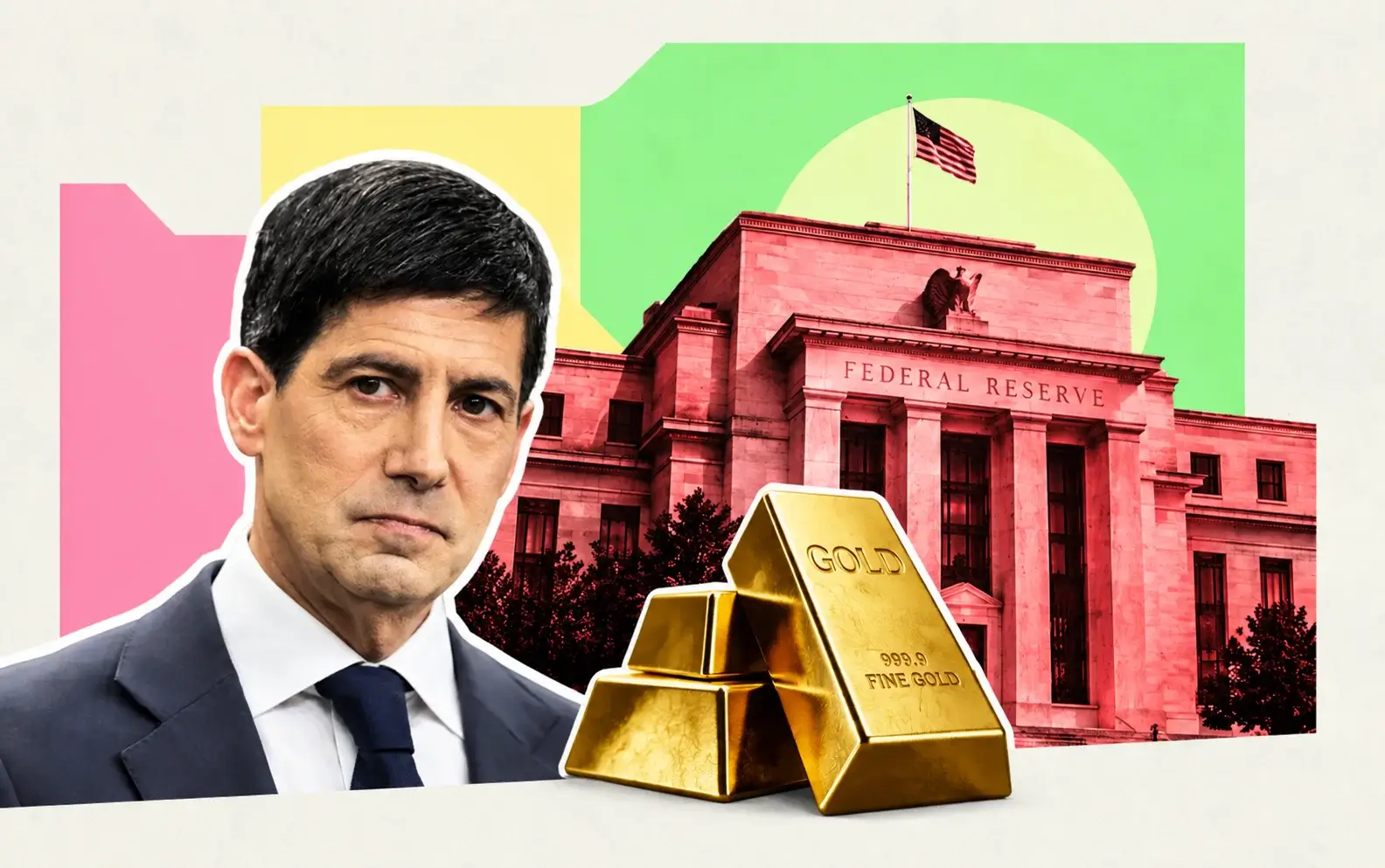
The macro regime shifted the moment Kevin Warsh was sworn in as Federal Reserve chairman, and gold has been paying for it ever since. Warsh took the chair amid growing expectations of tighter global monetary policy, and the market read his arrival as a hawkish pivot at exactly the wrong time for bullion. The bond market's working assumption flipped from "the next move is a cut" to "the next move could be an increase," with analysts flagging that traders had largely discarded the possibility of 2026 rate cuts as rising energy costs complicate the path to price stability. At various points this year the probability of a December hike pushed toward the high-30s percent while the odds of any cut collapsed toward low single digits, a dramatic reversal from pre-conflict expectations of at least two cuts. A Fed that's leaning toward holding or hiking is a Fed that keeps real yields elevated, and elevated real yields are the single most reliable headwind for gold. Friday's record stock close and a four-year-high factory reading only reinforce the case that the economy is hot enough for Warsh to stay tight.
The dollar and real yields are doing the damage
Strip the geopolitics away and the price of gold right now is a pure currency-and-yield trade. The dollar has firmed on the combination of safe-haven flows and higher-for-longer rate bets, and the 10-year Treasury yield is parked around 4.45%, near multi-week highs. Every tick higher in the greenback mechanically lowers the gold price for the rest of the world, and every tick higher in real yields makes a Treasury bill look more attractive than a bar of metal that just sits in a vault generating nothing. This is the dominant driver of the entire 2026 decline — not a collapse in fear, but a relentless grind higher in the cost of holding the asset. The painful irony for bulls is that the war is the thing strengthening the dollar, so the very crisis that's supposed to help gold is the source of its biggest headwind. As long as the dollar stays bid and yields stay firm, bounces in bullion get sold, and that's exactly the rhythm the four-hour chart has been printing.
Oil is the villain hiding inside the bull case
Energy is the wildcard that flips gold's logic on its head. In a normal cycle, surging oil and a regional war would be an unambiguous gold positive. In this cycle, crude pushing toward and beyond $90 is the mechanism that keeps inflation alive, keeps the Fed hawkish, and keeps the dollar strong — so oil strength has become a gold negative through the inflation-and-rates channel. The market is laser-focused on the Strait of Hormuz, the chokepoint that moves a fifth of global oil and gas, and any disruption there would spike crude further and deepen the inflation problem rather than trigger a clean safe-haven rotation into metal. This is the counterintuitive heart of the whole forecast: gold bulls who are rooting for the war to escalate are rooting for the exact conditions that have kept the metal pinned. Only a genuine de-escalation that pulls oil and inflation lower — and frees the Fed to ease — would let gold trade on its safe-haven and monetary properties again.
The charts: a descending channel and a Strong Sell
The technical picture is clean and it's bearish. Gold has been riding the low water mark of a strong parallel descending channel on the four-hour frame, the kind of orderly slide that keeps grinding until volume forces a break. On the higher timeframes the swing read is technically bullish but the internal structure is bearish, with price trading inside an established internal range and the intraday expectation pointing toward a reaction at either the 50% equilibrium or a demand zone before targeting a weak internal low priced down near $4,099. The daily momentum picture favors sellers, and the broad technical rating has flipped to Strong Sell. There's a faint bullish signal underneath — a change-of-character that hints at a possible pullback phase — but it's swimming against the dominant downtrend and needs confirmation it hasn't earned yet. For now the path of least resistance runs lower, and the channel won't break until either a macro catalyst or a clean reclaim of overhead resistance forces it.
The levels: $4,500, $4,460, $4,099
The map for the days ahead is straightforward. The immediate battleground is $4,518 down to the round $4,500 figure, the level that's been absorbing the selling and the line that defines whether this stays a controlled grind or turns into something faster. Just below sits a potential reversal zone running $4,501 to $4,454, which lines up with the recent lows near $4,460 that marked the metal's weakest levels since early January. Lose that cluster decisively and the structure thins out badly, opening the door toward that weak internal low near $4,099 that the higher-timeframe charts keep flagging as a magnet. On the upside, the first real wall is Friday's $4,580 close and the descending channel's upper boundary, and bulls need a clean reclaim of that zone to even begin weakening the bearish structure. Anything between $4,460 and $4,580 is just chop inside a downtrend. The break out of that band, in either direction, is the trade.
The bull case lives in central banks and supply
The long-term floor under gold has nothing to do with this week's price and everything to do with who's been buying the dips. Central banks remain the structural anchor — the People's Bank of China alone added 160,000 ounces in a single month earlier this year, part of a multi-year reserve-diversification trend that the World Gold Council expects to keep underpinning demand through 2026 and beyond. That official-sector buying doesn't chase momentum; it accumulates into weakness, which is precisely what creates a floor when speculative money flees. On the supply side, the math is unforgiving in gold's favor: declining ore grades, rising extraction costs, and supply-chain disruptions cap annual production growth at roughly 1% to 2%, so even modest increases in demand translate into meaningful price appreciation over time. The structural scarcity gives gold a long-term floor that distinguishes it from almost every other commodity. JP Morgan stays firmly bullish on this exact logic, citing the diversification trend and the outperformance of real assets over paper. The cycle is ugly; the secular case is intact.
The week ahead is wall-to-wall data
This is a data-bomb week and gold will trade off every print. The calendar runs hot from the open — manufacturing PMI and remarks from the Fed orbit early in the week, JOLTS job openings, ADP private payrolls, services PMI, and the Fed's Beige Book in the middle, jobless claims and productivity figures after that, and the heavyweight at the end: Friday's May nonfarm payrolls and the unemployment rate. Every one of these feeds the rate narrative, and the rate narrative is the price of gold right now. A string of strong labor and activity data hardens the higher-for-longer case, lifts the dollar and yields, and pushes bullion toward $4,460. A soft jobs number or any crack in the inflation story does the opposite, knocking the dollar back and handing gold the room to reclaim $4,580. Behind the data sits the Warsh-led Fed meeting, where any further hawkish tilt would cap the metal's upside no matter what the war headlines say.
Read More
-
Yen Stalls at 160 Despite a 3% JGB and Tokyo Core CPI at 2.0% — Intervention Sits at 164, Friday's Payrolls Decide
02.09.2026 · TradingNEWS ArchiveEnergy
-
T-Rex 2X Inverse MSTR ($4.39) Rips 10.44% as Strategy Pauses Bitcoin Buys for a 2nd Week — $4.63 Close Opens $5.27
15.09.2026 · TradingNEWS ArchiveStocks
-
XRPR ($10.59) and XRPI ($7.04) Open at Highs and Close at Lows After Senate Kills CLARITY Act
15.09.2026 · TradingNEWS ArchiveCrypto
-
NG ($2.908) Holds Above $2.80 Low as LNG Feedgas Hits 18.8 Bcf and TTF Trades 9.2x Henry Hub
15.09.2026 · TradingNEWS ArchiveCommodities
-
USD/JPY (155.09) Faces 275bp Policy Gap as BOJ Prepares 31-Year-High Rate — Close Below 154 Opens 153.40
15.09.2026 · TradingNEWS ArchiveForex
The miners and the ETFs
The pain isn't contained to spot. The bullion ETFs that track the metal — the big physically-backed funds — move tick for tick with XAU/USD, so the same dollar-and-yield headwind dragging on spot is dragging on those vehicles directly. The miners carry even more leverage to the gold price, and the major producers tend to amplify both the downside and the upside, so a 1% slide in spot can translate into a sharper move in the mining names and the miner-focused funds. That leverage cuts both ways: in a genuine gold reversal, the producers historically rip harder than the metal because their margins expand fastest when the price turns. For now, with spot pinned under $4,520 and the rate backdrop hostile, the equity complex around gold is wearing the same defensive posture as the metal itself, and traders are treating bounces in the miners with the same skepticism they're treating bounces in spot.
Forecast and verdict
The honest verdict is bearish in the near term and constructive in the long term, and the seam between the two is exactly where price sits today. The base case for the days ahead is continued pressure that respects the $4,460 to $4,580 range until the week's data forces a resolution. Hold $4,500 and reclaim $4,580, and gold weakens the descending channel and reopens a path back toward the $4,700 area where it traded earlier this spring. Lose $4,500 on volume, and $4,460 falls quickly, with the weak internal low near $4,099 becoming the next real magnet in the worst-case version of June. The deciding variable isn't the war — it's the dollar and the Fed, full stop. A hawkish Warsh and a firm greenback keep the metal capped no matter how loud the Middle East gets; a soft jobs print or a genuine ceasefire that cools oil and inflation is what finally lets gold trade like a safe haven again. Underneath all of it, central banks keep buying and supply stays scarce, which is why this looks like a brutal correction inside a secular bull rather than the end of one. The metal is down, the trend is down, and the floor is being built quietly beneath the selling.