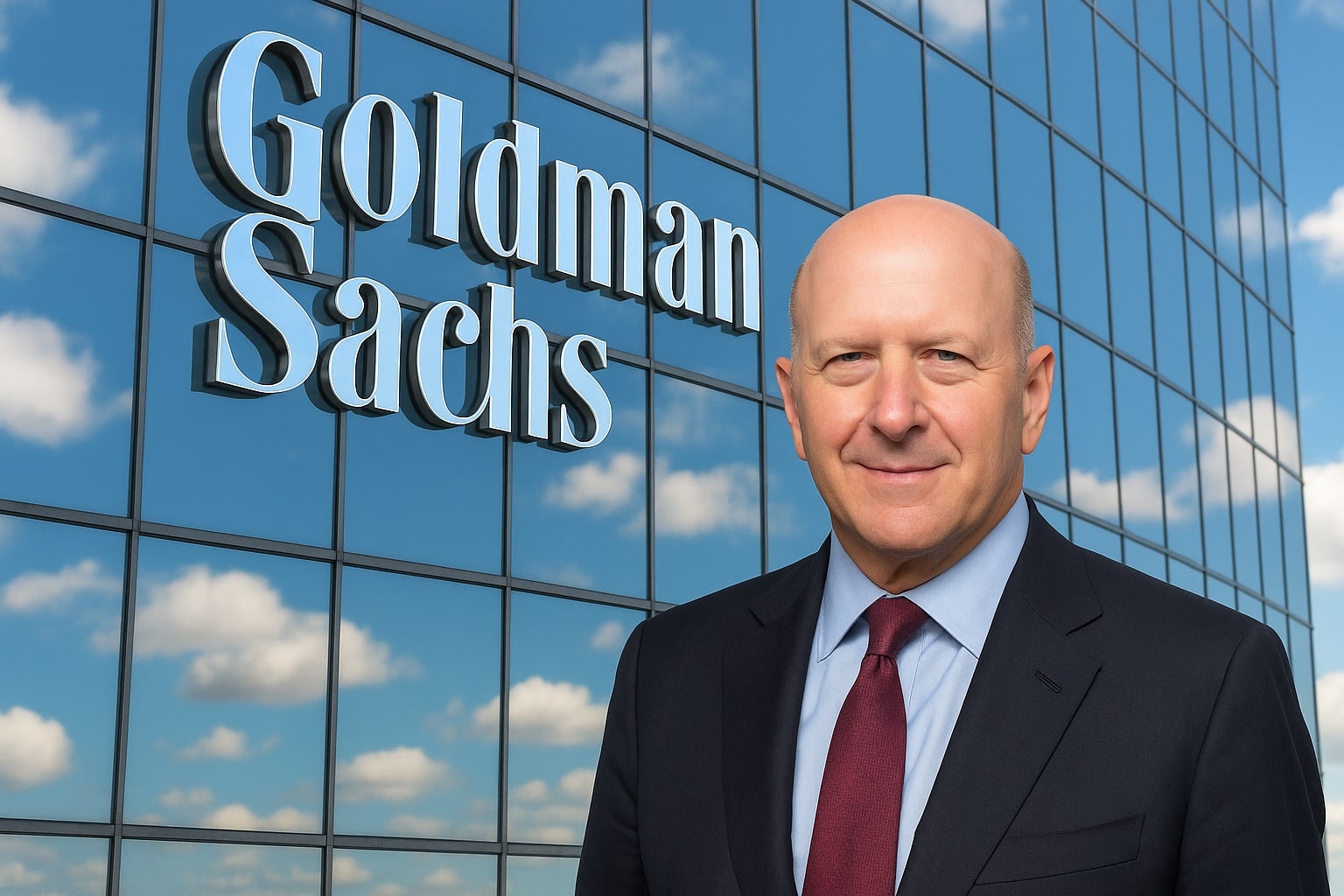
Goldman Sachs Stock Price Forecast - GS Stock Near $815, Targets 40% Upside
Goldman Sachs posted $14.85B in Q3 revenue and $4.10B in net income, boosting EPS to $12.25 and ROE to 14.2% | That's TradingNEWS
Goldman Sachs (NYSE:GS) Surges Past $815 as Investment Banking Revival and AI Initiative Drive Record Profitability
Earnings Momentum and Segment Expansion at NYSE:GS
Goldman Sachs Group Inc. (NYSE:GS) is trading at $815.14, marking a 0.98% intraday gain and continuing a powerful uptrend that has pushed shares within reach of their 52-week high at $841.28. With a market capitalization of $244.35 billion, the firm has become one of Wall Street’s most profitable and diversified institutions, supported by accelerating top-line expansion and a rapidly modernizing business model.
For the third quarter of 2025, Goldman Sachs posted $14.85 billion in revenue, up 20.67% year-over-year, while net income surged 37.06% to $4.10 billion, reflecting a net profit margin of 27.61% and an earnings-per-share (EPS) of $12.25, a sharp 35.81% increase compared to last year. The firm’s return on equity (ROE) has strengthened to 14.2%, and operating efficiency continues to improve as operating expenses rose only 12.08%, well below the revenue growth rate. These metrics signal a company firing on all cylinders across every major division.
Investment Banking and Global Markets Reignite Profit Growth
Goldman Sachs’ Global Banking & Markets division remains its powerhouse, driving roughly two-thirds of total revenue. Segment revenues grew 18% year-over-year, while investment banking fees spiked 42% to $2.657 billion, reaffirming the firm’s dominance in advisory, debt underwriting, and equity capital markets. Goldman has regained its footing as one of the top underwriters on Wall Street, benefiting from a resurgence in M&A and IPO activity.
Fixed Income, Currencies, and Commodities (FICC) trading delivered 17% growth, aided by volatility in bond markets and strong institutional flows, while Equities trading advanced 7%, reflecting stable liquidity conditions. Goldman’s CFO, Denis Coleman, confirmed that its investment banking backlog reached a three-year high, suggesting deal flow visibility well into 2026. Even with the temporary slowdown caused by the U.S. government shutdown affecting IPO timing, the underlying rebound in corporate financing remains robust.
Asset and Wealth Management Pushes Beyond $3.45 Trillion in AUS
Goldman Sachs’ Asset & Wealth Management (AWM) unit delivered $4.399 billion in revenue, up 17% year-over-year, driven by client inflows and a resilient market backdrop. Assets under supervision (AUS) climbed to $3.45 trillion, a 4.86% annual increase, with net inflows of $79 billion — a sign of continued investor confidence in the firm’s long-term stewardship.
Management and other recurring fees grew 12%, private banking and lending revenues rose 40%, and total deposits reached $490 billion, up from $466 billion a year earlier. This expansion demonstrates Goldman's balanced approach between investment management, lending, and advisory operations. The wealth segment continues to capture high-net-worth and institutional clients globally, benefiting from renewed risk appetite and broadening financial markets.
Platform Solutions and AI Integration Under “OneGS 3.0” Initiative
Goldman’s Platform Solutions business — which includes transaction banking and consumer financial technology — generated $670 million in quarterly revenue, an astonishing 71% year-over-year growth. Although partially inflated by the sale of the General Motors credit card portfolio, the segment is now streamlined and strategically aligned under the firm’s digital transformation framework, known as OneGS 3.0.
This initiative integrates artificial intelligence and automation into every operational layer to reduce costs and enhance productivity. Management projects that this multi-year program will cut total compensation and benefit expenses by up to 5%, equating to potential net income growth of 5.7%. Goldman’s move toward a leaner operational model mirrors its historical ability to adapt faster than peers like JPMorgan or Morgan Stanley during market transitions.
Liquidity, Capital Strength, and Shareholder Returns
Goldman’s liquidity remains exceptional. Cash and short-term investments total $1.01 trillion, and total assets rose 4.62% to $1.81 trillion, while liabilities increased 4.78% to $1.68 trillion. The price-to-book ratio (P/B) now stands at 2.32, significantly above the sector average, underlining investor confidence but also raising valuation questions.
Goldman’s aggressive capital-return policy continues to underpin shareholder value. The firm has returned $66.42 billion cumulatively through dividends and buybacks — equivalent to 26.8% of its current market capitalization — and maintains a dividend yield of 1.96%. Over the past five years, Goldman has distributed roughly 80% of its net income back to shareholders, one of the highest payout ratios among major banks. Free cash flow and financing activities contributed to a net change in cash of $16.61 billion, up 132% year-over-year, reinforcing balance sheet resilience.
Read More
-
Yen Stalls at 160 Despite a 3% JGB and Tokyo Core CPI at 2.0% — Intervention Sits at 164, Friday's Payrolls Decide
02.09.2026 · TradingNEWS ArchiveEnergy
-
QQQ ETF ($739) Fades From an Early Tech Rally as a 77.9 ISM Prices Index Meets Micron's $61.5B Guide — $760 Record Test Ahead
01.10.2026 · TradingNEWS ArchiveStocks
-
XRPR and XRPI Follow XRP's $1.49 Test as Spot Funds Hold 1.16B XRP and a 1 Billion Token Escrow Release Lands — $1.70 in Play
01.10.2026 · TradingNEWS ArchiveCrypto
-
November NG Slips Below $3 as Decade-High Storage Meets Capped LNG Exports — $2.75 in Sight
01.10.2026 · TradingNEWS ArchiveCommodities
-
Dollar-Yen at 158 Presses Toward 160 as a 363 bp Carry Gap Meets Katayama-Bessent Intervention Risk — 159 in Sight
01.10.2026 · TradingNEWS ArchiveForex
Valuation and Profitability Metrics Signal Strength Despite Premium
At $815 per share, Goldman Sachs trades at a P/E ratio of 16.55, modest relative to its historical average, but with its P/B at 2.3, it now sits roughly 90% above the financial sector median. Bulls argue this premium is justified given the firm’s 37% profit growth, 25.4% margin to common shareholders, and global leadership in high-fee segments.
However, the valuation debate is nuanced. On an intrinsic basis, using conservative earnings growth assumptions of 8.38% annually over five years and an 80% payout ratio, fair value estimates suggest a potential upside of nearly 40% to current prices. The market still discounts future margin expansion from OneGS 3.0 and the scaling of its AI-enhanced financial infrastructure, both of which can deliver sustainable EPS growth through 2026–2027.
Macro Sensitivity and Federal Reserve Impact on NYSE:GS
The main macro risk for Goldman Sachs remains monetary policy. Markets currently price an 86.4% probability of a 25-basis-point rate cut by the Federal Reserve. A prolonged easing cycle could compress Goldman’s net interest income and reduce returns on fixed-income holdings. Nonetheless, its diversified revenue model — particularly in investment banking and asset management — provides a cushion against rate-driven volatility.
Despite the decline in the effective federal funds rate since May 2024, the firm’s return on assets (ROA) remains healthy at 0.91%, and leverage remains stable. The next Fed meeting and subsequent yield-curve shifts will likely determine whether Goldman’s rally continues toward its $841.28 yearly high or stabilizes near the $790–$800 support range.
AI Transformation and Operational Resilience
Under CEO David Solomon, Goldman’s transformation strategy blends AI integration, capital-light lending, and disciplined cost control. The OneGS 3.0 initiative targets better risk management, enhanced scalability, and a more responsive client infrastructure. The company has already begun trimming redundant roles and expects a 5% workforce reduction, which could free up over $1.2 billion in annual operating costs.
Combined with elevated trading revenues and rising investment-banking backlog, these measures position Goldman Sachs as one of the few financial giants poised to leverage AI for tangible profit growth rather than narrative appeal.
Buyback Acceleration and Long-Term Shareholder Value Creation
Goldman Sachs’ capital discipline remains a defining factor in its premium valuation. The bank recently authorized additional share repurchases and continues to target double-digit ROE and ROTE, aligning with its long-term strategy to balance risk-adjusted growth and shareholder yield. Liquidity coverage ratios remain well above regulatory minimums, and the firm’s strong funding position allows continued capital flexibility even in a lower-rate environment.
Given that Goldman’s total equity stands at $124.75 billion, the bank’s internal capital generation supports further buybacks without over-leveraging. This structural strength explains why long-term investors continue to assign the stock a premium multiple relative to its peers.
Outlook and Verdict
With its share price consolidating near $815, Goldman Sachs stands at an inflection point: valuation-rich but still fundamentally undervalued when accounting for its 40% potential upside and expanding AI-driven margins. Its diversified global platform, surging deal flow, and record-level $3.45 trillion AUS position it as one of the most strategically agile banks on Wall Street.
While near-term headwinds from a potential Fed rate cut could pressure interest income, the firm’s momentum in investment banking, asset management, and technological reinvention outweighs short-term risks.
Verdict: BUY (Bullish Bias) — Based on the data, Goldman Sachs (NYSE:GS) remains a high-quality compounder with strong cash generation, disciplined cost management, and accelerating profit metrics. With potential upside toward $900–$950, the firm’s current valuation is justified by earnings trajectory and capital efficiency.
Live Chart: Goldman Sachs Real-Time Price