HPQ Jumps 11.49% to $31.15 on Earnings Beat; $34 Target in Sight
An 11.8% free cash flow yield and a 3.98% dividend back a $34 target if $30 holds | That's TradingNEWS
Key Points
- HP Inc. closes at $31.15, up 11.49%, after Q4 revenue of $16.0 billion beats the $15.3 billion consensus.
- Memory and storage now make up 40% of HP's PC bill of materials, pushing PC margins down to 3.0% from 5.8%.
- HP lifts its quarterly dividend to $0.31 and guides fiscal 2027 EPS at $3.15 to $3.45, with $2.9B–$3.1B in FCF.
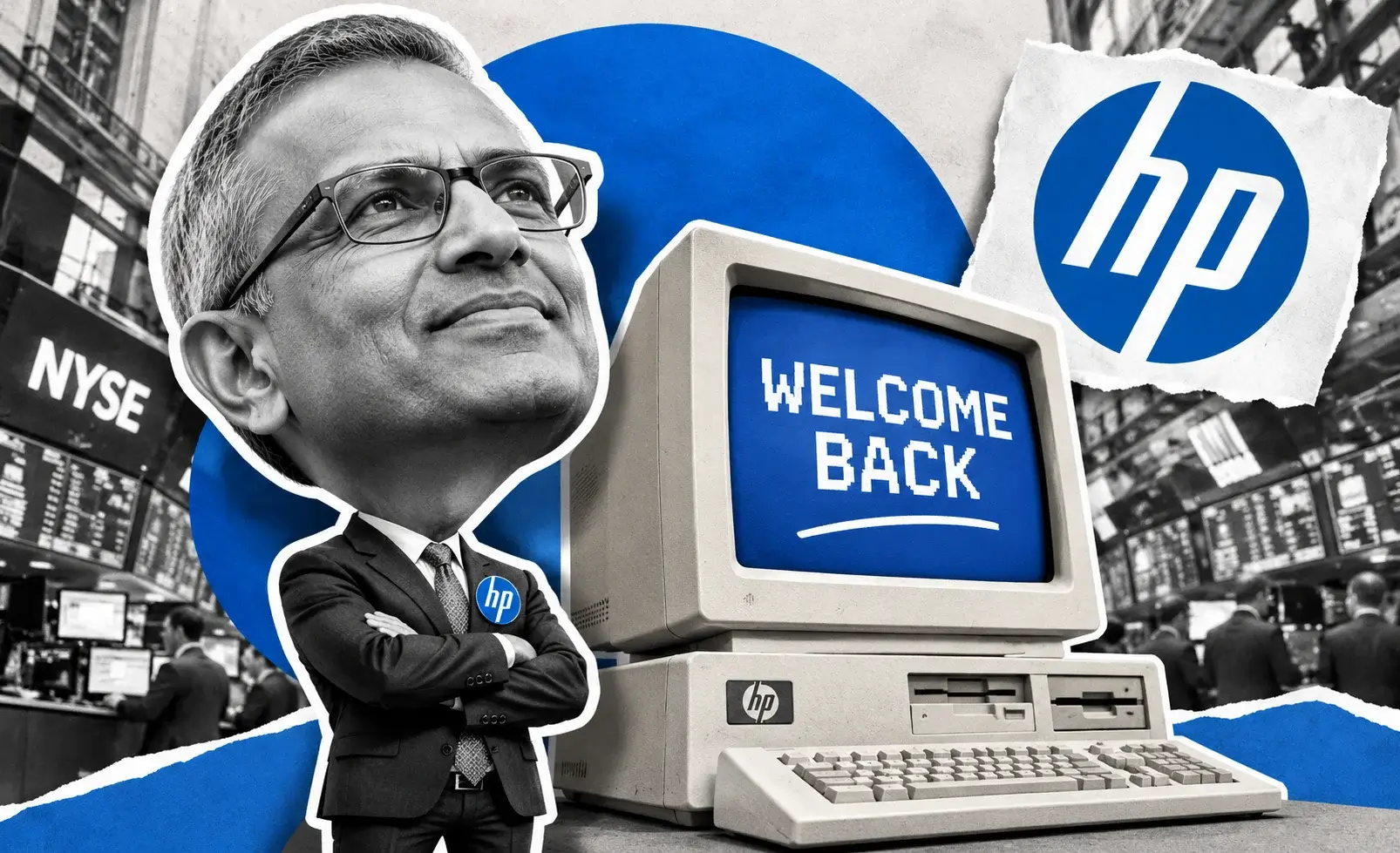
HP Inc. (NYSE: HPQ) closed Wednesday at $31.15, up $3.21 or 11.49% from Tuesday's $27.94 close, after the PC and printer maker delivered fiscal fourth-quarter results that beat revenue and earnings expectations. The stock traded as high as $32.05 in late morning, a 14.7% gain that made it the strongest performer in the S&P 500 at that point. U.S. cash equity markets are closed Thursday for Thanksgiving, so $31.15 is the price that carries into Friday's half session, which ends at 1:00 p.m. ET.
The move came against a hostile tape. The S&P 500 fell 3.2% intraday on Wednesday after a hot 3.3% core PCE print locked in a Federal Reserve hike for December 9, before recovering to close down 0.25%. Nvidia fell 3.9%. Hewlett Packard Enterprise had dropped 16.33% on Tuesday, its worst session since the 2015 split, after warning that memory supply will stay constrained until at least late 2028. HPQ moved the other way, and investors rotated toward cash-generative, dividend-paying hardware while selling high-multiple AI names.
The reversal was sharp. HP reported after Tuesday's close and the stock initially popped in after-hours trade, then faded. Before Wednesday's open it was indicated 1.8% lower, and one premarket print showed $27.48. Buyers took control from the opening bell, and the stock closed near the upper end of its range, $0.90 below the intraday high.
The numbers behind the move are mixed. Fourth-quarter revenue rose 9.3% to $16.0 billion against a $15.3 billion consensus. Non-GAAP diluted EPS came in at $0.83 against a $0.75 consensus and above HP's own $0.69 to $0.79 outlook. The quarterly dividend rises to $0.31 from $0.30. But $0.15 of the $0.83 came from tariff refunds, Personal Systems operating margin fell to 3.0% from 5.8%, and fiscal 2027 guidance of $3.15 to $3.45 in non-GAAP EPS points to lower underlying earnings once a change in accounting treatment is stripped out.
At $31.15, HP has a market value of $28.2 billion on 904 million basic shares. The stock sits 77.4% above its 52-week low of $17.56 and 14.0% below its 52-week high of $36.23. The annualized $1.24 dividend yields 3.98%, and the stock trades at 9.44 times the midpoint of fiscal 2027 guidance.
The upside target in this forecast is $34.00, a 9.15% gain from $31.15. The setup requires the stock to hold above $30.00 and clear $32.05, the Wednesday high. A close below $27.94, the pre-earnings level, would erase the entire earnings gap and invalidate the bullish case.
Fourth Quarter: $16.0 Billion in Revenue and an $0.83 EPS Beat Built on $0.15 of Tariff Refunds
HP's fourth quarter, which ended October 31, 2026, produced the company's strongest top line in years. According to the fourth-quarter release filed with the SEC, net revenue rose 9.3% to $16.0 billion, or 8.6% in constant currency. That beat the $15.3 billion consensus by $700 million.
Earnings were less clean. GAAP diluted EPS came in at $0.84, flat with the prior year and at the top of HP's $0.74 to $0.84 outlook. Non-GAAP diluted EPS was $0.83, down 10.8% from $0.93 a year earlier but above the $0.69 to $0.79 outlook and the $0.75 consensus. The beat was $0.08 per share.
The tariff refunds explain the beat. HP booked $0.15 per share of favorable impact from refunds of previously paid tariffs in the fourth quarter, against the $0.08 it had assumed in its outlook. Strip out the full $0.15 and non-GAAP EPS falls to $0.68, which is $0.07 below the $0.75 consensus. Strip out only the $0.07 of refunds that exceeded HP's own assumption and EPS lands at $0.76, a penny above consensus. Either way, the operating business did not drive the earnings beat.
Margins tell the same story. Non-GAAP operating margin fell to 6.2% from 8.0% a year earlier. GAAP operating margin fell to 5.3% from 6.6%. Revenue rose $1.4 billion year over year, but operating profit shrank because memory and storage costs rose faster than HP could raise prices.
Cash flow weakened in the quarter. Operating cash flow fell 42.6% to $0.93 billion and free cash flow fell 45.9% to $0.80 billion. Inventory rose 11 days sequentially to 84 days, or $12.3 billion, as consumer demand softened late in the quarter. That inventory build absorbed cash and raises the risk of promotional pricing in the first half of fiscal 2027.
Shareholder returns stayed steady. HP returned $0.8 billion in the quarter, including $0.5 billion in buybacks that retired 15.9 million shares and $270 million in dividends.
The market looked past the quality issues. Revenue of $16.0 billion was the cleanest beat, and it confirmed that the commercial PC refresh cycle is real. The stock's 11.49% gain priced that confirmation and the dividend increase, while discounting the refund-driven earnings and the margin squeeze. For the forecast, the next leg higher depends on evidence that margins have bottomed, which the fourth quarter did not provide.
Memory Costs Climb From 15% to 40% of the PC Bill of Materials in 12 Months
The defining number from HP's earnings call is the share of memory in the cost of building a PC. Memory and storage accounted for 15% to 18% of a PC's bill of materials at the start of fiscal 2026. By the fourth quarter, that share had climbed to 40%. The shift took 12 months, and it is the main reason HP's Personal Systems margin collapsed to 3.0%.
The cause is AI infrastructure demand. Hyperscalers and AI server builders are absorbing DRAM and NAND supply, leaving less for PC makers and pushing contract prices higher. HP's own release cites rising memory and storage costs and supplier memory shortages as ongoing risks. Hewlett Packard Enterprise, HP's sister company since the 2015 split, said on Tuesday that memory will remain constrained until at least late 2028.
HP's guidance assumes the pressure persists but slows. CFO Karen Parkhill said memory and storage costs will continue to increase in fiscal 2027 but at a lesser rate. That is a meaningful distinction for the stock. A slower rate of cost increase gives HP's price increases and design changes time to catch up, which would let Personal Systems margins stabilize from 3.0% and recover in the second half of fiscal 2027.
HP's response comes in a specific order. The first steps are cheaper designs, new component configurations and competitive sourcing. Price increases come only after those. The Omnibook 5 at $699 is one example of HP engineering around memory costs to protect entry price points. Fewer gigabytes per machine protects margins, but it conflicts with the AI PC strategy, which depends on more memory to run on-device models.
HP will also stop disclosing the bill-of-materials figure. Investors will have to track memory cost pressure through Personal Systems operating margin instead, which makes the first-quarter fiscal 2027 segment margin the key data point when HP reports in early March.
The peer contrast is sharp. HPE fell 16.33% on Tuesday as it struggled to pass memory costs through to server customers. Dell Technologies raised its outlook the same day, showing that pricing power varies across hardware makers. HP sits between the two. Commercial customers are paying higher prices for premium AI PCs, while consumers are pulling back.
For the forecast, memory is the central risk and the central opportunity. If contract DRAM prices peak in the first half of 2027, HP's margin recovery could be faster than guidance assumes, and the stock would rerate toward $34.00 and beyond. If memory costs accelerate again, Personal Systems margins could stay near 3.0% through fiscal 2027 and cap the stock below $32.05.
Personal Systems: Revenue Up 14% to $11.8 Billion as Units Fall 29%
The Personal Systems segment produced a striking split between revenue and volume in the fourth quarter. Revenue rose 14% to $11.8 billion, while total unit shipments fell 29%. That combination means revenue per unit rose 60.6% year over year, driven by price increases to offset memory costs and by a shift toward premium commercial machines.
The commercial business carried the quarter. Commercial Personal Systems revenue rose 23% to $8.6 billion as enterprises bought premium AI-capable machines and continued a multi-year replacement cycle. Consumer Personal Systems revenue fell 7% to $3.15 billion as households pulled back in the face of higher prices. Consumer units fell 31% and commercial units fell 28%.
The AI PC transition is moving fast. Interim CEO Bruce Broussard said AI PCs are approaching 60% of HP's shipments. That share supports pricing, because AI-capable machines carry higher average selling prices, and it ties HP's revenue to enterprise software and device refresh cycles rather than to consumer discretionary spending.
The margin is the problem. Personal Systems operating margin fell to 3.0% from 5.8% a year earlier and from 4.6% in the third quarter. It sits below HP's long-term target range of 5% to 7%. At 3.0% on $11.8 billion of revenue, the segment produced $354 million of operating profit in the quarter. Consumer weakness, higher memory and storage costs and an unfavorable product mix all contributed.
The outlook for units is weak. HP projects calendar 2027 PC market unit sales will fall by a high-single-digit to low-double-digit percentage, with market revenue flat. That means the industry will sell fewer machines at higher prices. HP also plans more promotions to clear inventory after consumer demand softened late in the fourth quarter, which adds pressure to consumer margins in the first half of fiscal 2027.
The commercial engine is the bull case. Enterprise buyers have absorbed price increases so far, and commercial revenue growth of 23% shows demand has held up. If commercial pricing holds and memory cost growth slows as HP expects, Personal Systems margin can move back toward 4% in the second half of fiscal 2027.
For the forecast, Personal Systems drives the stock's direction. Revenue growth of 14% is strong enough to support the rally to $31.15. A margin recovery from 3.0% is what would carry the stock to $34.00. A consumer slump that spreads into commercial demand would put $27.94 back in play.
Printing Delivers 70% of Segment Profit on a 19.7% Margin
The Printing business is shrinking, but it is the reason HP still generates strong cash flow. Printing revenue fell 1% to $4.3 billion in the fourth quarter, with an operating margin of 19.7%. That margin produced $847 million of operating profit, against $354 million from Personal Systems. Printing generated 70.5% of HP's combined segment operating profit on 26.7% of combined segment revenue.
The composition is stable. Supplies revenue, the high-margin ink and toner business, fell 2% to $2.7 billion, or 3% in constant currency. Commercial printing hardware rose 2% to $1.23 billion. Consumer printing hardware fell 1% to $0.31 billion. Total printing hardware units fell 2%. The supplies decline continues a multi-year trend as offices print less and consumers shift to cheaper third-party cartridges.
The pace of decline is manageable. A 2% supplies decline keeps the revenue base stable, and the 19.7% margin sits within the range HP has defended through cost cuts and pricing. Print subscriptions, which tie consumers to HP's own ink through recurring plans, posted double-digit revenue growth in fiscal 2025 and support supplies revenue.
Printing matters to the stock because it funds the dividend and buybacks. HP returned $2.3 billion to shareholders in fiscal 2026, and Printing's stable profit stream is what makes that commitment credible while Personal Systems margins swing with memory costs. Without Printing, HP's earnings would fall by more than two-thirds at current Personal Systems margins.
HP is also pushing software and services into the print business. Product updates in commercial printing software accompanied the earnings release, and HP has emphasized AI-powered print features across its lineup. These moves aim to slow the supplies decline by adding value to managed print contracts.
The risk is a faster decline. If supplies revenue falls 5% or more in fiscal 2027 instead of 2%, the $2.7 billion quarterly supplies base would lose more than $80 million of revenue each quarter, the highest-margin dollars HP earns, and reduce the cushion that protects HP's cash returns. The fourth quarter showed no sign of that acceleration.
For the forecast, Printing is the floor under HPQ. A business producing $847 million of quarterly operating profit at a 19.7% margin supports a valuation near 9 times forward earnings even if Personal Systems margins stay depressed. That floor helps explain why the stock rallied 11.49% on a revenue beat while chip and hardware peers sold off. A stable Printing segment keeps the $30.00 support level intact.
Fiscal 2026 Full Year: $60.5 Billion in Revenue, $3.33 Billion in Free Cash Flow
HP's full fiscal 2026 results show a company growing revenue while protecting cash generation. Net revenue rose 9.5% to $60.5 billion, or 7.8% in constant currency, from $55.3 billion in fiscal 2025. That was the strongest annual growth in years, driven by the commercial PC refresh and higher prices.
Earnings came in above guidance. GAAP diluted EPS was $2.62, down 1.1% from $2.65 in fiscal 2025 and at the top of HP's $2.52 to $2.62 outlook. Non-GAAP diluted EPS was $3.33, up 6.7% from $3.12 and above the $3.19 to $3.29 outlook. Both figures include $0.26 per share of tariff refunds, against the $0.19 HP had assumed. Excluding the full refund impact, non-GAAP EPS was $3.07, down 1.6% from fiscal 2025.
Cash generation was the highlight. Operating cash flow rose 7.5% to $3.98 billion. Free cash flow rose 13.5% to $3.33 billion. At the current $28.2 billion market value, that is an 11.8% free cash flow yield, one of the highest among large-cap U.S. technology companies.
HP returned $2.3 billion to shareholders, 70% of free cash flow. That included $1.2 billion in buybacks that retired 46.7 million shares and $1.1 billion in dividends. Diluted weighted-average shares fell to 919 million in the fourth quarter from 926 million for the full year.
Margins compressed through the year. Fiscal 2026 non-GAAP operating margin fell to 6.7% from 7.4%. GAAP operating margin fell to 5.1% from 5.7%. The compression accelerated in the second half as memory costs climbed, with the fourth-quarter non-GAAP margin of 6.2% the lowest of the year.
Restructuring continued. HP recorded $611 million of restructuring and other charges in fiscal 2026, up from $405 million in fiscal 2025. The charges relate to the Fiscal 2026 Plan announced in November 2025, which targets $1 billion in gross run-rate cost savings by the end of fiscal 2028 and involves cutting 4,000 to 6,000 jobs. Total plan charges are estimated at $650 million.
The balance sheet is stable. Cash, cash equivalents and restricted cash stood at $4.4 billion on October 31, 2026. Total debt was $9.3 billion, including $1.3 billion short-term and $8.0 billion long-term, leaving net debt of $4.9 billion and an enterprise value of $33.1 billion.
For the forecast, the full-year numbers support the valuation floor. A company producing $3.33 billion of free cash flow and returning 70% of it does not trade at 9.44 times forward earnings without a reason, and that reason is the margin outlook.
Fiscal 2027 Guidance: $3.15 to $3.45 in EPS and a $0.38 Accounting Change
HP's fiscal 2027 outlook is where the bear case lives. The company guided non-GAAP diluted EPS of $3.15 to $3.45, excluding $0.75 per share of adjustments. The midpoint of $3.30 looks flat with fiscal 2026's $3.33. It is not.
Starting in the first quarter of fiscal 2027, HP's non-GAAP results will exclude stock-based compensation. HP said that change would have added $0.38 per share to fiscal 2026 non-GAAP EPS. On a like-for-like basis, fiscal 2026 non-GAAP EPS would have been $3.71. Against that, the $3.30 midpoint represents an 11.1% decline. Excluding the $0.26 of tariff refunds from fiscal 2026 as well, the comparable base is $3.45, and the $3.30 midpoint is still a 4.3% decline.
The guidance assumes a 17% non-GAAP tax rate under the new methodology. The low end of $3.15 matches consensus, which explains why the initial after-hours reaction faded. The market saw a forecast that is only acceptable on headline terms and weaker on an underlying basis.
The first quarter is weaker still. HP guided first-quarter fiscal 2027 non-GAAP EPS of $0.66 to $0.76, excluding $0.24 of adjustments. The $0.71 midpoint compares with $0.81 in the first quarter of fiscal 2026 on the old methodology. CFO Karen Parkhill described the outlook as a prudent view of continued cost and demand pressures and said profitability should improve through the year.
Free cash flow guidance is lower. HP expects $2.9 billion to $3.1 billion in fiscal 2027 free cash flow, down from $3.33 billion. The $3.0 billion midpoint is a 9.9% decline and still gives a 10.6% free cash flow yield at the current market value. At a 70% return ratio, that supports $2.1 billion of dividends and buybacks.
The guidance leaves room for upside. HP's assumptions include memory costs rising at a slower rate, PC market units falling by a high-single-digit to low-double-digit percentage and flat market revenue. If memory prices peak earlier or commercial demand holds better than forecast, the $3.45 high end is reachable. HP has beaten its own outlook in each quarter of fiscal 2026.
For the forecast, guidance sets the valuation range. At $3.30, the stock trades at 9.44 times. At the $34.00 upside target, the multiple is 10.3 times the midpoint and 9.86 times the high end. A 10 times multiple on $3.40 of EPS gives a $34.00 share price, which anchors the target.
Dividend Raised to $0.31: A 3.98% Yield and $2.3 Billion Returned in Fiscal 2026
The dividend increase was a small number with a large signal. HP raised its quarterly dividend to $0.31 per share from $0.30, a 3.3% increase. The dividend is payable on January 6, 2027, to shareholders of record on December 9, 2026. The annualized payout of $1.24 yields 3.98% at $31.15.
The increase follows last year's raise to $0.30 and shows management confidence in cash generation despite the margin squeeze. HP paid $1.1 billion in dividends in fiscal 2026, 33% of free cash flow. At fiscal 2027 free cash flow guidance of $2.9 billion to $3.1 billion, the dividend consumes 36% to 39% of cash generation, leaving room for buybacks.
Buybacks have been steady. HP repurchased $1.2 billion of stock in fiscal 2026, retiring 46.7 million shares at an average price of $25.70. The fourth-quarter repurchase of $0.5 billion retired 15.9 million shares at an average of $31.45. That average sits above the current price, which shows HP bought aggressively at higher levels.
Total shareholder returns of $2.3 billion in fiscal 2026 equal 8.2% of the current $28.2 billion market value. If HP maintains a 70% return ratio on fiscal 2027 free cash flow of $3.0 billion, it would return $2.1 billion, a 7.4% shareholder yield. Including dividends, buybacks and the reduction in share count, that is one of the highest capital return profiles in large-cap technology.
The yield helped drive Wednesday's rally. Investors sold high-multiple growth names and moved toward dividend payers and consumer staples as the hot inflation print locked in the December Fed hike. HP, with a 3.98% yield and a 9.44 times forward multiple, fit that rotation. The stock rose 11.49% while the S&P 500 fell 0.25%.
The rate backdrop cuts both ways. A 10-year Treasury yield of 4.85% means the dividend yield trails risk-free returns by 87 basis points. That limits HP's appeal as a pure income stock. A Fed that hikes on December 9 and signals more in 2027 would pressure dividend payers broadly. A Fed that signals a pause would support them.
For the forecast, the capital return program is the stock's anchor. A 3.98% yield, $2.1 billion of expected annual returns and a dividend record date of December 9 give investors a reason to hold through the first half of fiscal 2027, when earnings guidance is weakest. That support helps keep the stock above $30.00 while the margin story plays out.
Leadership: Emma Walmsley Takes Over as CEO on January 4, 2027
HP enters fiscal 2027 with a leadership change at the top. The board unanimously appointed Emma Walmsley as Chief Executive Officer effective January 4, 2027, in an announcement on November 4, 2026. Walmsley served as CEO of GSK from April 2017 through December 2025 and has been a member of Microsoft's board of directors for seven years.
The appointment ends a 10-month interim period. Bruce Broussard, a member of HP's board since 2021 and former CEO of Humana, became Interim CEO on February 3, 2026, after Enrique Lores stepped down to become CEO of PayPal. Broussard will become Chair of the Board on January 4, 2027, succeeding Chip Bergh.
Walmsley's background is unusual for a hardware company. She led GSK through the spinoff of its consumer health business as Haleon in 2022 and a restructuring of the pharmaceutical pipeline. Her Microsoft board seat gives her exposure to the software and AI ecosystem that drives PC demand. In her statement, she said she will focus on harnessing the AI era and putting HP's innovation to work to unlock new sources of growth.
The market will read the appointment as a signal on strategy. A CEO with experience separating businesses could prompt questions over whether HP's Printing and Personal Systems segments belong together. Printing generates 70.5% of segment operating profit on a 19.7% margin, while Personal Systems runs at 3.0%. A strategic review could unlock value, though HP has given no indication that a separation is planned.
The transition also brings execution risk. Walmsley takes over in the middle of a memory cost cycle that has compressed Personal Systems margins by 2.8 percentage points in a year, with first-quarter guidance at its weakest point. She will report her first quarterly results in early March, when HP posts first-quarter fiscal 2027 numbers, and investors will look for new targets or a strategy update.
Broussard's tenure produced solid execution. Under his interim leadership, HP beat its outlook in each quarter of fiscal 2026, raised full-year guidance twice and delivered 13.5% free cash flow growth. The stock rose from the low $20s to $31.15 over the period.
For the forecast, the leadership change is a near-term catalyst. A new CEO often resets expectations, either by lowering targets to create an achievable baseline or by announcing strategic moves that rerate the stock. A Walmsley investor update in the first quarter of 2027 that outlines margin recovery or portfolio changes would support a move toward $34.00 and the $36.23 52-week high.
Valuation: 9.44 Times Forward Earnings, an 11.8% Free Cash Flow Yield and a $26.82 Average Target
HPQ is cheap on every standard measure, and the question for the forecast is whether that discount is justified. At $31.15, the stock trades at 9.44 times the $3.30 midpoint of fiscal 2027 non-GAAP EPS guidance, 9.03 times the high end of $3.45 and 9.89 times the low end of $3.15. On trailing fiscal 2026 non-GAAP EPS of $3.33, the multiple is 9.35 times.
Cash flow measures look even cheaper. Fiscal 2026 free cash flow of $3.33 billion gives an 11.8% yield on the $28.2 billion market value. The fiscal 2027 midpoint of $3.0 billion gives a 10.6% yield. Enterprise value of $33.1 billion, including $4.9 billion of net debt, equals 9.9 times fiscal 2026 free cash flow and 0.55 times fiscal 2026 revenue of $60.5 billion.
The discount reflects the earnings trajectory. On a like-for-like basis, fiscal 2027 guidance implies an 11.1% decline from fiscal 2026's $3.71 adjusted base, or 4.3% excluding tariff refunds. The market prices HP as a company with shrinking underlying earnings, and a 9.44 times multiple is consistent with that view.
Street price targets sit below the stock. The average price target across covering firms stands at $26.82, with a high of $33.40 and a low of $19.00. The consensus rating is Hold. At $31.15, the stock trades 16.1% above the average target, which means the 11.49% rally ran ahead of published forecasts. Several firms raised targets after the report, but most remain below the current price.
That gap between price and targets creates two paths. Targets could move higher to catch up with the stock, which would support further gains and validate the move toward $34.00. Or the stock could drift back toward the targets as the excitement fades, which would test the $30.00 support and potentially $27.94.
Peer comparisons offer context. Dell Technologies raised its outlook this week on a $132.3 billion backlog and trades at a premium multiple tied to AI servers. HP has no comparable AI server exposure and trades at a discount. HPE fell 16.33% on Tuesday after its margin warning and sits near $40.
For the forecast, valuation supports the upside target. A 10 times multiple on the $3.40 high end of fiscal 2027 guidance gives $34.00. A multiple of 10.5 times on the $3.30 midpoint gives $34.65. The $36.23 52-week high would require 10.98 times the midpoint, which is reachable only if margins recover faster than guidance assumes.
Read More
-
Yen Stalls at 160 Despite a 3% JGB and Tokyo Core CPI at 2.0% — Intervention Sits at 164, Friday's Payrolls Decide
02.09.2026 · TradingNEWS ArchiveEnergy
-
Avis Stock Price Forecast — CAR Breaks Out to $141.82 on Thin Float; $160 Target in Range
26.11.2026 · TradingNEWS ArchiveStocks
-
XRP Climbs to $0.9520 as ETF Buyers Return and Shorts Pile Up; $1.08 Target in Sight
26.11.2026 · TradingNEWS ArchiveCrypto
-
Oil Price Forecast — Brent Hits $95.58, WTI $84.70 on Gulf Strikes; $100 Brent, $89 WTI in Play
26.11.2026 · TradingNEWS ArchiveCommodities
-
Stock Market Today: S&P 500 SPX Erases 3.2% Plunge, Nasdaq IXIC and Dow DJI Recover; 7,420 Next
26.11.2026 · TradingNEWS ArchiveMarkets
-
GBP/USD Price Forecast — Sterling Defends 1.3109 as BoE Hike Bets Build; 1.3300 Target in Sight
26.11.2026 · TradingNEWS ArchiveForex
Technical Map: $30.00 Support, $32.05 Resistance and the $34.00 Upside Target
The earnings gap reset the chart. HPQ jumped from $27.94 to $31.15 on Wednesday, opening a $3.21 gap that now defines the near-term structure. The stock pushed back above its 50-day moving average on the move, and the 14-day RSI sits at 58.9, positive without being overbought. The one-week return stands at 8.69%, while the one-month return is still negative at 7.24% after a selloff in early November.
The first support is $30.00, a round number and the level where the stock held after the initial surge on Wednesday morning. A close below $30.00 would signal that sellers are reclaiming the gap and open a move toward $29.16, the November 16 trading level.
The second support is $28.46, the November 6 close after a 3.33% drop. Below that sits $27.94, the pre-earnings close and the bottom of the gap. A daily close below $27.94 would erase the earnings move entirely and invalidate the bullish setup. That level is $3.21, or 10.3%, below the current price.
On the upside, the first resistance is $32.05, Wednesday's intraday high. A close above $32.05 would confirm that buyers are willing to pay more than the peak of the earnings reaction and open the next level.
The second resistance is $32.64, the September 4 close, which marked a peak in early autumn before the stock fell to $30.20 on October 9 and to $27.83 by October 23. A break above $32.64 would clear the autumn range.
The upside target is $34.00, a 9.15% gain from $31.15. That level represents 10 times the $3.40 high end of fiscal 2027 guidance and sits $0.60 above the highest published price target of $33.40. Above $34.00, the 52-week high of $36.23 is 16.3% above the current price.
Volume and momentum favor the bulls in the short term. Wednesday's move came on elevated trading volume against a 3-month average of 14.3 million shares a day. The stock outperformed its technology equipment sector, which fell 1.11% on the day. Friday's half session will carry thin liquidity, so price action may not be meaningful until full trading resumes on Monday, November 30.
The risk-reward from $31.15 is balanced. Upside to $34.00 is $2.85. Downside to $27.94 is $3.21. A close above $32.05 tilts the odds toward the target. A close below $30.00 tilts them toward a gap fill.
The Calendar: Fed December 9, Dividend Record December 9, Walmsley January 4
The next three months carry a sequence of catalysts for HPQ. The week ends with Friday's half session, which closes at 1:00 p.m. ET, and the November monthly close falls on Monday, November 30. Thin holiday trading can amplify moves in either direction, so a test of $30.00 or $32.05 on Friday would carry less weight than the same move next week.
The macro calendar comes first. The November jobs report lands on December 4. The Federal Reserve decides on December 9, with a 25 basis point hike to 4.00% to 4.25% priced at 97% to 98%. A hawkish dot plot that signals more hikes in 2027 would pressure dividend-paying stocks and rate-sensitive hardware names. A signal of a pause would support HP's yield appeal.
December 9 is also the dividend record date. Shareholders of record on that day receive the $0.31 quarterly payment on January 6, 2027. Under standard settlement rules, the stock goes ex-dividend on the same day, and the share price typically adjusts lower by the dividend amount.
HP will present at an industry technology conference on December 10, its first public appearance after the earnings report. Management commentary on memory pricing trends, commercial PC demand and inventory clearing will shape expectations for the first quarter.
The leadership transition follows. Emma Walmsley takes over as CEO on January 4, 2027, and Bruce Broussard becomes Chair. Investors will watch for any early communication from Walmsley on strategy or priorities.
HP's first-quarter fiscal 2027 results arrive in early March 2027. That report covers November through January and is guided at $0.66 to $0.76 in non-GAAP EPS under the new methodology. It will show the first Personal Systems margin since HP stopped disclosing the memory share of the bill of materials, and it will be Walmsley's first earnings call.
The sequence creates two windows. Between now and December 9, HPQ trades on the post-earnings drift and on Fed expectations. Between January 4 and early March, it trades on the new CEO and on memory pricing. The cleanest path to $34.00 is a dovish Fed signal on December 9, stable memory pricing into the new year and an early strategy update from Walmsley.
The risk window is the first quarter. Guidance for $0.66 to $0.76 is the weakest quarterly outlook of the cycle, and any shortfall would land under a new CEO with an incentive to reset expectations lower.
HPQ Stock Price Forecast: $34.00 Upside Target, $27.94 Invalidation
The forecast for HPQ over the next three months rests on whether the market keeps looking past margin pressure to the cash flow and the commercial refresh cycle. The base case is a move toward $34.00 before HP reports first-quarter fiscal 2027 results in early March. That case is built on four points: fourth-quarter revenue of $16.0 billion, a $700 million beat that confirms commercial PC demand; free cash flow of $3.33 billion, an 11.8% yield on the $28.2 billion market value; a dividend raised to $0.31 for a 3.98% yield, with $2.3 billion returned in fiscal 2026; and a valuation of 9.44 times forward earnings that leaves room for a rerating if margins stabilize.
The sequence to watch is specific. HPQ needs to hold $30.00 through the holiday and the December 9 Fed decision. A close above $32.05 would confirm the breakout. A break above $32.64, the September 4 close, would clear the autumn range and open the $34.00 upside target, a 9.15% gain from $31.15. Stable memory pricing and a strategy update from Emma Walmsley after January 4 would accelerate the move. A Personal Systems margin above 3.0% in the first quarter would extend it toward the $36.23 52-week high.
The bear case is a margin squeeze that deepens. Memory costs reached 40% of the PC bill of materials in fiscal 2026, Personal Systems margin fell to 3.0%, and inventory rose to 84 days. On a like-for-like basis, fiscal 2027 EPS guidance implies a decline of 4.3% to 11.1%. The fourth-quarter beat relied on $0.15 of tariff refunds, without which EPS would have come in at $0.68 against a $0.75 consensus. The stock trades 16.1% above the $26.82 average price target. A first-quarter miss, a hawkish Fed or a renewed memory price spike would push HPQ through $30.00 toward $28.46. A daily close below $27.94 would erase the earnings gap.
The balance of risks tilts toward the upside in the near term. HPQ rallied 11.49% on a day the S&P 500 fell 3.2% intraday, which shows strong demand for cash-generative hardware with a dividend. Printing generates 70.5% of segment profit and provides a floor. The structural picture remains mixed: units fell 29% and underlying earnings are declining.
The verdict is tactically bullish for the next three months and neutral on the longer trend. HPQ at $31.15 has room to rally toward the $34.00 upside target as long as $30.00 holds, with an 11.8% free cash flow yield, a 3.98% dividend yield and a new CEO providing support. A daily close above $32.05 is the trigger. A daily close below $27.94 invalidates the setup and returns the stock to its pre-earnings range.