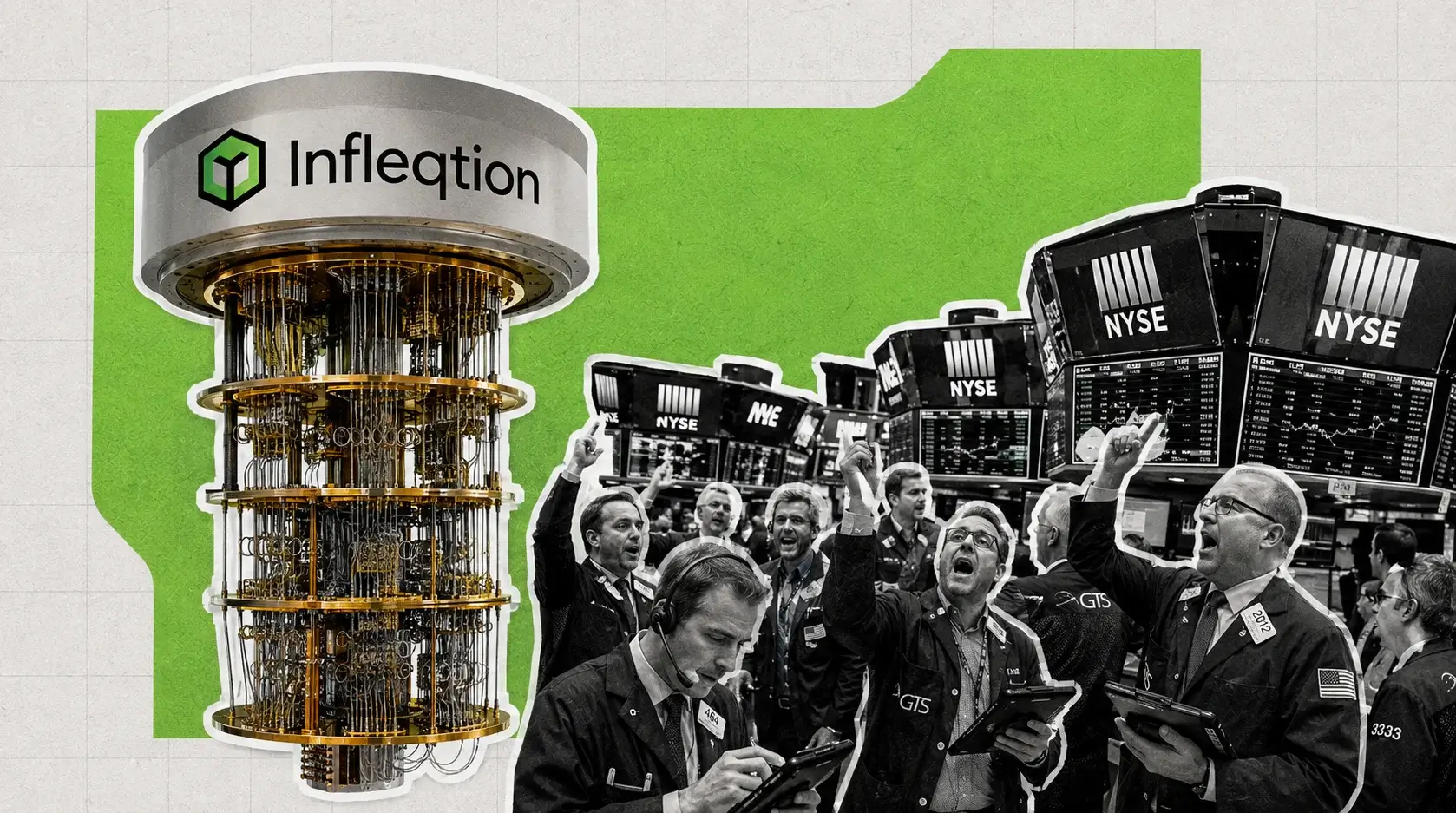
INFQ Fails $14.50 Again as the Only Quantum Name With Real Government Revenue Trades Below Its $15 Debut
The company holds $582M in cash with zero debt and raised guidance twice | That's TradingNEWS
Key Points
- INFQ closed at $13.42, down 6.3%, on volume 81% below its 9.67 million average.
- Q2 revenue was revised to $13.54 million from $12.63 million, lifting growth to 157%.
- The balance sheet holds $582 million in cash and zero debt against $36 million annual burn.
Infleqtion closed out August at $13.42, down 6.3% on Friday after trading as low as $13.30. The prior close was $14.32. Volume was the notable part: 1,883,679 shares changed hands, an 81% decline from the 9,667,250 average.
That combination — a 6.3% drop on one-fifth of normal volume — is a stock being marked down by absence of buyers rather than active selling. On a session where the Nasdaq Composite fell 0.52%, the VanEck Semiconductor ETF dropped more than 3%, and the entire long-duration complex repriced on Warsh's Jackson Hole remarks, that is exactly what you would expect.
The week that preceded it was the opposite. On August 25, quantum stocks rose broadly and Infleqtion led. On August 26 it jumped 5.98% to close at $13.83. On August 27 it climbed 6% to $14.32 after NASA awarded a $20 million follow-on contract. Three sessions up, one session down, all of it inside a $12.86 to $14.32 band.
The listing history frames everything. Infleqtion went public on February 17, 2026 via merger with Churchill Capital Corp X, becoming the first neutral-atom quantum company to list in the United States. Shares rose roughly 15% on day one. The debut price was $15.59, and the stock has not traded above it since.
Six months and no new high. Shares are down about 14% over twelve months, and at one point in late July the year-to-date decline read 48.5%.
The recent trough was $12.55 on August 20, followed by a 10% single-session bounce to $13.82. On August 24 the name fell 10.20% to $12.86 while IonQ dropped 8.11%, D-Wave 6.34%, Quantum Computing Inc 5.67% and Rigetti 5.05% against a QQQ down 0.67%.
The thesis for this forecast: Infleqtion is the only pure-play quantum company selling hardware that governments already pay for at scale — $13.54 million of second-quarter revenue growing 157% while peers post single-digit millions — and it trades at roughly half the market capitalization of those peers. It also restated two years of revenue in an amended filing three weeks ago.
The Chart: $10.87 Base, $14.50 Ceiling, $15.59 Unfilled
The technical structure is a recovering base with a well-defined ceiling that has now been tested twice.
Key resistance sits near $14.50. The stock reached $14.32 on August 27 and failed. Above $14.50, the next reference is the $15.59 debut price — a level that has capped the stock since day one of trading and would represent the first genuine breakout of its listed life.
Immediate support is $13.30, Friday's low. Below that, $12.86 marks the August 24 close and $12.55 the August 20 trough. The structural floor is around $11.50, which sits close to the 50-day exponential moving average at $11.81.
The moving average configuration has been improving. The 20-day simple moving average sat at $10.87 and the 50-day at $11.92 as of mid-August, with the stock trading 16.1% above the 20-day and 5.9% above the 50-day. Critically, the 20-day remained below the 50-day, meaning the broader downtrend had not fully reversed. Since then the stock has run from $12.55 to $14.32 and back to $13.42, which will have pulled the 20-day toward and possibly through the 50-day — the classic reversal signal to watch this week.
Momentum improved through the same stretch. The MACD moved above its signal line with a positive histogram, indicating selling pressure easing rather than buying pressure building.
The volume profile is the caution flag. Average daily volume of 9,667,250 shares against Friday's 1.88 million means liquidity thins dramatically on down days, which is characteristic of a recently listed SPAC where the float is still finding its holders.
CNN's screening notes the stock trading near the bottom of its 52-week range while sitting above its 200-day simple moving average — a description of a name that has been range-bound rather than trending since listing.
Trading read: $13.30 and $14.50 define the box. Neither has broken on volume.
Q2 Revenue Revised Up to $13.54 Million and Growth to 157%
The second-quarter numbers are the strongest in the pure-play quantum group by a wide margin, and they got better after the fact.
Infleqtion originally reported second-quarter 2026 revenue of $12.63 million, up 116% year over year, when it published results on August 12. It then revised the figure to $13.54 million in an amended SEC filing, lifting reported growth from 116% to 157%. That revision beat the $10.64 million consensus by 27%.
The earnings line went the other way. The updated second-quarter loss came in at $0.11 per share against a consensus estimate of $0.05 to $0.07 — a miss of four to six cents.
Put that in sector context. Quantum Computing Inc reported second-quarter revenue of $5.6 million. Rigetti, D-Wave and IonQ all operate in the same single-digit-millions territory on a quarterly basis. Infleqtion produced $13.54 million — roughly 2.4 times the nearest pure-play comparison — and grew it 157%.
The 2025 base explains why. Full-year 2025 revenue was $32.46 million, up 12.58% from $28.84 million, with a loss from operations of $35.3 million and a non-GAAP operating loss of $28.1 million excluding $3.1 million of stock-based compensation and $4.1 million of acquisition and integration costs. Full-year losses came to $31.80 million, 40.86% narrower than 2024.
So the company entered 2026 with a real, if modest, revenue base and a narrowing loss — which is not the profile of the other four names in the basket.
CEO Matthew Kinsella framed the quarter directly: Q2 was a record quarter, the company remains on track for 30 logical qubits this year, and the pace of quantum commercialization is accelerating.
The near-term concerns are equally clear from the sell-side write-ups: modest absolute revenue, continued operating losses and cash burn around $36 million annually, and program-driven lumpy revenue dependent on government contracts.
That last item is the entire risk profile in one phrase.
The Amended Filing Restated 2024 and 2025 Revenue
The revision that lifted second-quarter growth from 116% to 157% deserves more scrutiny than it received.
Infleqtion attributed the change to an accounting adjustment involving two government contracts. The adjustment shifted the timing of revenue recognition between reporting periods. The company stated that the noncash adjustment does not affect the underlying business, operating cash flow, or balance-sheet cash.
It also resulted in corresponding reductions to revenue previously recognised in fiscal 2024 and fiscal 2025.
That is the sentence that matters. Revenue was not created — it was moved forward from prior years into the current quarter. The 157% growth rate is arithmetically inflated by both a higher numerator and a lowered denominator.
For a company that listed six months ago via SPAC, restating two prior fiscal years within its second reported quarter is a governance datapoint regardless of how benign the mechanics are. Revenue recognition timing on government contracts is a legitimately complex area, and a shift between periods is not an accusation of anything. But investors underwriting the growth rate should underwrite the adjusted rate, not the headline.
The market's reaction was telling. The amendment landed on August 12 and most coverage missed it entirely. When the revision was picked up a week later, it fed a sector-wide rally — the growth number improved on paper without any change to the business.
The stock fell 5.67% to $12.65 in premarket the following Tuesday as the wider details circulated.
The full-year guidance moved with it, rising to approximately $45.1 million from $43 million. That increase is roughly the same $0.9 million to $2 million as the quarterly revision, which suggests the annual number was adjusted mechanically for the same timing shift rather than on new demand.
Analysts now expect a loss of $0.24 per share for the current fiscal year.
Treat $45.1 million as the operative revenue figure and treat 157% as a number that requires a footnote.
$582 Million in Cash and Zero Debt
The balance sheet is the strongest asset here and it is genuinely differentiated within the group.
Infleqtion holds $582 million in cash with zero debt. That position came from the February SPAC merger with Churchill Capital Corp X, which delivered more than $550 million in gross proceeds — including almost all of Churchill's trust cash and over $125 million from a PIPE backed by existing and new institutional investors.
Against annual cash burn of roughly $36 million, that is more than fifteen years of runway at the current rate. Even accounting for the capital intensity of scaling quantum hardware manufacturing, the company is under no financing pressure and will not need to dilute shareholders on a compressed timeline.
Compare that to the alternative. NuScale Power, the other pre-commercial name in this week's coverage, launched a $750 million at-the-market equity programme on August 11 after tripling its share count in twelve months. Infleqtion has no comparable overhang.
Simply Wall St's screen describes the balance sheet as flawless with minimal risk, and it is the single item on which the company scores unambiguously well.
Market capitalisation sits near $2.0 billion. With $582 million of net cash, roughly 29% of the equity value is cash. Enterprise value is therefore approximately $1.4 billion against $45.1 million of guided 2026 revenue — a 31 times EV/sales multiple, which is expensive but not absurd for a company growing revenue at triple digits with government backing.
The employee base is small at around 200, which keeps the fixed cost structure light relative to the cash pile.
The one debit against the balance sheet: cash that is not deployed generates no return beyond interest, and interest at 4% on $582 million produces roughly $23 million annually — which happens to cover about two-thirds of the operating burn. The company can afford to be patient. Whether patience produces a commercial quantum computer is a different question.
Guidance Raised Twice: $40M to $43M to $45.1M
The guidance trajectory across 2026 is the cleanest evidence of operational momentum.
Infleqtion announced initial 2026 revenue guidance of $40 million in April, describing it as reflecting growing customer demand for quantum sensing and computing solutions. At second-quarter earnings on August 12 it raised the outlook to approximately $43 million from at least $40 million. The amended filing then lifted it again to about $45.1 million.
From $40 million to $45.1 million is a 12.75% increase in four months, and against 2025 revenue of $32.46 million it implies 39% annual growth.
The stated primary growth driver is the Quantum Gravity Gradiometer programme — the NASA work, not the quantum computer.
That composition is the most important fact about this company and the one most consistently misunderstood. Infleqtion's revenue comes overwhelmingly from quantum sensing sold to government customers, not from quantum computing sold to enterprises. Its commercial portfolio includes quantum computers alongside quantum radio frequency systems, quantum clocks, and inertial navigation solutions — and the sensing products are the ones generating cash today.
Its systems are already in use by the U.S. Department of War, NASA, and the U.K. government. It serves organisations across national security, critical national infrastructure, scientific discovery, advanced computing, space, defence, energy, finance and telecommunications.
That customer list is a defence-electronics profile wearing a quantum-computing valuation.
The federal funding record backs it up. A $6.2 million ARPA-E ENCODE award, followed by an additional $3.9 million through the ARPA-E QC3 programme in March 2026 for chemistry and materials science applications. More than $20 million contracted on the NASA Quantum Gravity Gradiometer Pathfinder mission as of February.
Guidance raised twice on government programme execution is a genuinely good sign. It is also a reminder that the revenue is lumpy and appropriations-dependent.
NASA's $20 Million and the Government Sensing Model
The August 27 award is the clearest illustration of what this company actually is.
NASA awarded Infleqtion a $20 million follow-on contract to continue development of the Quantum Gravity Gradiometer Pathfinder, a mission led by NASA's Jet Propulsion Laboratory. The work funds a space-based quantum gravity sensor intended to support the world's first quantum gravity mission and ultimately fly in space.
The stock rose 6% to $14.32 on the news, with IonQ climbing 4% on sympathy buying despite having no involvement.
That reaction pattern is instructive on its own. Infleqtion's government-sensing model sets it apart from commercial quantum computing peers like D-Wave and Rigetti, and yet the entire basket trades as one instrument.
The commercial logic of the sensing business is more grounded than the computing business. Quantum gravity gradiometers, optical clocks, RF receivers and inertial navigation systems solve problems that exist today for customers who buy today: submarine navigation without GPS, resilient timing when satellites are jammed, subsurface mapping from orbit. None of that requires fault-tolerant quantum computing to arrive.
Eaton selected Infleqtion to support new research evaluating how quantum computing can improve the resilience of the U.S. electrical grid, as part of an Eaton award. The company also holds multiple collaborations with NVIDIA and a partnership with the Japan Science and Technology Agency for developing quantum computers, with Japan's first atom-based quantum computer now operational and expected to start with about 50 qubits.
Infleqtion was formerly known as ColdQuanta and changed its name in January 2026. It was founded in 2007 — nineteen years of building sensing hardware before the quantum computing narrative arrived.
That history is the bull case in one line. This is not a company that pivoted into quantum for the listing.
The $100 Million Commerce LOI and the Genesis Mission
Two government financing threads sit alongside the contract revenue, and both are larger than anything the company earns today.
Infleqtion secured a $100 million proposed funding letter of intent from the U.S. Department of Commerce, disclosed alongside second-quarter results. An LOI is not a signed contract and carries execution risk, but $100 million against a $2.0 billion market cap and $45.1 million of guided revenue is material if it converts.
Separately, the company has won Department of Energy Genesis Mission projects, adding another federal programme to a portfolio that already spans ARPA-E, NASA, the Department of War and the U.K. government.
The policy backdrop turned sharply favourable in May, when quantum stocks soared on reports that the U.S. government planned a $2 billion award programme alongside equity stakes in domestic quantum companies. Infleqtion's CEO subsequently appeared discussing expectations for a White House quantum summit.
That is the structural argument for owning this name over its peers. If Washington deploys capital into domestic quantum capability the way it deployed capital into domestic semiconductor capability, the company with nineteen years of federal contract history, active programmes across four agencies, and hardware already deployed with the Department of War is the first stop.
The structural argument against it is identical in shape. Revenue that depends on appropriations is revenue that depends on budget priorities, and Congressional funding is not a contract — it is an annual political decision. The same risk language that appears in every federal contractor's filings applies here: delayed, reduced or terminated funding has a material adverse impact.
For a company with $582 million of cash and $36 million of burn, that risk is survivable. For a $2.0 billion valuation resting on government-scale demand materialising, it is the whole thesis.
The Commerce LOI is the item to watch. Conversion to a definitive agreement would be the single largest commercial validation the company has received.
30 Logical Qubits and a Utility-Scale Machine This Year
The computing side has a specific, dated, falsifiable milestone, which is rare in this sector.
Infleqtion says it remains on track to deliver a utility-scale quantum computer later this year and advanced toward a 30 logical qubit milestone during the second quarter. Kinsella reiterated the 30-logical-qubit target for 2026 explicitly.
Logical qubits are the meaningful unit. A logical qubit is an error-corrected abstraction built from many physical qubits, and 30 of them would place Infleqtion among the leading systems globally. The neutral-atom architecture the company uses — trapping individual atoms with lasers rather than fabricating superconducting circuits — has theoretical advantages in scalability and does not require dilution refrigeration.
The company pairs the hardware with its Superstaq software stack, which sits between quantum applications and the underlying machine.
The competitive landscape is crowded and well capitalised. IBM has been publishing updates on three quantum advantage experiments. Quantinuum is building for scale and has partnered with Oracle on the quantum-AI intersection. D-Wave expanded its AT&T relationship and completed a major acquisition. Rigetti and IonQ both signed deals that sparked sector rallies. PsiQuantum received a $125 million award. IonQ closed its purchase of Vector Atomic, moving directly into quantum sensing for navigation and timing — the exact market Infleqtion dominates.
That last item is the competitive risk most worth tracking. IonQ has a considerably larger market capitalisation and has now bought its way into Infleqtion's core business.
Infleqtion appointed Dr. Joseph Buck as senior vice president of quantum computing systems in July, which reads as a build-out of the computing organisation ahead of the delivery milestone.
Delivering 30 logical qubits and a utility-scale machine before December is the binary that determines whether this stock revisits $15.59 or returns to $11.50. There is no scheduled catalyst between now and then that matters more.
Valuation: 1 of 6 Checks, 3.3x Book, Half the Peer Cap
The valuation debate on this name is unusually polarised, and both sides have real numbers.
Infleqtion passes only 1 of 6 standard valuation checks, which points to a stock that leans expensive rather than obviously cheap on broad measures. Price-to-book sits at 3.3 times against a technology sector average around 2.3 times and a peer group average near 1.6 times — a material premium on a balance-sheet yardstick, even after the share price reset.
The counterargument comes from the growth and comparison side. Citron Research has called Infleqtion the most obvious mispricing in quantum, arguing it trades at half the market capitalisation of peers despite NVIDIA wins.
That comparison holds up on the numbers. At roughly $2.0 billion, Infleqtion's market cap sits well below IonQ's, and Infleqtion generates 2.4 times the quarterly revenue of the nearest pure-play comparison. Enterprise value at approximately $1.4 billion after netting $582 million of cash puts it at roughly 31 times guided 2026 revenue — expensive in absolute terms, cheaper than several peers on the same basis.
The analyst consensus sits firmly in the bull camp. Five analysts carry an average rating of Strong Buy with a twelve-month price target of $21.00, implying roughly 56% upside from Friday's $13.42. Citi raised its target to $22 from $20 while maintaining Buy. Wedbush assumed coverage with an Outperform rating and a $20 target. BTIG maintains a Buy.
The quantitative services disagree entirely. Wall Street Zen raised the stock from strong sell to sell on August 22. Weiss Ratings reissued a sell (D). Zacks upgraded to hold in June.
That split — five fundamental analysts at Strong Buy against three ratings services at hold-or-worse — is the honest summary of the valuation. There is no P/E, no free cash flow, and no comparable. The number depends entirely on whether you underwrite the 2029 revenue or the 2026 balance sheet.
Read More
-
Yen Stalls at 160 Despite a 3% JGB and Tokyo Core CPI at 2.0% — Intervention Sits at 164, Friday's Payrolls Decide
02.09.2026 · TradingNEWS ArchiveEnergy
-
QQQ ETF ($706.22) Slides 7.4% Below Its High as the Market Reprices the AI Capex Bill — $686.57 Target if $700 Breaks
22.10.2026 · TradingNEWS ArchiveStocks
-
XRPI ($7.00) and XRPR ($10.74) Slide Toward 52-Week Lows as Spot XRP ETF Flows Stall at $708,510
22.10.2026 · TradingNEWS ArchiveCrypto
-
NG ($2.775) Decoupled From Europe’s €88 Gas Crisis as LNG Feedgas Hits 18.9 Bcf/d — $3.30 Upside on Cold Weather
22.10.2026 · TradingNEWS ArchiveCommodities
-
Dollar-Yen (157.35) Loses 157.65 as the Yen Rallies on Haven Demand — 155 Target if 156 Breaks
22.10.2026 · TradingNEWS ArchiveForex
The Sector: QTUM Up 37% While Every Pure Play Was Negative
The most useful sector observation of the month has nothing to do with Infleqtion specifically.
Through a late-August Thursday close, the Defiance Quantum ETF was up 37% year to date at around $149.87. Every U.S.-listed pure-play quantum stock was negative over the same stretch. IonQ was down 7% year to date, Quantum Computing Inc down 21%, Rigetti down 27%, and D-Wave down 28%.
Whatever produced the fund's 2026 gain, it was not these stocks. QTUM holds a broad basket of companies with quantum exposure alongside the pure plays, and the diversified holdings carried it.
That gap is the sharpest available warning about the pure-play trade. Investors who bought the theme through the ETF made 37%. Investors who bought the theme through the names lost money.
The correlation within the basket is near total and it is headline-driven. Five pure-play quantum stocks surged between 7% and 10% on a single Friday with zero company announcements to explain the move, while the sector's biggest ETF barely budged at +0.5%. The following Monday the whole group gave it back, with Infleqtion down 10.20% and QQQ down just 0.67% — the quantum names declining roughly ten times as hard.
The macro sensitivity is equally extreme. Rising Treasury yields hit quantum stocks directly on August 18. With the thirty-year Treasury at 5.21%, the two-year at 4.36%, and September Fed hike odds at 58% after Warsh's remarks, every long-duration cash flow in the market is being discounted harder.
Infleqtion also fell more than 9% in a single week in July in step with wider market declines linked to renewed U.S.-Iran tensions and a reinstated Strait of Hormuz blockade — a macro event with no plausible connection to neutral-atom physics.
The practical conclusion for anyone trading this: position sizing outweighs name selection in a high-beta basket where everything moves together.
Insider Selling and the Ratings Split
Two governance signals landed alongside the price action and they point opposite directions.
Chief Technology Officer Pranav Gokhale sold 120,000 shares on June 4 at an average price of $17.73, for total proceeds of $2,127,600. That price is 32% above Friday's close, which means the CTO exited a meaningful block near the post-listing highs.
Insider sales at a recently listed company are frequently mechanical — lockup expirations, pre-planned 10b5-1 arrangements, tax obligations on equity vesting. Six months after a SPAC merger is exactly when such sales cluster. But a 120,000-share disposition by the CTO at $17.73, followed by a slide to $13.42, is a datapoint holders should register rather than dismiss.
On the institutional side, Davis Asset Management L.P. established a new position in Infleqtion. New institutional entries at a $2.0 billion market cap are the type of holder base the stock needs to reduce its correlation to retail-driven basket moves.
The ratings picture is genuinely split. Five sell-side analysts carry an average Strong Buy with a $21.00 twelve-month target. Citi is at $22 with a Buy. Wedbush is at $20 with an Outperform. BTIG maintains Buy and hosted management for a group luncheon in New York on August 13.
Against that, Wall Street Zen upgraded the stock from strong sell only as far as sell on August 22. Weiss Ratings reissued a sell (D). Zacks moved to hold in June.
The distinction between the two camps is methodological. Fundamental analysts model 2028 and 2029 revenue from government programmes and quantum commercialisation. Quantitative services score current earnings, cash flow and valuation ratios, all of which are negative or expensive.
Both are correct within their frameworks, and that is precisely why the stock has ranged rather than trended for six months.
What Would Actually Change the Price
Four catalysts could break this stock out of its $11.50 to $14.50 range, and their timing is uneven.
Delivery of the utility-scale quantum computer and the 30 logical qubit milestone before year-end is the primary one. Management has committed to both publicly and repeatedly. Hitting the target validates the neutral-atom architecture against superconducting and trapped-ion competitors and gives the computing segment a commercial story to match the sensing segment's revenue. Missing it resets the narrative to 2027 and takes the stock toward $11.50.
Conversion of the $100 million Department of Commerce letter of intent into a definitive agreement is the second. That single item is more than twice guided 2026 revenue and would materially change the funding picture for capacity expansion.
Federal quantum policy is the third and the largest. Reports in May that Washington planned a $2 billion award programme with equity stakes in domestic quantum companies sent the whole sector higher. If that programme materialises with Infleqtion as a named recipient — plausible given its Department of War, NASA and Department of Energy footprint — the market cap re-rates in a single session.
The fourth is the rate path, and the company does not control it. With September Fed hike odds at 58%, ISM Manufacturing printing Tuesday, ADP Wednesday and the August employment report Friday, the discount rate applied to 2029 cash flows is being set this week. July payrolls fell 23,000 against an +83,000 consensus and the Chicago Business Barometer collapsed to 47.1, which argues for a dovish surprise — the outcome that lifts every long-duration name.
The downside triggers are narrower: a slipped delivery timeline, further revenue restatements, or IonQ leveraging its Vector Atomic acquisition into Infleqtion's sensing customers.
Next earnings should land in November. There is no scheduled company event before then.
Infleqtion Stock Forecast: $11.50 Downside, $16 Upside, Hold Below $14.50
Infleqtion at $13.42 is a nineteen-year-old government sensing contractor with $582 million of cash, priced as a quantum computing option and trading below the $15.59 price at which it debuted six months ago.
The bull case has five legs. Second-quarter revenue of $13.54 million grew 157% and beat consensus by 27%, roughly 2.4 times the nearest pure-play comparison. Full-year guidance has been raised twice, from $40 million to $43 million to approximately $45.1 million, implying 39% growth over 2025's $32.46 million. The balance sheet carries $582 million in cash against zero debt and roughly $36 million of annual burn — more than fifteen years of runway with no dilution overhang. Government validation keeps compounding: a $20 million NASA follow-on for the Quantum Gravity Gradiometer Pathfinder, a $100 million Commerce Department funding LOI, Department of Energy Genesis Mission projects, ARPA-E awards, and deployed systems at the Department of War and the U.K. government. And five analysts carry a Strong Buy with a $21.00 average target, with Citi at $22.
The bear case has four. The 157% growth figure required an amended filing that reduced previously recognised fiscal 2024 and 2025 revenue, and the operative annual number is $45.1 million against a $2.0 billion market cap. The stock passes 1 of 6 valuation checks and trades at 3.3 times book against a 1.6 times peer average. The CTO sold 120,000 shares at $17.73 in June, and Weiss and Wall Street Zen both rate it sell. And this is a basket instrument — it fell 10.20% on a day QQQ fell 0.67%, and the Defiance Quantum ETF returned 37% year to date while every pure play lost money.
The verdict is Hold, with a trading bias to accumulate below $12.50 and trim into $14.50. Base case through the November report: $11.50 to $15.00, midpoint near $13.25. Upside target on a daily close above $14.50 on volume is $15.59, then $16.50; delivery of 30 logical qubits or Commerce LOI conversion puts $18 to $21 in scope. Downside target on a close below $13.30 is $12.55, then $11.50 at the 50-day EMA zone.
Own the sensing business. Do not pay for the computer until it exists.