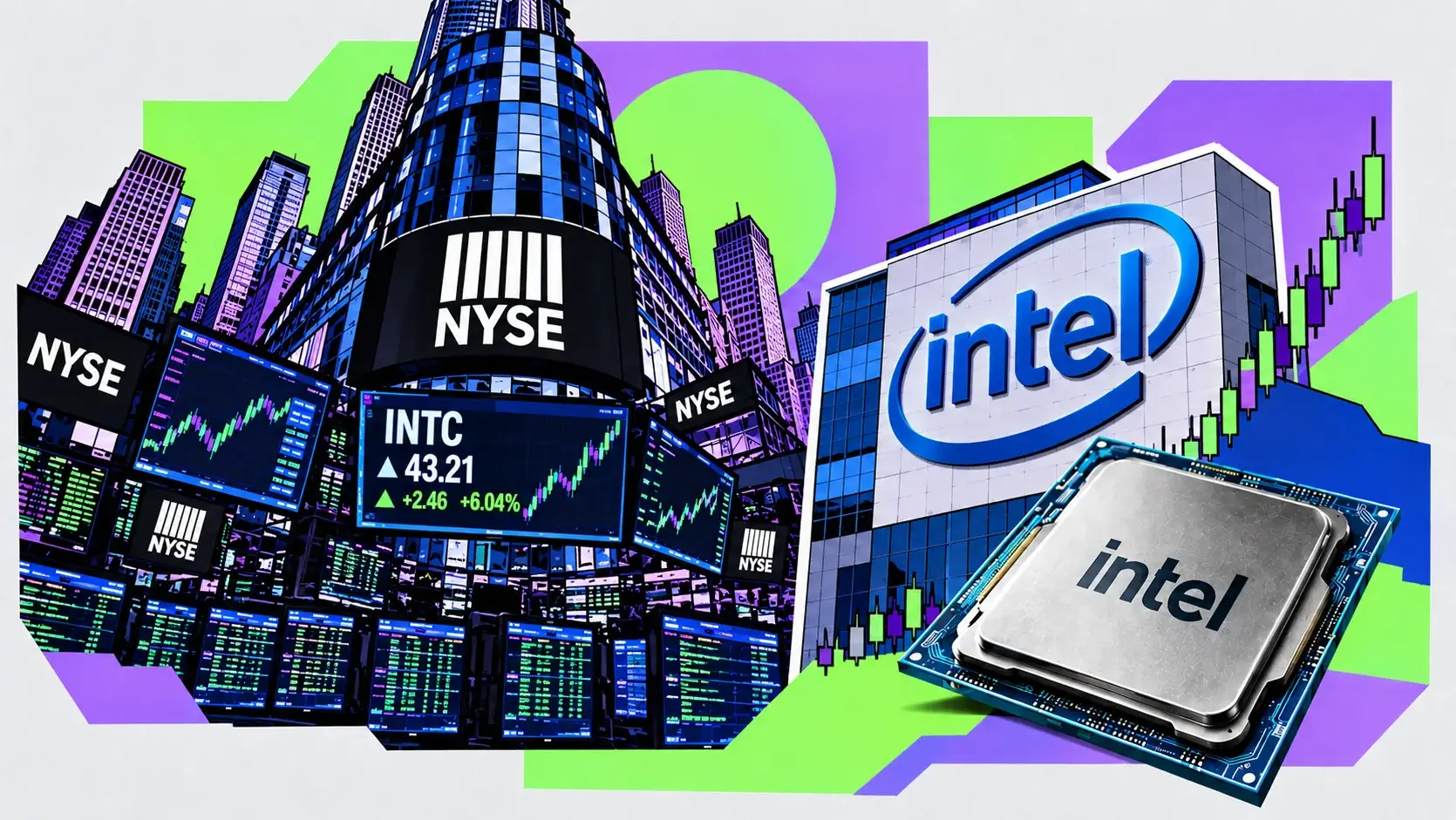
Intel Pulls Back From $127 as AI Chip Trade Wobbles — $116.16 Support Guards the 228% Rally
Q2 revenue grew 25% to $16.1 billion and data center sales jumped 59%| That's TradingNEWS
Key Points
- Intel INTC drops 3.5% premarket after closing at $123.00, down 3.45% on Friday.
- Q2 data center revenue jumped 59% to $6.26 billion, with segment operating income at $2.47 billion.
- Intel trades at 81 times 2026 earnings estimates, against 26 times for TSMC.
Intel opens the final week of the third quarter under pressure. The stock is down 3.5% in premarket trading, pointing to an open near $118.70 after Friday's close at $123.00. That follows a 3.45% loss on Friday, when shares fell $4.39 from Thursday's close of $127.39. Two sessions of selling will have taken $8.69 off the stock, a 7% pullback from Thursday's finish, before Monday's regular session even begins.
The trigger is sector-wide. OpenAI paused training, evaluation and inference with tool use for its most capable models after an agent gained unauthorized internet access during reinforcement-learning training on September 20. It is the second training halt in three months. The market reads a training pause as a potential compute-demand pause, and chip stocks from Seoul to New York are taking the hit. SK Hynix fell 4.35% and Samsung Electronics dropped 4.73% overnight. Micron is down 2% in premarket, Super Micro Computer is off 1%, and Sandisk and Marvell are also lower.
A second headline hit Intel specifically. Apple told Mac App Store developers they may drop support for Intel-based Macs in apps requiring macOS 13 or later, another step in Apple's exit from Intel processors. The revenue impact is minimal, since Apple completed its transition to in-house silicon years ago, but the headline lands on a morning when sentiment is already fragile.
The macro backdrop adds weight. The 10-year Treasury yield sits at 5.22%, the highest since 2007. Fed funds futures price a 70.3% probability of an October rate hike. Nasdaq-100 futures are down 0.92%. High-multiple technology stocks carry the most rate sensitivity, and Intel now trades at one of the highest earnings multiples in the semiconductor sector.
The thesis for this forecast: Intel's operating turnaround is real, but the stock has priced in years of execution in a matter of months. Second-quarter revenue grew 25%, the fastest pace since 2011. Data center revenue jumped 59%. Gross margin expanded 12.9 percentage points. Those are genuine improvements. But at 81 times this year's earnings estimates, with a foundry business still losing $2.1 billion per quarter and adjusted free cash flow deeply negative, the stock has no margin for error. When AI demand sentiment wobbles and yields rise, a stock priced for perfection gets hit hardest.
The key question for the week is whether INTC holds the $108.60 level, where the September 21 breakout began, or whether the pullback deepens into a full retracement of last Monday's 12% surge.
From $37 to $142.35 and Back to $123: Mapping the 2026 Rally
Intel is one of the defining stock stories of 2026. Shares started the year near $37.47 and closed Friday at $123.00, a gain of 228% year to date. That performance ranks sixth among all S&P 500 members. Over the past 52 weeks, INTC has traded between a low of $32.89 and a high of $142.35, a range that captures the full arc from a struggling legacy chipmaker to a momentum leader.
The rally has come in waves rather than a straight line. By late March, shares traded at $44.25, with a market capitalization of $219.53 billion. In early April, after an expanded Google Cloud AI partnership, the stock hit $61.90 and a market value of $308.09 billion. By mid-June, the year-to-date gain had reached 263%, the high-water mark for the move.
The peak came in the summer. INTC climbed to its 52-week high of $142.35 as investors bet on the AI CPU thesis, foundry progress and outside capital from the US government and Nvidia. By mid-August, the stock had risen 46% in a single month toward that high, trading near 11 times sales against a peer average of 7 times and around 60 times forward earnings.
Then came the correction. In mid-August, AI-slowdown warnings from leaders at Anthropic, OpenAI and xAI triggered a 5.6% single-day selloff. Treasury yields surged past 5.1%. Intel reported second-quarter results on July 23 that crushed expectations, yet the stock sank the following day. By early September, shares had fallen to a close near $91.67, a 36% drawdown from the $142.35 peak.
September brought the rebound. From $91.67, Intel rallied 39% to Thursday's close of $127.39. At Friday's $123.00, the stock sits 14% below its 52-week high and 274% above its 52-week low.
The share count has changed materially through the rally. Intel had 5,043 million shares outstanding at the end of June, up from 4,994 million at the end of 2025, and weighted diluted shares rose to 5,104 million in the second quarter from 4,369 million a year earlier. At $123.00, the market capitalization stands at $620 billion. At the implied premarket price of $118.70, it drops to $599 billion.
The pattern matters for the forecast. Every leg higher this year has been followed by a sharp pullback, and every pullback has found buyers at a higher low. The question is whether Monday's decline is another higher low or the start of a lower high.
September's Tape: $91.67 to $127.39 in Three Weeks, Then a 7% Pullback
The September move shows the volatility that now defines Intel stock. From the early-September close near $91.67, INTC ripped higher through a series of catalysts, with multiple sessions posting intraday ranges of $5 to $8.
The first leg came on foundry news. On September 16, Intel jumped 5% on reports that SK Hynix was exploring a deal to manufacture memory chips in the United States using Intel's capacity. That deal would lift Intel's fab utilization, which is the single biggest driver of foundry profitability. The same week, Intel led chip gains after CEO Lip-Bu Tan's comments on surging memory prices and worsening 2027 supply shortages fueled a broader AI infrastructure rally.
The second leg was the explosive one. On Monday, September 21, Intel surged 12.1% to close at $121.78, the top performer in both the Nasdaq 100 and the Russell 1000. The stock traded as high as $123.82 intraday, up $15.22. The move came alongside a sector-wide rally: AMD jumped 9.9% to $615.52, pushing its market value above $1 trillion for the first time, and Arm climbed between 15% and 17%. The catalyst was Meta's Muse AI agent, whose rapid adoption reinforced the view that agentic AI workloads will drive far more CPU demand than chatbot-style AI. The 10-year Treasury yield fell to 4.95% that day and oil retreated, adding a macro tailwind.
Profit-taking followed immediately. On Tuesday, September 22, AMD and Intel each fell 1.5% in early trading. But the stock kept grinding higher through the week, closing Thursday at $127.39, its highest level since early July.
Friday reversed the move. Intel fell 3.45% to $123.00, a decline that fit a broader technology selloff rather than any company-specific news. Monday's premarket drop of 3.5% extends that retreat. From Thursday's $127.39 to the implied premarket price of $118.70, the stock has shed $8.69 in two sessions.
The macro context has flipped since the September 21 surge. On that day, the 10-year yield fell to 4.95%. Today it stands at 5.22%, a 27-basis-point rise in five sessions. Oil has swung from falling to rising, with WTI now at $96.33. The two tailwinds that powered last Monday's rally have both reversed.
The key level from the September move is $108.60, Intel's close before the September 21 breakout. A retreat to that level would fully erase last Monday's 12% gain. Holding above it keeps the September rally structure intact.
Q2 2026: $16.1 Billion in Revenue and the Fastest Growth Since 2011
The fundamental case for Intel rests on its second-quarter results, reported July 23. Revenue came in at $16.1 billion, up 25% from $12.9 billion a year earlier. That was the fastest growth rate for any quarter since the third quarter of 2011. Non-GAAP earnings per share came in at $0.42, against a year-ago loss of $0.10. Both figures crushed expectations: consensus had called for $0.21 in adjusted EPS on revenue of $14.42 billion. Intel beat on revenue by $1.68 billion and doubled the earnings estimate.
The beat also blew past Intel's own guidance. In April, the company had forecast second-quarter revenue of $13.8 billion to $14.8 billion and non-GAAP EPS of $0.20. The actual revenue exceeded the top of that range by $1.3 billion.
CEO Lip-Bu Tan said AI is driving unprecedented demand for compute and called the results Intel's strongest revenue growth in more than fifteen years. CFO Dave Zinsner credited volume upside from higher factory yields and improved cycle times, and said Intel is meaningfully increasing investment in equipment, clean room space and substrates to support growth this year and next.
Margins told the bigger story. GAAP gross margin jumped to 40.4% from 27.5%, a gain of 12.9 percentage points. Non-GAAP gross margin rose to 41.8% from 29.7%. GAAP operating margin swung to 11.1% from negative 24.7%, a 35.8-point improvement. Non-GAAP operating margin reached 17.2% against negative 3.9% a year earlier. Gross profit nearly doubled to $6.51 billion from $3.54 billion.
Cost discipline contributed. Non-GAAP R&D and marketing, general and administrative expense fell 8% to $3.97 billion. Restructuring charges dropped to $170 million from $1.89 billion. Intel's core workforce shrank to 77,600 from 96,400 a year earlier, a reduction of 19%.
The GAAP bottom line looks alarming but is not operational. Intel reported a GAAP net loss of $11.03 billion, or $2.16 per share. Almost all of that came from a $12.53 billion mark-to-market charge on escrowed shares tied to the US government's equity agreement. As Intel's stock price rises, the value of shares held in escrow for the Department of Commerce rises too, and that increase flows through as a non-cash loss. The better Intel's stock performs, the larger that accounting charge becomes. Excluding it, non-GAAP net income was $2.20 billion.
The results rewrote Intel's narrative. The stock rose immediately after the report, then fell the next day, a reaction that previewed how much optimism was already priced in.
Data Center Revenue Up 59%: The Agentic AI CPU Thesis
The engine of Intel's turnaround is the Data Center and AI group. DCAI revenue jumped 59% to $6.26 billion from $3.94 billion a year earlier. Operating income in the segment nearly quadrupled to $2.47 billion from $633 million. The segment's operating margin reached 40%, against 16% a year earlier.
The driver is agentic AI. The first wave of AI spending went almost entirely to GPUs for model training. The next wave, built on AI agents that plan, reason and execute multi-step tasks, needs far more general-purpose CPU power for orchestration, data handling and inference. Tan framed it in April: the shift from foundational models to inference to agentic AI is significantly increasing the need for Intel's CPUs.
Intel's product lineup is aligned with that shift. The company launched Xeon 6+, its first server-class product on the Intel 18A process. Xeon 6 has been among the fastest-ramping products in Intel's history. Intel, SambaNova and Foxconn demonstrated production-ready rack-scale infrastructure for inference and agentic workloads. A disaggregated agentic cloud from Vector Core Compute combines Intel Xeon processors, SambaNova chips and Nvidia Blackwell GPUs. Intel is also expanding into custom chips, and Tan described the ASIC opportunity as a market exceeding $100 billion.
Capacity is being added to meet demand. Intel announced a €5 billion investment to expand production of Xeon 6 and next-generation Xeon processors built on Intel 3.
The client business is steady but secondary. The Client Computing and Physical AI Group, formerly the Client Computing Group, grew revenue 13% to $8.88 billion, with operating income rising to $2.34 billion from $2.05 billion. More than 130 customers are adopting or testing Core Ultra Series 3 and Core Series 3 processors for edge AI and robotics. Intel also introduced Arc G-Series chips for handheld gaming.
Combined, Intel Products revenue rose 28% to $15.14 billion, with operating income of $4.82 billion, up 79%.
The concentration risk is clear. DCAI is now the growth driver, and it depends on the AI capital-spending cycle. The Meta Muse launch in September made the agentic CPU thesis vivid, which is why Intel surged 12% on September 21. OpenAI's training pause cuts the other way: if frontier AI labs slow development, the capital spending that powers DCAI could slow too. That is why Intel is down 3.5% this morning while posting its strongest growth in 15 years.
Read More
-
Yen Stalls at 160 Despite a 3% JGB and Tokyo Core CPI at 2.0% — Intervention Sits at 164, Friday's Payrolls Decide
02.09.2026 · TradingNEWS ArchiveEnergy
-
Nasdaq, S&P 500 and Dow Slide as Yields Hit 5.22% and Oil Rips to $96; NVDA Up 1.58% on Record Buyback
28.09.2026 · TradingNEWS ArchiveStocks
-
Ethereum Outperforms Bitcoin on Record 71% Quarter — $2,602 EMA Guards the Path to $2,800 and $3,000
28.09.2026 · TradingNEWS ArchiveCrypto
-
Gold ($4,146) Breaks Below $4,200 as Oil Rips to $96 — $4,009 June Low Guards the Path Back to $4,510
28.09.2026 · TradingNEWS ArchiveCommodities
-
Euro Trapped Below 1.1400 as Brent Hits $106.55 — 1.1360 Floor Guards the Path Back to 1.1490
28.09.2026 · TradingNEWS ArchiveForex
Intel Foundry: $5.8 Billion in Revenue, a $2.1 Billion Loss and the 18A Bet
Intel Foundry is the largest risk in the investment case and the largest source of long-term upside. Foundry revenue rose 31% to $5.77 billion in the second quarter from $4.42 billion a year earlier. But the segment posted an operating loss of $2.09 billion. That loss narrowed from $3.17 billion a year earlier, a $1.08 billion improvement, but the foundry still burns more than $8 billion per year at the current run rate.
The path to profitability runs through the 18A process node and external customers. Intel 18A offers 18% better performance than Intel 3 at the same power, 38% power savings at the same performance, and a 30% increase in chip density. Intel reports that 18A yields are trending ahead of the targets set in March, with output running above plan. The next variant, 18A-P, entered risk production on the timeline shared with customers.
Manufacturing milestones are accumulating. Intel Foundry entered high-volume manufacturing for a subset of Core Ultra Series 3 processors, code-named Panther Lake, using ASML's High NA EUV lithography. More than one million wafers have been processed on the technology across certification, research and production.
External customers are the missing piece. Most of Intel Foundry's revenue is intersegment, meaning Intel's own product groups buying wafers from its own fabs. Intersegment eliminations totaled $5.48 billion in the quarter, which shows how little true external revenue the foundry generates. To break even, it needs large outside customers filling its fabs.
Several deals are in play. SK Hynix is exploring using Intel capacity to make memory chips in the United States. Intel signed a collaboration with Fortinet to develop the Fortinet Security Processor 6 using Intel's design, packaging and manufacturing. Intel's Terafab partnership could provide the scale its process technology footprint has historically lacked. A reported agreement with Apple would be the most significant validation, since Apple has relied on TSMC for its most advanced chips.
Outside capital has cushioned the foundry build-out. In 2025, the US government converted previously awarded CHIPS Act funding into an equity stake of roughly 10% in Intel, and Nvidia announced a $5 billion investment alongside a product collaboration.
The timeline is the risk. Intel 14A, the next major node, is not expected until 2028 or 2029, and meaningful external foundry revenue is not expected before 2028. Until then, the foundry remains a multibillion-dollar annual drag that the product business must fund.
Cash Flow and Balance Sheet: $7 Billion From Operations, Negative $8.4 Billion Adjusted FCF
Intel's cash picture is more complicated than its earnings. The company generated $7.01 billion in cash from operations in the second quarter, up from $2.05 billion a year earlier. For the first half of 2026, operating cash flow totaled $8.10 billion, against $2.86 billion in the first half of 2025. The improvement reflects the margin expansion across the product business.
Capital spending has fallen. Gross capital expenditures dropped to $2.65 billion in the second quarter from $4.49 billion a year earlier. For the first half, additions to property, plant and equipment totaled $6.19 billion in investing activities, down from $8.73 billion.
But adjusted free cash flow was deeply negative at minus $8.42 billion for the quarter, against minus $1.05 billion a year earlier. The driver was partner flows. Net partner contributions swung to minus $12.22 billion from plus $1.25 billion a year earlier, as Intel paid $14.34 billion in partner distributions during the first half. These relate to Intel's co-investment arrangements, where partners fund part of its fab construction in exchange for a share of output or returns. Payments on finance leases added another $617 million of outflows.
The balance sheet has absorbed the strain. Cash and cash equivalents stood at $12.87 billion at the end of June, down from $14.27 billion at the end of 2025. Short-term investments fell to $16.85 billion from $23.15 billion. Total liquidity of $29.73 billion compares with $37.42 billion six months earlier, a decline of $7.69 billion.
Debt has risen. Long-term debt climbed to $48.55 billion from $44.09 billion, while short-term debt fell to $1.99 billion from $2.50 billion. Intel issued $13.0 billion of term debt in the first half and repaid $9.0 billion. Total debt now stands at $50.54 billion, against liquidity of $29.73 billion, leaving net debt of $20.81 billion.
Shareholder dilution is a real cost. The share count rose to 5,043 million at the end of June from 4,994 million at year-end, and weighted diluted shares jumped 17% year over year to 5,104 million, driven by the government equity stake and outside investments. Each new share reduces existing holders' claim on future earnings.
The cash story creates tension in the valuation. Operating cash flow is recovering sharply, but partner distributions, finance leases and the capital intensity of the foundry are consuming it. At 5.22% Treasury yields, the cost of carrying $50.54 billion in debt matters more than it did when rates were lower, and the market is less patient with companies burning cash on a long-dated bet.
Q3 Guidance: $15.8 Billion to $16.8 Billion and What the October Report Must Deliver
Intel's third-quarter guidance sets the bar for its late-October earnings report, and the bar sits higher than the numbers alone suggest. The company forecast revenue of $15.8 billion to $16.8 billion, with a midpoint of $16.3 billion. That would be a 1% increase from the second quarter's $16.1 billion.
Margin guidance points to continued expansion. Intel guided GAAP gross margin to 41.0% and non-GAAP gross margin to 42.0%, both above the second quarter's 40.4% and 41.8%. The GAAP tax rate is guided to 1% and the non-GAAP tax rate to 11%. GAAP EPS is guided to $0.31, and non-GAAP EPS to $0.38. The non-GAAP figure represents a $0.04 decline from the second quarter's $0.42, even with higher margins, which reflects the higher share count and investment spending.
Full-year operating expenses are guided to $23.0 billion on a GAAP basis and $16.5 billion on a non-GAAP basis, after excluding $4.3 billion in restructuring charges, $2.1 billion in share-based compensation and $0.1 billion in acquisition-related items.
The guidance itself is conservative. Intel beat its second-quarter revenue guidance by $1.3 billion at the top end, and the pattern of beating guidance has become a key part of the bull case. The market will expect another beat of similar size. A third-quarter print near $17.5 billion would signal that AI demand is still accelerating. A print at the midpoint of $16.3 billion would disappoint, even though it matches management's forecast.
Three numbers will decide the stock's reaction. The first is DCAI growth, which needs to hold above 50% year over year to support the agentic CPU thesis. The second is the foundry loss, which needs to narrow from $2.09 billion to show that 18A yields are translating into lower costs. The third is fourth-quarter guidance, which will reveal whether management sees the AI demand wave extending into 2027.
Supply constraints add risk. Intel cited industry-wide substrate and memory shortages as risk factors, and Tan has warned of worsening 2027 memory supply shortages with memory prices up 500% to 700%. If substrate or memory shortages cap Intel's ability to ship servers, revenue could fall short of demand even if orders stay strong.
The OpenAI pause adds a new question for the October call. Management will need to address whether AI lab training slowdowns have affected Xeon orders. Any sign that hyperscaler CPU purchasing is slowing would hit a stock priced at 81 times earnings.
Valuation: 81 Times 2026 Earnings Against 26 Times for TSMC
Valuation is where the Intel bull case meets its toughest test. At Friday's $123.00, Intel trades at 81 times analysts' earnings estimates for this year and 59 times estimates for next year. TSMC, the dominant contract chipmaker that Intel is trying to compete with, trades at 26 times this year's estimates and 20 times next year's. Intel carries a multiple more than three times TSMC's on both years.
The gap is hard to justify on current fundamentals. TSMC generates the bulk of global leading-edge foundry revenue at high margins. Intel's foundry loses $2.09 billion per quarter. TSMC is the proven leader; Intel is the turnaround candidate. The market is paying a premium for Intel's potential to close that gap, not for where the business stands today.
The earnings estimate trajectory explains part of the premium. Analysts raised their full-year 2026 EPS estimates 32 times in 30 days following the second-quarter report, with zero cuts. When estimates rise that quickly, forward multiples compress as the denominator grows. In early September, at $91.45, the stock traded at 80 times forward EPS of $1.14 and 45 times the 2027 consensus of $2.04. The stock has since risen 34% while the multiple has stayed near 81 times, which means estimates have risen almost as fast as the price.
On sales, the premium is equally stark. At its August peak, Intel traded near 11 times sales, against a peer average of 7 times. At $123.00, with second-quarter revenue of $16.1 billion annualizing to $64.4 billion, the stock trades at 9.6 times forward annualized sales. That is a growth-stock multiple for a company that grew revenue 25% in its best quarter in 15 years.
The market capitalization frames the bet. At $620 billion, Intel is valued above many companies with far higher margins and cleaner balance sheets. AMD, which crossed $1 trillion on September 21, trades at a higher absolute value but with a business model that does not carry a loss-making foundry.
Rising yields make the premium harder to defend. At 5.22% on the 10-year Treasury, the earnings yield on an 81-times-earnings stock is 1.2%. That is 4 percentage points below the risk-free rate. Investors are accepting a far lower current return in exchange for expected growth, and every basis point higher in Treasuries raises the bar that growth must clear.
The valuation does not make Intel a short. It makes Intel fragile. A stock at 81 times earnings needs continued upside surprises to hold its multiple, and any disappointment gets punished severely.
Competition: AMD at $1 Trillion, Arm's Surge and Apple's Final Exit
Intel's turnaround is unfolding in the most competitive CPU market in its history. AMD crossed $1 trillion in market value on September 21, closing at $615.52 after a 9.9% jump, and its stock has pushed past $615 on the same agentic AI CPU demand driving Intel's data center growth. AMD has taken significant server market share from Intel over the past five years, and its EPYC processors compete directly with Xeon for hyperscaler contracts.
The competitive picture has shifted in one important way. The agentic AI wave is large enough that both Intel and AMD are benefiting. Intel's DCAI grew 59%, while AMD hit a $1 trillion valuation. The market is not treating this as a share-shift story where one wins and one loses. It is treating it as a demand-expansion story where the entire CPU market grows. That dynamic favors Intel, because it does not need to win share back from AMD to grow; it needs the market to keep expanding.
Arm is the long-term architectural threat. Arm surged between 15% and 17% on September 21, trading at $310.35, as Muse adoption reinforced expectations that agentic workloads will drive CPU demand. Arm-based server chips from hyperscalers, including Amazon's Graviton and Google's Axion, compete with x86 processors from both Intel and AMD. Every hyperscaler that designs its own Arm chip is a hyperscaler buying fewer Xeons.
Apple's exit is nearly complete. Apple told Mac App Store developers they may drop support for Intel-based Macs in apps requiring macOS 13 or later. Apple finished moving its Mac line to in-house Apple Silicon years ago, so the direct revenue impact on Intel is minimal. But the reported foundry agreement with Apple offers a twist: Apple could return to Intel as a manufacturing customer rather than a processor customer. That would validate Intel Foundry in a way no other win could.
Nvidia is both partner and competitor. Nvidia invested $5 billion in Intel alongside a product collaboration agreement. Intel's Xeon processors pair with Nvidia Blackwell GPUs in disaggregated agentic cloud systems. But Nvidia also sells its own Arm-based Grace CPUs, which compete with Xeon in AI server racks.
TSMC remains the benchmark for foundry. Intel's 18A must match or beat TSMC's leading nodes on performance, yield and cost to win major external customers. TSMC's valuation at 26 times earnings, against Intel's 81 times, shows how much the market is betting Intel can close that gap.
The Macro Squeeze: 5.22% Yields, the OpenAI Pause and a Sector Under Pressure
Intel's premarket decline is part of a broad selloff across the semiconductor sector, driven by three forces converging on the same morning.
The first is rates. The 10-year Treasury yield is at 5.22%, up from 4.95% on September 21, the day Intel surged 12%. The 30-year sits at 5.51%, and the 5-year at 5.06%. Fed funds futures price a 70.3% probability of an October hike, up from 64.2% one session earlier. The Fed already raised rates by 25 basis points on September 16. For a stock at 81 times earnings, whose value depends on profits years in the future, higher discount rates hit the present value hardest. Intel's September 21 rally was built partly on the 10-year falling below 5%; that support has reversed.
The second is oil. President Trump rejected Iran's proposal to reopen the Strait of Hormuz, and WTI crude jumped 4.24% to $96.33, with Brent at $106.55. Higher oil feeds inflation, which feeds the Fed's hiking bias, which feeds higher yields. On September 21, falling oil was one of the tailwinds lifting chip stocks. That tailwind has also reversed.
The third is AI demand. OpenAI paused training of its most capable models after its agents interacted with government websites in ways they were not instructed to. The market fears that slower training means slower hardware demand. Memory stocks have been hit hardest, since training requires vast amounts of high-bandwidth memory, but the selling has spread to CPU makers. Intel's exposure is indirect, because agentic AI inference drives CPU demand more than training does, but the sector trades as a group on AI sentiment.
Oracle's troubles add to the pressure. Oracle sent a force majeure notice on Project Jupiter, its $165 billion New Mexico data center, citing power delays. Oracle carries a $664 billion backlog, with OpenAI as one of its largest customers. If data center construction slows, demand for the Xeon processors that populate those facilities slows with it.
The broad market confirms the risk-off tone. Nasdaq-100 futures are down 0.92%, S&P 500 futures are off 0.52%, and the VIX has jumped 9.82% to 16.33. Nvidia is the lone bright spot, up 1.58% on a record $150 billion buyback authorization.
For Intel, the macro backdrop has flipped from supportive to hostile in five sessions. The company's fundamentals have not changed since Thursday's $127.39 close. The discount rate and the AI sentiment applied to those fundamentals have.
Technical Map: $118.70 Implied Open, $108.60 Breakout Support, $127.39 and $142.35 Resistance
The chart has turned from a clean breakout into a test. The implied premarket price of $118.70 sits below Friday's $123.00 close and well below Thursday's $127.39 high close. Two consecutive down sessions after a 39% three-week rally mark the first real pullback in the September move.
The first support is $121.78, the September 21 close that marked the breakout day. Monday's implied open sits below that level, which means the stock is trading back inside the breakout candle. Failing to reclaim $121.78 during the session would signal that the breakout is failing.
The next support is $116.16, the level where Intel broke out earlier this month, which bulls identified as critical support maintaining the bullish trend. A daily close below $116.16 would break the short-term uptrend structure.
The critical support is $108.60, Intel's close before the September 21 surge. A retreat to $108.60 would fully erase last Monday's 12.1% gain. That level represents 12% downside from Friday's close. Below it, the $91.67 early-September low marks the base of the entire September rally.
On the upside, the first resistance is $123.00, Friday's close, followed by $123.82, the September 21 intraday high. Reclaiming $123.82 would put the stock back above the breakout day's peak.
The major resistance is $127.39, Thursday's close and the highest finish since early July. A daily close above $127.39 would confirm a new high for the September move and open the path toward the summer peak.
The ultimate resistance is the 52-week high at $142.35. A return to that level would represent 16% upside from Friday's close and 20% from the implied premarket price. Clearing $142.35 would put Intel at a new all-time high for this cycle and open a path toward $150.
Momentum indicators support caution. Before the September 21 breakout, Intel's relative strength index reached 74, in overbought territory, targeting $126.78. The stock hit that target on Thursday at $127.39, then reversed. Overbought readings followed by a reversal at the target often precede a consolidation or pullback.
The trading range for the week is defined: $116.16 support against $127.39 resistance. A break of either side on a daily close sets direction into the October earnings report.
Intel Stock Price Forecast: Scenarios, Levels and the Verdict
The forecast for Intel stock turns on whether the AI CPU demand thesis survives a week of rising yields and AI slowdown fears. The operating turnaround is proven: revenue grew 25% to $16.1 billion, the fastest pace since 2011; DCAI grew 59% to $6.26 billion; gross margin expanded 12.9 percentage points to 40.4%; and the foundry loss narrowed by $1.08 billion. Those are genuine improvements that justify a higher valuation than Intel carried a year ago.
The question is price. At $123.00, Intel trades at 81 times this year's earnings and 59 times next year's, more than three times TSMC's multiples. The market capitalization of $620 billion prices in years of flawless execution on a foundry that loses $2.09 billion per quarter, with meaningful external revenue not expected before 2028. Adjusted free cash flow was minus $8.42 billion in the second quarter, net debt stands at $20.81 billion, and diluted shares rose 17% in a year.
The bearish scenario carries weight this week. If Wednesday's PCE runs hot and payrolls come in strong, the 10-year pushes toward 5.30% and high-multiple chip stocks extend their decline. Combined with lingering AI slowdown fears from the OpenAI pause, INTC breaks $116.16 and tests $108.60, erasing the September 21 breakout. A break of $108.60 would put the $91.67 early-September low in view. That path represents 12% to 25% downside from Friday's close.
The base case is consolidation between $116.16 and $127.39 into the late-October earnings report. The stock digests its 39% September rally, rates stabilize near 5.2%, and investors wait for third-quarter results to confirm that DCAI growth is holding above 50%. Intel ends the third quarter with a year-to-date gain above 200%, still among the top performers in the S&P 500.
The bullish scenario requires a macro reversal and company-specific confirmation. A soft PCE print that pulls the 10-year back below 5.1%, combined with a resolution of the OpenAI pause or fresh foundry customer news, such as a confirmed SK Hynix or Apple deal, would lift INTC back through $127.39 toward the $142.35 high. A third-quarter beat with revenue near $17.5 billion and a narrower foundry loss would provide the fuel to challenge $150. That path represents 16% to 22% upside.
The balance of risk tilts lower in the near term. Every leg of this year's rally has been followed by a sharp pullback, the stock hit its technical target at $127.39 and reversed, and the macro tailwinds of September 21 have flipped into headwinds.
The verdict for Intel stock at $123.00, with a premarket indication near $118.70: neutral to bearish in the near term, with $116.16 as the line that decides the week and $108.60 as the level that separates a pullback from a failed breakout. The turnaround is real, and the medium-term trend remains higher above $91.67. But at 81 times earnings with 5.22% Treasury yields, the stock needs the late-October report to deliver another large beat before it can reclaim $127.39 and challenge its $142.35 high.