Meta Rips 10% on Cloud Pivot as Chips Roll Over, Dow Prints Fresh Record to Open Q3
S&P 500 hugs 7,508 flatline and Nasdaq slips on semiconductor weakness while the Dow hits 52,443; ADP payrolls miss at 98,000 sets up Thursday's early jobs print.
Key Points
- Meta (META) ripped 10% to ~$619 on plans to sell excess AI compute; CoreWeave (CRWV) and Nebius (NBIS) got slammed.
- Dow (DJI) hit a second straight record near 52,443 as chips dragged Nasdaq (IXIC) red; S&P 500 (SPX) held ~7,508 flat.
- ADP private payrolls rose just 98,000 in June, missing the 110,000 call, ahead of Thursday's early nonfarm print.
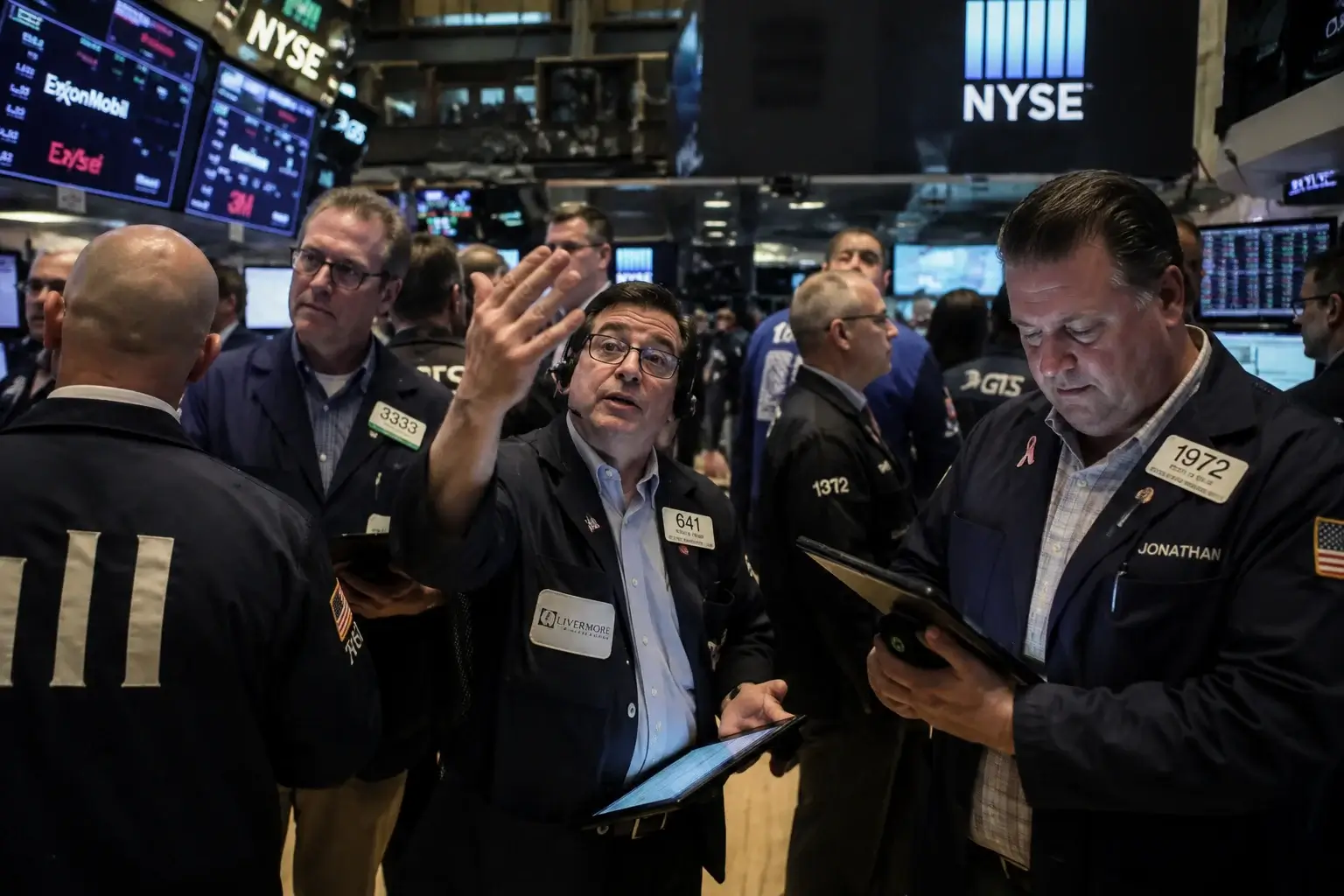
Wall Street kicked off Q3 with a fractured tape. The S&P 500 (SPX) hovered right on the flatline near 7,508, up about 9 points or 0.12% at midday, while the Dow Jones Industrial Average (DJI) pushed to fresh record territory at roughly 52,443, tacking on 124 points for a 0.24% gain. The Nasdaq Composite (IXIC) went the other way, sliding around 38 points to 26,176, a 0.15% dip driven entirely by weakness in the mega-cap chip complex. The Russell 2000 (RUT) held green at 3,029, up 0.15%, keeping the small-cap bid alive into the new quarter. The CBOE Volatility Index bled lower to 16.38, down 0.43%, a sign the desk isn't reaching for protection even with the split under the surface. This is a tape divided by name, not by direction — the Dow's value-and-industrial tilt carried it to a second straight record close while the Nasdaq's semiconductor weight dragged it into the red. The divergence tells the real story: money is rotating, not fleeing. Breadth backed that up, with roughly 64% of S&P 500 names sitting above their 50-day line as of Monday, up sharply from around 50% a month earlier. That widening participation is why the index can absorb a chip pullback and still grind sideways rather than crack. The session opened after the strongest quarter for the S&P 500 and Nasdaq since 2020, and the first day of a holiday-shortened week carries thin-volume risk ahead of Friday's shutdown for July 4. Window dressing wrapped up Tuesday as major funds shed losers and added winners before quarter-end reports went out, which clears some of the mechanical noise. Gold ripped to 4,103, up 1.61% and pressing record ground as the safe-haven bid stayed firm. Crude rolled over hard, with the August contract sliding 1.70% to 68.32 after Middle East peace talks stumbled. Bitcoin churned near 59,000, whipping between red and green through the morning as risk appetite stayed choppy. The setup into midday: a market that snapped back to record highs on the Dow, faded on chips, and now waits on a jobs print that lands a day early because of the holiday. Positioning is constructive but jumpy, and every macro headline is getting a hard look.
Meta Rips 10% on the Cloud Pivot
Meta Platforms (META) was the single biggest force on the tape, ripping as much as 10% to around $619 after word broke that the company is standing up a cloud infrastructure business to sell its excess artificial-intelligence compute. The move reframes the entire bear case in one headline. For most of 2026, Meta stock carried a heavy discount — down roughly 7.5% on the year heading into Wednesday — because the market questioned whether the company's monster capital-spending plan would ever pay off. Meta guided 2026 capex to a staggering $125 billion to $145 billion, almost all of it aimed at data centers and AI silicon, and every quarter the number drew fresh skepticism about returns. The cloud plan flips that math. Instead of a pure cost center, the buildout becomes a potential revenue engine, letting outside customers rent compute that would otherwise sit idle between internal workloads. The internal effort runs under a segment called Meta Compute, led by infrastructure chief Santosh Janardhan, Superintelligence Labs figure Daniel Gross, and company president Dina Powell McCormick. Two paths are on the table: a model-as-a-service offering that hosts Meta's own Muse Spark models and charges developers for access, mirroring Amazon's Bedrock, and a raw-compute rental business that would put Meta head-to-head with neocloud players. Mark Zuckerberg telegraphed exactly this in May, calling an external compute business "definitely on the table" and noting that outside firms were already knocking, asking to buy capacity at a premium. The bull read is clean: Meta was the heaviest spender relative to revenue, the crowd feared massive overbuild, and now that infrastructure gets monetized, lifting revenue, margins, and cash flow while the industry stays capacity-constrained. The bear read is sharper: forming an external cloud arm is a tacit admission that management overbuilt, or that internal AI demand is falling short of the buildout. Both sides have a point, and the stock is pricing the optionality either way. Prediction markets leaned bullish fast, assigning a high probability that Meta clears $620 in July. The next hard catalyst is the July 29 earnings report, where management will field questions on the strategy alongside advertising results. Q2 revenue landed near $47.5 billion with $17 billion in quarterly capex, so the scale is real, and the cloud pivot gives buyers a fresh reason to look past the spending.
The Neocloud Complex Gets Slammed
The flip side of Meta's rip landed squarely on the neocloud names, and it landed hard. CoreWeave (CRWV) dropped as much as 12% to around $86 on the read-through that a hyperscaler with Meta's data-center scale entering the raw-compute rental market would crush pricing for pure-play providers. Nebius Group (NBIS) tumbled even further, sinking as much as 15% toward $235, the worst single-name move among the AI infrastructure crowd. The logic is direct: these companies exist to rent GPU capacity, and a well-capitalized giant offering the same product at scale is a knife aimed straight at their margins. The stakes for CoreWeave run deeper than a one-day tape hit. Meta is already CoreWeave's largest customer through a $21 billion commitment signed earlier this year, part of a backlog that swelled to nearly $99.4 billion. A Meta pivot from buyer to seller reshapes that relationship over time — the biggest client could morph into the biggest competitor. Other data-center and neocloud names got caught in the downdraft too, with IREN and Cipher Digital sliding alongside the group as the market repriced the entire pure-play compute-rental thesis. The move follows a template set earlier this year, when SpaceX, via xAI, started selling excess compute and inked capacity deals with major AI labs. That precedent matters because it signals a structural shift: the winners of the AI race may not be the firms with the best models but the ones that own the data centers and can rent the overflow. Big Tech is on track to spend more than $700 billion on AI infrastructure this year, up from roughly $400 billion in 2025, and every hyperscaler with idle GPUs is now a potential landlord. That reframes the neocloud model as fragile rather than defensible. The counterpoint the bulls will press: the industry in aggregate still looks capacity-constrained, so any compute Meta lists externally gets absorbed quickly, and the pie is expanding fast enough to feed everyone. The bears counter that pricing power is the whole game, and adding a hyperscaler supplier caps how much the pure-plays can charge. The neocloud group has already traded at compressed valuations, sitting near the lowest forward multiples since ChatGPT launched and at a discount to the broad market, so the room for further multiple compression exists. Wednesday's action showed exactly where the pain concentrates when a giant muscles in.
Chips Roll Over as the Memory Trade Wobbles
The semiconductor complex rolled over again, dragging the Nasdaq into the red and reviving the on-again, off-again anxiety around how much room is left in the AI silicon trade. Micron (MU) led the memory-chip weakness lower, with Sandisk sinking alongside it as the group gave back a chunk of this week's rally. Nvidia (NVDA) shed close to 3%, extending a stretch in which the bellwether has been the weakest performer inside the PHLX Semiconductor Index this year, a striking underperformance given its size and its central role in every AI narrative. The chip read-through from the Meta news cut two ways. On one hand, if Meta has enough excess compute to rent out, that implies the company may be dialing back future silicon orders, which pressures the demand outlook for the picks-and-shovels crowd. On the other, the sector had ripped hard into quarter-end, adding roughly $2 trillion in combined market cap to Micron, Intel, and Advanced Micro Devices during Q2 alone, so some giveback was mechanical after a record chip rally. Broadcom, Marvell Technology, Intel, ASML, and TSMC all traded lower in sympathy, spreading the weakness across the full supply chain. The memory names carry their own crosscurrent. Micron has locked in binding take-or-pay contracts with hyperscalers and smaller buyers, collecting billions in cash deposits as guarantees, and the structural demand story — data-center high-bandwidth memory, advanced driver-assistance systems, and a coming robotics cycle — remains intact even when the tape sells off. That's the tension: the fundamental backlog looks stronger than ever, but the stocks got priced for perfection, and any wobble in the AI capex story snaps them lower fast. One desk voice captured the mood, warning that the semis are getting "a bit too hot" and cautioning against aggressive buying at these levels even for those who like the long-term setup. The memory tax on AI — the surging cost and demand for the chips that feed the models — is the through-line the market keeps re-rating. When compute looks scarce, the memory names rip. When a hyperscaler hints it has too much, they fade. Wednesday belonged to the second story, and the chip complex paid for it with a broad, if orderly, pullback that kept the Nasdaq underwater while the rest of the tape held firm.
AMD Bucks the Tape
Not every chip name got dragged down. Advanced Micro Devices (AMD) ripped roughly 8% to around $580, standing out as a rare green semiconductor print on a day the rest of the complex bled. The divergence underlines how selective the money has become inside AI silicon — the crowd is no longer buying the whole sector as a single trade but picking winners and dumping the rest. AMD's strength came even as Micron, Nvidia, and Broadcom rolled over, a split that would have been unthinkable during the wholesale chip rallies earlier in the cycle. The move fits a broader rotation the desk has been running for months: capital broadening out beyond the graphics-processor bellwether toward other layers of the AI stack, including central processors and custom accelerators where AMD competes hardest. That rotation has real teeth. Attention has widened from the single dominant GPU name toward memory, CPUs, and the specialized silicon that fills out a data center, and on Wednesday AMD sat on the right side of that shift. The stock's pop also reflects positioning cleanup after quarter-end, with funds adding to names that carry momentum into the new period. Nvidia's own story stayed constructive on the research front even as the stock faded — one prominent shop reiterated an outperform call and tagged it a top idea, framing the current parallel-processing and connected-computing era as a multi-year buildout in which the company owns the full stack. That bullish note didn't stop the tape from selling the stock, a reminder that in a crowded trade, sentiment and price can diverge sharply on any given session. The read across the chip group is that leadership is fracturing. The names with the cleanest AI narratives and the least valuation baggage catch the bid, while the ones priced for flawless execution catch the knife. AMD's Wednesday performance put it firmly in the first camp. The stock has ridden the AI infrastructure boom hard, and the market keeps rewarding its inference and data-center traction even on days the broader semiconductor tape cracks. For the desk watching sector internals, AMD holding green while Micron and Nvidia rolled over is the cleanest signal of the day: the AI chip trade is alive, but it's no longer a rising tide. It's a stock-picker's tape now, and the money is being ruthless about which names it wants and which it's willing to let go.
The Dow's Record Run
While chips dragged the Nasdaq lower, the Dow marched to its second straight record close, powered by a mix of mega-cap tech leadership and value-sector strength that the price-weighted index rewards. The blue-chip gauge climbed to roughly 52,443, adding 124 points for a 0.24% gain and extending a run that has quietly outperformed the flashier averages this week. Microsoft (MSFT) led the charge, tacking on close to 2% as the hyperscaler crowd held its rebound from earlier in the week after a long stretch of underperformance versus the AI infrastructure names since mid-May. Apple (AAPL) added around 0.89% and Chevron gained roughly 0.94%, giving the Dow the kind of broad-based leadership that carries a record. The index also welcomed a new member: Alphabet (GOOGL) joined the Dow at the start of the week, and its first days as a component added a growth engine to a benchmark long criticized for lagging the tech-heavy averages. That addition matters structurally — it tilts the Dow's composition toward the AI winners while keeping its value ballast intact. Not everything inside the average worked. Caterpillar dropped about 4.5%, the biggest single drag on the index, while Walmart (WMT) shed roughly 4.3% as the retail giant came under pressure. Nvidia's near-3% slide also weighed, since the chip name now sits inside the Dow's roster. But the winners outmuscled the losers, and the record held. The Dow's leadership signals something the broad-market bulls have wanted to see all year: the rally is no longer hostage to a handful of chip and mega-cap tech names. Value, energy, and industrials are contributing, and that rotation gives the advance a firmer base than the narrow, top-heavy moves that defined earlier stretches of 2026. The Dow logged its best first half since 2021, climbing 8.9% through the six-month mark, and it entered Q3 with momentum the other averages spent Wednesday morning giving back. The price-weighted structure means high-dollar names like the industrials and financials carry outsized sway, so the Dow's record is a read on the broadening beneath the surface rather than a pure AI story. That distinction is the whole point of the split tape: the Nasdaq measures the chip anxiety, and the Dow measures the rotation into everything else. On Wednesday, the rotation won, and the blue chips printed a fresh high while the semiconductor names took their lumps.
Jobs Data Sets the Table
The macro backdrop turned on labor data, and Wednesday's numbers pointed to a cooling hiring picture that lands right as the market braces for the marquee print later this week. Private payrolls grew by 98,000 in June according to the ADP report, coming in below the 110,000 consensus and down from 122,000 in May. The miss reinforced a slowing-hiring narrative that's been building for weeks. ADP's chief economist framed it as a story of both supply and demand — people are taking longer to find work, but there are also labor-supply constraints in certain industries, and the net effect is a slowdown in job creation. That's the kind of soft-landing signal the rate-cut crowd wants, but it cuts both ways depending on how the Fed reads it. Separate data from an outplacement firm showed U.S. employers announced just under 46,000 job cuts in June, a touch below the roughly 48,000 planned in the same month a year earlier, so the layoff pace stayed contained even as hiring cooled. The May Job Openings and Labor Turnover Survey was also on the docket, expected to show a slight drop to around 7.3 million openings after the metric hit a nearly two-year high in April. The ratio of openings to unemployed workers sitting back above 1 has kept the labor market from tipping into genuine weakness. All of this sets the stage for the June nonfarm payrolls report, which lands Thursday this week rather than the usual Friday because of the July 4 holiday shutdown. That timing change concentrates the risk: a shortened week, thinning volume, and a jobs print dropping a day early into a market already jumpy about the Fed's path. The payrolls number will move the tape hard because it feeds directly into the rate debate. A hot print revives fears of a Fed rate hike this year — a risk the market has been actively gauging all week — while a soft number strengthens the case that the labor market is cooling enough to keep policy on hold or turn easier. The desk is watching the openings data, the private payrolls trend, and Thursday's headline as a package. The through-line from Wednesday's ADP miss is that hiring is decelerating, and whether that reads as goldilocks or as a warning depends entirely on what Thursday delivers and how the Fed frames the risks around it.
Read More
-
Yen Stalls at 160 Despite a 3% JGB and Tokyo Core CPI at 2.0% — Intervention Sits at 164, Friday's Payrolls Decide
02.09.2026 · TradingNEWS ArchiveEnergy
-
QQQ ETF ($739) Fades From an Early Tech Rally as a 77.9 ISM Prices Index Meets Micron's $61.5B Guide — $760 Record Test Ahead
01.10.2026 · TradingNEWS ArchiveStocks
-
XRPR and XRPI Follow XRP's $1.49 Test as Spot Funds Hold 1.16B XRP and a 1 Billion Token Escrow Release Lands — $1.70 in Play
01.10.2026 · TradingNEWS ArchiveCrypto
-
November NG Slips Below $3 as Decade-High Storage Meets Capped LNG Exports — $2.75 in Sight
01.10.2026 · TradingNEWS ArchiveCommodities
-
Dollar-Yen at 158 Presses Toward 160 as a 363 bp Carry Gap Meets Katayama-Bessent Intervention Risk — 159 in Sight
01.10.2026 · TradingNEWS ArchiveForex
Warsh Holds His Cards
Federal Reserve Chair Kevin Warsh took the stage at the European Central Bank's annual forum in Sintra, Portugal, and gave the market exactly nothing to trade on. In early remarks to a panel of global central bank leaders, Warsh offered no signal on the Fed's policy path, keeping his cards firmly held even as the crowd hunted for clues on where rates go from here. The appearance carried weight beyond its content. It marked Warsh's first public showing since a post-meeting press conference two weeks earlier and his first speaking engagement since being confirmed to the top job in May. He shared the panel with heavyweight company — ECB President Christine Lagarde, Bank of England Governor Andrew Bailey, and Bank of Canada Governor Tiff Macklem — the kind of stage where an offhand remark can move global bond markets. Warsh declined to give one. The silence lands in a charged context. The market has spent much of 2026 trading on the assumption that a new Fed chair would eventually reshape policy, and Warsh's confirmation earlier this year fed that narrative. His refusal to telegraph the next move keeps the rate debate wide open at a moment when the data is sending mixed signals — cooling hiring on one side, sticky inflation worries tied to the energy shock on the other. The market is actively weighing the risk of a Fed rate hike this year, a scenario that would upend the soft-landing thesis, and Warsh's non-answer neither confirmed nor killed that fear. That ambiguity is its own kind of policy. By staying quiet, the chair forces the market to lean harder on the incoming data, which is why Thursday's payrolls print now carries even more freight. Euro-zone inflation offered a supportive backdrop across the Atlantic, coming in at 2.8% for June, below the 3.0% consensus and down from 3.2% in May, as the energy-price pressure from the Middle East conflict eased. That cooling on the European side gives Lagarde room the Fed may or may not share. For the U.S. side of the panel, the message was restraint. Warsh's debut on the international stage was a study in saying little, and the market read it as a hold pattern — no green light for cuts, no warning of a hike, just a chair waiting on data before tipping his hand. The rate picture stays as murky as it was before he spoke.
Nike Beats, China Bites
Nike (NKE) delivered a quarter that split the difference between a headline beat and a nagging worry, and the stock chopped around the flatline as the market wrestled with both sides. The athletic-wear giant posted fiscal fourth-quarter earnings of 72 cents per share, blowing past estimates by a wide margin, on revenue of roughly $11 billion that also cleared expectations despite slipping 0.9% year over year. On paper, that's a clean beat on both the top and bottom lines. The problem sits in one region: Greater China. Sales there fell 12% to around $1.30 billion, and management flagged that the weakness — particularly in China — could persist even as the broader business improves. That warning is what kept a lid on the stock. The company's finance chief framed the results as in line with expectations and pointed to financial discipline in an increasingly challenging operating environment where sell-through remains under pressure. Management emphasized improving the health of the business, managing the product portfolio, and adjusting operating costs for greater efficiency over time — the language of a turnaround still in progress rather than complete. The market's reaction captured the ambivalence. Shares had wobbled in extended trading after the print before finding a footing near the flatline in the regular session, trading around $41 to $42 as the beat and the China caution fought to a draw. The bulls point to the earnings and revenue upside as proof the cost discipline is working and the worst may be behind. The skeptics fixate on the China number, since the region has been Nike's growth engine for years and a 12% decline signals a structural problem, not a one-quarter blip. Consumer anxiety showed up in the commentary too, with the company noting the challenged demand backdrop that's weighing on the entire consumer-discretionary space. Nike's report matters beyond its own ticker because it's a bellwether for global consumer spending and for the China exposure that runs through so many multinational names. A beat that gets sold on regional weakness tells the market the consumer story is fragile even where the numbers technically clear the bar. The stock's flat finish reflected a market unwilling to fully reward the beat or fully punish the guidance — a holding pattern that mirrors the broader tape's split personality on the day. Nike stays a show-me story, and the China line is the number the crowd will keep watching every quarter until it turns.
Kroger Buys Giant Eagle
Consolidation ripped through the grocery aisle as Kroger (KR) announced a $1.65 billion deal to acquire regional supermarket operator Giant Eagle, a move that pulled the stock down roughly 2.8% in early trading as the market weighed the price and the strategic logic. The acquisition marks Kroger's return to dealmaking after a bruising setback. The company's $25 billion attempt to merge with Albertsons in 2024 collapsed after regulators and courts blocked it, leaving Kroger to pursue growth through smaller, more digestible transactions rather than a transformational tie-up. Giant Eagle fits that mold — a regional chain that expands Kroger's footprint without triggering the antitrust firestorm that doomed the Albertsons deal. The competitive backdrop explains the urgency. Kroger faces relentless pressure from Walmart (WMT) and Amazon (AMZN), two giants with the scale and the balance sheets to hold grocery prices down and squeeze traditional supermarket margins. In that environment, bulking up through acquisition is one of the few levers a legacy grocer can pull to defend market share and wring out cost synergies. The Giant Eagle purchase gives Kroger more density in its operating regions, more buying power with suppliers, and a larger base over which to spread the fixed costs of a modern grocery operation. The stock's dip on the news reflects the usual acquirer's discount — the market often marks down the buyer on deal day, pricing in integration risk and the cash outlay before the synergies show up. At $1.65 billion, the deal is a fraction of the failed Albertsons attempt, which signals a chastened Kroger playing a more careful hand after the regulatory rejection. The smaller size also lowers the odds of another antitrust blockade, since a regional bolt-on draws far less scrutiny than a mega-merger between two national chains. For the grocery sector, the deal underlines the structural squeeze traditional supermarkets face. Caught between Walmart's price leadership and Amazon's logistics muscle, regional and legacy grocers are consolidating to survive, and Kroger is positioning itself as a consolidator rather than a target. The Walmart weakness on Wednesday — the stock shed more than 4% and ranked among the biggest Dow drags — added a layer of irony, since the grocery competition that pressures Kroger cuts both ways in a tough consumer tape. The Giant Eagle deal is Kroger's bet that scale is the answer to a brutally competitive market, and the modest stock dip suggests the crowd sees the logic even if it's cautious on the near-term cost.
The Small-Cap Surge
Underneath the mega-cap noise, small caps quietly ran one of the great halves in their history. The Russell 2000 (RUT) surged nearly 22% in the first six months of 2026, clinching its best first-half performance since 1991 — a three-decade record that says the rally has legs well beyond the handful of trillion-dollar names dominating the headlines. On Wednesday the small-cap gauge held green at 3,029, up 0.15%, extending a run that has been the quiet story of the year. That strength matters for the durability of the broader advance. When small caps participate, it signals the rally isn't hostage to a narrow band of AI and chip winners — the money is flowing into the domestic, cyclical, rate-sensitive corners of the market that only work when the crowd believes in the economy and in easier policy ahead. The Russell's outperformance flips the usual 2026 script, in which the tech-heavy averages hogged the gains while the broad market lagged. Breadth confirmed the shift. Roughly 64% of S&P 500 names traded above their 50-day moving average as of Monday, up from just 50% a month earlier, a meaningful improvement that shows participation widening even as the headline index churned sideways. That's the constructive read the bulls have chased all year: under the surface, the market is broadening, and it's less dependent on chips and mega-cap tech for further upside. The small-cap surge fits that picture. These companies carry more domestic exposure, more debt, and more sensitivity to interest rates, so their outperformance reads as a bet that the Fed stays on hold or turns easier and that the economy avoids a hard landing. The cooling-hiring data from Wednesday's ADP print feeds that thesis, since a softer labor market pulls forward the case for rate relief that small caps crave. The risk is that a hot payrolls number Thursday reignites rate-hike fears, which would hit the leveraged, rate-sensitive small-cap names hardest. But heading into that print, the Russell's best first half since 1991 stands as evidence that the rally has broadened out from the top. The rotation into small caps and value is exactly what a maturing bull market wants to see — a handoff from the narrow leadership that carried the early move to the wider participation that sustains it. On Wednesday, with chips fading and the Dow at a record, the small caps held their ground and kept the broadening story intact.
Oil, Gold, and the Iran Talks
Commodities told their own story on Wednesday, with crude rolling over and gold ripping to record ground as the safe-haven bid stayed firm. West Texas Intermediate for August delivery slid 1.70% to 68.32, dropping back below $69 as peace talks aimed at ending the Middle East conflict stumbled. Brent crude fell toward $72 a barrel in sympathy. The catalyst was a breakdown in the diplomatic track: peace talks in Qatar faltered after Iran said its delegates wouldn't meet the U.S. team, clouding hopes for progress toward a lasting deal and a return to normal oil flows. The market's read was counterintuitive but telling — rather than spiking on the diplomatic setback, oil dropped about 1%, a sign the crowd is pricing in eventual de-escalation and treating the talks' stumble as a bump rather than a re-escalation. The energy backdrop has been the defining macro variable of 2026. The Iran conflict disrupted shipping through critical chokepoints earlier in the year, sending Brent to peak prices above $113 a barrel at points in the spring and feeding inflation worries that reshaped Fed policy expectations. The recent wind-down of that conflict has been one factor clipping the technology rally and relieving pressure on cyclical sectors, so every twist in the peace process ripples through the whole tape. Wednesday's stumble in Qatar reintroduced a sliver of uncertainty, but falling oil prices suggest the market still leans toward normalization. Gold went the other direction, ripping 1.61% to 4,103 and pressing toward record territory as the metal held its safe-haven premium even with equities steady. The gold bid reflects a market hedging against the murky rate path, the geopolitical tail risk, and the possibility that inflation proves stickier than the soft-landing crowd hopes. When gold rips while stocks hold and volatility stays low, it signals the crowd is buying protection quietly rather than dumping risk outright. The energy easing also showed up in Europe, where cooling energy pressure helped pull euro-zone inflation down to 2.8% in June. Falling oil relieves the inflation squeeze, which supports the case for rate relief on both sides of the Atlantic and feeds the equity rally by lowering the cost pressure on cyclical names. The commodity tape on Wednesday captured the crossroads: oil betting on peace, gold hedging against uncertainty, and both moving on the same Middle East story that has driven markets all year. The Qatar setback bears watching, but the price action said the market still expects the conflict to fade.
The Half-Year Scorecard
The first six months of 2026 closed as one of the strongest halves in years, and the scorecard frames why the market entered Q3 with such momentum despite Wednesday's chip wobble. The Dow climbed 8.9% in the first half, its best first-half performance since 2021, powered by the value rotation and its fresh Alphabet addition. The S&P 500 rose 9.6% over the same stretch, notching its strongest first half in years and closing out a Q2 that ranked as the best quarter for the broad index since 2020. The Nasdaq led the majors with a 12.8% first-half gain, riding the AI infrastructure boom even through the periodic chip selloffs that kept knocking it around. And the Russell 2000 topped them all in percentage terms, surging nearly 22% for its best first half since 1991. That's a broad, powerful advance — every major average posting strong gains, with leadership rotating from the mega-cap tech names that drove the early move to the value, small-cap, and cyclical corners that carried the baton into midyear. The overall outperformance in the first six months was driven by a surge in chip and AI-related names, with a record chip rally adding roughly $2 trillion in combined market cap to the memory and processor giants in Q2 alone. But the half wasn't smooth. The escalation of the Middle East conflict disrupted shipping earlier in the year, sending oil to peak prices above $113 a barrel and feeding inflation concerns that triggered sharp index-level drawdowns in late winter and early spring. The recoveries were fast, but the underlying uncertainty never fully lifted, and the market spent much of the half climbing a wall of worry. What stands out is the resilience. For the second straight year, U.S. equities defied expectations after a geopolitical shock, with the consumer holding up and a generational AI capex cycle driving earnings growth. Six straight quarters of double-digit earnings growth underpinned the double-digit index returns, giving the rally a fundamental foundation beyond pure sentiment. Entering Q3, the setup is a market that has proven it can absorb energy shocks, chip selloffs, and Fed uncertainty and still grind higher. The concentration risk remains — a handful of names carry outsized weight in the cap-weighted indexes — but the broadening beneath the surface, captured by the small-cap surge and improving breadth, gives the bulls a stronger hand than the narrow leadership of past stretches. The half-year scorecard reads as a rally that widened and deepened.
What Sets the Next Move
The path from here runs through a handful of catalysts, and the market enters the back half of the week positioned for volatility on thin holiday volume. The single biggest event is Thursday's June nonfarm payrolls report, pulled forward a day because of the July 4 shutdown. That print is the whole ballgame for the near-term rate debate. Wednesday's ADP miss of 98,000 against a 110,000 consensus set a cooling-hiring tone, and the payrolls number either confirms that slowdown — strengthening the case for rate relief and lifting the small-cap and rate-sensitive names — or comes in hot and revives the fear of a Fed rate hike this year that would hit the leveraged corners of the market hardest. The crowd is trading blind after Warsh declined to signal anything at Sintra, so the data carries maximum weight. On the corporate front, Meta's July 29 earnings report looms as the key test of the cloud-business narrative that drove Wednesday's 10% rip. Management will field questions on the Meta Compute strategy alongside advertising results, and the stock's reaction hinges on whether the pivot looks like a monetization win or a hedge against internal AI demand falling short. The chip complex stays a swing factor. The semiconductors got priced for perfection during the record Q2 rally, and every wobble in the AI capex story — including any read that hyperscalers are trimming silicon orders — snaps them lower fast. The split between AMD's Wednesday rip and the Micron-Nvidia fade shows leadership fracturing inside the group, so name selection matters more than sector beta now. Thin volume compounds all of it. A holiday-shortened week means lighter participation, which can amplify moves in either direction, and anyone active around Thursday's print faces the double risk of a market-moving data drop into a shallow book. The Middle East peace track adds a geopolitical wildcard — the Qatar talks stumbled, and any re-escalation would jolt oil and reset the inflation calculus that drives Fed expectations. Gold's record push signals the crowd is already hedging that tail. The setup into the back half of the week: a market at record highs on the Dow, split by the chip fade, waiting on a jobs number that lands early, a Fed chair who won't tip his hand, and a corporate catalyst calendar that heats up at month-end. Positioning is constructive but jumpy, and the next move belongs to the data.