Natural Gas Futures Price Forecast: Henry Hub at $2.92 While Asia Pays $26 and Europe Faces Shortages
With Waha Setting a Record Low at -$9.75, European Storage at 28.5%, QatarEnergy Declaring Force Majeure, and Three Rejections From $3.25 Confirming the Downtrend | That's TradingNEWS
Key Points
- Henry Hub at $2.92, Waha at -$9.75 Record Low — U.S. Oversupply Is Structural — Natural Gas Futures shed 9% from $3.25 to $2.92 in days as three consecutive rejections from the $3.25–$3.47 zone confirm pure distribution with RSI at 39.59 still trending lower
- Qatar Force Majeure on 17% LNG Capacity for Up to 5 Years — Europe at 28.5% Storage Heading Into Summer Refilling — QatarEnergy declared force majeure on long-term LNG contracts covering buyers in Italy, Belgium, South Korea, and China after Iranian strikes damaged two Ras Laffan production trains, with repairs potentially taking three to five years
- Asian LNG at $26 Going to $40 — Thailand Ordering Full Coal Capacity, Korea and Taiwan Switching Fuels — Asian LNG at $26/MMBtu is already 143% above pre-war levels with analysts targeting $30+ in summer and $40+ if Hormuz stays shut for six months, forcing Thailand to run coal plants at full capacity, Bangladesh to boost coal consumption, and South Korea and Taiwan
Natural Gas Futures are trading at approximately $2.92 per million British thermal units (MMBtu) at Henry Hub on Tuesday, March 24, 2026 — and that number, sitting where it is, is one of the most surreal data points in the entire global commodity complex right now. European benchmark Dutch TTF natural gas is trading between 53 and 54 euros per megawatt hour — the equivalent of more than $20 per MMBtu — after briefly clearing 60 euros on Monday. Asian LNG spot prices are at approximately $26 per MMBtu this spring, with analysts projecting a surge above $30 per MMBtu in the summer if the Strait of Hormuz remains closed, and potentially above $40 per MMBtu if the disruption persists for six months. Henry Hub at $2.92 versus European benchmarks at $20-plus versus Asian LNG at $26 — that is a price ratio of 1:7:9 for the same molecule at different geographic coordinates. The divergence is not a market inefficiency waiting to be arbitraged. It is a structural consequence of the most severe energy supply shock in modern history landing asymmetrically on markets with completely different infrastructure, storage capacity, and import dependency profiles.
Since the U.S.-Israeli war on Iran began on February 28, European gas benchmarks are up approximately 85% while Asian LNG spot prices have surged approximately 143%. Both of those moves substantially outpace Brent crude's 55% increase over the same period — which is a statement about gas market fragility relative to oil. Oil markets at least have rerouting flexibility and diverse global supply sources. Natural gas markets, as Tuesday's analysis explicitly noted, face "a shortage of storage capacity and lack the swift alternatives available to oil" — meaning the same geopolitical disruption hits gas harder, lasts longer, and is more difficult to offset through conventional supply management tools. QatarEnergy has declared force majeure on certain long-term LNG contracts. Shell's CEO has warned Europe could face shortages "by next month." European storage sits at just 28.5% — critically low heading into the summer refilling season. And in West Texas, producers are paying other parties to take natural gas off their hands at prices as low as -$9.75 per MMBtu while simultaneously planning infrastructure expansion.
Henry Hub Natural Gas Futures at $2.92: The Technical Breakdown That Has Sellers in Complete Control
Natural Gas Futures at Henry Hub shed 27.5 cents over the two sessions ending Tuesday, March 24, bringing the April contract back to approximately $2.92 — the lowest level since late February and a 9% decline from the $3.25 highs tested repeatedly in March. The speed of the selloff is what demands attention: three separate attempts to hold above $3.25 in less than three weeks all failed, with each rally meeting accelerating selling pressure. This is distribution pattern behavior — not accumulation — meaning large-scale holders are using every bounce toward the $3.25-$3.47 range to unload positions rather than add them.
The technical structure on Natural Gas Futures is unambiguously bearish from current levels. Price has breached all four key moving averages in rapid succession. The 20-period EMA at $2.95 — the first level that needs to be reclaimed — is now acting as overhead resistance having previously been support. The 50-period EMA at $3.07 and the 100-period EMA at $3.04 are both stacked above current price, with the 200-period EMA at $3.07 creating a cluster of resistance between $3.04 and $3.09 that represents the first meaningful recovery target. The previous analysis had identified $3.10–$3.13 as consolidation support and $3.01 as the critical level for maintaining recovery structure. Both levels have now been violated decisively, confirming the consolidation gave way to a genuine breakdown rather than building a base for the next leg higher.
The RSI at 39.59 is the most revealing number in the current Natural Gas Futures technical setup. A reading of 39.59 is meaningfully below the neutral 50 threshold but has not yet reached the oversold territory below 30 that typically precedes powerful short-covering bounces. The signal line at 35.77 — below the RSI reading itself — confirms that momentum is still declining rather than leveling off. This combination tells you there is more selling left before a sustainable bottom forms. IG's technical analysis confirms the bear case: Natural Gas Futures are testing last week's 271.4 low, with the next meaningful support at 268.2–265.9 in the mid-February-to-early March region, and more significant support at the February 253.3 low. The short-term outlook is explicitly bearish while below the March 19 high of 305.6. Medium-term, the bias remains bearish below the March 9 high of 322.9.
The immediate support-resistance framework for Natural Gas Futures from current levels is: support at $2.90, then $2.85, then the critical $2.80 level. Resistance is stacked between $2.95 and $3.07. A reclaim of $2.95–$3.07 would shift the near-term outlook to neutral. A break below $2.90 removes all near-term support and opens the path toward $2.85, with a failure there activating $2.80 as the next destination and potentially $2.50 in the extended bear scenario that analysts have explicitly flagged as the domestic oversupply endgame.
The Waha Hub Disaster: -$9.75 Per MMBtu, Flaring at Five-Year Highs, and Negative Prices That Have Been the Norm More Often Than Not in 2026
The most extraordinary individual data point in the U.S. natural gas market right now is the Waha hub in the Permian Basin of West Texas, where spot prices fell to -$9.75 per MMBtu last week — the lowest weekly average Waha spot price on record. The week's average at that level represents not just a new low but a categorical departure from any historical reference point for natural gas pricing in North America. Negative gas prices at Waha are not new — the infrastructure bottleneck that causes them has existed for years — but -$9.75 is an extreme that captures exactly how severe the domestic oversupply problem has become while the rest of the world is experiencing an acute shortage of the same commodity.
The mechanism is straightforward but its consequences are profound. Drilling in the Permian Basin produces both oil and natural gas simultaneously. Crude oil has extensive pipeline infrastructure connecting it to national and export markets — there are enough takeaway options that WTI is trading near $92 per barrel and producers are printing money. Natural gas does not have equivalent infrastructure. The pipeline network out of West Texas is constrained, particularly during periods of high production, creating localized surpluses that cannot reach demand centers. When more gas is produced than can be transported, the price turns negative — meaning producers must pay pipeline operators or other counterparties to accept the supply and take it off their hands. That is the perverse economics of -$9.75: producing gas is more expensive than not producing it, but producers cannot stop producing it because it comes out of the ground alongside the oil that is generating $92 per barrel in revenue. WTI has risen 47% to nearly $100 per barrel since the Iran war began, making oil production even more profitable and further incentivizing activity that generates negative-priced gas as a byproduct.
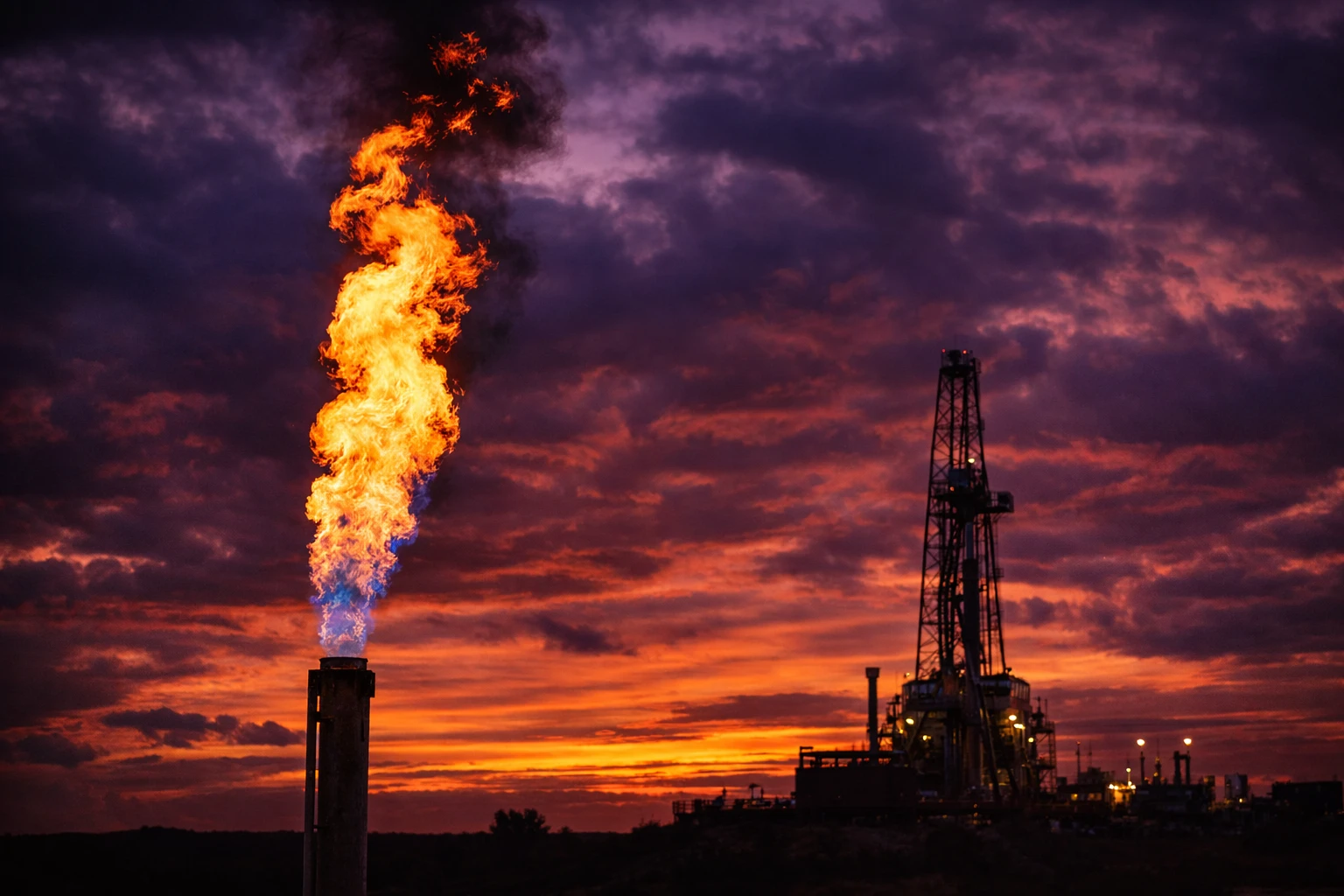
The result is flaring — burning off excess natural gas that cannot be transported — at five-year highs. Seasonal pipeline maintenance later this year is expected to tighten takeaway capacity further, with traders suggesting Waha could reach -$10 when that maintenance restricts flows. Double E Pipeline LLC is seeking long-term shipper commitments for a proposed expansion of its interstate pipeline system pulling gas from the Permian Basin — an infrastructure response to the structural mismatch that is years away from resolution. California's gas market tells the opposite story: SoCal Border and SoCal Citygate prices spiked above $10 per MMBtu in January during peak winter demand, reflecting that the same gas that cannot find a home at Waha becomes extremely valuable just a pipeline connection away in the right market conditions.
Read More
-
Yen Stalls at 160 Despite a 3% JGB and Tokyo Core CPI at 2.0% — Intervention Sits at 164, Friday's Payrolls Decide
02.09.2026 · TradingNEWS ArchiveEnergy
-
QQQ ETF ($706.22) Slides 7.4% Below Its High as the Market Reprices the AI Capex Bill — $686.57 Target if $700 Breaks
22.10.2026 · TradingNEWS ArchiveStocks
-
XRPI ($7.00) and XRPR ($10.74) Slide Toward 52-Week Lows as Spot XRP ETF Flows Stall at $708,510
22.10.2026 · TradingNEWS ArchiveCrypto
-
NG ($2.775) Decoupled From Europe’s €88 Gas Crisis as LNG Feedgas Hits 18.9 Bcf/d — $3.30 Upside on Cold Weather
22.10.2026 · TradingNEWS ArchiveCommodities
-
Dollar-Yen (157.35) Loses 157.65 as the Yen Rallies on Haven Demand — 155 Target if 156 Breaks
22.10.2026 · TradingNEWS ArchiveForex
Qatar's Force Majeure Declaration and the 17% LNG Export Capacity Loss That Could Last Five Years
The geopolitical damage to global LNG supply is not abstract — it has a specific number, a specific location, and a specific timeline that makes the current European and Asian gas price spike structurally different from prior energy market shocks. QatarEnergy has declared force majeure on certain long-term LNG contracts, citing Iranian strikes that damaged Ras Laffan Industrial City and sidelined approximately 17% of Qatar's LNG export capacity. The critical detail is the repair timeline: estimates suggest restoration may take up to three to five years. This is not a shipping disruption that resolves when the Strait of Hormuz reopens. It is physical infrastructure destruction to the world's largest LNG export complex that will reduce Qatar's global supply contribution for years regardless of what happens diplomatically in the coming weeks.
QatarEnergy listed buyers in Italy, Belgium, South Korea, and China among those with contracts now disrupted. These are not marginal purchasing countries — they include two major EU economies and two of the world's largest LNG-importing nations. Italy and Belgium both feed European regas terminals that have been critical to Europe's effort to replace Russian gas since 2022. South Korea and Taiwan, as Shell's Cedric Cremers noted, are particularly exposed because they produce much of the world's semiconductors and face the prospect of energy rationing affecting manufacturing output at the exact facilities that the global technology supply chain depends on most critically. South Korea and Taiwan have both signaled preparation to rely more heavily on coal for electricity generation — returning to the 2022 playbook of fuel switching that coal producers and power plant operators in both countries had hoped was permanently behind them.
The 17% capacity loss from Qatar alone represents a structural supply reduction in global LNG markets that independent supply additions cannot quickly offset. Qatar is the world's largest LNG exporter by a significant margin. Losing 17% of that capacity for three to five years does not create a temporary spike in gas prices — it creates a multi-year baseline elevation in the market clearing price for LNG, particularly in Asia and Europe where Qatar supply is contractually dominant. Shell's CEO Wael Sawan warned explicitly that Europe could face shortages "by next month" — and Shell's integrated gas head Cedric Cremers stated that geopolitical jolts of this type "send the wrong signals to customers" regarding the reliability and cost of gas over the long run. That last comment is significant not just for its near-term implications but for what it signals about the strategic investment calculus of LNG customers who will now be incentivizing domestic production, alternative energy sources, and supply diversification at a pace that would not have been economically justified before this disruption.
European Dutch TTF at €53–54/MWh, Storage at 28.5%, and the Summer Refilling Crisis That Has No Easy Solution
Dutch TTF natural gas, the European benchmark, briefly cleared 60 euros per megawatt hour on Monday before easing to 53–54 euros on Tuesday — a level that remains more than double its pre-war price of approximately 26 euros and 85% above where it stood on February 28 when the war started. European gas jumped as much as 35% on a single day last week to approximately 70 euros per megawatt hour at its peak — a single-session move that rivals the most dramatic days of the 2022 Russian invasion of Ukraine energy shock, though it remains far short of the record 345 euros per megawatt hour seen in August 2022 when European gas storage was at critically low levels and Russia's Nord Stream disruption was at its most acute.
The current 28.5% European storage level is the number that concentrates minds at every energy ministry in the EU. Europe fills storage from spring through summer to build the reserves needed to survive the following winter. The summer refilling season typically requires sustained net injections from approximately April through October. Starting that process at 28.5% after a heating season that drew down reserves — while simultaneously facing reduced LNG supply from Qatar and constrained Hormuz passage — puts Europe in a position where achieving adequate pre-winter storage levels requires either substantial additional LNG supply or significant demand destruction. Neither option is cost-free or guaranteed. Australia's Santos contributed to the tightness by shutting its Darwin LNG plant for scheduled maintenance, cutting off additional spot supply at precisely the moment European buyers need every available cargo. Santos shares fell 2.6% on the announcement — a market verdict that the maintenance timing is damaging to the company's commercial relationships with buyers who cannot afford supply shortfalls.
The structural difference between gas and oil in terms of crisis response capability is what makes European gas markets more vulnerable than oil markets to the same geopolitical shock. Rerouting crude oil cargoes is a matter of logistics and price negotiation — a tanker destined for one port can change course with 48-72 hours notice and appropriate commercial adjustments. Rerouting LNG involves specialized cryogenic vessels, dedicated receiving terminals with specific unloading capabilities, and regasification infrastructure that cannot be deployed or expanded on short notice. The Dutch central banker Olaf Sleijpen flagged the amplification risk specifically: this shock could ripple faster than 2022 because "both households and companies are quicker to react to energy inflation now" — meaning demand destruction from consumption behavioral change and fuel switching accelerates faster than in 2022, but so does pricing in of the full supply risk premium. Glencore's Maxim Kolupaev maintains that existing LNG flows can cover demand if redirected — but "if redirected" is doing a lot of work in that statement, and the force majeure from QatarEnergy is precisely the scenario where redirection cannot compensate for actual supply destruction.
Asian LNG at $26/MMBtu Going to $30 in Summer and Potentially $40 If Hormuz Stays Shut — Fuel Switching, Four-Day Workweeks, and Coal Comebacks
Asian LNG spot prices at $26 per MMBtu represent a 143% increase since February 28 — the largest percentage surge of any energy benchmark during the war period, surpassing both Brent crude's 55% gain and European gas's 85% advance. The speed and magnitude of Asian LNG price appreciation reflects the structural reality that Asia is the most price-sensitive LNG market in the world because it has the least alternative infrastructure. European buyers can, with significant cost and disruption, draw on Norwegian pipeline gas, remaining Russian flows through certain corridors, North African supply, and accelerated deployment of onshore renewable capacity. Asian economies dependent on LNG have fewer immediate substitution options.
Analysts have issued specific forward price targets based on Hormuz closure duration: above $30 per MMBtu in summer if the Strait remains closed, and potentially above $40 per MMBtu if the disruption extends six months. The $40 scenario at Asian LNG terminals would represent prices not seen since the 2022 peak in European markets — but applied to the world's most LNG-dependent industrial economies including Japan, South Korea, and Taiwan. The fuel switching response is already underway across Asia in ways that document demand destruction at scale. Thailand has ordered coal-fired power plants to operate at full capacity. Bangladesh has boosted coal consumption at utilities. South Korea and Taiwan — the semiconductor manufacturing nations — are both preparing increased coal dependency. The coal comeback that decarbonization policy had spent the prior decade working to reverse is happening in real time across Asian economies that cannot afford the alternative of industrial shutdowns.
Henning Gloystein of Eurasia Group summarized the competitive dynamics with precision: "Asia is in full price competition, with any country that can switch from gas to coal doing so." That statement has significant implications for coal mining companies, coal shipping logistics, and carbon emissions trajectories that extend well beyond the immediate natural gas price discussion. Countries implementing four-day workweeks to reduce commercial energy consumption — an extreme demand response measure not seen since the 1970s oil embargo in some markets — are providing the most direct evidence that $26 per MMBtu Asian LNG is already creating economic disruption that policy makers are treating as emergency conditions.
ConocoPhillips CEO Says Gas Headwinds Are Now Tailwinds — The LNG Export Story That Will Drive Recovery Even in a Bearish Domestic Market
ConocoPhillips CEO Ryan Lance made the most important long-term observation about Natural Gas Futures at Henry Hub in a statement that markets are not yet pricing: "whether the war with Iran comes to a swift end, a lift in global natural gas futures is likely locked in with limited production on the horizon." That statement is a specific prediction about the structural medium-term floor for Henry Hub, and it deserves serious analytical weight because of who is saying it and the information asymmetry they possess. Ryan Lance runs one of the largest independent natural gas producers in the United States. His visibility into production trajectories, export capacity additions, and long-term supply curves is superior to any financial analyst modeling the market from outside.
The LNG export capacity picture supports Lance's optimism in a way that the current Henry Hub price of $2.92 completely ignores. Cheniere Energy, the U.S.'s top LNG exporter, is already operating beyond its listed capacity — and CFO Zach Davis stated no significant additional output increase is possible until later this year when new expansion trains come online. Venture Global's CEO Mike Sabel noted that 31% of the company's production in 2026 is not locked into long-term contracts, providing flexibility to offer short-term spot cargoes at premium prices into the disrupted European and Asian markets. The IEA projected a 7% increase in global LNG output in 2026 before the Iran war began, primarily driven by U.S. capacity additions — which means the structural direction of travel for U.S. natural gas exports is firmly higher, and higher exports reduce the domestic oversupply that is keeping Henry Hub at $2.92.
The math on export absorption is straightforward: every LNG cargo loaded at Sabine Pass or Corpus Christi represents approximately 3.3 billion cubic feet of natural gas withdrawn from the U.S. supply pool. Current U.S. LNG export capacity has been running at record utilization. When additional capacity comes online later in 2026 — the trains that Cheniere's CFO referenced — the pull on Henry Hub supply increases. The combination of seasonal spring shoulder demand decline pushing prices lower in the immediate term and structural LNG export demand growth tightening the supply balance into the fall and winter creates the classic energy market setup where near-term bearish pressure and medium-term bullish pressure are simultaneously valid, and the entry decision depends entirely on the investment horizon.
The 50-Day EMA at $3.35, the $3.50 Resistance Wall, and the $2.50 Bear Target That Domestic Oversupply Could Activate
The technical levels for Natural Gas Futures that define the risk/reward from current price are specific and well-supported by both price history and fundamental supply-demand analysis. The 50-day EMA has dropped to approximately $3.35 — down from $3.47 earlier in March — and is still declining, reflecting that the trend in medium-term momentum has turned against bulls. The $3.50 level represents even more significant resistance, where previous price activity created a substantial supply overhang. To break above $3.50 on a sustained basis — the threshold that would genuinely change the medium-term trend — would require either a direct disruption to U.S. natural gas supply infrastructure (a weather event severe enough to drive emergency heating demand, a significant pipeline outage affecting a major production basin, or a dramatic acceleration in LNG export utilization that rapidly tightens the domestic supply balance) or a resolution to the Iran conflict that produces immediate global energy price normalization and redirects capital flows back into long positions in U.S. gas futures.
At the current trajectory, the $2.80 target that technical analysts have flagged is the path of least resistance. Below $2.80, $2.50 becomes the extended bear scenario — a price level that would represent a near-total elimination of the Iran war risk premium in Henry Hub while European and Asian prices remain structurally elevated by 600-800%. The oversupply in the United States is documented with specific numbers: Permian Basin Waha spot prices have been negative on more than 50% of trading days so far in 2026. Flaring events are at five-year highs. Storage is building at seasonal norms or above in many basins. The shoulder season demand collapse through April and May traditionally depresses Henry Hub prices, and this year that seasonal demand destruction is occurring simultaneously with peak production and constrained export takeaway capacity.
The Global Gas Price Divergence Is the Most Profitable Trade in Energy — But Not the Way You Might Think
The 1:7:9 price ratio between Henry Hub ($2.92), European TTF ($20+), and Asian LNG ($26) should theoretically narrow through arbitrage — buying cheap U.S. gas and shipping it to expensive European and Asian markets. That arbitrage is exactly what U.S. LNG export terminals exist to execute. Every LNG cargo loaded in the Gulf of Mexico at Henry Hub-linked prices and sold into European or Asian spot markets at $20–$26 per MMBtu generates the approximate margin differential between the two price points minus liquefaction costs, shipping, and regasification — approximately $8–$12 per MMBtu of profit on each cargo in the current market environment. That is an extraordinary margin for an energy commodity with historically thin margins in normal operating conditions.
Cheniere (NYSE:LNG) and the other U.S. LNG exporters are the direct financial beneficiaries of exactly this price spread — they are effectively printing money on every cargo in the current environment, constrained only by the physical limits of their export capacity. Shell (NYSE:SHEL) as a major integrated LNG producer and trader is similarly positioned. The constraint is not economics — the economics have never been better. The constraint is physical capacity: Cheniere's CFO explicitly stated no significant additional output is possible until later in 2026. The infrastructure bottleneck that keeps Henry Hub at $2.92 despite $20+ TTF is the same infrastructure bottleneck that makes the LNG exporter equity thesis so compelling on a multi-year horizon as capacity additions come online.
The Verdict on Natural Gas Futures at Henry Hub: Sell Rallies to $2.95–$3.07, Buy the $2.80–$2.85 Support Zone for a Seasonal Trade, Own LNG Exporters for the Structural Play
Henry Hub Natural Gas Futures: Bearish near-term. Sell any rally toward $2.95–$3.07 with a stop above $3.25. Target $2.80 first, $2.50 as the extended domestic oversupply scenario. Buy the $2.80–$2.85 zone for a tactical bounce trade targeting $3.05–$3.10 with a tight stop at $2.75.
European TTF and Asian LNG: Structurally Bullish. The Qatar capacity loss is not a headline risk — it is a multi-year supply reduction affecting 17% of the world's largest LNG exporter. European storage at 28.5% heading into the summer refilling season with reduced LNG supply creates the conditions for TTF to retest the 60+ euro level and potentially spike above 70 euros per megawatt hour if summer demand exceeds refilling capacity. Asian LNG at $26 going to $30–$40 in the summer-to-winter scenario is the most credible commodity price forecast in the current energy complex.
Equity expression: Long Cheniere (NYSE:LNG) as the pure-play U.S. LNG export beneficiary of the current price differential. Long Shell (NYSE:SHEL) for integrated LNG exposure with significant long-term contract book and trading flexibility. Both are benefiting directly from the price spread that keeps Henry Hub at $2.92 while their export-linked revenues are priced against $20+ TTF or $26+ Asian spot. The infrastructure investment story behind U.S. LNG expansion — longer-dated, higher conviction — is the most straightforward way to express the ConocoPhillips CEO's observation that "headwinds have become tailwinds" regardless of whether the Iran war ends tomorrow or extends for six months.