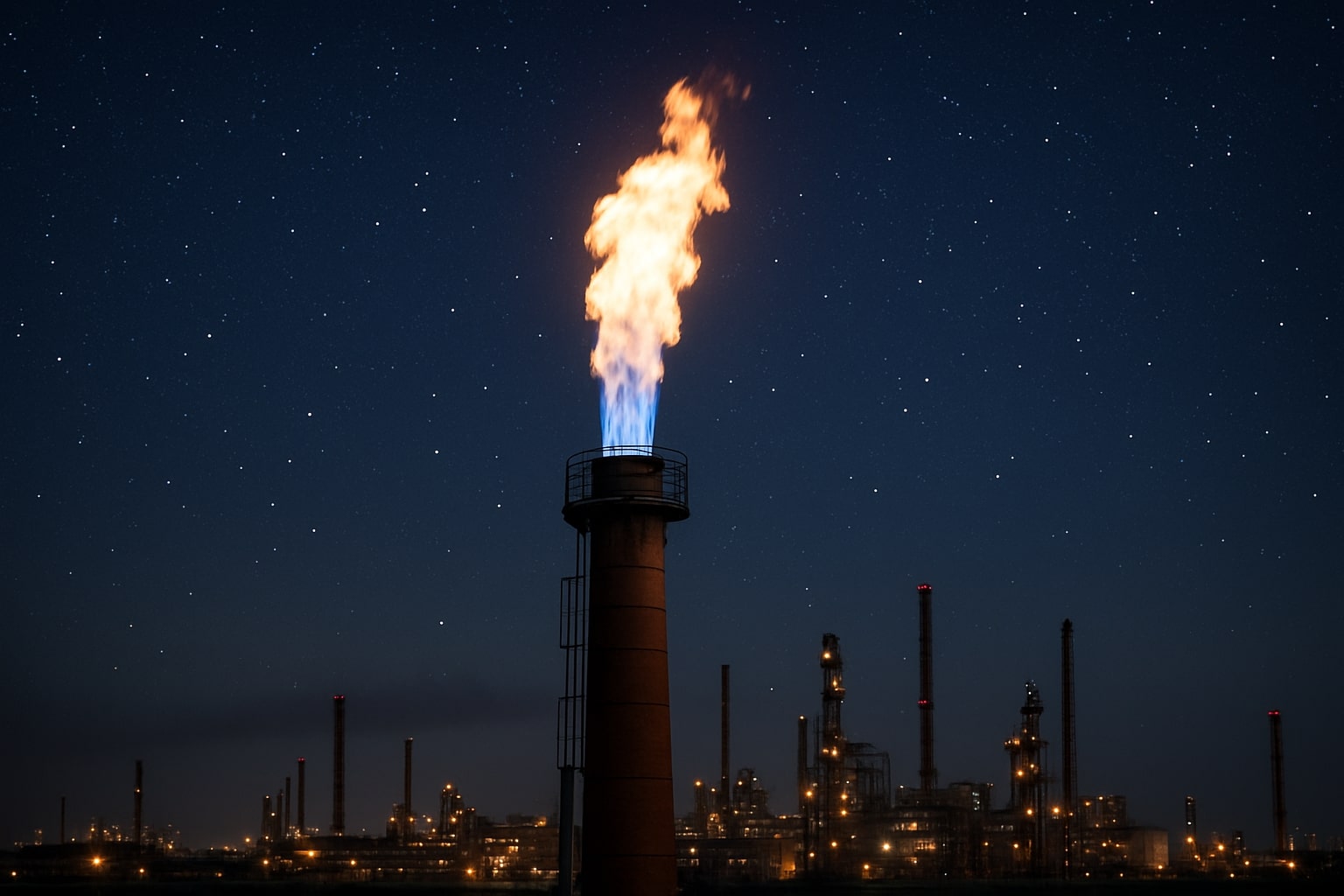
Natural Gas Price (NG=F) Nears $5.00 as Arctic Cold, Record LNG Exports, and Tight Supply Fuel a Bullish Winter Surge
Henry Hub natural gas climbs to $4.975/MMBtu, its highest since 2022, as freezing U.S. weather and record LNG shipments
Natural Gas (NG=F) Prices Surge Toward $5.00 as Cold Wave, LNG Exports, and Coal Switch Drive Energy Market Repricing
The U.S. natural gas benchmark (NG=F) has climbed sharply to $4.975 per MMBtu, its highest level since 2022, extending a powerful rally that began in September. Futures have now risen over 40% since late Q3, propelled by extreme winter weather, record LNG exports, and a renewed structural shortage in domestic inventories. The latest move marks a near 50% price increase year-over-year, with analysts forecasting an additional 13% rise through 2026 as export demand outpaces new production capacity.
Cold Weather Shock and Rising Power Demand Reshape NG=F Dynamics
The arrival of an Arctic cold front across the Midwest and Northeast has accelerated heating demand, lifting front-month natural gas futures by 2.5% to $4.963/MMBtu on the NYMEX. Power sector data shows natural gas consumption for heating has surged 7% week-over-week, tightening storage levels that were previously at record highs. The price rally from $3.50 in January to nearly $5.00 by early December reflects a sharp shift from oversupply conditions to a constrained winter market. Analysts at major energy firms report that the January contract is testing resistance at $5.00, with a confirmed breakout potentially opening targets of $6.50 to $7.00.
LNG Export Boom Tightens Domestic Supply
U.S. liquefied natural gas exports have reached an all-time record of 750 million metric tons in 2025, with demand from Europe and Asia absorbing available supply before the peak winter season. Export terminals including Cheniere Energy’s Sabine Pass and Corpus Christi facilities have operated at near 100% utilization. New projects from Sempra and Venture Global are expected to add capacity in 2026, further tightening the balance between domestic consumption and export obligations. The Biden and Trump administrations’ bipartisan support for expanding LNG sales abroad has strengthened America’s role as the global supplier of last resort but has also intensified competition for feedgas, pushing prices higher for U.S. utilities.
Coal-Fired Power Rebounds as Gas Becomes Costlier
Natural gas now accounts for roughly 42% of U.S. electricity generation, but as Henry Hub prices approach $5.00, many utilities are reverting to coal to curb costs. Coal-fired output rose 21% in Q1 2025 compared with 2024 and climbed another 16% in October–November, marking the highest seasonal use since 2022. Gas-fired generation, by contrast, fell 3% year-over-year in November — the lowest output for that month in three years. As coal emits 75% more CO₂ per kWh than natural gas, this shift undermines emission targets but remains a practical response to rising energy costs. The U.S. Energy Information Administration (EIA) projects the 2025 annual average gas price paid by power plants to rise 37%, with industrial users seeing 21% increases year-over-year.
Regional Prices Reflect Intensifying Tightness Across North America
Benchmark hubs across the continent mirror the national trend. Algonquin Citygate prices surged to $8.37/MMBtu, while AECO in Canada surpassed C$3.00 per gigajoule, the strongest rally since early 2023. Western Canada’s inventories have finally begun to draw down as cold weather and LNG export commitments drain reserves. In the U.S., Southern Natural reported price gains exceeding 58 cents to $5.28/MMBtu, the largest December increase in three years. The AECO benchmark now reflects a broad tightening, supported by accelerated pipeline flows toward LNG Canada’s export terminals.
EIA and Market Forecasts Point to Sustained Strength
The EIA expects Henry Hub natural gas spot prices to average $4.00/MMBtu in 2026, about 16% above 2025, driven by stable exports and stagnant production. Futures markets currently price $4.24/MMBtu through March 2026, confirming market expectations of prolonged tightness. Long-range data also indicate that this marks the third consecutive annual rise in U.S. natural gas prices, the first such streak since 2019–2021. Analysts note that without a significant production boost from the Permian or Appalachia, the current structural imbalance could extend into 2027.
European Markets React to U.S. LNG Flood While TTF Slips
Across the Atlantic, Europe remains well-supplied due to record U.S. LNG imports. The Dutch TTF benchmark trades near €27.92 per MWh, down 12% on the month, despite storage levels slipping below 75% capacity. Europe’s mild winter forecasts and diversified LNG access have offset fears of shortage following the EU’s decision to ban Russian gas imports by 2027. Analysts note that while the policy reshapes long-term trade flows, it has little immediate effect, as Russian pipeline volumes have already declined by 90% from their 2016 peak.
Production and Policy: Balancing Export Expansion with Domestic Stability
The Trump administration’s continued support for the coal sector and expanded LNG trade has created competing pressures between export profitability and domestic affordability. The U.S. power sector, constrained by limited storage flexibility, faces difficult trade-offs as export terminals divert a growing share of feedgas. The EIA forecasts that coal inventories will end 2025 at 107 million short tons, 17% lower than 2024, underscoring the strain across both energy inputs. Utilities increasingly view rising emissions as a necessary cost to maintain grid stability during peak demand months.
Technical Setup and Trading Strategy for NG=F
Technically, NG=F shows a clear bullish trend with strong support at $4.60 and resistance near $5.00. The price structure remains constructive, with traders identifying $5.00 as a critical psychological breakout point. If this threshold breaks decisively, upward extensions toward $6.50–$7.00 become plausible before the end of winter. Market participants continue to favor buying on pullbacks rather than chasing rallies, as volatility remains high. The Relative Strength Index (RSI) sits at 63, suggesting the market is trending strongly but not yet overbought.
Read More
-
Yen Stalls at 160 Despite a 3% JGB and Tokyo Core CPI at 2.0% — Intervention Sits at 164, Friday's Payrolls Decide
02.09.2026 · TradingNEWS ArchiveEnergy
-
SOFI ($16.71) Posts Its Best Day of the Quarter as Profit Guidance Finally Rises — Holding $15.70 Unlocks $20
27.10.2026 · TradingNEWS ArchiveStocks
-
XRP-USD ($1.30) Defends a $1.27 Double Bottom as Whales Hold 68.5% of Supply — Break of $1.31 Opens $1.35 and $1.40
27.10.2026 · TradingNEWS ArchiveCrypto
-
Brent ($113.88) Trades a $2.35 Range as Houthi Strikes Meet Saudi-Iran Diplomacy — Break of $117 Unlocks $120
27.10.2026 · TradingNEWS ArchiveCommodities
-
Nasdaq Rips 1.3%, S&P 500 Hits 7,728, Dow Stalls as BA Drops to $171
27.10.2026 · TradingNEWS ArchiveMarkets
-
GBP/USD (1.3310) Can’t Cash In on 5.43% Gilt Yields as Budget Risk Meets a Firm Dollar — Break of 1.3274 Opens 1.3200
27.10.2026 · TradingNEWS ArchiveForex
Macro Environment and Global Outlook
Globally, the balance between LNG exports, European storage, and Asian winter demand dictates near-term direction. China and Japan remain key importers, with both securing record forward contracts through 2026. The anticipated ramp-up of Eni’s Congo LNG Phase 2 and Qatar’s North Field expansion in early 2026 will add incremental supply, but not enough to offset record global consumption. The International Energy Agency estimates global LNG demand will rise 4.7% in 2026, keeping upward pressure on U.S. benchmark prices.
Final Assessment: NG=F Maintains Bullish Bias with Tight Supply and Strong Export Demand
Given the combination of record LNG shipments, domestic supply constraints, weather-driven demand, and persistent coal substitution, the outlook for Natural Gas (NG=F) remains bullish. With futures trading near $4.975/MMBtu and potentially breaking the $5.00 ceiling, structural market fundamentals point to a sustained rally. The medium-term projection sees average 2026 prices at $4.15–$4.25, with high volatility into Q1 2026. The decisive breakout scenario above $5.00 would confirm momentum toward $6.50, supported by global supply tightness and North American demand strength. Based on current fundamentals, NG=F is rated Buy, with strong upside bias through winter 2026 as gas markets enter a renewed supercycle driven by export-led scarcity.