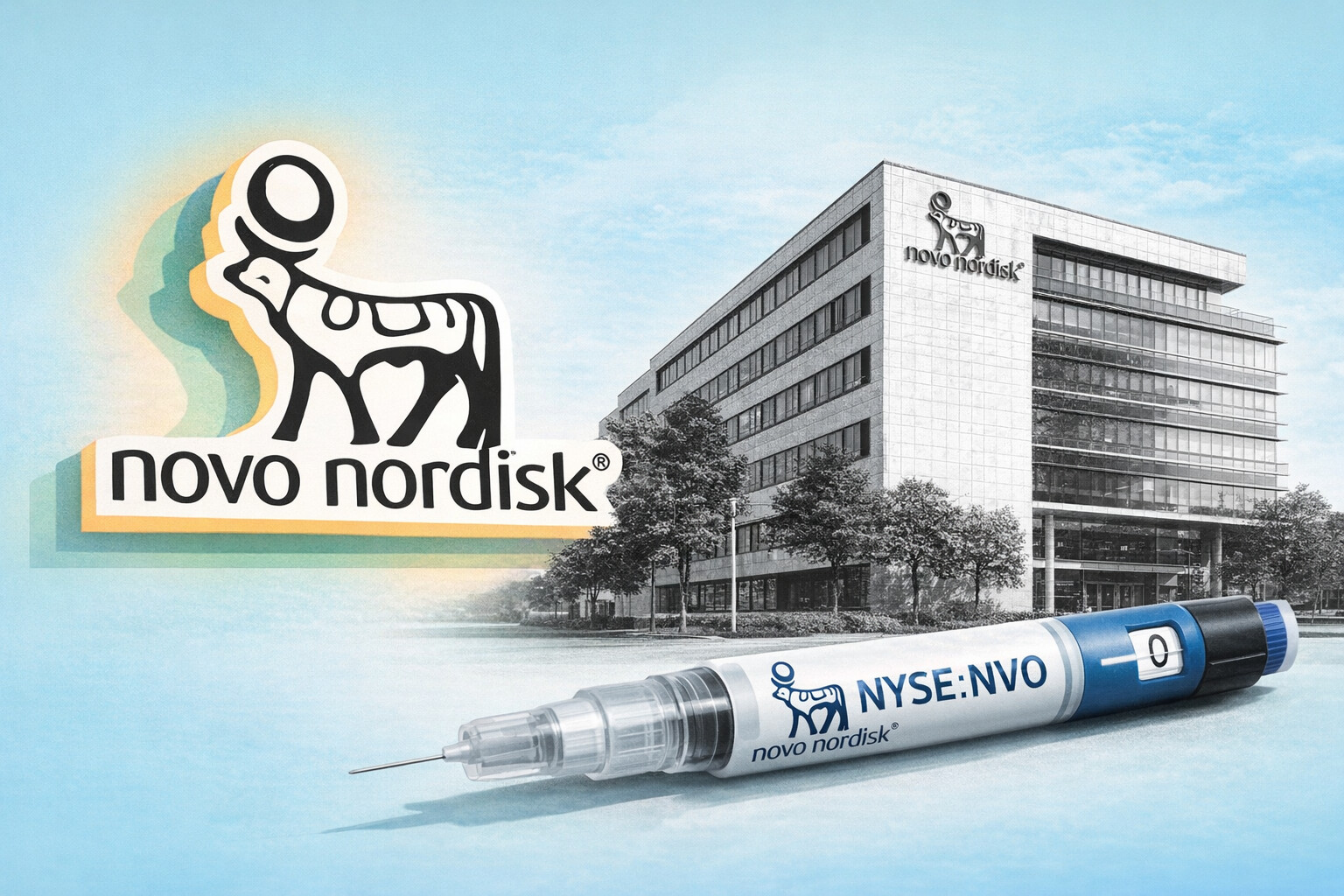
Novo Nordisk Stock Price Forecast - NVO Wegovy Pill Ignites A Rebound From The $43–$93 GLP-1 Rollercoaster
With NVO back near $58 after a 2025 crash, investors are re-pricing Wegovy pill adoption, CagriSema parity with Zepbound, Amycretin’s 20%+ weight-loss data and a post-Catalent margin rebuild | That's TradingNEWS
NYSE:NVO – GLP-1 Reset, Wegovy Pill And Valuation Reboot
NYSE:NVO – From Obesity Super-Star To Deep Correction
NYSE:NVO trades around $58.53, down roughly 38% from the $93.80 52-week high and above a $43.08 low. Market cap is about $200.3B, with a P/E near 16x and a 2.95% dividend yield. After the 2025 blow-off in GLP-1 expectations, the stock was hit by three simultaneous shocks: brutal multiple compression, share loss to Eli Lilly’s Zepbound and compounders, and U.S. drug-pricing headlines focused on GLP-1 costs. At the bottom the market was effectively pricing in no further GLP-1 growth and structurally weaker margins, which is completely inconsistent with the demand reality in obesity and diabetes. The current rebound of more than 40% off the lows is the market slowly repricing from “broken story” back toward a platform-company narrative, but valuation still sits far under the 2024 hype zone.
Obesity Engine: Wegovy Pill Changes The NYSE:NVO Growth Math
The Wegovy pill is not a cosmetic add-on; it is a structural shift in how NYSE:NVO monetises semaglutide. Phase 3 data for the 25 mg oral dose delivered about 16.6% average weight loss over 64 weeks, essentially in line with the 15–17% range seen with Wegovy injections, removing the old doubt that an oral GLP-1 would be meaningfully weaker. U.S. launch on January 5 came with aggressive cash pricing: starter doses around $149/month, maintenance near $299/month, versus $500–$1,000/month many patients currently pay for Zepbound or compounded semaglutide. On paper that looks dilutive, but pills are cheaper to manufacture, distribute and store than refrigerated pens, especially once scale is reached. The strategy is explicit: crush the grey market, undercut injectables, onboard a much broader, needle-averse population and then keep those patients in the Novo ecosystem for 5–10 years of chronic therapy. Short term, consensus bakes in about -2% obesity revenue in 2026 as cannibalisation masks volume growth. Medium term, if oral volumes reach >2x the units lost from injections, revenue and profit both rise even at lower price points because capacity and mix improve.
CagriSema: High-Efficacy Combo To Close The Gap With Lilly
CagriSema is the second major leg of the NYSE:NVO GLP-1 strategy. The REDEFINE-1 trial delivered around 22.7% mean weight loss, essentially matching Lilly’s Zepbound rather than trailing it. The stock reacted negatively when CagriSema missed an internal 25% stretch goal, but that reaction ignored the competitive reality: if Novo offers similar efficacy with a differentiated profile, it has enough firepower to defend share. Early data suggest the amylin component could preserve lean muscle more effectively than GLP-1 alone, which gives Novo a marketing angle around “quality of weight loss” rather than just the headline percentage. Timelines point to a potential late-2026 approval path. When combined with the nine-month head-start in orals, that keeps Novo competitive across both the mass-market and high-end obesity segments instead of being permanently relegated to second place behind Lilly.
Amycretin: Long-Dated Optionality For The 2030s
Further out, Amycretin is the true “endgame” asset in the NYSE:NVO story. It is a unimolecular dual-agonist rather than a cocktail, which simplifies manufacturing and improves stability. Early mid-stage data show weight loss of roughly 22% at 36 weeks with no visible plateau, suggesting potential to approach or exceed 30% over longer treatment periods. The oral Amycretin trials delivered Wegovy-pill-like outcomes in about half the time, indicating a much steeper efficacy curve. Phase 3 kicks off this quarter. If those results confirm the trajectory, Novo effectively refreshes its franchise again in the early 2030s, extending a high-margin obesity and metabolic cash machine well beyond the current Wegovy/CagriSema cycle. The market is not paying full price for this optionality at a ~16x P/E, especially given how sensitive GLP-1 names have been to any data point – upside optionality is being heavily discounted.
Manufacturing Scale, Catalent Integration And Supply Risk For NYSE:NVO
A critical failure in the first Wegovy wave was capacity. NYSE:NVO could not produce enough pens to satisfy demand, leaving a hole that compounders and Lilly happily filled. That is now being systematically addressed. The acquisition and integration of Catalent sites gives Novo control over key bottlenecks and is expected to double U.S. supply chain capacity by mid-2026 versus 2024. Pills are structurally less complex than injection pens: no cold chain, simpler packaging, higher throughput per line. Management has guided for CapEx intensity to peak as new factories are completed and then fall back, which supports margin expansion from 2027 onward as the new manufacturing base is fully loaded. If execution is solid, the market rerates NYSE:NVO from “chronically supply constrained” to “scaled industrial GLP-1 platform” – a very different valuation framework.
Competitive Landscape: Eli Lilly Versus NYSE:NVO In GLP-1
The biggest external risk to NYSE:NVO remains Eli Lilly (LLY). Lilly currently leads the U.S. obesity market with Zepbound and is working on its own oral GLP-1 and triple-agonist Retatrutide with potential 28–30% weight-loss outcomes. Consensus right now effectively assumes that Novo’s pill does not materially dent Lilly’s revenue trajectory: street models continue to show ~30% growth for Lilly’s obesity franchise in 2026 while expecting a mid-teens revenue drop for Novo in some segments. That gap is unlikely to be sustainable. Either Novo’s pill and pipeline gain more share than currently modelled, or Lilly’s growth path has to be revised down once oral competition bites. Novo’s edge is breadth: a low-price Wegovy pill anchoring the mass market, injectable Wegovy and CagriSema playing higher up, plus long-dated Amycretin optionality. The trade-off is that Lilly may still lead in absolute peak efficacy with next-gen triples. The equity question is simple: at ~16x earnings with visible growth drivers, NYSE:NVO already discounts a lot of competitive pain; Lilly does not.
Regulation, IRA And U.S. Political Risk Around NYSE:NVO
Regulatory and political risk is real and cannot be hand-waved away. Under the Inflation Reduction Act, Ozempic is slated for the next round of Medicare price negotiations, with deeper cuts expected around 2027. Parallel to that, Trump’s healthcare push and “Great Healthcare Plan” rhetoric has sharpened attention on high-profile GLP-1s, especially from “foreign drugmakers”. That is precisely the type of language that pressured NYSE:NVO in 2025. Two points matter. First, a large portion of obesity usage is outside Medicare; commercial and cash-pay segments remain central, and the $149–$299 Wegovy pill pricing is clearly designed to be politically defensible. Second, if policymakers focus on total system costs, broad GLP-1 adoption can be framed as preventive: lower rates of cardiovascular events, fewer diabetes complications and reduced bariatric surgery demand. That narrative, combined with Novo’s U.S. manufacturing footprint, makes an outright hostile policy outcome less likely. Risk is there, but the stock already trades at a discount multiple relative to its growth and margin profile, which builds in part of that overhang.
Read More
-
Yen Stalls at 160 Despite a 3% JGB and Tokyo Core CPI at 2.0% — Intervention Sits at 164, Friday's Payrolls Decide
02.09.2026 · TradingNEWS ArchiveEnergy
-
SOFI ($16.71) Posts Its Best Day of the Quarter as Profit Guidance Finally Rises — Holding $15.70 Unlocks $20
27.10.2026 · TradingNEWS ArchiveStocks
-
XRP-USD ($1.30) Defends a $1.27 Double Bottom as Whales Hold 68.5% of Supply — Break of $1.31 Opens $1.35 and $1.40
27.10.2026 · TradingNEWS ArchiveCrypto
-
Brent ($113.88) Trades a $2.35 Range as Houthi Strikes Meet Saudi-Iran Diplomacy — Break of $117 Unlocks $120
27.10.2026 · TradingNEWS ArchiveCommodities
-
Nasdaq Rips 1.3%, S&P 500 Hits 7,728, Dow Stalls as BA Drops to $171
27.10.2026 · TradingNEWS ArchiveMarkets
-
GBP/USD (1.3310) Can’t Cash In on 5.43% Gilt Yields as Budget Risk Meets a Firm Dollar — Break of 1.3274 Opens 1.3200
27.10.2026 · TradingNEWS ArchiveForex
Financial Profile, Margins And Valuation For NYSE:NVO
On current numbers NYSE:NVO sits at roughly 15–16x GAAP earnings, versus historical peaks well above 30x, despite still being one of the most profitable names in large-cap pharma. Reported gross margin is above 80%, net margin sits in the low-30s and EBITDA margins are expected to remain >47% even through the pill-driven price reset. Free cash flow yield is in the mid-single digits (around 4–5% depending on the year) and should step up as Catalent-driven CapEx falls after 2026. One detailed DCF framework from the coverage you provided assumes moderate revenue growth, margin expansion from the shift to pills and lower CapEx, and still derives roughly 124% upside from today’s price with a fair value north of $100 per ADR under reasonable discount-rate and terminal-growth assumptions. Even when stress-testing with a higher WACC (~7.6%) and lower terminal growth (~1.8%), implied value remains near $105, almost 80%+ above the current $58–59 trading band. For a business growing obesity and metabolic revenue at double-digit rates over the medium term, that valuation is difficult to reconcile with the fundamentals.
Technical And Trading Setup Around NYSE:NVO
Technically, NYSE:NVO has moved from a falling-knife structure in 2025 to a recovery trend. Price bottomed near the low-$40s, then rallied more than 40% to the current high-$50s. The prior resistance zone around $60–62 now acts as the first test area; sustained closes above that band would open room toward the mid-$70s where heavier supply from the old breakdown sits. On the downside, the $55–56 region is the first meaningful support, with a more important structural floor around $50. From a trading perspective, the name has shifted from “do not touch” to a constructive risk/reward: you are buying an industry leader after capitulation, not chasing a parabolic move at 40–50x earnings.
Insider Behaviour, Ownership And Signals For NYSE:NVO
For tracking management and insider stance in NYSE:NVO, the relevant datapoints sit in the dedicated insider and profile sections. Any cluster of insider buying after the 2025 collapse would reinforce the view that internal confidence in the Wegovy pill, CagriSema and Amycretin pipeline is high, while persistent net selling into the rebound would argue for more caution. For up-to-date detail, use the official insider page: NVO insider transactions and the broader stock profile to monitor changes in major holders, buyback activity and capital-return policy. The combination of a ~3% dividend yield, ongoing repurchases and high free-cash-flow conversion is consistent with a shareholder-friendly stance, which is exactly what you want when the market is still sceptical.
Investment View On NYSE:NVO – Buy, Sell Or Hold
Putting the pieces together – a $58–59 share price, $43–94 52-week range, ~16x P/E, ~3% yield, Wegovy pill launch, CagriSema parity with Zepbound, Amycretin as long-dated upside, doubled U.S. capacity post-Catalent and margins still north of 30% – the risk/reward is tilted in favour of the long side. Competitive and political risks are real, but they are already reflected in the de-rating; the market is pricing NYSE:NVO closer to a mature pharma than to a structurally advantaged obesity platform with multi-year volume growth and expanding manufacturing leverage. Based strictly on the data, pipeline and current valuation, the stance is clear: NYSE:NVO is a Buy, not a Hold, with upside driven by faster-than-modelled Wegovy pill adoption, CagriSema approval and eventual Amycretin scaling, while the downside is cushioned by premium margins, strong cash generation and a balance sheet capable of absorbing policy and pricing shocks.