NVDA Holds $200 as Jensen Huang Declares "Profitability Era" and Vera Rubin Ships — Forward P/E 19.3, Analysts Eye $298.93 and a 50% Rally
Nvidia rose 1.5% on Micron's record quarter and a Bernstein "absurdly cheap" call, sitting 15% under its $236.54 peak | That's TradingNEWS
Key Points
- Nvidia NVDA holds near $200, up ~1.5% on the chip rally, 15% below its $236.54 all-time high; market cap ~$4.85T.
- FY2026 revenue rose 65% to $216B; Q1 FY2027 data center sales jumped 92% to $75B with $49B free cash flow.
- 62 analysts rate NVDA Strong Buy, target $298.93 (+50%), high $500; forward P/E 19.3 sits below the S&P 500.
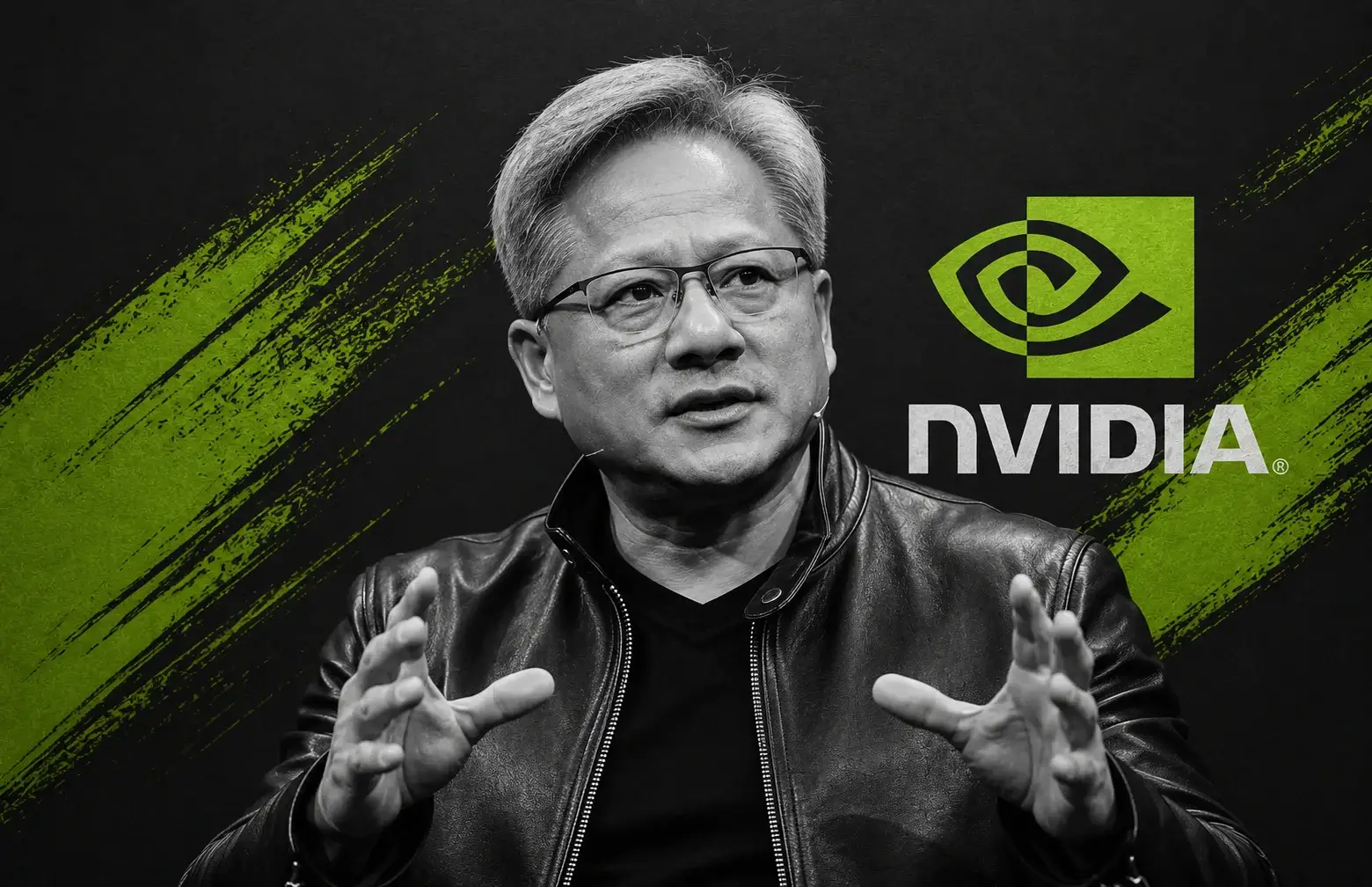
Nvidia is back on offense, and the catalyst came from a rival's earnings report rather than its own. NVDA changed hands near $200 on Thursday, trading a $196.58 to $201.67 band after climbing roughly 1.5% in pre-open action, riding the broad semiconductor rally that Micron's record quarter ignited. The move was stock-specific strength as much as sector lift: the Nasdaq slipped 0.4% and the S&P 500 dipped 0.1% on Apple's price-hike drag, yet the world's most valuable company pushed higher on its own catalysts. With a market value near $4.85 trillion, Nvidia sits about 15% below its $236.54 all-time high set on May 14, 2026, after surviving a brutal week that saw the chip complex crater. CEO Jensen Huang used the company's shareholder meeting to declare that AI has entered a true profitability era and confirmed the next-generation Vera Rubin architecture is moving into full-scale production, reframing the stock's narrative just as the AI trade needed reassurance.
A Rival's Blowout Lifts the King
The Thursday advance was borrowed from Micron, and the irony is sharp. Micron's fiscal third-quarter results, with revenue of $41.46 billion and a record gross margin of 84.9%, reignited confidence across the entire AI semiconductor chain after a week in which the PHLX Semiconductor Index tumbled 8% on Tuesday and Nvidia itself shed more than 4%. When memory stabilized and the AI-spending narrative regained its footing, capital flowed back into the sector's anchor, and NVDA rose even as the broader Nasdaq stayed red.
The rally carried multiple stock-specific tailwinds beyond the sector lift. A Bernstein analyst labeled both Nvidia and Broadcom absurdly cheap in a note published Thursday morning, providing a direct catalyst timed to the session, while evidence of surging real-world GPU demand from SpaceX compute deals reinforced the case that Nvidia's chips remain the indispensable backbone of the AI buildout. The combination gave the market enough conviction to push the stock higher against a softening tech tape.
The pattern reveals how Nvidia now functions as the market's AI bellwether. The stock's resilience after a week of semiconductor carnage signals that the underlying demand thesis survived the valuation scare, and the speed of the recovery underscores how quickly capital returns to the highest-quality name when the AI narrative reasserts. Nvidia did not need its own earnings to bounce; it needed proof that the spending cycle remains intact, and Micron supplied it.
Huang Declares the Profitability Era and Vera Rubin's Arrival
The shareholder meeting on the prior day handed the stock its most important forward catalyst. Huang declared that AI has entered a true profitability era and characterized the current computing shift as the largest industry reset in 60 years, framing autonomous agents as the core engine that will drive compute demand for decades. He confirmed that the Vera Rubin architecture, the successor to Blackwell, is moving into full-scale production, a transition that anchors the company's growth narrative for the coming product cycle.
Huang grounded the vision in concrete financials. He highlighted that fiscal 2026 revenue climbed 65% year over year to $216 billion, with operating profit reaching $130 billion, presenting the results as evidence that AI infrastructure is no longer experimental but fully revenue-generating. The message was deliberate: at a moment when the market questioned whether AI spending would ever pay off, Huang asserted that the returns are already flowing through the income statements of the companies deploying his chips.
The Vera Rubin transition matters more than any single quarter. Unveiled at the company's March 2026 technology conference alongside the Vera CPU, the architecture represents a meaningful step beyond Blackwell in performance, and its move into full production de-risks the next leg of revenue growth. For a company whose valuation depends on sustained data center expansion, the confirmation that the next-generation platform is shipping on schedule removes a key overhang and gives the bull case a tangible product roadmap to point to.
The Numbers Behind the $4.85 Trillion Valuation
Nvidia's fundamentals remain staggering even by the standards of the AI boom. Fiscal 2026 revenue reached $215.94 billion, a 65.47% increase from the prior year's $130.50 billion, while net income surged 64.75% to $120.07 billion, figures that would have seemed impossible for a chipmaker just a few years ago. The company generated these results at a 74.1% gross margin, a level that reflects the pricing power Nvidia commands as the dominant supplier of AI accelerators.
The most recent quarter extended the trajectory. Nvidia's first quarter of fiscal 2027, reported in late May, delivered revenue of $82 billion, up 85% year over year, with adjusted EPS of $1.87 beating the $1.77 forecast. Data center revenue surged 92% year over year to $75 billion, the engine of the entire business, and the company posted a record $49 billion in free cash flow at a 74.9% gross margin. The board responded by authorizing a new share repurchase program and raising the dividend, returning capital even amid heavy reinvestment.
The cash generation reframes the valuation debate. Nvidia's 2026 free cash flow is forecast near $195.4 billion, of which roughly $97 billion could be available for shareholder returns through buybacks and dividends. A company producing nearly $200 billion in annual free cash flow supports an enormous market value on fundamentals rather than speculation, and the scale of the cash flow gives the company the firepower to fund its roadmap, buy back stock, and weather any cyclical wobble in AI demand.
Micron Steals the Margin Crown
One subplot of the week carried a pointed message for Nvidia. The financial commentary noted that Micron stole Nvidia's margin king crown, with the memory maker's 84.9% gross margin eclipsing Nvidia's 74.1%, a milestone that signals how the memory shortage has shifted pricing power toward the suppliers of high-bandwidth memory that Nvidia's chips require. The reversal highlights a genuine tension in Nvidia's cost structure.
The dynamic cuts directly into Nvidia's economics. The same AI-driven memory shortage that lifted Micron's margins to records raises Nvidia's input costs, since high-bandwidth memory is a critical and increasingly expensive component of every AI accelerator. As memory suppliers capture more of the value chain, the question becomes whether Nvidia can maintain its own margins while paying up for the scarce memory that its products depend on.
The relationship remains symbiotic despite the margin shift. Micron's record results were driven by demand from AI chipmakers like Nvidia, and the $100 billion in contracted memory revenue that Micron disclosed reflects the durability of the buildout that Nvidia anchors. The two companies rise together on the AI spending cycle, but the margin crown changing hands is a reminder that the economics of the AI supply chain are evolving, and Nvidia no longer captures every dollar of the value it helped create.
The Valuation Paradox: Cheap on Forward Earnings
The most counterintuitive aspect of the Nvidia story is its valuation. Despite a $4.85 trillion market capitalization, the stock trades at a forward price-to-earnings ratio near 19.3, below the S&P 500, a multiple that reflects the market's expectation of continued explosive earnings growth. On a trailing basis the P/E sits near 30.6, but the forward figure captures why analysts can call the stock cheap even at its enormous scale.
The Bernstein note labeling Nvidia and Broadcom absurdly cheap rests on this math. When earnings grow 65% to 85% year over year, even a high absolute valuation compresses quickly on forward estimates, and a forward multiple below the broad market for the company driving the entire AI revolution strikes many analysts as a disconnect. The valuation case argues that the market is underpricing the durability of Nvidia's growth relative to its dominant competitive position.
The skeptics counter that the forward multiple assumes growth that may not persist. A forward P/E of 19.3 looks cheap only if the 85% revenue growth continues, and any deceleration in AI capex or erosion of market share would expose the stock to a sharp de-rating. The valuation paradox is that Nvidia is simultaneously the cheapest mega-cap on forward earnings and one of the most exposed to a shift in the AI narrative, leaving the multiple a function of conviction in the growth story rather than a settled judgment.
Hyperscaler Capex and the Demand Backdrop
The foundation of Nvidia's growth is the relentless capital spending of the hyperscalers, and the recent corporate signals point to acceleration rather than restraint. Nvidia raised $25 billion in its largest-ever bond deal, drawing $85 billion in orders, a financing move that signals the company is preparing for sustained capacity expansion rather than a near-term peak. The bond demand itself reflects the market's confidence in the durability of the buildout.
The customer commitments reinforce the demand picture. The SpaceX compute deals provided fresh evidence of surging real-world GPU demand, and the broader pattern of hyperscalers and AI labs locking in long-term capacity has insulated Nvidia from the cyclical fears that periodically grip the sector. Micron's $100 billion in contracted memory revenue and the $22 billion in firm financial commitments illustrate the multi-year visibility that now underpins AI infrastructure spending across the chain.
The scale of the spending has reshaped the entire market. AI-related names now account for roughly 40% of total US equity weight, a concentration that makes Nvidia's trajectory a market-wide variable rather than a single-stock story. The hyperscaler capex cycle that drives Nvidia's revenue shows no sign of slowing, with each major AI lab racing to secure compute capacity, and that demand backdrop is the single most important support for the stock's valuation.
The Competition Closes In
Nvidia's dominance is no longer uncontested, and the competitive threats are multiplying. Qualcomm used its investor day to announce a push into data center chips, projecting $15 billion in segment revenue by 2029 with its Dragonfly C1000 CPU and Meta and Microsoft as launch customers, entering a space Nvidia has owned. AMD continues to gain ground with its server-rack offerings, and Broadcom's custom-silicon business has become a meaningful alternative for hyperscalers designing their own chips.
The custom-silicon threat may be the most structural. OpenAI revealed it is making its own computer chips, a processor it calls Jalapeño, and Intel-backed startup SambaNova is raising $800 million to $1 billion as AI server chips that compete with Nvidia's reach record demand. The proliferation of custom ASICs from the very hyperscalers that are Nvidia's largest customers represents a long-term risk to the company's share of the accelerator market, even if Nvidia's general-purpose GPUs remain dominant today.
The competitive landscape has not yet dented Nvidia's economics, but it bears watching. The Bernstein note that called Nvidia cheap also upgraded AMD, signaling that the analyst community sees room for multiple winners as the market expands. Nvidia's response has been to accelerate its roadmap with Vera Rubin and to deepen its software moat, but the entry of Qualcomm, the expansion of AMD and Broadcom, and the rise of in-house silicon mean the company can no longer assume the near-monopoly economics that drove its ascent.
China, Export Controls, and the Gray Market
Geopolitics remains Nvidia's most unpredictable risk, and the China situation has grown more complex. Reports indicate Nvidia's AI chip prices are surging on China's black market as US export controls tighten official channels, with buyers turning to gray-market sources to secure restricted chips. The dynamic illustrates the depth of Chinese demand even as the regulatory walls rise, and it creates both a lost-revenue problem and a compliance headache for the company.
Huang addressed the issue directly at the shareholder meeting. He told shareholders that US national security would come before any commercial opportunity, especially regarding restricted AI chip exports, and warned that smuggled AI chips are a dead end, distancing the company from the gray-market trade. The comments reflect Nvidia's effort to stay on the right side of export policy even as it forgoes a significant portion of the Chinese market that once contributed meaningfully to revenue.
The China overhang caps the upside without derailing the thesis. The export restrictions have removed a large addressable market, and the uncertainty over future policy adds a discount to the valuation, but Nvidia's growth has continued at an 85% pace despite the constraints, demonstrating that demand from the rest of the world has more than offset the China shortfall. The risk is that further tightening, or retaliation, could disrupt supply chains or invite new restrictions, keeping geopolitics a persistent source of volatility for the stock.
The Capex Sustainability Debate
The central question hanging over Nvidia is whether AI capital spending can persist at its current pace, and the market is genuinely divided. The week's selloff was driven by fears that massive AI investments by hyperscalers may generate weaker-than-expected returns, the saturation thesis that periodically grips the sector. The concern is that the buildout has run ahead of the revenue it can ultimately generate, leaving the spending vulnerable to a sharp pullback.
The bulls argue the opposite risk is larger. One market voice contended that AI capex under-investment is a bigger risk than saturation, framing the buildout as still early relative to the eventual demand for agentic AI compute. Huang's profitability-era declaration directly addressed the saturation fear, asserting that the infrastructure is already revenue-generating, and Micron's $100 billion in contracted revenue lends support to the view that demand visibility extends well beyond the current quarter.
The debate defines the stock's risk profile. If the bulls are right and AI spending accelerates as agents proliferate, Nvidia's growth continues and the forward multiple proves cheap. If the bears are right and the buildout outpaces returns, the spending decelerates and Nvidia faces both slower growth and a multiple compression. The AI chip market has been described as the hottest and riskiest to play, and Nvidia sits at the center of that tension, its valuation a direct bet on which side of the capex debate prevails.
The Technical Map: 15% Below the Peak
The chart structure reflects a stock that has corrected but not broken. Nvidia trades near $200, about 15% below its $236.54 all-time high from May 14, and well above its 52-week low near $149.26, leaving it in the upper portion of its annual range despite the recent volatility. The week's recovery off the chip-selloff lows suggests the $196 to $200 zone is acting as near-term support, with the stock stabilizing as the AI narrative reasserts.
The technical signals are mixed across timeframes, capturing the market's uncertainty. Shorter-term momentum indicators have flashed bearish readings after the week's swings, while longer-term measures remain constructive given the stock's powerful uptrend, a divergence that mirrors the fundamental debate between near-term capex fears and long-term growth conviction. The $236.54 record stands as the key resistance, with a reclaim needed to signal the uptrend has fully resumed.
The levels to watch are clear. Support sits in the $196 to $200 zone that held during the recovery, with deeper support near the recent selloff lows and the 52-week low at $149.26 marking the structural floor. On the upside, the stock must clear the $210 to $220 area before challenging the $236.54 all-time high, and a break to new records would open uncharted territory for a company whose market value already exceeds $4.8 trillion. Until then, the stock is likely to consolidate within its range as the market weighs the competing narratives.
Read More
-
Yen Stalls at 160 Despite a 3% JGB and Tokyo Core CPI at 2.0% — Intervention Sits at 164, Friday's Payrolls Decide
02.09.2026 · TradingNEWS ArchiveEnergy
-
QQQ ETF ($739) Fades From an Early Tech Rally as a 77.9 ISM Prices Index Meets Micron's $61.5B Guide — $760 Record Test Ahead
01.10.2026 · TradingNEWS ArchiveStocks
-
XRPR and XRPI Follow XRP's $1.49 Test as Spot Funds Hold 1.16B XRP and a 1 Billion Token Escrow Release Lands — $1.70 in Play
01.10.2026 · TradingNEWS ArchiveCrypto
-
November NG Slips Below $3 as Decade-High Storage Meets Capped LNG Exports — $2.75 in Sight
01.10.2026 · TradingNEWS ArchiveCommodities
-
Dollar-Yen at 158 Presses Toward 160 as a 363 bp Carry Gap Meets Katayama-Bessent Intervention Risk — 159 in Sight
01.10.2026 · TradingNEWS ArchiveForex
The Bull Case: Strong Buy and a Path to $500
The analyst community remains overwhelmingly constructive. Among 62 analysts covering the stock, the consensus rating is Strong Buy, with 59 recommending purchase against a single sell, and the average 12-month price target sits at $298.93, implying roughly 50% upside from current levels. The high estimate reaches $500, reflecting the most aggressive view of Nvidia's growth trajectory, while even the low estimate of $180 sits not far below the current price.
The bull thesis rests on the durability of the AI buildout and Nvidia's central role in it. With fiscal 2026 revenue at $216 billion growing toward an even larger fiscal 2027, data center revenue expanding 92% year over year, and the Vera Rubin architecture entering full production, the growth runway appears long. The forward P/E near 19.3, below the broad market, gives the bulls room to argue the stock is undervalued relative to its earnings power, and the $195.4 billion free-cash-flow forecast underpins the case on fundamentals.
The most optimistic scenarios point to another major leg higher. Analysts have asked whether another 50% rally is possible, and the $500 high target implies a doubling from current levels if AI demand accelerates as the agentic-computing thesis suggests. The bull case requires the capex cycle to continue, the competition to remain secondary, and the China overhang to stay contained, but if those conditions hold, Nvidia's combination of dominant share, explosive growth, and a reasonable forward multiple supports substantial further upside.
The Bear Case and the Forecast Into August Earnings
The bearish scenario centers on the capex and competition risks. If AI spending decelerates as the saturation thesis predicts, Nvidia's growth slows and its forward multiple compresses, exposing the stock to a sharp decline given how much of the valuation depends on sustained expansion. The low analyst target of $180 captures this risk, and a break below the $196 to $200 support could open a move toward the deeper selloff lows and potentially the 52-week low near $149.26.
The competitive and geopolitical threats reinforce the downside. The entry of Qualcomm, the expansion of AMD and Broadcom, the rise of custom ASICs from OpenAI and the hyperscalers, and the persistent China export overhang all chip away at the near-monopoly economics that drove Nvidia's ascent. The margin crown ceding to Micron is an early sign that the AI value chain is redistributing, and any erosion of Nvidia's pricing power or market share would undercut the growth story the valuation requires.
The near-term forecast hinges on the AI narrative holding and the August 26 earnings report. The base case for the coming weeks is consolidation in the $196 to $220 range as the market digests the Micron-driven rally and awaits Nvidia's own results, with the stock likely to trade on AI-sentiment swings and analyst commentary. A reclaim of $220 would signal the uptrend resuming toward the $236.54 record and the $298.93 consensus target, while a break below $196 would validate the capex fears and open the deeper support zones. With Nvidia near $200, sitting 15% below its peak and carrying a forward multiple below the market, the August earnings print and the trajectory of AI capex will likely settle whether the next move is toward $298.93 or back toward $180.