Oil Price Forecast: WTI Swings $8 in Hours as Trump's Tuesday Iran Ultimatum Collides With 45-Day Ceasefire Talks — $115 or $90 Next?
Brent (BZ=F) Up 74.59% Year-Over-Year at $111, Gas Hits $4 Nationally, Jet Fuel at $195 — OPEC's 206,000 Barrel Hike Does Nothing While Hormuz Stays Closed | That's TradingNEWS
Key Points
- WTI surged to $115.48 before reversing to $109.59 in hours as Axios reported US-Iran ceasefire talks; Brent trades at $111, up 32.64% in just one month on Hormuz closure.
- Trump's Tuesday 8 p.m. deadline threatens Iranian power plants and bridges; a confirmed strike sends Brent toward $125–$140, a ceasefire deal pulls it toward $90–$95 immediately.
- Gas nationally hit $4 for first time since 2022, jet fuel reached $195, OPEC's 206,000 bpd May hike is largely symbolic — real supply relief requires Hormuz reopening, nothing else.
Brent crude (BZ=F) and West Texas Intermediate (CL=F) are not trading on fundamentals right now. They are trading on Trump's Truth Social account, on Axios ceasefire reports, on Iranian Revolutionary Guard Corps press releases, and on every Reuters dispatch from Oman's foreign ministry. Monday's session proved that with mathematical precision. WTI (CL=F) surged as much as 3.5% to $115.48 per barrel in early Asian trading before reversing to trade 1.6% lower at $109.59 — an $8.48 intraday reversal that happened not because a single barrel of oil changed hands differently, but because Axios reported that U.S., Iranian, and regional mediators were discussing a 45-day ceasefire. Brent (BZ=F) spiked 2.6% before reversing to trade 0.4% lower at $108.62 per barrel at 4:26 a.m. ET. Then, as the ceasefire report faded from the headline cycle and Trump's escalatory rhetoric reasserted itself, both contracts climbed back — Brent crossing $110 again, WTI recovering toward $111-$112.
As of 9 a.m. ET Monday, Brent was pricing at $111.25 per barrel — down $2.78 from Sunday's close of $114.03, a 2.43% decline that still leaves the global benchmark 32.64% above where it sat one month ago at $83.87 and 74.59% above the year-ago level of $63.72. Let those numbers sit for a moment. Brent crude has gained 74.59% in twelve months. The last time oil made that kind of move in a single year was during the post-COVID demand surge of 2021 — and before that, during the supply shock of the early 1970s Arab embargo. What is happening in global energy markets right now is not a normal commodity cycle. It is a genuine supply crisis driven by the closure of the world's most critical oil transit chokepoint.
Earlier in the session, Brent on London's ICE exchange crossed $110 per barrel for the first time since March 30, with prices reaching $110.50 at 1:00 a.m. Moscow time before accelerating to $111.89 — a 2.43% gain in the same window. Last week, Brent spot prices surged above $140 per barrel — the highest level since the 2008 financial crisis — before pulling back as ceasefire speculation entered the tape. The $140 print is the number that frames everything: it represents the ceiling of what this market is capable of reaching if the Iran conflict escalates into the infrastructure bombing that Trump has been threatening, and it is the level that would trigger a global recession with a probability that most economic models put above 70%.
Trump's Tuesday Deadline: "Power Plant Day and Bridge Day" — What $115 Oil on Wednesday Looks Like
The proximate cause of Monday's volatility is Trump's Sunday Truth Social post — described uniformly as "expletive-laden" across every major news outlet — in which he declared Tuesday "Power Plant Day, and Bridge Day, all wrapped up in one, in Iran," and threatened to destroy the country's civilian power infrastructure and bridges if the Strait of Hormuz is not reopened to all maritime traffic by 8:00 p.m. Eastern Time on Tuesday. The post used language that directly addressed the Iranian leadership and concluded with "Praise be to Allah" — a rhetorical flourish that added to the geopolitical theatre without changing the underlying military calculus.
Trump subsequently told Fox News correspondent Trey Yingst there was a "good chance" a deal could be reached on Monday before his self-imposed deadline, but also said he was "considering blowing everything up and taking over the oil" if negotiations failed. In a later statement, Trump said "if I had my choice" he would "take the oil" from Iran because "there's not a thing they can do about it." These statements, taken together, create a negotiating posture that deliberately leaves maximum uncertainty about U.S. intentions — which is precisely why the WTI (CL=F) range on Monday spanned from $109.59 to $115.48 within hours.
Senior Iranian military officer General Ali Abdollahi Aliabadi dismissed Trump's deadline framework entirely, calling it "helpless, nervous, unbalanced and stupid" and warning that "the gates of hell will open" for the U.S. president. The Iranian Revolutionary Guard Corps separately warned Monday that attacks against U.S. economic interests would be intensified if Iranian civilian infrastructure is targeted. These statements are not diplomatic overtures — they are escalation signals that, if acted upon, would push Brent toward $120-$130 within 48 hours of any confirmed strike on Iranian civilian infrastructure.
The White House's own internal framing is instructive. A White House source told the BBC that the 45-day ceasefire concept described in the Axios report is "one of many ideas and Trump has not signed off on it. Operation Epic Fury continues." That last phrase — Operation Epic Fury — is not reassuring language for anyone holding a short position in CL=F. It signals that the military operation remains active doctrine regardless of what diplomatic conversations are occurring in parallel, and it means the market cannot price in a ceasefire as anything more than a tail probability until Trump himself confirms agreement.
The Strait of Hormuz: 20% of Global Supply and Why OPEC's 206,000 Barrel Increase Is Meaningless
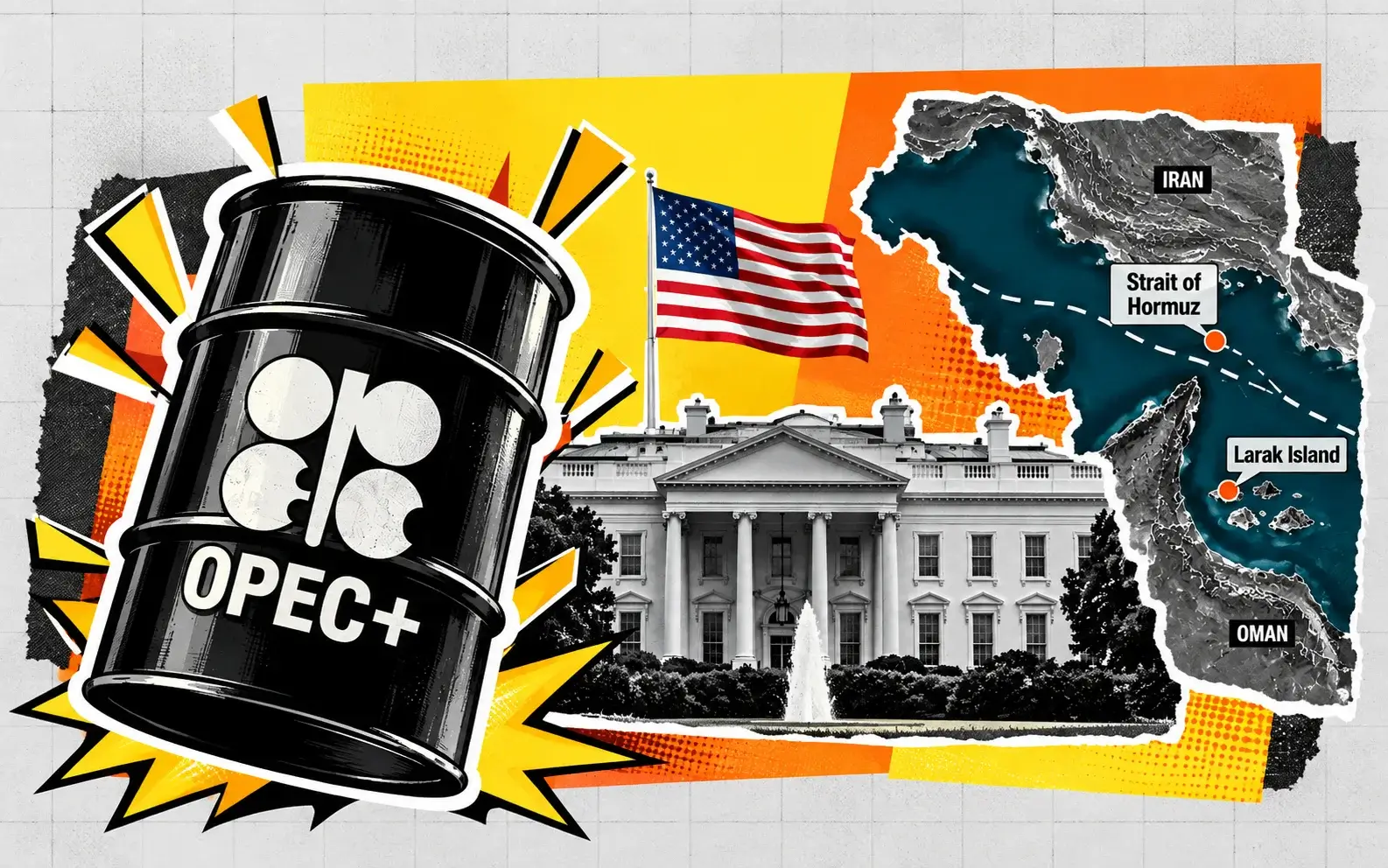
The fundamental supply disruption driving WTI (CL=F) and Brent (BZ=F) to levels not seen since 2008 is structurally simple and devastating in its magnitude. The Strait of Hormuz, through which approximately one-fifth of the world's oil and liquefied natural gas shipments normally pass, has been effectively closed to standard commercial traffic since Iran began retaliating for U.S. and Israeli airstrikes that commenced on February 28. Iran has threatened to "set fire" to ships attempting to use the narrow passage — a threat it has backed with action, having struck multiple vessels and energy infrastructure facilities across the Gulf region over the preceding six weeks.
One fifth of global oil supply removed from the market simultaneously is not a scenario that any conventional energy model was designed to handle. The Strategic Petroleum Reserve exists for exactly these situations, and the U.S. has deployed it — but the SPR is a temporary relief mechanism, not a structural solution. The International Energy Agency coordinated releases from member country reserves earlier in the conflict, but those releases have been absorbed by a market that is now pricing in a sustained supply shortfall rather than a temporary disruption.
OPEC+ agreed Sunday to increase monthly production by 206,000 barrels per day in May — the same increment the cartel had already implemented for April. The headline sounds like a supply response to the crisis. The reality is almost entirely symbolic. Several of the cartel's key Gulf members — those with the capacity to actually increase output meaningfully — cannot do so because their own energy infrastructure faces Iranian attack threats, their logistics chains through the Gulf have been disrupted, and in some cases their facilities have been directly targeted. Kuwait's desalination and power plants were struck over the weekend. Bahrain's BAPCO oil refinery was attacked. Kuwait Petroleum Corporation's headquarters was hit. These are not countries that are going to meaningfully increase output while their energy infrastructure is being targeted by Iranian missiles.
The gap between OPEC+'s paper production quota increase and actual deliverable barrel additions to the market is likely close to 200,000 barrels per day of the 206,000 announced — meaning the actual supply relief from Sunday's OPEC+ decision is de minimis at best and entirely irrelevant at worst. Brent barely moved on the OPEC+ announcement because the market already understood this.
The average price of gasoline in the United States has now crossed $4 per gallon for the first time since 2022, when Russia's invasion of Ukraine sent energy prices surging. Jet fuel prices reached $195 per barrel at the end of March — a level that is forcing airlines to either cancel flights or pass the cost directly to consumers through fare increases. Grocery prices are rising as transportation and logistics costs push consumer inflation higher across every category of physical goods. The Iran war is not a geopolitical abstraction for the U.S. economy — it is manifesting directly in the grocery cart, the gas pump, and the airline ticket.
Iranian Strikes on Kuwait, Bahrain, and UAE Over the Weekend: The Escalation That Pushed BZ=F Back Above $110
The weekend's geopolitical developments were not limited to Trump's Truth Social posts. Iran executed a significant wave of strikes on petrochemical plants and energy infrastructure across multiple Gulf states, and Tehran claimed responsibility publicly rather than maintaining ambiguity. The targets included Kuwait's BAPCO oil refinery-equivalent facilities, Bahrain's energy infrastructure, and petrochemical plants in the United Arab Emirates. Kuwait also reported strikes on power and desalination plants — civilian infrastructure whose destruction creates cascading consequences beyond the immediate energy production impact.
These strikes serve a dual purpose in Iran's strategic calculus. First, they demonstrate that Iran's retaliatory reach extends beyond the Strait of Hormuz to the physical energy infrastructure of U.S.-allied Gulf states — raising the cost of supporting the U.S.-Israeli military campaign for every regional actor. Second, they establish the precedent and capability that Iran has explicitly threatened to use at scale against Saudi Arabia's oil production infrastructure and Israel, in statements made through accounts associated with parliamentary speaker Mohammad Bagher Ghalibaf, a former IRGC general.
The specific threat issued through those channels — that Iran will "preemptively, irreversibly, and on a massive scale target the Saudi electricity and oil production infrastructure" if Iranian civilian infrastructure is attacked — is the single most important variable for Brent (BZ=F) pricing over the next 72 hours. Saudi Arabia produces approximately 9-10 million barrels per day of crude oil. A successful large-scale strike against Saudi oil production infrastructure — the Abqaiq facility, the Ras Tanura terminal — would instantly remove another 5-7 million barrels per day from global markets on top of the Hormuz closure. That scenario sends Brent to $150-$170 and WTI to levels that would cause demand destruction so severe that it precipitates a recession regardless of any Federal Reserve response.
This is not presented as the base case — the probability of that specific escalation within the next week is below 30% — but it is the tail risk that every serious market participant is managing for, and its existence as a plausible scenario creates a structural floor under Brent that prevents meaningful sustained decline even when ceasefire news hits.
The $140 Brent Spike and the 2008 Comparison: What History Actually Says
Brent crude spiked above $140 per barrel last week — the highest level since the 2008 financial crisis. That historical reference deserves careful unpacking because the 2008 experience is instructive about what happens next. In 2008, Brent hit approximately $147 per barrel in July before the global financial crisis sent demand collapsing and crude prices crashed to below $40 within six months. The 2008 spike was demand-driven — the product of a synchronized global economic boom that outstripped supply — while the current spike is supply-driven, the product of a physical supply removal through a closed transit chokepoint.
The distinction matters for price trajectory. Demand-driven oil spikes collapse when demand collapses — as 2008 demonstrated. Supply-driven spikes remain elevated until supply is physically restored. The Strait of Hormuz will not reopen until a diplomatic or military resolution occurs, and a military resolution — the U.S. bombing Iran's power plants and bridges as Trump threatens — does not reopen the Strait. It escalates the conflict and increases the probability of Saudi infrastructure strikes. The only scenario that restores supply at the Hormuz chokepoint is a diplomatic agreement, and as of Monday morning, that agreement remains a probabilistic outcome rather than a scheduled event.
Wood Mackenzie consultant Sushant Gupta stated directly that oil prices will remain volatile and swing with each escalation or de-escalation headline. The focus, he said, remains on whether energy shipments from the Gulf can resume to ease the supply shortage that has propagated through economies globally. That is not an insight — it is a statement of the obvious that carries the weight of institutional consensus: nobody in the energy market believes WTI or Brent normalize until the Strait reopens.
BCA Research chief strategist Marko Papic offered a more provocative and ultimately more useful framework on Sunday. Looking at COVID-19 and the Ukraine war as precedents, Papic noted that in both instances, markets bottomed before the crises were actually resolved — the market "moved on" before the peace agreement or the vaccine was administered. He argued that the most likely outcome for the coming month is a transition to what he calls a "new kinetic equilibrium" — a state in which geopolitical friction becomes a background constant rather than the primary daily driver of price action. He explicitly imagined a scenario in which Israel and Iran remain in open warfare for years while global markets and economies simply adapt and continue functioning, much as European economies adapted to Russia's ongoing war in Ukraine without the catastrophic collapse that was initially feared.
This "new kinetic equilibrium" framework implies that Brent settles into an elevated range — perhaps $100-$120 — rather than continuing to spike toward $140-$150 or collapsing toward $80 on a ceasefire. It implies that the daily volatility driven by Trump tweets and ceasefire reports gradually compresses as the market builds the war premium into structural pricing rather than event-driven pricing. The practical trading implication: fade the extreme spikes above $115 on escalation headlines, buy the dips toward $105-$107 on ceasefire headlines, and manage the range between those two poles until the diplomatic situation conclusively resolves in one direction or the other.
Gas Prices at $4, Jet Fuel at $195, Groceries Rising — The Consumer Transmission Mechanism
The translation from WTI (CL=F) at $111 to the consumer experience is not a lagged or theoretical relationship — it is already fully manifest in the U.S. economy and in economies globally. The $4 per gallon national average for regular gasoline in the United States is the most visible symptom, representing the first time the $4 threshold has been breached since Russia's 2022 Ukraine invasion. The "rockets and feathers" dynamic — where gas prices spike rapidly with oil prices and decline slowly when oil falls — means that even a short-term ceasefire that pulls Brent from $111 to $95 would not immediately relieve the consumer at the pump, because downstream pricing adjusts at a fraction of the speed of upstream crude movement.
Jet fuel at $195 per barrel at the end of March is operating at levels that structurally compress airline profitability and push the airline industry toward a choice between dramatic fare increases and capacity reduction. Delta Air Lines (DAL), which reports earnings Wednesday, will quantify this pressure in detail — and its guidance on fuel cost assumptions and forward booking will be the most important bellwether data point for how the broader economy is absorbing the energy shock. Every airline executive on an earnings call this month faces the same question: at what oil price does demand destruction become the primary risk rather than cost inflation?
The grocery price transmission works through multiple channels simultaneously. Transportation costs — truck fuel, rail fuel, refrigerated logistics — flow through to every product that moves through a physical supply chain. Packaging materials that use petroleum-based inputs face cost increases. Fertilizer prices, which are linked to natural gas pricing, increase agricultural production costs that flow through to food prices. The Federal Reserve's March CPI is expected to show a 1% monthly increase — driven substantially by the energy shock — and if that reading materializes Friday, it will eliminate any remaining probability of 2026 rate cuts and potentially bring rate hike discussions from the margins of Fed deliberation into the center.
The Ceasefire Scenarios and What Each Means for CL=F and BZ=F Pricing
Scenario one: A genuine 45-day ceasefire is agreed before Tuesday's 8 p.m. ET deadline, including a commitment to reopen the Strait of Hormuz to commercial traffic. In this scenario, Brent (BZ=F) falls immediately and sharply — toward $90-$95 in the first 48 hours as the war risk premium compresses. WTI (CL=F) follows toward $87-$92. The decline would be the mirror image of the ascent: violent and rapid, driven by short covering from energy hedge funds and commodity CTAs who have been net long oil as a war hedge. Beyond the initial spike lower, Brent would likely stabilize above $85 rather than falling to pre-war levels of $63-$64, because the conflict has exposed the structural fragility of Gulf oil infrastructure and permanently raised the geopolitical risk premium embedded in Middle Eastern crude.
Scenario two: Tuesday's deadline passes without a deal, Trump orders strikes on Iranian power plants and bridges. Brent surges immediately toward $120-$125, potentially retesting the $140 spike high within days. Iran's threatened retaliation against Saudi oil infrastructure becomes the primary market risk, with a successful large-scale Saudi strike scenario pushing Brent toward $150-$160. WTI follows proportionally, with the spread between the two contracts potentially widening as U.S. domestic production remains physically intact while Gulf supply deteriorates further.
Scenario three: The Papic "new kinetic equilibrium" — talks continue, no ceasefire, no escalation, the conflict settles into a protracted standoff with limited Hormuz access. Brent ranges between $100 and $115, oscillating with each headline but maintaining a structural elevated floor. This is the scenario in which the energy market becomes a macro background factor rather than the daily catalyst, and attention shifts toward the Friday CPI print and the FOMC minutes as the near-term price drivers.
Scenario four: Iran agrees to partial Hormuz reopening — allowing Iraqi vessels through (roughly 3 million barrels per day as signaled over the weekend) — without a formal ceasefire. Brent declines modestly toward $100-$105 as marginal supply returns to market, but the war premium persists at $15-$20 above pre-war levels because the threat of full reclosure remains. This partial scenario is arguably the most likely near-term outcome given Tehran's explicit statement that the Strait "will open when damages resulting from the war are compensated from transit fee revenues" — a formulation that leaves room for selective reopening as a negotiating tool without full diplomatic resolution.
Read More
-
Yen Stalls at 160 Despite a 3% JGB and Tokyo Core CPI at 2.0% — Intervention Sits at 164, Friday's Payrolls Decide
02.09.2026 · TradingNEWS ArchiveEnergy
-
COCO Bounces From Oversold as Short Interest Hits 10.9% of Float — Hold Into Q3, With $59.82 the Level to Reclaim
08.10.2026 · TradingNEWS ArchiveStocks
-
XRP-USD ($1.35) Slides 18.7% From September High as 3 Supports Fail — $1.27 Demand Zone Is Next, Bulls Must Reclaim $1.45
08.10.2026 · TradingNEWS ArchiveCrypto
-
Brent ($103.63) and WTI ($90.87) Fade From 5% Spike as Nine Tanker Attacks Hit Hormuz — $108.23 Breakout
08.10.2026 · TradingNEWS ArchiveCommodities
-
S&P 500 Slips Below 7,800, Nasdaq −0.56%, Dow Under 51,000 on $105 Oil and 5.35% Yields; HAE +13.41%
08.10.2026 · TradingNEWS ArchiveMarkets
-
Sterling Stuck Between 1.3180 and 1.3287 as Gilt Selloff Tests UK Fiscal Credibility — BoE Hike in Play for Nov. 5
08.10.2026 · TradingNEWS ArchiveForex
The WTI-Brent Spread Anomaly: What the Current Structure Reveals
One of the more technically significant features of the current oil market is the apparent premium that WTI (CL=F) appears to carry over Brent (BZ=F) in certain quote comparisons — a relationship that inverts the normal market structure where Brent typically prices above WTI due to its superior sulfur content and global benchmark status. The Wall Street Journal's analysis attributes this apparent inversion not to a genuine physical market reversal but to the mechanics of how the two contracts settle, combined with the massive supply shortfall created by the Hormuz closure.
In normal market conditions, Brent prices Gulf and North Sea crude that serves as the benchmark for two-thirds of globally traded oil. WTI prices Cushing, Oklahoma delivery crude that is the North American benchmark. With Gulf supply disrupted and Hormuz closed, the premium that Gulf-sourced crude typically commands is being impacted by the inability to physically deliver it, while physically accessible crude — including U.S. shale production — commands a premium simply by virtue of being deliverable. Buyers are willing to pay a premium for any crude they can actually access, which creates the pricing distortion that makes WTI appear elevated relative to its historical relationship with Brent.
The backwardation in both forward curves — where near-term contracts price significantly above longer-dated ones — is the most direct expression of the market's assessment that the supply disruption is temporary rather than permanent. Deep backwardation signals that the market believes current prices are elevated relative to future equilibrium, incentivizes inventory drawdowns and immediate production maximization, and provides a soothing signal to equity markets that the credit and financial stress that would accompany a permanently elevated oil price is not being priced as the base case. It is the primary reason that equity markets have not experienced the catastrophic decline that the oil price spike alone would historically have implied.
The Strategic Petroleum Reserve and Its Limits as a Relief Mechanism
The U.S. Strategic Petroleum Reserve holds crude oil for exactly the kind of supply shock the Hormuz closure represents. SPR releases have been used during this conflict, and their impact has been to modestly soften the initial price surge rather than prevent it. The SPR's capacity and the release rate are finite constraints — the reserve holds approximately 350-400 million barrels of crude at current levels, and even aggressive drawdown at 1 million barrels per day could only partially offset the 20 million+ barrels per day of Hormuz-transiting supply that has been disrupted.
The IEA coordinated releases from member country reserves earlier in the conflict, but those combined releases were insufficient to prevent Brent from crossing $100, $110, $120, and $140 as the conflict escalated. At current Brent levels of $108-$111, the SPR is providing marginal price support but is not functioning as a price ceiling. The structural supply deficit created by the Hormuz closure is simply too large for any reserve release to fully offset. The SPR is, as Fortune's analysis notes, an immediate relief mechanism for keeping critical parts of the economy running — emergency services, public transportation, key industries — rather than a mechanism for normalizing consumer energy prices during a sustained supply shock.
WTI (CL=F) and Brent (BZ=F) Directional Call: Trade the Range, Hold the Structural Long
The oil market at current prices — WTI (CL=F) between $109-$115 and Brent (BZ=F) between $107-$112 — presents a specific and actionable trading framework rather than a simple directional call. The structural long case is intact as long as the Strait of Hormuz remains closed, which it will unless a diplomatic agreement explicitly addressing reopening is signed. Tuesday's 8 p.m. ET deadline is the most important near-term catalyst, but it is not the only one — the conflict has now produced six consecutive weeks of deadlines, threats, and partial diplomatic gestures without resolution, and the market has learned to discount any single deadline as potentially extensible.
Fade the spikes above $115 in WTI and above $112-$113 in Brent — these levels represent the maximum war premium the market is willing to pay without confirmation of further physical supply disruption. The rally from $83.87 one month ago to $111-$115 today — a 32.64%-37% move — has already priced in an enormous amount of geopolitical risk premium. Additional upside from current levels requires incremental escalation beyond what is already occurring: specifically, a confirmed strike on Iranian civilian infrastructure or a large-scale Iranian strike on Saudi oil production.
Buy the dips toward $105-$107 in Brent and $103-$105 in WTI on ceasefire headline-driven declines — these represent the level at which the war premium compresses to its minimum sustainable level given the physical supply disruption that remains in place regardless of diplomatic developments. A 45-day ceasefire that includes Hormuz reopening is worth $15-$20 per barrel of downside in Brent — meaning even the most optimistic diplomatic outcome sends the global benchmark toward $90-$95, not $63-$64.
The medium-term directional call is hold-long on CL=F and BZ=F at current levels with a target range of $115-$120 in Brent as the 30-day base case in the Papic "new kinetic equilibrium" scenario, and a $125-$140 bull target if Tuesday's deadline produces a military strike on Iranian infrastructure. The stop on the structural long is a confirmed daily close below $100 in Brent — a level that would require either a genuine comprehensive ceasefire with full Hormuz reopening or a catastrophic demand destruction event. Neither is the base case. Oil stays structurally elevated, and every dip toward $105-$107 is a buying opportunity until the Strait reopens for real.