Palantir Stock Price Forecast – Is PLTR Stock Undervalued at $170?
With PLTR near $170, Q4 EPS expected at $0.23 on $1.34B revenue, a $448M US Navy ShipOS deal and a sharp drop in insider selling, investors are asking if Palantir’s premium AI valuation is still too low | That's TradingNEWS
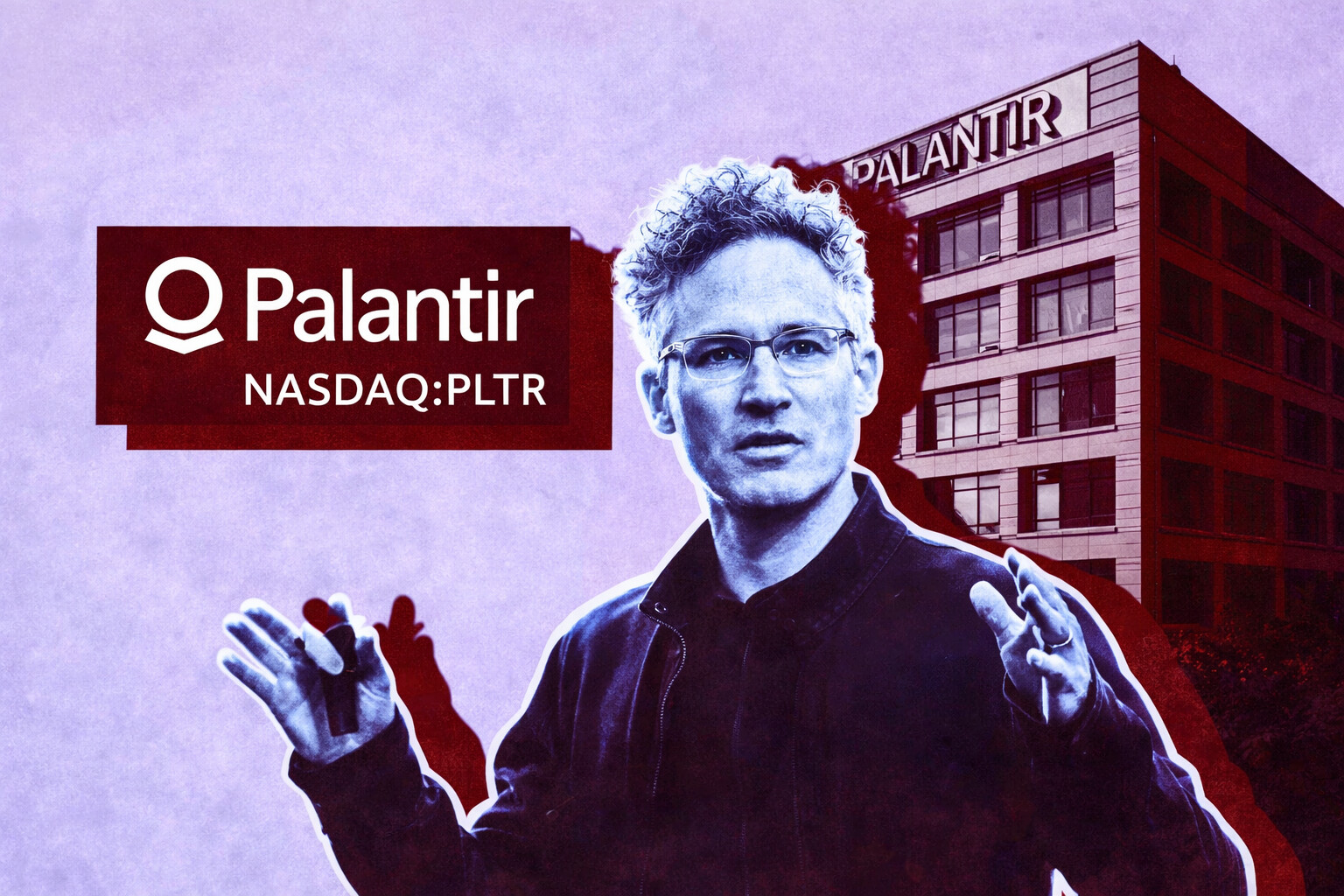
Palantir (NASDAQ:PLTR) – AI’s Decision Brain With A Bubble-Level Price
Where NASDAQ:PLTR actually trades today and what the market is pricing in
Palantir (NASDAQ:PLTR) is not a cheap growth story; it is priced like a core AI asset. The stock trades around $170.02, down $0.95 on the day, inside a session range of $166.24–$170.43. Over the last year the range has been brutal: roughly $66.12 on the low side up to $207.52 on the high. Market cap sits near $399.3B, with average daily volume of approximately 37M shares, which means the name is highly liquid but also fully institutionalised – this is no longer a niche retail trade.
On earnings, the headline multiple is extreme: a trailing P/E around 398.5x, and even on forward estimates the valuation sits at roughly 236x 2025 earnings and ~169x 2026 earnings, depending on which forecast set you overlay. On revenue, the stock changes hands at roughly 92x 2025 sales and ~65x 2026 sales. For context, the market is implicitly assuming revenue will climb from about $4.4B in 2025 to around $6.3B in 2026, and that margins will stay in the 30–40%+ adjusted operating margin band. At this price, NASDAQ:PLTR only works if those numbers hit and the AI thesis continues to compound; any stumble will compress this multiple fast.
From GPUs and data centers to NASDAQ:PLTR as the AI profit layer
The AI cycle is already through its easy money phase. Phase one was pure compute – NVIDIA and a handful of GPU vendors sold everything they could build and saw share prices explode more than 200% as chips became the bottleneck. Phase two shifted higher in the stack: data centers, power, and hyperscale infrastructure. New players and repurposed Bitcoin miners rushed in, AI capex ran vertically, and profit pools were shared between cloud platforms and specialised infra providers.
That buildout is now crowded. AI infrastructure is no longer scarce; capital has flooded in and margins are naturally compressing. The next phase is about monetising AI – embedding models in real workflows, in defence, manufacturing, logistics, healthcare, and finance. That is precisely where NASDAQ:PLTR is positioned. Its stack sits at the decision layer – combining data ingestion, model orchestration and operational workflows – where actual P&L impact is captured, not just GPU utilisation.
Product architecture in NASDAQ:PLTR – Gotham, Foundry, AIP and the ontology moat
Palantir’s moat is not a single application; it is the way its platforms map the real world.
On the government side, Gotham powers intelligence and defence workloads under high security constraints. On the commercial side, Foundry ingests messy operational data across factories, supply chains, fleets and financial systems. On top of Foundry, AIP (Artificial Intelligence Platform) orchestrates models and agentic workflows.
The glue is the ontology. Instead of throwing a generic data lake at clients, NASDAQ:PLTR builds a structured representation of assets, entities, processes, and relationships. That mapping turns raw data, models and business rules into a live digital twin of the operation. When AI agents act, they act inside that ontology – on real assets, orders and constraints.
You can see the impact in deployment speed. At one large customer, two human forward-deployed engineers plus AIP “AI FDEs” migrated the client off a legacy data warehouse in five days. Traditional system integrators would have needed up to two years to do the same migration. That gap is not cosmetic; it reflects a mature, reusable stack instead of custom one-off consulting. Once a client’s workflows sit on this ontology, churn is structurally low and switching costs are high.
Government engine for NASDAQ:PLTR – Q4 setup, Navy ShipOS and a defence supercycle
Government is not a side business here; it is a structural growth driver with long-duration contracts. In Q3 2025, NASDAQ:PLTR printed adjusted EPS of $0.21, beating the $0.15 consensus by a wide margin. The upcoming Q4 2025 report, scheduled for February 2, 2026, has a bullish setup:
Street expectations are for normalized EPS around $0.23 on ~$1.34B of revenue, implying sequential growth of roughly +10% in EPS and +13% in top line. Critically, there have been 21 upward EPS revisions and zero downward revisions heading into the print – a clean revision pattern that normally precedes positive surprises.
The contract pipeline explains why. A standout is the two-year, $448M US Navy ShipOS award, aimed at embedding AI and autonomy in submarine shipbuilding. That contract does more than add revenue; it validates Palantir as a core systems player in one of the most complex, data-heavy industrial processes in defence. Once embedded in shipbuilding, the door opens into broader naval logistics, maintenance and asset tracking.
Macro tailwinds are aligned. US defence spending under the 2026 NDAA is authorised at roughly $900.6B, with separate programmes like Golden Dome missile defence estimated anywhere between $161B and over $800B over two decades, with some projections stretching into the trillions. Analysts looking at NASDAQ:PLTR government revenue project around 51% y/y growth in 2026, roughly 800bps above street consensus, with a bull scenario of 70%+ growth if a full defence “supercycle” materialises and allies modernise alongside the US.
Given that many government deals run 5–10 years, this is not just a short-term contract bump; it increases revenue visibility and reduces execution risk for the whole model. For a stock trading at 100x+ earnings, that visibility matters.
Commercial flywheel in NASDAQ:PLTR – expansion-led economics and 130%+ NDR
On the commercial side, NASDAQ:PLTR has quietly shifted from “hero sales” into expansion-led compounding. Early years were dominated by long pilots, one-off deployments and heavy engineering involvement for each logo. That phase is over.
Today, the growth profile is driven increasingly by existing customers ramping their usage. Net dollar retention in core segments sits consistently above 130%, with total NDR hovering around 134%. That means the average client is not only renewing; they are expanding spend by 30%+ every year on top of retention.
The key is that Foundry and AIP are no longer custom offers for each client. AIP bootcamps let potential customers stand up real AI use cases in a matter of days, often converting to paid contracts within the same quarter. The more standardised the tooling becomes, the more each incremental dollar of revenue carries higher contribution margin and lower deployment cost.
This is why, while revenue is growing north of 50%, sales and marketing expense is growing slower than revenue. Without even seeing a CAC table you can infer that the payback period is shortening: more of the growth is coming from low-friction upsell to embedded clients, not from expensive new-logo hunting.
Margins, capex and operating leverage in NASDAQ:PLTR – not normal SaaS physics
The margin profile of NASDAQ:PLTR is what separates it from typical high-growth software. In most SaaS stories, you either buy growth with margin sacrifice or you shrink growth to harvest margins. Palantir is currently doing both at once – growing fast and expanding margins.
On an adjusted basis, operating margins were in the low-teens in 2023. Recently they have moved above 40%, at the same time as revenue growth has accelerated above 50%. That combination tells you the underlying economics of the platform have shifted: more product, less bespoke service; more expansion revenue, less heavy lift per dollar.
Capex data confirms the capital-light nature of the business. The capex-to-revenue ratio has fallen from roughly 0.024 in late 2019 to about 0.004 currently. The company does not need data centre-scale capex to grow; it rides on top of the AI infra capex that others are funding. Each extra revenue dollar requires very little incremental capital, which is exactly how you get sustainable free cash flow compounding if growth holds.
Insider transactions in NASDAQ:PLTR – selling slowed sharply into Q4
For a name priced this aggressively, insider behaviour matters. Over the last three months (roughly Nov 2025–Jan 2026), insiders at NASDAQ:PLTR recorded 167 sell transactions totalling about $178.2M in value. Most of that selling happened in the early part of that window.
In the last month the picture changed sharply: insiders sold a bit over $6.2M across 15 transactions, with notable sellers including Director Stat Friedman and executive Alexander Moore, disposing shares around the $167–$170 range. There have been no insider buys, but the intensity of selling has collapsed compared with the ~$172M offloaded in the previous two months.
Given the stock’s pullback from its $207.52 high to the $170 area and the strong Q4 setup, this slowdown is not something you ignore. It suggests that management and directors are more comfortable holding their residual exposure at these levels heading into an earnings event they likely expect to be supportive.
Read More
-
Yen Stalls at 160 Despite a 3% JGB and Tokyo Core CPI at 2.0% — Intervention Sits at 164, Friday's Payrolls Decide
02.09.2026 · TradingNEWS ArchiveEnergy
-
SOFI ($16.71) Posts Its Best Day of the Quarter as Profit Guidance Finally Rises — Holding $15.70 Unlocks $20
27.10.2026 · TradingNEWS ArchiveStocks
-
XRP-USD ($1.30) Defends a $1.27 Double Bottom as Whales Hold 68.5% of Supply — Break of $1.31 Opens $1.35 and $1.40
27.10.2026 · TradingNEWS ArchiveCrypto
-
NG($3.002) Takes the Front Month Near a Multi-Month Low as Record Production Meets Mild Weather — Break of $2.945 Opens $2.80
27.10.2026 · TradingNEWS ArchiveCommodities
-
Nasdaq Rips 1.3%, S&P 500 Hits 7,728, Dow Stalls as BA Drops to $171
27.10.2026 · TradingNEWS ArchiveMarkets
-
GBP/USD (1.3310) Can’t Cash In on 5.43% Gilt Yields as Budget Risk Meets a Firm Dollar — Break of 1.3274 Opens 1.3200
27.10.2026 · TradingNEWS ArchiveForex
Is NASDAQ:PLTR actually overpriced? What the multiples are really saying
Superficially, the case that NASDAQ:PLTR is “too expensive” is trivial: a P/E around 398x, non-GAAP P/E of 236x on 2025 estimates and ~169x on 2026, with price-to-sales above 90x on 2025 forecasts and roughly 65x on 2026, is higher than almost any large-cap software peer. A Yahoo snapshot even frames it as 65x forward sales with the stock “stuck” near $170, below the August 2025 region, and warns that earnings would need to double multiple times just to feel as “cheap” as NVIDIA.
But the market is not applying those multiples to a generic SaaS vendor. The numbers embed a specific scenario:
Revenue steps from roughly $4.4B in 2025 to around $6.3B in 2026, maintaining 35–40%+ growth for several years. Adjusted operating margins stabilise in the low-to-mid 30s, rather than falling back. Net dollar retention remains in the 130%+ zone, and government plus commercial both continue to expand without a major macro shock.
If that path holds, multiples will fall mechanically as the top line scales. Price-to-sales could compress from 90x to 30–40x over a few years while shareholders still enjoy strong absolute returns. If any of those pillars crack – if growth slows into the 20s, if margins erode, or if AI budgets pause – then today’s valuation will look fragile and the stock will de-rate hard.
AI rotation risk for NASDAQ:PLTR – when the story stock becomes the benchmark
There is also narrative risk. NASDAQ:PLTR is now one of the flagship AI names, not a contrarian niche. That means it trades as part of an AI basket: sentiment, factor flows and ETF allocation can move it more than fundamentals, at least in the short term.
The AI trade has rotated once already – from chips to data centres. A further rotation toward “cash flow now” AI, or toward cheaper second-tier names, can hit PLTR purely on relative value grounds. With a forward P/S in the 60s and a P/E in the high hundreds, the stock is highly exposed if investors decide to tighten the valuation bands on the whole sector.
There is also dilution risk via stock-based compensation. Historically, NASDAQ:PLTR had heavy SBC that weighed on GAAP profitability. The trend is improving – operating margins have recovered from the 2021 squeeze and sit near peak levels over the last 2–3 years – but if compensation inflation in AI talent re-accelerates, operating leverage can be partially offset by higher opex and continued issuance.
Options and volatility around NASDAQ:PLTR – how the market prices the Q4 event
For traders looking at leverage, the options market offers another angle. Implied volatility on NASDAQ:PLTR sits around 63.1, only modestly above the 52-week average of 61.2 – a roughly 3% premium. For a stock heading into a potentially strong Q4 print with a highly polarised valuation debate, that IV does not look extreme.
That makes near- to medium-dated call options a plausible vehicle for expressing a bullish view if you accept the binary risk: options can go to zero, while owning stock lets you ride multi-year compounding. The reason options are interesting here is simple: if EPS of $0.23 and $1.34B in revenue are beaten materially and guidance is stepped up, the re-rating could be violent. If the print disappoints, common shares and calls both get hit, but calls at least cap the absolute dollar loss.
This is not an endorsement of a specific strategy; the point is that the volatility surface does not yet fully reflect how binary the short-term reaction could be given the stretched valuation and strong fundamental setup.
Final stance on NASDAQ:PLTR – structurally bullish business, tactically a HOLD at $170
Pulling the pieces together – the $170.02 share price, $399.3B market cap, trailing P/E near 398x, forward P/S in the 60–90x band, net dollar retention around 134%, adjusted operating margins above 40%, capex-to-revenue down at 0.004, insider selling collapsing from about $172M in late 2025 to $6.2M in the last month, a $448M Navy contract, a Q4 setup with EPS expected at $0.23 on $1.34B revenue and 21 positive revisions – the business quality is undeniable and the equity risk is obvious.
The structural view is bullish: Palantir has a real moat at the AI decision layer, an entrenched position in US and allied defence, a commercial expansion engine with 130%+ NDR, and a capital-light model that converts growth into margin rather than burning cash. Over a 5–10 year horizon, that profile justifies a premium.
At roughly $170, however, the stock already discounts a lot of that future. With valuations at hundreds of times earnings and dozens of times sales, the risk/reward for new money is not compelling. Any wobble in AI spending, any delay in defence awards, or any normalisation of growth from 50%+ to 30% can take NASDAQ:PLTR down sharply from here.
My clear decision based on the data: NASDAQ:PLTR is a HOLD at current levels. Long-term investors who bought earlier have a strong case to keep core positions and use volatility to trim or add around the edges. New entrants looking at $170 as a fresh entry should treat the stock as high quality but tactically overextended, and wait for either a material pullback or a major step-up in earnings before treating it as a clean long.