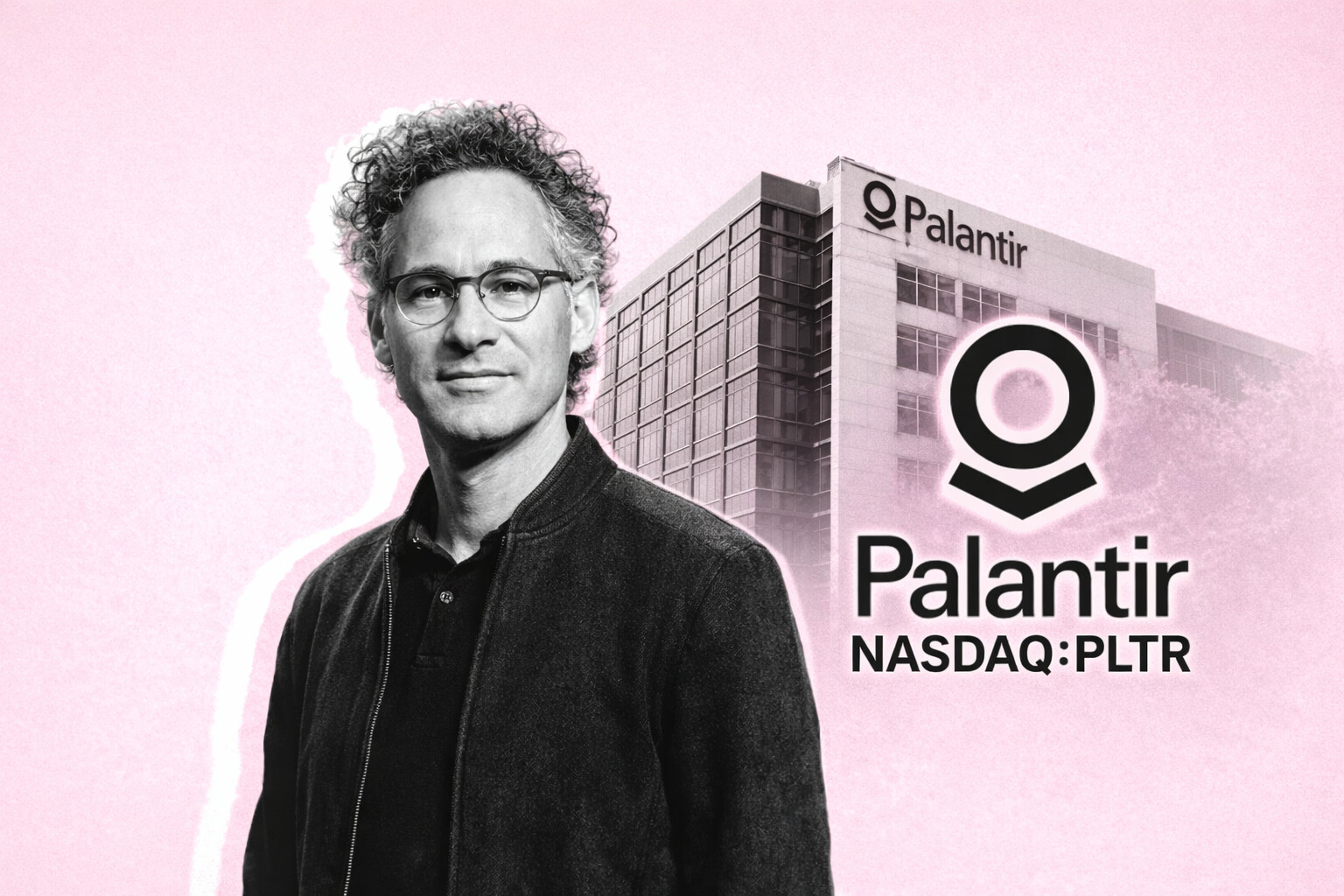
Palantir Stock Price Forecast - PLTR at $166; AI Infrastructure Giant Priced for Just 21% Upside to $199
Q3 2025 revenue surged 63% to $1.18B, US commercial exploded 121% to $397M, backlog and TCV jumped 66%–151%, yet PLTR still trades near $166 at almost 390x earnings, with our AI-driven valuation band capped around $190–$199 after three straight years of triple-digit gains | That's TradingNEWS
Palantir NASDAQ:PLTR – AI Control Layer With A Stretched Price Tag
*Share Price, Scale And Setup For NASDAQ:PLTR
NASDAQ:PLTR trades around $166–167 with a market cap close to $397–400 billion.
The stock has run roughly +167% in 2023, +340% in 2024 and +135% in 2025, then stalled below its $207.5 high. Valuation is extreme: trailing GAAP P/E is about 390x, forward P/E above 200x, and the PEG ratio on non-GAAP earnings is above 5x, several hundred percent richer than the broader software group.
Despite that, the operating metrics are the opposite of a bubble shell. Q3 2025 revenue came in at $1.18 billion, up about 63% year-on-year, with GAAP net income of $475.6 million and a GAAP net margin above 40%. Cash and short-term investments stand around $6.4 billion on total assets of $8.1 billion, with only $1.4 billion of liabilities and no long-term debt, giving equity of roughly $6.7 billion and a return on assets near 12–13%.
The gap between fundamentals and valuation is exactly where the investment decision on NASDAQ:PLTR sits.
*Growth Engine: Government Cash Machine Plus Explosive US Commercial For NASDAQ:PLTR
Palantir’s business is now balanced between government and commercial, but the growth vector has flipped decisively toward US enterprises.
Q3 2025 revenue of $1.18 billion split roughly $632–633 million from government (about 55% growth) and $548 million from commercial (about 73% growth). Within that, US commercial revenue hit about $397 million, rising 121% year-on-year and now contributing more than one-third of total group revenue. That mix shift is exactly what long-term holders wanted: reduced dependence on government budgets and proof that AIP is not just a defence tool but an enterprise engine.
Government contracts remain a structural pillar. The US and allied governments continue to expand spend on data-driven defence, intelligence and battlefield decision platforms, with Palantir sitting in the core of that spend. On top of that, the commercial side is now compounding on top of defence, giving management enough confidence to push full-year 2025 revenue guidance up to about $4.396–4.4 billion, implying ≈53% growth versus 2024.
The key point: NASDAQ:PLTR is not selling generic SaaS seats. It is wiring itself into the operating fabric of clients’ data infrastructure with multi-year, high-margin contracts on both the government and commercial side.
Backlog, RPO, RDV And TCV: Revenue Visibility For NASDAQ:PLTR Is Unusually Strong
The backlog metrics justify why bulls are willing to tolerate such rich multiples.
Remaining Performance Obligations (RPO) are growing around 66% year-on-year, and more than 56% of that RPO is now classified as non-current, meaning the revenue will be recognized beyond 12 months. A year earlier the non-current share was near 54%, and in early 2024 about 47%. That shift means bigger contracts, longer durations and more revenue already locked in across years rather than quarters.
Historically, current RPO (less than 12 months) tracked closely with next-quarter commercial revenue growth. Through 2024 the differential between current RPO growth and subsequent commercial revenue growth sat within roughly 1–2 percentage points, with a strong positive correlation. In 2025 the pattern shifted: total RPO aligns more tightly with forward commercial growth because more value sits in long-dated expansions and extensions. The street’s work on those series shows a correlation that supports forward commercial growth in the mid-60s % range when RPO is growing at about 66%.
On top of RPO, Remaining Deal Value (RDV) is running at about $8.6 billion, up roughly 91% year-on-year, and Total Contract Value (TCV) bookings reached around $2.8 billion, up about 151%. The company closed 83 deals above $1 million, including 40 above $5 million and 21 above $10 million in the last reported quarter. Customer count rose 45% to 911, while trailing-twelve-month revenue from the top 20 customers climbed 38% to roughly $83 million per customer.
Those numbers are not story stock metrics. They point to a pipeline and backlog machine capable of supporting a multi-year 30%+ growth path even if headline AI enthusiasm cools.
AIP, Ontology And Agentic Stack: Why NASDAQ:PLTR Is Levered To The Inference Wave
The strategic logic behind the premium valuation sits in AIP and the ontology stack. Hyperscalers and chip names like TSMC and NVIDIA are harvesting the capex wave for AI training and hardware. Palantir is one of the cleanest listed plays on monetizing inference—turning that hardware and model capacity into operational outcomes inside enterprises and governments.
Management has continued to extend AIP with agentic capabilities: AI Forward Deployed Engineers (AI FDEs) that can translate natural-language instructions into Foundry and AIP operations; AI Hivemind, which orchestrates multiple agents to solve complex multi-step tasks on top of clients’ ontologies; and Edge Ontology, a lightweight version of the ontology optimized for mobile and edge devices, allowing decisions on drones, vehicles, industrial equipment and field hardware rather than just centralized cloud.
A concrete example from a customer migration illustrates the leverage: a pair of human FDEs used AI FDEs to migrate a client off a legacy data warehouse in five days, versus the up to two years a traditional SI team would have needed. That sort of step-change in deployment cost and time-to-value explains why the US commercial business is growing above 100% while margins expand.
As the AI build-out transitions from training to inference – with estimates pointing to inference workloads exceeding 40% of data-center demand by 2030 and growing at roughly 35% CAGR – Palantir’s control layer sits in the right part of the stack: where data from multiple systems is fused, scored and translated into actions that deliver measurable ROI.
*US Commercial, International And AI Bifurcation: Positioning Of NASDAQ:PLTR
Inside software, the market has started to separate three categories: infrastructure that becomes more critical as AI agents proliferate; workflow substrates and control layers that orchestrate those agents; and long-tail SaaS applications that are essentially UI wrappers over someone else’s data and are the most at risk.
Palantir clearly sits in the second category. It is not a narrow application with per-seat pricing under threat from generic agents. It is the orchestration and decision layer plugging directly into the most sensitive data and workflows of governments and enterprises. That distinction explains why NASDAQ:PLTR has outperformed most SaaS names during the recent “SaaS apocalypse” triggered by autonomous agent launches like Claude Cowork, even though the NASDAQ 100 and broader software indices have seen sharp drawdowns.
Internationally, execution has lagged. Non-US revenue still represents roughly a quarter of the mix and has grown slower, with some regions held back by regulatory friction and slower AI adoption. That underperformance is a risk but also an unpriced call option. If management can lift international commercial growth to even half the US pace, there is room for several hundred million dollars of incremental high-margin revenue over the next few years without heavy incremental R&D.
Financial Quality For NASDAQ:PLTR: Margins, Cash, FCF And Operating Leverage
Palantir’s financial profile is already in the upper echelon of high-growth software.
Gross profit in Q3 was about $973.8 million, up 68% YoY, with gross margin at ≈82.5%. Operating expenses were roughly $580.5 million, up only ~25%, so operating income jumped to about $393 million, up roughly 248%. Net income of $475.6 million grew more than 230%, and GAAP net margin crossed 40%. EBITDA was just under $400 million, up more than 220%.
On the cash side, operations generated around $507.7 million in cash during the quarter, with free cash flow of about $248.9 million even after heavier investment, though FCF was down around 26% year-on-year as the company spent more aggressively. Net change in cash was almost $694 million, reflecting both operating strength and portfolio flows into marketable securities.
The balance sheet is clean: $6.44 billion in cash and short-term investments, $8.11 billion in assets, $1.43 billion in liabilities and effectively no long-term debt. Price-to-book above 60x underlines how much of the valuation is intangible future cash flow, but it is supported by a return on capital near 15% and return on assets above 12% at an early stage of scale.
Importantly, operating leverage is very visible. With revenue growing above 60% and operating expenses growing around 25%, Palantir can realistically push long-run operating margins into the 50–60% band if growth stays above 30% for several more years. That is the core of every DCF that justifies high headline multiples.
Valuation For NASDAQ:PLTR: From 65x Sales And 167x Earnings To A Rough $190–$200 Fair Range
The valuation debate is not about whether Palantir is a real business. It is about the price you pay for that quality and growth.
On near-term numbers, NASDAQ:PLTR has traded around 65x next-twelve-months (NTM) sales and roughly 167x NTM earnings in parts of 2025. Even after the pullback, the current trailing GAAP P/E is near 390x, with forward P/E still well north of 200x and a non-GAAP PEG ratio above 5x. Sector medians for software names are closer to 8x sales and 30–35x earnings, with PEG typically under 2x. The market is paying a premium of several hundred percent for Palantir’s growth and moat.
DCF-style work on the name clusters around a similar range. One framework assumes revenue growth compounding at about 34% over five years and 29% over nine years, with earnings rising at around 43% and 35% CAGRs over those same periods, terminal growth of 3.5% and a discount rate near 8.8%. That pushes intrinsic value into the $180 per share area.
Another framework keeps gross margin anchored at roughly 82%, normalizes operating-expense growth from 20% in 2025 toward 7% thereafter, and lands on non-GAAP operating income around $5.2 billion by 2027. That implies operating margin expansion of roughly 1,300 basis points to the low 60s% and supports a price target just under $200 per share when you apply a forward P/E of about 115x, roughly six times the S&P 500 multiple but in line with earnings growth around 50% between 2025 and 2027.
Wall-street targets cluster around $190 on average, with bullish cases up to $250+. At a spot price of roughly $166, you are looking at theoretical upside in the 15–25% band if everything goes right and the market is willing to keep paying triple-digit earnings multiples. That is upside, but it is not asymmetrically large relative to the drawdown risk if growth disappoints or the AI trade derates.
Read More
-
Yen Stalls at 160 Despite a 3% JGB and Tokyo Core CPI at 2.0% — Intervention Sits at 164, Friday's Payrolls Decide
02.09.2026 · TradingNEWS ArchiveEnergy
-
SOFI ($16.71) Posts Its Best Day of the Quarter as Profit Guidance Finally Rises — Holding $15.70 Unlocks $20
27.10.2026 · TradingNEWS ArchiveStocks
-
XRP-USD ($1.30) Defends a $1.27 Double Bottom as Whales Hold 68.5% of Supply — Break of $1.31 Opens $1.35 and $1.40
27.10.2026 · TradingNEWS ArchiveCrypto
-
Brent ($113.88) Trades a $2.35 Range as Houthi Strikes Meet Saudi-Iran Diplomacy — Break of $117 Unlocks $120
27.10.2026 · TradingNEWS ArchiveCommodities
-
Nasdaq Rips 1.3%, S&P 500 Hits 7,728, Dow Stalls as BA Drops to $171
27.10.2026 · TradingNEWS ArchiveMarkets
-
GBP/USD (1.3310) Can’t Cash In on 5.43% Gilt Yields as Budget Risk Meets a Firm Dollar — Break of 1.3274 Opens 1.3200
27.10.2026 · TradingNEWS ArchiveForex
*Macro, AI And Competitive Risk Overhangs For NASDAQ:PLTR
There are several structural risks that can compress the multiple even if Palantir continues to execute.
First, macro and AI-trade concentration risk. A large piece of Palantir’s premium is tied to the broader AI theme. If high-profile platforms like OpenAI stumble on funding, execution or regulation, the entire AI complex can de-rate for a period. OpenAI is expected to drive revenue from around $20 billion in 2025 toward $100 billion by the end of the decade while relying on huge capital commitments. Any sign that such trajectories are not realistic will hit AI valuations across the board, regardless of Palantir’s fundamentals.
Second, software sector repricing. The “SaaS meltdown” triggered by autonomous agents and concerns about seat-based models has shown how brutal multiple compression can be even without estimate cuts. Many SaaS names are down double-digits year-to-date while indices make new highs. Palantir has held up better because it sits in the AI-infrastructure bucket, but it is not immune if investors broadly demand lower multiples on software.
Third, political and reputational risk. Palantir openly positions itself on one side of the geopolitical and ideological spectrum. Work with organizations like ICE and the US defence and intelligence community has already generated internal and external protests. If political cycles change or if some commercial customers decide they do not want to be associated with those deployments, parts of the opportunity set can shrink. Conversely, if management is perceived as yielding to activists, it can damage relationships with core government clients. The risk is explicitly acknowledged in company filings and cannot be dismissed.
Fourth, talent risk. Defence-tech and AI infrastructure have become highly competitive hiring fields. New start-ups targeting the same budget pools offer equity and narrative upside that can attract Palantir’s senior engineers. The company is already fighting legal battles with some ex-employees over alleged non-compete violations and misuse of confidential documents. Even if Palantir is in the right, legal fights raise costs and signal how intense the talent war is. If stock-based compensation has to rise again to keep the best engineers, margin expansion will be slower than modeled.
*Government Exposure And Budget Risk For NASDAQ:PLTR
Government work still contributes roughly 40%+ of Palantir’s revenue and a large share of its strategic relevance. That cuts both ways.
On one hand, long-dated defence and intelligence programs are sticky. Once Palantir is wired into a mission-critical system, rip-and-replace is extremely difficult, and incremental modules are easier to sell. Large awards like the $10 billion US Army contract show the ceiling if Palantir continues to align with strategic national-security priorities and the widening AI arms race.
On the other hand, that same visibility comes with budget and political risk. If fiscal pressure pushes lawmakers to scrutinize AI and data-analytics spend, high-visibility contracts may be targeted for deferral, resizing or delay in recognition. A deceleration of government growth from the current 50%+ range to 10–20% would knock a few hundred million dollars off annual revenue versus bull cases and, more importantly, hit sentiment on “AI defence spend” as a theme. With a P/E near 400x, NASDAQ:PLTR does not have room for multiple years of single-digit growth in any major segment without a sharp re-rating.
*Scenario View For 2026 On NASDAQ:PLTR
Base case: Palantir delivers another revenue beat in Q4 and prints full-year 2025 revenue around $4.4 billion, with growth comfortably above 50%, strong US commercial expansion and operating margin pushing higher into the 30s%. For 2026, revenue growth moderates into the 35–40% zone, EPS growth decelerates but remains strong, and the market gradually takes the forward P/E down from the 200+ range toward something closer to 120–150x as the story matures. That path can justify share prices in a $190–200 band within the next 12–18 months, roughly 15–20% above current levels, with volatility.
Bull case: RPO and TCV momentum translates into another year of 50%+ revenue growth, US commercial keeps compounding near triple digits, several incremental large government deals land, international finally accelerates, and AI equity sentiment stays hot. Under that setup, the market may tolerate forward P/E near current levels, and targets in the $220–250+ zone become reachable. This scenario assumes both execution and a friendly macro and AI-funding backdrop.
Bear case: AI-trade multiples compress, OpenAI or other platforms trigger broader skepticism, or government/commercial budgets reset. Revenue growth drops toward the 20s%, EPS growth slows harder, and the market pulls P/E back toward 60–80x, still a premium but far below today. On current earnings power, that would put NASDAQ:PLTR back in a $100–130 price range, roughly 20–40% below the current quote, with deeper downside if a true tech de-rating occurs.
Final Stance On NASDAQ:PLTR – High-Quality Compounder, Rated Hold Around $166
Fundamentally, Palantir is one of the strongest AI infrastructure assets in public markets:
Revenue is growing above 60%, US commercial is compounding over 100%, gross margin sits above 80%, operating margin is already in the 30s%, the balance sheet carries $6.4 billion in cash and no long-term debt, backlog (RPO, RDV, TCV) is exploding, and the product stack is positioned exactly where the AI cycle is heading—monetizing inference, not just training hype.
The problem is the price. At roughly $166 per share with a trailing P/E close to 390x, forward P/E above 200x, sales multiples in the 60x+ band and a PEG above 5x, a lot of that future execution is already embedded in the valuation. Upside toward $190–200 exists if growth and margins keep beating, but the drawdown risk back toward the low-hundreds is real if the AI trade or software multiples reset.
On that basis, the analytical rating at current levels is Hold for NASDAQ:PLTR around $166:
At this price, long-term holders who believe in the AI infrastructure thesis and can stomach volatility have a rational case to stay invested and manage risk with size and time horizon.
Fresh capital looking for asymmetric payoff does not get enough margin of safety here; better entry points are likely on broader AI or software drawdowns.