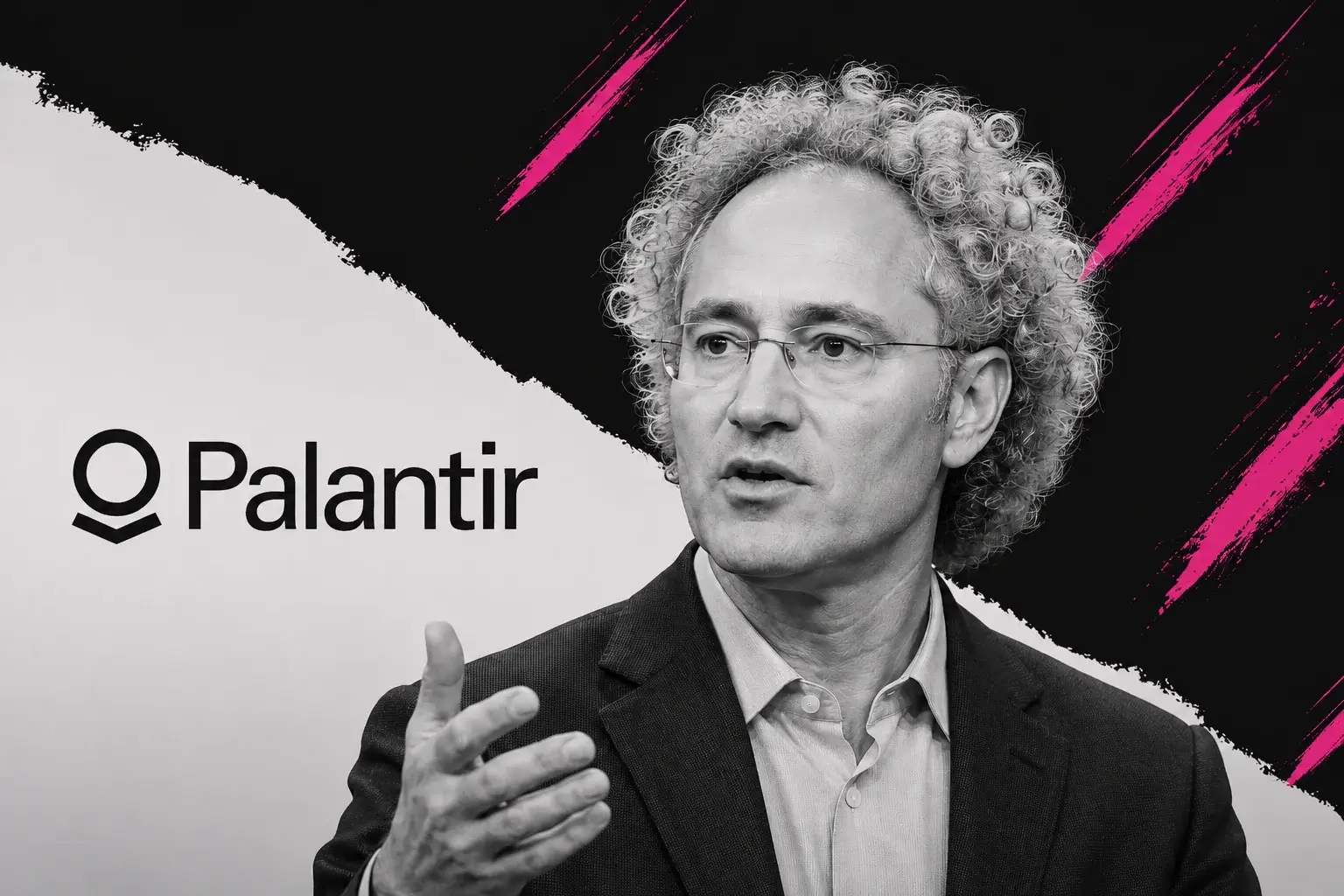
Palantir Stock Price Forecast - PLTR Drops to $134.24 as Blowout Q1 Print Battles 151x P/E
PLTR down 2.58% despite revenue jumping 84.71% to $1.63B and free cash flow exploding 551.67% to $581M | That's TradingNEWS
Key Points
- PLTR at $134.24, down 2.58%, despite Q1 revenue jumping 84.71% to $1.63B and EBITDA up 316.47%.
- Free cash flow explodes 551.67% to $581.28M; net retention hits 145%, commercial bookings top $1B again.
- Trailing P/E at 151.42, forward P/S at 42.84x; $130 support holds, Maven proven in Iran combat operations.
Palantir was being marked lower again Monday morning, with Palantir (NASDAQ:PLTR) changing hands at $134.24 — down 2.58% or $3.56 against Friday's $137.80 close — in another session where blowout fundamentals continue to lose the argument against valuation compression. The intraday band ran $132.77 to $136.66, the 52-week range stretches from $115.01 to $207.52, and the current price sits roughly 35% beneath the November high while still holding a meaningful cushion above the trailing-year floor. Market capitalization registered at $323.41 billion against 2.40 billion shares outstanding, the trailing P/E ratio sits at 151.42, and the price-to-book ratio stamps at 39.15 — multiples that telegraph precisely the kind of expectation premium that has compressed every session since the late-2025 peak. Average daily volume of 48.62 million shares confirms that liquidity has not dried up, which means the selling pressure being absorbed at the $130 level is being met by genuine bid-side conviction rather than passive flow. The post-earnings reaction is the cleanest tell that the PLTR narrative has shifted — the company is no longer being rewarded for delivering beat-and-raise quarters, it is being punished for not delivering numbers large enough to justify a 90-times forward multiple. That dynamic is the entire story heading into the rest of the quarter, and the way it resolves will set the tape for the remainder of 2026.
The Q1 2026 Scorecard That Would Have Triggered a 15% Rally in a Different Tape
The financial print Palantir delivered for the March quarter reads like a forecast model assembled by an analyst who had never met reality. Revenue exploded 84.71% year-over-year to $1.63 billion, with operating expenses growing only 23.92% to $662.79 million — operating leverage so dramatic that net income detonated 306.73% to $870.53 million and lifted the net profit margin to 53.32%, a 120.15% year-over-year improvement that places PLTR in a margin category that nearly no enterprise-software peer can match. Earnings per share landed at $0.33, up 153.85%, EBITDA climbed 316.47% to $760.76 million, and the effective tax rate of 1.37% reflects the accumulated NOL benefit working through the income statement — a tailwind that will continue compressing the effective rate through the back half of 2026. Cash from operations surged 189.81% to $899.17 million while cash from investing landed at just -$26.72 million, a capital-light operating model the SaaS peer group structurally cannot replicate. The metric that deserves triple underlining sits in the free-cash-flow line — $581.28 million generated in Q1 alone, a 551.67% year-over-year increase that translates to roughly $2.3 billion annualized if Q1 is even held flat, with quarter-over-quarter acceleration likely on the way. Net change in cash for the quarter was $873.43 million, lifting cash and short-term investments to $8.03 billion (+47.80% year-over-year) against total assets of $10.20 billion (+51.39%) and total liabilities of only $1.64 billion (+34.89%). Total equity sits at $8.56 billion, return on assets prints 19.74%, and return on capital reaches 22.87% — figures that compare favorably against nearly every enterprise-software comparable and provide the structural floor under the multiple debate.
The 145% Net Retention That Quietly Anchors the Entire Bull Case
The single most consequential number buried inside the Q1 release does not sit in the revenue or margin tables — it sits in the customer-economics block. Net dollar retention reached 145%, a level only a handful of public software companies have ever sustained at meaningful scale, and trailing-twelve-month revenue from the top customer cohort climbed 55% to $108 million annually per client. That is not a customer base experimenting with the platform; that is a customer base structurally dependent on it, with switching costs that grow non-linearly as Ontology embeds deeper into the customer's operational decision-making layer. The US commercial customer count grew 42% year-over-year to 615 customers, commercial total contract value bookings exceeded $1 billion for the third consecutive quarter, and the deal-size distribution tells the same story — Palantir closed 206 deals valued over $1 million in Q1, with 23% of them carrying contract values above $10 million, and average revenue per customer climbed 41% to $1.6 million on the back of larger deals across both government and commercial verticals. The commercial segment growth rate landed at roughly 95% year-over-year, while the US commercial topline accelerated above 100% — figures very few enterprise software firms have produced at this revenue scale in the past two decades. The Rule of 40 metric came in at 145%, more than triple the threshold most growth-investing frameworks use to identify healthy software businesses. The lone soft spot bears latched onto: US commercial bookings growth decelerated to 45% from the previous quarter's pace, which the market interpreted as the first leading indicator of demand fatigue even as the absolute bookings figure remained among the strongest in software.
The AIP Bootcamp Engine and Why the Forward Deployed Engineer Moat Cannot Be Replicated Easily
The reason Palantir is converting pipeline into revenue at a pace the rest of enterprise software cannot match traces directly to the forward deployed engineer model and the AIP bootcamp go-to-market motion. While traditional enterprise software vendors push proof-of-concept engagements that linger in evaluation purgatory for six to nine months — what the industry quietly calls PoC purgatory — Palantir's AIP bootcamps embed company engineers directly into customer workflows, deploy working AI solutions within days, and let prospects interact with operational examples rather than slide decks and reference architectures. The conversion economics from that model are visibly working — the 42% jump in US commercial customer count and the third straight quarter of $1 billion-plus commercial TCV bookings are direct outputs of the bootcamp pipeline. The strategic risk attached to this model is the one bears have been flagging since 2023: forward deployed engineering is engineer-intensive, which means the revenue-per-engineer leverage pure SaaS firms enjoy gets diluted by the heavy human-capital component embedded in the deployment process. Palantir has been managing that tension carefully — increasing operating leverage while continuing to scale FDE capacity — and the Q1 operating-margin expansion suggests management is winning the leverage battle even as commercial volumes accelerate. The deeper competitive read is that the bootcamp model creates exactly the kind of switching cost legacy enterprise software has tried and failed to build for two decades. Once Palantir engineers are embedded in a customer's operational workflow and the Ontology layer has mapped the organizational logic, removing the platform becomes a multi-year cost rather than a procurement decision — which is precisely why net retention sits at 145% rather than the 110%-115% range typical of mature enterprise software franchises.
Government Vertical Acceleration and the Maven Combat Trial in Iran
The government business is no longer the slower-growing sibling of the commercial segment — it is now firing at a comparable pace and arguably providing the more durable structural narrative. Government revenue grew 84% year-over-year to $687 million in Q1, driven by expansion across defense, manufacturing, intelligence, and federal sectors. Palantir's Maven Smart System has been deployed to assist with military targeting operations in Iran, where the platform identified 2,000 candidate sites and prioritized 1,000 primary targets for coordinated kinetic action — leveraging satellite imagery, signals intelligence, surveillance feeds, and reconnaissance data to deliver precise targeting and weapons-system recommendations within hours rather than the days such analysis traditionally required. Maven usage doubled within the past four months and is up fourfold year-over-year — operational metrics that translate directly into deeper Pentagon procurement budget allocation in the upcoming fiscal cycle. The ShipOS deployment compressed manufacturing approval cycle times from hundreds of hours to mere seconds in several documented use cases, an efficiency improvement that, if even partially replicable across the broader defense industrial base, would justify multi-billion-dollar contract expansion on the production-readiness argument alone. The DOGE controversy that initially spooked the market as a potential procurement-cut risk has evolved into a counterintuitive tailwind — the administration is interested in replacing legacy consulting-firm engagements with software-based operational systems, and PLTR sits at the front of the queue for those replacement contracts. The government vertical does carry its own volatility — continuing resolution dynamics, procurement delays, and political administration shifts all affect contract-award timing even when the underlying demand signal is unambiguous — but the structural health of the segment is materially better than the market consensus has been reflecting.
The Ondas Partnership and the Multi-Domain Autonomous Stack That Has Not Been Priced In
A development that has not yet been fully absorbed into Palantir (NASDAQ:PLTR) sits in the recently announced strategic partnership with Ondas (ONDS). The integration links Palantir's AIP platform with World View Stratollites and Ondas' unmanned aerial systems, ground autonomy modules, and counter-UAS capabilities — building a unified, multi-domain autonomous fleet that can communicate and coordinate operations across the airframe, ground, and atmospheric layers. The deployment uses three Palantir building blocks simultaneously: Warp Speed for manufacturing optimization, AI Flight Detector for atmospheric data and telemetry integration into a single operating platform, and SkyWeaver for edge workflow execution. The commercial implication is meaningful — the partnership opens a defense-and-aerospace revenue lane that did not exist in the previous model, and Warp Speed's positioning as the manufacturing-optimization backbone for both EU and US defense industrial reshoring extends the addressable market materially. Conversations with European and American automotive manufacturers about transitioning production lines into munitions and drone manufacturing reportedly include Palantir AIP as a core orchestration layer, and the GE Aerospace partnership deepening that Palantir highlighted on the Q1 call points to the same direction — military aviation supply-chain optimization running through the AIP stack, with the kind of multi-year contract economics that anchor predictable revenue rather than the lumpy patterns government work has historically delivered.
Industrial Reshoring and the $1.66 Trillion Manufacturing Wave Powering Warp Speed
The structural setup behind Palantir's commercial growth runs deeper than enterprise AI adoption — it is structurally tied to the largest US manufacturing reshoring push in three decades. Announced manufacturing investments since 2025 total approximately $1.662 trillion across consumer technology, semiconductor fabrication, pharmaceuticals, and automotive verticals — and every one of those facilities will need orchestration, automation, and AI-inferencing infrastructure of exactly the type Warp Speed provides. Inflationary pressures on raw materials and fuel costs are compounding the incentive for manufacturers to automate aggressively, and that demand vector translates into expanding AIP deployment opportunities across the industrial base. Token costs have fallen roughly 1,000x in the past three years, which under the Jevons paradox dynamic has not reduced AI usage — it has accelerated it, with enterprises finding many more processes to apply AI to as the marginal cost approaches zero. Palantir captures that wave because the deployment problem at the enterprise level was never the model itself — it was the governance, permissions, workflow integration, and auditing layer that sits between model output and operational decision. That is precisely where Ontology lives, and the more cheap intelligence becomes available, the more valuable the orchestration layer above it becomes. The 2026 transitional year hypothesis — that AI capex pivots from model development to AI inferencing and agentic AI deployments — sits squarely in Palantir's sweet spot. Industrial reshoring going into full motion only amplifies the demand for factory automation and orchestration, which directly extends AIP's addressable market.
Ontology and the AI Slop Defense That Cannot Be Cloned by Foundation Model Firms
The single most important structural moat PLTR has built is the Ontology layer — the abstraction that maps how an enterprise actually operates, who holds decision authority, how workflows connect, and what guardrails apply to which AI outputs. Foundation-model providers including OpenAI and Anthropic have started rolling out their own "DeployCo" go-to-market motions designed to replicate Palantir's forward deployed engineer approach, but the structural problem they face is that delivering implementation services is not the same as delivering the operational orchestration layer that Ontology represents. AIG management explicitly cited Palantir's Ontology as the reason their agentic AI deployment succeeded where prior approaches stalled — in highly regulated industries with zero margin for AI-generated errors (so-called "AI slop"), the governance framework matters more than the underlying model quality. The blog post Palantir published in mid-April reiterating Ontology's role was less a marketing exercise and more a strategic education effort for prospects evaluating whether to lean toward foundation-model deployment services or toward an orchestration platform that sits above the model layer. ServiceNow and other established software vendors are now building "toll booths" charging AI agents for access to their proprietary data — a development that paradoxically strengthens Palantir's positioning, because the data-orchestration and permissions layer becomes more valuable as the underlying data sources become more fragmented and individually monetized. The deeper read on the AI slop framing that came up repeatedly during the Q1 call is that as AI agents move into fully autonomous, multi-step workloads, the consequences of slop scale non-linearly. More tokens does not mean less slop — quite the opposite — which means the demand for the kind of governance and auditing Ontology provides accelerates with every step toward agentic AI deployment in production environments.
Margin Architecture and the Share-Based Compensation Discipline That Reshapes the Multiple Math
The operating-margin story is where the bull case gets its strongest structural pillar. Share-based compensation as a percentage of revenue dropped to 12.35% in Q1 from 17.58% in the year-ago quarter — a 523-basis-point improvement that flows directly to GAAP margins while still rewarding employees through equity participation. That trajectory matters enormously for the valuation debate because GAAP earnings power is the only thing that can structurally compress the forward P/E multiple over time without requiring price destruction. The combined effect of revenue accelerating 84.71%, operating expenses growing only 23.92%, and SBC dilution compressing produces operating-margin expansion that justifies a multi-year hold even at uncomfortable entry multiples. Free cash flow at $581 million for the quarter — up 551.67% — is the cleanest single proof point that the unit economics are working, and the $8.03 billion cash hoard provides ample optionality for accretive acquisitions, share buybacks, or strategic partnerships without diluting the equity base further. Q2 forecasts from sell-side desks targeting $1.88 billion in revenue and adjusted EPS of $0.45 with a Rule of 40 metric of 148% reflect continued top-line acceleration paired with incremental margin gains — a setup that, if delivered, would force another round of analyst estimate revisions higher.
Read More
-
Yen Stalls at 160 Despite a 3% JGB and Tokyo Core CPI at 2.0% — Intervention Sits at 164, Friday's Payrolls Decide
02.09.2026 · TradingNEWS ArchiveEnergy
-
QQQ ETF ($739) Fades From an Early Tech Rally as a 77.9 ISM Prices Index Meets Micron's $61.5B Guide — $760 Record Test Ahead
01.10.2026 · TradingNEWS ArchiveStocks
-
XRPR and XRPI Follow XRP's $1.49 Test as Spot Funds Hold 1.16B XRP and a 1 Billion Token Escrow Release Lands — $1.70 in Play
01.10.2026 · TradingNEWS ArchiveCrypto
-
November NG Slips Below $3 as Decade-High Storage Meets Capped LNG Exports — $2.75 in Sight
01.10.2026 · TradingNEWS ArchiveCommodities
-
Dollar-Yen at 158 Presses Toward 160 as a 363 bp Carry Gap Meets Katayama-Bessent Intervention Risk — 159 in Sight
01.10.2026 · TradingNEWS ArchiveForex
The Valuation Wall — Where the Bull and Bear Cases Collide
The valuation conversation around Palantir (NASDAQ:PLTR) is genuinely the entire investment debate, and there is no painless way to frame it. The stock trades at a trailing P/E ratio of 151.42 — a multiple that essentially demands flawless execution for years. On forward 2026 figures, the forward price-to-sales sits between 42.84x and 67.81x depending on which calculation methodology gets applied, the forward P/E lands at roughly 87x to 94x, and the forward EV/EBITDA prints near 69.4x. The sector median forward P/S of just 3.3x and forward P/E of 24.6x makes the comparison almost meaningless — Palantir is not priced as an enterprise-software stock, it is priced as a unique AI-infrastructure outlier that the market refuses to category-bucket. Even pulling forward to 2027 consensus does not fix the optics — revenue growing from $7.67 billion in 2026 to $11.09 billion in 2027 with EPS expanding from $1.46 to $2.06 still leaves the stock at 29.62x 2027 sales and 66.57x 2027 earnings. Michael Del Monte's $236 price target at 47x eFY26 price-to-sales reflects what a continuation of the current trading-premium architecture would imply — roughly 76% upside from $134.24 — while a multiple-compression scenario back toward 30x P/S would imply $90 to $100 even on the higher revenue base. The stock peaked at 125x price-to-sales during the late-2025 melt-up and has been grinding lower across the multiple stack ever since, currently sitting roughly 23% below the level it traded at six months ago even as fundamentals print at all-time highs. The disconnect tells the entire PLTR story — the debate is about multiples, not about the business itself.
The Long-Term Context That Both Bulls and Bears Need to Internalize
The wider lens matters when assessing the current pullback. PLTR has delivered a 3-year total return exceeding 1,600% — a return profile that has trounced essentially every comparable enterprise-software franchise — and remains up more than 15% over the trailing twelve months even after the recent grind lower. The peer comparison sharpens the read further: Adobe (ADBE) trades at "just" 10.5x forward earnings and is down 34% over the same trailing-year window — cheaper by a distance, but the underperformance is unmistakable. The market has been deliberately defending the $130 level in PLTR through six months of sideways consolidation, while sending stocks priced like value plays to the slaughterhouse. That asymmetric defense tells you the holder base believes the structural story even when the multiple looks indefensible on paper. The dip-buyer reflex visible in price action at $132-$134 is precisely the kind of demand profile that historically precedes the next leg higher rather than the breakdown bears keep forecasting.
The Risk Stack Investors Need to Internalize Honestly
Every bullish thesis on PLTR has to engage with three structural risk vectors with intellectual honesty. The first is expectation compression — at 43x to 68x forward sales depending on the calculation, even a deceleration from 85% growth to 50% growth would mechanically trigger meaningful multiple contraction unless margin expansion outpaces it. The second is the international commercial pace — Q1 international commercial growth came in at 26% versus 133% in the US, and replicating the AIP bootcamp model in jurisdictions with different procurement, regulatory, and cultural frameworks has been visibly slower than the domestic market. If international expansion stalls, the long-term TAM assumptions embedded in current valuation require revision. The third is the engineer-intensity bottleneck — forward deployed engineering creates the moat but also caps how quickly revenue can scale without proportional headcount investment, and any acceleration in commercial demand without corresponding FDE capacity expansion creates operational friction the bears will exploit. The government vertical introduces its own volatility through procurement timing, while the Maven Iran deployment success cuts both ways — it demonstrates real-world combat utility but also ties Palantir's defense narrative to the durability of US-Iran kinetic operations, which could de-escalate as quickly as they escalated. The reciprocal risk on the bear side is just as important to internalize — selling PLTR at $134.24 with revenue growing 84.71%, free cash flow up 551.67%, and the largest US manufacturing reshoring wave in three decades just beginning has its own ugly track record across the prior three years, during which the stock returned over 1,600%.
Where the Tape Sits Right Now
The setup for Palantir (NASDAQ:PLTR) at $134.24 is unusual because the operational performance and the price action are pointing in opposite directions simultaneously. Revenue growing 84.71%, free cash flow exploding 551.67%, net retention at 145%, US commercial customer count up 42%, three consecutive quarters of $1 billion-plus commercial bookings, Maven proven in combat operations in Iran, the Ondas partnership opening multi-domain autonomy revenue, and $1.66 trillion in announced US manufacturing reshoring providing a structural demand tailwind — that is the bull case in one paragraph, and it is unusually strong by any historical comparable. Against that sits a 151.42x trailing P/E, a 39.15x price-to-book, a stock that has compressed 35% from its $207.52 high, US commercial bookings growth decelerating to 45% from the prior quarter, international growth running at just 26%, and a multi-month sideways grind suggesting market participants are still digesting whether the multiple deserves to be defended. The chart structure tells you something specific — the $130 level has been resolutely defended for six consecutive months despite valuation pressure, and the absence of a true breakdown beneath that level suggests dedicated buyers are absorbing every sell wave delivered by macro-driven risk-off rotations. The Monday session low at $132.77 marks the immediate level to monitor, and a daily close below $130 would trigger meaningful technical selling that could pull the stock toward the $120 zone quickly. To the upside, a confirmed reclaim of $137.80 unlocks the $140-$150 band, with the prior consolidation top near $150 representing the next supply zone before momentum systems would re-engage on the long side. The data carries the next move — the Q2 earnings release expected to deliver $1.88 billion revenue and a Rule of 40 metric of 148%, the trajectory of US-Iran kinetic operations and Maven contract expansion, the Ondas partnership commercial ramp, GE Aerospace deployment milestones, and the international commercial acceleration question will sequentially calibrate whether the multiple compression has further to run or whether the structural growth thesis finally pulls the stock back toward the $200 zone. The medium and long-term bias leans constructive given the operational metrics, the Ontology moat architecture, the government acceleration, and the industrial reshoring tailwind that has not yet fully transmitted into commercial bookings — but the very short-term posture demands respect for the $130 line in the sand and the binary catalyst risk loaded into Q2