Rigetti (RGTI) Cools From Its Mid-$20s Surge on Insider Selling as a $100M Federal Quantum Grant Meets a $4.4M Revenue Base
Rigetti pulled back to ~$23.30, down 3.4%, as insider sales and a 244x price-to-sales | That's TradingNEWS
Key Points
- RGTI trades near $23.30, down ~3.4% from the ~$24.10 close, cooling after a ~60% rally and a +104% year.
- A $2B federal CHIPS Act program handed Rigetti a $100 million stake-backed grant, the core bull catalyst.
- Q1 revenue tripled to $4.4M (from $1.5M), but losses widen; P/S sits near 244x vs an ~4x industry average.
Rigetti Computing is taking a breather after one of the loudest runs in the market. RGTI is trading near $23.30, down about 3.4% from the prior close around $24.10, as the stock digests a parabolic move that carried it from a mid-May consolidation in the high teens into the mid-$20s on the back of a once-in-history federal funding wave. The pullback is orderly, not a collapse — but it lands right as two cold realities reassert themselves: insiders have been selling into the strength, and the valuation has detached from anything resembling current fundamentals. A high-flying sentiment stock catching its breath is exactly what this is.
The thesis for this forecast runs through every level below: Rigetti is a pre-commercial quantum pure-play whose stock trades on narrative, and the narrative just got a rocket strapped to it. A $2 billion federal program handed the company a $100 million stake-backed grant, real hardware milestones landed, and the sector caught a speculative bid. But underneath the story sits a business doing $4.4 million in quarterly revenue against a multi-billion-dollar market cap, a price-to-sales ratio north of 240, widening losses, and insiders cashing out. That tension — explosive government-backed upside versus brutal valuation math — is the entire story, and it's why this stock can rip 30% in a day and give back 3% the next.
The Tape: Where RGTI Sits Right Now
RGTI changed hands near $23.28 in the premarket and opened the regular session under modest pressure, off roughly 3.4% versus the prior close near $24.10. That's a pullback inside a powerful uptrend, not a trend break. The context matters: the stock was trapped in a tight consolidation through mid-May before exploding roughly 30% in a single session to $22.10, then printing a string of double-digit intraday surges — up over 22% on one of its hottest days — as the quantum basket went vertical. Over the past year, RGTI has delivered a total return north of 100%, the kind of move that bakes a mountain of expectation into the price.
Today's softness fits the broader tape. The session is risk-off at the index level, with megacap chips dragging the Nasdaq lower after a guidance miss, and a high-beta speculative name like Rigetti tends to amplify that pressure on down days the same way it amplifies the upside on green ones. The decline is also the natural cooling of a parabolic move — after a run that steep, a 3% to 4% give-back is consolidation, not capitulation. The stock is holding the bulk of its gains, which tells you the bid built during the rally hasn't evaporated. It's just no longer chasing.
The $2 Billion Catalyst That Lit the Fuse
The fuse for this entire move was lit on May 21, when the administration declared $2 billion to be distributed through Commerce Department grants to nine quantum computing firms in exchange for minority government equity stakes. These CHIPS and Science Act awards constitute the single biggest federal investment in quantum computing hardware in history, and they rewired how the market values the entire sector overnight. The largest tranche, $1 billion, went to IBM to build a matching quantum chip manufacturing facility. GlobalFoundries took $375 million. And a cluster of pure-plays — D-Wave, Rigetti, Quantinuum, and Infleqtion — were each slated for $100 million.
For Rigetti, the $100 million Letter of Intent isn't just cash; it's validation. A pre-revenue-scale company suddenly has the federal government as a stakeholder and a backstop, which transforms the risk profile in the eyes of speculative capital. The grant helps fund the hardware roadmap, lowers the existential cash-burn risk that haunts every quantum startup, and stamps a government seal on the technology's strategic importance. That's why the stock didn't just bounce — it went vertical. When Washington writes a nine-figure check and takes equity, the market reads it as a signal that this company won't run out of runway before the technology matures. The funding is the foundation the entire bull case now stands on.
What Rigetti Actually Builds
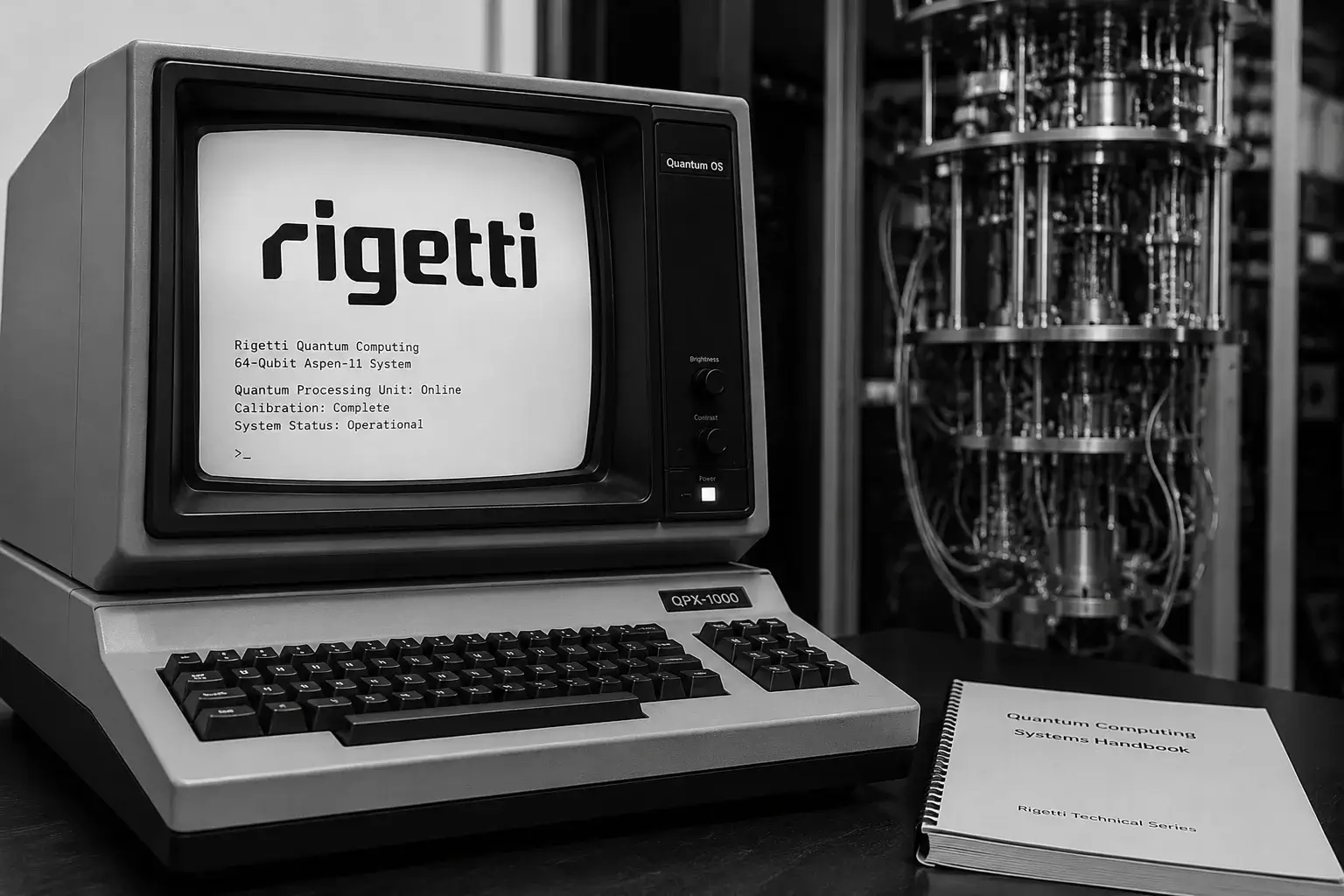
Strip away the stock action and Rigetti is a full-stack superconducting quantum computing company — it designs and fabricates its own quantum processors, operates them over the cloud through its Quantum Cloud Services platform, and sells on-premises systems to enterprise, government, and research clients. Its signature technical bet is a modular, chiplet-based architecture: instead of trying to build one massive monolithic quantum chip, Rigetti stitches together smaller chiplets, an approach designed to make scaling easier and cheaper as qubit counts climb.
The proof point landed with the 108-qubit Cepheus-1-108Q system, the company's highest qubit-count machine and one of the industry's largest modular quantum systems. It's built from twelve interconnected 9-qubit chiplets — tripling the qubit count of the prior 36-qubit generation — and is accessible through Rigetti's own cloud and through Amazon Braket. The performance specs are the part that matters to anyone tracking the technology: roughly 99.1% median two-qubit gate fidelity, a gate speed near 60 nanoseconds, and 99.9% median single-gate fidelity. The architecture trades some coherence time for faster gate operations and easier scaling — a deliberate engineering choice that bets the path to useful quantum computing runs through modularity and speed. This is real hardware shipping to real customers, which separates Rigetti from pure vaporware. The question is whether the hardware translates into revenue fast enough to justify the price.
The Revenue Reality: $4.4 Million Against a Multi-Billion Valuation
Here's the number that anchors every bear argument: Rigetti tripled its quarterly revenue to $4.4 million, up from $1.5 million. The growth rate is eye-catching — a 3x jump is the kind of acceleration that gets a story stock moving — but the absolute number is tiny. $4.4 million in a quarter is a rounding error against a market capitalization that runs into the billions, and the company is still posting widening losses as it pours capital into research and hardware development. This is a business in the earliest innings of commercialization, monetizing a technology that most of its own industry says won't deliver broad practical advantage for years.
The contrast with a peer sharpens the picture. IonQ, the trapped-ion competitor, posted quarterly revenue of $64.7 million — more than fourteen times Rigetti's — with over $3 billion in cash on the balance sheet. Rigetti's revenue base is a fraction of that, which means RGTI is being valued on roadmap and government backing rather than on a commercial business that exists today. The 3x revenue growth is genuine momentum off a small base, and small bases can compound fast. But "fast growth off $1.5 million" and "a business that justifies a multi-billion valuation" are separated by years of execution that hasn't happened yet. The revenue reality is the gravity this stock has to escape.
The Valuation Math Is Brutal
The valuation metrics on RGTI are not stretched — they're in a different universe. The stock trades at a price-to-book ratio around 15.3 times, against an industry average near 4.8 times. More striking, its price-to-sales ratio sits at roughly 244 times, compared with an industry average closer to 4 times. A P/S of 244 means the market is paying $244 for every $1 of annual sales — a multiple that prices in not just success, but a near-flawless march to large-scale commercialization and major technological breakthroughs. On standard value screens, the stock earns the lowest possible grade.
That math is the core risk, and it cuts both ways. On the one hand, a multiple this extreme leaves zero margin for disappointment — any stumble in the roadmap, any slip in the funding narrative, any cooling in sector sentiment, and the stock has a very long way to fall before it finds fundamental support, because there's almost no fundamental support beneath it. On the other hand, valuation is a notoriously useless timing tool for story stocks; a name trading at 244 times sales can go to 350 times if the narrative stays hot, just as easily as it can halve. The honest read is that RGTI is not priced as a business — it's priced as a call option on quantum computing becoming real. Options like that are worth something, but they're also the first thing repriced when risk appetite turns.
Insider Selling Is the Fresh Overhang
The newest weight on the stock is the most uncomfortable one: insiders have been selling into the rally, and that's raising questions after a roughly 60% run. When a stock goes vertical on a government-funding narrative and the people who know the business best start trimming their stakes, the market notices. Insider sales don't always signal trouble — executives diversify, exercise options, and hit pre-scheduled selling plans for all sorts of reasons unrelated to their view of the company. But the optics of insiders cashing out at the top of a speculative surge feed directly into the bear case that the price has run ahead of the fundamentals.
This is the kind of overhang that caps upside in the near term. Buyers chasing a momentum name want to see conviction from the inside, and a wave of insider selling does the opposite — it tells the marginal buyer that the smart money is taking chips off the table. It doesn't take much to cool a parabolic move; it just takes a reason to take profits, and insider selling is a perfectly good reason. Combined with today's broader risk-off tape, it explains why RGTI is giving back ground rather than extending the run. The selling is a sentiment dent, not a fundamental shift — but for a stock that trades almost entirely on sentiment, sentiment dents move the price.
The Quantum Peer Group and the Basket Trade
Rigetti doesn't trade alone — it moves as part of a quantum basket that ripped together and corrects together. IonQ, the trapped-ion leader trading near $69, is the revenue heavyweight of the group. D-Wave Quantum focuses on annealing-based systems and hybrid quantum-classical solutions. Quantum Computing Inc. is chasing photonics, quantum sensing, and cybersecurity. When the sector caught fire on the federal funding news, these names surged in lockstep — double-digit percentage gains across the board in a single session — and they tend to pull back together too.
That basket dynamic is a double-edged sword for RGTI holders. On the upside, any positive sector catalyst — a government headline, a technical milestone from any peer, a bullish call from an industry leader — lifts the entire group, and Rigetti rides that wave regardless of its own news flow. On the downside, sector-wide profit-taking or a souring of speculative appetite hits every name at once, and RGTI's high beta means it often falls hardest. The sector ETF that bundles these plays has become a popular way to express a quantum view precisely because picking the single winner among pre-commercial competitors is so hard. For Rigetti, the read-through is clear: the stock's direction is set as much by sector sentiment and the basket trade as by anything specific to its own roadmap.
The 2026 "Quantum Advantage" Catalyst
The bull case has a date attached to it. Industry leadership has flagged 2026 as the year the first examples of genuine "quantum advantage" — quantum computers solving real problems faster than classical machines can — are expected to appear. That's the holy grail the entire sector is built on, and if a credible demonstration lands this year, it would validate the technology's commercial trajectory and likely send the whole quantum basket into another leg higher. For a stock priced on a call option on quantum becoming real, a quantum-advantage milestone is the event that starts turning the option into intrinsic value.
That forward catalyst is a big part of why RGTI held its gains rather than fully reversing — the market is positioning ahead of a potential 2026 breakthrough, and no one wants to be short a government-backed quantum name into a year that industry leaders are billing as the inflection point. The flip side is expectation risk: when a sector prices in a milestone this heavily, the bar for the actual demonstration becomes brutal, and anything short of a clear, commercially relevant breakthrough could trigger the same sell-the-news reaction that hit other high-expectation tech names this week. The catalyst is real and it's bullish. Whether it's already in the price is the open question.
The Chart: A Parabolic Move Digesting Gains
The technical picture is the signature of a parabolic stock cooling off. RGTI ran from a high-teens consolidation base to the mid-$20s in a near-vertical move, printing fresh highs on volume that ran multiples of its average. That kind of move leaves the stock extended above its moving averages and primed for a pullback — which is exactly what's playing out as price slips toward $23. The first thing to watch is whether the recent breakout level in the low $20s holds as support; a stock that breaks out, runs, and then pulls back to retest the breakout is following a textbook pattern, and holding that level would keep the uptrend intact.
The levels that matter are straightforward. On the downside, the breakout zone around $20–$22 is the first support, and below that the consolidation base in the high teens is the line that would signal the parabolic move is fully unwinding. On the upside, reclaiming the prior session's $24-plus level and pushing back toward the recent highs near $25–$26 would signal the buyers are back in control and the digestion phase is over. Volume is the tell to watch on any bounce — a low-volume drift higher is suspect, while a high-volume reclaim of the recent highs would confirm the move has more room. For now, the chart reads as a healthy pause inside a strong trend, with the breakout retest the key test.
Read More
-
Yen Stalls at 160 Despite a 3% JGB and Tokyo Core CPI at 2.0% — Intervention Sits at 164, Friday's Payrolls Decide
02.09.2026 · TradingNEWS ArchiveEnergy
-
T-Rex 2X Inverse MSTR ($4.39) Rips 10.44% as Strategy Pauses Bitcoin Buys for a 2nd Week — $4.63 Close Opens $5.27
15.09.2026 · TradingNEWS ArchiveStocks
-
XRPR ($10.59) and XRPI ($7.04) Open at Highs and Close at Lows After Senate Kills CLARITY Act
15.09.2026 · TradingNEWS ArchiveCrypto
-
NG ($2.908) Holds Above $2.80 Low as LNG Feedgas Hits 18.8 Bcf and TTF Trades 9.2x Henry Hub
15.09.2026 · TradingNEWS ArchiveCommodities
-
USD/JPY (155.09) Faces 275bp Policy Gap as BOJ Prepares 31-Year-High Rate — Close Below 154 Opens 153.40
15.09.2026 · TradingNEWS ArchiveForex
Analyst Views: Buy Rating, $30 Target, Loud Caveats
The sell-side leans bullish, but with its fingers crossed. Across the roughly 19 analysts tracking the name, the consensus rating is Buy, with an average price target near $30 — implying upside of roughly 25% to 30% from current levels around $23. The bullish case rests on the government funding, the hardware milestones, the modular-architecture scaling story, and the optionality of a 2026 quantum-advantage breakthrough. For a momentum crowd, a Buy rating and a $30 target on a government-backed quantum pure-play is catnip.
But the caveats are loud and they're unanimous on one point: valuation. Even analysts carrying Buy ratings flag that the stock looks significantly overvalued on traditional metrics, and the most candid framing acknowledges that the valuation only "turns positive" if everything goes according to plan and Rigetti hits its long-term growth targets. That's a polite way of saying the price already discounts a best-case scenario. The honest read of the analyst picture is a community that believes in the long-term technology story and the government tailwind, while openly admitting the stock is priced for perfection. A $30 target with an asterisk the size of a 244x sales multiple is what passes for bullish on a name like this.
The Forecast: Scenarios From Here
The honest forecast is a set of scenarios, because a stock this speculative is driven by catalysts and sentiment, not by a clean fundamental model. The near-term base case has RGTI consolidating in a wide $20–$26 range, digesting its parabolic gains while it retests the breakout zone and waits for the next sector catalyst — a choppy, high-volatility pause inside the broader uptrend, with the insider-selling overhang and risk-off tape capping the upside in the short run. This is the path the chart and the current setup favor.
The bullish case needs a fresh catalyst to fire: a credible 2026 quantum-advantage demonstration, additional government funding, a commercial-deployment headline, or a sector-wide speculative surge that lifts the whole basket. Any of those reclaims the recent highs and opens the path toward the $30 analyst target and beyond, with the high beta meaning the move could be violent. The bearish case is equally violent in the other direction: a break of the high-teens base, a souring of quantum sentiment, a disappointing milestone, or a broad risk-off flush could cut the stock sharply, because there is almost no fundamental valuation support beneath it — a name at 244 times sales falls fast when the narrative cracks. The spread between those outcomes is enormous, which is the defining feature of a pre-commercial story stock: the upside is a multiple and the downside is a trapdoor.
Bottom Line: A Government-Backed Quantum Option Priced for Perfection
Rigetti is trading near $23.30, down about 3.4% as it digests a roughly 60% government-funded rally, with insider selling and a stretched valuation cooling the move against a risk-off tape. The bull case is genuine and powerful — a $100 million federal stake-backed grant, a real 108-qubit modular system shipping to customers, 3x revenue growth, a Buy consensus with a $30 target, and a 2026 quantum-advantage catalyst that industry leaders are billing as the inflection point. The bear case is just as real: $4.4 million in quarterly revenue, widening losses, a price-to-sales ratio near 244 times, insiders cashing out, and a price that discounts a flawless future.
The levels frame the trade: the $20–$22 breakout zone is the first support and the high-teens base is the line that signals the parabola is unwinding; reclaiming $24 and pushing toward $25–$26 puts the $30 target back in play. RGTI is not priced as a business — it's priced as a call option on quantum computing becoming real, and it trades with all the volatility that implies. The base case is range-bound consolidation until the next catalyst picks the direction. None of this is personalized financial advice — a pre-commercial name at this valuation can move 20% in either direction on a single headline, and position sizing matters more than the story.