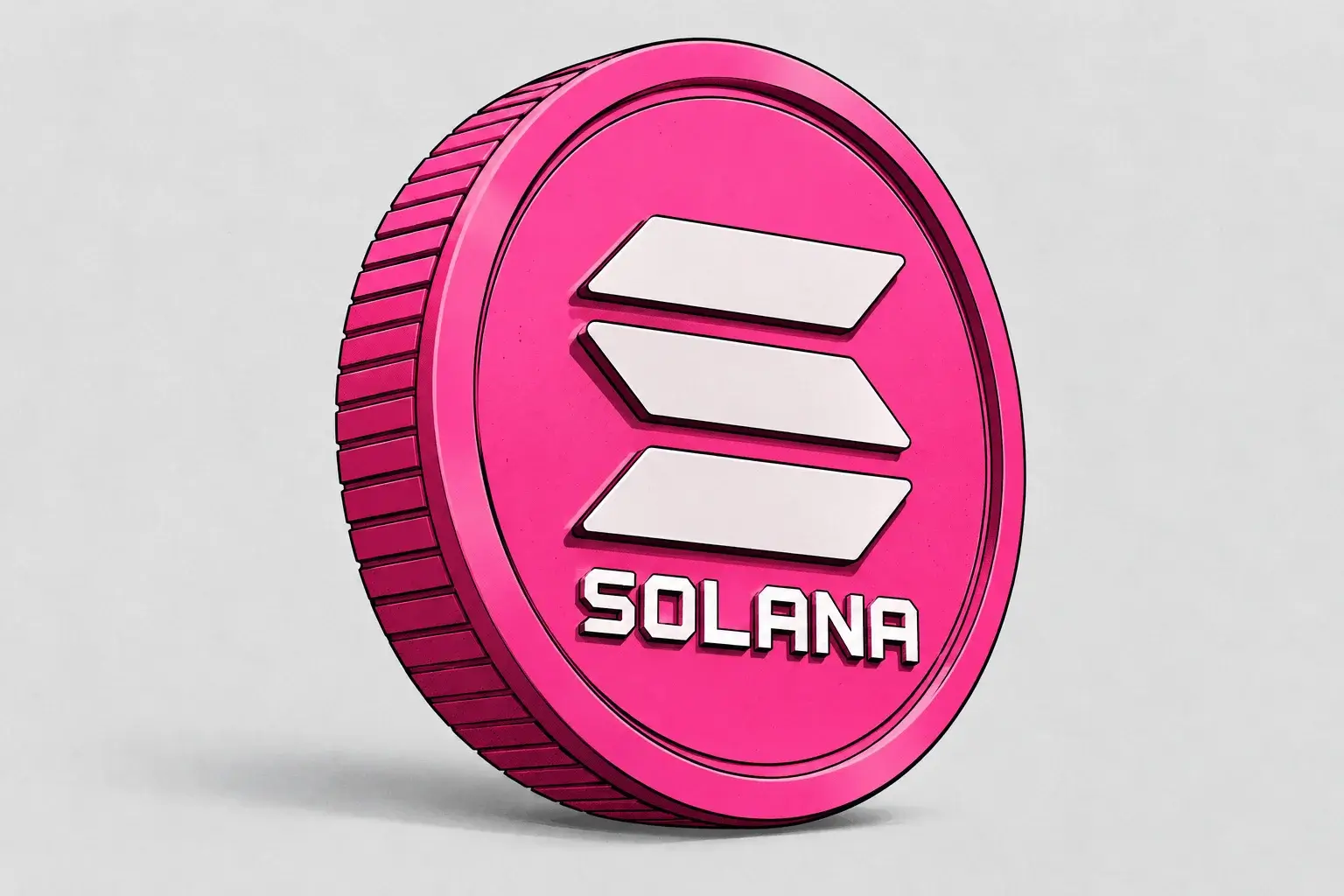
Solana Reclaims the 50-Day at $75.18 With $81.59 the Wall and $73 the Line That Cannot Break
Open USD, backed by Visa, Mastercard, Stripe and BlackRock across 140-plus firms, launches on Solana while the XRP Ledger did not make the list | That's TradingNEWS
Key Points
- SOL trades $77.73 with the 20-day at $71.97, the 50-day at $75.18 and the 100-day at $81.59.
- Nine straight red months leave the coin 73.6% below its all-time high of $294.87.
- Polymarket puts $80 in July at 75.7% and $70 support holding at 50.5%.
Solana trades $77.73, having climbed from $74.30 a week ago and reclaimed the middle of a range that has held since early June. The level that matters is $77, and SOL is 96 cents above it.
That proximity is not a coincidence. It is the entire setup.
The daily chart shows SOL boxed between roughly $63 and $80 since the start of June. Price sits above the 20-day exponential average at $71.97 and above the 50-day at $75.18, with the 100-day at $81.59 and the 200-day at $97.17 both overhead. That stacking of longer averages above the market says the longer-term trend is still pointed down, and it is the honest read on an asset sitting 73.6% below its $294.87 all-time high.
The recovery arithmetic is brutal. Revisiting the record requires a 277.35% move from here.
What has changed in the last two weeks is momentum rather than structure. The Relative Strength Index has climbed toward 60 and prints 62.19, which is neutral rather than overbought and leaves room. Price moved 11.32% across the preceding seven days. A rising wedge has formed on the lower timeframe since the June low, with SOL making higher lows while staying capped under the $77 to $80 resistance band.
Higher lows into a fixed ceiling is a coil. Coils resolve.
The prediction market has already picked a side. The Above 80 threshold leads the July market at 75.7% probability on Polymarket, with $477.65 thousand of volume, $394.12 thousand of liquidity and $248.44 thousand of open interest as of Wednesday afternoon.
Real money is 76% confident SOL touches $80 this month. SOL is 2.9% away.
Nine Red Months in a Row
Solana has closed lower for nine consecutive months. That is a heavy weight for any asset to shake off and it is the single most important piece of context for everything below.
Nine months of distribution does two things. It exhausts the marginal seller, which is what produces the higher lows visible in the current wedge. And it destroys the reflexive buyer, which is why on-chain activity can run near yearly highs while price sits near yearly lows.
The peer comparison this week frames the underperformance precisely. Bitcoin tagged $65,494 and trades $64,743, up 3.31%. Ether cleared its $1,825 neckline and holds $1,926, up 3.91% with an 8.32% week. XRP defended $1.07 and trades $1.13. Every major bounced on the same macro repricing.
SOL is the only one of the four still trading below its 100-day exponential average.
The structural driver of the drawdown is not complicated. Bitcoin's moves directly impact SOL, and when Bitcoin drops, SOL typically falls harder given its high-beta nature. Bitcoin fell roughly 20% over a month and slipped below $59,000 through the June flush. Solana fell with it and further.
The inflation schedule adds a mechanical headwind that Bitcoin does not carry. New SOL enters circulation through a schedule designed to fund staking rewards, launched at 8% annually and decreasing 15% each year until reaching a long-term floor of 1.5%. That is real dilution against a price that has fallen for nine straight months.
The offsetting cycle argument is long-dated. Solana's price history tracks Bitcoin's four-year halving cycle, with the 2021 and 2024 bull runs both coinciding with post-halving altcoin seasons and the next halving in 2028.
Nine red months is either capitulation or a trend. $77 tells you which.
The $63 to $80 Box and Why It Has Held Six Weeks
The range is precise and it has contained every attempt in both directions since early June. The floor is $63, the ceiling is $80, and $73 has emerged as the support that price bounced firmly off before retesting resistance just below the top.
That is a 27% box on an asset with SOL's volatility profile, which means it is tight rather than wide by this market's standards.
The Bollinger structure confirms the compression. The upper band sits at $85.15 and the lower at $64.78, with the simple moving average at $74.97. SOL at $77.73 is 8.7% below the upper band and 3.7% above the mean, which is a market in the upper half of its statistical range with room to extend before it stretches.
The trading pattern inside the box has been mechanical. The coin spent weeks grinding sideways in a tight range. Price held $73 as on-chain activity neared yearly highs, bounced, and now retests resistance just below $80.
The intramonth read from the prediction market is that proximity matters more than conviction. SOL near $78 makes an $80 print feel mechanically reachable, while the lower thresholds still carry weight. Pricing implies SOL revisits the $80 handle in July but does not cleanly escape the $70 to $90 range without a fresh spot catalyst.
That is the honest base case and it is what six weeks of a $63 to $80 box produces.
The barriers overlap, which is worth noting for anyone reading the odds. A move through $90 also validates $80, so the curve is more about the intramonth price path than a single terminal July close. The $90 threshold carries a 22.5% probability by July against a 50.5% probability for $70 support holding.
The market thinks $80 is likely, $90 is a stretch, and $70 is a coin flip.
The EMA Ladder: $71.97 Taken, $75.18 Taken, $81.59 Next
Four exponential averages define the recovery and SOL has cleared two of them.
The 20-day sits at $71.97. Price reclaimed it during the bounce off $73 and has held it, which is what kept the short-term structure intact through the sideways grind. The 50-day sits at $75.18 and was the level capping the range at the start of the month when SOL traded $74.30. Price is now 3.4% above it.
The 100-day at $81.59 is the wall. It is 5.0% above spot and it sits directly inside the $80 psychological handle that the prediction market is pricing at 75.7%. Clearing both together is what converts this from a bounce inside a box into a structure change.
The 200-day at $97.17 is 25% above spot and it is the level that ends the bear market. Nothing in the current setup reaches it.
That ladder is the forecast stated in ascending order. Two rungs taken, one at $81.59 that decides the quarter, one at $97.17 that decides the year.
The comparison to Ether is instructive because the setups are nearly identical and the outcomes have diverged. Ether cleared its 20-day at $1,740, its 50-day at $1,798, and its $1,825 neckline, and now sits 1.0% beneath its 100-day at $1,946 with a $2,140 double-bottom objective above. SOL cleared its 20-day and 50-day and sits 5.0% beneath its 100-day.
Same structure, five points further from the wall.
The difference is what happens if both clear. Ether's objective is 11.1% above spot. SOL's, if $77 flips to support, is a different order of magnitude entirely.
$77 Flips and $125 to $130 Opens
The specific call on the table is that $77 is the trigger level, and a flip of that price into support could open the door toward $125 to $130.
That is 61% to 67% above spot. It is the most aggressive published target on any major in this week's tape and it deserves scrutiny rather than dismissal.
The technical logic is the rising wedge. Price has made higher lows since the June bottom while staying capped under $77 to $80, and a wedge that breaks upward from a nine-month downtrend measures to the prior structural level rather than to the next round number. The $125 to $130 zone is where SOL consolidated before the leg that took it to the $63 low, which makes it the first real supply shelf above the box.
The intermediate framing is more conservative and arrives at the same door. A daily close above $80 would strengthen the recovery case and open the path toward $100 and eventually $120. That is the same destination reached through two stops rather than one.
The requirement is identical in both frames: SOL has to convert $77 to $80 from resistance into support, and it has to do it on a daily close rather than an intraday wick.
The reason to take it seriously is what sits behind the level. On-chain activity is near yearly highs. The Alpenglow consensus upgrade could act as a catalyst if activation nears in the third quarter. Open USD launches on Solana. The Solana Foundation is a Premier Member of the x402 agentic payments standard.
The reason to discount it is nine red months and a 200-day at $97.17 that is still falling toward price rather than the reverse.
$77 is 96 cents away. July hinges on whether SOL can convert strong network fundamentals into a decisive break above $80.
Open USD Launches on Solana — The Thing XRP Wanted and Did Not Get
The Open USD consortium carries more than 140 backers including Visa, Mastercard, Stripe and BlackRock. It launches in 2026 on blockchains such as Solana and Polygon.
The XRP Ledger is not among the initial platforms.
That single sentence is the most underpriced catalyst in this file and the market has not paid a dollar for it.
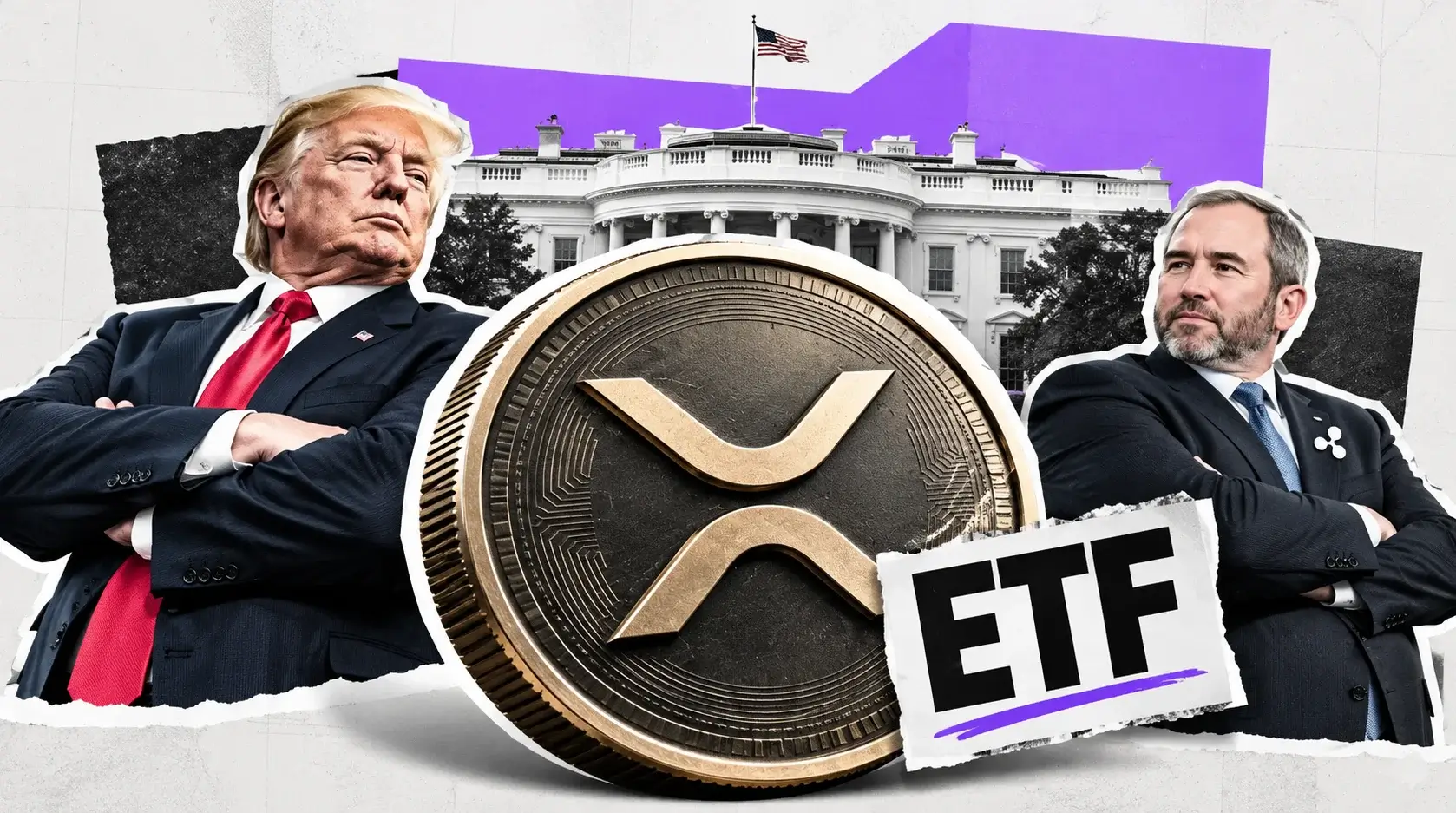
Understand what it means structurally. A dollar stablecoin backed by the two largest card networks, the largest payments processor and the largest asset manager on earth is choosing settlement rails, and it chose Solana. Ripple joined the consortium as a day-one partner and its own ledger did not make the list, positioning the XRPL as one option among several rather than the rail.
Solana got the rail without asking for it.
The economics matter more than the credential. Stablecoin settlement volume on a chain generates fee revenue and requires the native token for transaction costs and validator economics. Unlike the XRPL, where transactions cost fractions of a cent and a million agentic transactions burn a rounding error, Solana's fee market is designed to capture value from throughput.
The competitive context is Wednesday's tape. Stripe and Advent bid $60.50 per share for PayPal, more than $53 billion with roughly $50 billion of committed financing, and the strategic core is folding PYUSD and PayPal's crypto services into Stripe's Tempo and Bridge stablecoin systems. Circle was cut to underperform with a $50 target on the Open USD threat. The Fed chair testifying this week opposes a central bank digital currency and favors private stablecoins, with a multi-year CBDC ban already passed.
Every institution in payments is building a dollar stablecoin. The winner needs a chain.
SOL trades $77.73 and 73.6% below its high while that decision gets made in its favor.
x402 and the Agentic Payments Race
The Solana Foundation is a Premier Member of the x402 Foundation alongside Coinbase, Circle, Google, Mastercard, Visa, Amazon Web Services, Stripe, Shopify, American Express, Adyen, Cloudflare, Fiserv, the Stellar Development Foundation, the Monad Foundation, MoonPay and Ripple.
That is the standard for AI agents initiating payments, and it is the closest thing to a genuinely new demand vector in crypto.
The mechanism is straightforward. As AI agents take on more of the transaction lifecycle, they need a way to pay that is as fast and reliable as the way they already exchange data. Card rails are not built for machine-speed micropayments. Blockchain rails are, and the constraint is throughput and cost.
That constraint is where Solana wins on architecture rather than on partnerships. Agentic commerce means high-frequency, low-value, permissionless settlement, which is the exact workload Solana was designed for and the exact workload that congests every alternative.
The competitive evidence is already visible. Affirm expanded its Stripe partnership in March to support Shared Payment Tokens, letting AI agents initiate pay-over-time purchases with credentials protected and Stripe handling backend processing, rolling out to non-Stripe merchants later this year. The XRPL has processed more than one million agentic transactions since its x402 rollout.
One million transactions is a pilot. The workload that matters is orders of magnitude larger, and it goes to whichever chain can carry it at cost.
The market is pricing none of this. SOL trades inside a $63 to $80 box that has held six weeks while the entire payments industry builds the rails it was designed to carry.
Fundamentals do not move price until flows do. The question for the third quarter is whether Open USD and x402 arrive as flow or stay as headlines.
Alpenglow Is the Q3 Catalyst
The Alpenglow consensus upgrade could act as a catalyst if activation nears in the third quarter.
That is the network-specific event on the calendar and it is the one variable that could break the range without help from Bitcoin.
Consensus upgrades matter for Solana in a way they do not for other chains because the entire thesis is throughput and finality. The value proposition against Ethereum has never been decentralization or security. It is that transactions settle fast enough and cheap enough to carry real payment volume, and every improvement to consensus directly expands the addressable workload.
The timing is what makes it live. The third quarter runs through September. If activation nears while Open USD approaches launch and the x402 standard moves from pilot to production, the sequence compounds rather than arrives in isolation.
The setup around it is already constructive on the network side. On-chain activity is near yearly highs. That is the divergence that matters most: usage is running at the top of its annual range while price sits 73.6% below its record and 25% below its 200-day.
Networks that get used eventually get paid for. The lag between the two is where the return lives, and nine red months is a long lag.
The risk to all of it is stated plainly. Broader market weakness, seen in recent ETF outflows, remains the main risk, and the broader Bitcoin, Ether, Solana and XRP fund complex remains roughly $4.4 billion in the red.
A consensus upgrade does not fix a fund complex bleeding capital. It changes what the chain can do, and the market decides later whether that matters.
July hinges on the break. The third quarter hinges on Alpenglow.
Read More
-
Yen Stalls at 160 Despite a 3% JGB and Tokyo Core CPI at 2.0% — Intervention Sits at 164, Friday's Payrolls Decide
02.09.2026 · TradingNEWS ArchiveEnergy
-
QQQ ETF ($706.22) Slides 7.4% Below Its High as the Market Reprices the AI Capex Bill — $686.57 Target if $700 Breaks
22.10.2026 · TradingNEWS ArchiveStocks
-
XRPI ($7.00) and XRPR ($10.74) Slide Toward 52-Week Lows as Spot XRP ETF Flows Stall at $708,510
22.10.2026 · TradingNEWS ArchiveCrypto
-
NG ($2.775) Decoupled From Europe’s €88 Gas Crisis as LNG Feedgas Hits 18.9 Bcf/d — $3.30 Upside on Cold Weather
22.10.2026 · TradingNEWS ArchiveCommodities
-
Dollar-Yen (157.35) Loses 157.65 as the Yen Rallies on Haven Demand — 155 Target if 156 Breaks
22.10.2026 · TradingNEWS ArchiveForex
On-Chain at Yearly Highs, Price at Yearly Lows
On-chain activity is near yearly highs. Price is $77.73, 73.6% below the all-time high and inside a $63 to $80 range that has held six weeks.
That divergence is the entire investment case and it is also the entire warning.
The bull reading is that usage leads price. A network processing near-record activity while its token trades at a 74% discount is either mispriced or the activity does not accrue value. Solana's fee market means throughput generates revenue for validators and burns supply, which is a functioning link between usage and token economics.
The bear reading is that the link is weaker than the thesis requires. Activity on Solana has historically been dominated by workloads with minimal fee generation, and near-record transaction counts against a $77.73 price says the market has already decided how much that activity is worth.
The supply side does not help. The inflation schedule launched at 8% annually and steps down 15% per year toward a 1.5% floor. Nine red months of price against a positive issuance rate means holders have been diluted into a drawdown, unlike Ether where roughly a third of supply is staked and locked or Bitcoin where issuance is fixed and halving.
The comparison to Ether is unavoidable and it is unflattering. Ether has 4.9 million coins locked in one corporate treasury's validators alone, a third of supply staked, and $10 billion of ETF assets that took in $58 million on Tuesday. SOL has activity.
The resolution is mechanical rather than philosophical. Usage becomes price when a buyer with a mandate shows up. Open USD is that buyer if it launches on Solana at scale.
Yearly highs in activity. Yearly lows in price. One of them is wrong.
ETF Flows Are the Main Risk and the Hole Is $4.4 Billion
Broader market weakness, seen in recent ETF outflows, remains the main risk to Solana's recovery. The combined Bitcoin, Ether, Solana and XRP fund complex sits roughly $4.4 billion in the red.
That is the constraint on every altcoin bid right now and it is why the range has held.
The read-across from the majors is direct. Bitcoin ETFs carry $78 billion in assets against $5.4 billion of year-to-date net outflows, one of the worst institutional selloffs in the product's history, and took in $181 million Tuesday after shedding $425 million Monday. Ether ETFs crossed $10 billion and drew $58 million Tuesday, all of it from one product, snapping an eight-week outflow streak with $84.42 million the prior week. XRP ETFs have drawn $1.48 billion since November and the token fell more than 50%.
None of that capital is rotating into Solana. It is leaving the complex.
The unresolved questions are structural rather than cyclical. ETF fee pressure and fund mechanics are flagged alongside the coming consensus upgrade as the variables that determine whether a range trade turns into a decisive move.
Fee pressure matters because a newer product competing against established Bitcoin and Ether funds has to buy shelf space, and buying shelf space compresses the economics that make issuers push a product to allocators.
The offsetting signal is rotation. The Altcoin Season Index has climbed to 58 and Bitcoin dominance has slipped toward key support. Centralized exchange spot volumes rose 15.3% to $1.11 trillion in June, the first increase in five months.
Capital is moving down the cap stack. It reached Ether. It has not reached Solana.
$4.4 billion has to stop leaving before $77 can flip.
The Macro: 42% to 17% and SOL's Beta
June CPI fell 0.4% month over month with the annual rate slowing to 3.5% from 4.2% and core easing to 2.6% from 2.9%. Wholesale prices fell 0.3% against a flat consensus, the first decline in nearly a year. July hike odds collapsed from 42% to 17%. Two-hike odds fell from 58% to 35%. The two-year Treasury yield dropped 7 basis points to 4.19%.
Most of the crypto downturn traced back to fear over rates and what the Fed might do next, which pulled money out of the asset class across the board. That fear just got materially smaller.
SOL moved 11.32% across the preceding seven days on it. That is the beta working, and it is why the coin is at $77.73 rather than $70.
The problem is the destination rather than the direction. The federal funds target sits at 3.50% to 3.75%, held for a fourth consecutive meeting. Warsh testified Wednesday, called the CPI report one data point, rejected the mission-accomplished framing, and gave no timetable for easing. September hike odds run 49%. Brent trades $85.92 with a reimposed naval blockade of Iranian ports, which puts an energy shock into the July inflation data that the June prints did not contain.
The catalysts flagged for the rest of the month are exactly this: remaining July spot volatility, late-July macro or Solana-specific news, and a Bitcoin-led crypto drawdown.
The third one is the risk that matters. SOL falls harder than Bitcoin when the mood turns, and Bitcoin just tagged $65,494 and failed the close on $1.1 billion of mostly short liquidations with lower-timeframe RSI near 67.
If Bitcoin rolls over from a failed breakout, SOL does not hold $73.
The Fed decides July 29. SOL decides at $77.
Downside: $73, Then the $63 Demand Zone
$73 is the first line. Price bounced firmly off it while on-chain activity neared yearly highs, and failure to hold it would expose the $63 demand zone again. That is 6.1% and 19.0% below spot respectively.
The $63 level is the floor of the six-week box and the June low. Below it, there is no structure, and the published bear projections take over.
The forecast distribution is wider than it looks. The July average projects $81.78 with a $74.87 to $88.69 range. August extends to a $70.23 minimum and a $99.27 peak. September is the ugly month: a $77.38 maximum against a $68.80 minimum and a $73.09 average. October recovers to $75.67 to $82.66.
Read that sequence carefully. The models have SOL peaking in August near $99 and then giving it all back to $73 by September. That is not a forecast of a trend. It is a forecast of the box holding through the third quarter with one excursion.
The prediction market agrees. $70 support carries a 50.5% probability and $90 by July carries 22.5%. Overall sentiment is bearish. Pricing implies SOL revisits $80 but does not cleanly escape $70 to $90 without a fresh spot catalyst.
That last clause is the whole trade. The fresh spot catalyst exists on paper: Open USD launching on Solana, x402 agentic payments, Alpenglow activation nearing in the third quarter, on-chain activity at yearly highs.
None of it has produced a bid yet.
The longer-dated market is more constructive: a 77.0% probability of $90 by the end of 2026, against a $95.89 year-end projection from one model.
$90 by December at 77%. $90 by July at 22.5%. The market thinks it happens. It thinks it happens later.
The Forecast: $100 on an $80 Close, $63 If $73 Breaks
The base case is a $73 to $85 range through the July 29 Fed decision. SOL has cleared its 20-day at $71.97 and its 50-day at $75.18, sits 5.0% beneath its 100-day at $81.59, and is 96 cents from the level that decides the quarter. The RSI at 62.19 is neutral with room. The rising wedge since the June low has produced higher lows into a fixed ceiling for six weeks.
The bull path is specific and the whole market agrees on the level. A daily close above $80, which takes the 100-day at $81.59 with it, strengthens the recovery case and opens the path toward $100 and eventually $120. The more aggressive frame has a flip of $77 into support opening $125 to $130, 61% to 67% above spot. The prediction market prices $80 at 75.7% for July and $90 at 77.0% for year-end.
The catalysts to carry it are real and they are queued. Open USD, backed by Visa, Mastercard, Stripe, BlackRock and more than 140 firms, launches on Solana while the XRP Ledger did not make the list. The Solana Foundation is a Premier Member of x402 alongside Google, Amazon Web Services and Coinbase. Alpenglow could activate in the third quarter. On-chain activity is near yearly highs.
The bear path needs $73. Below it, $63 opens directly and the nine-month downtrend that has produced nine consecutive red closes resumes. The trigger is a Bitcoin-led drawdown, and Bitcoin just failed at $65,000 for a fourth time on $1.1 billion of short liquidations.
The structural drag is honest: a 200-day at $97.17 that is still above price, an inflation schedule that dilutes holders every block, and a fund complex $4.4 billion in the red.
Forecast: $100 by the end of the third quarter on a confirmed daily close above $80, with $73 the invalidation and $63 beneath it.