Sterling Outruns the Euro as Burnham Calm and BoE Hawks Lift Cable — GBP/USD Stalls at the 1.3460 Wall
GBP/USD held near 1.3400 on Monday as the dollar's haven bid faded on Iran mediation hopes and sterling rode a political-risk unwind the euro lacks | That's TradingNEWS
Key Points
- GBP/USD held 1.3389 near 1.3400 as UK political risk collapsed on Burnham's smooth path to the premiership.
- Cable presses pivotal Fibonacci resistance at 1.3460/73; support runs from 1.3326 to the 1.3165 June low.
- The BoE holds at 3.75% with a hawkish tilt; US CPI Tuesday and the July 30 BoE-Fed double-header are the triggers.
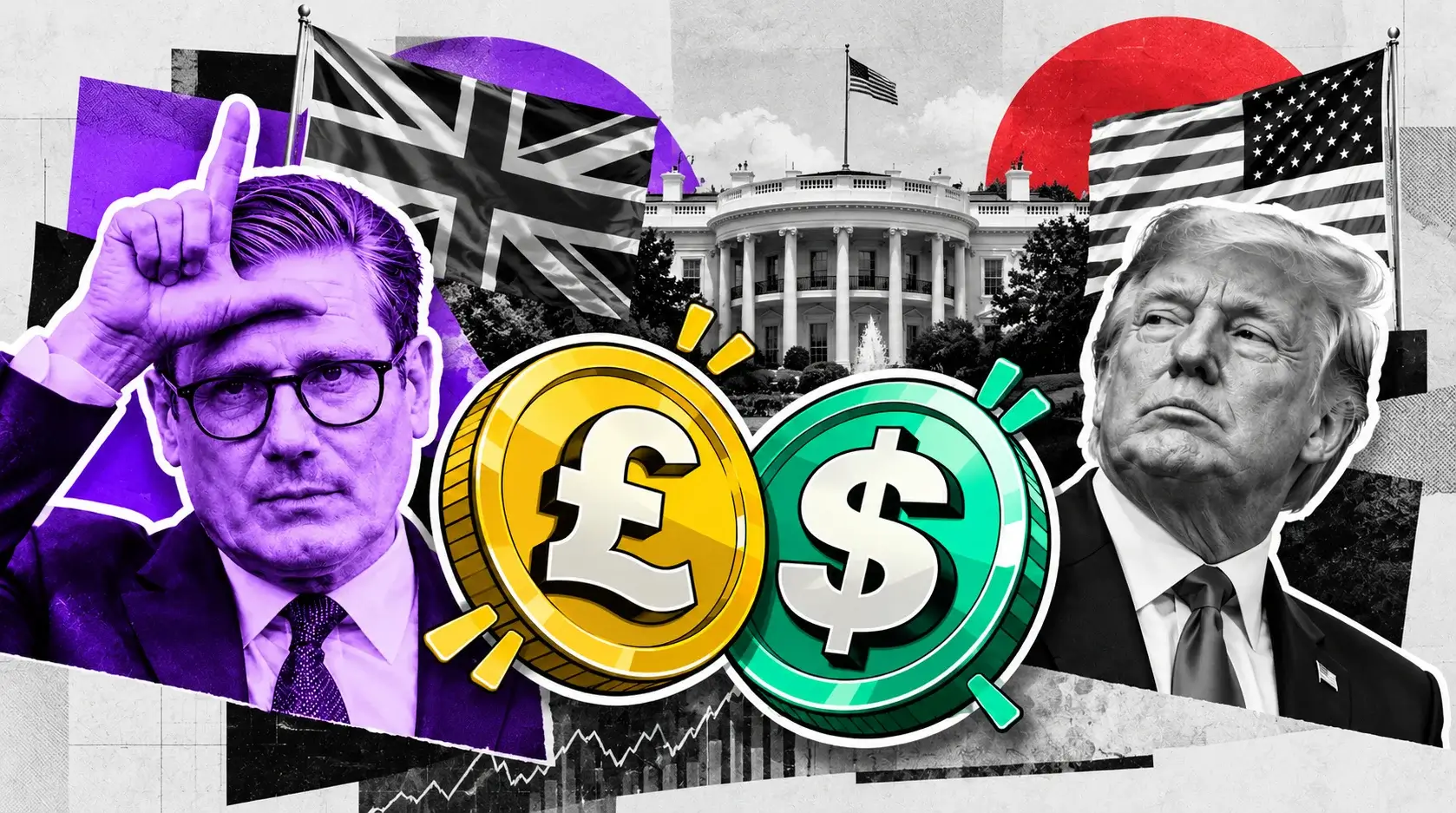
GBP/USD held at 1.3389 Monday, finding support near 1.3370 and clinging to its recovery near 1.3400, as sterling rebounded off the weekend risk-off shock while the dollar's safe-haven bid faded on Iran mediation signals. The contrast with the euro is the story: while EUR/USD sits pinned at one-year lows near 1.1390, cable has clawed to within striking distance of a two-month high, hitting a three-week peak near 1.3450 last week before consolidating. The pound is the relative outperformer of the dollar bloc, and the reason is domestic — a collapse in UK political risk after Prime Minister Keir Starmer's resignation, with Andy Burnham's smooth path to the Labour leadership and the premiership calming the instability that had weighed on sterling for weeks. Cable is not fighting the dollar on rate divergence alone; it is riding a political-risk unwind that the euro cannot match.
The forecast turns on a pair pressing pivotal resistance with a rare tailwind. Sterling carries two supports the euro lacks: the political-risk collapse that has lifted confidence in the UK outlook, and a Bank of England forced toward a more hawkish stance by the Hormuz oil shock, which threatens to feed energy inflation into a UK economy acutely vulnerable to it. Two BoE dissenters at the June meeting already pushed for hikes, and every firm inflation print strengthens their hand — a dynamic that supports the pound. But cable is now testing the pivotal Fibonacci resistance at the 1.3460/73 yearly-open zone, where the multi-week rally is vulnerable to a sharp inflection, and the sell-side sees sterling fading toward 1.24-1.31 over the medium term on enduring dollar strength. The pair is best read as a range between the 1.3165 June low and the 1.35/1.3550 resistance, where Tuesday's US CPI and the July 30 BoE-Fed double-header decide whether cable clears 1.35 toward 1.3650 or rolls back toward 1.3165. Sterling has the momentum; the resistance and the data decide if it lasts.
Sterling's Resilience Rests on a Political-Risk Collapse
The single biggest driver of the pound's outperformance is domestic politics, and the risk premium has drained fast. Prime Minister Keir Starmer resigned three weeks ago, and the prolonged uncertainty over the succession had been holding sterling back — a political discount baked into the currency that suppressed its value regardless of the rate outlook. The resolution came cleanly: former Greater Manchester mayor Andy Burnham secured the support of the vast majority of Labour MPs to replace Starmer, an unopposed path to the leadership that calmed concerns about political instability. Burnham is expected to be nominated Labour leader Friday and to take office as Prime Minister on July 20, a smooth transition of power that has restored confidence in the UK's political outlook.
The mechanism from politics to the pound is direct. Political uncertainty attaches a risk premium to a currency — money demands compensation for holding assets in a country with an unresolved leadership question — and as that uncertainty resolves, the premium unwinds and the currency strengthens. Sterling's strong performance over the past week highlights exactly how much the prolonged uncertainty had been suppressing it: as the crowd further reduced the political risk attached to the pound, cable rallied to three-week highs and squeezed bearish positioning that had built up during the instability. That position squeeze added fuel to the move, forcing shorts to cover as the political picture cleared. The forecast reads the political-risk collapse as a genuine and durable tailwind for sterling, one that distinguishes it from the euro, which faces its own political overhang from French leadership uncertainty. The Burnham transition is the pound's structural support, and as long as it proceeds smoothly toward July 20, it underpins cable's resilience. The political premium has largely unwound, though — which means the pound now needs fresh drivers beyond politics to extend the rally, and those drivers live at the Bank of England and in the data.
The BoE's Hawkish Tilt Is the Oil-Shock Paradox
The Bank of England provides sterling's second support, and the Hormuz oil shock has paradoxically strengthened it. The BoE holds its Bank Rate at 3.75%, having held at the June meeting in a 7-2 vote where two dissenters pushed for a hike — and the market now prices at least one 25-basis-point increase by the end of 2026. The Hormuz escalation, which spiked oil more than 5% toward $75, is the counterintuitive catalyst: because the UK is acutely vulnerable to energy shocks as a net importer, higher oil prices threaten to feed inflation, which forces the BoE toward a more hawkish stance and supports the pound. The same oil spike that pressures growth-sensitive currencies elsewhere lifts sterling through the rate-expectations channel.
The dynamic runs through the BoE's internal debate. The two June dissenters were explicit that they fear the energy shock feeding into wages and price-setting, and every firm inflation reading strengthens their hand and raises the odds of a hike. Sticky UK services inflation, running near 3.7%, is the strongest pro-sterling data point available — as long as it holds up, the market can keep pricing a hawkish hold or even a later hike, and the rate differential leans in cable's favor. The paradox is sharp: a Middle East supply shock that would normally hurt a growth-sensitive currency instead supports the pound because it hardens the BoE's inflation-fighting resolve. The forecast reads the BoE tilt as a real but conditional support — conditional on UK inflation staying sticky enough to keep the hike bets alive. The risk is that the sell-side has begun to doubt the hike case, with some now expecting no BoE increases this year as the central bank waits out the short-term inflation shock and weighs labour-market slack. That divergence of views is the crux of the pound's near-term uncertainty: if the BoE hawks win, cable pushes higher; if the doves prevail on growth concerns, sterling's rate support erodes. The oil shock is the pound's unexpected ally, but its durability depends on the inflation data.
The Dollar's Haven Bid Faded on Mediation Hopes
The dollar side of the equation shifted intraday Monday, and it favored the pound. The weekend Hormuz escalation initially drove a safe-haven bid into the greenback, but by the European session the dollar was losing that haven demand as Iran confirmed mediation efforts with the U.S., and cable rebounded near 1.3400 as the risk premium eased. The dollar's inability to hold its safe-haven gains is a recurring pattern — even amid escalating U.S.-Iran tensions, resilient market sentiment has repeatedly limited demand for the greenback, and the currency has struggled to sustain its risk-off rallies. That fading haven bid is what let sterling recover Monday even as the broader geopolitical backdrop stayed tense.
The dollar's underlying support, though, remains formidable and caps cable's upside. The greenback draws strength from the Fed's hawkish, higher-for-longer stance, resilient U.S. growth, and Treasury yields at a 4.59% seven-week high — a trifecta that the sell-side believes will keep the dollar grinding higher against most major currencies. The market frames the dollar's recent strength as the product of twin economic shocks — the AI investment boom and the oil-price surge — forces that look increasingly likely to endure and to keep the greenback supported. The US Dollar Index has been testing major resistance near 101.39, a level that held on prior tests, and a break above it on a hot US CPI would be the catalyst that sends cable lower. The forecast reads the dollar dynamic as a two-sided force: the fading haven bid on de-escalation hopes gives sterling near-term room to rally, but the structural dollar strength from Fed hawkishness and enduring economic tailwinds caps cable's upside and underpins the sell-side's bearish medium-term view. The pound's Monday resilience is real, but it leans on the dollar's haven bid staying subdued — and Tuesday's CPI could reverse that in an instant. The dollar holds the whip hand on the data.
The 1.3460/73 Fibonacci Wall Is the Pivotal Test
Cable's rally has carried it into a pivotal resistance zone, and it is where the multi-week advance is most vulnerable. The pair is trading into the confluence of the 61.8% retracement of the May decline and the objective yearly open at 1.3460/73 — a Fibonacci-and-structure cluster that marks the first real test for the bulls and a zone from which sterling reversed sharply lower once already, with that prior decline extending more than 2.5% off the June highs. The Bollinger upper band at 1.3470 reinforces the barrier, a level where buyers could hesitate. Cable's multi-week advance is vulnerable while it trades below this pivotal zone, and the focus is on whether the pair inflects lower off the resistance or breaks through.
The levels above map the bullish continuation. Beyond the 1.3460/73 zone sits the big round number at 1.3500, confluent with a resistance level near 1.3489, followed by the 1.3550 threshold that would offer stronger confirmation of a breakout, and then the 61.8% retracement of the yearly range at 1.3591 and the 2025-and-2026 high-week closes at 1.3648/84. A breach and weekly close above the 1.3460/73 pivot would invalidate the May downtrend and fuel a larger recovery within the yearly range, opening the path toward 1.3650-1.3700. The forecast reads the 1.3460/73 zone as the decisive near-term battle: cable has to clear it on a weekly closing basis to confirm the rally has legs, and the ascending channel that has contained the advance is showing initial signs of breaking down, a warning that momentum may be stalling into resistance. The market is not asking whether sterling can rally a few pips; it is asking whether it can clear 1.3460/73 and then 1.35, and the pair's prior sharp reversal off this zone means the bulls face a real test. Until cable closes above 1.3473, the rally remains vulnerable to a downside inflection.
Support Runs From 1.3370 to the 1.3165 Floor
The downside map defines where the rally's failure would lead, and the levels are layered. Immediate support sits at 1.3370, the level cable held Monday, backed by the Bollinger middle band near 1.3300. Below that, the May low close at 1.3326 marks the first weekly support, reinforced by the 38.2% retracement and the 2026 low-week close at 1.3194/99. A break beneath the 1.3326 zone would constitute a breakdown of the yearly opening range and threaten the next major leg of the decline, shifting the structure from recovery to renewed downtrend.
The critical downside level is 1.3165, the June 24 low from which the current recovery launched. That level is the line in the sand — sterling has climbed roughly 1.53% off it, and a break below 1.3165 would confirm the bearish scenario, exposing the 1.30-1.31 area that the sell-side's more negative forecasts contemplate. Below the June low, the 2026 high-week close pivot at 1.3092 provides subsequent support, with the Bollinger lower band around 1.3130 offering a nearer cushion on a deeper pullback. The forecast treats 1.3165 as the swing level that separates the bullish and bearish cases: hold above it, and cable retains its recovery structure and its shot at clearing 1.3460/73; lose it on a weekly close, and the pound's rally reverses toward 1.30. The 52-week moving average near 1.3406 sits right at current price as an additional pivot — cable's ability to hold above it offers guidance on whether the medium-term trend has turned constructive. The immediate contest is at 1.3370 and 1.3326, with 1.3165 as the ultimate floor. As long as sterling holds above the June low, the political-and-BoE tailwind keeps the recovery intact, but a break there would signal the dollar and weak UK data have reasserted control.
The Technicals Show a Rally Losing Steam
The technical structure captures a recovery pressing resistance with fading momentum. Cable has been contained by an ascending linear-regression channel that held for many days, pushing the price higher, but recent price action has begun trading below that channel — an initial sign the uptrend may be losing steam as it approaches the pivotal 1.3460/73 resistance. The pair sits near its clustered 8-day, 21-day, 50-day, and 100-day EMAs, a configuration that reflects a market at an inflection point rather than in a strong trend, with the moving averages bunched around current price offering little directional edge.
The Bollinger structure frames the range precisely. The upper band at 1.3470 caps the topside, the middle band near 1.3300 provides support, and the lower band around 1.3130 would contain a deeper pullback — a band structure that brackets the 1.33-1.3470 range the pair has been navigating. The 52-week moving average near 1.3406 is the key pivot to watch on weekly closes, offering guidance on whether the medium-term trend is turning up. The forecast reads the technicals as a rally approaching exhaustion into resistance: the channel breakdown, the clustered EMAs, and the proximity to the 1.3460/73 Fibonacci wall collectively suggest cable is more likely to inflect lower or consolidate than to break decisively higher without a fresh catalyst. From a positioning standpoint, the zone into the yearly open is where the rally is most vulnerable — a natural area to reduce long exposure and raise protective stops. The technical picture does not preclude a breakout, but it warns that the multi-week advance has stretched into pivotal resistance with momentum fading, and the burden sits on a bullish catalyst — a soft US CPI or a hawkish BoE signal — to force the break above 1.3473. Absent that, the technicals lean toward a pullback or a range.
The UK Data Mix Refuses to Resolve
Beneath the political and rate stories, the UK economic data presents a mixed picture that keeps cable range-bound. The pro-sterling data point is sticky services inflation near 3.7%, the strongest support for the pound because it keeps the BoE's rate expectations elevated and the hawks' case alive. As long as that services print holds up, the market can price a hawkish hold or a later hike, and the rate differential leans in cable's favor. That inflation stickiness is the foundation of the bullish case — not strong growth, of which there is little, but firm enough prices to keep the BoE from easing.
The offsetting data is the growth and labour weakness that limits the upside. UK GDP dipped 0.1% month-over-month in April against a still-positive three-month trend, the services PMI has slipped below 50 into contraction, and hiring has softened — a mix that argues the consumer is wobbling, not breaking. Retail sales rose 1.2% in May, helped by promotions and warm weather, after a revised 1.0% fall in April, capturing the choppy, unresolved nature of the data. That combination leaves neither the bulls nor the bears with full confirmation: the BoE cannot ignore services inflation, but sterling bulls cannot ignore weakening output, softer hiring, and a sub-50 services PMI. The forecast reads the UK data mix as the anchor for the base-case range: firm inflation supports the pound, but weakening growth caps it, producing a choppy 1.32-to-1.35 tape that reacts to each release without a sustained break. The critical UK data lands later in the month — May GDP on July 16, labour data on July 21, and June CPI on July 22, the single biggest input for BoE pricing. Until those prints resolve the growth-versus-inflation tension, cable lacks the domestic catalyst to break its range decisively. The data refuses to pick a side.
US CPI Is the Dollar's Trigger
Every thread converges on Tuesday's June US CPI, the print that sets the dollar's tone and will most likely decide cable's near-term direction. Consensus looks for the annual rate to ease toward 3.8%, and a cooler number is the pound's cleanest path higher: it would soften the Fed's hike bias, keep the dollar's haven bid subdued, and let cable challenge the 1.3460/73 resistance and press toward 1.35. With the dollar already losing haven demand on Iran mediation hopes, a soft CPI would compound the greenback's weakness and give sterling the room to break out. The US inflation print is the single most important input for the dollar, and by extension for cable.
The risk is a hot CPI that reverses the dynamic. Monday's Hormuz oil spike lands too late to appear in June's data, so Tuesday's number reflects a cleaner inflation world than the one the market now trades — and a hot surprise would arrive with fresh energy inflation loading into the July pipeline, cementing the Fed's hawkishness and driving the dollar higher. A notably higher-than-expected CPI could be the catalyst that breaks the US Dollar Index above its 101.39 resistance, sending cable lower unless the pound becomes extremely strong on its own account. There is already concern that the Fed will keep making hawkish tilts, and a firm CPI would validate that fear. The forecast reads the US CPI as the dollar's binary trigger: a cool print keeps the greenback's haven bid subdued and lets sterling test 1.35, while a hot print firms the dollar, breaks 101.39 on the index, and drags cable back toward 1.3326 and the June low. Fed Chair Warsh's testimony Tuesday and Wednesday stacks behind the CPI as a confirming catalyst. The pound's resilience Monday leans on a subdued dollar — and Tuesday's inflation number decides whether that persists. The dollar holds the trigger, and CPI pulls it.
The July 30 Double-Header Is the Main Event
The defining event for cable sits at month-end, when the Fed and the Bank of England deliver back-to-back decisions. The Fed's decision on July 29-30 and the BoE's decision plus a fresh Monetary Policy Report on July 30 create a double-header that is the natural moment for either central bank to signal a change of direction — and the most likely trigger for a decisive break out of cable's range. The BoE event carries added weight because the Monetary Policy Report brings new forecasts and a press conference, the platform for the central bank to clarify whether the hawks or the doves are winning the internal debate over the energy-shock inflation.
The setup makes the double-header the decisive catalyst. A hawkish BoE that signals a hike on the back of sticky services inflation and the energy shock would compress the rate gap in sterling's favor and drive cable higher, while a dovish tilt that prioritizes the weakening labour market would erode the pound's rate support and pull it lower. Simultaneously, the Fed's stance sets the dollar side: a hawkish Fed firms the greenback and pressures cable, while any softening would give sterling room. The interplay of the two decisions in a 24-hour window is why the month-end is the main event — it resolves both sides of the pair at once. The forecast reads the July 30 double-header as the definitive trigger that will break cable out of its 1.32-1.35 range in one direction or the other, with the BoE's Monetary Policy Report the single most important signal for whether the pound's rate-support thesis holds. Between now and then, the UK data — GDP, labour, and CPI — will shape the BoE's decision, and the US CPI will shape the Fed's. Cable is range-bound until the double-header, and then it moves decisively. The month-end is where the range breaks.
Sterling Is Outrunning the Euro
The clearest expression of the pound's relative strength is its performance against the euro, and cable has been winning that cross. EUR/GBP has dropped about 2% over the past three weeks to trade near 0.8515, with euro bulls subdued and sellers struggling to find acceptance below 0.8500 — a move that reflects sterling's outperformance of its European counterpart. The divergence is instructive: while the Hormuz oil shock and higher oil prices weigh heavily on the euro, pressuring the ECB to hike further amid sluggish eurozone growth, the pound has shown resilience amid the same conflict and its own political impasse.
The contrast illuminates why cable is the dollar bloc's outperformer. Both the euro and the pound face a hawkish domestic central bank forced by the oil shock, but sterling carries the political-risk unwind from the Burnham transition that the euro lacks — the euro instead faces its own political overhang from French leadership uncertainty. The market has granted sterling the benefit of the doubt on the smooth UK transition while remaining wary of the eurozone's growth fragility and political risk. That relative confidence shows up in EUR/GBP's slide toward 0.8500 and in cable's climb to three-week highs while EUR/USD languishes at one-year lows. The forecast reads the EUR/GBP dynamic as confirmation of sterling's relative strength: the pound is the preferred European currency right now, benefiting from political clarity and BoE hawkishness while the euro struggles with growth and politics. That said, EUR/GBP sellers struggling below 0.8500 and technical signs that the pound's bullish trend may be losing steam suggest the sterling outperformance is stretching. The cross is a useful tell — as long as EUR/GBP holds below 0.8500, sterling retains its edge, but a bounce there would signal the pound's relative rally is fading. For now, cable is the leader of the European pack against the dollar.
Read More
-
Yen Stalls at 160 Despite a 3% JGB and Tokyo Core CPI at 2.0% — Intervention Sits at 164, Friday's Payrolls Decide
02.09.2026 · TradingNEWS ArchiveEnergy
-
QQQ ETF ($706.22) Slides 7.4% Below Its High as the Market Reprices the AI Capex Bill — $686.57 Target if $700 Breaks
22.10.2026 · TradingNEWS ArchiveStocks
-
XRPI ($7.00) and XRPR ($10.74) Slide Toward 52-Week Lows as Spot XRP ETF Flows Stall at $708,510
22.10.2026 · TradingNEWS ArchiveCrypto
-
NG ($2.775) Decoupled From Europe’s €88 Gas Crisis as LNG Feedgas Hits 18.9 Bcf/d — $3.30 Upside on Cold Weather
22.10.2026 · TradingNEWS ArchiveCommodities
-
Dollar-Yen (157.35) Loses 157.65 as the Yen Rallies on Haven Demand — 155 Target if 156 Breaks
22.10.2026 · TradingNEWS ArchiveForex
The Sell-Side Leans Bearish Medium-Term
Despite sterling's near-term resilience, the medium-term forecasts lean decisively bearish, and the gap is worth understanding. The sell-side consensus sees cable fading over the coming year, with 12-month forecasts clustered in the 1.24-to-1.31 range on the back of enduring dollar strength — a view that treats the current rally as a temporary political-risk unwind rather than the start of a sustained uptrend. The bearish case rests on the dollar: the forces that have strengthened the greenback, the AI investment boom and the oil-price surge, look increasingly likely to endure, and the dollar is expected to grind higher against most major currencies including sterling.
The divergence between near-term resilience and medium-term bearishness defines the pound's setup. Some forecasts see cable near 1.3324 by September and 1.3412 by December 2026 before a modest recovery toward 1.3543 in early 2027 — a path that implies the pound holds its ground near-term but lacks the catalyst for a sustained rally against a firm dollar. Others are more bearish, expecting no further BoE hikes this year as the central bank waits out the short-term inflation shock and weighs labour-market slack, which would remove the rate support underpinning the pound. The forecast reads the sell-side view as a caution against extrapolating the current rally: sterling's political-risk unwind and BoE hawkishness have driven a genuine recovery, but the structural dollar strength and the UK's weakening growth argue for a fade over the medium term. The bullish case does not rest on strong UK growth, of which there is little — it rests on inflation staying sticky enough to keep rate expectations supported while the dollar loses momentum. If either leg fails — if UK inflation cools or the dollar reasserts — the sell-side's 1.24-1.31 targets come into view. The near-term momentum is sterling's; the medium-term bias, per the consensus, belongs to the dollar.
Three Scenarios Into the Month-End Decisions
The forecast resolves into three concrete paths, each gated by the data and the July 30 double-header. The bullish scenario requires sticky UK services inflation, resilient wage growth, and a softer dollar: that combination would push cable through 1.35 and toward 1.3650-1.3700, with a sustained move above 1.3550 offering stronger confirmation before the high-1.36s open up. This path needs the UK June CPI on July 22 to show services inflation holding and the US inflation or jobs data to weaken the dollar into month-end — the pound clearing 1.3460/73 first, then 1.35, then extending. The bullish case leans on inflation stickiness keeping rate expectations elevated while the dollar loses momentum.
The base case, and the most likely, is a choppy 1.32-to-1.35 range as the UK data refuses to resolve. With growth fading but not collapsing, services inflation firm but output soft, neither side gets enough confirmation, and cable chops between 1.32 support and the 1.3475-1.3550 resistance, reacting to each release without a sustained close beyond either edge. The bearish scenario depends on weaker UK labour and growth data combined with a firm dollar: soft UK GDP on July 16, weak labour data on July 21, and a hot US CPI that breaks the dollar index above 101.39 would drive cable below 1.3326 and threaten a break of the 1.3165 June low, exposing the 1.30-1.31 area. The probability tilt, given the rally stretching into pivotal resistance, the sell-side's bearish medium-term view, and the fading channel momentum, leans toward the base case near-term with bearish risk into month-end. The political-and-BoE tailwind keeps a bullish break live if UK inflation holds and the dollar softens — but 1.3460/73 is the wall, and 1.3165 is the floor that decides the bigger move.
The Verdict: A Resilient Pound Pressing Resistance With the Data Ahead
The forecast for GBP/USD at 1.3389 is constructively cautious, and the emphasis belongs on sterling's relative strength meeting a pivotal resistance. The pound is the outperformer of the dollar bloc, holding near 1.3400 and within reach of a two-month high while the euro languishes at one-year lows — a divergence driven by the collapse in UK political risk after Starmer's exit and Burnham's smooth path to the premiership, plus a BoE forced hawkish by the Hormuz oil shock and sticky 3.7% services inflation. Monday's resilience came as the dollar's haven bid faded on Iran mediation hopes, giving cable room to recover. The near-term momentum belongs to sterling, and a clear break above 1.3460/73 on a soft US CPI would open the path toward 1.35 and 1.3650.
The counterweight is a rally stretching into pivotal resistance with fading momentum and a bearish medium-term consensus. Cable is testing the 1.3460/73 Fibonacci-and-yearly-open zone from which it reversed 2.5% once already, the ascending channel is breaking down, and the sell-side sees the pound fading toward 1.24-1.31 on enduring dollar strength from the Fed's hawkishness, resilient US growth, and the AI-and-oil twin shocks. The UK data refuses to resolve — firm inflation supporting the pound, weakening GDP and labour capping it — leaving a choppy 1.32-1.35 base-case range. The decisive catalysts are Tuesday's US CPI, which sets the dollar's tone, and the July 30 BoE-Fed double-header, which will break cable out of its range in one direction. A cool CPI and a hawkish BoE push sterling through 1.35 toward 1.3650; a hot CPI and soft UK data break 1.3165 toward 1.30. Until cable closes above 1.3473, the rally remains vulnerable to a downside inflection, and the base case is a range-bound tape where sterling's political-and-BoE tailwind fights the dollar's structural strength — the pound leads for now, but the resistance and the month-end decisions decide whether it lasts. Cable holds the momentum; 1.3460/73 and 1.3165 hold the answer.