Stock Market Today: Dow 49,504 and S&P 6,966 Hit Records as Jobs Miss, Trump’s $200B Mortgage Push and AI Rally Fuel Risk-On Week
Nasdaq closes at 23,671, Russell 2000 gains over 4% on the week, gold climbs to $4,496, Bitcoin holds near $90K and homebuilders, lenders and chip leaders like INTC, AVGO and ASML surge after softer 50K payrolls and a 4.4% unemployment rate | That's TradingNEWS
Wall Street closes the week at record levels as risk-on rotation widens beyond mega-cap tech
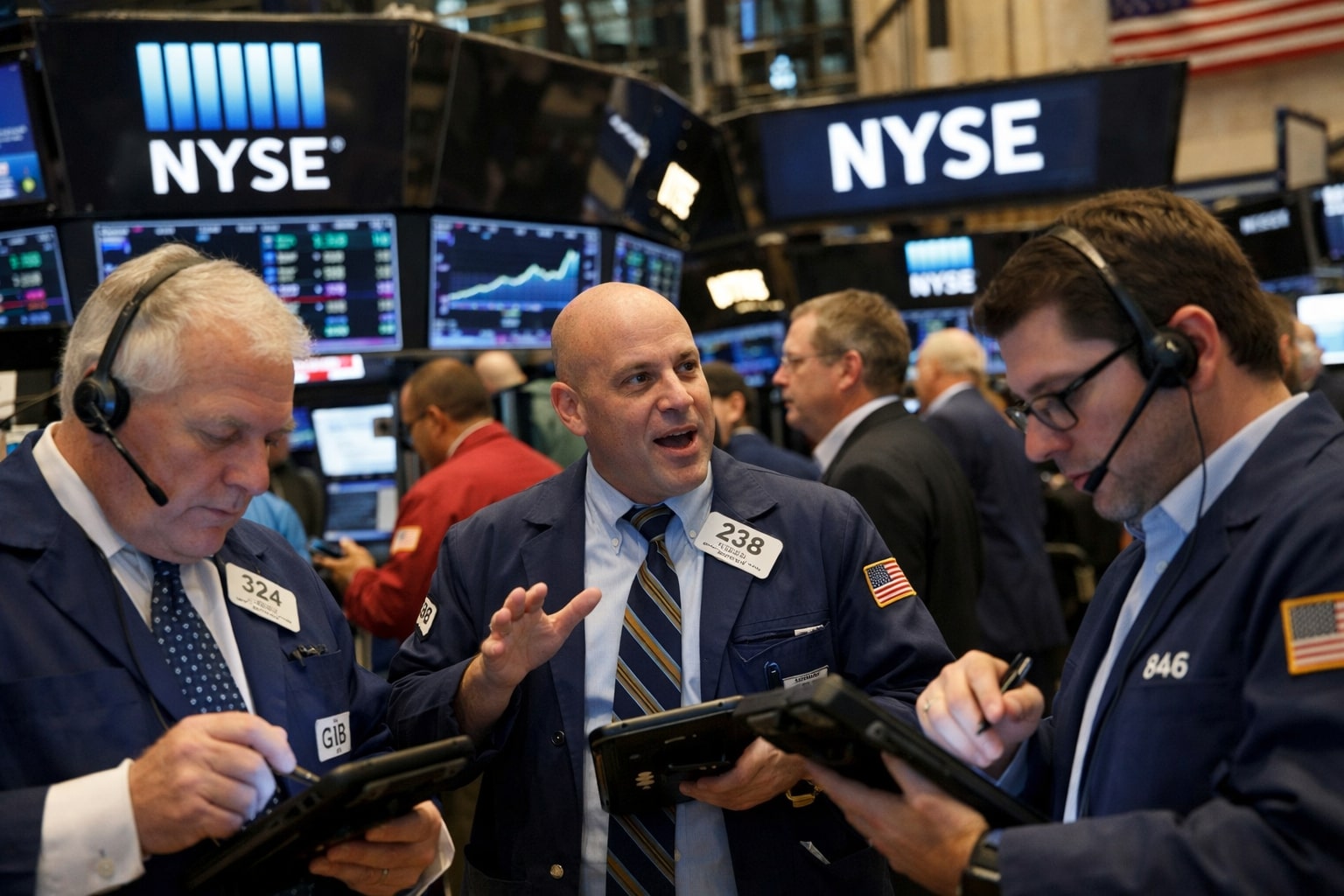
The first full week of 2026 ended with U.S. equities pushing into new territory. The S&P 500 closed Friday at 6,966.28, up 0.65% on the day and about 1.6% for the week, marking its third intraday record in a single week and a new all-time closing high. The Dow Jones Industrial Average finished at 49,504.07, up 237.96 points or 0.48%, also a record close. The Nasdaq Composite ended at 23,671.35, gaining 0.81% on Friday and roughly 1.9% week-to-date. Futures into the weekend held the tone: DJIA futures around 49,733, S&P 500 futures near 7,004, and Nasdaq futures at about 25,931, signaling only marginal consolidation rather than an immediate reversal.
Macro snapshot: indices, global risk sentiment, yields, oil and crypto
The rally is not confined to U.S. large caps. The small-cap Russell 2000 traded near 2,624, up almost 0.8–1.0% on the day and more than 4% for the week, pushing its 2026 gain above 5% and outperforming the S&P 500 by roughly two percentage points over the same period. In Europe, the Stoxx 600 closed around 609.67 (+0.97%), while China’s SSE Index printed roughly 4,120.43 (+0.92%), confirming that risk appetite extended to global equities. In rates, the U.S. 10-year Treasury yield eased to about 4.175%, down roughly 2–3 basis points, while the Dollar Index hovered near 99.14, reflecting a softer dollar backdrop that typically supports risk assets and commodities. Crude stayed firm, with front-month oil around $58.78 and daily gains close to 1.8–2.0%, driven by Venezuela and Iran headlines. In digital assets, Bitcoin (BTC-USD) traded around $90,500–90,550 with modest daily moves (<1%), Ethereum (ETH-USD) sat just above $3,000, and XRP held above the $2.00 area after rebounding off the $2.07 zone. The crypto tape is consolidating rather than leading, but stable prices at these levels help reinforce the broader risk-on tone.
Jobs report: soft payrolls, lower unemployment and a cleaner data print support the soft-landing story
The December U.S. labor data provided the primary macro catalyst for Friday’s move. Nonfarm payrolls increased by 50,000, well below the roughly 73,000 expected by economists and also below the 55,000 average monthly gain seen over the prior 11 months of 2025. At the same time, the unemployment rate fell to 4.4%, better than the 4.5% consensus and down from 4.6% previously. This combination – weaker headline job creation but lower unemployment – fits the “low-hire, low-fire” narrative highlighted by Anthony Saglimbene of Ameriprise, where labour demand cools without tipping into broad layoffs. Importantly, this was the first “clean” nonfarm payrolls report in months, with no data-collection distortions from the extended government shutdown that had forced the Bureau of Labor Statistics to skip the full October report and delay November numbers. For equities, the message is straightforward: growth is slowing but intact, the labour market is loosening without collapsing, and the Federal Reserve has no immediate need to cut in January and probably not in March, but the data still leans toward eventual easing rather than renewed tightening.
Index leadership: small caps, cyclicals and breadth finally join the rally
A critical shift this week was the improvement in market breadth. The Russell 2000 gained more than 4% over the week versus roughly 1.6% for the S&P 500 and just under 2% for the Nasdaq Composite, after years of underperformance. That relative gain pushed the small-cap index’s 2026 advance above 5%, making small caps one of the early outperformers of the year. At the same time, breadth within the S&P 500 improved markedly: 42 index constituents printed new 52-week highs on Friday, while only six sank to new 52-week lows. New-high names included Alphabet (GOOGL) at all-time levels back to its 2004 IPO, off-price retailer The TJX Companies (TJX) setting records dating to 1987, upscale beauty group Estee Lauder (EL) revisiting levels not seen since mid-2024, and defense contractors L3Harris Technologies (LHX) and Lockheed Martin (LMT) trading at record highs stretching back to their 1950s and 1990s histories. Travel- and consumer-linked names such as Southwest Airlines (LUV) and Marriott International (MAR) also joined the new-high list, along with semis and equipment like Intel (INTC) and Lam Research (LRCX) and biotech heavyweight Biogen (BIIB). On the downside, the new-low list was dominated by rate-sensitive and secularly pressured names: DaVita (DVA), GoDaddy (GDDY), tower REITs American Tower (AMT) and Crown Castle (CCI), data-platform CoStar Group (CSGP) and SBA Communications (SBAC). The message is clear: leadership is broadening beyond the “Magnificent Seven,” but the market is still punishing structurally challenged or rate-exposed business models.
Policy shock in housing: Trump’s $200 billion mortgage-bond push ignites homebuilders and mortgage lenders
President Donald Trump added a major policy headline by announcing that he is instructing his “representatives” to buy $200 billion in mortgage-backed securities, arguing that Fannie Mae and Freddie Mac are sufficiently capitalized to support a large-scale program designed to pull mortgage rates and monthly payments lower. Equity traders moved first, regulators later. Rate-sensitive housing names ripped higher: homebuilders D.R. Horton (DHI) jumped nearly 8%, PulteGroup (PHM) gained more than 7%, and Lennar (LEN) rallied over 8%, while home-improvement bellwether Home Depot (HD) also advanced. Mortgage financiers saw even sharper moves. Rocket Companies (RKT) climbed more than 7%, UWM Holdings (UWMC) spiked over 12% for its best day since 2023, PennyMac (PFSI) rose roughly 5%, AI-driven mortgage name Better Home & Finance (BETR) gained more than 11%, and real-estate platform Opendoor Technologies (OPEN) – a known meme stock – surged more than 16%. If a material portion of that $200 billion actually hits the market via Fannie/Freddie, 30-year mortgage rates pushing into the 5.5% area become realistic, which would reset volumes, affordability and equity narratives across the housing complex. For now, the tape is signalling that the market is willing to front-run the policy, even though operational details and legal authority are still vague.
Tariff ruling delay: Supreme Court disappoints retailers and keeps trade risk on the table
On the trade front, expectations that the U.S. Supreme Court would rule Friday on the legality of President Trump’s broad tariff regime were not met. The Court issued just one opinion, unrelated to tariffs, leaving the market without clarity on whether the administration can use the International Emergency Economic Powers Act as the basis for sweeping tariffs and, crucially, whether importers could be reimbursed for duties already paid if the tariffs are found improper. Retail and consumer stocks, which had rallied earlier in the week on hopes of at least a partial rollback, reversed as the non-decision hit the tape. For import-heavy consumer names, that means continued pressure on gross margins from elevated landed costs and no visibility yet on whether relief is coming. For the S&P 500 overall, it keeps an overhang on global supply chains and could re-ignite volatility if a surprise ruling forces a rapid repricing of trade-exposed sectors.
Energy and geopolitics: oil holds near the high-$50s on Venezuela reset and Iran unrest
Crude futures settled around $58.78 with a daily gain near 1.8–2.0%, reflecting a reassessment of supply risk rather than a demand shock. Two elements dominate: U.S. policy shifts toward Venezuela and escalating unrest in Iran. Trump scheduled a White House meeting with major oil executives to discuss investment plans in Venezuela just days after the U.S. helped remove Nicolás Maduro. That opens a path for fresh U.S. capital into Venezuelan fields longer term, but near-term flows are constrained by infrastructure, sanctions and governance risk. Simultaneously, instability in Iran raises the probability of supply disruption or tighter sanctions at some point in 2026. The result is a wider band of outcomes for medium-term supply: plenty of upside risk in the near term, offset by the potential for incremental barrels from Venezuela later in the decade. For energy equities, this keeps a constructive but not explosive backdrop. Oil-sensitive S&P 500 and Dow constituents benefit from a higher floor under WTI, but the path to $70+ is not yet guaranteed given these cross-currents.
Semiconductors and AI: ASML, AVGO, INTC, TSM, TXN and AI ETFs extend leadership
The semiconductor and AI complex remained a key engine behind the Nasdaq outperformance. U.S.-listed shares of ASML Holding (ASML) jumped about 7%, reflecting strong demand for EUV and advanced lithography as foundries expand high-end capacity. Broadcom (AVGO) gained around 4%, Taiwan Semiconductor (TSM) added roughly 1.4%, and diversified analog player Texas Instruments (TXN) rose about 1%. These moves are layered on top of prior year-to-date gains, reinforcing semis as the structural growth trade. Politically, Trump’s comments about Intel (INTC) amplified the sector’s profile. After meeting with Intel CEO Lip-Bu Tan, Trump stated that the U.S. government – now owning a 10% stake – has already made “tens of billions of dollars” in just four months on the position, calling Intel a success for American taxpayers. INTC rose roughly 2–3% in regular trading and tacked on another 1.7% after hours. In parallel, Mizuho reiterated Nvidia (NVDA), Broadcom (AVGO) and Lumentum (LITE) as top 2026 semiconductor picks, citing three pillars: AI accelerators and wafer-fab equipment, optical networking, and memory (DRAM/NAND), while expressing caution on xEV/Auto/SiC/Analog and PC/handset exposure. The combined message is simple: the AI infrastructure cycle is still early, policy support is explicit (particularly for INTC), and earnings leverage remains with the producers of compute, memory and manufacturing tools.
Read More
-
Yen Stalls at 160 Despite a 3% JGB and Tokyo Core CPI at 2.0% — Intervention Sits at 164, Friday's Payrolls Decide
02.09.2026 · TradingNEWS ArchiveEnergy
-
QQQI ($53.80) Turns Nasdaq Volatility Into a 14.2% Monthly Yield as Assets Top $15B — Big Tech Earnings Set November
27.10.2026 · TradingNEWS ArchiveStocks
-
XRPI ($7.09) Rises 2.46% as Spot XRP Funds Hold $1.47B but Flows Stall Near Zero — $1.35 Breakout Sets the Next Leg
27.10.2026 · TradingNEWS ArchiveCrypto
-
NG($3.002) Takes the Front Month Near a Multi-Month Low as Record Production Meets Mild Weather — Break of $2.945 Opens $2.80
27.10.2026 · TradingNEWS ArchiveCommodities
-
USD/JPY (157.86) Squeezed Between a 2.8-Point Carry Edge and Tokyo’s 160 Line — BoJ Hawkish Hold Friday Sets the Break
27.10.2026 · TradingNEWS ArchiveForex
Nuclear and data-center power: Vistra (VST) and Oklo (OKLO) explode higher on Meta power deals
Outside classical semis, nuclear-linked power names tied to data-center growth generated aggressive pre-market moves. Vistra (VST) and Oklo (OKLO) both jumped in the mid-teens – roughly 15% and 18% respectively – after disclosing deals to supply nuclear-based power to Meta Platforms for its AI build-out. These moves underline a broader theme: the AI and cloud cycle is now a power-market story as much as a chip story. Data-center operators and hyperscalers are scrambling for reliable, low-carbon baseload electricity at scale, and the winners in that race – whether in nuclear, renewables, or hybrid solutions – will see structurally higher contracted revenues. For equity investors, the takeaway is that the AI ecosystem extends well beyond NVDA, AVGO and TSM into long-duration infrastructure exposures that trade more like utilities with a growth overlay.
Financials and autos: GM kitchen-sinks EV and China; mortgage and credit policy shift the narrative
In after-hours trading, General Motors (GM) fell about 2% after revealing in a regulatory filing that it will record $7.1 billion in special charges in Q4 2025, tied to a pullback in its electric-vehicle roadmap and restructuring in China. That charge signals management’s willingness to reset expectations around EV profitability and Chinese exposure after years of over-promising. Strategically, this is a de-risking step for GM equity; tactically, it pressures near-term earnings and caps multiple expansion until investors see clear returns on the re-focused capital allocation. On the consumer-credit side, Trump’s parallel push for a 10% cap on credit-card interest rates for one year would, if enacted, compress margins for card issuers and banks while relieving some pressure on households. Combined with the proposed $200 billion mortgage-bond purchase program, it points toward a policy stance that favours borrowers over lenders. For S&P 500 financials, that is a headwind on net interest margins but may be partially offset by better credit performance if lower rates stabilise household balance sheets.
Consumer, defensives and upgrades: MO gets a fresh buy rating, towers remain under pressure
Defensive yield names continue to see selective interest. Altria Group (MO) was upgraded to Buy from Neutral at UBS, with the price target raised from $61 to $63, implying nearly 13% upside from the prior close. The analyst’s thesis rests on an expected improvement in cigarette-volume trends through 2026, aided by better overall industry volumes and pricing that can stabilise Altria’s share. Combined with MO’s high dividend yield and relatively low valuation, that upgrade adds another yield-oriented option for investors repositioning away from pure cash as rates drift lower. In contrast, rate-sensitive tower REITs AMT, CCI and SBAC all traded at or near multi-year lows (with CCI at levels last seen in 2016, SBAC back to 2019 levels). This underscores that not all yield plays are equal: leverage and duration risk matter, and the market is discriminating between bond-proxy sectors.
Streaming and media: NFLX price target cut ahead of Warner Bros. asset decision
Ahead of its January 20 earnings release, Netflix (NFLX) remains under scrutiny. Goldman Sachs maintained a Neutral stance but cut its price target from $130 to $112, still implying nearly 24% upside from Thursday’s close. The key swing factor is Netflix’s planned acquisition of Warner Bros.’ film and streaming assets, now facing a hostile counter-bid from Paramount Skydance. Warner Bros. Discovery’s board has already recommended shareholders reject the hostile offer, but the ultimate structure of any combination remains fluid. For NFLX, the near-term story is still solid execution into year-end 2025, with scale and ad-tier growth supporting revenue. The medium-term equity case, however, depends on whether the Warner assets are integrated cleanly or whether prolonged deal noise undermines the multiple. Until there is clarity, the stock is likely to trade on earnings-day surprises and deal headlines rather than purely on fundamentals.
Sentiment and the macro narrative: consumer confidence, economic acceleration and rate-cut expectations
Macro sentiment data are consistent with the market’s risk-on stance. The University of Michigan’s consumer-sentiment index rose to 54.0 in early January from 52.9 in December, its highest level since September, signalling that households perceive incremental improvement in the economic backdrop. Equity strategists emphasise that the current rally is less about pure Fed rate-cut speculation and more about the prospect of an economic acceleration into 2026 after a mid-cycle slowdown. That view is reinforced by the behaviour of cyclically sensitive indices: the Russell 2000 outperforming, the Dow hitting records, and a broad set of S&P 500 constituents making new highs. At the same time, derivatives markets have scaled back the most aggressive early-2026 cut expectations after the “clean” 50,000 payroll print and 4.4% unemployment, implying a slower but still real easing path rather than a rapid pivot.
OTC drugs and healthcare consumer theme: secular 8.1% CAGR supports defensives
Beyond day-to-day tape action, structural themes are quietly reinforcing defensive growth pockets. According to a new Verified Market Research® report, the global Over-the-Counter (OTC) drugs market was valued at $196.86 billion in 2024 and is projected to reach $367.08 billion by 2032, implying a CAGR of 8.10% from 2026 to 2032. The drivers are straightforward: rising self-medication, increased health awareness, easier access to treatments without prescriptions, and the impact of e-commerce on distribution. For listed OTC players and consumer-health spin-offs inside the S&P 500 and Stoxx 600, that growth runway offers a secular offset to cyclical swings, especially as investors rotate toward income and diversifiers. As traditional 60/40 stock-bond portfolios struggle to provide the same risk-adjusted returns during stress, healthcare consumer names linked to this trend become more attractive as long-duration compounders.
BlackRock’s 2026 playbook: AI, income and diversifiers reshuffle ETF flows
From an allocation standpoint, BlackRock (BLK) – managing more than $13 trillion – is framing 2026 around three pillars: artificial intelligence, income, and diversification. On the AI side, BlackRock continues to see a long-term, capital-intensive investment cycle, with infrastructure spending elevated and productivity and earnings gains backed by AI deployment. Its iShares A.I. Innovation and Tech Active ETF (BAI) closed around $34.33, up roughly 2.11% on the day before slipping to $34.26 after hours, and has already amassed over $8 billion in assets. Competing or complementary AI funds above the $1 billion AUM line include Roundhill Generative AI & Technology ETF (CHAT), Ark Autonomous Technology and Robotics ETF (ARKQ), Global X Robotics and Artificial Intelligence ETF (BOTZ), Global X Artificial Intelligence and Technology ETF (AIQ), iShares Future AI & Tech ETF (ARTY) and the Dan Ives Wedbush AI Revolution ETF (IVES). BlackRock highlights concentration risk: the “Magnificent Seven” now represent over 40% of the S&P 500 index, pushing investors to decide how much single-theme exposure they can tolerate. Equal-weight and targeted-sector ETFs are attracting flows from those looking to dilute mega-cap dominance. On income, BlackRock expects falling rates and renewed Fed cuts to undermine cash and money-market yields, forcing investors into bond and dividend strategies. On diversification, the firm argues that frequent volatility spikes and narrow leadership mean the traditional 60/40 stock-bond mix is less reliable, driving interest in alternatives and assets that behave differently from both equities and Treasuries. With the S&P 500 delivering an annualised 13.5% over the past decade, BlackRock is effectively warning that forward returns will be lower and that hitting targets will require better factor and sector selection rather than passive beta alone.
Crypto and cross-asset backdrop: gold above $4,400, Bitcoin near $90,000, Nasdaq eyeing 24,020
Cross-asset moves validated the equity rally. Spot gold climbed about 0.5% to roughly $4,496.09, extending weekly gains as traders priced in at least two Fed rate cuts in 2026 and responded to the weaker-than-expected jobs headline and softer dollar. Lower real yields reduce the opportunity cost of holding non-yielding assets such as gold and help position it as a hedge against both inflation and policy error. Equities and gold rising together is a classic soft-landing configuration: growth is strong enough to support earnings, but uncertainty and lower real rates support hedging demand. In crypto, Bitcoin rebounded from the $90,000 support area, holding around $90,500, with bulls still targeting six-figure levels if macro conditions remain supportive. Ethereum traded around $3,900 in the CoinGape piece, while XRP bounced off the $2.07 zone. For equities, crypto’s stability at these high absolute levels matters primarily as a sentiment gauge – a sign that speculative risk appetite is intact and that liquidity conditions remain favourable across assets.
Market stance: bullish bias on U.S. equities with a preference for growth plus breadth – rating: BUY with selectivity
Putting all the data together – record closes for the S&P 500, Dow and strong Nasdaq; an outperforming Russell 2000 up more than 4% on the week; 42 S&P 500 constituents at new 52-week highs versus only six at new lows; a December jobs report with just 50,000 payroll additions but a lower 4.4% unemployment rate; gold near $4,500 on rising rate-cut bets; sector-specific surges in homebuilders, mortgage lenders, semiconductors, nuclear-linked power and AI ETFs; and major allocators like BlackRock (BLK) explicitly positioning for continued AI-led growth and a search for yield – the balance of evidence supports a bullish stance on U.S. equities. Valuations are not cheap and concentration risk is real, but breadth is improving, small caps are finally participating, policy is biased toward supporting housing and credit, and the macro data still fit a soft-landing profile rather than a pre-recession environment. On that basis, the U.S. equity market – across Nasdaq, S&P 500, Dow and Russell 2000 – justifies a BUY rating, with a clear tilt toward AI, semiconductors, data-center power, selective cyclicals (housing, certain financials) and structural defensives (OTC healthcare, high-quality income), and a relative underweight to over-levered, rate-sensitive laggards such as tower REITs and structurally pressured retail.