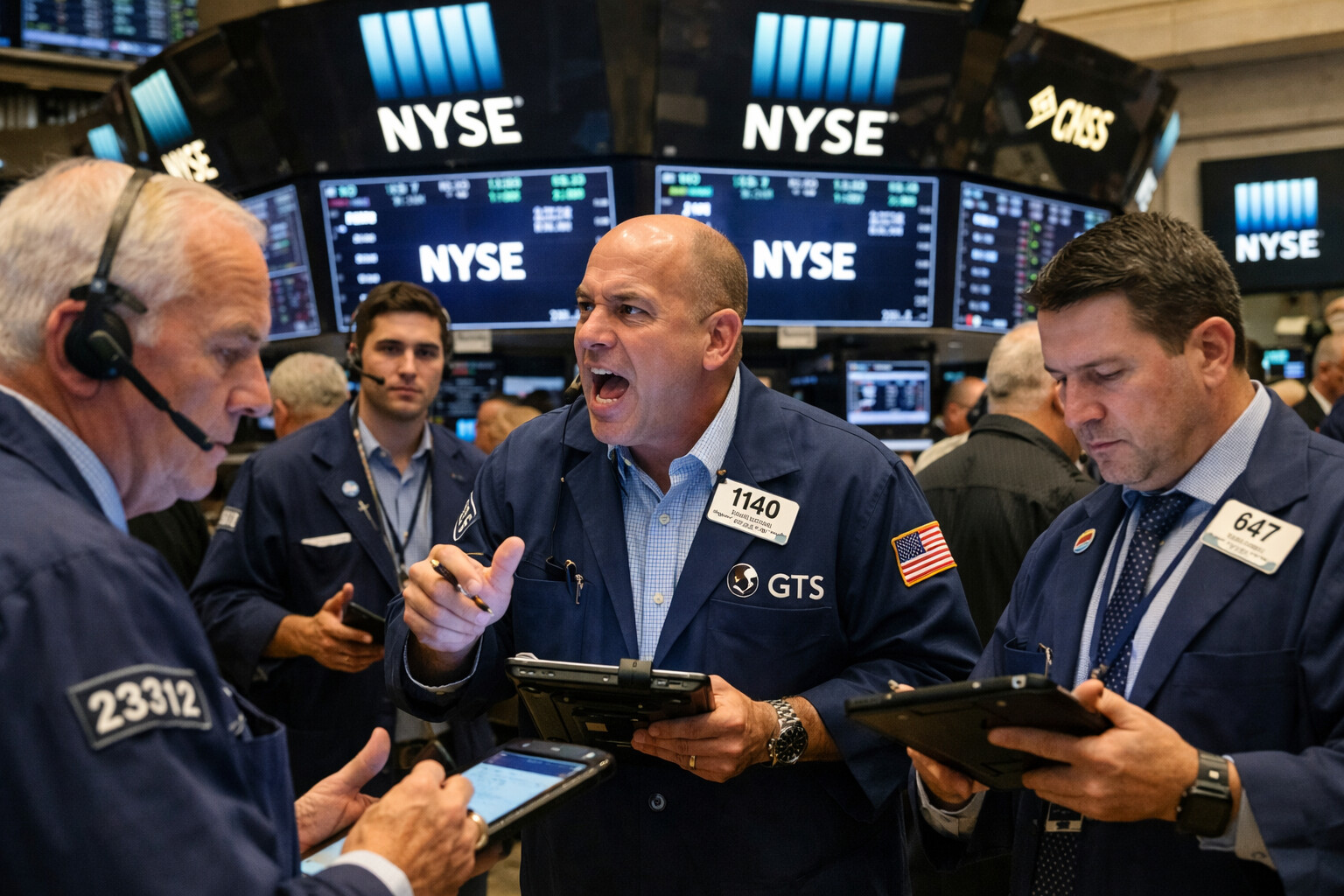
Stock Market Today: Dow Jones 49,300, S&P 500 6,945, Nasdaq 23,600 as Gold Blasts Above $5,000
Gold clears $5,000 and silver jumps past $110 while the Dow Jones hovers near 49,300, the S&P 500 around 6,945 and the Nasdaq near 23,600, with Trump’s 100% Canada tariff threat, rising shutdown odds and a weaker dollar colliding with Big Tech earnings and the Fed decision | That's TradingNEWS
Stock market today: indices grind higher while fear trades explode
The equity tape is constructive but not euphoric. The Dow Jones Industrial Average (DJIA) trades around 49,200–49,300, up roughly 0.3%–0.4%. The S&P 500 (SPX) is near 6,940–6,950, also gaining about 0.4%–0.5%. The Nasdaq Composite (COMP) is around 23,580–23,600, adding roughly 0.3%–0.4%. The Russell 2000 (RUT) fluctuates around 2,670–2,685, underperforming earlier but eventually up about 0.5%–0.6%. This comes after two straight losing weeks and after the sharp January 20, 2026 selloff, when SPX dropped about 2.1%, COMP fell 2.4%, and the DJIA lost roughly 870 points on tariff headlines. Index-level price action shows cautious risk-on, but the real story sits in gold, FX and specific stock winners and losers.
Gold above $5,000 and silver above $100
Gold has taken over as the primary market signal. Front-month gold futures GC00 broke through $5,000 per troy ounce for the first time and are trading around $5,090–$5,130, up roughly 2.2%–2.3% on the day. Over the last 12 months, gold is up more than 80%, with an additional 17% gain already in 2026. Silver futures SI00 trade around $111–$112, up roughly 9%–10% and well above the $100 mark. The move is not a slow grind; it is a disorderly repricing of the fear premium. Drivers are concentrated in politics and policy risk: threats of 100% tariffs on Canadian goods if Canada signs a trade agreement with China, sharply rising odds of a U.S. government shutdown by month-end, and continued public attacks on the Federal Reserve. Investors are dumping political and fiscal risk into gold and silver instead of relying solely on Treasuries. Equity beneficiaries are clear: large miners such as Newmont (NEM) and Freeport-McMoRan (FCX) extend strong year-to-date rallies, while other diversified producers and royalty companies are gaining as leveraged plays on spot prices. From an allocation perspective, the market is treating gold not as a tactical hedge but as a core refuge from tariff shocks, fiscal standoffs, and institutional stress.
Dollar, yen and the ‘sell America’ rotation
The U.S. Dollar Index (DXY) has broken below 97, its weakest zone in nearly four years, while gold rips higher. The U.S. dollar is lower against almost every major currency. The biggest message comes from the Japanese yen. USD/JPY has swung from around 158.7 at Friday’s Tokyo close to roughly the mid-153–154 area after U.S. and Japanese officials signaled they are ready to intervene to support the yen. That has knocked Japanese stocks and local bond yields and has reminded macro traders that one-way short-yen positioning is no longer a free trade. At the same time, investors are rotating out of dollar exposure and into gold, select European currencies such as SEK and NOK, and U.S. Treasuries. The phrase “sell America” is visible in flows: sell the dollar and tariff-sensitive U.S. risk, buy metals, quality FX and selective duration. Equities are not collapsing, but FX and metals are clearly repricing U.S. political and policy risk.
Rates, credit and the complacency gap
The U.S. 10-year Treasury yield (10Y) trades around 4.21%, only a few basis points below Friday’s close. The 2-year (2Y) is around 3.60%–3.65%, with a $69 billion 2-year auction on the calendar. Yields suggest steady demand for Treasuries, not panic. The problem sits in credit spreads. Investment-grade and high-yield spreads over Treasuries are back to their tightest levels since 1998, even as equities have seen multiple sharp risk-off episodes and gold signals escalating uncertainty. That creates a clear gap: metals and FX are loudly pricing political and policy risk, while credit markets act as if default and downgrade risk are minimal. If tariffs escalate or a shutdown hits, the adjustment will likely come via wider spreads and pressure on leveraged balance sheets rather than via Treasuries, which are still being treated as a safety valve.
Fed decision week: communication risk, not rate risk
The Federal Reserve is expected to leave the federal funds rate unchanged in a 3.50%–3.75% target range at this week’s meeting. Fed funds futures price about a 97% probability of no move. The central bank has already delivered three quarter-point cuts and wants time to observe the impact on growth and inflation. The real risk is not the decision itself but the messaging. The Fed is operating under political fire, with the chair under investigation and direct criticism from the White House. Markets will dissect every sentence for three things: how strongly the Fed defends its independence, whether it leans against further cuts or leaves the door open, and how it frames the balance between inflation risk and labor-market stability. A more dovish tone with gold already above $5,000 and DXY breaking down would likely push metals and long-dated Treasuries even higher. A hawkish surprise or a clumsy defense of independence could trigger another equity air pocket similar to the January 20 selloff.
Mega-cap tech and earnings: AAPL, MSFT, META, TSLA
Index performance this week will ultimately hinge on a handful of mega-cap names. Apple (AAPL) trades around the mid-$250s, up roughly 2%+ today, after a major bank reaffirmed an overweight rating and lifted its price target from $305 to $315, implying about 27% upside from current levels. The call leans on stronger-than-expected iPhone 17 demand and tight cost control heading into Thursday’s earnings. Meta Platforms (META) adds roughly 1% as traders position for Wednesday’s report. Microsoft (MSFT) will be scrutinized for AI-driven cloud demand and capex, while Tesla (TSLA) is down roughly 2.5% ahead of Wednesday’s numbers, still under pressure from margin compression and EV price competition. This all sits on top of the January 20, 2026 AI-led shock, when Nvidia (NVDA), TSLA, Amazon (AMZN) and Alphabet (GOOGL) fell between roughly 3.4% and 4.4% in a single session. With more than 90 S&P 500 constituents reporting this week and about 76% of early reporters beating expectations, the bar is not low. Any combination of weaker guidance from AAPL, cautious commentary from MSFT, or softer ad trends at META would challenge the entire multiple that has been assigned to the growth complex.
AI infrastructure: Nvidia, CoreWeave and crowded AI valuations
The clearest AI winner today is CoreWeave (CRWV). NVDA is injecting $2 billion into CRWV at $87.20 per share, a discount to the prior close near $92.98. CRWV now trades above $100, up more than 10%–12% intraday. Strategically, this is important. NVDA is not just selling GPUs; it is shaping the AI infrastructure stack by financing “AI factories” via partners such as CRWV. That reinforces demand visibility for high-end chips and locks cloud operators further into the NVDA ecosystem. At the same time, the broader AI universe is flashing valuation risk. Bill Gates has already labeled AI a “hypercompetitive” arena, warning that a “reasonable percentage” of current AI names cannot justify their valuations. With hyperscalers spending about $400 billion on infrastructure in 2025 and projected to boost that by another third in 2026, any slowdown or reprioritization in capex could hit second-tier AI infrastructure and software names hard. The trade here is selective: core exposure to NVDA and high-quality infrastructure is justified, but broad AI beta remains dangerous at stretched multiples.
Biotech and broken deal momentum: RVMD
M&A-driven biotech has delivered a reminder of deal risk. Revolution Medicines (RVMD) is down roughly 20% in pre-market and early trading after Merck (MRK) walked away from acquisition discussions that could have valued RVMD near $30 billion. The two sides appear unable to agree on price after RVMD surged more than 185% over the past year on takeover hopes and oncology pipeline optimism. In a market where investors are willing to pay technology-like multiples for scarce growth in oncology and AI-adjacent platforms, a broken deal story quickly flips from euphoria to air-pocket. The message is straightforward: richly priced, single-catalyst names are vulnerable when negotiations fail or valuation gaps widen.
Obesity drugs: Novo Nordisk versus Eli Lilly
The obesity-drug theme remains one of the strongest secular stories on the board. Deutsche Bank’s read on prescription data shows that oral Wegovy from Novo Nordisk (NVO) is largely additive, not cannibalizing the injectable version. Most prescriptions are classified as new-to-brand rather than switches. That dynamic explains why NVO is up roughly 25% month-to-date, while Eli Lilly (LLY) is flat to slightly down over the same stretch. For the broader market, this segment matters for two reasons. First, it anchors a major defensive growth pocket inside healthcare, where demand looks durable and pricing power remains strong despite political attention. Second, it offers a cash-flow and earnings engine that can grow even if tariffs and political volatility hit more cyclical sectors. Valuations are full, but the earnings visibility and real-world demand justify an overweight stance on leaders such as NVO and LLY versus marginal players.
Weather risk and U.S. airlines
The winter storm across the central and eastern U.S. has triggered more than 20,000 flight cancellations between the weekend and Monday. American Airlines (AAL) alone has canceled over 1,500 flights, roughly half its schedule. AAL, Delta Air Lines (DAL) and United Airlines (UAL) are all trading modestly lower. For the indices, this is a rounding error. For the airlines, it is another quarter where weather, operational disruptions, and compensation costs will drag on margins and capacity plans. With fuel prices hovering near $60–61 for WTI and wage pressure elevated, this sector continues to face episodic hits that make consistent earnings delivery difficult. The market has little patience for operational surprises when investors can buy secular compounders elsewhere.
Read More
-
Yen Stalls at 160 Despite a 3% JGB and Tokyo Core CPI at 2.0% — Intervention Sits at 164, Friday's Payrolls Decide
02.09.2026 · TradingNEWS ArchiveEnergy
-
SOFI ($16.71) Posts Its Best Day of the Quarter as Profit Guidance Finally Rises — Holding $15.70 Unlocks $20
27.10.2026 · TradingNEWS ArchiveStocks
-
XRP-USD ($1.30) Defends a $1.27 Double Bottom as Whales Hold 68.5% of Supply — Break of $1.31 Opens $1.35 and $1.40
27.10.2026 · TradingNEWS ArchiveCrypto
-
Brent ($113.88) Trades a $2.35 Range as Houthi Strikes Meet Saudi-Iran Diplomacy — Break of $117 Unlocks $120
27.10.2026 · TradingNEWS ArchiveCommodities
-
Nasdaq Rips 1.3%, S&P 500 Hits 7,728, Dow Stalls as BA Drops to $171
27.10.2026 · TradingNEWS ArchiveMarkets
-
GBP/USD (1.3310) Can’t Cash In on 5.43% Gilt Yields as Budget Risk Meets a Firm Dollar — Break of 1.3274 Opens 1.3200
27.10.2026 · TradingNEWS ArchiveForex
Rare earths and strategic metals: USAR and policy-driven winners
The most aggressive policy-driven move today is in rare earths. USA Rare Earth (USAR) is surging after the U.S. Department of Commerce agreed in principle to provide $1.6 billion in federal backing, including loans and grants, in exchange for an equity stake. The structure involves 16.1 million new shares and about 17.6 million warrants, giving the government roughly a 10% stake. USAR has already more than doubled year-to-date to around $24–29 and is up another 20%–30% today. The company’s mine-to-magnet model in Texas and Oklahoma fits directly into U.S. national-security objectives for securing rare earths and permanent magnets used in semiconductors, defense, wind turbines and EVs. This is not isolated. Previous support for names such as MP Materials (MP) shows that certain mining and processing assets are being treated as strategic infrastructure rather than pure cyclicals. Add in the C$5.5 billion all-cash bid by Zijin Gold for Allied Gold, and you have a clear M&A and policy floor under quality hard-asset producers. The flip side is concentration risk: these names are now tightly tied to a specific policy regime. A shift in administration priorities or permitting attitudes could hit valuations hard.
Flows, hedge funds and positioning
Institutional allocators are rotating back into active risk. A Goldman Sachs survey shows about 45% of institutions expect to increase hedge-fund exposure in 2026, net of those planning cuts, the highest proportion since at least 2017. After several years of underperformance and fee pressure, “alpha winter” is giving way to renewed appetite for strategies that can trade dispersion in rates, FX, commodities and equities. This is happening while credit spreads are at their tightest since 1998, gold is at a record, and the dollar is under pressure. That combination signals that large allocators want uncorrelated or crisis-alpha strategies in the portfolio but are still leaving traditional credit risk aggressively priced. It sets the stage for higher dispersion: stock selection, macro timing and cross-asset relative value will matter more than simple index exposure.
Small caps, unprofitable rally and risk appetite
Despite all the political noise, risk appetite is very much alive. Within the Russell 2000, unprofitable small caps have rallied more than 12% since Halloween, outpacing profitable peers. Money is flowing back into high-beta, speculative parts of the market at the same time as investors load up on gold and sell the dollar. That is classic late-cycle behavior. Investors are simultaneously buying upside optionality in smaller, leveraged names and insuring tail risk through metals and FX. It is not a defensive stance; it is a high-beta, high-hedge profile, which usually ends with a violent repricing in one of the legs when a real macro shock hits.
Key underperformers: INTC, TCPC and pockets of stress
Today’s losers underscore where the market is intolerant of weakness. Intel (INTC) is down another 4% after crashing roughly 17% on Friday, following soft guidance and warnings about supply constraints in the coming quarter. Against the backdrop of NVDA and AMD domination in high-end compute, the market is treating INTC as a structurally impaired story unless it can prove sustained progress in foundry and process technology. In credit, BlackRock TCP Capital (TCPC) is down roughly 8%–13% after flagging an expected ~19% hit to net asset value. That is a direct warning about parts of the private credit and BDC complex where underlying loans are not as bulletproof as spreads imply. Combine this with the RVMD deal break, and you get a clear pattern: narratives are not enough; the market is ruthless when cash flows, balance sheets or deal logic disappoint.
Macro-political overhang: tariffs, shutdown odds and credibility
The macro fundamentals are not weak. November durable-goods orders rose 5.3%, beating expectations of 4.5% and reversing a 2.1% decline in October. Excluding defense, orders climbed 6.6%; excluding transportation, they still rose 0.5%. That profile is consistent with an economy that is still expanding. The pressure points are political: a threatened 100% tariff on Canadian goods if Canada signs a trade deal with China; prediction markets putting nearly 78% odds on a U.S. government shutdown by the end of January, up from less than 10% only days ago; and ongoing public attacks on the Fed and institutional checks and balances. Markets are not questioning growth yet; they are questioning policy coherence and fiscal discipline. That is why GC00 is above $5,000, SI00 is above $110, DXY is below 97, and yet 10Y yields are only slightly lower and credit spreads are near multi-decade tights. The divergence is the central macro feature of this tape.
Bitcoin, oil and the rest of the commodity complex
Bitcoin (BTC-USD) trades around $87,000–$88,000, up roughly 1.8%–2% on the day. It is participating in the risk-hedge trade but is not leading it; the magnitude of the move is far smaller than in gold and silver. Energy is subdued. West Texas Intermediate crude (CL) sits around $60.5–$60.9 per barrel, down roughly 0.3%–0.8%. The broader S&P GSCI Spot Index is around 587, up only about 0.5%, far behind precious metals. That tells you this is not a broad commodity super-cycle day; it is a targeted monetary-metal breakout, while oil continues to price steady supply, modest demand uncertainty, and the absence (so far) of a fresh geopolitical supply shock.
Market stance: buy, sell or hold across major themes
Equities, metals, FX and credit are sending distinct signals and you have to position accordingly. For large-cap U.S. equities through SPX and COMP, the right stance is HOLD with a mild bullish tilt. Earnings growth remains positive, more than 75% of early reporters are beating expectations, and the economy has not rolled over. At the same time, valuations, especially in AI megacaps, are rich, and political risk is real. New money should favor cash-rich, reasonably valued compounders over the most extended AI stories. For gold and silver via GC00, SI00, the stance is BUY. Fiscal uncertainty, tariff threats, questions over institutional independence and a weakening DXY support further upside, even after a historic run, though position sizing must stay disciplined. For the U.S. dollar via DXY, the stance is BEARISH. A break below 97, combined with record gold and intervention talk around the yen, argues for further downside versus select G10 currencies and metals. For strategic-metal names such as USAR and MP, the stance is SPECULATIVE BUY. Policy support and national-security positioning create powerful tailwinds but also high volatility and regime risk, so they belong in a tactical, not core, bucket. For the frothiest AI and biotech names surrounding NVDA, CRWV and RVMD-type stories, the stance is SELECTIVE HOLD or TRIM. Stay with genuine earnings power and balance-sheet strength, reduce exposure where valuations rely solely on narratives or M&A optionality. Putting it together, markets are pricing a world where growth is still intact but policy and currency risk are accelerating. The smart allocation keeps core exposure to U.S. equities, raises strategic allocations to gold and quality miners, underweights the dollar and high-beta excess, and remains prepared for abrupt moves as tariffs and shutdown negotiations hit the tape.