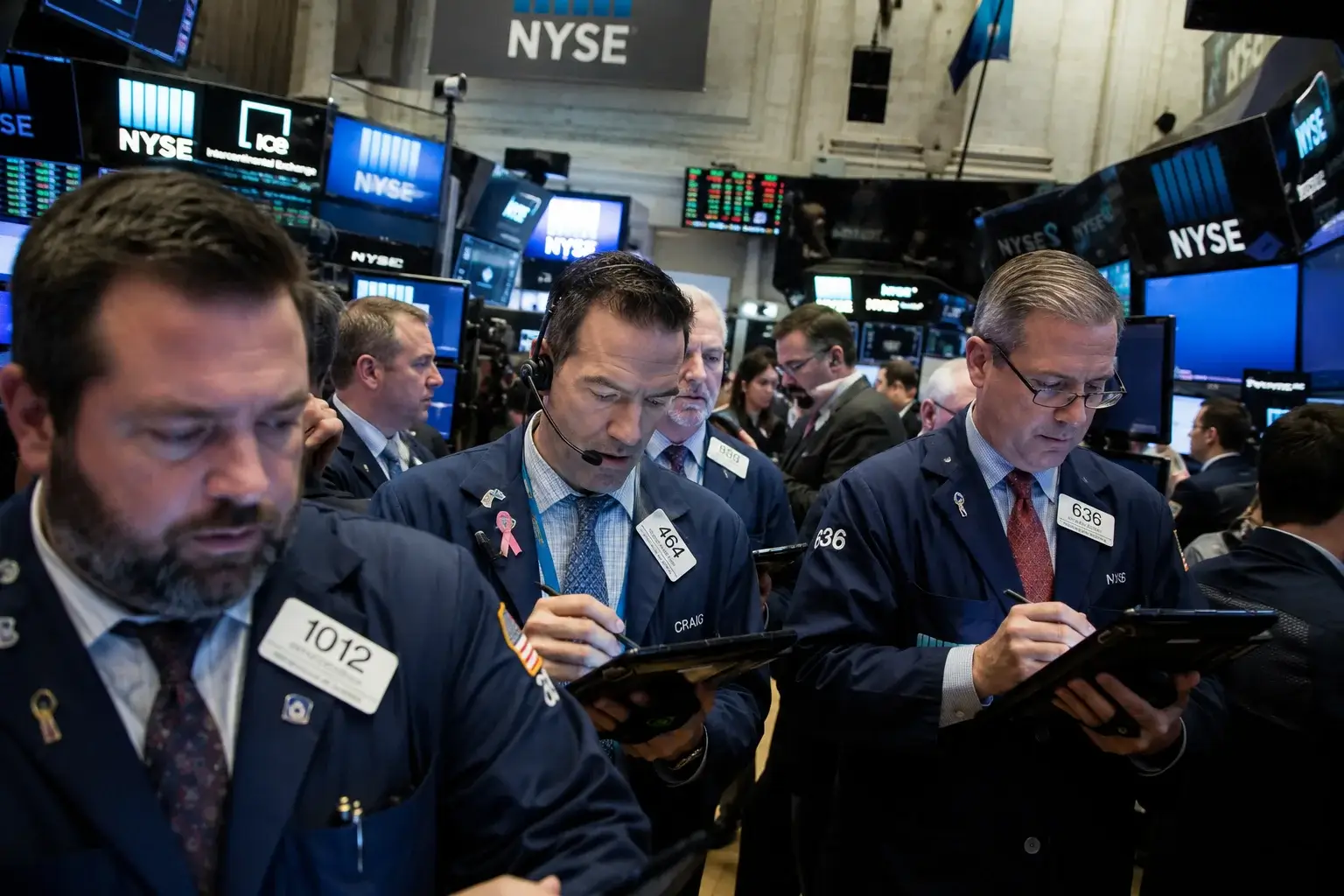
Stock Market Today: Dow Sheds 0.56% Off 51,308 Record, S&P 500 Eases From 7,609 and Nasdaq at 27,093 as (MRVL) Runs +7%
3 straight record closes gave way to a narrow pullback as the Dow slid 0.56% from 51,307.79 and the S&P 500 eased off 7,609.78 | That's TradingnEWS
Key Points
- S&P 500 eased 0.14% off its 7,609.78 record; 7,550 is first support, 7,650 the next upside target.
- Dow fell 0.56% from 51,307.79 as rate-sensitive blue chips led the pullback; 51,000 is the line to hold.
- Nasdaq held flat near 27,093 as semis kept the growth trade green; Russell 2000 ripped 0.90% to ~2,932.
The streak met its first speed bump. After the Dow, S&P 500, and Nasdaq all printed fresh record highs on Tuesday — the latest leg of a run that's stretched across ten consecutive weeks — stocks rolled over at Wednesday's open and stayed soft into the morning. The S&P 500 slipped 0.14% off its record 7,609.78 close, the Dow Jones Industrial Average dropped 0.56% from 51,307.79, and the Nasdaq Composite clung to flat, up a single basis point near 27,093. The Russell 2000 was the lone index that didn't get the memo, ripping another 0.90% to keep its own breakout intact.
This isn't a top. It's a digestion. The selling is narrow, concentrated, and explainable — a leverage-heavy corner of the market got smoked while the actual engine of this rally kept running. What cracked today was the part of the tape that's most exposed to two specific threats: oil pushing back toward $97 on fresh Middle East strikes, and a brand-new Fed chair whose first meeting is days away. Strip those out and the broad market barely moved. The index that matters most to the growth trade, the Nasdaq, refused to break. That tells you everything about where conviction still lives even on a red day.
The Dow Took the Brunt
The blue chips wore the loss. The Dow's 0.56% slide was the worst showing among the majors, and the index opened 0.33% lower before the bid faded further into the morning. That's a sharp reversal from Tuesday, when the Dow tacked on roughly 229 points to close at 51,307.79 with nine of its components doing the heavy lifting. The reversal makes sense when you see what's underneath it — the Dow is the most rate-sensitive and most cyclically exposed of the three indices, and with crude grinding higher and yields sticky near 4.45% on the 10-year, the value-and-industrials side of the tape is the natural release valve.
The 51,300 level becomes the line in the sand here. The index spent Tuesday establishing it as a record, and a clean hold above 51,000 keeps the breakout structure intact even with today's fade. Below that, 50,800 is the first real shelf where buyers stepped in last week. The Dow's weakness today wasn't a referendum on earnings — it was rotation, plain and simple, money rolling out of the rate-sensitive blue chips and into small caps and semis where the momentum still burns.
Semiconductors Refuse to Quit
The chip trade is the spine of this entire move, and it didn't break today. Marvell Technology extended its monster run, tacking on another 7% after gapping up more than 10% in the premarket on a heavy $3.3 billion in dollar volume. That's a continuation of Tuesday's 32% explosion — one of the largest single-day moves a chip name of that size has put up in years — sparked when Nvidia chief Jensen Huang flagged Marvell from the Computex stage in Taipei as a candidate to become the next trillion-dollar company. His logic was straightforward: when you break a computing problem into thousands of distributed pieces across a data center, the connective tissue tying it all together is the bottleneck, and that connectivity layer is exactly where Marvell lives.
The numbers behind the hype aren't vapor. Marvell posted record fiscal first-quarter revenue of $2.418 billion, and the company is guiding custom-silicon revenue to top $10 billion by fiscal 2029. The stock is up roughly 265% over the trailing year. Today's continuation buying — even with the broad tape red — shows the AI infrastructure bid is still the strongest single theme in the market. Intel rode the same wave, climbing 5.6% as the broader semiconductor complex stayed firm. The Philadelphia Semiconductor Index jumped nearly 6% on Tuesday and held those gains. Cathie Wood threw $67 million at Nvidia on the dip, a vote that the chip leadership has further to run. When the index is down and the most expensive, most-loved corner of the market is up, that's not distribution — that's leadership.
Small Caps Stole the Show
The Russell 2000's 0.90% pop is the quietest important story on the tape today. While the headline indices faded, the small-cap benchmark pushed up near 2,932 and kept building on a breakout that's been quietly developing for two weeks. This matters more than the point move suggests. Small caps are the most leveraged play on domestic growth and the most sensitive to the rate path — when they outrun the S&P 500 and the Nasdaq on a down day, it signals money is rotating down the cap spectrum rather than fleeing risk entirely.
That rotation is the tell. A market that's truly rolling over doesn't see its riskiest, most economically sensitive segment ripping 0.90% green. The breadth that's been missing from much of this AI-driven rally is finally showing up in the most unlikely place. If the Russell holds above 2,900 and the semis keep their bid, the bears have nothing to grab onto — the selling stays trapped in the leverage names and the rate-sensitive blue chips, and the broad market keeps grinding.
Oil's Geopolitical Bid Came Roaring Back
The Middle East wrote itself back into the script overnight, and crude responded. Brent pushed toward $97 a barrel — climbing 0.93% to roughly $96.89 — for its third consecutive session of gains, while WTI snapped back above $95 for its own third straight advance. The trigger was ugly: Iran launched ballistic missiles at Kuwait and Bahrain, killing one person in Kuwait, while U.S. forces conducted retaliatory strikes on Qeshm Island and hit an oil tanker bound for an Iranian port. The geopolitical risk premium that had bled out of crude through May came flooding back in.
The fundamentals are pulling the same direction. U.S. crude inventories fell 7.974 million barrels last week, marking a sixth consecutive weekly drawdown in stockpiles — a draw that, if confirmed by official government data later in the session, points to genuine tightness rather than pure headline risk. President Trump kept insisting negotiations remain active and floated a memorandum of understanding to reopen the Strait of Hormuz within a week, but Iranian state media cast doubt on any progress. As long as Hormuz shipping stays in question and inventories keep drawing, crude has a floor under it and the path of least resistance is back toward $100. That's the single biggest threat to this equity rally — oil at $100 reignites inflation fears just as the Fed changes hands.
The Leverage Names Got Smoked
Here's where the real damage hit. The alternative asset managers got taken to the woodshed, and it wasn't subtle. KKR snapped 5.7% lower, Blackstone shed 5.5%, Ares Management dropped 5%, and StepStone Group cratered 9.1%. The catalyst came out of Europe: Switzerland's Partners Group reportedly capped withdrawals from one of its funds, and that single move sent a cold wave through the entire private-capital complex. When one major player gates redemptions, the market immediately reprices the liquidity risk embedded across every name that runs locked-up, illiquid capital.
This is the corner of the tape that explains most of the Dow and S&P weakness. These are leverage-heavy, rate-sensitive, sentiment-driven names, and a redemption scare is exactly the kind of spark that lights them up on the downside. GitLab also rolled over 6% in the same risk-off pocket. The selling here is contained and explainable — it's not a signal about the broad market's health, it's a specific repricing of liquidity risk in a specific sector. But it's the kind of tremor worth watching, because gated funds have a way of turning isolated scares into broader credit anxiety if the headlines keep coming.
Today's Biggest Winners
The gainers board told the rotation story in vivid color. Laser Photonics blew through the roof, ripping 30.5% on 46 million shares after the U.S. Department of War selected its anti-drone system — a textbook event-driven move that put a small-cap defense-tech name at the top of the leaderboard. NextNav surged 10.8% in early trading. IPG Photonics jumped 10%. GameStop ran 9.4%, the meme-era favorite catching another speculative bid. And Macy's climbed 2.3% in the premarket after the retailer posted better-than-expected first-quarter results, raised its full-year guidance, and delivered its strongest first-quarter comparable-sales performance in four years.
The thread tying the winners together is risk appetite, not risk aversion. Defense tech, semis, meme names, a turnaround retailer beating and raising — this is what a tape looks like when speculative money is still very much in the game, just rotating away from the crowded rate-sensitive trades. Macy's in particular cuts against the recession narrative; a department store posting its best comps in four years and lifting guidance is not what you'd expect if the consumer were rolling over. The breadth of the winners list, spanning defense, chips, retail, and pure speculation, says the bull case is still intact under the surface.
Today's Biggest Losers
The downside of the leaderboard was concentrated in two buckets: biotech blowups and the leverage complex. NRx Pharmaceuticals got crushed 23.8% after announcing a proposed underwritten public offering — dilution does what dilution does. Mineralys Therapeutics dropped 11.2%. Datadog retreated 7.1% in a software-wide pullback that also caught GitLab. And the alternative asset managers — KKR, Blackstone, Ares, StepStone — filled out the rest of the red, all victims of the same European redemption scare.
What's missing from the losers list is just as important as what's on it. There's no megacap tech carnage, no broad financial collapse, no consumer-staples flight that would signal genuine fear. The losses are idiosyncratic — a dilutive offering here, a software wobble there, a sector-specific liquidity scare in private capital. That's the profile of a market taking a breather and shaking out specific weak hands, not one heading for the exits. A real risk-off day looks broad and indiscriminate. This one looks surgical.
The Jobs Print and the Data Wall Ahead
The macro calendar is doing real work this week. ADP's National Employment Report showed private payrolls rose 122,000 in May, beating expectations and topping the downwardly revised 105,000 gain from April. That's a labor market that's cooling but not cracking — exactly the kind of print that keeps the soft-landing narrative breathing. The number sets up Friday's official jobs report as the week's main event, and the stakes are higher than usual because the data lands right as the Fed prepares for its June meeting.
A 122,000 ADP print is the sweet spot for equities — strong enough to argue the economy isn't rolling into recession, soft enough that the labor market isn't reaccelerating inflation. But it also feeds directly into the rate debate at the worst possible moment, with crude climbing and a new chairman in the seat. If Friday's payrolls come in hot, the market has to confront the possibility that the Fed not only holds but signals it's done easing entirely. If it comes in soft, the recession crowd gets fresh ammunition. Either way, the tape is on edge ahead of the print, and today's caution partly reflects traders unwilling to load up risk into a binary data event.
The Warsh Fed Enters the Picture
There's a new hand on the wheel, and the market is still figuring out what that means. Kevin Warsh has taken over as Federal Reserve chairman, and an internal memo to the central bank's more than 20,000 employees offered the first read on his approach — a stated commitment to the best of the Fed's traditions paired with a willingness to review existing practices. The translation traders care about: continuity on the surface, but a chairman who may not be in any hurry to keep cutting. The combination of elevated oil, reaccelerating inflation, and a fresh PCE reading that ran near a three-year high has the market bracing for the Fed to strip the easing bias out of its June statement.
This is the macro overhang sitting on top of the entire rally. Warsh's first meeting is the moment the market learns whether the easy-money tailwind that's powered ten weeks of gains is about to flip. A hawkish hold — rates steady, easing bias removed — would hit the rate-sensitive corners hardest, which is precisely the part of the tape that bled today. The blue-chip weakness and the leverage-name carnage are partly the market front-running a Fed that may turn less friendly. Until the June statement lands, expect the rate-sensitive trades to stay jumpy and the growth-and-momentum names to keep absorbing the rotation.
Cross-Asset Check: Rates, Gold, and Crypto
Away from equities, the picture sharpened the risk-off-in-pockets read. The 10-year Treasury yield held sticky near 4.45%, refusing to rally even as stocks softened — a sign the bond market isn't pricing a growth scare, it's pricing inflation risk from oil. Gold sat near $4,473 after fading roughly 1% in the prior session, struggling to catch a safe-haven bid despite the Middle East escalation, which tells you the move in crude is being read as a supply-and-geopolitics story rather than a broad flight to safety. The dollar index held firm near 99.
Bitcoin was the cleanest risk barometer, and it flashed caution — slipping toward $66,950 after dropping 2.52%, walking into June with selling pressure rather than the momentum that's carried equities. When crypto sells off while the Nasdaq holds flat, it signals the marginal speculative dollar is getting more selective, pulling back from the most volatile risk assets while staying committed to the AI infrastructure trade. The VIX ticked up toward 16.3, gaining roughly 3% — elevated enough to show traders are paying up for protection ahead of the jobs print and the Fed, but nowhere near the levels that signal genuine panic. The cross-asset tape reads exactly like the equity tape: cautious, rotational, and far from broken.
Read More
-
Yen Stalls at 160 Despite a 3% JGB and Tokyo Core CPI at 2.0% — Intervention Sits at 164, Friday's Payrolls Decide
02.09.2026 · TradingNEWS ArchiveEnergy
-
T-Rex 2X Inverse MSTR ($4.39) Rips 10.44% as Strategy Pauses Bitcoin Buys for a 2nd Week — $4.63 Close Opens $5.27
15.09.2026 · TradingNEWS ArchiveStocks
-
XRPR ($10.59) and XRPI ($7.04) Open at Highs and Close at Lows After Senate Kills CLARITY Act
15.09.2026 · TradingNEWS ArchiveCrypto
-
NG ($2.908) Holds Above $2.80 Low as LNG Feedgas Hits 18.8 Bcf and TTF Trades 9.2x Henry Hub
15.09.2026 · TradingNEWS ArchiveCommodities
-
USD/JPY (155.09) Faces 275bp Policy Gap as BOJ Prepares 31-Year-High Rate — Close Below 154 Opens 153.40
15.09.2026 · TradingNEWS ArchiveForex
What the Tape Is Telling You
Pull it all together and the message is clean. Ten weeks of gains, three straight record closes, and the market finally took a breather — but it took that breather in the most constructive way possible. The selling stayed trapped in the rate-sensitive blue chips and the leverage-heavy alt-manager complex, while the actual leadership of this rally — semis, small caps, defense tech, speculative names — kept right on running. The Nasdaq held flat, the Russell ripped 0.90%, and Marvell extended a historic run. That's not the anatomy of a top. That's the anatomy of a rotation.
The two real threats are external and specific: crude grinding back toward $97 on Iran strikes and tightening inventories, and a brand-new Fed chair days away from a meeting where the easing bias hangs in the balance. Both feed the same fear — inflation reaccelerating just as the monetary tailwind fades. Watch the levels: the S&P 500 holding 7,550 keeps the trend intact, with 7,650 the next target; the Dow needs to defend 51,000; the Russell holding 2,900 keeps the breadth story alive. As long as oil stays under $100 and Friday's jobs print lands in the soft-landing zone, the dips stay shallow and the rotation stays orderly. Break $100 crude or get a hawkish surprise from Warsh, and the conversation changes fast. For now, the rally is bending, not breaking — and the smart money spent today buying the part of the market that's still working.