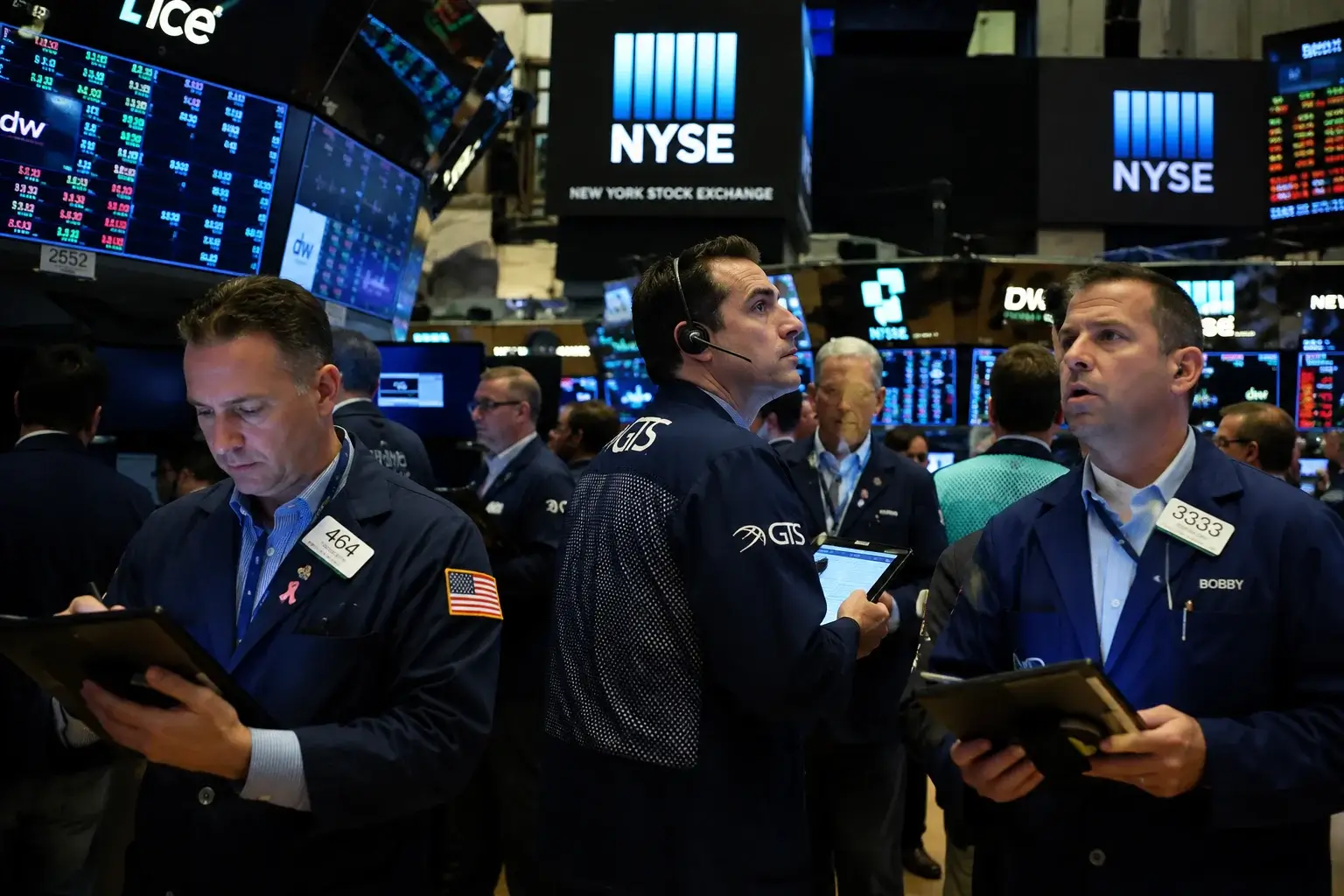
Stock Market Today: S&P 500 falls to 7,377, Nasdaq drops 0.59%, Dow Slide From Records on 3.8% CPI and $100 Oil
Nasdaq leads losses as Micron and Intel roll over, energy surges on Iran tensions, and Fed rate-cut hopes collapse.
Key Points
- S&P 500 falls to 7,377, Nasdaq drops 0.59%, Dow sheds 386 points as April CPI prints 3.8%
- WTI crude climbs 3.71% to $101.71, Brent jumps to $108.05 as Trump rejects Iran's counterproposal
- Micron (MU) drops 3%, Intel (INTC) falls 4.3%, Qualcomm (QCOM) sheds 4% after parabolic April runs
A blistering April inflation print combined with crude futures north of $100 a barrel knocked the wind out of Wall Street's record-setting rally on Tuesday morning, sending the S&P 500 (^GSPC) down 34.90 points to 7,377.94, a 0.47% slide that arrived less than 24 hours after the index posted its first-ever close above 7,400. The Dow Jones Industrial Average (^DJI) shed 386 points to 49,318.37, off 0.78%, while the Nasdaq Composite (^IXIC) dropped 155.82 points to 26,118.31, a 0.59% reversal that erased a meaningful slice of the parabolic move semiconductor names had carved out over the prior fortnight. The Russell 2000 (^RUT) lost 22 points to 2,848.60, off 0.77%, and the VIX climbed 1.69% to 18.69, ending a stretch of unusually low realized volatility.
The April CPI Print Just Broke The Disinflation Narrative
The headline number is the one every desk on the Street is digesting this morning: consumer prices rose 0.6% month-over-month and 3.8% year-over-year in April, blowing past the 3.7% consensus polled by Dow Jones and clocking the hottest annual reading since May 2023. That's a second consecutive 3-handle print after March's 3.3%, and it confirms a trend that had been brewing for weeks beneath the surface — headline CPI was tracking at just 2.4% as recently as January and February. The core measure, which strips out food and energy, advanced 0.4% on the month and 2.8% annually, both exceeding the 0.3% and 2.7% expectations and reaccelerating from March's 0.2% monthly and 2.6% annual readings. That core overshoot is the single most important data point for traders, because it removes the easy defense that this is purely an energy-driven spike. Inflation has now embedded itself in the services and goods baskets that Federal Reserve officials track to gauge persistent pricing pressure, and the path to additional rate cuts has effectively been closed. Northlight Asset Management's Chris Zaccarelli flagged Tuesday morning that the combination of accelerating inflation and a still-healthy labor market makes Fed easing implausible in the near term, and the conversation now turns to whether 2027 rate hikes need to be priced back into the curve.
Inside The Inflation Print, The Composition Tells The Real Story
Beneath the headline, the components paint a grimmer picture than the toplines suggest. The energy index climbed 3.8% in April alone and is now up a staggering 17.9% year-over-year. Energy commodities — the basket that includes gasoline and fuel oil — surged 5.6% on the month, with gasoline up 28.4% annually and fuel oil running 54.3% higher than a year ago. Energy services covering electricity and piped natural gas rose 1.6% on the month, providing a small offset but not enough to mute the headline damage. Food prices added 0.5% on the month and 3.2% on the year, and economists have warned that the disappearance of Persian Gulf fertilizers from global supply chains during the Iran conflict will pressure agricultural inputs in coming quarters. Airline fares were the silent killer in this report — up 6.3% on the month and 20.7% year-on-year — a direct read on jet fuel passthrough and a leading indicator for service-sector inflation broadly. The takeaway is that the old comfort zone around 2% has been replaced by a new floor that looks structurally closer to 3%, and the market's pricing of multiple Fed cuts through 2026 is now a stretched assumption rather than a base case.
Real Wages Just Flipped Negative For The First Time In Three Years
The data point that arguably deserves more attention than the CPI itself came from the same Bureau of Labor Statistics release, with real average hourly earnings dropping 0.3% year-over-year and real average weekly earnings down 0.2% in April. That's a complete 180-degree pivot from March, when those metrics printed positive at 0.3% and 0.2% respectively, and it marks the first annual decline in inflation-adjusted worker pay in roughly three years. Joe Brusuelas at RSM made the point on Yahoo Finance Tuesday morning that this is the variable that turns the inflation conversation into a paycheck conversation, with prices rising fast enough to compress real spending power even as the S&P 500 climbs to new records. The bifurcation Brusuelas described is essentially the entire macro thesis right now: wage gains are clustered among earners who recycle disposable income into equities, while the broader consumer base watches grocery shelves run 3.2% higher and gasoline pumps charge $4.50 per gallon nationally. The equity market can absorb a 3.8% CPI for a while. Household balance sheets cannot, and that's where the slow-burn drag on consumer discretionary names begins to materialize.
Crude Markets Continue To Reflect A Permanently Damaged Hormuz Corridor
Oil is the volatile asset class that's repricing fastest. WTI crude (CL=F) rose 3.71% to $101.71 a barrel, and Brent (BZ=F) added 3.68% to $108.05, extending Monday's 2.9% advance after Donald Trump publicly rejected Iran's counterproposal as "garbage" and declared the ceasefire on "massive life support." Tehran's terms in the latest exchange were maximalist by any measure — war reparations, full sovereignty over the Strait of Hormuz, the release of frozen Iranian assets, and a full sanctions rollback — and the White House response signals that a near-term diplomatic resolution is off the table. Kuwait separately alleged that the Islamic Revolutionary Guard Corps launched an incursion against a Kuwaiti island, an event the Kuwaiti foreign ministry called a flagrant sovereignty violation, and traffic through the Strait remains essentially halted into the tenth week of the conflict. Saudi Aramco CEO Amin Nasser warned Monday that global oil losses are running at scale every day the conflict continues, and the US Department of Energy released 53.3 million barrels from the Strategic Petroleum Reserve on Tuesday as part of a coordinated International Energy Agency package totaling 172 million barrels. SPR releases at this magnitude are a short-term price absorber but not a structural fix, and the longer Hormuz stays choked, the more permanent the supply premium becomes.
Trump's Beijing Trip Brings A Sixteen-CEO Delegation Into Focus
Tuesday also marks the start of the long-anticipated summit between Trump and Xi Jinping, with a delegation that reads like a who's-who of the S&P 500 leadership ranks — Tesla's Elon Musk (TSLA), Apple's Tim Cook (AAPL), BlackRock chief Larry Fink, Boeing CEO Kelly Ortberg, and Goldman Sachs head David Solomon among the sixteen executives accompanying the president. Trade policy and artificial intelligence are expected to dominate the agenda, with chip export licensing and tariff de-escalation as the substantive deliverables traders are watching for. Apple (AAPL) traded slightly lower at $291.86, off 0.28% in premarket activity, holding most of the gains it logged on last week's chipmaking deal with Intel that pushed the stock to a fresh record close. Chinese tech as a complex is staring at a major technical inflection — the Invesco China Technology ETF (CQQQ) is pressing against a long-term downward-sloping trend line that begins at the February 2021 peak and captures the 2025 and 2026 highs. The ETF is still down nearly 50% from that 2021 high, and a clean break above the $60 zone that capped 2025 could trigger a meaningful short squeeze across Chinese tech ADRs.
Memory Chips And Semiconductors Roll Over After A Parabolic April
The single largest source of selling pressure in this morning's tape is concentrated in the memory and semiconductor names that drove last week's record-breaking move. Micron Technology (MU) is down more than 3% Tuesday morning after gaining 6.5% on Monday and surging 37.7% over the past week. To frame just how stretched the move had become, MU rallied 53% in April after dropping 18% in March — a textbook parabolic pattern that almost always ends with a sharp positioning unwind. Advanced Micro Devices (AMD) fell 2%, Qualcomm (QCOM) dropped 4%, and Intel (INTC) retreated 4.3% as traders booked profits after the stock more than doubled in a single month and tagged record highs on Monday. Sandisk (SNDK) also came off its highs. The fundamental story underpinning the move remains intact — Samsung, SK Hynix and Micron control roughly 95% of DRAM and 67% of NAND revenue, giving the trio extraordinary pricing power in a cycle where memory has become a bottleneck for AI infrastructure buildouts — but positioning had become extreme, and South Korean commentary about AI profitability hit the Kospi hard overnight, exporting that nervousness directly into the US tape at the open.
The Dot-Com Comparison Is Imperfect But The Setup Rhymes
Evercore ISI strategist Julian Emanuel captured the current sentiment with a phrase that's been making the rounds — "Relatives, friends, doctors, Uber drivers are all talking about AI/Tech stocks" — and openly compared the period to 1999. The valuation arithmetic, however, is different in meaningful ways. The dot-com cohort traded at a median price-to-earnings multiple of roughly 152 times at the 1999 peak, meaning investors were paying $152 for every $1 of profit. Today's so-called AI Class of 2026 trades at approximately 39 times earnings — rich, but a fraction of the Y2K extreme. The Roundhill Magnificent Seven ETF (MAGS) fell 0.76% to $68.92 in early trade, tracking the broader pullback in mega-cap tech, but the cohort is still generating substantial cash flow and earnings, which separates this episode from the speculative euphoria that defined the dot-com peak. That said, parabolic moves carry their own physics regardless of underlying fundamentals, and the kind of vertical extension seen in MU, INTC, and AMD typically resolves with multi-week consolidations at best and 20% retracements at worst.
Single-Name Earnings Action Highlights A Sharp Polarization
The earnings tape this morning is bifurcating cleanly between names delivering on aggressive expectations and those falling short of stretched bars. Plug Power (PLUG) jumped 11% after posting strong revenue growth and reaffirming a Q4 2026 path to profitability. Hims & Hers Health (HIMS) plunged 14% in premarket activity and 12% after hours following a surprise Q1 loss as the telehealth platform pivots away from cheaper compounded GLP-1 weight-loss copycats and toward branded versions, with Q2 EBITDA guidance of $35 million to $55 million disappointing the Street. On Holding (ONON) fell 4% to 5% despite beating Q1 estimates and reiterating its full-year net sales growth forecast while raising earnings guidance — Co-CEO Caspar Coppetti's framing that the company's "premium strategy is really working" couldn't offset a high valuation entry point. Quantum Computing (QUBT) rocketed 27% after Q1 revenue surged from just $39,000 a year ago to $3.69 million, though elevated costs weighed on profitability, and peer D-Wave Quantum (QBTS) added 1% in sympathy. Zebra Technologies (ZBRA) surged 15.4% on a clean earnings beat from the asset-tracking specialist, Amentum Holdings (AMTM) gained 3.4% after topping estimates, and DaVita (DVA) slipped 4% in what analysts characterized as profit-taking after a recent rally exceeded 30%. Under Armour (UA) posted one of the morning's worst reactions, dropping 14% after reporting a Q1 loss of three cents per share on revenue of just $1.17 billion, missing Wall Street's modeled $1.68 billion consensus by roughly half a billion dollars — that's not a soft quarter, that's a structural read on the brand's positioning that demands a deeper look. Wendy's (WEN) rallied 9% to 12% after the Financial Times reported that Nelson Peltz's Trian Fund Management is sounding out financing for a take-private bid, with the stock down 45% over the prior year creating an attractive entry for activist capital.
GitLab's Restructuring And The Quiet Stress In Software Margins
After Monday's close, GitLab shed 8% after CEO Bill Staples outlined a substantial restructuring tied to a pivot toward agentic AI, including workforce reductions, layers of management cuts, and a narrowed geographic footprint. That's the kind of announcement that almost always precedes further margin compression as the costs of the AI pivot get absorbed, and it fits a broader pattern across the software sector where companies are scrambling to demonstrate AI relevance while protecting profitability. Cleanspark dropped 10% after posting a Q2 loss of $1.52 per share, far worse than the $0.56 loss FactSet was modeling. Palantir (PLTR) slipped 1.3% in premarket trade even after CEO Alex Karp met with Ukrainian President Volodymyr Zelenskiy to launch a project called "Brave1 Dataroom" focused on AI-based drone defense systems using combat data accumulated since Russia's full-scale invasion in 2022.
The eBay-GameStop Saga Closes With A Hard Rejection
eBay (EBAY) formally rejected GameStop (GME) CEO Ryan Cohen's audacious $55 to $56 billion takeover proposal at $125 per share, structured as half cash and half stock. Chairman Paul Pressler's rejection letter cited six concerns including financing credibility, the impact on eBay's standalone trajectory, leverage and operational risk from a combined entity, and concerns around GameStop's governance and executive incentives. The math underscored why institutional support was always going to be elusive — eBay's market value sits around $48 billion, dwarfing GameStop's roughly $10.3 billion capitalization. GME dropped 3% to 4% in premarket and was last trading at $22.49, off 2.93%, while EBAY traded slightly lower. The story took a meme-stock detour Monday evening when Keith Gill, the financial influencer known as Roaring Kitty, posted cryptic images including a cat and Pepe the Frog wearing his trademark red bandanna, sending GME up as much as 13% before the posts were deleted within an hour and the stock surrendered the move. Chewy Inc., founded by Cohen, also rallied as much as 3% in sympathy before fading.
Citi Pounds The Table On Lowe's Heading Into May 20
Citi upgraded Lowe's (LOW) from neutral to buy on Tuesday with a maintained $285 price target, suggesting 26% upside from Monday's close. Analyst Steven Zaccone's thesis hinges on Lowe's beating Q1 Street estimates when the company reports on May 20 before the bell and continuing to outperform the home improvement industry through 2026. LOW shares have declined 6% year-to-date, meaningfully lagging the broader market amid record-low consumer sentiment driven by the Iran conflict and persistent inflation. Zaccone acknowledged the risk that geopolitical tensions could escalate further but maintained that the home improvement industry has bottomed and is positioned for a multi-year recovery. That call dovetails neatly with the broader sector rotation theme building underneath the surface — defensive cyclicals with idiosyncratic catalysts are quietly outperforming the high-beta names that dominated April's tape.
European Markets Crack As Britain's Political Crisis Hits Gilts
European tape is uglier than the US session. The pan-European Stoxx 600 dropped 0.83% to 607.72, with Germany's DAX falling 1.21% to 24,056, Italy's FTSE MIB shedding 1.05% to 49,141, Spain's IBEX 35 dropping 1.29% to 17,622, and France's CAC 40 down 0.73% to 7,997. London's FTSE 100 held up better, declining just 0.37% to 10,231, but the action in UK government bonds was the real story. The yield on the benchmark 10-year gilt spiked nearly 12 basis points to 5.126% as Prime Minister Keir Starmer's grip on power deteriorated, with more than seventy Labour MPs joining ministers in calling for the prime minister to resign or set a departure timetable after disastrous local council election losses. UK banks bore the brunt of the political risk repricing, with NatWest falling 4.7%, Lloyds sliding 4.3%, and Barclays dropping 4.1%. The gilt move is significant because it represents a forced repricing of sovereign risk in a G7 economy that has spent the past year trying to convince markets that fiscal discipline is back on the agenda.
Read More
-
Yen Stalls at 160 Despite a 3% JGB and Tokyo Core CPI at 2.0% — Intervention Sits at 164, Friday's Payrolls Decide
02.09.2026 · TradingNEWS ArchiveEnergy
-
QQQ ETF ($739) Fades From an Early Tech Rally as a 77.9 ISM Prices Index Meets Micron's $61.5B Guide — $760 Record Test Ahead
01.10.2026 · TradingNEWS ArchiveStocks
-
XRPR and XRPI Follow XRP's $1.49 Test as Spot Funds Hold 1.16B XRP and a 1 Billion Token Escrow Release Lands — $1.70 in Play
01.10.2026 · TradingNEWS ArchiveCrypto
-
November NG Slips Below $3 as Decade-High Storage Meets Capped LNG Exports — $2.75 in Sight
01.10.2026 · TradingNEWS ArchiveCommodities
-
Dollar-Yen at 158 Presses Toward 160 as a 363 bp Carry Gap Meets Katayama-Bessent Intervention Risk — 159 in Sight
01.10.2026 · TradingNEWS ArchiveForex
Asian Markets Split As Korea's AI Trade Unwinds
Asia's overnight session was sharply divided. Japan's Nikkei 225 gained 0.52% to 62,742.57 and the broader Topix added 0.83% to 3,872.90, finding support from a softer yen and continued enthusiasm around tech exporters. South Korea's Kospi was the most violent move overnight, crashing 2.29% to 7,643.15 after notching a record high on Monday, with the small-cap Kosdaq dropping 2.32% to 1,179.29 on negative AI-profit commentary out of Seoul that hit the memory-heavy index particularly hard. Australia's S&P/ASX 200 lost 0.36% to 8,670.70, Hong Kong's Hang Seng slipped 0.22% in choppy trade, the CSI 300 in mainland China was effectively flat at 4,948.05, and India's Nifty 50 dropped 1.30% in one of the session's largest single-market losses outside of Korea.
Monday's Sector Leadership Is Now The Tuesday Source Of Selling
Monday's GICS sector ranking now looks completely inverted given Tuesday's CPI shock. Six of eleven sectors closed higher Monday, led by Energy at +2.63%, Materials at +1.43%, Industrials at +1.01%, and Information Technology at +1.00%. The Monday laggards were Communication Services at -2.33%, Consumer Staples at -0.76%, and Consumer Discretionary at -0.64%. Tuesday's tape punishes the same cohort that led — the IT names that drove Monday's record highs are the largest sources of selling pressure this morning, while energy continues to outperform on the crude rally. The rotation suggests defensive positioning is finally returning after weeks during which beta absorbed every dip, and the durability of that rotation depends almost entirely on whether the Hormuz blockade persists and whether the next inflation print confirms April's reacceleration.
Gold, Silver And Bitcoin Are Not Behaving Like Inflation Hedges
The reaction in traditional inflation hedges has been counterintuitive. Gold fell 0.47% to $4,706.30, and silver dropped 1.84% to $84.40 per ounce. Bitcoin (BTC-USD) retreated to $80,708.09, off 0.40%. A 3.8% headline CPI print combined with $108 Brent should, in a textbook risk-off rotation, have driven these assets higher. The fact that they didn't suggests positioning was already heavy long inflation hedges heading into the print, and Tuesday's tape is forced de-risking from over-extended positions rather than a fundamental shift in the inflation thesis. The structural bid for gold from negative real wages, central bank diversification flows, and geopolitical risk remains intact, even as the near-term tape reflects mechanical position adjustment.
The Fed Path Is Now The Single Most Important Variable
Friday's stronger-than-expected April jobs report, which added 115,000 jobs to the economy, has combined with Tuesday's hot inflation print to box the Federal Reserve into a corner. The traditional dual mandate framework requires the central bank to weigh maximum employment against price stability, and right now both legs of that mandate are pointing in opposite directions from a policy easing perspective. The labor market is healthy enough to remove the urgency for cuts, while inflation has reaccelerated to a degree that makes cuts actively counterproductive. The Fed funds curve is now in the process of repricing what had been a relatively orderly cutting path, and the move in Treasury yields over the coming sessions will be the most important macro variable for equity multiples. If 10-year yields follow UK gilts higher, multiple compression begins immediately, and the high-multiple growth names that have led the market over the past month become the largest sources of additional downside.
The Bottom Line For Positioning Through The Rest Of The Week
The story unfolding across Tuesday's session is not the beginning of a sustained correction — at least not yet — but it is the unmistakable end of the consequence-free environment that defined April and early May. Two structural pillars have cracked simultaneously: oil is signaling that the Iran conflict has no diplomatic off-ramp, and inflation is signaling that the disinflation trade has run its course. The equity market entered Tuesday priced for continuous earnings momentum and Fed accommodation, and one of those two assumptions has just been compromised in real time. Energy and defensive cyclicals with identifiable catalysts deserve overweight exposure, while the parabolic semis that drove April's outperformance look ripe for a multi-week consolidation that could shake out 10% to 15% of recent gains before the next leg gets confirmed. The path of least resistance for the broader tape has shifted from euphoria to caution, and the next inflation print, the next OPEC commentary, and the readout from the Trump-Xi summit are the three catalysts that will determine whether this is a single-day reset or the start of something more sustained. The melt-up phase looks finished. The bull market does not — yet.