Stock Market Today: Dow, S&P 500, Nasdaq Drop As Gold Rips Higher And WMT, TEM, SNCY Rally
DOJ subpoenas Fed Chair Powell, sparking a ‘Sell America’ move as the Dow retreats from record highs, financials (COF, SYF, AXP, JPM, BAC, WFC) sink on Trump’s 10% card-rate push, and gold (GC=F) breaks $4,600 while WMT, TEM and SNCY stand out on index, AI and M&A news | That's TradingNEWS
Powell Criminal Probe And The New Fed Risk Premium
How The DOJ Investigation Reprices U.S. Monetary Credibility
The Department of Justice’s criminal probe into Jerome Powell, formally tied to the $2.5 billion renovation of the Fed’s headquarters and his Senate Banking testimony, is being priced by markets as a direct attack on central bank independence. Powell’s own video statement made the link explicit: he framed the subpoenas and threat of indictment as a consequence of setting interest rates based on data rather than the president’s preferences. That reframes the Fed from a technocratic institution into a potential political battlefield. Once that line is crossed, every future FOMC decision is viewed through a political filter, and investors start demanding a structural risk premium for holding U.S. duration, U.S. equities and U.S. dollars. The question is no longer whether the next move is a 25-basis-point cut or hold; it is whether U.S. monetary policy remains anchored by an independent committee or becomes another arm of the administration’s economic agenda. That is why a legal story around building renovations has instantly morphed into a macro story about credibility, inflation expectations and the long-term value of dollar assets.
Equity Indices: From Record Highs To A Controlled De-Risking
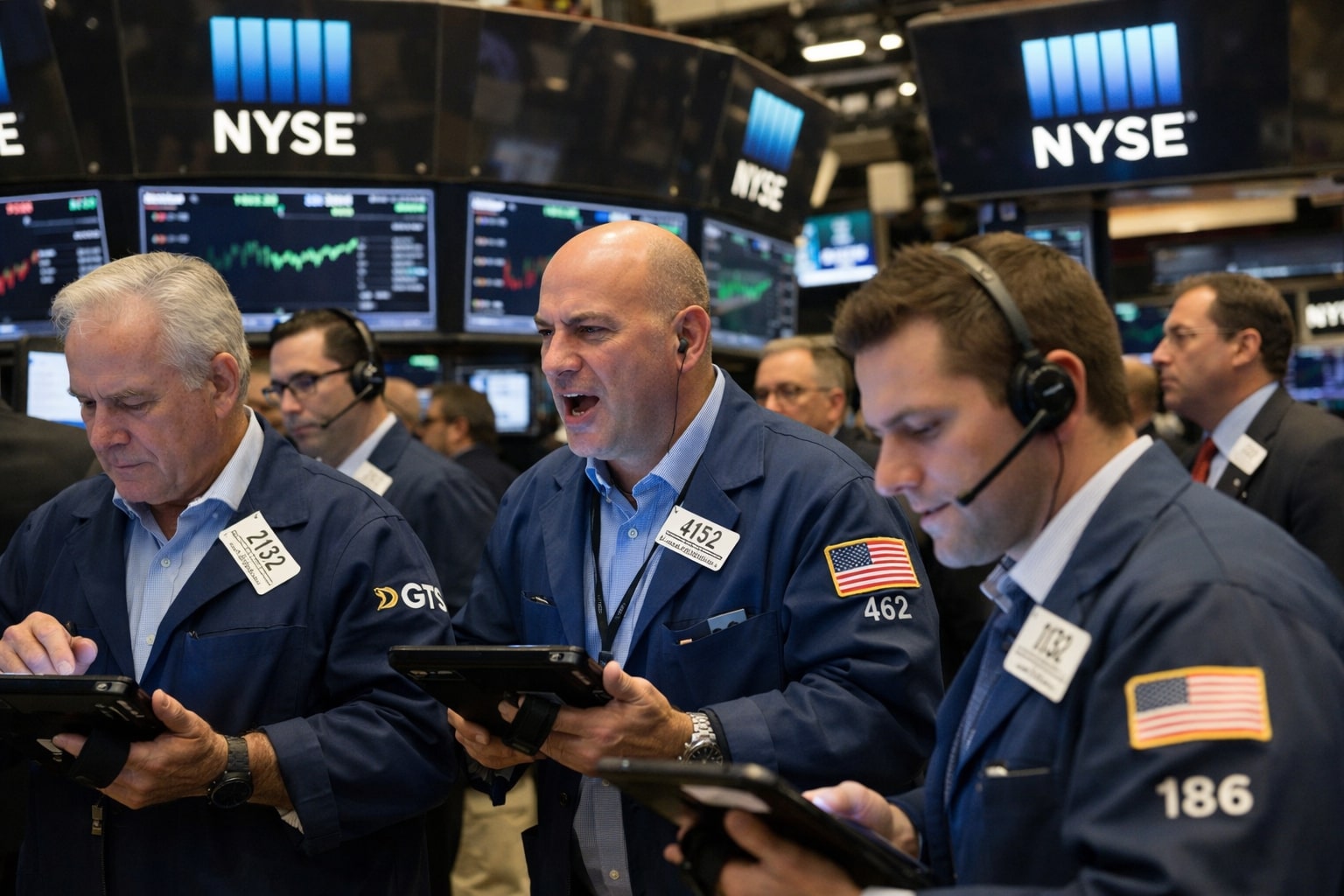
The equity reaction is a deliberate de-risking, not a panic. The Dow Jones Industrial Average trades around 49,200, down roughly 0.5–0.8%, while the S&P 500 hovers near 6,960, off about 0.1%, and the Nasdaq Composite is flat to slightly negative after printing fresh record closes last week. Volatility is picking up from very depressed levels, with the VIX in the mid-15s, up almost 7%. That combination tells you exactly what is happening: investors are trimming gross exposure from stretched highs, paying up for protection, and shifting out of U.S.-centric financial risk, but they are not indiscriminately dumping everything. The tape is rotating rather than collapsing. The trigger is political, but the response is rational portfolio management after a powerful rally. With the Powell probe, a new set of tail risks has appeared on top of already elevated valuations. That forces global allocators to ask whether U.S. equities still deserve the same premium they enjoyed when the Fed’s institutional independence was unquestioned.
Financials And Credit Cards: Political Theatre Turned Into EPS Damage
The most violent moves are in U.S. financials, especially in card-heavy lenders and universal banks exposed to consumer credit. Trump’s call for a one-year cap on credit card interest rates at 10%, backed by rhetoric that non-compliant lenders will be “in violation of the law” after January 20, directly targets a key profit engine for the sector. Capital One is down in the high single digits, American Express is off several percent, and Synchrony has also been hit hard. Citi, JPMorgan, Bank of America and Wells Fargo trade lower as well, with the KBWB bank ETF losing around 1.3–1.5%. Street estimates already flag that a strict 10% cap could slice 5–18% off pre-tax earnings for diversified banks and effectively wipe out earnings for pure-play card lenders for the cap period. Even if the legal path is unclear and Congress has not passed any enabling legislation, equity markets cannot ignore those numbers. The result is an immediate repricing of the whole consumer finance complex. At the same time, buy-now-pay-later players such as Affirm are bid up on the idea that if card issuers are forced to restrict credit or lose money, alternative channels will absorb part of the demand. What started as a political talking point has been translated into concrete EPS risk, and the sector is being valued accordingly.
Gold, Silver And The Mechanics Of A Political Safe-Haven Bid
Gold futures breaking through $4,600 an ounce and spot gold trading around $4,580–4,620 represent a textbook safe-haven spike driven by institutional risk, not just macro data. The sequence is straightforward: late-cycle U.S. equity euphoria, then subpoenas to the Fed and Powell’s public accusation of political retaliation, followed by a sharp move higher in precious metals. Silver is even more aggressive, with futures printing new all-time highs around $84–86 an ounce and intraday spikes near $85.7. The move is not being driven by a collapse in real yields or a classic recession scare. Instead, it is driven by doubts about whether the world’s main central bank can resist direct executive pressure. Gold is a hedge against inflation, but it is also a hedge against institutional decay. Once investors start to price the possibility of a politically constrained Fed that may be slow to lean against future inflation, the convexity of owning gold improves dramatically. Silver, with its thinner liquidity and industrial overlay, simply amplifies that move. Strategists are already talking about an additional 10–15% upside in gold if the Powell–Trump confrontation drags on or escalates, and in that scenario silver can easily outperform in percentage terms as the high-beta play on the same theme.
The Dollar, Treasuries And The Cost Of Eroding Institutional Trust
The dollar’s reaction looks modest in absolute terms, but meaningful in context. The dollar index trades just below 99, down about 0.3–0.4%, its sharpest daily drop in roughly three weeks, despite the absence of a dovish shock from the Fed itself. The message from big asset managers and macro funds is that institutional trust is now being priced alongside traditional rate differentials. If investors believe that the Fed might be coerced into cutting faster for political reasons, they worry about inflation not being contained aggressively in the next cycle. That makes non-U.S. currencies and real assets relatively more attractive at the margin. At the same time, the U.S. 10-year Treasury yield is nudging up toward 4.19%, slightly above Friday’s close. This is not a classic “growth scare” rally where yields collapse; it is the start of a potential repricing of term premium. Several houses are already flagging the risk of a steeper curve: short-end rates could fall in the future if forced cuts are delivered, while the long end may demand a higher premium to compensate for inflation and political risk. That steepening narrative is dangerous for long-duration U.S. growth stocks and for any strategy that has been anchored on a “lower for longer, forever” rates regime.
Oil, Iran And Venezuela: Why Crude Is Not Spiking (Yet)
Despite clear geopolitical noise, oil is trading lower on the day, with WTI around $58.8 and Brent near $63.2, down roughly 0.3–0.5%. On paper, the backdrop is bullish for crude: deadly protests in Iran raise questions about regime stability in an OPEC producer pumping roughly 3.2 million barrels per day, while the Venezuela story adds another layer of uncertainty, including Trump’s public threat to exclude ExxonMobil from the Venezuelan reopening after critical comments from its CEO. Under normal conditions, this combination would produce a healthy risk premium in crude. The fact that prices are slipping instead shows how dominant the growth and FX channels are right now. A politicized Fed, a weaker dollar and a “Sell America” narrative push investors to think about slower global demand and less appetite for U.S. risk, which dampens the willingness to chase oil higher despite supply threats. That can change quickly. If Iranian unrest escalates into outright supply disruptions or if Venezuelan flows are materially constrained again, the market will be forced to reprice. For the moment, crude is hostage to macro sentiment rather than purely to barrels.
Trump’s Credit And Housing Gambit: Direct Intervention In Price Of Money
The credit card cap is only one leg of a broader attempt by the administration to control the cost of money. In parallel, Trump has ordered Fannie Mae and Freddie Mac to purchase $200 billion in mortgage bonds to push 30-year mortgage rates down toward 6%, their lowest since early 2023. The stated goal is to revive housing affordability and unlock demand from sidelined buyers. Combined with the campaign-style promise of a one-year 10% ceiling on card rates, this amounts to a de-facto attempt to run parts of monetary policy from the White House via quasi-fiscal and regulatory channels, while simultaneously pressuring the Fed from the outside. Markets see that pattern clearly. On one side, there is direct political pressure on Powell including the threat of indictment and removal. On another side, there is an attempted administrative cap on a key profit center for banks. On a third side, there is a massive QE-style instruction for housing credit via government-sponsored enterprises. Together, these moves undermine the idea that the cost of credit in the U.S. is set by an independent central bank responding to macro conditions. Instead, they signal that the executive branch intends to micromanage borrowing costs into the election cycle. That is why global investors are talking again about the structural cost of capital for U.S. assets rising relative to the rest of the world.
Equity Microstructure: Sector Rotation Inside A Political Shock
Under the surface of the indices, the tape is highly bifurcated. Cyclical and financial names bearing direct policy risk are being de-rated, while idiosyncratic stories with clear catalysts still attract flows. Walmart is a prime example: the stock is up around 2–3%, supported by its upcoming inclusion in the Nasdaq-100 and the mechanical demand that will come from QQQ and other index products, as well as by its AI partnerships with Google’s Gemini and OpenAI’s ChatGPT to improve the shopping experience. For a mega-cap retailer, joining the Nasdaq-100 at a time when passive flows dominate marginal demand is a substantial technical tailwind. In travel, the Allegiant–Sun Country deal shows that corporate M&A is proceeding despite macro noise. Sun Country trades 12–17% higher on a roughly $1.5 billion cash-and-stock offer at a near 20% premium, while Allegiant is modestly lower as the acquirer. The market is rewarding clear, accretive leisure-focused strategies even on a risk-off day. In contrast, highly rate-sensitive sectors such as real estate and pockets of leveraged growth remain under pressure as investors reassess discount rates and balance sheet resilience in a world where the path of policy is blurred by politics.
Read More
-
Yen Stalls at 160 Despite a 3% JGB and Tokyo Core CPI at 2.0% — Intervention Sits at 164, Friday's Payrolls Decide
02.09.2026 · TradingNEWS ArchiveEnergy
-
SPY Stalls Below Its Record As A 4.63% Earnings Yield Loses To A 4.74% Treasury
03.09.2026 · TradingNEWS ArchiveStocks
-
Bitwise Holds 286.8M XRP At A $480M Cost And $393M Of Value — The Category Bought Every Dip And Is Still Underwater
03.09.2026 · TradingNEWS ArchiveCrypto
-
Natural Gas Stalls Under $3 As Record 111.5 Bcf/d Production Absorbs Every Bullish Signal
03.09.2026 · TradingNEWS ArchiveCommodities
-
Dow 53,461, S&P 500 7,702 And Nasdaq 26,392 Climb On Waller's Dovish Turn — HOOD Explodes 14.9%
03.09.2026 · TradingNEWS ArchiveMarkets
-
Yen Rips Four Yen In A Session As Japan Takes Control Of The Dollar — Brent At $97.62 Could Not Stop It
03.09.2026 · TradingNEWS ArchiveForex
Big Tech, AI And The New Political-Industrial Complex
Mega-cap tech is being pulled in two directions. On one hand, there is clear evidence of fundamental strength. Apple is on track for roughly $78 billion in iPhone sales this quarter, held global smartphone leadership in 2025 with a 20% annual share and a 25% share in Q4, and yet the stock is flirting with its longest losing streak since 1991. That is positioning, not a collapse in demand. Late-cycle portfolios are taking profits in the most crowded names when a political shock hits, regardless of whether the shock has direct implications for smartphone units. On the other hand, companies like Meta are moving to embed themselves deeper into the new power structure. By appointing Dina Powell McCormick—Trump’s former deputy national security adviser—as President and Vice Chair, Meta is explicitly adding a heavyweight political operator to help manage global relationships at the same time it plans $71 billion in capex for AI data centers to compete with Alphabet, Microsoft and Amazon in infrastructure. That is not accidental. It is a recognition that in an environment where the administration is willing to threaten the Fed chair, the ability to navigate Washington becomes a core strategic asset for any firm spending tens of billions a year on regulated data-heavy infrastructure. At the same time, names like Tempus AI, which rallied double digits on record $1.1 billion contract value and a 126% net revenue retention rate, demonstrate that institutional demand for AI-driven healthcare and data products remains robust even when indices wobble. The AI secular theme is intact; the question is how it reprices under a higher U.S. political risk premium.
Macro Data, Earnings Season And The Next Phase Of The “Sell America” Trade
The immediate reaction to the Powell probe has revived the “Sell America” narrative that last surfaced aggressively during the universal tariff shock. Dollar, Treasuries and U.S. equities are all under synchronized pressure, while gold and other safe havens surge. Whether this crystallizes into a sustained trend or remains a tactical spasm will be decided in the next one to four weeks. On the macro side, the December CPI release, followed by PPI and retail sales, will show whether inflation is cooling in a way that justifies the market’s current pricing of no January rate cut but several cuts later in the year. A hot CPI print occurring simultaneously with a public brawl over Fed independence would be toxic: the Fed would, in principle, need to stay hawkish or at least patient, while the administration doubles down on demands for faster cuts. That would amplify the perception of institutional conflict and push more capital into gold and out of the dollar. A benign CPI, by contrast, would let investors test how far politics can accelerate easing without overtly clashing with the data. On the micro side, the upcoming earnings season for major banks—JPMorgan, BNY Mellon, Bank of America, Wells Fargo, Citi and others—will clarify how management teams see the political risk to their card portfolios, net interest margins and regulatory environment. Their guidance, commentary on Trump’s cap proposal, and any early hints about credit quality will set the tone for the entire financial sector. Beyond banks, earnings from key tech and AI names will show whether margin and demand trends can withstand a higher discount rate if long-end yields grind higher on political risk premium rather than pure growth expectations. If the Powell investigation escalates, if credit card caps start moving from rhetoric to concrete regulatory steps, and if inflation data refuse to cooperate, the “Sell America” trade moves from a narrative to a structural allocation shift. If, instead, the probe fizzles, the cap talk stalls, and the data validate a gradual easing path, this episode will be remembered as a violent but ultimately contained repricing of U.S. political risk.