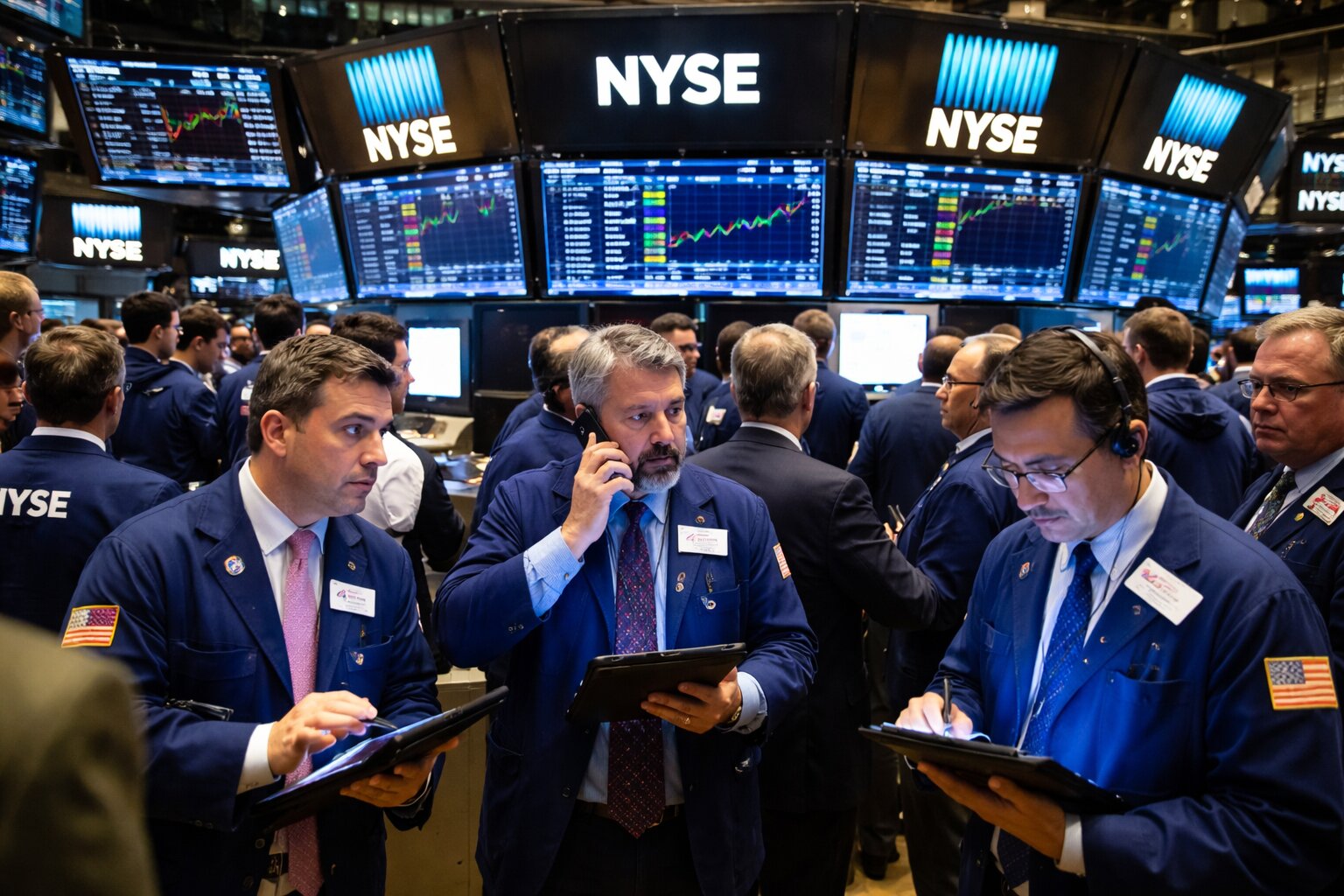
Stock Market Today: Dow (^DJI) Surges 471 Points, S&P 500 (^GSPC) +1.1% as Oil Retreats From $106 to $94 — NVDA GTC Kicks Off, NBIS Explodes 14% on $27B Meta Deal
Nasdaq (^IXIC) Leads With +1.3% as All 11 S&P 500 Sectors Turn Green — Fed Decision, Micron Earnings, and the Hormuz Coalition Define the Week Ahead | That's TradingNEWS
Wall Street Snaps Three-Week Skid as Crude Reversal and AI Momentum Collide
Breadth Tells the Real Story
Three consecutive weeks of losses, a Strait of Hormuz frozen by war, and oil touching triple digits twice in four days — and yet Monday morning Wall Street opened with its strongest broad-based rally since late January. The S&P 500 (^GSPC) climbed 1.11% to 6,706, the Dow Jones Industrial Average (^DJI) added 471 points or 1.01% to 47,029, and the Nasdaq Composite (^IXIC) led all major benchmarks with a 1.28% advance to 22,389. The Russell 2000 joined the party, tacking on 1.19% to 2,509. According to Dow Jones Market Data, 450 of the 503 individual equity issues in the S&P 500 were trading higher — on pace for the broadest single-session advance since May 27 — and all 11 sectors were in the green simultaneously for the first time since January 21. That kind of breadth is not noise. It is a signal, and the market generated it on a day when every macro headline was still pointed in the wrong direction.
Hormuz, $100 Oil, and the Trade That Just Shifted
One Sentence From Bessent Does More Than Three Weeks of Diplomacy
The proximate catalyst for Monday's reversal was a combination of geopolitical signaling and one sentence from Treasury Secretary Scott Bessent. Speaking on CNBC, Bessent confirmed that the United States has been allowing Iranian oil tankers to transit the Strait of Hormuz — "Iranian ships have been getting out already, and we've let that happen to supply the rest of the world." That statement — paired with a Wall Street Journal report indicating the Trump administration would soon announce a coalition of countries to physically escort commercial vessels through the strait — was enough to knock crude off its highs and put a floor under equities.
Crude Pulls Back But the War Math Stays Ugly
WTI crude (CL=F) had crossed $100 per barrel during Sunday's overnight session for the second time since the Iran war began in late February, but retreated sharply Monday to trade near $94–95, a decline exceeding 3.7%. Brent (BZ=F) had briefly touched $106.50 in early Monday trading before pulling back to approximately $101–102. That is still a staggering number — Brent futures are up more than 42% since the conflict commenced — but the directional shift is what markets were hungry for. The war is now in its third week. Late Friday, U.S. forces struck Iranian military assets on Kharg Island, the processing hub for roughly 90% of Iran's crude exports. President Trump explicitly warned that oil infrastructure on the island could become a target if Tehran continued blocking the Strait. Simultaneously, drone strikes from Iran on Saturday and again Monday halted oil loadings at the port of Fujairah in the UAE. Two Indian-flagged tankers carrying LPG became the rare exception, successfully crossing Hormuz on Saturday without naval escort — a fact markets latched onto as a potential precedent.
BofA and Capital See a Market Underpricing the Downside
Capital analyst Daniela Hathorn described Monday's situation accurately: a high-stakes stalemate that markets are struggling to price, with energy flows significantly constrained and the risk of prolonged global energy shock very much alive. Bank of America global economist Antonio Gabriel is even more explicit — he argues markets are pricing an almost entirely transitory shock while the probability of the conflict extending into Q2 is, in his view, equally as likely as a quick resolution, and a more protracted war cannot be ruled out. With U.S. equities still less than 5% off their all-time highs and the dollar index briefly pushing above 100 on Friday before retreating Monday by 0.41–0.50%, the asymmetry here is real. The market is absorbing enormous risk at relatively elevated valuations, and oil at 42% above pre-war levels is not a footnote — it is the entire inflation story for the next two quarters. JPMorgan and others are now openly discussing whether the Federal Reserve might be forced to consider rate hikes, a scenario most participants consider remote but no longer entirely off the table. Energy Secretary Chris Wright told reporters high gasoline prices could persist a few more weeks, which does nothing to reduce the uncertainty embedded in Wednesday's Fed decision.
Federal Reserve Meeting: Rates on Hold, Fault Lines Deepening
99% Probability of a Hold Masks a Deeply Divided Institution
Wednesday's Federal Open Market Committee decision is already priced as a near-certainty — the CME FedWatch tool shows over 99% probability of no change to the current target range of 3.50%–3.75%. That rate was cut by 25 basis points at each of the Fed's last three meetings of 2025, three consecutive reductions designed to stabilize a faltering labor market. Now those cuts look prescient, but the inflationary surge from $100 oil introduces a new and uncomfortable variable. Former Kansas City Fed President Esther George framed the dilemma without hedging: now is not the time to try to tease out where the neutral rate is, because there is too much going on in the economy that could turn in too many directions. A few weeks ago the internal Fed debate was a relatively benign technical argument about how far the current rate sits from neutral. That debate has been supplanted by something harder: how do you communicate credibly about the inflation trajectory when the biggest input cost in the global economy is determined by whether two Indian tankers can transit a 21-mile-wide strait.
Sticky Inflation Meets an Energy Shock — The Fed's Worst Nightmare
John Lloyd, global head of multi-sector credit at Janus Henderson Investors, noted that inflation was already stickily above the Fed's 2% target heading into this week's meeting. Both the CPI and PPI readings from last week told the same story. Adding an oil shock on top of an already-sticky baseline is, as Lloyd put it, raising the possibility that inflation could remain elevated for longer. Goldman Sachs analysts offered some measured relief — their analysis suggests the current inflation shock is narrowly concentrated in the energy sector, which distinguishes it structurally from the post-COVID surge that was broad-based across goods and services. But the memory of 2021–2022 is still fresh inside the Marriner Eccles Building, and central bankers will not want to be caught flat-footed again. The 10-year Treasury yield (^TNX) fell 4.6 basis points to approximately 4.234% Monday — down from Friday's close above 4.28%, the highest closing level since January 20. The 2-year yield dropped 3.4 basis points to 3.700%, and the 30-year slipped to 4.867%. The dollar index (DXY) retreated 0.41–0.50% to the 99.68–99.95 range, having briefly broken 100 on Friday for the first time since November. That coordinated pullback in yields and the dollar is doing real work Monday, giving stocks and bonds breathing room simultaneously.
Goldman's Correction Warning vs. Yardeni's Earnings Resilience
Two Frameworks, One Market — One of Them Is Wrong
Goldman Sachs issued a note Monday morning that reads like a carefully calibrated two-handed warning. The firm's equity strategists described stocks as facing rising correction risk — pointing to stretched valuations, deteriorating macro conditions, and emerging cracks in growth, inflation, credit, and labor markets. Goldman's framing was explicit: equities are not heading into a bear market because earnings remain resilient and balance sheets are solid, but history suggests that geopolitical shocks often present opportunity rather than lasting damage. That is a mild but unmistakable call for near-term turbulence. On the other side, Ed Yardeni, president of Yardeni Research, makes a counter-argument rooted in analyst estimates. Industry consensus EPS forecasts for 2026 and 2027 have actually been moving higher in recent weeks — something Yardeni characterizes with dry humor, noting that analysts apparently did not get the memo about the possible negative consequences of a protracted war. The S&P 500 remains just 5% below its all-time high, which under the circumstances is either a sign of remarkable fundamental resilience or a dangerous complacency premium. Based on what Goldman is flagging — stretched multiples in an environment where macro headwinds are multiplying — a hold-to-sell posture on extended names is warranted until oil stabilizes definitively below $90.
Hedge Funds Are Not Buying This Dip — They Are Pressing It
Hedge fund positioning adds another layer of context that should not be dismissed. According to Goldman Sachs's prime brokerage team, last week saw the largest net selling of global equities among hedge funds since liberation day last April. Equities were sold for the fourth consecutive week, and the sixth out of the past seven, driven almost entirely by short sales. Professional money is not buying this dip — it is pressing it. Monday's bounce, while technically meaningful and structurally broad, is arriving in the teeth of institutional short-side positioning that has been building for nearly two months. Five weeks ago a similar relief rally held through a Friday session and extended into the following Wednesday before sellers reemerged Thursday. The VIX (^VIX) dropped 2.82 points or 10.34% to 24.37 on Monday, a meaningful decompression, but still elevated enough to confirm the market is not in a settled state.
Read More
-
Yen Stalls at 160 Despite a 3% JGB and Tokyo Core CPI at 2.0% — Intervention Sits at 164, Friday's Payrolls Decide
02.09.2026 · TradingNEWS ArchiveEnergy
-
QQQ ETF ($739) Fades From an Early Tech Rally as a 77.9 ISM Prices Index Meets Micron's $61.5B Guide — $760 Record Test Ahead
01.10.2026 · TradingNEWS ArchiveStocks
-
XRPR and XRPI Follow XRP's $1.49 Test as Spot Funds Hold 1.16B XRP and a 1 Billion Token Escrow Release Lands — $1.70 in Play
01.10.2026 · TradingNEWS ArchiveCrypto
-
November NG Slips Below $3 as Decade-High Storage Meets Capped LNG Exports — $2.75 in Sight
01.10.2026 · TradingNEWS ArchiveCommodities
-
Dollar-Yen at 158 Presses Toward 160 as a 363 bp Carry Gap Meets Katayama-Bessent Intervention Risk — 159 in Sight
01.10.2026 · TradingNEWS ArchiveForex
NVDA, NBIS, META, MU: The Names Driving Monday's Tape
Nvidia GTC Kicks Off — The Real Story Is Not the Chips
Nvidia (NVDA) stock gained approximately 2% in Monday trading, with CEO Jensen Huang scheduled to take the stage at SAP Center in San Jose at 2 p.m. ET to open the company's annual GTC developer conference. Rothschild & Co. Redburn analyst Timm Schulze-Melander set the framing ahead of the event precisely: the real story at GTC is not chips, it is Nvidia's five-layer stack designed to compress hyperscaler margins and lock in the agentic AI generation. Nvidia's moves over the past twelve months — including a nonexclusive inferencing deal with Groq and the hire of Groq founder Jonathan Ross along with president Sunny Madra — point toward a company aggressively expanding its software and deployment surface, not just its silicon. At GTC, more of that strategy is expected to be revealed. Intel (INTC) jumped 5% Monday on reports it is teasing a major partnership announcement with Nvidia as part of the GTC event — a potential inflection point for a company that has spent the past two years on the back foot in AI infrastructure.
Nebius-Meta Deal Is the Biggest AI Infrastructure Commitment of the Year — NBIS Is a Buy
Nebius Group (NBIS) was the single biggest winner in Monday's session, surging 12–14% after announcing a five-year AI infrastructure supply agreement with Meta Platforms (META) worth up to $27 billion. Under the deal, Nebius will provide $12 billion of dedicated compute capacity across multiple locations — one of the first large-scale deployments of Nvidia's Vera Rubin platform — beginning in early 2027. Meta committed to purchase up to $15 billion of additional available capacity across upcoming Nebius clusters. This deal follows Nvidia's own $2 billion investment in Nebius just last Wednesday, which sent NBIS shares up 16% on that single day. Nebius shares have now added more than a third of their value year-to-date, and the architecture of the deal — Vera Rubin deployment, Meta's five-year commitment, Nvidia's financial stake — makes NBIS a conviction buy. This is exactly the kind of structural AI infrastructure buildout that does not unwind on a bad macro week.
Meta's Layoff Narrative Reads as a Positive — Hold-to-Buy
Meta (META) rose 2.6% Monday on a dual catalyst: the Nebius infrastructure deal and a Reuters report — which Meta publicly called speculative — that the company is planning layoffs potentially affecting over 20% of its workforce, its most sweeping restructuring since late 2022. Meta stock had dropped nearly 4% Friday on a New York Times report that the company was delaying the rollout of a new AI model due to performance concerns. The layoff narrative, counterintuitively, is reading as a positive — Wall Street sees it as evidence management is prioritizing margin discipline alongside its aggressive AI investment cycle. META at current levels around $629 is a hold-to-buy: the AI infrastructure commitment via Nebius is credible, the workforce restructuring will improve operating leverage, but the Friday selloff on the model delay is a reminder that AI execution risk is real and persistent.
Micron Announces Second Taiwan Facility Two Days Before Earnings — Buy
Micron Technology (MU) gained roughly 4–5% Monday, with some reports describing the session as a record high, after announcing plans to build a second manufacturing facility in Taiwan specifically to expand supply of leading-edge DRAM. Micron reports earnings Wednesday — already on every institutional radar given the AI memory demand cycle — and the Taiwan expansion news arriving two days before the print suggests management wanted to control the narrative going into the release. Memory chip stocks have been a relative outperformer in the current downdraft, and that is not an accident. The AI inference stack requires enormous memory bandwidth, and with the Vera Rubin platform entering large-scale deployment, DRAM demand is structurally elevated. MU is a buy ahead of Wednesday's earnings; the Taiwan announcement signals production confidence, and guidance will either validate or complicate the broader AI hardware capex story for the rest of the year.
Crypto Breaks the Oil Correlation — Bitcoin Hits a 6-Week High
BTC Finds Its Own Niche While Everything Else Trades Oil
Bitcoin (BTC/USD) reached its highest level since early February on Monday, trading near $73,600–$73,800 after dipping below $71,500 overnight — a 3.1% gain. What makes this notable is the reason: crypto has been entirely immune to the oil price gyrations that have been dictating almost every other risk asset for three weeks. IG Group chief market analyst Chris Beauchamp put it directly: "Everything else seems to live or die based on oil prices. Bitcoin has been immune to that. It's been finding its own little haven niche." Ethereum (ETH/USD) outperformed even more sharply, gaining 7% to approximately $2,270–$2,287. Crypto-linked equities followed in kind — MARA Holdings (MARA) was up 4–6%, Strategy (MSTR) gained 4–4.5%, Circle Internet Group (CRCL) jumped 5.4–5.5%, Coinbase Global (COIN) advanced 4–4.7%, and Robinhood Markets (HOOD) added approximately 2.5%. Bitcoin remains well below its record above $126,000 set last October, but the 6-week high in the context of a geopolitically stressed macro environment is constructive. COIN and MARA are buys on the crypto recovery thesis — both have lagged the underlying asset meaningfully and offer direct leverage to a continued Bitcoin rebound.
Software Stocks: The Bounce Nobody Trusts
IGV Gets a Dead Cat Bounce — The Sector Still Has Not Proven Itself
The iShares Expanded Tech-Software Sector ETF (IGV) climbed 0.77% Monday, but that number carries an asterisk. IGV staged a roughly 15% rally from its February 23 low to its peak the prior Friday — and then gave most of it back in a single week. What looked like a sector bottom turned out to be, once again, a trade to rent rather than leadership to own. Cloudflare (NET), CrowdStrike (CRWD), Datadog (DDOG), Intuit (INTU), and Thomson Reuters (TRI) all posted double-digit gains from the late-February trough, only to watch those gains evaporate by Friday. The sector hit a technical wall, and Adobe (ADBE) served as the cautionary tale — a reminder of how quickly AI-driven software optimism can reverse on a single product update or revenue guide. Software as a sector remains structurally trapped in the AI scare trade: every week is a referendum on whether AI is a revenue multiplier or a competitive disruptor for incumbents. Until the group can string together more than one good week, the posture here is hold — not a sale, but not a conviction add.
Fertilizer Names Take a Second Straight Beating — Sell Into the Bounce
CF, MOS, NTR Were a Geopolitical Momentum Trade — That Trade Is Reversing
CF Industries (CF) and Mosaic (MOS) were the worst two performers in the S&P 500 in Monday's early session, each down nearly 5%, while Nutrien (NTR) fell approximately 4%. This follows Friday's session where Mosaic dropped 6%, CF fell 4.5%, and NTR slid 1%. These stocks had surged since fighting commenced February 28 on the logic that Middle East supply disruption would benefit North American fertilizer producers — the Gulf is a critical source of urea and natural-gas-derived fertilizers. CRU vice president Chris Lawson flagged a specific and underappreciated problem: Gulf fertilizer factories are approaching storage capacity and will soon need to shut down production, pushing urea prices sharply higher. CRU projects the Egyptian urea benchmark could rise more than 60% above pre-war levels in coming weeks — it had already climbed 41% as of Thursday. The Bessent comment about Iranian tankers moving through Hormuz deflated the pure supply-squeeze thesis, and Treasury's signaling of a potential escort coalition did the rest. The fertilizer trade was a geopolitical momentum play, and those reverse hard when the geopolitical signal shifts. CF, MOS, and NTR are sells into this bounce — the underlying long-term crop nutrient demand story is intact, but the war premium is not a durable investment thesis.
Upstart, Best Buy, Rocket, Dollar Tree: Secondary Movers Worth Watching
UPST Gets an Upgrade on a Bank Charter Thesis the Market Ignored
Upstart Holdings (UPST) gained 6.2% after BTIG upgraded the stock to buy from neutral, with analyst Vincent Caintic's $43 price target implying approximately 63% upside from Friday's close of $27.99. The key catalyst: Upstart's announcement last week that it plans to apply for an insured national bank charter. A bank charter addresses what Caintic describes as a key downside risk — Upstart's reliance on private credit markets, which have been under pressure. The market barely reacted to the announcement when it dropped, which BTIG views as a mispricing. UPST is a speculative buy — the charter thesis is legitimately transformative if executed, but execution risk on a bank application is real and the timeline is not short.
Best Buy, Rocket, Dollar Tree — Reading the Consumer Stress Signal
Best Buy (BBY) had its price target cut by Loop Capital from $85 to $75, with the buy rating maintained, implying roughly 20% upside from Friday's close. Analyst Anthony Chukumba's logic is direct: elevated gasoline prices act as a tax on discretionary spending, and while it is too early to quantify the damage to F2026 estimates, the valuation multiple deserves a haircut. BBY is already down 6% year-to-date. Hold — consumer electronics underperforms when real incomes are being squeezed by energy costs, and the gas price spike is just beginning to work through household budgets. Rocket Companies (RKT) surged 6% Monday, recovering from Friday's close at its lowest level since July 2025, as easing Treasury yields directly reduce mortgage rates and improve origination economics. The 10-year dropping from 4.28% toward 4.23% intraday is mechanically meaningful for a rate-sensitive business. RKT is a near-term buy, contingent on yields continuing to ease through the Fed meeting. Dollar Tree (DLTR) jumped 4.7% despite delivering an earnings update with a downbeat annual sales forecast — the relief rally reflects how badly the stock had been punished heading into the print. Its customer base skews toward lower-income households disproportionately exposed to gas price spikes, and at $95+ WTI that exposure is acute. Hold.
Gold Near $5,000, Dollar Retreating, Asia-Pacific Mixed
Gold's Bull Case Is Getting Complicated by the Very Crisis Driving It
Gold (GC=F) oscillated around the $5,000 level Monday, falling as much as 1% before paring losses to trade near $5,000–$5,004. Gold dropped for a second consecutive week — paradoxically — in an environment of escalating geopolitical risk. The pressure is coming from rising energy prices feeding inflation concerns, which had been pushing real yields higher and the dollar stronger, both of which are structural headwinds for the metal. With the dollar pulling back Monday and yields easing, gold is finding support, but the bull case is genuinely complicated. The metal is being simultaneously pulled by safe-haven demand and pushed by the inflationary implications of $100 oil, which strengthens the dollar and real yields at the margin. Silver (SI=F) was little changed at approximately $81.40 an ounce. An aide to President Trump told reporters the conflict could last four to six weeks, a timeline that keeps the geopolitical bid alive but not expanding.
Asia Splits — China's Data Beats While Japan and Australia Slip
Overnight Asian sessions gave a divided verdict. Hong Kong's Hang Seng rose 1.45% to close at 25,834, buoyed by China's January-February data releases that beat expectations on both consumption and production fronts. Chinese retail sales grew 2.8% year-over-year, beating the consensus forecast of 2.5% — though that represented a notable deceleration from the 4% expansion in the same period of 2025. Industrial output climbed 6.3%, well above the Reuters poll expectation of 5%, sustained by resilient external demand from European and Southeast Asian buyers. The CSI 300 was effectively flat at 4,671. Japan's Nikkei 225 ended the Asian session down 0.13% at 53,751 — a recovery from an earlier loss exceeding 1% — while South Korea's KOSPI gained 1.14% to 5,549. Australia's ASX 200 fell 0.39% to 8,583. U.S.-China talks in Paris wrapped Monday, with Trade Representative Jamieson Greer confirming discussions covered China's rare-earth export controls, U.S. agricultural goods, and energy trade. Bessent called the talks constructive and noted the possibility of establishing a mechanism to review bilateral trade flows. He separately acknowledged that the Trump-Xi summit could be delayed if Trump remains in Washington to coordinate the Iran conflict response — a diplomatic variable worth watching given its implications for tariff trajectories.
What the Week Holds: Fed, Micron Earnings, and the GTC Overhang
Wednesday Is the Convergence Point for Every Risk Factor in the Market
This is one of the densest macro weeks of the year. Wednesday brings the FOMC decision — a hold at 3.50%–3.75% is the base case at 99%+ probability — but every word of Jerome Powell's press conference will be parsed for signals about how the Fed frames the energy shock, its inflation patience, and any shift in the rate cut timeline for the back half of 2026. The Bank of Japan, European Central Bank, and Bank of England are also meeting this week, making this a global central bank gauntlet running alongside $100+ oil and a war with no visible off-ramp. Micron's earnings Wednesday are the week's most important single-company event in equities — the memory cycle is directly tied to AI infrastructure spending, and with Nvidia's Vera Rubin platform entering large-scale deployment through deals like the Nebius-Meta agreement, DRAM demand is structurally elevated. Micron's guidance will either validate the AI hardware capex story or complicate it for the rest of the sector. Monday's session — all 11 S&P 500 sectors green, breadth at its strongest since May, oil down more than 3.7%, Treasury yields falling 4–5 basis points, and the VIX contracting sharply — is the best single-day tape in weeks. Goldman's correction warning, the hedge fund short-selling surge, BofA's underpriced growth shock thesis, and an oil market that could reclaim $100 on a single headline all argue against reading one session as a trend. The bears have not been wrong about the macro setup. They have been early. Monday's rally buys time, not resolution.