Stock Market Today - Dow Jones Sheds 400 Points, PPI Doubles Estimates at 0.7% — M Stock Jumps 8%, LULU Slips as Fed Holds Rates
February wholesale inflation runs twice as hot as forecast, rate-cut odds collapse to 39.5% no-cut probability, Micron earnings on deck after a 62% year-to-date run | That's TradingNEWS
PPI Shocker Meets $109 Oil: Wall Street's Fragile Two-Day Rally Evaporates on Fed Day
The February PPI: Structural Inflation, Not a Blip
February's producer price index came in at 0.7% month-over-month — more than double the 0.3% consensus estimate. Core PPI, stripping out food and energy, rose 0.5%, also well above what economists had penciled in. This wasn't noise. Todd Schoenberger, CIO at CrossCheck Management, called it plainly: metals, industrial inputs, and manufacturing costs are all accelerating in tandem, and the culprit isn't a temporary supply bottleneck — it's structural pressure baked in by tariff policy. He argued this is "structural inflation, not temporary," and that monetary policy will feel the weight of it deep into Q3.
What makes this reading particularly dangerous is the timing. The Iran war began February 28th, meaning the energy price explosion that has sent diesel above $5 a gallon and Brent crude toward $110 has barely registered in official data yet. February's PPI was collected before any of that war premium hit the supply chain. When March data eventually comes in, the pipeline number could be dramatically worse. The market knows this, which is why the reaction Wednesday wasn't just a flinch — it was a recalibration of the entire rate-cut trajectory for 2026.
Fed Rate Expectations Collapse: Rate Cuts Fade Further Into the Distance
Before Wednesday's data, the probability that the Fed would keep its benchmark rate in the 3.5%-to-3.75% range through end of 2026 sat at 30.5% according to the CME FedWatch Tool. Within hours of the PPI release, that probability jumped to 39.5%. Futures markets are now pricing in roughly 99% odds that Chair Jerome Powell holds steady at Wednesday's decision — but the more consequential signal will come from Powell's press conference, not the decision itself.
Anthony Saglimbene, chief market strategist at Ameriprise Financial, framed it precisely: the central bank is almost certainly on hold, but what markets desperately need is clarity on how Powell frames the Iran conflict as it relates to inflation risk and the broader growth outlook. If the Fed is perceived as dismissing energy-driven inflation as transitory — the same word that haunted 2021 — expect another leg down in equities. Rate cuts were being slowly priced back in for the second half of the year just weeks ago. Now, with both headline PPI and energy costs running hot simultaneously, the central bank finds itself in the same stagflationary crossfire it spent years trying to escape. The European Central Bank, Bank of England, and Switzerland's central bank are all holding meetings this week, and economists broadly expect all four institutions to sit on their hands.
DJIA, S&P 500, Nasdaq, Russell 2000: A Broad-Based Retreat Across Every Index
The Numbers Tell the Full Story
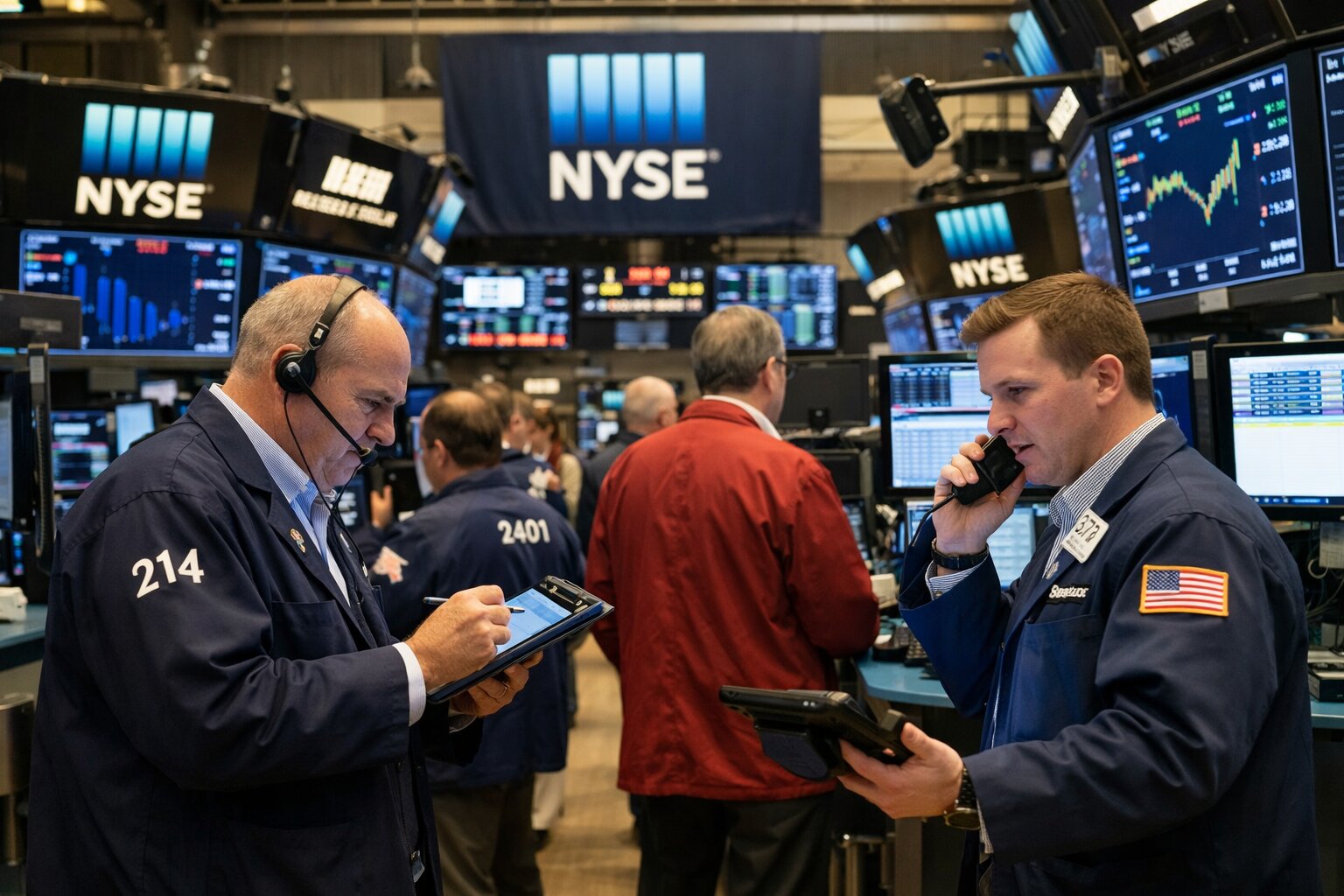
The selling Wednesday was not concentrated — it was distributed across every cap size and every index. The Dow Jones Industrial Average ($DJIA) shed between 348 and 440 points depending on the hour, settling around 46,644 — a decline of 0.74% to 1% from the prior close. The S&P 500 ($SPX) was off 0.46% to 0.6%, trading near 6,684. The Nasdaq Composite ($COMP) fell 0.44% to 0.6%, sitting at 22,381. The real pain landed on smaller companies: the Russell 2000 ($RUT) dropped 0.79% to 1%, hitting 2,500 — a move that reflects just how aggressively risk appetite is being pulled back from the market's most economically sensitive corner.
Small-caps are particularly exposed to the combination of higher-rates-for-longer and rising input costs, and the Russell's underperformance relative to the Nasdaq on a day like Wednesday is a telling signal. When small caps fall harder than megacaps during a broad selloff, it often means credit conditions are beginning to tighten at the margins. The VIX ($VIX) surged 4.16% to 23.30, snapping a three-session retreat and confirming that hedging demand is back in force. In futures, E-Mini Dow contracts ($YM00) were off 0.74% at $46,997. E-Mini S&P 500 ($ES00) slipped 0.48% to $6,741. E-Mini Nasdaq 100 ($NQ00) dropped 0.39% to $24,919. The directional conviction is clearly negative, and no buyer of size stepped in during morning trade to defend any major level.
Brent at $109, WTI at $98: The War Premium Is Compounding Fast
Oil Markets Are the Dominant Force in Every Asset Class
Brent crude ($BRN00) surged 5.08% to $108.67 a barrel Wednesday morning, at times touching $109.42 after Iran issued evacuation warnings to oil facilities across the Gulf. West Texas Intermediate crude ($CL.1) climbed 2.50% to $98.62 per barrel. The specific trigger Wednesday was Israeli strikes on Iran's South Pars gas field — the massive facility Iran shares with Qatar — which prompted Tehran to threaten retaliatory strikes against oil infrastructure in Saudi Arabia, the UAE, and Qatar. Iran already attacked UAE energy infrastructure earlier this week. With only 38 vessels having passed through the Strait of Hormuz since March 2nd according to shipping data from Kpler, the effective closure of the world's most critical energy chokepoint is no longer a theoretical risk — it is a live operational reality.
Goldman Sachs laid out the math starkly: approximately 2.2 million barrels per day of global refining capacity has been taken offline, and the Strait closure has cut roughly 3.3 million barrels per day of refined products that typically flow through that waterway. Another 12.8 million barrels per day of crude that exits the Strait toward Asian refineries is now disrupted. The Goldman commodities team noted that nearly 60% of typical crude exports from the Persian Gulf are medium and heavy crude — the grades that produce diesel, jet fuel, and fuel oil — with very limited alternative suppliers outside the Middle East capable of replacing that volume.
Diesel Above $5 and the Jones Act Suspension: Trump's Tactical Response
The national average for diesel hit $5.044 per gallon Tuesday, up from $3.651 just a month ago — a 38% jump in 30 days that is already rippling through freight costs, agriculture pricing, and consumer-facing supply chains. Diesel isn't just a pump price. It is the economic transmission mechanism for the entire goods economy, fueling every truck, train, and ship that moves product across the country. President Trump moved to counteract the supply crunch by issuing a 60-day waiver of the Jones Act, the longstanding U.S. shipping law requiring only American-flagged vessels to carry cargo between domestic ports. The waiver allows oil, natural gas, fertilizer, and coal to move freely to U.S. ports during the suspension period.
The move signals the administration recognizes the urgency of the supply problem, even as its foreign policy posture has muddied coalition-building efforts to secure the Strait of Hormuz. Trump posted on Truth Social that the U.S. does not need NATO help in the Middle East, and several U.S. allies have reportedly declined to participate in a multinational vessel escort operation. HSBC offered a measured counterpoint to panic: analyzing 11 geopolitical crises going back to the 1990 Gulf War — including September 11 and the Ukraine war outbreak — their global investment officers found the median oil price impact one month after a crisis is just 0.8%, and the S&P 500 has historically averaged a 2.9% gain over the same one-month window. Their recommendation remains an overweight on global equities, with preference for the U.S. and Asia. That's a sober, historically grounded view — but it assumes the Strait reopens on something approximating a normal timeline, which remains far from assured.
Energy Sector: XLE Posts Its 16th Record High of 2026
The Broadest Bull Move in Any Sector This Year
If there is one sector that has been unambiguously rewarded in this environment, it is energy — and not merely as a headline oil trade. The Energy Select Sector SPDR Fund ($XLE) notched its 16th record intraday high of the year Tuesday, gaining over 1.5% on the session. The breadth of the leadership is the more important story because it confirms this is a full-cycle sector move, not a crisis spike concentrated in crude producers.
Exxon Mobil ($XOM) has delivered 17 intraday record highs in 2026 and is up more than 30% year-to-date. Shell ($SHEL) has climbed over 25% this year and added 2% on Tuesday's session. ConocoPhillips ($COP) is nearly matching Exxon's pace. In the refiner sub-sector, Valero Energy ($VLO) has posted a staggering 45% gain in 2026 alone and logged 15 intraday record highs, while Marathon Petroleum ($MPC) is up 18% just in March and added 2% Tuesday. Pipeline and midstream players are participating just as forcefully: Antero Midstream ($AM) is up 30% in 2026 with 13 intraday records, and Williams Companies ($WMB) has posted 15 highs of its own. In oil services, Liberty Energy ($LBRT) surged nearly 5% Tuesday and is up 70% year-to-date — the kind of return that defines a sector cycle leader. Baker Hughes ($BKR) added nearly 4% on the session. This kind of distributed strength across integrated majors, refiners, pipeline operators, and oilfield services is characteristic of a bull move with legs. Verdict: Buy across the energy complex — and not a reluctant one.
Consumer Staples and Materials Get Crushed by the Inflation Squeeze
The Cost-Push Trap Is Closing on Defensive Names
Wednesday's PPI-driven selloff found its most concentrated damage in consumer staples and materials. Dollar Tree ($DLTR) fell 3.94% to $107.44 — the discount retail model depends entirely on stable input costs, and those are now moving sharply against it. Clorox ($CLX) shed 3.04% to $108.01. Procter & Gamble ($PG) dropped 2.60% to $147.53. Sherwin-Williams ($SHW) declined 2.29% to $313.35. Newmont Corp. ($NEM) fell 3.05% to $107.65. The S&P 500 Consumer Staples Sector Index ($SP500.30) dropped 1.68% to 931.82. The S&P 500 Materials Sector Index ($SP500.15) fell 1.15% to 615.00.
Both sectors are structurally vulnerable: input cost inflation is accelerating while pricing power has limits imposed by a consumer already feeling energy price pressure at the pump and at the grocery store. Companies that cannot pass through cost increases fast enough will see margin compression reflected in upcoming quarterly prints. These are Hold at best for names with genuine pricing power — and closer to Sell for those without it. Dollar Tree in particular faces an existential pricing model question at $107 that won't resolve quickly.
Micron Technology (MU): The AI Memory Earnings Everyone Is Watching
62% Gains This Year and the Fiscal Q2 Print Looms
Micron Technology ($MU) was among the standout movers Wednesday, ticking up 2.1% ahead of its fiscal second-quarter earnings report expected after the bell. This follows a 5% surge Monday on news of plans to build a second chip manufacturing facility in Taiwan. The stock has rallied approximately 62% this year, powered by insatiable demand for high-bandwidth memory — the architecture that underpins AI training clusters and inference workloads across every major hyperscaler.
Micron's quarterly print will function as a real-time readout on the health of the AI semiconductor supply chain. If HBM pricing holds and data center demand commentary is strong, the stock has a credible path meaningfully higher. The setup into the print is constructive: South Korea's Samsung Electronics gained over 7.5% and SK Hynix rose nearly 9% Tuesday in Seoul, even as Samsung's unionized workers voted to approve a strike that could disrupt operations at the world's largest memory chipmaker. That labor risk at Samsung is actually a supportive pricing data point for Micron — constrained supply at a direct competitor is a tailwind for average selling prices. Verdict: Buy into the print with position size sized appropriately for earnings binary risk.
Nvidia (NVDA): China Approval, $1 Trillion Vision, and the Nebius Fallout
The Most Important Chip Company on Earth Keeps Accumulating Catalysts
Nvidia ($NVDA) gained nearly 1% in premarket Wednesday after Reuters reported, citing sources, that the Chinese government approved the chipmaker to sell its H200 chips in China. The company is also reportedly preparing to make a version of its Groq AI chip available in that market. This is a significant development — China has been effectively locked out of Nvidia's most advanced silicon for years, and any re-entry represents a meaningful revenue expansion that the street hasn't aggressively priced. At the GTC event, CEO Jensen Huang announced a slate of new partnerships and articulated a vision of $1 trillion in chip sales through the end of 2027. That is not a modest number — it is a statement of category dominance.
Nebius ($NBIS) — an AI neocloud company providing GPU cloud services — announced deals cumulatively valued at $29 billion with both Meta ($META) and Nvidia in March, driving its stock 32% higher over the prior month. Nebius then fell 10% Tuesday after announcing a $3.75 billion convertible debt raise — $2 billion due 2031 and $1.75 billion due 2033 — to fund data center buildout and chip procurement. The dilution reaction is rational, but the strategic trajectory of building cloud GPU capacity ahead of the AI infrastructure wave is sound. Nvidia itself remains a clear Buy at any reasonable pullback.
Macy's (M): A Genuine Earnings Beat in a Difficult Retail Environment
Macy's ($M) popped 8% premarket Wednesday after posting Q4 results that cleared the bar on both lines. The retailer earned $1.67 per share excluding items on revenue of $7.64 billion, against consensus of $1.53 per share and $7.62 billion. That's a beat on both measures in a quarter where retail wasn't supposed to be delivering upside surprises. The magnitude of the earnings beat — nearly 9% above the EPS estimate — is meaningful enough to justify the move. Verdict: Hold — the quarter earns genuine credit, but macro headwinds facing department store retail in a higher-inflation environment are not resolved by one strong print. Watch for guidance on the Q1 call.
Lululemon (LULU): Strong Quarter, Weak Outlook
The Guidance Miss Is the Story, Not the Beat
Lululemon ($LULU) delivered Q4 results that beat on both earnings and revenue, but the market was forward-looking and did not like what it saw. Full-year 2026 revenue guidance of $11.35 billion to $11.50 billion came in below the $11.52 billion analyst consensus. Full-year EPS guidance of $12.10 to $12.30 also missed the $12.58 consensus. Shares fell roughly 1% in premarket — a muted reaction given the guidance shortfall, which suggests some of the downside is already priced in. But the combination of weakening consumer discretionary budgets, elevated energy costs eating into household spending power, and management's own admission of slowing demand is a compounding negative. Verdict: Sell the bounce — the guidance miss is directionally concerning and the consumer environment is not improving.
Docusign (DOCU) and Oklo (OKLO): After-Hours Movers With Very Different Stories
DocuSign ($DOCU) gained 1.3% in after-hours trading Tuesday after beating Q4 estimates and issuing Q1 revenue guidance of $822 million to $826 million — above the $813 million consensus. That's the kind of clean execution that justifies the stock's inclusion in software recovery portfolios. Verdict: Hold with a positive lean as the company demonstrates it can grow through a difficult macro environment. Oklo ($OKLO), the nuclear technology company, posted a full-year 2025 loss of 72 cents per share — a slight improvement from the 74 cent loss the year prior — and shares fell more than 2% after hours. Separately, the company signed a safety design agreement with the Department of Energy for its first reactor. At this stage, Oklo trades on regulatory milestones, not earnings. Verdict: Hold for existing positions; not a buy for new money at current speculative valuations.
Beyond Meat (BYND): Approaching Zero With No Visible Floor
Beyond Meat ($BYND) dropped over 7% Tuesday after delaying its 2025 annual report and releasing preliminary Q4 revenue of $61 million — missing the $63 million estimate. The stock is trading at $0.74 per share and received a Nasdaq delisting warning last week. The company has until August 31 to regain compliance with exchange listing standards. In 2021, shares traded as high as $151 shortly after going public. Plant-based meat demand never materialized at projected volumes, the business model has failed to scale, and the company is undergoing a rebrand — dropping "Meat" from its name and pivoting toward protein drinks. CEO Ethan Brown acknowledged the moment isn't right for plant-based meat. The delisting risk alone makes this position uninvestable for anything beyond the most aggressively speculative capital. Verdict: Sell.
SL Green Realty (SLG): Deutsche Bank Sees 15% Upside in the AI-Disruption Fear Discount
Deutsche Bank upgraded SL Green Realty ($SLG) to Buy Wednesday morning with a price target of $44, implying roughly 15% upside from Tuesday's close. The New York office REIT has fallen more than 15% year-to-date as AI disruption fears triggered concerns about long-term office demand and its impact on Manhattan leasing. Analyst Peter Abramowitz argues the market is ignoring solid fundamental leasing dynamics and that the stock trades at a 51.4% discount to net asset value. The catalyst he identifies is strong execution on asset sales and refinancings — particularly at One Madison and 245 Park — that would demonstrate balance sheet health and allow investor attention to return to the occupancy recovery story playing out through 2026 and 2027. Verdict: Buy for patient capital willing to look past AI-driven sentiment noise and wait for the NAV discount to narrow.
Read More
-
Yen Stalls at 160 Despite a 3% JGB and Tokyo Core CPI at 2.0% — Intervention Sits at 164, Friday's Payrolls Decide
02.09.2026 · TradingNEWS ArchiveEnergy
-
QQQ ETF ($739) Fades From an Early Tech Rally as a 77.9 ISM Prices Index Meets Micron's $61.5B Guide — $760 Record Test Ahead
01.10.2026 · TradingNEWS ArchiveStocks
-
XRPR and XRPI Follow XRP's $1.49 Test as Spot Funds Hold 1.16B XRP and a 1 Billion Token Escrow Release Lands — $1.70 in Play
01.10.2026 · TradingNEWS ArchiveCrypto
-
November NG Slips Below $3 as Decade-High Storage Meets Capped LNG Exports — $2.75 in Sight
01.10.2026 · TradingNEWS ArchiveCommodities
-
Dollar-Yen at 158 Presses Toward 160 as a 363 bp Carry Gap Meets Katayama-Bessent Intervention Risk — 159 in Sight
01.10.2026 · TradingNEWS ArchiveForex
Software Sector: Recovering, But Still Looking for Proof
IGV Hits $87 Resistance — The Sector Needs Revenue Proof, Not Promises
Software stocks broadly outperformed chips Tuesday, with the iShares Expanded Tech-Software Sector ETF ($IGV) popping to $87 before meeting resistance — a level that has repeatedly capped rallies and marks the first real technical hurdle for the sector's recovery. The bigger question is whether software can translate a tradeable bounce into genuine market leadership, and that requires hard evidence that AI is generating real revenue and margin expansion — not just pipeline chatter and demo days.
From the February 23rd low, some names have made impressive moves: Cloudflare ($NET) up 25%, Datadog ($DDOG) up 25%, CrowdStrike ($CRWD) up 23%, and Intuit ($INTU) up 28%. Even with Microsoft ($MSFT) and Salesforce ($CRM) in the red Tuesday, others are gaining traction in March: ServiceNow ($NOW) up 9%, Palantir ($PLTR) up 13%, and Palo Alto Networks ($PANW) up 14%. The sector warrants selective Buy on names demonstrating real AI revenue proof points — avoid the names still trading purely on forward-looking promises that haven't materialized in the income statement.
Bitcoin (BTC): Resilience Cracks Under Wednesday's Risk-Off Pressure
Bitcoin ($BTCUSD) was trading near $74,000 Tuesday before retreating toward $71,044 Wednesday morning, down 4.70% on the session. Despite Wednesday's selloff, the broader context matters: since the Iran war erupted on February 28th, Bitcoin has risen approximately 10%, while the S&P 500 declined 2% and gold fell nearly 4% over the same period. Bernstein analyst Gautam Chhugani attributed the relative strength to $2.1 billion in ETF inflows over three weeks as wealth managers, institutional allocators, pension funds, and sovereign wealth funds accelerated positions into crypto as a perceived uncorrelated asset.
Wednesday's 4.70% drop partially erases that geopolitical premium and aligns Bitcoin more closely with the broader risk-off dynamic sweeping every asset class. The question is whether the institutional bid that drove those ETF inflows holds firm through a sustained inflationary shock. If it does, the pullback to $71,000 is a retracement within an uptrend. If institutional allocators derisked alongside equities, the floor is considerably lower. Verdict: Hold — with conviction building again above $73,000 and risk management tightening on a break below $68,000.
Asia Markets: South Korea's Kospi Surges 5%, Japan Beats on Exports
Asia provided a sharp contrast to Wednesday's Western session anxiety. South Korea's Kospi surged over 5% to close at 5,925.03 — a move large enough to trigger a five-minute trading halt when Kospi 200 futures jumped 5%. Samsung Electronics gained over 7.5% even as its unionized workers voted to approve strike action. SK Hynix climbed nearly 9%. The memory chip rally in Seoul is a direct read-through to global AI infrastructure demand, and it arrived before Micron's U.S. earnings print — reinforcing the bullish setup for $MU into its release.
Japan's Nikkei 225 jumped 2.87% to 55,239.4 after February export data showed a 4.2% year-over-year rise, well above the 1.6% Reuters consensus, though a significant deceleration from January's extraordinary 16.8% surge. The Topix added 2.49% to 3,717.41. Australia's S&P/ASX 200 gained 0.31% to 8,640.6. Hong Kong's Hang Seng rose 0.66%, and the CSI 300 added 0.45% to 4,658.33. Asian markets opened Tuesday's session with momentum that U.S. markets initially sustained, before Wednesday's macro data erased the goodwill entirely.
Airline Sector: A Short-Term Demand Spike That Won't Outlast the Fuel Bill
The Iran conflict is playing out counterintuitively for airline stocks in the very near term. Delta Air Lines ($DAL) rose 4% Tuesday after raising Q1 revenue guidance and reaffirming the ability to manage higher fuel costs. Alaska Airlines ($ALK) CEO Ben Minicucci confirmed at the JPMorgan Industrials conference that when oil prices spiked, demand spiked with it — travelers are rushing to lock in fares before prices escalate further. American Airlines ($AAL) also expects higher revenue this quarter driven by the same front-loaded booking behavior.
The dynamic here is a short-term pull-forward of demand as consumers accelerate purchases they would otherwise have made later, while jet fuel costs are still rising and have not yet peaked. The rally may have limited runway unless oil stabilizes. The fundamental math of airlines burning more expensive fuel while potentially facing a demand hangover after the front-loaded booking cycle completes is not attractive. Verdict: Hold for the majors — the near-term demand tailwind does not overcome the medium-term fuel cost pressure building in the income statement.
Mastercard (MA): A $1.8 Billion Stablecoin Bet on the Future of Payments
Mastercard ($MA) announced the acquisition of BVNK, a stablecoin infrastructure provider, in a deal valued at approximately $1.8 billion. Shares were roughly flat on the news. The deal follows Mastercard's March announcement of a digital assets partnership network connecting Circle, Binance, and others to its traditional payments rails. The strategic logic is straightforward: Mastercard wants to own the plumbing that bridges fiat and digital currencies before a competitor does, and at $1.8 billion it's a meaningful but not outsized commitment for a company of its scale. Verdict: Buy — the digital payments infrastructure thesis is intact, and this acquisition meaningfully extends the moat into the stablecoin settlement layer.
Warner Bros. Discovery (WBD): $887 Million for Zaslav — The $110 Billion Media Reset
Warner Bros. Discovery ($WBD) CEO David Zaslav is in line to receive up to approximately $887 million in total compensation if the Paramount Skydance ($PSKY) acquisition closes at $31 per share in a deal valued at roughly $110 billion. The package breaks down as $517.2 million in unvested equity that vests upon deal closure, $115.8 million in vested equity, $34.2 million in cash, and $335.4 million in tax reimbursements. CFO Gunnar Wiedenfels receives $120 million. Chief revenue officer Bruce Campbell gets $121.5 million. Streaming and games CEO Jean-Briac Perrette is in line for $142 million.
The deal ended a bidding war between Paramount and Netflix ($NFLX) for control of Warner Bros., with both parties escalating offers before the $110 billion Paramount Skydance transaction emerged the winner. At $887 million, Zaslav's package will generate headlines — but the more relevant number is the $110 billion enterprise value that sets a specific benchmark for media consolidation pricing going forward.
EU-U.S. Trade Deal Ratification Restarts After Supreme Court Uncertainty
The European Union is restarting ratification proceedings for its trade deal with the United States, according to European Parliament trade committee chair Bernd Lange. Under the July 2025 agreement, the EU agreed to remove all tariffs on U.S. industrial products in exchange for a 15% levy on its own exports — a lopsided deal that EU leadership at the time defended as necessary to avoid a prolonged trade war. Ratification had stalled as EU lawmakers sought protection following the U.S. Supreme Court's decision to invalidate IEEPA tariffs. EU lawmakers inserted an amendment conditioning the deal's effect on the U.S. honoring the original July terms — a condition the Trump administration has not yet explicitly guaranteed. The trade committee votes Thursday, with a full plenary vote expected in late March or April. A successfully ratified deal would remove one significant trade uncertainty from global markets at a moment when macro uncertainty is already elevated.
Treasury Yields, the Dollar, and Gold: The Rate Market Reprices in Real Time
The 10-year Treasury yield ($TMUBMUSD10Y) rose to 4.23% Wednesday, up approximately 2.7 basis points from the prior session. The 2-year yield ($TMUBMUSD02Y) climbed about 3.2 basis points to 3.716%, reflecting front-end repricing of rate-cut probability following the PPI print. Both yields had spent three consecutive sessions declining before Wednesday's reversal — a pattern consistent with safe-haven demand temporarily overpowering inflation concerns, then giving way once the hard data arrived. The U.S. Dollar Index ($DX00) was trading at $99.50, up 0.17%. A sustained break above 100 in the DXY, combined with the 30-year yield pushing through 5%, has been cited as a potential trigger for an equity drawdown of 10% or more — neither threshold has been definitively breached, but both are within striking distance.
Gold ($GC00) fell 2.59% to $4,878.50, pulling back despite the geopolitical backdrop. That decline is notable — gold's historical role as a conflict hedge is being undermined by the strong dollar and rising real yields, which make the non-yielding metal less attractive in relative terms. The HSBC analysis confirmed this across 11 historical crises: gold's median move one month after a major geopolitical event is essentially flat.
SEC's Quarterly Reporting Proposal: A Market Structure Shift With Real Consequences
SEC Chair Paul Atkins confirmed the agency will seek public comment on a potential move to eliminate mandatory quarterly financial reporting for public companies — replacing the requirement with a semi-annual cadence. The proposal would represent the most significant structural change to U.S. market transparency in decades. For active market participants, reduced data frequency is a direct headwind to pricing efficiency — fewer data points mean wider spreads between intrinsic value and market price, which creates opportunities but also extends the time horizon over which mispricing can persist. For long-duration investors, the argument is that removing the quarterly earnings treadmill encourages longer-term corporate decision-making. The comment period will reveal where the market actually stands, but the directional intent from the SEC under Atkins is clearly toward deregulation of the reporting framework.
The Full Picture: Stagflation Risk Is Real, and the Oil Variable Has No Quick Resolution
February's 0.7% PPI print was not the ceiling — it was the floor before war-driven energy costs enter the official data. The structural tariff inflation that Schoenberger described is compounding in real time with a geopolitical energy shock that has taken 2.2 million barrels per day of refining capacity offline and effectively disrupted 12.8 million barrels per day of crude flows through the Strait of Hormuz. Diesel is above $5. Brent is above $109. The 10-year yield sits at 4.23%. The probability of no rate cuts in all of 2026 jumped 9 percentage points in a single morning session.
The tactical picture for broad U.S. equities — $DJIA, $SPX, $COMP — is bearish in the near term. The VIX at 23.30 is not yet in panic territory — that threshold sits closer to 30 to 35 — which means there is room for further deterioration before institutional hedging demand peaks and creates a contrarian entry. Energy is the only large-cap sector with genuine fundamental tailwinds that justify current prices and continued accumulation. Everything dependent on consumer spending, stable input costs, or near-term rate cuts is under pressure and deserves scrutiny. Tech has bifurcated cleanly: AI infrastructure — chips, memory, cloud GPU capacity — remains constructive and earns the Buy rating. Legacy software and SaaS names need earnings proof before they reclaim their premium multiples. The Fed holds Wednesday. Powell speaks. What matters is not the decision — it's the language. If he frames energy-driven inflation as temporary, the bond market will call his bluff. If he signals rates remain elevated well into the second half, equity multiples compress further across the growth universe. Either way, this is a session where knowing exactly what you own — and why you own it — is the only defensible position.