Stock Market Today: Dow, S&P 500 (SPX), Nasdaq Climb on Iran Ceasefire Extension — BA,GEV Lead Earnings Rally
Nasdaq hits 24,570 record; BA +2.9%, GEV +10%, PLTR +3.4%, BBY -4.8% | That's TradingNEWS
Key Points
- Nasdaq (IXIC) Prints Record 24,570 — Tech gauge up 1.2% as XLK chases 16-session streak; S&P 500 (SPX) adds 0.9% to 7,118, Dow gains 410 points to 49,547.
- Boeing (BA) Crushes Q1 Estimates — Loss of $0.20 beats $0.76 consensus; revenue $22.22B tops $21.78B; cash burn narrows to $1.45B vs. $2.61B expected; stock up 2.9% to $225.57.
- GE Vernova (GEV) Rockets 10% — Q1 revenue $9.34B beats $9.25B; power-grid rally lifts ETN, CMI, HUBB to fresh highs.
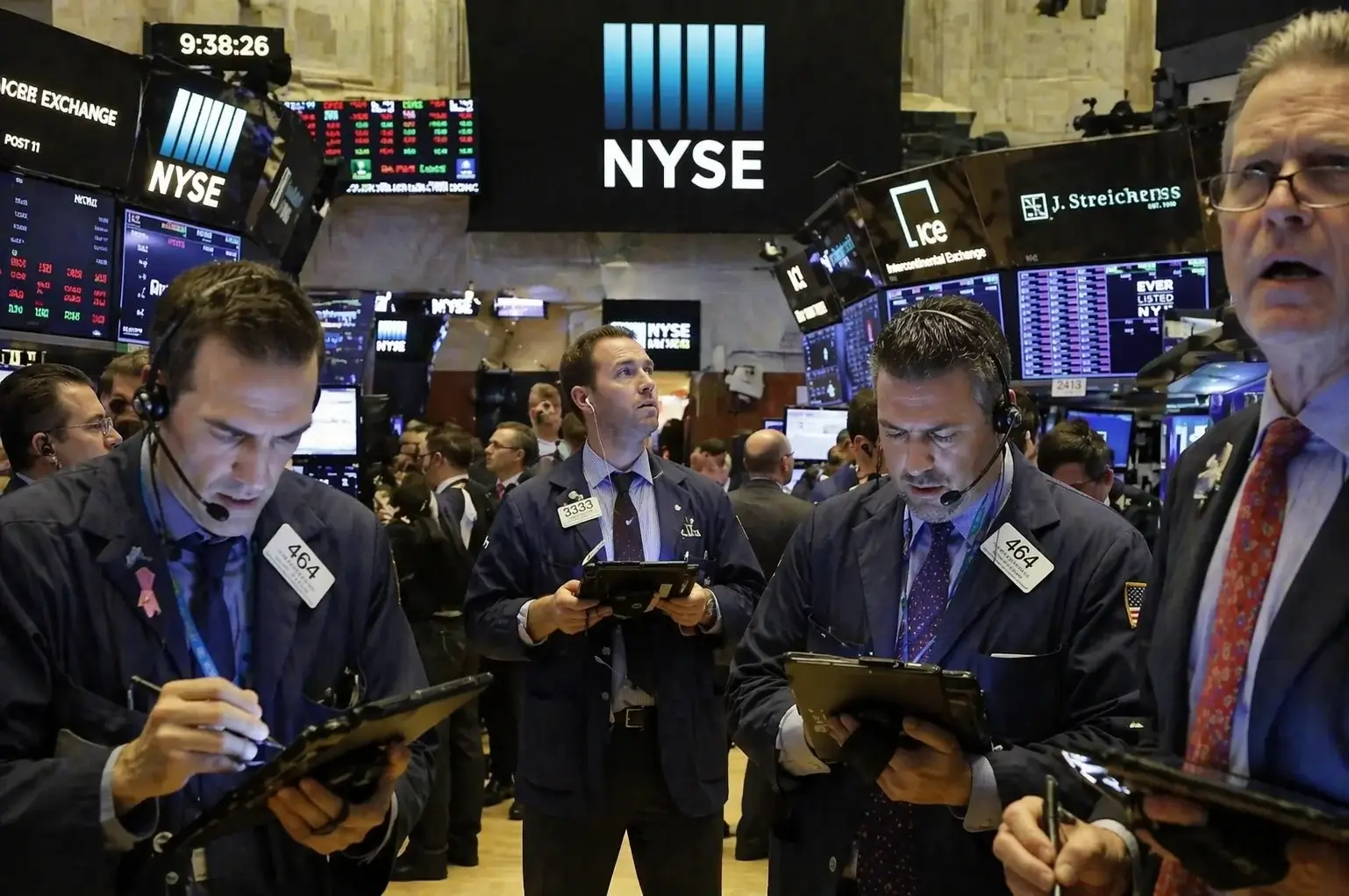
Equity markets roared back on Wednesday with conviction that had been conspicuously missing through the opening stretch of the week, shrugging off fresh provocations in the Strait of Hormuz and instead latching onto President Donald Trump's Tuesday-night decision to prolong the fragile U.S.-Iran ceasefire. The Nasdaq Composite punched through to a fresh all-time intraday peak at 24,570.66, last quoted 1.2% higher at 24,528.88 with a 268.91-point advance — an astonishing bounce given the index sat in correction territory only weeks ago during the worst of the Middle East escalation. The S&P 500 added 0.9% to reach 7,118.25, a 54.24-point lift that carried the benchmark above Friday's record close of 7,126.06 during morning trade, while the Dow Jones Industrial Average tacked on roughly 410 points, or 0.8%, to 49,547.38. Small caps joined the party with the Russell 2000 climbing 0.72% to 2,784.97, and the Cboe Volatility Index (VIX) slid 1.95% to 19.12 — under the widely used rule-of-16, that reading translates to expected average daily S&P 500 swings of only 1.2%, a remarkably benign implied-vol regime considering the geopolitical backdrop. The president's Truth Social post framed the extension as a response to Iran's "seriously fractured" government and a request from Pakistani Prime Minister Shehbaz Sharif and Field Marshal Asim Munir, with Trump directing the U.S. military to maintain the blockade while holding off on additional strikes until Tehran produces a unified proposal. Iranian negotiators reportedly dismissed the talks as a waste of time, and Vice President JD Vance's planned trip to join peace discussions was paused — yet the tape chose optimism over skepticism, and breadth is the evidence. All 11 GICS sectors traded higher simultaneously, only the fourth such session of 2026. For context, all 11 sectors rose together on just 14 trading days during the entirety of 2025, so Wednesday's synchronization is a bona fide breadth signal, not statistical noise.
Dow Edges Toward Correction Exit as Breadth Signal Flashes Durable Uptrend
The Dow's reclamation story is worth lingering on. The blue-chip gauge now sits 9.7% above its March 45,166.64 closing trough and requires a finish above 49,683.30 to formally shed the correction label — a mere 0.3% from current levels. That kind of symmetrical recovery from a correction tends to reward continuation trades rather than mean-reversion skepticism, particularly when it comes paired with a VIX reading below 20 and an earnings beat rate north of 80% on the S&P 500 companies that have reported this cycle. Sector leadership in the Dow tape skewed toward technology, industrials, and communications services, with Information Technology (XX:SP500.45) up 1.41% to 6,024.78 and Communications Services (XX:SP500.50) climbing 0.98% to 471.65. Real Estate (XX:SP500.60) was the lone laggard at 277.81, slipping 0.17%, and Financials (XX:SP500.40) was essentially flat at 869.34. Energy (XX:SP500.10) gained 0.93% to 863.78 on the back of Brent's move above $100, while Consumer Staples (XX:SP500.30) advanced 0.84% to 931.56 and Materials (XX:SP500.15) added 0.72% to 655.07. The setup here is bullish-continuation: broad participation, low realized vol, strong earnings beats, and a benchmark that's about to formally confirm trend reversal. Tactical allocation call: overweight equities, maintain a modest oil-equity overlay as geopolitical insurance, and avoid the reflex to fade strength simply because the indices are pushing records.
Technology Goes Vertical — XLK Chases 16-Session Streak, SOXX Notches Tenth Straight Intraday Record
The Technology Select Sector SPDR (XLK) is hunting a historic sixteen-session winning streak, a cadence almost unheard of at the sector-fund level, and traded 1.29% higher at $156.68 for a $1.99 gain on the day. The SOXX semiconductor ETF is carrying a ten-straight intraday record streak, and the PHLX Semiconductor Index (SOX) itself powered 1.53% higher to 9,794.52 — a 147.30-point single-session advance that reinforces the narrative that AI infrastructure spending is not peaking, it is broadening. The individual-stock tape reads like a roll call of every part of the silicon stack: AMD, Amkor (AMKR), Arista Networks (ANET), AXT (AXTI), ChipMOS (IMOS), Cisco (CSCO), Cirrus Logic (CRUS), Dell (DELL), Keysight (KEYS), Kulicke & Soffa (KLIC), Lattice Semiconductor (LSCC), MACOM (MTSI), Monolithic Power Systems (MPWR), SiTime (SITM), Seagate (STX), Teradyne (TER), Texas Instruments (TXN), and Western Digital (WDC) all minted fresh intraday records. Across the Atlantic, ASM International (ASMI) surged nearly 8% — last quoted at €830.00, up €48.00 or 6.14% — after reporting Q1 revenue of €862.5 million ($1.01 billion) that cleared consensus with room to spare. The Dutch chipmaker's ALD equipment sits directly on the critical path for sub-3-nanometer process nodes, and the blowout adds independent confirmation to the thesis that capital intensity in leading-edge logic is accelerating, not normalizing. Recommendation: remain bullish on SOXX, AMD, MPWR, KLIC, and ASMI with a staged-entry framework — any 3%-5% pullback is a buying opportunity rather than a reason to lighten up. The stocks to watch for potential near-term exhaustion are MPWR and ANET, which have outrun their 50-day moving averages meaningfully — trim 15%-20% of those positions into strength rather than wait for a reversion event to force the decision.
Boeing (BA) Delivers the Cleanest Earnings Beat of the Morning as Cash Burn Collapses
Boeing printed a genuine inflection-quality quarter. Adjusted loss per share came in at $0.20 against consensus estimates that ranged from $0.76 (Bloomberg) to $0.83 (LSEG) — a miss-the-miss by a comfortable margin — while revenue of $22.22 billion topped the $21.78-$21.79 billion estimate and expanded 14% year-over-year. The metric that truly separates this print from prior disappointments is cash: adjusted free cash flow landed at negative $1.454 billion versus consensus of negative $2.61 billion, meaning Boeing burned roughly $1.2 billion less than the Street had modeled. Operating cash flow improved to negative $179 million from negative $1.6 billion a year earlier — a 10x improvement at the operating-cash level that tells the story of CEO Kelly Ortberg's factory discipline biting into the structural cost base. Management reiterated guidance for 737 Max 7 and Max 10 certifications this year with deliveries beginning in 2027, and Ortberg highlighted a record-breaking backlog and the Artemis II mission as forward catalysts. Shares last traded at $225.57, up 2.92% or $6.41, after a pre-market pop of more than 4%. The verdict here is straightforward: BA is a buy with conviction. Cash-burn trajectory is the single cleanest leading indicator for a turnaround story, the Max 7/10 certifications unlock a volume step-function no competitor can match on timing, and the backlog provides earnings visibility multiple years out. Price-target bias: the $250 level is the first technical resistance worth tracking; a clean break opens the path to $275.
GE Vernova (GEV) Rips 10% on Revenue Blowout as Power Buildout Thesis Accelerates
GE Vernova stole Wednesday's large-cap earnings highlight reel with a roughly 10% explosion higher after posting Q1 revenue of $9.34 billion against $9.25 billion FactSet consensus — and reported EPS of $17.44, though StreetAccount flagged comparability questions against the $1.95 headline consensus. Ignore the EPS debate for a moment: the revenue line is the cleanest expression of power-grid electrification demand available in public markets, and it just accelerated past expectations. The read-through hit the rest of the industrial-power complex immediately, with Cummins (CMI), Eaton (ETN), Emcor (EME), Hubbell (HUBB), Nucor (NUE), Quanta Services (PWR), Ryder (R), Steel Dynamics (STLD), Tenaris (TS), Trane (TT), and Veeco Instruments (VECO) all marking intraday records. Beneath that list lies a single investable thesis: AI data-center electrification is a multi-year, non-cyclical capex cycle that transmits directly into turbine orders, grid-transformer backlogs, HVAC equipment, and specialty steel. GEV remains a buy on any pullback toward the 50-day; aggressive sizing into Q2 prints makes sense. ETN and CMI are the cleanest second-derivative plays, HUBB the highest-torque small-cap in the cohort.
Vertiv (VRT) Punished Despite Dual Beat — A Textbook "Priced for Perfection" Trap
Vertiv's tape action is the flip side of the power-capex coin and a warning about positioning. EPS of $1.17 topped the $1.00 consensus, and revenue of $2.65 billion edged past $2.64 billion — both lines beat — yet shares slid more than 4%. That divergence is a positioning unwind, not a fundamentals event. When a stock has run hard into a report, even clean beats fail to deliver the incremental catalyst fast money needs to maintain exposure, and the resulting de-grossing often produces a short-term air pocket. Rating: hold. The fundamentals remain intact and the thermal-management moat inside AI data centers is real, but waiting for the flush to complete before adding exposure is the disciplined trade. A re-entry zone in the mid-to-high single-digit pullback from current levels would restore risk/reward.
AT&T (T) Beats on Both Lines Yet Tape Stays Flat — Pricing Power Without Multiple Expansion
AT&T posted adjusted EPS of $0.57 on revenue of $31.5 billion, against LSEG consensus of $0.55 and $31.25 billion respectively — a clean beat top-to-bottom. The market response: T last traded at $25.27, down 2.36% or $0.61. That disconnect signals that the telecom's earnings power is already baked into valuation, and incremental outperformance no longer earns multiple re-rating. Rating: hold. Own T for the dividend coupon, not capital appreciation — the equity story is income-driven and will remain so until management surprises with a meaningful capital-return acceleration beyond the existing framework.
Bitcoin (BTC-USD) Breaches $78K as Risk-On Flows Return, COIN and HOOD Ride the Tape
Bitcoin charged 4.05% higher to $78,919.65 with a $3,072.97 single-session gain, cresting an eleven-week peak not seen since early February. Crypto-adjacent equities captured the benefit cleanly: Coinbase (COIN) jumped nearly 4.5% and Robinhood Markets (HOOD) added around 3.5% in the pre-market tape, with HOOD carrying a secondary bullish driver — the Robinhood Ventures Fund I (RVI), which debuted on the NYSE in March and offers retail exposure to private technology companies, disclosed a $75 million stake in OpenAI. RVI president Sarah Pinto framed the position as one of the fund's largest to date, reinforcing that the vehicle's mandate is now materially AI-weighted. The strategic implication: HOOD is no longer purely a trading-platform equity; it's also now a limited-liquidity proxy for private AI exposure, a positioning benefit that deserves valuation consideration. Recommendation: COIN is a buy on any retracement toward the $300 zone given direct BTC beta and the widening custodial moat; HOOD is a buy with the RVI thesis adding multi-expansion optionality on top of the core brokerage franchise. Gold (GC00) climbed 0.68%-0.71% to around $4,751.90-$4,753.00 per ounce with a $32.30-$33.40 gain, and silver (SI00) advanced 1.68% to $77.77 — Kitco's Jim Wyckoff pegged the move to bargain hunting after Tuesday's fade alongside softer dollar dynamics and firmer crude. The U.S. Dollar Index (DXY) sat at 98.50, up a modest 0.11%.
Palantir (PLTR) Lands $300 Million USDA Contract, Reinforcing Federal Software Moat
Palantir Technologies popped 3.38% to $150.90, gaining $4.93, after disclosing a $300 million software purchase agreement with the U.S. Department of Agriculture under the "One Farmer, One File" initiative. The deal covers software to streamline farmer self-reporting of acreage and accelerate disaster-recovery payments, and provides USDA visibility into agricultural supply-chain resilience and foreign-adversary exposure. The strategic read: Palantir's civilian-federal footprint is expanding beyond defense and intelligence, which reduces the single-customer concentration risk that has long been a bear-case pillar. Every incremental federal contract compresses the deceleration thesis. Verdict: buy, but position with volatility awareness. Realized vol remains north of 50% and valuation metrics remain stretched on every traditional yardstick — but the contract trajectory is moving in the right direction at a pace that can keep momentum buyers engaged. A stop-loss framework tied to the 200-day moving average is reasonable for size management.
SpaceX-Cursor $60 Billion Option and OpenAI's $1.5 Billion DeployCo — Private AI Signals for Public Plays
Private-market moves worth decoding for public comparables. SpaceX (SPAX.PVT) has reportedly secured an option to either acquire AI coding startup Cursor outright for $60 billion later this year or pay $10 billion for a partnership structure, a move that plants xAI (which merged with SpaceX in February) directly into developer tooling alongside OpenAI (OPAI.PVT) and Anthropic (ANTH.PVT) ahead of SpaceX's anticipated IPO in coming months. Simultaneously, OpenAI is set to commit up to $1.5 billion to a new joint venture with private equity — internally dubbed DeployCo — which will be Delaware-incorporated, expected at a $10 billion valuation in a funding round closing early May, with $500 million of OpenAI equity going in up front and super-voting shares retained. The DeployCo vehicle is explicitly designed to accelerate enterprise adoption of OpenAI's workplace tools. Public-market implications: anything positioned as enterprise-AI infrastructure benefits thematically — Microsoft (MSFT), Oracle (ORCL), Palantir (PLTR), Snowflake (SNOW), MongoDB (MDB) — while pure-play coding copilots without defensible differentiation face accelerating competitive pressure. The Cursor valuation marker specifically reframes developer-tooling multiples for the entire category.
Netflix (NFLX) — Wolfe Research Leans Into Pricing Power Over Subscriber Math
Netflix shares were tracking a 0.5% year-to-date decline heading into Wednesday, but Peter Supino at Wolfe Research sharpened the bull case by reframing it around pricing power rather than subscriber additions. The crux: average U.S. Netflix subscribers already consume roughly 1.6 hours per day on the platform, equivalent to one-third of total daily video viewing time, and that engagement share is the structural asset that permits price increases without meaningful churn. With the Warner Bros. Discovery bid formally abandoned earlier in 2026, management's pivot from subscriber-count growth to profitability optimization looks deliberate and durable. Recommendation: buy on weakness. The pricing runway has years left, content capex is being imposed with greater discipline, and the operating leverage embedded in the current cost structure will compound as ARPU creeps higher.
Coca-Cola (KO) Positioned as All-Weather Hedge Ahead of April 28 Print
JPMorgan's Andrea Teixeira reiterated an overweight rating on Coca-Cola with an $83 price target — implying roughly 11% upside from Tuesday's close. The thesis centers on KO's insulation from inflationary cost pressures relative to other staples peers and a sophisticated playbook that lets the company engage both value-seeking and premium consumers without margin erosion. Shares are up nearly 7% year-to-date in 2026 and traded flat in the pre-market. Earnings hit April 28. Call: buy. In a tape where tail-risk re-emergence in the Middle East would likely trigger a defensive rotation, KO is the cleanest low-beta hedge that also offers real pricing elasticity — a rare combination inside the staples complex. Hold alongside core equity exposure rather than as a substitute for growth allocations.
Best Buy (BBY) Slumps Nearly 5% on CEO Transition Announcement
Best Buy sank 4.78% to $63.41 after CEO Corie Barry — the electronics retailer's first female chief executive, who steered the company through both the COVID-19 pandemic and the 2025 tariff cycle — announced she will step down October 31. Her successor is Jason Bonfig, currently chief customer, product, and fulfillment officer, who joined the company in 1999 the same year Barry did and will assume the CEO seat plus her board position with a six-month strategic-advisory handoff from Barry. Leadership transitions at specialty retailers rarely set up cleanly for outperformance given the cyclicality of consumer electronics demand, and the execution risk around reshaping the strategic direction mid-cycle argues for caution. Rating: hold with a bias toward underweight until Bonfig outlines his framework publicly. A post-announcement fade into the high-$50s area would reset the risk/reward, but chasing the pullback here before strategic clarity emerges is premature.
Brent Crude Tests $100 as Hormuz Standoff Continues Despite Ceasefire Extension
The energy tape refuses to calm down, and the bifurcation between diplomacy and reality is stark. Brent crude (BRN00, BZ=F) cleared $100 per barrel intraday, last at $101.38 with a 2.94% gain of $2.90, while West Texas Intermediate (CL00, CL=F) traded near $92.25, up 2.88% or $2.58 — earlier quotes hit $92.23 on Barron's data. The oil volatility index has spiked to its highest level since 2020's Covid-driven demand shock. Iran's navy seized two container ships in the Strait of Hormuz on Wednesday and sent two of its own oil supertankers to directly test the U.S. blockade. Trump's Truth Social language was explicit on the blockade staying in place until discussions are concluded "one way or the other" — and he warned that any deal contingent on lifting the blockade would require capitulation Tehran is unlikely to offer. Hormuz typically carries roughly one-fifth of global crude flows, and the longer this remains locked up, the more second-order effects emerge in refined-product markets, shipping rates, and airline fuel costs. Energy-equity call: bullish bias on Exxon Mobil (XOM), Chevron (CVX), and Permian-weighted E&Ps into any pullback; avoid refiners where crack-spread compression becomes the second-order risk if crude stays elevated. A barbell of integrated majors plus select upstream names captures the upside without the refining margin squeeze.
Read More
-
Yen Stalls at 160 Despite a 3% JGB and Tokyo Core CPI at 2.0% — Intervention Sits at 164, Friday's Payrolls Decide
02.09.2026 · TradingNEWS ArchiveEnergy
-
QQQ ETF ($739) Fades From an Early Tech Rally as a 77.9 ISM Prices Index Meets Micron's $61.5B Guide — $760 Record Test Ahead
01.10.2026 · TradingNEWS ArchiveStocks
-
XRPR and XRPI Follow XRP's $1.49 Test as Spot Funds Hold 1.16B XRP and a 1 Billion Token Escrow Release Lands — $1.70 in Play
01.10.2026 · TradingNEWS ArchiveCrypto
-
November NG Slips Below $3 as Decade-High Storage Meets Capped LNG Exports — $2.75 in Sight
01.10.2026 · TradingNEWS ArchiveCommodities
-
Dollar-Yen at 158 Presses Toward 160 as a 363 bp Carry Gap Meets Katayama-Bessent Intervention Risk — 159 in Sight
01.10.2026 · TradingNEWS ArchiveForex
Airline Sector Faces Fuel Squeeze — United (UAL) Issues Disappointing Guidance
The energy pain is already bleeding into other P&Ls. United Airlines (UAL) rose less than 1% in Tuesday's aftermarket despite issuing disappointing guidance for both the current quarter and the full year, explicitly citing rising fuel prices as the headwind. With jet fuel comprising roughly 30%-plus of airline operating cost structures, every $10 move higher in crude compresses full-year EPS meaningfully across the sector. MarketWatch flagged that airlines are already cutting flights in response to the cost spike — an economic fallout markets may be partially underestimating. Sector call: avoid commercial airlines as a tactical long until crude stabilizes or a durable Hormuz reopening emerges. Hedge carriers — Delta (DAL) and Southwest (LUV) specifically — are slightly better-positioned through existing fuel hedges, but the sector-wide headwind dominates idiosyncratic positioning in this environment.
Adobe (ADBE) Announces $25 Billion Buyback Through April 2030
Adobe rose more than 2% in Tuesday's post-bell session after its board authorized a $25 billion share repurchase program running through April 2030. That's a sizable capital-return commitment that signals management's view on the intrinsic-value gap and should provide a meaningful price floor on any creative-software cyclical scare. Rating: buy. Adobe's AI-monetization story — Firefly credits, GenStudio, and enterprise Creative Cloud pricing ladders — is still underappreciated by a market focused on perceived competition from OpenAI and smaller generative-image players. The buyback accelerates EPS mechanically and provides flexibility to deploy capital opportunistically if the stock experiences an unjustified drawdown.
Capital One (COF) Slips on Q1 Print as Credit Cycle Overhang Persists
Capital One dropped more than 2% after reporting Q1 adjusted EPS of $4.42 on revenue of $15.23 billion. The card-issuer credit cycle remains the central overhang — provisions, net charge-offs, and delinquency trajectories all need to demonstrate stabilization before the market rewards COF with multiple expansion. Rating: hold. The pending Discover integration synergies remain intact, but credit quality is the binary variable, and a premature long positions traders into a potentially extended work-out period if loss content drifts higher.
Fed Rate-Cut Odds Compress Further After Warsh Hearing Signals Independence
Rate-cut optimism continued to drain even as equities charged higher. CME FedWatch tool data shows traders pricing a 69% probability that the federal funds target range remains at 3.5%-3.75% through year-end, marginally trimmed from 70% on Tuesday — essentially a "no cuts in 2026" base case. Kevin Warsh's Senate confirmation hearing for the Fed chairmanship was read as reassuring on institutional independence and policy continuity, with Nuveen's Laura Cooper noting he sidestepped specific rate-path commitments while emphasizing a measured balance-sheet approach. Jefferies remains in the minority still calling for two cuts. Bond-market reaction was muted: the U.S. 10-year yield (TMUBMUSD10Y) slipped 0.9 basis points to 4.29% and the dollar traded fractionally softer. Positioning implication: duration-heavy trades (long-dated Treasuries, TLT) remain the losing allocation in this regime; short-duration high-quality credit, floating-rate instruments, and dividend-growth equities in staples and healthcare produce the best risk-adjusted returns until the Fed's reaction function visibly shifts.
Nikkei Prints Record as SoftBank and ARM Leadership Shift Ignites Rally
Japan's Nikkei 225 closed at an all-time high of 59,585.86, up 0.4%, after March trade data showed a seventh consecutive month of export expansion with a 667 billion yen ($4.18 billion) surplus — though that undershot the 1.1 trillion yen consensus materially. The Topix diverged, slipping 0.67%. SoftBank Group surged as much as 10% on news that Rene Haas, CEO of SoftBank-owned ARM Holdings (ARM), will assume the expanded role of SoftBank Group International CEO effective April 21. The governance signal is that Masayoshi Son is elevating ARM's leadership into the broader SoftBank strategic architecture, a move that could further entwine ARM's roadmap with SoftBank's ambitions in AI infrastructure. The Bank of Japan's policy meeting next week looms as the next Japan-specific catalyst.
Kospi, Kosdaq, and SK Hynix's $12.9 Billion Chip Packaging Commitment
South Korea's Kospi added 0.46% to 6,417.93 while the Kosdaq rose 0.18%. SK Hynix shares slipped nearly 1% after the memory giant confirmed a 19 trillion won ($12.90 billion) capital investment in an advanced chip-packaging facility in South Korea — capex validation of the AI-driven memory demand curve but a near-term earnings drag given the depreciation pass-through. March producer-price data clocked the fastest pace in over three years, a direct transmission from elevated crude prices feeding through the industrial input complex. Mainland China's CSI 300 added 0.66% to 4,799.62, Hong Kong's Hang Seng shed 1.21% in its final trading hour, and India's Nifty 50 lost 0.74% — weighed down by HCL Technologies, which plunged 8.87% after Q4 earnings missed expectations. Australia's S&P/ASX 200 slid 1.18% to 8,843.6.
European Bourses Mixed as ASMI Steals the Spotlight on Chip Strength
European indices traded mixed despite the ceasefire relief. The STOXX Europe 600 slipped 0.33% to 613.98, Germany's DAX fell 0.29% to 24,200.00, the CAC 40 declined 0.81% to 8,169.19, the FTSE 100 lost 0.20% to 10,477.26, FTSE MIB shed 0.10% to 47,856.67, and Spain's IBEX 35 dropped 0.63% to 18,027.60. Sector dispersion was stark: basic resources led gains at 1.6% while travel and leisure names fell nearly 1.3%, an intuitive spread given the crude backdrop. The single-name highlight was ASMI — covered earlier in the chip section — whose €1.01 billion quarterly revenue print cements the semiconductor capex thesis in a second, non-U.S. data point. Trade implication: ASMI remains a buy on any European-session weakness. ALD dominance plugs directly into the AI-chip roadmap already being priced into the U.S. SOXX complex, and the European listing often lags the American chip tape by a session or two, providing arbitrage opportunities for patient allocators.
Earnings Scorecard: 80%+ Beat Rate Provides the Fundamental Backbone for the Rally
The earnings scorecard this cycle is the quiet story underpinning the entire equity advance. More than 80% of S&P 500 companies reporting so far have topped expectations, per FactSet — a hit rate that is materially above historical averages and provides legitimate fundamental cover for the Nasdaq's record-chasing run. It's worth emphasizing that Wednesday's rally comes with confirmed breadth: all 11 GICS sectors higher simultaneously, only the fourth such day of 2026 and dramatically rarer than 2025's 14 total instances across the full year. Breadth confirmations during new-high prints have historically raised the probability of durable continuation rather than imminent reversal. The earnings calendar hits another inflection after the close Wednesday with Tesla (TSLA) reporting — the electric-vehicle giant's commentary on robotaxi timelines, Optimus humanoid progress, AI infrastructure capex, and overall delivery cadence will set the reaction function for the Magnificent Seven cohort through Thursday's open. Expectations remain elevated, and a dovish delivery guide combined with a robotaxi update that lands without surprise could still disappoint a tape that has re-rated sharply higher in April.
Positioning Verdict and Tactical Allocation Framework
Stephanie Aliaga at JPMorgan Asset Management framed the macro picture accurately in her "Closing Bell: Overtime" appearance — markets are forward-looking, de-escalation remains the base case, the road higher has bumps, and the underlying drivers of AI spending and productivity gains are intact. The operational translation: net bullish equities through mid-2026, with disciplined hedges via VIX call spreads for tail-risk management and a moderate oil-equity overlay through XOM and CVX to offset Hormuz risk. High-conviction longs cluster in the semiconductor complex (SOXX, AMD, MPWR, KLIC, ASMI), the power-and-grid electrification theme (GEV, ETN, CMI, HUBB, PWR, TT), government-AI software (PLTR), streaming pricing-power (NFLX), the buyback-cushioned creative-software giant (ADBE), defensive quality (KO), and aerospace turnaround (BA). Holds span T, COF, and VRT — all three have legitimate long-term stories but near-term setups that argue for patience rather than aggression. Avoids or trims cover airlines (UAL and the sector generally) on fuel exposure and BBY through the CEO transition. The Dow sits 0.3% away from formally exiting correction territory, the Nasdaq just minted another intraday record, the XLK is eyeing sixteen consecutive gains, the SOXX has printed ten straight record highs, and earnings are beating at above-80% rates with breadth confirming the advance. That is not the statistical signature of a tape ready to roll over — it is the signature of a market where the pain trade remains higher until proven otherwise, and the risk management discipline is to stay long quality with tactical hedges rather than to fade strength into an environment the fundamentals continue to validate. Tesla's after-the-bell print is the final wildcard that determines whether the Nasdaq holds its new high into Thursday's open or surrenders a portion of Wednesday's gains.