Stock Market Today: Nasdaq (^IXIC) Climbs 0.78%, S&P 500 (^GSPC) Holds 6,608; Bitcoin Touches $70K
Dow (^DJI) Flat at 46,644, Oil Holds $112, Tesla Drops on 358K Delivery Miss, JPMorgan Warns Inflation Is the "Skunk at the Party" | That's TradingNEWS
Key Points
- Pakistan handed Washington and Tehran a ceasefire framework; Axios reports a 45-day truce is in active discussion ahead of Trump's Tuesday 8 p.m. ET deadline with oil at $112.
- Nasdaq (^IXIC) led gains at +0.78% as Bitcoin surged 3.79% to $69,384, briefly tagging $70,000 on $154M in short liquidations, lifting MSTR, COIN, and MARA each over 3%.
- Tesla (TSLA) steadied at $363 after a 5% Friday drop; JPMorgan reiterated a $145 price target implying 60% downside on a 358,023-vehicle Q1 delivery miss, 4% below consensus.
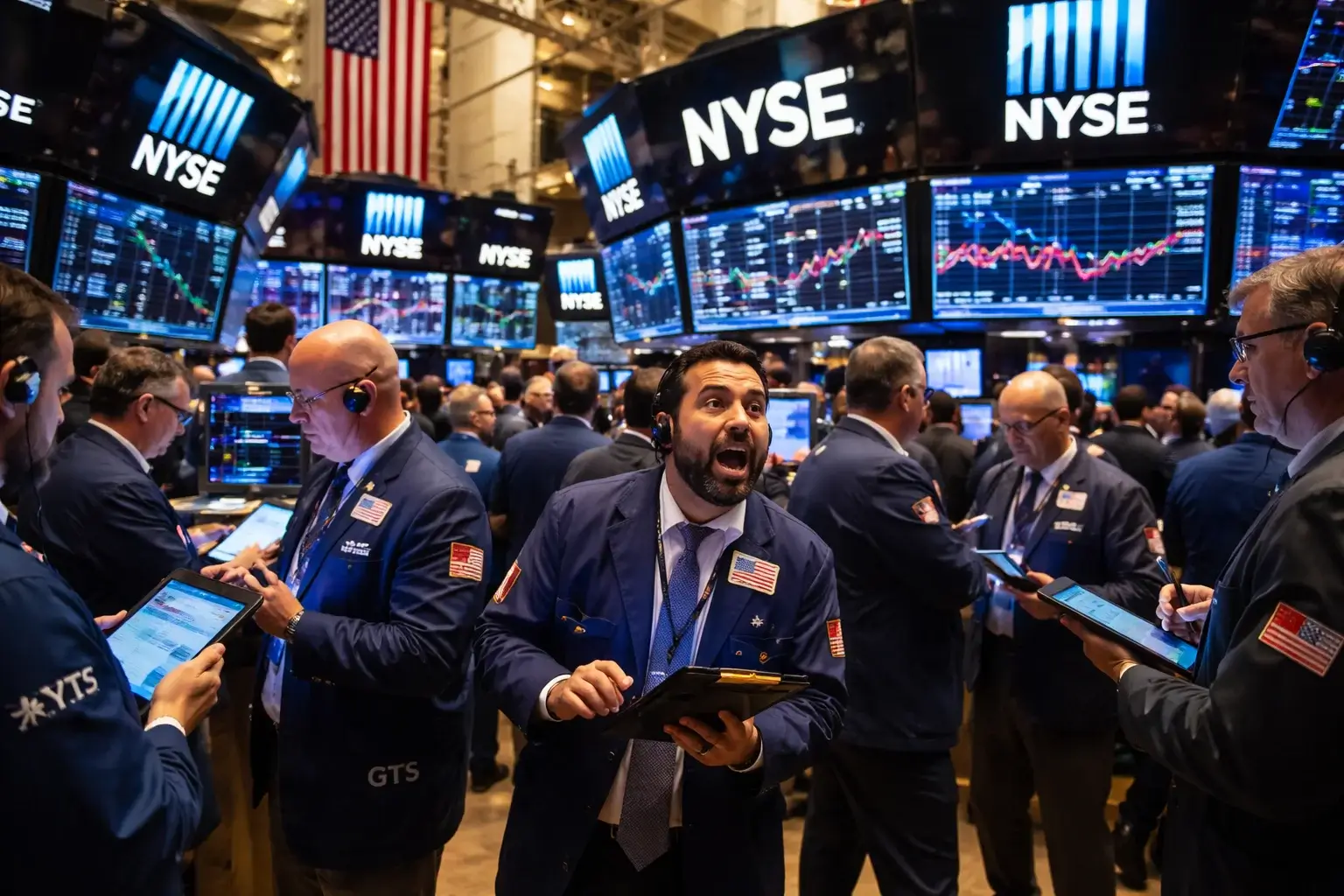
Six weeks into a conflict that has fundamentally redrawn the global energy map, equity markets opened Monday in a state of controlled tension — neither panicking nor celebrating, neither capitulating nor charging. The S&P 500 (^GSPC) gained 0.3% to trade near 6,608, the Nasdaq Composite (^IXIC) pushed 0.78% higher to 22,049, while the Dow Jones Industrial Average (^DJI) struggled to hold any meaningful ground near 46,644, oscillating between fractional gains and fractional losses with the kind of indecision that perfectly mirrors the geopolitical situation driving it. The Russell 1000 Value Index is up 2.4% for the year, beating the Russell 1000 Growth Index, which has lost 9.1% — the widest margin between the two since 2022. The Russell 2000 added 0.30% to 2,537. These are not the numbers of a market that has resolved anything. They are the numbers of a market doing exactly what markets do when the outcome remains binary and potentially catastrophic in one direction: drift cautiously toward the better scenario while keeping one foot firmly outside the door.
That better scenario, at least for now, involves Pakistan. Reuters reported that Islamabad handed both Washington and Tehran the framework of a peace plan — one that, if accepted by both sides, would trigger an immediate ceasefire and reopen the Strait of Hormuz to all maritime traffic. Separately, Axios reported that U.S. officials and a group of regional mediators are actively discussing terms for a 45-day halt to hostilities, a temporary truce designed to serve as a bridge toward a permanent end to the war. Trump scheduled a press conference for 1 p.m. ET Monday and stated publicly Sunday that he believed a deal could be reached before his own Tuesday deadline expired.
That deadline, however, is anything but diplomatic in its framing. Trump posted to Truth Social early Sunday morning declaring that Tuesday would be "Power Plant Day, and Bridge Day" in Iran, threatening coordinated mass bombardments of civilian power infrastructure and bridges throughout the country if the Strait is not fully reopened by 8 p.m. ET Tuesday. The post was followed hours later by a Fox News report in which Trump told correspondent Trey Yingst he was considering "blowing everything up and taking over the oil." Markets did not take that lightly. Dow Jones, S&P 500, and Nasdaq-100 futures lost 0.5%, 0.6%, and 0.7% respectively in overnight trading before recovering sharply as ceasefire reports began flowing through financial news terminals in the early morning hours. The recovery was real but incomplete. Oppenheimer Asset Management's chief investment strategist John Stoltzfus captured the mood precisely — persistent concern about the timeline to any effective resolution remains a negative overhang that the market has not and cannot fully shake until an actual deal is signed.
The Crude Complex Prices In Both Scenarios at Once
West Texas Intermediate (CL=F) was last trading up 0.91% at $112.55 a barrel, having swung violently in both directions through the overnight session and early morning trade. Brent crude (BZ=F) steadied near $109.25, up 0.20%. The intraday pattern was telling — oil fell initially as ceasefire headlines broke, then reversed and climbed back above $112 as the market digested just how slim the odds of a breakthrough before Tuesday actually are. Both benchmarks have surged more than 50% since the Iran conflict erupted roughly six weeks ago, and the effective closure of the Strait of Hormuz has produced a supply shortfall of a magnitude that the global energy market has not experienced in the modern era.
The supply disruption is so severe that WTI contracts are appearing to trade at a premium to Brent — a relationship that is virtually unheard of in normal market conditions and that reflects not a genuine structural inversion but rather the specific mechanics of how the two contracts settle, combined with the reality that buyers are willing to pay a premium for any crude oil they can physically access outside the Gulf. Raymond James institutional equity strategist Tavis McCourt noted in a Sunday note that one reason stocks haven't cratered harder over five weeks of effective Hormuz closure is the oil forward curve's deep backwardation — a structure in which near-term prices are significantly higher than long-term prices, signaling that the market believes the disruption is temporary. That structure, McCourt wrote, has soothed credit and equity markets even as spot prices remain at crisis levels.
OPEC+ agreed over the weekend to increase its monthly production quota by 206,000 barrels per day in May, matching exactly the April increase the cartel had already implemented. The gesture is largely symbolic. Against the backdrop of a closed or partially closed Strait of Hormuz, incremental quota increases from OPEC members do almost nothing to address the actual supply shortfall. Iran did signal over the weekend that it would allow Iraqi vessels to transit the Strait — a concession that could theoretically return roughly 3 million barrels per day to the market. Iran's president's office went further, stating the Strait would open fully when "damages resulting from the war are compensated from transit fee revenues." Oman's foreign ministry confirmed it held direct talks with Iran's foreign ministry Saturday, exploring options for partial resumption of flows through the world's most critical oil chokepoint.
The VIX rose 3.97% to 24.82 Monday morning — elevated and rising but not yet in territory that signals full-scale market panic. The index sat comfortably below the levels that accompanied last year's Liberation Day shock, which itself was resolved with a strong subsequent recovery. Markets have priced in substantial geopolitical risk. They have not priced in a permanent closure of the Strait or a full-scale bombing of Iranian civilian infrastructure. Tuesday's deadline will determine whether that pricing was correct.
Gold and the Dollar Signal a Market Running Defensive Plays
Gold (GC=F) advanced 0.32% to $4,694.80 per ounce Monday, extending a trend that has made it one of the few unambiguous beneficiaries of the Iran war. Futures pushed toward $4,700, with some contracts trading as high as $4,700 during the session. The yellow metal has become the clearest expression of the market's underlying anxiety — even as equities manage modest gains on ceasefire hopes, gold continues to attract defensive buying that tells a different story about how institutional money actually feels about the situation. The metal's ascent has been consistent and largely uninterrupted since hostilities began.
The U.S. Dollar Index slipped 0.27% to 96.63, a move that reflects the complex cross-currents at work. A weaker dollar typically supports commodity prices including oil and gold, adding a secondary tailwind to both. The yield on the 10-year Treasury (^TNX) edged up to 4.343%, a 0.70% rise on the session, as bond markets continued the repricing process that began the moment it became clear the Iran conflict would not be resolved quickly. The 10-year yield sitting above 4.3% while the Fed remains on hold reflects a bond market that has already done significant monetary tightening on the Fed's behalf — a dynamic that multiple strategists have now characterized as the market effectively hiking rates in the absence of Fed action.
Bitcoin Squeezes Through $70,000 and the Crypto Complex Ignites
Bitcoin (BTC-USD) jumped 3.79% to $69,384 Monday, briefly tagging $70,000 for the first time in nearly two weeks. The move was not purely driven by fundamental re-rating — CoinGlass data showed a wave of short liquidations that peaked around 5 a.m. ET, with approximately $154.43 million liquidated in the preceding 24-hour window. Overnight macro headlines flipped positive as ceasefire reports hit, triggering a cascade of forced short covering that amplified the upward move well beyond what organic buying alone would have produced. Bitcoin has been range-bound between $63,000 and $73,000 for roughly a month. What is striking about that range is that within it, Bitcoin has quietly outperformed both U.S. equities and gold as the Iran conflict has dragged on through March and into April. The asset class most associated with speculative excess has functioned, at least partially, as a store of value during a genuine geopolitical crisis.
The ripple through the crypto-equity complex was immediate and decisive. Strategy (MSTR) jumped nearly 4% in Monday trading. Coinbase (COIN) and Circle each advanced approximately 3%. MARA Holdings (MARA) and Robinhood Markets (HOOD) both opened higher in sympathy. These names trade as leveraged proxies for BTC spot price movement, and on a day when Bitcoin gains 4%, they tend to amplify that move. The directional call here is straightforward — if the ceasefire materializes and risk appetite returns broadly, crypto and crypto-adjacent equities are among the highest-beta expressions of that rotation. If Tuesday brings escalation rather than resolution, the $63,000 floor gets tested again. The risk-reward is asymmetric and the position sizing should reflect that.
Tesla's Q1 Delivery Collapse Sets Up the Quarter's First Major Battle
Tesla (TSLA) edged up 0.86% to $363.69 Monday, a technically positive but operationally hollow stabilization following a more than 5% collapse on Friday in reaction to the company's first quarter 2026 delivery data. The numbers were difficult to dress up. Tesla delivered 358,023 vehicles globally in Q1 2026, a figure that came in 4% below Bloomberg consensus estimates. Energy storage installations declined 15% year-over-year — the first such decline since Q2 2022. Tesla also produced more than 50,000 vehicles in excess of what it actually delivered during the quarter, resulting in what JPMorgan called a record surge in unsold vehicle inventory at a time when the company has already been running aggressive promotional pricing to stimulate demand.
JPMorgan analyst Ryan Brinkman reiterated his bearish stance Monday with a December 2026 price target of $145 — implying approximately 60% downside from current trading levels. The bank advises approaching TSLA "with a high degree of caution." The numerical foundation of that call is hard to dismiss. In June 2022, when Tesla's quarterly delivery volumes peaked, Wall Street consensus expected full-year 2026 free cash flow to be a positive inflow of $35.7 billion. That same consensus now projects a negative outflow of $4.9 billion — a deterioration of more than $40 billion in expected cash generation over roughly four years. Over that same period, TSLA shares have somehow managed to climb 50% above where they traded at the peak of deliveries. Management has guided for more than $20 billion in capital expenditures for 2026, a figure that, combined with the projected free cash flow deficit, raises serious questions about how the company finances its ambitions without dilution or debt.
The bull case for TSLA at current levels rests almost entirely on the robotaxi and autonomous driving narrative — a story about the future that requires accepting enormous present-day deterioration in the underlying automotive business. The stock is priced for a company executing flawlessly on transformational technology. The delivery numbers suggest a company losing market share in its core business while spending aggressively on businesses that have not yet generated meaningful revenue. The honest assessment is that this is a hold at best for anyone already long with a long time horizon, and a name to avoid for anyone evaluating a fresh entry at $363. The 60% downside case JPMorgan lays out is not a tail risk — it is a base case built on numbers that are already in the public record.
JPMorgan's Dimon Puts the Bear Case on Paper in 48 Pages
JPMorgan Chase (JPM) CEO Jamie Dimon published his annual shareholder letter Monday — all 48 pages of it — and the document reads less like a corporate communication and more like a detailed macro warning to anyone who believes the current period of surface-level market resilience will continue indefinitely. Dimon acknowledged that consumers and businesses are currently healthy, that the U.S. economy has demonstrated genuine resilience. He then methodically dismantled the case for complacency.
On the Iran war's economic impact, Dimon wrote that the conflict means markets face "the potential for significant ongoing oil and commodity price shocks, along with the reshaping of global supply chains, which may lead to stickier inflation and ultimately higher interest rates than markets currently expect." His metaphor for the central risk was direct: "The skunk at the party — and it could happen in 2026 — would be inflation slowly going up, as opposed to slowly going down." Dimon explicitly referenced the deep recessions of 1974 and 1982, both of which were preceded by rapidly increasing oil prices combined with elevated inflation — exactly the conditions currently developing. Brent crude above $109 with the Fed holding rates and inflation already running above 2% for five consecutive years is not a benign setup.
Dimon also flagged rising private credit losses. He stated that actual losses in private credit and leveraged lending are "already a little higher than they should be, relative to the environment" — a warning that the credit cycle may be turning at precisely the wrong moment, before the full economic impact of the oil shock has been absorbed by corporate borrowers. The combination of tightening credit conditions, higher energy costs, and a Fed that cannot cut because inflation is re-accelerating is the scenario that keeps risk managers awake at night. Dimon didn't frame it as a probability — he framed it as a possibility that the market is currently under-pricing. That distinction matters enormously when positioning for the second quarter.
Goldman Sachs Lays Out the AI Displacement Timeline
Goldman Sachs economists Pierfrancesco Mei and Jessica Rindels published a client note Monday morning that addresses one of the most consequential and least quantified dynamics in the current economic landscape — the actual labor market impact of AI-driven job displacement, and specifically what it means for the workers caught in the transition. Their conclusion is not optimistic. Displacement from AI, they argue, imposes lasting costs that ripple through individual financial trajectories for years — not quarters. For workers displaced early in their careers, the economists found that technological disruption "meaningfully slows wealth accumulation relative to other workers," with the primary mechanism being delayed homeownership driven by lower earnings and persistent employment instability.
The note also contains a critical macro warning that goes beyond the individual worker level. The negative effects of AI-driven displacement are "substantially larger when job losses coincide with a recession." Given that the Iran war has materially increased recession probability through oil price shock and inflation re-acceleration, the Goldman note is essentially describing a scenario in which two powerful negative forces — AI displacement and war-driven economic contraction — arrive simultaneously. Retraining programs, the economists concede, can "help to mitigate some of the negative effects," enabling displaced workers to "earn modestly higher wages and achieve more stable employment." The word "modestly" is doing significant work in that sentence.
For equity markets, the Goldman note has specific implications for software and enterprise technology names, where the AI monetization thesis depends partly on a smooth labor market transition that doesn't trigger political backlash or regulatory intervention. If displacement becomes visibly painful and economically destabilizing at scale, the regulatory environment around AI changes — and that changes the valuation math for the sector's leading names.
Dan Ives Pounds the Table on Software While Goldman Warns on Jobs
Wedbush's Dan Ives used a Sunday night note to reiterate his position that the software sector selloff has gone dramatically too far and that the AI monetization trade remains the defining investment opportunity of 2026. The contrast with the Goldman note is sharp and deliberate — Ives is not unaware of the displacement concerns, but his thesis rests on a different layer of the same story. CIOs across major enterprises, Ives wrote, are telling him that the rapid pace of AI adoption is underway and that the focus is now on finding specific enterprise and department-level use cases to launch within the current calendar year. That channel check, he argues, is "very good news for the enterprise software sector AI monetization thesis."
Ives specifically called out Microsoft (MSFT), Salesforce (CRM), and ServiceNow (NOW) as names where the selloff is "very disconnected" from the AI monetization opportunities that lie ahead. He also addressed directly the concern that Anthropic, OpenAI, and other foundational AI incumbents might evolve into direct enterprise software competitors — a fear that has pressured software multiples. After speaking with CIOs across the industry, Ives concluded this is "more of a major stretch," arguing that the core revenue generation focus of AI labs will remain centered on partnering around AI workflows rather than displacing the enterprise software stack. The bottoming in the software trade, he wrote, is "likely in the rear-view mirror." That is a direct buy call on the sector, backed by proprietary channel checks. MSFT, CRM, and NOW are all names where, at current valuations relative to their AI monetization runways, the risk-reward has shifted to the upside.
Read More
-
Yen Stalls at 160 Despite a 3% JGB and Tokyo Core CPI at 2.0% — Intervention Sits at 164, Friday's Payrolls Decide
02.09.2026 · TradingNEWS ArchiveEnergy
-
QQQ ETF ($739) Fades From an Early Tech Rally as a 77.9 ISM Prices Index Meets Micron's $61.5B Guide — $760 Record Test Ahead
01.10.2026 · TradingNEWS ArchiveStocks
-
XRPR and XRPI Follow XRP's $1.49 Test as Spot Funds Hold 1.16B XRP and a 1 Billion Token Escrow Release Lands — $1.70 in Play
01.10.2026 · TradingNEWS ArchiveCrypto
-
November NG Slips Below $3 as Decade-High Storage Meets Capped LNG Exports — $2.75 in Sight
01.10.2026 · TradingNEWS ArchiveCommodities
-
Dollar-Yen at 158 Presses Toward 160 as a 363 bp Carry Gap Meets Katayama-Bessent Intervention Risk — 159 in Sight
01.10.2026 · TradingNEWS ArchiveForex
Netflix Gets a Goldman Upgrade as Streaming Defies the Macro
Netflix (NFLX) climbed 1.5% in premarket trading Monday after Goldman Sachs upgraded the stock to Buy from Neutral. The bank argued that Netflix will continue to lead in content acquisition and development regardless of the broader macro environment, and pointed to a high probability of multiyear capital return programs — buybacks and potentially dividends — being returned to shareholders. Streaming, Goldman's view implies, is among the more defensible consumer spending categories even in an environment where fuel costs are rising and consumer confidence is softening. People cut discretionary travel before they cut Netflix. That behavioral reality, combined with the platform's global content moat, makes NFLX one of the more interesting long setups in the consumer sector heading into what promises to be a difficult summer for cyclical consumer names.
Twilio Gets a Jefferies Upgrade on Voice AI Positioning
Twilio (TWLO) shares rose more than 3% Monday after Jefferies upgraded the stock to Buy from Hold. The thesis is specific and forward-looking — Jefferies argued that Twilio will be a critical infrastructure provider in the development and production of voice artificial intelligence applications. As AI moves from text generation into voice interfaces and real-time communications, the platforms that sit at the intersection of developer tools, communications APIs, and AI workflow integration become structurally important. Twilio is one of the few companies that genuinely occupies that space at scale. At current valuation levels, following a multi-month selloff that has compressed the stock significantly, the Jefferies call reflects a view that the market has been throwing out genuine AI infrastructure along with the software sector's speculative excess. TWLO is a buy on the dip if the voice AI thesis is correct, and the channel evidence from enterprise CIOs that Ives cited suggests it is.
Soleno Therapeutics Soars 33% on a $2.9 Billion Neurocrine Takeout
Soleno Therapeutics (SLNO) surged 33% to above $52 Monday after Neurocrine Biosciences (NBIX) announced it would acquire the company for $53 per share in cash — a 34% premium to Soleno's closing price last Thursday. The deal values the transaction at approximately $2.9 billion and is expected to close within 90 days. The strategic rationale centers on VYKAT XR, Soleno's first-in-class treatment for hyperphagia — the defining feature of Prader-Willi syndrome — which received FDA approval in Q2 2025 and generated $190 million in full-year 2025 revenue, including $92 million in Q4 alone. That quarterly revenue run rate implies annualized sales approaching $370 million, suggesting Neurocrine is paying roughly 7.8x annualized revenue for an asset growing at a pace that could justify the multiple within two years. NBIX shares slipped approximately 2% on the announcement — a standard acquirer discount that reflects dilution concerns rather than any fundamental skepticism about the asset being acquired.
JBS Workers End Strike, Shares Rise
JBS (JBS) shares moved higher Monday after workers at the company's Colorado facilities agreed to end a three-week strike, removing an operational disruption for the world's largest meatpacking company at a time when protein supply chains are already under pressure from the broader inflation environment. The resolution clears a near-term operational overhang that had been weighing on the stock.
March Jobs Report Lands Strong Into a Market That Needs Certainty
U.S. markets were closed Good Friday when the Bureau of Labor Statistics released March employment data, making Monday the first session in which the market could fully digest the numbers. The read was strong — 178,000 jobs created in March, roughly three times what economists had expected, and a figure that reversed the surprisingly large job losses reported in February. The unemployment rate ticked down to 4.3%. On the surface, this is unambiguously positive. A resilient labor market supports consumer spending, corporate revenue, and earnings growth. Northlight Asset Management's chief investment officer Chris Zaccarelli noted that the report "establishes a baseline of a resilient economy" that should allow consumer spending and corporate profits to continue expanding.
The complications emerge when that strong jobs number is placed in the context of the current inflation dynamic. A hot labor market argues against near-term Federal Reserve rate cuts. Investors entered 2026 expecting one or two cuts this year. Those expectations have now been entirely unwound. The bond market has done the Fed's work for it — global short- and long-term government bond yields have risen significantly since the Iran conflict began, repricing to reflect the rapidly changing inflation outlook. Kansas City Fed president Jeff Schmid stated plainly last week that "with inflation already running hot, now is not the time to assume that the inflation from higher oil prices will be transitory." That language — pointedly rejecting the "transitory" framing that defined 2021 Fed communication — signals that at least two Fed members are actively considering whether rate hikes, rather than cuts, should be on the table.
The March CPI report, due Friday, will be the first major piece of inflation data to capture the early impact of the Iran war's oil shock on consumer prices. Economists expect headline inflation to rise 1% in March, up sharply from the 0.3% increase in February. A 1% monthly increase in headline CPI would represent a significant acceleration and would almost certainly push year-over-year inflation to levels that make rate cuts in 2026 a fantasy. Wednesday brings the personal consumption expenditures index — the Fed's preferred inflation gauge — which will add another data point to what is becoming a very uncomfortable inflationary picture.
Delta Earnings on Wednesday Will Define the Airline Sector's Pain Threshold
Delta Air Lines (DAL) reports first quarter 2026 earnings Wednesday morning before the market opens, and the results will set the tone for what promises to be a difficult earnings season for an industry simultaneously absorbing higher fuel costs, softening consumer sentiment, and disruptions to international travel patterns. Delta's stock has held up better than most airline peers — down approximately 4% year-to-date — while Southwest (LUV) has fallen 9%, United Airlines (UAL) has lost 18%, and both Alaska Airlines (ALK) and American Airlines (AAL) have plunged close to 30%. The relative performance differential suggests the market already believes Delta's operational model and loyalty revenue base provide more insulation than its peers, but Wednesday's guidance will determine whether that relative premium is justified.
The key variables are fuel cost assumptions, revenue per available seat mile trends, and what management says about forward booking trends on international routes that cross Middle Eastern airspace or depend on passenger confidence that hasn't been shaken by five weeks of war coverage. Every airline executive on an earnings call over the next three weeks will face the same fundamental question: at what oil price does demand destruction become the primary risk rather than cost inflation? Delta's answer to that question, even implicitly through guidance, will move the entire sector.
Raymond James Frames the Market's Structural Puzzle
Raymond James institutional equity strategist Tavis McCourt articulated Monday what many market participants have been quietly wondering for weeks — why haven't stocks sold off harder? Five weeks of the Strait of Hormuz being "effectively closed," oil above $112 a barrel, inflation re-accelerating, and no Fed rate cuts on the horizon. By any conventional macro framework, those conditions should have produced a capitulation event. They haven't. McCourt's explanation rests on two pillars: exceptionally strong economic momentum in early 2026, evidenced by March's blowout jobs number, and the backwardated shape of the oil forward curve, which signals a market belief in resolution that has so far prevented the kind of credit and equity market stress that a "permanent" supply disruption would generate.
The S&P 500 is coming off a 3.4% gain last week — its best weekly performance since late November — a move that snapped a five-week losing streak and saw the Dow advance 3% and the Nasdaq pop 4.4% over those five sessions. The recovery was genuine but came with enormous intraday volatility as traders repeatedly repriced the same Iranian headlines in both directions within single sessions. The current level of the S&P 500 near 6,600 represents a market that has absorbed a genuine geopolitical shock, maintained its fundamental earnings thesis, and is now waiting for Tuesday's deadline to either validate the ceasefire scenario or force a fundamental re-evaluation of every growth-dependent valuation in the index. The next 48 hours will determine which of those two outcomes the next chapter of this market is written around.