Stock Market Today: S&P 500 (^GSPC), Nasdaq (^IXIC), Dow (^DJI) Climb as Quantum and Dell (DELL) Rally
Dow prints fresh intraday record; Qualcomm (QCOM), Dell (DELL), and quantum names lead as consumer sentiment hits a record low | That's TradingNEWS
Key Points
- Dow up 326 points to a new intraday record; S&P 500 lines up its 8th straight weekly gain, longest since 2023.
- Dell (DELL) +14.5%, Qualcomm (QCOM) +12.8%, IBM on pace for its best week in 25 years on quantum momentum.
- UMich consumer sentiment hits record low 44.8; Fed's Waller warns next move could be a rate hike, not a cut.
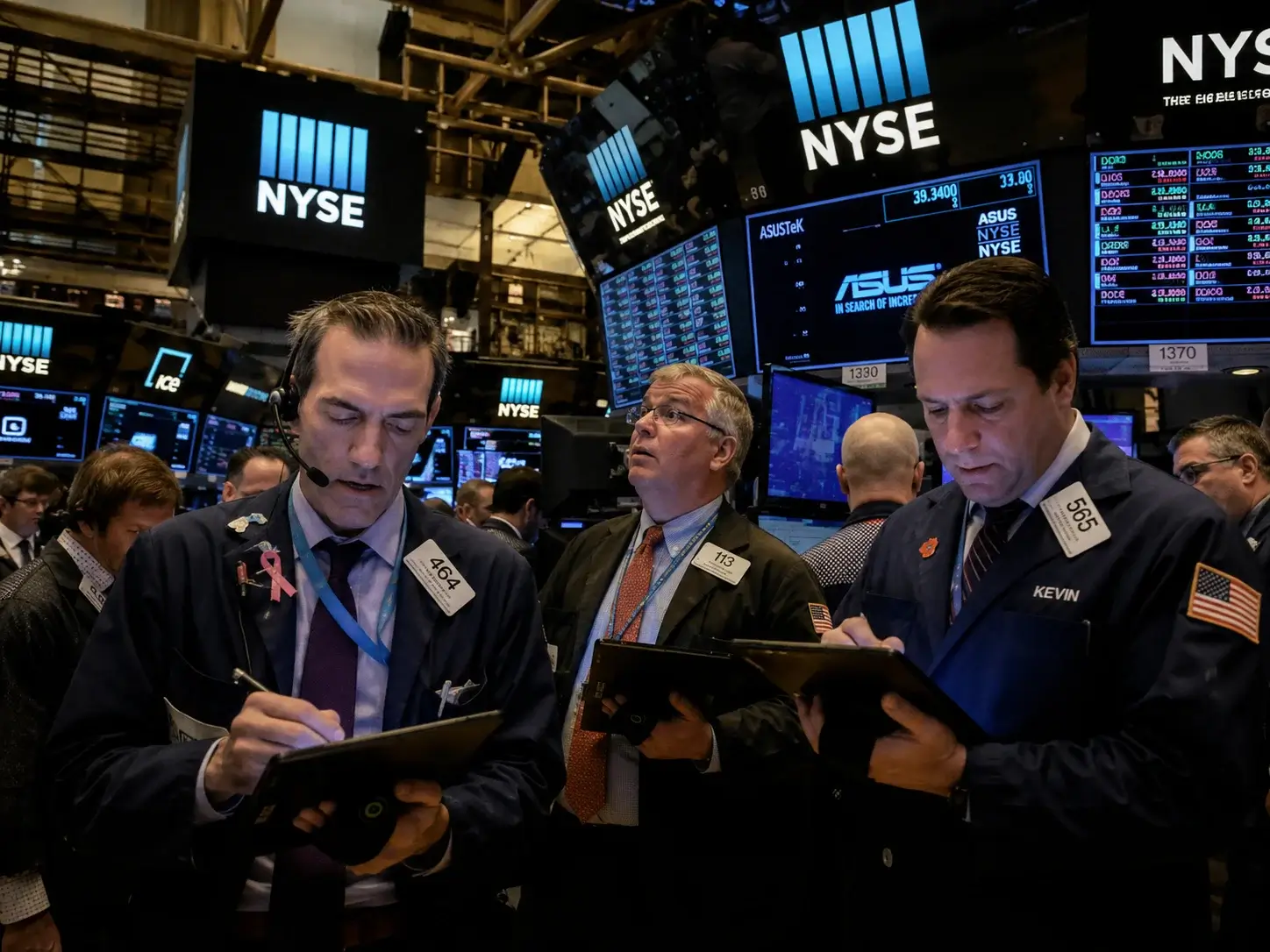
Equities walked into Memorial Day weekend in a posture that should not be possible given the macro tape underneath, and yet there it is. The Dow Jones Industrial Average is up 0.64%, or roughly 326 points, to 50,605.51, having printed an intraday all-time high of 50,686.15 earlier in the session — its first intraday record since February 10 and on track to be the ninth record close of 2026 if the level holds. The S&P 500 is climbing 0.55% to 7,486.32, the Nasdaq Composite is gaining 0.62% to 26,456.59, and the Russell 2000 is leading the field with a 0.74% advance to 2,864.55. The streak under the surface is the real story. A close above 7,408.50 locks in the S&P 500's eighth straight weekly gain, the longest stretch since the nine-week run that ended in late 2023. Through five sessions, the S&P 500 is up 1.1%, the Dow is up 2.2% in its third positive week out of four, and the Nasdaq is up 0.8% for its seventh weekly gain in the past eight. The VIX is sitting at 16.59, down 1.01%, which tells you the bid is not anxious and the path being priced is not panicked. This is a tape that has decided to look through a record-low consumer sentiment print, an openly hawkish Fed governor, oil hovering near $100 on a war that is still hot, gas prices closing in on four-year highs, and a bond market that spent the early part of the week testing whether yields would finally break the equity rally. None of it stuck.
The Quantum Trade Has Mutated From a One-Day Spasm Into a Full-Blown Federal Re-Rating
The single most violent move on the screen is in quantum computing names, and the move has now extended into a second session that is bigger than the first. Thursday's announcement from the Commerce Department, deploying $2 billion into the sector with direct equity stakes in nine companies under the CHIPS Act framework, lit a fire that is still burning hot. Rigetti Computing is up 19.46% to $26.33 on 87.9 million shares traded, nearly three times its three-month average daily volume. D-Wave Quantum is climbing 15.79% to $29.81. Quantum Computing Inc. is up 14.98% to $13.12. IonQ is adding 8.74% to $64.04. Infleqtion sits atop the entire screen at +21.43%, last quoted at $17.85. The heavyweight of the basket is IBM, which is up roughly 17.5% on the week and on pace for its biggest weekly gain since April 2001, a 25-year record for a company that spent most of the last decade fighting to stay relevant in the cloud conversation. GlobalFoundries is riding the same wind. The Defiance Quantum ETF jumped 4.6% in Thursday's session and Friday's follow-through is broader and more aggressive. Ed Yardeni framed it as "rational exuberance," tying the move to the eventual fusion of quantum compute with AI training and inference workloads, and the international read-through arrived almost on cue: France's President Emmanuel Macron announced a separate $1 billion-plus investment into domestic quantum-computing companies including Pasqal and Alice & Bob, partly routed through military procurement, reinforcing the framing that this is a sovereignty race rather than a speculative pocket. What is being priced in is not just the federal capital. It is the symbolic weight of Washington taking direct ownership in a strategic technology, on top of last year's 10% stake in Intel, with the implicit message that the U.S. government is now a price-insensitive bidder for compute capability that touches AI. The bear read remains live and credible — most of these companies have minimal revenue, valuations are pure optionality, and the basket is one bad headline away from giving back a quarter — but nobody is being paid to argue that today.
The Real AI Trade Has Migrated From the Magnificent Seven Into Hardware and Custom Silicon
The other concentration of heat on the leaderboard sits in compute hardware and chip-supply names, and the dispersion is striking. Dell Technologies is exploding 14.54% higher to $289.56, blowing through its prior all-time high of $263.99 on AI-server momentum heading into earnings, with a twelve-month return now sitting at +125.49%. HP Inc. is up 14.86% to $25.16, finally getting paid for a PC refresh cycle that the market had been ignoring. Qualcomm is one of the more remarkable single-name moves of the session, up 12.81% to $240.75 after Melius Research raised its target and built the case that QCOM owns the edge silicon and power-management franchises the next leg of AI infrastructure requires. NetApp is up 11.74% to $138.49. Hewlett Packard Enterprise is climbing 9.41% to $37.24. Vishay Intertechnology is up 12.17% to $47.30. Wolfspeed is up 11.11% to $77.22. Navitas Semiconductor is up 17.15% to $28.56. Texas Instruments is gaining 4.61% on an analog upgrade tying the company directly to the power-delivery requirements of AI data centers. The conspicuous absence is Nvidia, which is down 0.92% to roughly $217.50 despite Thursday's clean print and the rosy guide that came with it. The rest of the Magnificent Seven cohort is mixed and inert, almost a mirror of how the group traded into the close yesterday. What is unfolding is a textbook handoff. The market is paying up for the second derivative of the AI build — power semis, servers, storage, networking, custom silicon, analog — and rotating out of the obvious flagship name. That broadening is the single healthiest signal in the session, and the fact that it is happening with small caps participating via a 0.74% Russell move, with the VIX compressed, and with credit calm tells you that the rotation is not being forced by stress. It is being earned by earnings power and order books.
The Space and Orbit-Economy Basket Catches a SpaceX Halo As a Record IPO Approaches
The third high-beta pocket running hot is the space-launch and satellite-services complex, lit up by SpaceX's S-1 filing on Wednesday and a reported plan to raise as much as $75 billion at a valuation between $1.75 trillion and $2 trillion. A deal of that size would triple the previous U.S. IPO record set by Alibaba in 2014 at $21.8 billion, and would dwarf every other IPO in American capital-market history — only eight U.S. listings have ever raised more than $10 billion, three of which have since been delisted or acquired. The market is treating the entire orbit basket as a halo trade. AST SpaceMobile is up 11.36% to $106.46, riding a 52-week gain of roughly 299%. Rocket Lab is adding 9.18% to $136.96, with a twelve-month move near +393%. Firefly Aerospace is up 13.26% to $48.54. Redwire is up 14.27% to $17.54. Intuitive Machines is up 10.18% to $37.72. Virgin Galactic is up more than 9%. The narrative shift sitting underneath this is structural. Starlink has quietly turned SpaceX into an internet service provider that happens to launch rockets, and the prospectus makes clear that the Mars and AI ambitions Elon Musk has long telegraphed are going to be funded by selling Wi-Fi. The rest of the satellite and launch complex is inheriting that revenue-model legitimacy by association. The skeptical read — that the company burns roughly as much cash as it brings in, and that historically the biggest IPOs do not guarantee outsize long-term returns — is not landing in the price action today. The Reddit synthesis circulating in WallStreetBets put it more plainly than any analyst note: the story matters more than the fundamentals.
Consumer Sentiment Just Collapsed to an All-Time Low and the Fed Is Openly Debating Hikes
The macro tape is exactly the setup that should be working against equities, and the disconnect between the data and the price is one of the more striking features of this session. The University of Michigan's final May reading came in at 44.8, down from the preliminary 48.2 and well below April's 49.8. That is a fresh all-time low, lower than the previous trough recorded in June 2022 during the post-pandemic inflation panic. Surveys of Consumers director Joanne Hsu tied the drop to supply disruptions in the Strait of Hormuz and the resulting pump prices, but flagged that the more dangerous signal is the spread of inflation expectations beyond fuel. Drivers are now paying a national average of $4.55 per gallon, the highest Memorial Day-weekend price since 2022 following Russia's invasion of Ukraine, and GasBuddy has laid out a path where the average pushes above $5.03 into the summer if the Strait does not reopen. Set against this, the Fed reacted in real time. Governor Christopher Waller, speaking from Germany roughly an hour before Kevin Warsh was sworn in as the new Fed Chair at the White House — the first chair to take the oath there since Alan Greenspan in 1987 — said the central bank should "hold rates steady for the near term" and warned that the next move could be a hike if inflation continues to surprise to the upside. Nordea framed the picture cleanly: the FOMC is now visibly split between members who still expect cuts later this year and members who see persistent inflation as grounds for tightening, with inaction the default. The market itself has now begun pricing rate hikes in the U.S., a meaningful shift from where positioning stood a few months ago, when cuts were the consensus. Equities are simply staring through it, which is a remarkable feature of the price action and one that will not last forever if Hormuz remains closed and the June print confirms what May has been signaling.
The Bond Market Cooled Just Enough to Let Equity Multiples Breathe
Yields are the quiet release valve underneath this rally, and the cooling here is the reason multiples have stopped getting punished. The 10-year Treasury yield is at 4.584%, off about three basis points in the early session and meaningfully below Tuesday's intraday peak of 4.69%, the highest level since January 2025. The 30-year is at 5.088%, down from a level earlier in the week that was the highest seen since before the 2008 financial crisis. The 2-year is sitting at 4.14%, off a one-year high of 4.122% that printed on the front end. Bond market volatility had been the dominant pressure on equities through the early part of the week as traders priced in a long-running Iran conflict, sticky oil, and the inflation pass-through that comes with both. The mild retreat in yields has been enough to take pressure off multiples in the high-multiple software and AI-adjacent corners, and Glenn Dorsey of Clark Capital captured the dynamic plainly: the market is still riding strong Q1 earnings, and the yield retreat is what is letting the rally extend rather than fade. The mortgage market does not yet show that relief. Freddie Mac's weekly average for a new 30-year loan jumped to 6.51%, the highest since August 2025 and a meaningful step up from last week's 6.36%. Investopedia's Zillow-based average bottomed at 6.16% on February 27 — the day the Iran war began — and has since worked its way as high as 6.76% before easing to 6.74%. Even with that move, current rates remain meaningfully better than the 7%+ levels that defined the 2024 and 2025 spring buying seasons.
Oil, Gold, the Dollar, and Bitcoin Are Each Telling a Different Story Today
The cross-asset picture has more nuance than the equity tape suggests, and the divergence between oil and equities on the Iran story is the single sharpest tell in the session. West Texas Intermediate is up 1.42% to $97.72, with Brent adding 1.50% to $104.12 on mixed signaling from Washington and Tehran. The complication for the talks is reporting that Iran intends to keep its enriched uranium stockpile within the country, a position that runs directly into President Trump's stated objective of dismantling Iran's nuclear program as a condition of any deal. Equities are choosing to read the noise as a path toward a Hormuz reopening. Oil is pricing the opposite. Gold is down 0.81% to $4,505.60 as the risk-on bid pulls money out of the safe-haven corner. The dollar index is fractionally higher at 99.30, up 0.09%, supported largely by Waller's hawkish tone. Bitcoin is down 1.11% to $76,746, a soft tape that argues against the notion that this is a generalized melt-up — it is more selective than that. The S&P GSCI commodity index is up 0.44% to 735.02, and the KBW Nasdaq Bank Index is up 0.50% to 168.28, neither of which is breaking out but neither of which is breaking down.
Earnings Dispersion Is Wide and the Punishment for Anything Less Than a Raise Is Severe
The earnings movers tell a clean story about what the market is willing to pay for and what it is not. Workday is up around 4–5% in the cash session after surging 11% in after-hours on Q1 revenue of $2.54 billion and adjusted EPS of $2.66, both ahead of consensus, with the full-year adjusted operating margin guide lifted to 30.5% from 30%. Coming into the day, WDAY was down more than 40% year to date on fears that AI products would erode the enterprise software franchise, so the bid here is partly a relief rally and partly a re-rating of the AI-disruption discount that the entire software complex has been carrying. Zoom Communications is rallying 11.61% to $107.99 after lifting its FY27 outlook on a 184% jump in paid AI user growth, a print that flipped the AI-casualty narrative on its head and prompted RBC to flag accelerating growth in the AI tier. Ross Stores is climbing 6.46% to $231.22 after Q1 sales jumped 21% to $6.01 billion and management raised both comp and full-year EPS guidance. Merck is up roughly 4.8% after its lung cancer combination with China-based Kelun-Biotech, sacituzumab tirumotecan paired with Keytruda, cut tumor progression risk by 65% in a Phase 3 study, with an additional survival benefit. On the other side of the ledger, Take-Two Interactive is down 5.29% to $225.48 despite record net bookings and the confirmation that Grand Theft Auto VI is still on track for a November launch — a classic sell-the-news reaction on the only catalyst that mattered for the name. BJ's Wholesale Club is taking an 8% hit despite beating with adjusted EPS of $1.10 versus a $1.03 consensus, comparable club sales growth of 6.3%, and membership fee income up 9.9% year over year to $132.4 million, on top of opening one new club and six new gas stations. The penalty came because the company merely reaffirmed full-year EPS guidance of $4.40 to $4.60 against a $4.51 consensus rather than raising. In a tape where peers are lifting outlooks, holding the line is read as a soft signal. Booz Allen Hamilton is up more than 5% on fiscal Q4 adjusted EPS of $1.78 against expectations of $1.34, with revenue running modestly light.
Deal Tape: Estée Lauder Walks Away, IMAX Goes on the Block, Futu Gets Hit by Beijing
Estée Lauder is up 9.49% to $86.32 after confirming the termination of merger talks with Spanish beauty group Puig, ending speculation that began in late March about the creation of one of the world's largest beauty companies. Puig shares cratered 13% in Madrid, on pace for the second-largest decline since the company began trading in 2024. Coming into the day, EL had lost roughly a quarter of its value year to date, so the bid here is doing two things at once: rewarding management for walking away from a luxury-slump acquisition and re-rating a name that had been beaten down on demand fears. IMAX is up 13.16% to $38.34 on reports the premium-format theater company is exploring a sale through intermediaries, with Wedbush flagging Netflix, Apple, Sony, and private equity firms as plausible bidders. Generac is up more than 3% after Jefferies upgraded the stock to buy and built the call around the data-center buildout, which the bank does not believe is fully priced. Futu Holdings is the outright disaster of the morning, down 36% after Beijing announced a crackdown on illegal cross-border securities flows, with Reuters reporting that brokerages accused of illegally moving money to foreign markets will face penalties. Overnight in Asia, Lenovo surged 15% in Hong Kong on March-quarter revenue of $21.6 billion, up 27% year over year and the company's fastest growth rate in five years, with chairman Yuanqing Yang setting an explicit $100 billion revenue target within two years driven by AI. SoftBank Group climbed another 11.89% in Tokyo to ¥6,757, on top of Thursday's 20% rally that added more than $35 billion to its market cap, on OpenAI IPO chatter and the rip in its Arm Holdings stake. Arm itself is up 4.06% to $310.33 in U.S. trading after gaining more than 16% overnight and more than 15% in the prior session. Australia's Guzman y Gomez jumped as much as 20.58% after announcing an exit from the U.S. market to refocus on Australia, founder Steven Marks acknowledging the capital cost of an American expansion no longer justified continued shareholder investment. In Europe, Richemont delivered first-quarter group sales growth of 13% year on year, with Cartier leading the charge as luxury jewelry continues to outperform the broader handbag-and-leather slump that has hit Kering and others.
Read More
-
Yen Stalls at 160 Despite a 3% JGB and Tokyo Core CPI at 2.0% — Intervention Sits at 164, Friday's Payrolls Decide
02.09.2026 · TradingNEWS ArchiveEnergy
-
QQQ ETF ($706.22) Slides 7.4% Below Its High as the Market Reprices the AI Capex Bill — $686.57 Target if $700 Breaks
22.10.2026 · TradingNEWS ArchiveStocks
-
XRPI ($7.00) and XRPR ($10.74) Slide Toward 52-Week Lows as Spot XRP ETF Flows Stall at $708,510
22.10.2026 · TradingNEWS ArchiveCrypto
-
NG ($2.775) Decoupled From Europe’s €88 Gas Crisis as LNG Feedgas Hits 18.9 Bcf/d — $3.30 Upside on Cold Weather
22.10.2026 · TradingNEWS ArchiveCommodities
-
Dollar-Yen (157.35) Loses 157.65 as the Yen Rallies on Haven Demand — 155 Target if 156 Breaks
22.10.2026 · TradingNEWS ArchiveForex
Sector Leadership Is Pointing Defensive on a Weekly Basis and That Composition Matters
The weekly sector scoreboard is telling a story that does not get the airtime it deserves. Health Care is the top-performing sector in the S&P 500 this week, up 3.4%, its best five-day stretch in six months. Real Estate is right behind at +3%. That is not the leadership profile of a market chasing pure risk. The composition tells you the rally is being driven as much by the yield retreat and the bid for stable cash flows as it is by the AI and quantum frenzy on the high-beta side. Banks are participating modestly via the KBW Nasdaq Bank Index at +0.50%, but they are not the engine. Energy is firm on the crude bid, with the S&P GSCI up 0.44%, but it is not breaking out either. What you have is healthcare, real estate, small caps, hardware, quantum, and the space basket all doing real work alongside one another, with mega-cap tech sitting on its hands. That is a much healthier internal composition than a session driven by the Magnificent Seven alone, and it is precisely the kind of structure that historically extends rather than exhausts.
Retail and Consumer Margins Are Quietly Compressing Even as Index-Level Names Print Records
Sitting beneath the headline tape is a consumer story that needs more attention than it is getting. Kroger is testing price cuts on thousands of items in a bid to take share from low-cost rivals, with CEO Greg Foran openly stating that "the basket has to come down" because not every consumer's basket is the same and the inflation fatigue is real. Walmart said this week that it has cut prices on 7,200 items, up more than 20% from a year ago. That is not a sign of confidence about pricing power. Restaurants are flooding the market with value meals to hold traffic. Diners are venting on social media about fast-food prices. Egg prices became a flashpoint in the 2024 election cycle and the underlying complaint never went away. None of that is showing up in Ross Stores's 21% sales jump, but it is showing up in Walmart's margin commentary and Kroger's pricing strategy. The 44.8 print on consumer sentiment is the corroboration the retail tape is now corroborating in real time. For the index, this matters because the consumer is roughly 70% of U.S. GDP, and a record-low sentiment reading does not stay quarantined inside the staples aisle forever.
The Short-Squeeze Tail Is a Live Variable, Not a Theoretical One
The setup underneath the surface is increasingly stretched in a specific direction. Hedge fund short positioning has climbed to a 10-year high, according to data circulating through the morning. The S&P 500's eight-week advance has been the biggest eight-week gain in nearly six years. A positioning structure that heavy on the short side, against a tape that refuses to roll over, is the textbook setup for a squeeze higher rather than a relief sell-off. It explains why every dip this month has been bought aggressively, why bad macro headlines keep failing to land, and why the VIX has stayed pinned below 17 even with the front end of the Treasury curve testing year-to-date highs and gas approaching $5. It does not guarantee continuation. It does suggest that the path of asymmetric pain in the near term is to the upside rather than the downside.
Asian Trade Set the Tone Overnight and Europe Followed Through
Asia closed broadly higher in the overnight session. Japan's Nikkei 225 ended 2.68% higher at 63,339.07, with the Topix up 1% at 3,892.46, after Japan's core inflation print eased to 1.4% in April from 1.8% in March, well below the 1.7% economists were expecting and the lowest level since March 2022. That weakened the case for an early rate hike by the Bank of Japan and gave Japanese equities room to run. South Korea's Kospi added 0.41% to 7,847.71, with the Kosdaq ripping nearly 5% higher to 1,161.13. Australia's S&P/ASX 200 added 0.41% to 8,657. Hong Kong's Hang Seng rose 0.81% in late trade, mainland China's CSI 300 added 1.3% to 4,845.1, India's Nifty 50 gained 0.75%, and the BSE Sensex was up 0.8%. European indices climbed in tandem, and U.S. futures had been trending steadily higher into the open, with Dow futures up roughly 400 points and Nasdaq-100 futures up 124 points before the cash market took the baton.
The Read on the Session: Bullish, Broad, and Stretched All At Once
The day is bullish, not in a euphoric blow-off way, but unmistakably in price and breadth. The Dow is at an intraday record. The S&P 500 is on track for an eighth straight weekly gain, the longest run since late 2023. The Russell 2000 is leading on the upside, which is rare and meaningful. Volatility is compressed at 16.59. Yields are cooling at the long end. Healthcare and real estate are running hard on a weekly basis. Quantum names are absorbing federal capital. Hardware and AI-adjacent semis are stealing the leadership baton from Nvidia and the rest of the Magnificent Seven, which is exactly the kind of broadening this rally needed. The deal tape is alive with Estée Lauder walking away, IMAX going on the block, SpaceX filing for what would be the biggest IPO in U.S. history, and OpenAI reportedly close behind. Set against that, consumer sentiment just hit a record low, gas is at $4.55 and pointing higher, the Fed is now openly debating hikes rather than cuts, oil is back near $100, Hormuz is not yet reopened, and Nvidia is flat to down on a tape that should belong to it. What is being expressed in price is a market that has decided the earnings cycle and the AI capex super-trend matter more right now than the macro friction, and that the Iran story will end in a Hormuz reopening rather than an oil shock. Whether that bet is correct or merely well-positioned is the question that will define June, when the Fed under Kevin Warsh delivers its first decision and Salesforce reports into a software complex that is being pulled in two directions at once between AI optimism and AI displacement fear. Options pricing has Salesforce moving as much as 9% in either direction after the print, with Bank of America already out with an underweight rating and a $160 price target ahead of the call. For today, the tape is wide, the leadership is broader than it has been in months, the squeeze risk is live, the cross-asset divergence on the Iran story is the cleanest tell, and the path of least resistance into the long weekend is still up.