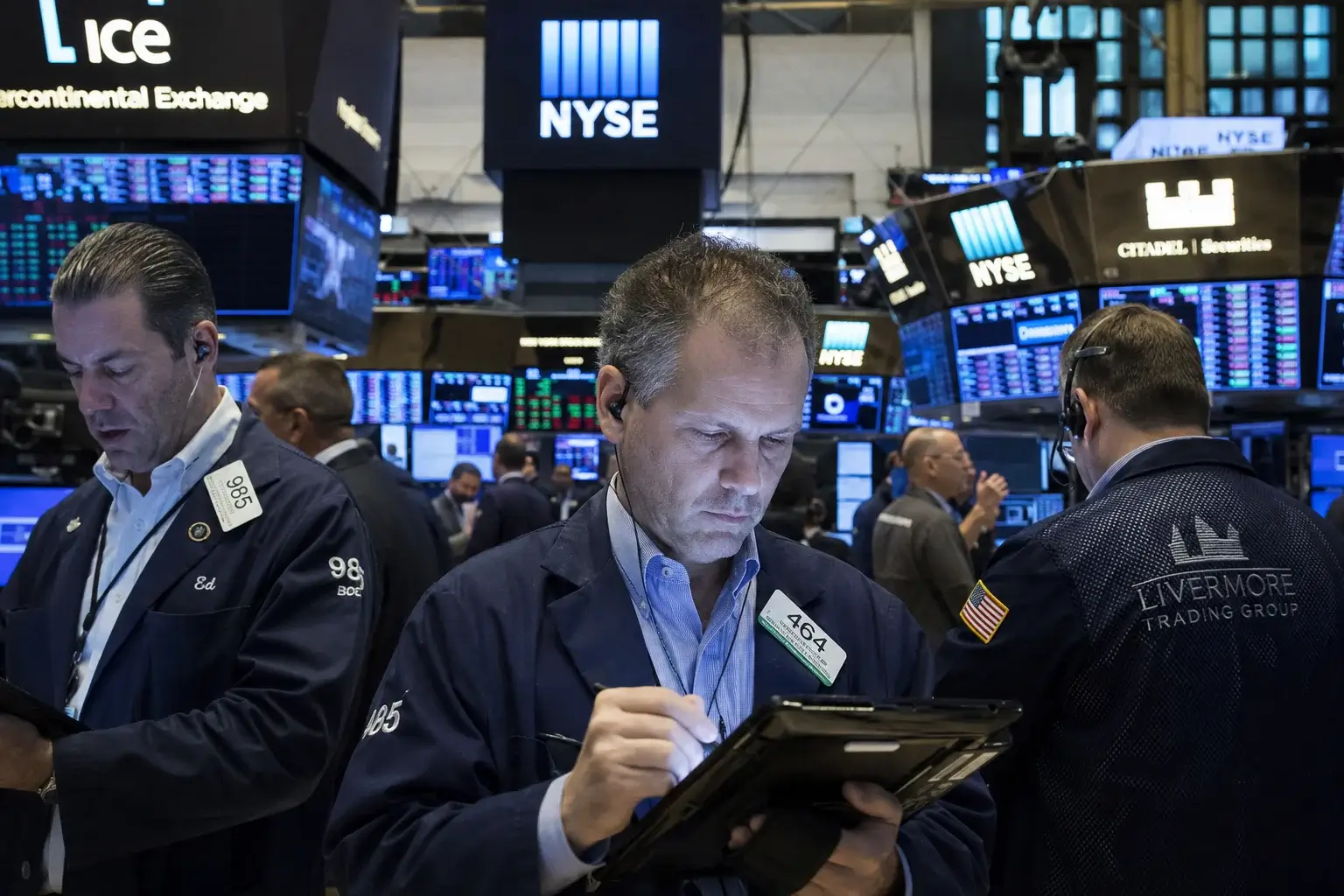
Stock Market Today: S&P 500 SPX Steadies Near 7,520, Nasdaq IXIC Dips and Dow DJI Drops 319 Points as MU Stock Powers the Memory Bid
An in-line April PCE reading at 3.8%, renewed U.S. strikes near the Strait of Hormuz | That's TradingNEWS
Key Points
- S&P 500 flat near 7,520; Dow skids 0.63% (~319 pts) while chips cushion the Nasdaq to just a 0.16% dip.
- Micron leaps ~18% to defend its $1T cap as UBS targets $1,625; AMD +6%, SK Hynix +11% extend the supercycle.
- April PCE in line at 3.8% as Hormuz strikes lift oil toward $90; Fed hike odds for December climb near 50%.
Wall Street spent Thursday in a grinding, low-conviction session that pitted the most powerful semiconductor rally in years against a fresh bout of Middle East risk and an inflation print sticky enough to keep the rate debate alive. The S&P 500 (SPX) was nearly flat, slipping just 0.02% from Wednesday's record close of 7,520.36, as the index repeatedly tested the 7,510–7,525 band without resolving in either direction. The Dow Jones Industrial Average (DJI) was the unmistakable laggard, dropping 0.63% — roughly 319 points off its Wednesday record of 50,644.28 to trade near 50,325 — dragged by a 2% slide in Caterpillar and broad weakness across energy-sensitive industrials. The Nasdaq Composite (IXIC) eased 0.16% from Wednesday's 26,674.73 finish to hover near 26,630, holding up far better than the Dow only because the chip complex absorbed selling elsewhere in tech. The small-cap Russell 2000 was essentially unchanged at −0.02% near 2,919, surrendering the outperformance it had flashed earlier in the week. For context on how far this market has traveled, the founder of Yardeni Research notes the S&P 500 entered the week up 9.2% year-to-date, with forward earnings up 14.4% and the forward price-to-earnings multiple actually down 4.6% — an advance driven by earnings rather than multiple expansion, which he argues keeps this rally out of true bubble territory. The tape's character on Thursday was caution rather than fear: volume clustered in memory chips and the morning's retail prints, while desks braced for overnight reports of renewed U.S. strikes near the Strait of Hormuz.
In-Line PCE Defuses the Worst Fears but Settles Nothing
The macro centerpiece was April's personal consumption expenditures price index, the Federal Reserve's preferred inflation gauge, which the Commerce Department reported rose a seasonally adjusted 0.4% on the month and 3.8% year-over-year at the headline level. That annual figure accelerated from 3.5% in March and 2.8% in February, tracing a clean upward arc rooted in the energy shock from the Iran conflict. The print matched the 3.8% consensus and undershot the 0.5% monthly increase economists had penciled in, a modest relief that capped fears of a runaway reacceleration. Core PCE, excluding food and energy, was expected to climb to 3.3% year-over-year — its hottest reading in more than two years and a sign energy costs are bleeding into underlying prices. The muted equity reaction told the real story: rather than rallying on an in-line number, stocks chopped because the data resolved none of the deeper tension between a sturdy labor market, elevated crude, and a central bank that has pivoted from a cutting bias toward a hawkish neutral. With the index trading at roughly 22 times forward earnings, "not worse than feared" was enough to prevent a selloff but nowhere near enough to spark fresh buying outside the secular artificial-intelligence trade that continues to do nearly all the market's heavy lifting.
The Memory Supercycle Refuses to Cool as Micron Defends $1 Trillion
If a single theme has carried this market through May, it is the structural mania in memory semiconductors, and Thursday extended it. Micron (MU) surged roughly 18% to around $889, building on the prior session's 19% explosion that first lifted the largest U.S. memory maker above the $1 trillion market-capitalization line on May 26. The catalysts arrived as a cascade of bullish revisions: UBS lifted its price target to $1,625 from $535 — the highest among the 46 brokerages covering the stock and an implied upside of more than 100% — while Barclays raised its target to $1,175 from $675. The fundamental backbone is genuine scarcity rather than pure momentum, with the company's entire 2026 high-bandwidth memory allocation already sold out and multi-year supply contracts locking in pricing that strips downside risk from established players. Strikingly, even after a run that has roughly tripled the stock in 2026 alone, Micron still changes hands at just 8.4 times forward earnings, a steep discount to the S&P 500's 22 times and the Nasdaq 100's 26 times — the kind of valuation dislocation that keeps bulls aggressive. The strength rippled across the memory triple play, with Western Digital and SanDisk maintaining their blistering pace, while Advanced Micro Devices (AMD) jumped nearly 6% to around $496. This has stopped being a single-name story; it is a sector-wide repricing of the AI infrastructure buildout that has minted multiple trillion-dollar chip giants inside a single month.
Space, Defense, and the Speculative Wing Keep Their Footing
Beneath the megacap chip headlines, the speculative wing of the growth complex held its ground, a sign risk appetite remains broad rather than narrow. The structural standout was confirmation that the largest private aerospace company is preparing a public-market debut expected to rank among the biggest initial public offerings in history, slated to trade under the ticker SPCX on the Nasdaq — a listing that has electrified the entire space-economy basket. The anticipation persisted even after a high-profile Starship test in which the booster shut down its engines during descent and impacted the water at high speed, while the spacecraft still released 20 mock satellites before a planned splashdown in the Indian Ocean. AeroVironment (AVAV) extended its defense-tech rally, climbing more than 15% to around $209, while pure-play space names such as Intuitive Machines (LUNR) and Redwire (RDW) posted high-single-digit to double-digit gains across recent sessions. The defense angle is increasingly inseparable from the geopolitics, with the Iran conflict and the contested Strait of Hormuz keeping a persistent bid under drones, satellites, and military software. These baskets remain the highest-beta expression of the bull market, prone to violent two-way swings, yet their resilience on a soft tape suggests the speculative engine behind 2026's gains has not yet stalled — and that breadth within growth is widening into adjacent themes rather than concentrating ever tighter into the same handful of megacaps.
Sector Internals Reveal a Market Split Down the Middle
Thursday's internals painted a deeply bifurcated market, with semiconductors carrying the load while energy-sensitive cyclicals and rate-exposed defensives lagged. Chips were the unambiguous leaders, and their outsized Nasdaq weighting explains why the tech-heavy index fell only 0.16% against the Dow's 0.63% drop, where industrial bellwethers like Caterpillar weighed on the price-weighted average. The equal-weight Roundhill Magnificent Seven ETF (MAGS) was slightly lower near $70.14, underscoring that the megacap cohort — Alphabet, Amazon, Apple, Meta, Microsoft, Nvidia, and Tesla — offered no leadership and that the day's strength was concentrated specifically in memory and AI silicon rather than big tech broadly. Earlier in the week the rotation had looked encouragingly wide, with defensive heavyweights such as Procter & Gamble surging nearly 4% and Eli Lilly adding 2%, but that defensive bid faded Thursday as rebounding oil pressured staples and healthcare. Financials were mixed: a steeper curve helps net interest margins, but JPMorgan had slid 2% earlier in the week after CEO Jamie Dimon flagged the bank could spend as much as $20 billion on an acquisition over the next couple of years. The clearest tell remained the gap between the Dow's energy-driven skid and the chip complex's strength — a split tape where the index level masks furious rotation underneath, characteristic of a late-cycle melt-up that keeps both bulls and bears partially right.
Cross-Asset Signals Flash Caution Even Near Record Highs
The cross-asset picture carried more warning than the headline indexes, with several markets flashing caution that equity bulls largely waved off. The 10-year Treasury yield sat near 4.47%, having retreated sharply from the 16-month high of 4.7% touched on May 20 as the early-week collapse in energy prices eased the inflation outlook, though the long end stayed elevated with the 30-year hovering near 4.9% and the 2-year anchored in the high-3% range — a curve that has both risen and flattened across 2026. Crude was the day's most volatile asset: West Texas Intermediate had cratered 5.55% on Wednesday to settle at $88.68 a barrel after Iranian state media claimed commercial traffic through the Strait of Hormuz would be restored within a month — a report the White House branded a "complete fabrication" — before rebounding back toward $90 Thursday on the fresh-strike headlines, while Brent climbed back above $96. Gold slipped modestly to around $4,490 an ounce, pulling back from its safe-haven highs as the week's peace-deal optimism trimmed hedging demand. Bitcoin was conspicuously weak, sliding roughly 2% to 3% toward the $73,000–$76,000 zone, a notable underperformance versus equities that suggests leveraged risk capital is rotating out of crypto and into chips. The VIX ticked up around 3% to the 17 area — a low absolute level that nonetheless reflects the persistent geopolitical tail risk shadowing an otherwise complacent market.
Earnings Dispersion Widens as Software and Cyclicals Split
Thursday's earnings reactions reinforced how punishing this market has become for any whiff of disappointment while richly rewarding genuine beats. The standout was Snowflake (SNOW), which surged roughly 37% after the cloud-data firm posted revenue growth of 33% to $1.39 billion and adjusted earnings of 39 cents — both topping the $1.32 billion and 32-cent consensus — and announced plans to spend $6 billion on Amazon Web Services over five years tied to Amazon's new Graviton processors. That blowout contrasted sharply with Synopsys (SNPS), which fell nearly 5% even after beating second-quarter forecasts, as investors fixated on lower GAAP earnings and restructuring costs. The retail prints offered their own dispersion: Best Buy (BBY) jumped more than 8% after delivering adjusted earnings of $1.28 per share on $8.9 billion in revenue — edging the $1.22 and $8.8 billion consensus — alongside a 29% surge in online sales, while Dollar Tree (DLTR) rallied on a record quarterly sales tally and resilient comparable-store growth. The transport tape was ugly, with Norfolk Southern (NSC) sinking 5.2% and Union Pacific (UNP) dropping 4.6% on investor skepticism toward their proposed $85 billion merger. The after-hours docket loomed large, with Costco, Dell Technologies, and Gap all due to report after the close alongside MongoDB and Autodesk, setting up a potentially decisive overnight session. In a market priced for perfection, the gap between the rewarded and the punished has rarely been wider.
Mega-Deals and Capital Commitments Underwrite the AI Buildout
The corporate-action backdrop kept validating the staggering scale of capital flooding into AI infrastructure, with a string of multi-billion-dollar commitments providing fundamental ballast beneath the speculative froth. Dell Technologies (DELL) climbed nearly 4% ahead of its after-the-close report after the Defense Department awarded the company a $9.7 billion contract to supply software and related services to the U.S. military — a deal landing on top of a stock already up roughly 136% year-to-date and one that reframes Dell as a critical government and enterprise AI supplier rather than a legacy hardware maker. The Snowflake–AWS arrangement, at $6 billion over five years, ranked among the largest commitments yet to Amazon's in-house AI CPU effort and showed how aggressively hyperscalers are vertically integrating silicon. Earlier in the week, news that Nvidia would invest up to $150 billion toward chipmaking capacity expansion and partnerships in Taiwan lifted Taiwan Semiconductor nearly 5% and rippled across the entire foundry supply chain. Smaller but telling, an AI infrastructure firm rose 13% after announcing a $1.6 billion purchase agreement with Dell for Nvidia-powered systems. These transactions matter because they convert the AI narrative from forward-looking optimism into contracted, multi-year revenue — the kind of hard backlog that lets bulls defend valuations that would otherwise look stretched, even as the broader index trades at 22 times forward earnings.
Consumer and Retail Margins Tell a Two-Speed Story
The morning's retail earnings pried open a window onto the American consumer, revealing a sharply two-speed economy where value and necessity thrive while discretionary big-ticket spending struggles. Dollar Tree's record quarterly sales and healthy comparable-store growth — driven by both rising traffic and a higher average order — confirmed that the trade-down behavior favoring deep-discount retail remains firmly entrenched as households navigate sticky inflation and elevated energy costs. Best Buy's results painted a more complicated picture: the consumer-electronics retailer beat profit estimates and posted that 29% jump in online sales, but underlying comparable sales stayed under pressure and management cautioned about ongoing industry-wide weakness in categories like mobile phones over the next two quarters. That softness ties directly into a startling industry data point, with the research firm IDC projecting global smartphone shipments will fall 13.9% in 2026 — a downward revision from an earlier 12.9% estimate and what would be the steepest annual decline in smartphone history — driven paradoxically by the same AI-fueled memory shortage enriching chipmakers and starving device makers of affordable components. The result is a consumer landscape where the AI boom is simultaneously a tailwind for the semiconductor supply chain and a headwind for the gadgets that depend on it. For investors, the retail tape reinforces a barbell: lean into discounters and AI infrastructure, stay cautious on discretionary hardware exposed to input-cost inflation.
Sentiment, Positioning, and the Fight Over a Summer Pullback
Beneath the record-chasing price action, the strategist community has grown sharply divided over whether this rally has room to run or is running on borrowed time. The bullish camp gained ammunition when Goldman Sachs raised its year-end S&P 500 target to 8,000 from 7,600, citing a solid earnings outlook that implies roughly 6% to 7% upside from current levels and effectively endorsing the melt-up thesis. The Yardeni Research framework reinforces that view: with the S&P up 9.2% year-to-date on forward earnings up 14.4% and a forward multiple that has contracted 4.6%, the firm argues this is fundamentals-driven rather than fear-of-missing-out hype. On the other side, Bank of America strategists warned that U.S. stocks may be running out of room after a relentless advance and urged clients to begin preparing for a summer pullback, pointing to stretched positioning and the seasonal vulnerability that often accompanies record highs. That tension shows up in the volatility market, where the VIX near 17 reflects genuine complacency even as it ticks higher on geopolitical headlines. Short interest has been squeezed repeatedly throughout the chip rally, with Micron and the memory complex inflicting heavy pain on bears who underestimated the supercycle's durability. The net read is a market where conviction AI longs coexist uneasily with a swelling chorus of caution — a configuration that historically produces sharp, fast corrections rather than slow grinds when the catalyst finally lands.
International Markets Split as Asia Chases Chips and Europe Stalls
The global backdrop offered its own version of the bifurcation gripping U.S. markets, with Asian equities riding the semiconductor wave while European bourses stalled under energy and rate pressure. The overseas standout was SK Hynix, which leapt as much as 11% to push the South Korean chipmaker's market capitalization above $1 trillion, extending a run that has seen the stock skyrocket roughly 250% since the start of the year on insatiable demand for high-bandwidth memory used in AI servers and accelerators. That strength rippled through Asian tech indexes, which broadly followed Wall Street higher, though the gains were uneven: Hong Kong's Hang Seng declined about 1.03% and mainland China's CSI 300 fell 0.79% to 4,908.53 as property-sector concerns and a firmer dollar weighed on sentiment. European markets were modestly softer, trading down roughly 0.4% in the morning, pressured by the same energy-cost dynamics rattling global cyclicals and by a hawkish repricing of central bank policy across the continent, where 10-year bond yields in many G10 nations now sit at or above their multi-year highs. The divergence underscores how thoroughly the AI memory trade has become a global phenomenon — lifting chip-heavy markets in Asia while leaving energy-importing, industrial-heavy European economies to absorb the brunt of the Iran-driven commodity shock. For global allocators, the playbook increasingly favors semiconductor-exposed indexes over old-economy regional benchmarks.
Read More
-
Yen Stalls at 160 Despite a 3% JGB and Tokyo Core CPI at 2.0% — Intervention Sits at 164, Friday's Payrolls Decide
02.09.2026 · TradingNEWS ArchiveEnergy
-
T-Rex 2X Inverse MSTR ($4.39) Rips 10.44% as Strategy Pauses Bitcoin Buys for a 2nd Week — $4.63 Close Opens $5.27
15.09.2026 · TradingNEWS ArchiveStocks
-
XRPR ($10.59) and XRPI ($7.04) Open at Highs and Close at Lows After Senate Kills CLARITY Act
15.09.2026 · TradingNEWS ArchiveCrypto
-
NG ($2.908) Holds Above $2.80 Low as LNG Feedgas Hits 18.8 Bcf and TTF Trades 9.2x Henry Hub
15.09.2026 · TradingNEWS ArchiveCommodities
-
USD/JPY (155.09) Faces 275bp Policy Gap as BOJ Prepares 31-Year-High Rate — Close Below 154 Opens 153.40
15.09.2026 · TradingNEWS ArchiveForex
The Fed Path Tilts Hawkish as Hike Odds Creep Toward 50%
Perhaps the most consequential shift hiding beneath the surface is the quiet transformation of the rate outlook from a cutting bias to genuine hike risk — a reversal that would have seemed unthinkable in January. Markets are now pricing roughly a 50% probability of a Fed rate hike by December, an extraordinary repricing driven by the energy-led inflation surge and a resilient labor market under new Fed Chair Kevin Warsh, who took the helm in May amid expectations he might push for lower rates that the inflationary reality of the Iran conflict has since overtaken. Thursday's labor data reinforced the picture of an economy too sturdy to justify easing, with initial jobless claims rising to 215,000 for the week ended May 23 — above the 211,000 expected and the prior week's 210,000 — while the four-week moving average ticked down to 209,000 and continuing claims edged up to 1.786 million from 1.771 million. The week also delivered the second estimate of first-quarter GDP, adding another data point to a mosaic depicting steady-but-not-overheating growth alongside uncomfortably sticky core inflation now running above 3%. The takeaway for equity investors is blunt: the era of guaranteed central bank support has ended, replaced by a regime where every hot inflation print or firm jobs number tightens financial conditions at the margin and raises the bar for the AI rally to keep defying gravity.
Breadth, Valuation, and the Question Beneath the Surface
For all the record closes stacking up across May, the deeper question is whether the index can keep advancing when so much of the gain is concentrated in a single corner of the market. The math is stark: Micron alone, tripling in 2026, has done outsized work lifting both the Nasdaq and the broad index, and the memory triple play together with SK Hynix, Taiwan Semiconductor, and AMD now represents an enormous share of the year's total return. That concentration is precisely what makes the Yardeni argument — forward earnings up 14.4% against a multiple that has contracted 4.6% — so important to bulls, because it suggests the advance rests on rising profit estimates rather than speculative re-rating. Skeptics counter that history is littered with chip booms followed by busts, and that a market leaning this heavily on one volatile, deeply cyclical sector is more fragile than the placid 17-level VIX implies. The Dow's 0.63% slide on Thursday, set against the Nasdaq's far shallower 0.16% decline, is a small but real illustration of how thin the leadership has become: strip out memory and AI silicon, and the tape looks considerably weaker. Whether that narrow leadership broadens into a durable, economy-wide expansion or eventually cracks under the weight of a hawkish Fed and $90 oil is the defining question hanging over the second half of 2026.
The Final Read: A Resilient Tape Walking a Geopolitical Tightrope
As the session wore on, the narrative crystallized into a market displaying remarkable resilience while balanced on an increasingly narrow ledge. The bulls can point to an in-line 3.8% PCE print, a chip supercycle still minting trillion-dollar winners, blowout earnings from Snowflake, Best Buy, and Dollar Tree, a Goldman target of 8,000 implying further upside, and the Yardeni read that this rally is earnings-driven rather than hype-driven. The bears have an equally compelling case: crude rebounding toward $90 on fresh Hormuz strikes after Wednesday's 5.55% plunge, a Fed that may hike rather than cut with December odds near 50%, jobless claims drifting up to 215,000, a smartphone market headed for its worst year on record at −13.9%, the $85 billion rail merger unraveling, and a respected strategist house openly warning clients to brace for a summer correction. That the indexes can absorb renewed military action in the Persian Gulf, a hawkish rate repricing, and a hot inflation trajectory while the S&P barely moves is itself the most important signal of the day — a testament to how powerfully the AI infrastructure trade has anchored sentiment. Yet history cautions that markets which shrug off mounting risks at 22 times forward earnings tend to do so right up until they don't. For now, the memory chips are winning the daily battle against the Dow's 319-point energy-driven skid, but the war between secular AI optimism and cyclical geopolitical reality is far from settled, and the next headline out of the Strait of Hormuz — or the next surprise in the inflation data — may well decide which side blinks first.