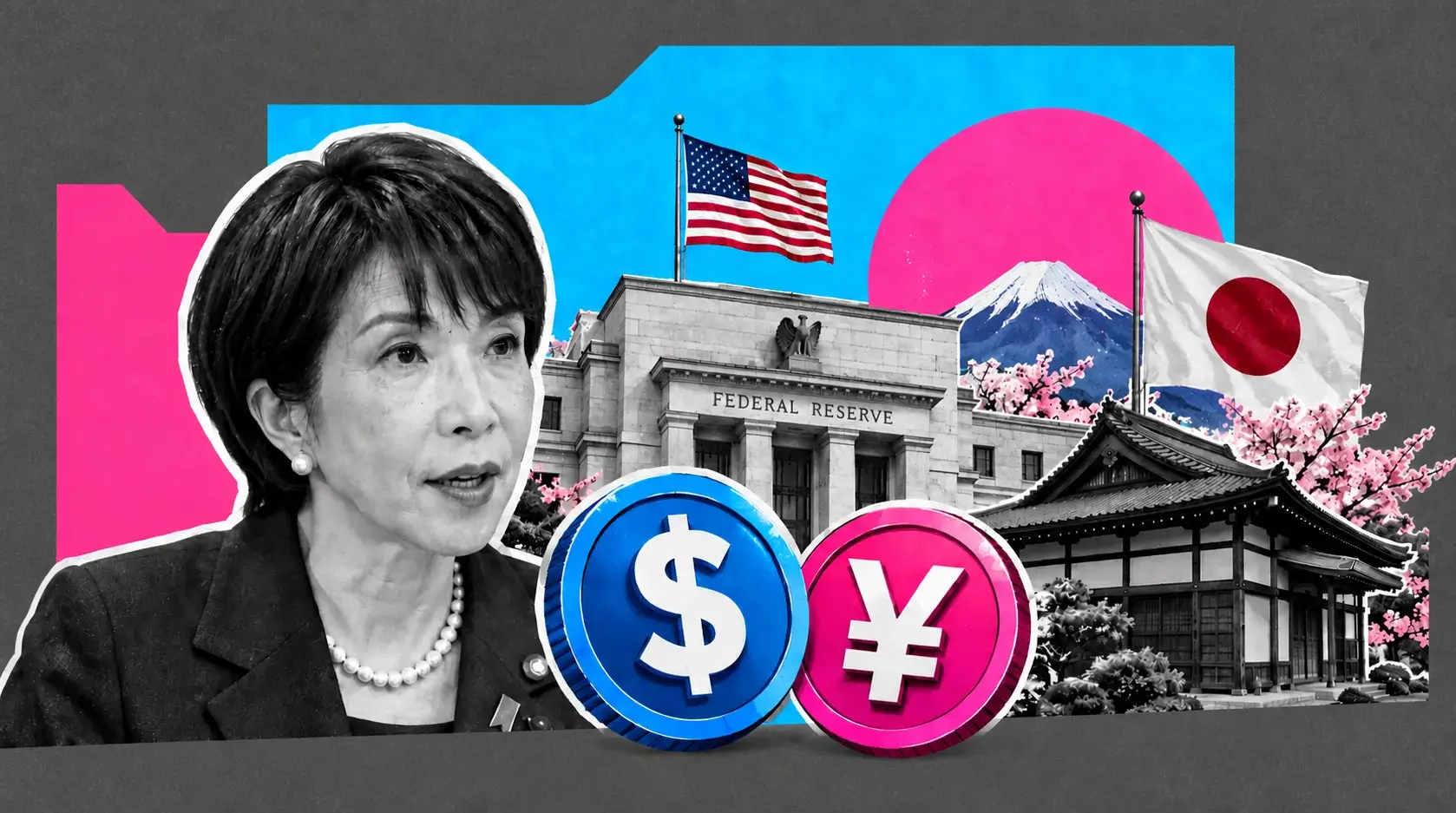

Yen Holds 163.67 as Brent Jumps to $90.35 Before Warsh's 2:00 P.M. Call and Friday's Bank of Japan Decision
USD/JPY trades at 163.6710, down 0.10%, within 32 pips of the 163.99 40-year low set last week | That's TradingNEWS
Key Points
- USD/JPY trades at 163.6710 (-0.10%), 32 pips below the 163.99 forty-year low, with the yen down 9.68% over twelve months and 7.5% since January.
- The Fed decides at 2:00 p.m. ET with roughly 33% hike odds priced; a hike or hawkish hold pushes the pair through 164.00 toward 165.00-165.50.
- Japan's Ministry of Finance spent ¥11.7349 trillion (~$71.7 billion) buying yen between April 28 and May 27 — one of the largest interventions on record — and the pair returned above 163 within six weeks.
The dollar traded at 163.6710 against the yen on Wednesday, down 0.10% from the previous session, holding within a whisker of the weakest level the Japanese currency has seen since December 1986.
That forty-year low was printed at 163.99 last week. The pair has consolidated between roughly 163.55 and 163.90 since, refusing to either break the handle or retreat from it. Monday opened the week at 163.84 and traded down to 163.571. Tuesday recovered to 163.787. Wednesday sits between the two.
The yen has weakened 0.68% over the past month and 9.68% over the last twelve months. The six-month arc is starker: the pair troughed at 152.46 on January 27, ran through 160 during the spring, printed 162.83 on July 1 as a forty-year low, cleared 162.80 again mid-month, and set 163.99 last week. That is roughly 7.5% of yen depreciation in half a year against a central bank that has actually been raising rates.
Two policy decisions land inside four days. The Federal Open Market Committee announces Wednesday at 2:00 p.m. ET with a press conference at 2:30. The Bank of Japan's two-day meeting runs July 30 to 31 with its decision due Friday.
One of them will determine where this pair trades into August, and it is probably not the Japanese one.
The tone in Tokyo has shifted in a way that experienced traders should register. Local reporting has noted a view spreading in the market that the 160-yen range is simply the new normal. That reads as capitulation from the people closest to the trade, and capitulation typically arrives late rather than early.
The immediate setup carries genuine two-way risk. Markets price roughly a 33% chance the Fed hikes this afternoon, which would widen an already-massive differential and push the pair through 164. Even a hawkish hold with higher-for-longer language could do the same job. Against that, analysts are explicitly flagging 164 as a potential intervention trigger, and Japan's Ministry of Finance has acted at comparable levels before.
That combination makes this the most binary major pair on the board today.
The Fed at 2:00 P.M. Decides This Pair, Not the BoJ
The asymmetry between the two central bank events this week is worth stating plainly, because most of the commentary has it backwards.
The Bank of Japan is overwhelmingly expected to hold at 1.00% on Friday. That outcome is fully priced, and the meeting's informational content sits in the quarterly Outlook Report and the governor's press conference language rather than in the rate.
The Fed is genuinely uncertain. Futures put roughly a 33% probability on a quarter-point increase this afternoon, with the target range at 3.50%–3.75%. There is no Summary of Economic Projections at this meeting, so no dot plot and no median path — the vote tally and the press conference constitute the entire information set.
For USD/JPY specifically, the transmission is the most direct of any major pair. The differential between a 3.625% US midpoint and a 1.00% Japanese policy rate is roughly 262 basis points, and every basis point of movement flows straight into carry economics. A hike widens it to 287. A dovish hold narrows expectations toward 237 by year-end.
The dollar has been firm on exactly that speculation. The yen has lingered near four-decade lows as the dollar held bid on the possibility the Fed could raise rates as soon as this week.
The framework for reading the announcement: a hike or a hawkish hold with explicit higher-for-longer language sends the pair through 164.00 and toward the 165.00 to 165.50 zone. A balanced hold with limited dissent triggers a pullback toward 163.30, and a decisive move below that opens the 162.00 to 162.60 support area.
The complicating factor is the intervention overlay. In any other pair, a hawkish Fed produces a clean directional move. Here, a hawkish Fed that pushes USD/JPY through 164 could force Tokyo's hand and create a sharp reversal within hours of the initial move.
That is why positioning into this afternoon has been unusually light and why the pair has traded a 35-pip range for three sessions.
164.00 Is the Number Everyone Is Watching and It Is Not a Technical Level
The round number sitting 33 pips above spot has acquired significance that has nothing to do with chart structure.
Analysts have been explicitly flagging 164 as a potential Japanese FX intervention trigger. The Ministry of Finance has intervened at similar levels before, which makes this a policy question rather than a technical one. A break above 164 following a hawkish Fed outcome could force Tokyo into the market and produce a violent reversal.
The technical map around it is dense, which compounds the effect. Immediate resistance sits at the 164.00 to 164.10 area, with a tighter read placing it at 164.05. Above that, a Fibonacci projection at 164.34 — the 61.8% extension of the 139.87 to 159.44 advance measured from 152.25 — provides the next objective. A firm break there targets the 100% projection at 171.82.
Which means 164.00 to 164.34 is a roughly 34-pip band containing a psychological level, a technical resistance cluster and an intervention threshold simultaneously. Markets do not typically resolve that kind of confluence gently.
There is a credibility problem underneath it. The market threshold at which investors previously expected Japan to intervene sat around 162, and that level has now been breached without triggering action. Each level that passes without a response degrades the deterrent value of the next one.
The argument for restraint is coherent. An actual intervention that gets quickly neutralised by market flows makes subsequent measures less effective and weakens the credibility of the threat itself. Tokyo is therefore likely to rely on verbal warnings for as long as it can, precisely because the ammunition is finite and the fundamentals are against it.
Finance Minister Satsuki Katayama has issued repeated warnings about intervention being available. Chief Cabinet Secretary Minoru Kihara said the government will work to build an economy less vulnerable to foreign-exchange volatility while remaining prepared to act if necessary. Markets have largely discounted both.
The honest read: 164 is more likely to produce a headline than an intervention, and the headline is unlikely to hold the level for more than a session.
Japan Spent $71.7 Billion Defending the Yen and It Bought Six Weeks
The most important precedent for anyone positioning into this week is what happened the last time Tokyo actually acted.
Between April 28 and May 27, 2026, Japan's Ministry of Finance spent ¥11.7349 trillion — approximately $71.7 billion — buying yen. That is one of the largest reported intervention totals on record.
The yen recovered temporarily. Then it fell again. USD/JPY returned above 163 by July 21 and set a fresh forty-year low at 163.99 within days.
Roughly $72 billion bought about six weeks. That is the arithmetic every trader should carry into any intervention scenario this week.
The reason is structural and it is not fixable by the Ministry of Finance. Intervention alone is unlikely to reverse losses while wide US-Japan rate differentials continue supporting the dollar. Unilateral action fights a carry trade that regenerates the moment the official bid disappears, because the underlying incentive — borrow cheaply in yen, invest in higher-yielding assets elsewhere — remains fully intact.
One prominent view from the market at the time was that authorities recognised intervention had become an exercise in futility, but did not want to leave yen losses unchecked in case it triggered a broader sell-Japan mindset that spread to government bonds and equities.
That framing is the key to reading Tokyo's behaviour. The intervention is not a currency policy. It is a financial stability policy designed to prevent disorderly moves from contaminating the JGB and equity markets.
Analysts have consistently argued that coordinated US-Japan intervention would be considerably more effective than unilateral action. There is no indication that Washington is interested, and a US administration comfortable with a strong dollar has little incentive to help.
The practical positioning implication: an intervention spike is a selling opportunity in the yen rather than a trend change, unless it coincides with a dovish Fed pivot. Those two things happening together is the only configuration that produces a durable reversal.
The BoJ Holds at 1.00% on Friday and the Debate Is October Versus December
Friday's meeting is a formality on the rate and a genuine event on the guidance.
The Bank of Japan is overwhelmingly expected to keep its benchmark unchanged at 1.00%, a level reached in mid-June that marks a 31-year high and the highest since 1995. The more significant development will be the quarterly Outlook Report, which is expected to upgrade Japan's GDP forecast to 0.8% for fiscal 2026.
The market question is the timing of the next increase, and the professional community is split almost exactly down the middle. A survey of 52 economists found 40% favouring October and 50% favouring December. A separate poll of 87 economists conducted July 23 found 86% expecting a 25 basis point hike to 1.25% by end-December, with political pressure from the Takaichi government cited as the key factor likely to delay action.
Looking further out, 70% of respondents expect the Bank to reach at least 1.50% by the second quarter of 2027, with 51% treating 1.50% as the terminal rate.
Market pricing is considerably more conservative. Roughly 27 basis points of hikes are priced from the central bank this year — barely more than a single quarter-point move.
Governor Kazuo Ueda has left the door open to a near-term increase, and the yen rallied modestly on those comments earlier in the month. That is the entire yen-positive catalyst set: a governor declining to rule something out.
There is a second channel that receives less attention and could matter more. Any acceleration in the pace of JGB purchase reduction would tighten long-end Japanese yields and reduce the relative attractiveness of carry trades even without a rate move. The tapering path is a legitimate policy lever and one the Bank can pull without confronting the government directly.
For USD/JPY, the Friday scenarios are narrow. A hold with unchanged guidance leaves the pair where the Fed puts it. A hold with explicit October signalling produces a one to two-figure yen rally that fades. Faster tightening than markets price would narrow the rate gap and is the only outcome that genuinely repairs the yen — and almost nobody expects it.
A 31-Year-High Policy Rate That Sits Below Inflation
The single fact that explains the yen's failure to respond to monetary tightening is that the tightening has not actually been tightening.
The Bank of Japan lifted its rate to around 1% in mid-June. That is the highest level since 1995. It also sits below an inflation rate running near 1.5%, which means the real policy rate remains negative — and deeply so once you account for the energy-driven cost pressure now feeding through.
A central bank raising nominal rates while real rates stay negative is not restricting anything. It is normalising slowly enough that the carry trade remains fully economic, and the currency market has priced that accurately.
Many investors say the Bank is behind the curve, and the JGB market agrees. The 10-year yield has climbed to 2.90%, the highest in 30 years. The super-long end has moved further, with the 40-year at 3.779% and the 30-year at 3.914% during recent sessions.
Those are not the yields of a bond market that trusts the policy path. They are the yields of a bond market pricing fiscal risk and inflation persistence into the long end because the front end is constrained.
The mechanism has been quantified. In the post-2024 regime, a 10 basis point rise in 10-year Japanese inflation breakevens is associated with the yen weakening roughly 1.2% — about 35% larger than the comparable pre-2024 sensitivity. Persistent wage gains and fiscal expansion have lifted breakevens, and because the front of the JGB curve is constrained by gradual normalisation, long-maturity yields and the currency have been left to bear the residual adjustment.
That is the doom loop in one sentence. Rising inflation expectations should strengthen a currency whose central bank is expected to respond. They weaken this one, because the market does not believe the response will come.
The constraint is political. The Bank is being held back by pressure from a government that wants it to go slow, and the administration is expected to use its forthcoming policy blueprint to discourage further increases.
The Differential Has Narrowed 50 Basis Points and the Yen Fell 15%
The most confounding data point in this market is that the rate gap has been closing while the currency has been collapsing.
Rate differentials narrowed by roughly 40 basis points from their cycle low, a shift that historically would have implied a stronger yen. Instead, the yen depreciated by about 15% against the dollar over the same period. Broader framing puts the differential compressing from roughly 325 basis points in early 2026 toward 250 to 275 basis points now.
Every conventional model says that should be yen-supportive. It has not been.
The explanation is that rising inflation expectations have filled the gap. The narrowing nominal differential has been more than offset by a widening real differential, because Japanese inflation expectations have risen faster than Japanese nominal yields. A dollar investor comparing real returns still finds the US considerably more attractive despite the nominal convergence.
The absolute levels illustrate the problem. US ten-year Treasuries pay around 4.6%. Japanese ten-year government bonds pay 2.90%. That gap is wide enough that even substantial further convergence leaves the carry trade profitable.
There is a fascinating wrinkle for institutional investors. After hedging yen exposure back into dollars, ten-year and thirty-year JGBs offer yields of roughly 5.6% and 6.8% respectively — well above comparable US Treasuries. Dollar-based investors can largely hedge the currency risk and are effectively compensated for doing so through the interest-rate differential embedded in the hedge.
That is an extraordinary situation and it tells you something important: the currency risk is being priced as so severe that hedging it turns a low-yielding domestic bond into one of the highest-yielding hedged instruments in developed markets.
Historically, every 100 basis points of differential compression has correlated with a meaningful yen appreciation. That relationship has broken this cycle, and until it reasserts, the standard rate-differential framework produces wrong answers on this pair.
Read More
-
Yen Stalls at 160 Despite a 3% JGB and Tokyo Core CPI at 2.0% — Intervention Sits at 164, Friday's Payrolls Decide
02.09.2026 · TradingNEWS ArchiveEnergy
-
T-Rex 2X Inverse MSTR ($4.39) Rips 10.44% as Strategy Pauses Bitcoin Buys for a 2nd Week — $4.63 Close Opens $5.27
15.09.2026 · TradingNEWS ArchiveStocks
-
XRPR ($10.59) and XRPI ($7.04) Open at Highs and Close at Lows After Senate Kills CLARITY Act
15.09.2026 · TradingNEWS ArchiveCrypto
-
NG ($2.908) Holds Above $2.80 Low as LNG Feedgas Hits 18.8 Bcf and TTF Trades 9.2x Henry Hub
15.09.2026 · TradingNEWS ArchiveCommodities
-
USD/JPY (155.09) Faces 275bp Policy Gap as BOJ Prepares 31-Year-High Rate — Close Below 154 Opens 153.40
15.09.2026 · TradingNEWS ArchiveForex
The commodity shock is a considerably bigger deal for the yen than for any other G10 currency, and it moved 7.4% overnight.
Brent crude gained to $90.35 a barrel after Iranian ballistic missiles targeted a US base in Jordan and US and Saudi forces struck sites in eastern Iraq. West Texas Intermediate advanced roughly 7.4% to $85.11.
Japan imports around 90% of its energy, with 95% of that coming from the Middle East. That is not a general terms-of-trade sensitivity — it is a near-total dependence on the specific region currently at war, transiting a strait one belligerent insists on controlling.
The mechanism runs through three channels simultaneously and all three are yen-negative. Higher energy costs worsen the trade balance directly, requiring more yen selling to buy dollars for oil. They raise cost-driven inflation, which lifts breakevens and — under the post-2024 relationship — weakens the currency by roughly 1.2% per 10 basis points. And they complicate the Bank of Japan's task, because the regulator must weigh wage growth against a weak economy, high energy prices and mounting fiscal risks.
Cost-push inflation from imported energy is the worst possible inflation for a central bank under political pressure to hold. Raising rates to fight it damages growth without addressing the source.
The asymmetry is instructive. The yen failed to get a lift when crude prices tumbled 45% over May and June. It weakens on rallies and does not strengthen on declines, which is the signature of a currency where the energy channel is one input among several rather than the dominant one.
Escalation in the Middle East means higher oil prices and additional costs for Japanese businesses, and Tokyo has correspondingly less room to defend the currency because the fundamental case against it strengthens with every dollar on the barrel.
JGBs are particularly exposed for the same reason, which is part of why the super-long end has been under such persistent pressure.
Takaichi's Fiscal Arithmetic Is the Structural Short
The political layer beneath this trade has become the dominant medium-term driver, and it is genuinely unresolved.
Prime Minister Sanae Takaichi's plan to cut Japan's food sales tax from 8% to 1% starting April 2027 has added materially to fiscal concern, pushing JGB yields to multi-decade highs. Her administration has struggled to shake the perception that it may pressure the Bank of Japan to delay further rate increases.
The scale of the fiscal commitment is what unnerves bond investors. There is a projected ¥370 trillion — roughly $2.28 trillion — in combined public and private investment through fiscal year 2040, and the lack of clarity on how the government's share gets funded is particularly troubling given public finances that were already in poor condition.
That combination — tax cuts, enormous investment commitments, no funding clarity, and a central bank discouraged from raising rates — is the textbook profile for currency debasement, and the market is trading it as such.
The reinforcing loop is what makes it dangerous. Fiscal expansion lifts inflation expectations. Rising expectations should trigger monetary tightening. Political pressure prevents the tightening. The absence of tightening validates the higher expectations. The currency absorbs the entire adjustment.
Institutional investors have flagged exactly this. Concern about substantial fiscal expansion combined with a central bank seen as lagging has been a recurring theme in conversations between Japan strategists and US allocators.
There is one scenario in which this reverses violently. If the Bank of Japan feels forced to raise rates to contain inflation generated by the fiscal stimulus, the yen could strengthen considerably — a sudden unwind of years of accumulated weakness. That would require the central bank to defy the government publicly, which has not happened and which the political pressure is specifically designed to prevent.
Until it does, the fiscal picture is a structural short on the currency with no natural stopping point.
The Chart: 163.55 Is the Line, 164.34 Is the Projection, 159.44 Is the Invalidation
The technical structure is cleanly bullish with well-defined trigger levels in both directions.
On the four-hour chart, the pair maintains a pronounced uptrend trading above the middle Bollinger Band and approaching the upper boundary, confirming buyers retain the advantage though the pace of the advance has slowed. It held above both the 50-period moving average at 163.700 and the 200-period at 163.744 through Tuesday's session, with the relative strength index at 59.29 against a 48.96 signal line — momentum positive without being stretched.
The immediate line is 163.55. As long as price holds above it, buyers retain control. A breakout and consolidation below would indicate weakening buying pressure and a short-term correction.
Beneath that, 163.30 is the level whose loss would trigger a deeper move toward the 162.00 to 162.60 support area. Intermediate references sit at 162.93 and 162.77, with 162.00 to 162.10 as the broader pivot. A break under 162.00 would meaningfully weaken the bullish structure and suggest the market is pricing a genuine yen catalyst — intervention, a softer dollar, or a hawkish BoJ read.
Overhead, 164.00 to 164.10 is the first barrier, with a tighter reading at 164.05. Breaking and consolidating above confirms continued momentum. Then 164.34 as the 61.8% Fibonacci projection, then the 165.00 to 165.50 zone that a hawkish Fed outcome would target.
The longer-term projection sits at 171.82 — the 100% extension — which is the level that would come into play if the pair clears 164.34 decisively and the differential widens rather than narrows.
The invalidation for the entire bullish structure is 159.44, the former resistance now acting as support. The outlook remains bullish as long as that holds, even through a deep pullback. A separate pivot estimate places the inflection at 159.83.
That gives the trade an unusually wide but well-defined risk frame: roughly 260 pips of downside before the structure breaks, against a projection target 800 pips above.
Repatriation Is the One Yen-Positive Force Nobody Controls
There is a genuine structural bid building for the yen and it operates entirely independently of the Bank of Japan.
Japanese investors sold $29.6 billion of US debt in the first quarter of 2026 alone as domestic yields rose, removing a historically reliable buyer from a Treasury market already navigating large fiscal deficits. Life insurers' foreign holdings now sit at roughly 40% of their peak, with rising domestic rates depressing new purchases.
The arithmetic driving it is straightforward. When a JGB pays 2.9% unhedged, the case for owning a Treasury at 4.6% with currency risk and hedging costs collapses. A Japanese institution with yen liabilities does not need to take dollar exposure to meet its return target any more.
That repatriation is mechanically yen-positive. Selling dollar assets and bringing the proceeds home requires buying yen, and the flows are large.
It is also structural rather than tactical. Asset-liability matching decisions at Japanese life insurers do not reverse on a monthly basis — they are multi-year reallocations driven by regulatory capital treatment and duration matching, and once the domestic yield clears the hurdle rate, the shift continues regardless of what the spot rate does.
The government is actively trying to accelerate it. Tokyo has been encouraging Japanese pension funds to invest domestically, with the finance minister making that explicit earlier this month.
The reason it has not shown up in the exchange rate is scale and timing. Quarterly repatriation of $30 billion against a currency market that trades trillions daily is a slow tide against a fast current. The carry trade regenerates daily; the repatriation flows arrive quarterly.
But tides win eventually. If JGB yields continue climbing toward and past 3% on the ten-year, the repatriation incentive strengthens rather than fades, and the pace accelerates.
That is the strongest medium-term argument for yen appreciation available, and it does not require the Bank of Japan to do anything at all.
Speculative Positioning at Multi-Year Peaks Cuts Both Ways
The positioning data is the reason this pair carries genuine reversal risk despite an overwhelming fundamental case.
Speculative bets against the Japanese yen have climbed to multi-year peaks. A fresh four-decade low tends to sharpen political anxiety in Tokyo, and the combination of extreme short positioning plus heightened intervention risk is the classic setup for a violent squeeze.
The mechanics matter. A crowded short in a currency with an official-sector actor capable of deploying $70 billion in a month is not a normal crowded short. It is a crowded short where the counterparty has unlimited domestic-currency funding and a political mandate to act.
That does not make the trade wrong. It makes the entry point critical. Chasing USD/JPY above 164 into an intervention threshold with positioning already at multi-year extremes is the specific configuration that produces multi-figure adverse moves inside minutes.
The historical pattern from April and May supports the caution. Intervention at unprecedented scale produced a temporary recovery followed by a full retracement over six weeks. Anyone short yen through that episode who held with adequate margin was fine. Anyone leveraged was stopped out at the bottom.
Against that, the resignation now visible in Tokyo commentary — the spreading view that the 160 range is the new normal — is itself a contrarian signal. Capitulation from local participants typically arrives near turning points rather than at the start of trends.
Both readings can be true simultaneously and probably are. The fundamental trend is intact and the positioning is crowded, which means the path higher is likely to include at least one sharp, disorienting reversal that does not change the destination.
For sizing, that argues for smaller positions with wider stops rather than tight stops that intervention noise will trigger. Define invalidation before entry and reduce exposure around scheduled announcements — of which there are two this week.
Bank Targets Span 150 to 172 for the Same Year-End
The forecasting community has no consensus on this pair, and the dispersion is the widest in G10.
Year-end 2026 bank forecasts range from 150 to 164 — a 14-point spread reflecting genuine disagreement over whether the yen finally strengthens or the dollar stays dominant. Those projections generally assume the Bank of Japan reaches 1.00% to 1.25% by late 2026 while the Fed sits at 3.50% to 3.75%, compressing the differential toward 250 to 275 basis points.
The bullish-dollar camp runs considerably higher. One model projects the pair stabilising near 164 in July, reaching 172 by November, and correcting to around 167 by December, with a full-year range of 160 to 172.
The bearish-dollar view targets 150 to 155, on the reasoning that persistent Japanese core inflation forces the Bank to tighten faster than priced while the Fed eventually eases.
The problem with the entire bearish-dollar framework is that it was built on an assumption that has failed all year: that the Fed would be cutting. The Fed has not cut since December 2025 and now carries roughly 80% odds of a September hike. Every forecast predicated on US easing has been wrong for seven months.
One institutional view has been explicit and correct: expect the yen to weaken over the medium term, on the basis that inflation expectations rather than nominal differentials are driving the repricing.
The pace of differential compression determines whether the yen bulls or dollar bulls are right — and compression has produced yen weakness rather than strength this cycle, which is the single most important empirical fact in the dataset.
At 163.67, the pair sits at the top of the bank forecast range and below the aggressive projections. That means consensus is effectively saying the move is done, and consensus has been saying that at every level since 155.
Forecast: 162.60–165.50 Base Case, With 164.00 the Trigger That Cuts Both Ways
Three scenarios across a 48-hour window containing two central bank decisions.
Base case, roughly 50% weight: the Fed holds with limited dissent and avoids explicit September commitment, then the Bank of Japan holds at 1.00% Friday with an upgraded GDP forecast and no firm guidance on October versus December. USD/JPY holds above 163.55, tests 164.00 to 164.10 without decisively clearing it, and trades a 162.60 to 164.35 corridor into month-end. Verbal intervention warnings continue and continue to be discounted. The forty-year low gets marginally extended without producing a headline move. Month-end flows add noise on Friday.
Bullish case, roughly 30% weight: the Fed hikes, or holds with three-plus dissents and higher-for-longer language. The differential widens toward 287 basis points, the pair clears 164.05 on a close, takes out the 164.34 Fibonacci projection, and runs at 165.00 to 165.50. That is the level where intervention becomes genuinely probable rather than rhetorical — but the April-May precedent says a $72 billion defence buys about six weeks, and the underlying carry economics regenerate immediately. Beyond 165.50, the 100% projection at 171.82 becomes the reference, which is a fourth-quarter destination rather than an August one.
Bearish case, roughly 20% weight: a unanimous dovish hold that pulls September pricing below 80%, combined with either confirmed intervention above 164 or a BoJ press conference that explicitly signals October. The pair loses 163.55, then 163.30, and tests 162.60 with the 162.00 to 162.10 pivot beneath. A break of 162.00 would mark the first genuine structural damage since January. The full bullish structure only invalidates below 159.44 — roughly 260 pips lower — which requires all three yen-positive catalysts landing together.
Positioning framework: 163.55 decides today. 164.05 decides the week. 165.50 is where Tokyo's hand gets forced. Below, 162.00 separates a pullback from a turn, and 159.44 is the invalidation. Wait for a candle close beyond the relevant zone and a successful retest — this pair produces violent first spikes around policy announcements and this week has two.