Stock Market Today: S&P 500, Dow And Nasdaq Rise As Nvidia Drops And Gold Crashes
U.S. indices push higher with the Nasdaq near 23,530 even as Nvidia slips toward $187 and gold plunges below $4,800, extending a violent metals selloff that is rippling through tech, miners and broader risk assets | That's TradingNEWS
Stock Market Today – Nasdaq, S&P 500, Dow Climb As Metals Crash, AI Jitters And Oil Slump Collide
Macro Overview And Index Performance – ^GSPC ^IXIC ^DJI
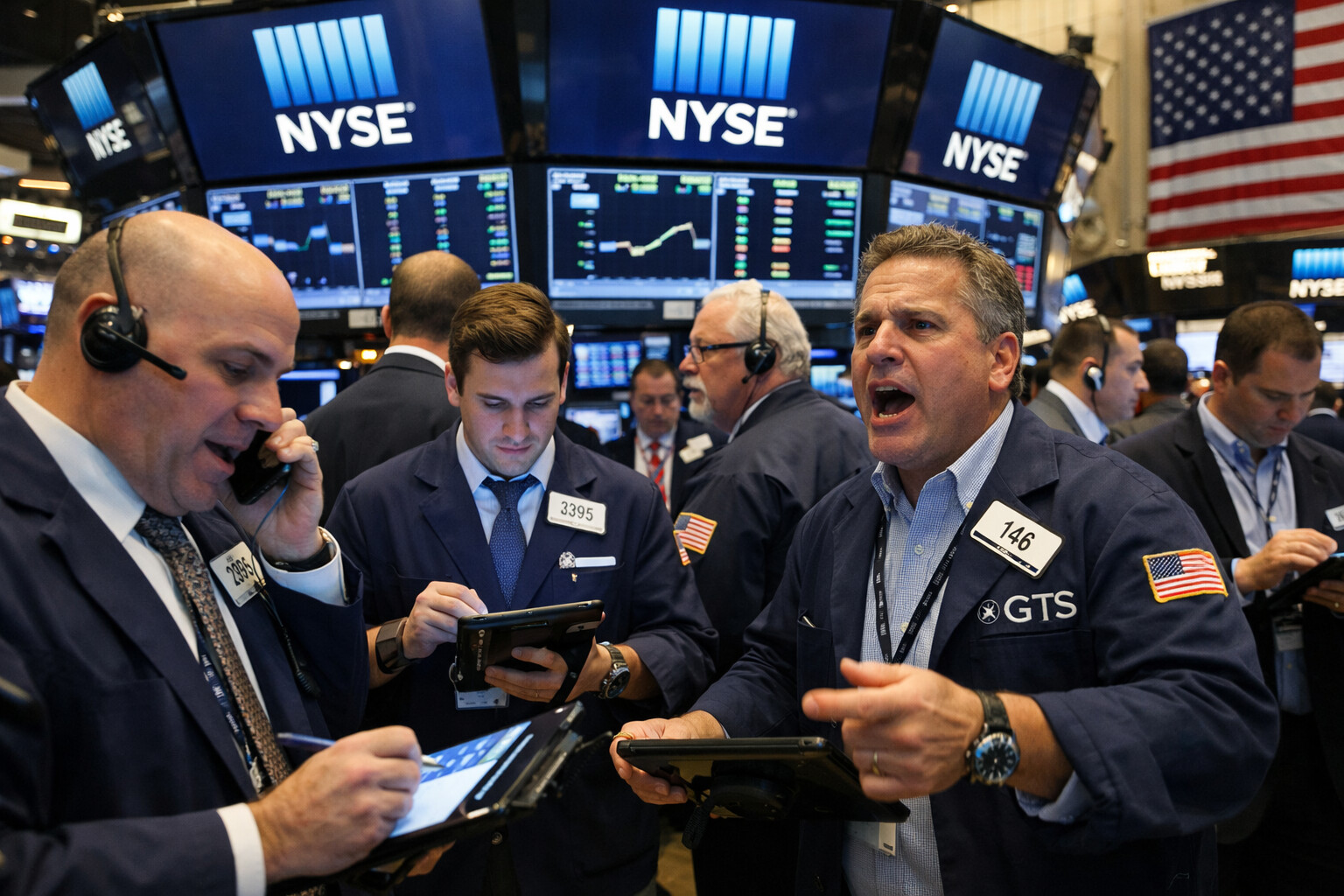
U.S. equities opened weak and flipped higher, with all three benchmarks recovering from early losses. The Dow Jones Industrial Average (^DJI) is up around 0.5%–0.6%, trading near 49,000–49,100 after briefly dipping at the open. The S&P 500 (^GSPC) adds roughly 0.25%–0.30%, hovering around 6,955–6,960, while the Nasdaq Composite (^IXIC) gains about 0.20%–0.30% near 23,510–23,530. Futures had pointed lower earlier, with Dow futures down about 0.2%, S&P 500 futures off 0.4% and Nasdaq 100 futures down roughly 0.6%, so the intraday reversal matters. It shows that, even after a violent unwind in gold, silver and Bitcoin, real money is still willing to buy large-cap U.S. equities, especially quality tech and defensive earnings stories, instead of abandoning risk altogether. Index moves are also happening against a macro backdrop where the U.S. Dollar Index (DX-Y.NYB) has bounced to around 97.3–97.5, up roughly 0.4%–0.5% over Friday and Monday, and the 10-year Treasury yield is back near 4.27% after closing just under 4.24% on Friday. The market is digesting President Trump’s nomination of Kevin Warsh to lead the Federal Reserve and still pricing roughly two rate cuts by year-end, with January nonfarm payrolls expectations clustered around 55,000–65,000 jobs and unemployment near 4.4%. That combination—modest index gains, stronger dollar, higher long yields—signals a regime where investors are re-rating crowded trades rather than pricing in a hard macro break
Precious Metals Volatility – GC=F SI=F NEM
Metals are the shock source. Gold futures (GC=F), which spiked above $5,625 per ounce on Thursday, collapsed nearly 10% on Friday, slicing through the $5,000 level and hitting lows around $4,423.2 on Monday before stabilizing around $4,720–$4,750. The contract traded below its 50-day moving average near $4,480.4 intraday for the first time since late August, a clear technical break that confirms an aggressive liquidation of leveraged longs rather than a small pause. Silver (SI=F) is even more extreme. After touching above $121.75 last week, silver suffered around a 30% single-day plunge on Friday, the worst since 1980, then whipsawed between lows near $71.20 and rebounds to roughly $75–$80 on Monday, with intraday swings as large as minus 16% followed by gains near 3%. This is classic overcrowded-trade behavior: long positioning in gold and silver, fuelled by inflation hedging, geopolitical anxiety and retail speculation, became so stretched that any trigger—Trump’s Fed pick, dollar strength, profit-taking—forced a cascade of margin calls. Miners are taking the hit. Newmont (NEM) is down more than 3% as gold trades nearly $1,000 below Thursday’s peak, compressing near-term cash-flow expectations and reminding holders that owning miners is levered exposure to both metal price and volatility. From a positioning angle the metals complex now looks fragile rather than defensive. The move has already bled into broader risk assets once; a second leg lower in gold and silver would again pressure sentiment, especially in commodity-linked currencies and high-beta equities. At current levels the risk-reward for chasing gold higher is poor. View: gold and silver are a short-term avoid or tactical sell on strength, not a fresh core buy, until volatility compresses and positioning visibly resets
AI And Megacap Tech Rotation – NVDA ORCL MSFT AMZN GOOGL TSLA PLTR
The AI complex remains the central equity story, but leadership is fragmenting instead of marching in a straight line. NVIDIA (NVDA) trades around $187–$188, down roughly 2%–2.5%, after management clarified that the much-touted “up to $100 billion” OpenAI investment is nonbinding and will be executed stepwise, if at all. Internally, concerns about concentration risk and partner discipline are tempering the headline number. For equity holders this matters in two ways: the upside optionality from a giant single deal is lower than the hype suggested, and the stock is still priced for relentless AI demand plus flawless execution. Any hint of capex discipline or slower deal pacing becomes an excuse to cut exposure. Short-term NVDA remains vulnerable to further derating if earnings later in the quarter do not reconfirm explosive data-center growth. Long-term, the company still owns the AI silicon stack and ecosystem, but at today’s valuation the balance tilts toward near-term cautious hold rather than aggressive buy.
On the other side of the AI trade Oracle (ORCL) is being rewarded for a different angle. The stock is up around 1.7%–2.0% near $168 after the company laid out a plan to raise $45–$50 billion in 2026 via debt and equity to expand Oracle Cloud Infrastructure capacity. That funding is explicitly tied to contracted demand from heavyweight clients including Advanced Micro Devices (AMD), Meta Platforms (META), NVIDIA (NVDA), OpenAI, TikTok and xAI. ORCL began the day more than 3% lower, then ripped more than 5% higher intraday before consolidating the gain, which shows investors are willing to underwrite large AI-capex cycles when there is visible backlog and multi-year commitments. Against a backdrop where some question the “AI ROI” for hyperscalers, the market is differentiating between pure-chip exposure and infrastructure providers with reasonably locked-in workloads. Here the skew favors a constructive buy-on-dips stance as long as the capex is matched by recurring high-margin cloud revenue.
Elsewhere in megacap tech Microsoft (MSFT) trades slightly negative around $429, still digesting an earlier post-earnings selloff triggered by aggressive AI-driven spending plans and extremely high expectations after a record run. Amazon (AMZN) edges higher around $243 with gains of roughly 1.6%–1.7%, and Alphabet (GOOGL) is also up around 1%, both ahead of key earnings later this week, with the market expecting higher capex but also strong cloud and advertising resilience. Tesla (TSLA) is the laggard, down about 3%–3.2% near $416–$418 as new registration data from Europe highlights demand challenges and as risk-off flows punish high-beta growth. That divergence inside the “Magnificent Seven” confirms that investors are no longer treating the group as a homogenous macro trade; balance-sheet strength, capital discipline and pricing power are driving relative performance. Palantir (PLTR) trades about 2.5% higher into its report, pricing in continued AI-driven contract momentum and leaving little room for disappointment. Overall, AI remains the core theme, but leadership has shifted toward cash-flow-backed cloud and software names rather than purely narrative-driven high-beta. The sector call: MSFT, AMZN, GOOGL, ORCL tilt buy on weakness, NVDA cautious hold, TSLA a tactical sell until fundamentals and pricing reset
Energy And Oil Dynamics – CL=F BZ=F DVN CTRA
Energy markets are in a sharp adjustment phase. West Texas Intermediate crude (CL=F) has dropped more than 4%, trading near $62.40 a barrel, while Brent (BZ=F) is down over 4% toward $66 as geopolitical risk premiums unwind. President Trump signaled that Washington and Tehran are engaged in serious talks and downplayed the likelihood of near-term regional escalation, which removes a chunk of war-risk pricing that had been built into crude after threats of a broader conflict. Positioning in oil had shifted toward a “risk-premium plus tightness” narrative; with no new supply shock and explicit political de-escalation, late longs are being flushed. This looks like a positioning reset, not a collapse in structural demand, but it still matters for producers and services.
Within equities the biggest headline is consolidation, not price action alone. Devon Energy (DVN) and Coterra Energy (CTRA) have agreed to an all-stock merger valued at roughly $58 billion. DVN shares trade around $40 with a modest loss near 0.3%, while CTRA is down more than 3% as arbitrage sets the spread to the fixed 0.7 DVN-for-CTRA exchange ratio. The combined operator will generate pro forma production above 1.6 million barrels of oil equivalent per day, including over 550 thousand barrels of oil and about 4.3 billion cubic feet of gas per day, with a strong footprint in the Delaware Basin across West Texas and southeastern New Mexico. In a world where both oil and gas can move 10%–20% in days, this scale is strategic: it gives more flexibility on capex timing, hedging and portfolio optimization across liquids and gas. Near-term, the crude flush and uncertainty around gas pricing will cap enthusiasm for the deal, but structurally the merger backs the idea that the U.S. shale patch is moving toward fewer, larger operators with stronger balance sheets. At current prices the sector view is nuanced: integrated majors and efficient shale consolidators like the combined DVN–CTRA profile as medium-term holds with a bullish tilt on weakness, while pure-beta small-cap E&Ps remain vulnerable to another leg down in oil if negotiations with Iran progress faster than expected
Natural Gas And Leveraged Products – Henry Hub NG Futures KOLD BOIL
Gas is in full whipsaw mode. Benchmark U.S. natural gas at Henry Hub saw a vertical spike in late January as Winter Storm Fern froze large parts of the U.S., knocked out power, disrupted production and tightened pipeline flows into the Eastern Seaboard. Futures surged more than 30% to the highest levels since November 2022, with front-month contracts pushing over three-year highs. That parabolic move has now reversed sharply. March Henry Hub futures have dropped nearly 16% to around $6.67 per MMBtu, and April contracts are down about 11.4% to roughly $3.80 per MMBtu after updated February forecasts pivoted toward above-normal temperatures across a large share of the U.S. The National Oceanic and Atmospheric Administration is projecting an 80% chance of warmer-than-average conditions from the northern High Plains through the western Rockies to the Pacific Coast, which slashes heating demand and frees up more gas for LNG export, indirectly improving European and U.K. supply conditions.
This volatility is being amplified by leveraged ETFs. ProShares UltraShort Bloomberg Natural Gas (KOLD), which benefits from falling gas prices, has surged more than 30%–37% in pre-market and early trade to around $18 and has become one of the most heavily discussed tickers on social platforms, with sentiment flagged as extremely bullish over the past 24 hours. ProShares Ultra Bloomberg Natural Gas (BOIL), the long-leveraged product, has tanked about 32% to around $27.7, with sentiment swinging from neutral to bearish as retail traders are forced out of margin-heavy positions. The pattern is textbook: retail and speculative accounts piled into leveraged long exposure during the spike, then were wiped out when the weather narrative changed, while inverse products rewarded those positioned for mean reversion. At the same time, UK natural gas futures (GWM1!) have fallen more than 11% below 84 pence a therm after touching a 10-month high at 103.7, as milder U.S. weather allows more LNG flows to Europe. Even with EU storage only about 41.1% full and U.K. storage near 36.9%, the marginal shift in flows is enough to knock risk premiums lower. For directional exposure, outright natural-gas futures are a high-risk trading vehicle rather than an investable trend at this moment; volatility and weather dependence argue for short-term tactical trades rather than buy-and-forget positioning. Among the ETFs, KOLD after a 30%–plus gain is closer to a hold or partial profit-taking zone, while fresh BOIL buying here is still aggressive knife-catching unless weather models turn colder again
Read More
-
Yen Stalls at 160 Despite a 3% JGB and Tokyo Core CPI at 2.0% — Intervention Sits at 164, Friday's Payrolls Decide
02.09.2026 · TradingNEWS ArchiveEnergy
-
AMD ($560.68) Rebounds 10% From Its October Low on the Meta Helios Win — November 3 Report Holds the Key to $649
27.10.2026 · TradingNEWS ArchiveStocks
-
Ethereum ($2,312) Lags Bitcoin and AI Stocks as BitMine Nears Its 5% Cap — Break of $2,295 Opens $2,200
27.10.2026 · TradingNEWS ArchiveCrypto
-
Brent ($113.88) Trades a $2.35 Range as Houthi Strikes Meet Saudi-Iran Diplomacy — Break of $117 Unlocks $120
27.10.2026 · TradingNEWS ArchiveCommodities
-
Nasdaq Rips 1.3%, S&P 500 Hits 7,728, Dow Stalls as BA Drops to $171
27.10.2026 · TradingNEWS ArchiveMarkets
-
GBP/USD (1.3310) Can’t Cash In on 5.43% Gilt Yields as Budget Risk Meets a Firm Dollar — Break of 1.3274 Opens 1.3200
27.10.2026 · TradingNEWS ArchiveForex
Earnings Leaders And Laggards – DIS TSN EL GME NEM PHAR
Single-name earnings are driving notable dispersion beneath the indices. Walt Disney (DIS) delivered fiscal first-quarter adjusted earnings per share of $1.63 on revenue of $25.98 billion, beating consensus expectations of about $1.56–$1.57 and roughly $25.7–$25.74 billion in sales. Parks and streaming were the bright spots: the experiences segment, including parks and cruises, produced record quarterly revenue of about $10 billion, with U.S. park attendance up around 1% and per-capita spending up about 4%. Yet the stock is down sharply, off around 6%–6.5%. The drag is operating income, which fell from $5.1 billion a year earlier to about $4.6 billion amid rising costs across units, plus skepticism about streaming profitability timelines and a potential transition in leadership, with investors watching closely as the CEO succession process narrows toward parks chief Josh D’Amaro. The message from the tape is clear: in a market sitting near record highs, beating on EPS and revenue is not enough if margins compress. At current valuation and with this reaction, DIS looks like a selective hold, not a clear buy, until the company proves it can grow experiences, stabilize linear businesses and drive streaming margins up at the same time.
Elsewhere Tyson Foods (TSN) reported stronger-than-expected results but still trades slightly lower, reflecting concerns around input costs and pricing power in a softer consumer environment. On the upside, The Estée Lauder Companies (EL) is up roughly 2.5% around $118 pre- and early-market after announcing a distribution partnership with SalonCentric that will put its products into more than 850 U.S. stores, a move that should support volume and brand visibility just as the company works through prior inventory and China-related pressure. GameStop (GME) is extending a recent rebound, building on a 4% gain Friday, after CEO Ryan Cohen talked about growth via acquisitions; the stock remains purely speculative, but flows show that retail still uses it as a trading vehicle in risk-on pockets. Gold miner Newmont (NEM), as noted, is down over 3% as the gold price collapse slashes near-term cash-flow expectations despite structurally high absolute price levels. Pharming Group (PHAR), while not a macro driver, is an instructive micro example: shares have rallied more than 130% over twelve months, but are now reacting to a “soft” Complete Response Letter from the FDA regarding its Joenja pediatric expansion—issues flagged are dosing and analytical methods, not safety—which has traders debating whether the pullback is a buyable dip. The breadth takeaway is that this earnings season is unforgiving: beats without clean forward narratives are punished, and only names with clear growth catalysts or distribution expansions are getting sustained rerates
Crypto And Listed Proxies – BTC-USD ETH-USD MSTR COIN HOOD MARA
Digital assets are under synchronized pressure, reinforcing the risk-off turn that started in metals. Bitcoin (BTC-USD) trades around $77,600–$78,000, having crashed over the weekend to lows near $74,000–$74,500, its weakest level since last April and marking a fourth consecutive down month. A key area sits near $73,000, flagged by technical and flow-based models as critical support. The latest leg lower coincides with Trump’s choice of Kevin Warsh for Fed chair—a pick seen as hawkish—alongside a stronger dollar and a violent de-risking in gold and silver. Ether (ETH-USD) and other majors are tracking the same pattern, with ETH slipping toward $2,200 and altcoins broadly lower. Retail sentiment on major platforms has shifted to “bearish” and “extremely bearish” for both BTC and ETH, with chatter in the “extremely high” zone, which typically occurs around stress points.
The equity knock-on is brutal. Strategy Inc (MSTR), often treated as a high-beta Bitcoin proxy due to its treasury strategy, is down more than 6%–7% near $140, and roughly 55% over the last year, even as BTC itself remains far above its prior cycle lows. Coinbase (COIN) drops about 4% as transaction revenue and trading activity expectations adjust downward with every volatility shock, while Robinhood (HOOD) is down around 3% and miner Marathon Digital (MARA) about 5%, reflecting deleveraging and concerns about mining economics if BTC spends prolonged time consolidating below peak levels. The structure of this selloff—broad, correlated, and accompanied by rising message volumes—suggests sentiment fatigue rather than panic capitulation. The risk is that a decisive break of the $73,000 area triggers another forced-liquidation wave. For positioning, listed crypto proxies like MSTR, COIN, MARA remain high-beta trading shorts or at best speculative holds, not core longs, until the macro narrative around rates, liquidity and risk appetite turns more supportive
Macro Policy, Fed Transition And Dollar – Kevin Warsh DX-Y.NYB 10Y Yield
Monetary policy politics have re-entered the equity narrative. President Trump’s decision to nominate Kevin Warsh as the next Fed chair introduces a figure with a split history: hawkish in the post-2008 period, critical of extended balance-sheet expansion, yet recently more aligned with calls for lower rates. Markets are trying to price that contradiction. Rate markets still expect about two cuts by year-end 2026, but the nomination has revived discussion about a faster run-off of the Fed’s $6.6 trillion balance sheet and a less predictable reaction function if growth wobbles while inflation remains sticky. That uncertainty has helped push the U.S. Dollar Index (DX-Y.NYB) up around 0.4%–0.5% to roughly 97.3–97.5 after a noticeable slump in the back half of January. The dollar’s move is hitting commodity-linked currencies, especially those tied to gold, silver and industrial metals, just as metal prices unwind.
The 10-year Treasury yield back near 4.27% underscores that the market is not buying the idea of a rapid easing cycle; instead, it is pricing a “higher for longer, but not dramatically higher” regime. Economists expect January payrolls to print around 55,000–65,000 with unemployment at roughly 4.4%. A stronger-than-expected labor print on Friday, combined with sticky wage growth, would add support to the dollar’s rebound and could put more pressure on metals, crypto and highly valued growth stocks. A weaker report would reinforce the case for two cuts, potentially capping yields and offering support to rate-sensitive sectors. For now this backdrop favours large, cash-generative U.S. corporates over leveraged, speculative plays and keeps pressure on crowded macro trades that had assumed a weaker dollar and lower yields throughout 2026
Market Verdict – Indices, Sectors And Buy/Sell/Hold Signals
Pulling all of this together, the structure of the day is clear. The S&P 500 (^GSPC) and Nasdaq (^IXIC) are absorbing violent shocks in metals and crypto with modest gains, showing that institutional money is still committed to U.S. equities, but the market is rotating hard under the surface. Gold near $4,750 and silver around $80 after record collapses are a warning flag, not a bargain signal; both look like avoids or tactical shorts on rips until positioning is clearly cleaned out. Oil (CL=F, BZ=F) around $62–$66 is digesting the removal of geopolitical premium; here the stance is neutral to modestly constructive hold on quality producers, particularly post-merger DVN–CTRA, where scale and diversified output provide an edge. In equities, the AI and megacap complex is no longer a monolith. ORCL, MSFT, AMZN, GOOGL merit buy or buy-on-weakness ratings given their cash generation and clear AI monetization paths. NVDA remains a structural AI winner but, at this valuation and with the OpenAI number reset, fits a cautious hold with downside risk if growth or guidance blink. TSLA is trading like a high-beta discretionary growth name, not a safe tech core, and sits firmly in sell or underweight territory until demand, pricing and margin visibility improve. DIS delivers mixed signals—strong parks and streaming revenue offset by margin compression and leadership uncertainty—so it stays hold, not accumulate, until the company shows clean operating leverage. In crypto and its listed proxies, the combination of a stronger dollar, hawkish Fed optics and technical damage keeps BTC-linked equities and miners in the bearish or at best speculative-trading bucket, not long-term buys.
Net, the day’s tape favours a bullish but selective stance on U.S. indices, a rotation toward profitable AI and cloud leaders, a defensive, data-driven approach to commodities, and a bearish or underweight view on over-levered, sentiment-driven assets that have just reminded everyone how fast crowded trades can unwind